State Rep. Chris Rabb is hugged by his son, Issa Rabb, during his primary election night event at Victorian Banquet Hall Tuesday, May 19, 2026, in Philadelphia.Read moreElizabeth Robertson / Staff Photographer
Rabb is now all but certain to win a two-year term to represent Pennsylvania’s 3rd Congressional District, a seat that has been held for a decade by retiring U.S. Rep. Dwight Evans.
State Rep. Chris Rabb, a democratic socialist who has repeatedly challenged Philadelphia’s political establishment, has won the tightly contested 3rd Congressional District primary — a striking victory for the city’s left-leaning coalition after a combative and rare open contest.
The Associated Press called the race at 10:42 p.m. on Tuesday. Rabb, a five-term state lawmaker from East Mount Airy, handily defeated two other top contenders in the hard-fought race, according to unofficial returns.
In the bluest district in the country, the result sets Rabb on an almost guaranteed path to succeeding U.S. Rep. Dwight Evans, who is retiring after a decade in the seat. Rabb’s election would mark a significant shift from half of Philadelphia voters being represented by a more mainstream Democratic voice to one in the most left-wing faction of Congress.
Rabb’s election night party at Victorian Banquet Hall in Germantown erupted as his victory appeared near. The candidate danced and hugged his way through the crowd.
“I did not win tonight. We won,” he said from the stage. “This is just the beginning.”
The win represented a major blow to leaders of Philadelphia’s Democratic Party, who largely rallied around the other candidates and have clashed with Rabb for years. And it was something of a turnaround for Rabb, whose campaign nearly ran out of money after he said his former treasurer embezzled more than $160,000 in contributions.
“There was a moment a couple of months ago, not long ago, that I was on the precipice of withdrawing from this race,” Rabb said Tuesday night. “And there were people who showed up for me at my worst, in depths of adversity.” (continued)
The 3rd Congressional District contenders both became state lawmakers in 2017 and have made their records central to their campaigns.
By Sam Janesch
Philadelphia Inquirer
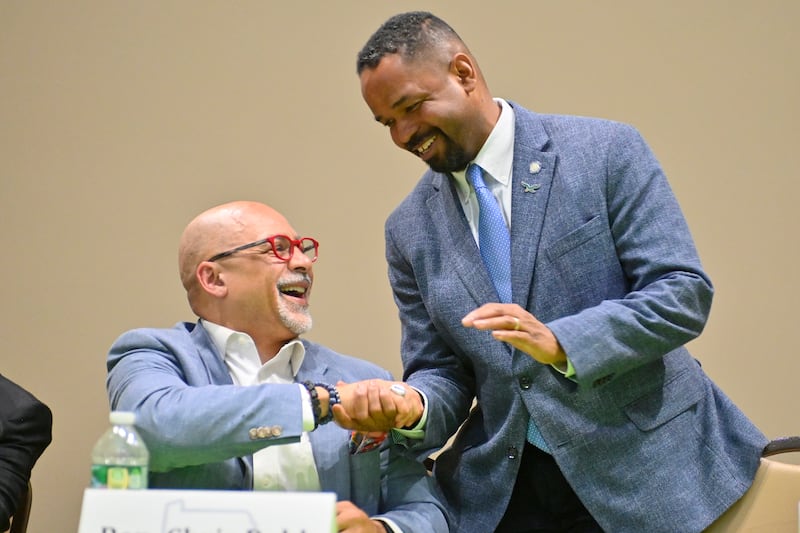
May 13, 2026 – Nearly a decade ago, Chris Rabb and Sharif Street walked into the Pennsylvania Capitol for the first time as elected officials and quickly staked their ground in different ways.
Street, a lawyer and scion of a powerful political family, went to work introducing bills to make technical changes in areas like election and vandalism laws, to decriminalize the possession of small amounts of cannabis, and to end life sentences without the possibility of parole.
Rabb, who had taken on a local Democratic machine to get to Harrisburg in the first place, put out feelers for legislation that would make lawmakers pay a $100,000 fine if they are convicted of a crime, increase taxes on wealthier Pennsylvanians, and limit police assisting U.S. Immigration and Customs Enforcement at the start of President Donald Trump’s first term.
The two Philadelphia Democrats would both go on to have more losses than wins. In a closely divided General Assembly where Republicans have kept unilateral control for six of the last 10 years, relatively few Democratic-led bills cross the finish line.
But as Street and Rabb face off in Tuesday’s tightly contested race to represent the 3rd Congressional District, the candidates’ legislative records — and their distinct governing styles — have become central to their pitches as they pursue one of the most Democratic-leaning seats in the country. (Continued)
PA. Democrats decry Jeffrey Yass spending in judicial races, compare him to Elon Musk | Politics | lancasteronline.com
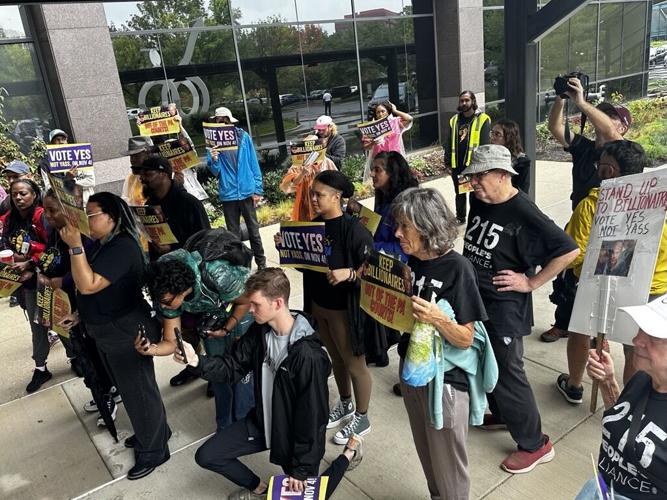
A coalition of progressive and pro-worker, pro-woman organizations in Pennsylvania did the impossible and radically expanded the amount of voters engaged in a critical, but easily ignored, State Supreme Court race.
By Jeffrey Lichtenstein and Steve Paul
Convergence Magazine
April 28, 2026 – The most important question on the 2025 Pennsylvania general election ballot, retention of State Supreme Court judges, was buried halfway down the back page.
But thanks to a strategic, multipronged coalition effort, voters in this battleground state retained three Democratic justices and kept the Democrats’ five-to-two majority on the court. This win will be critical for protecting reproductive freedom, workers’ rights and environmental regulations, as well as voting rights and fair legislative maps.
In odd-numbered election years, significant numbers of Pennsylvania voters do not vote their entire ballot, a phenomenon typically referred to as roll-off. Ordinarily, as many as 30% of voters will skip offices or questions closer to the end of their ballot that seem less important or recognizable.
But a network of Pennsylvania organizations including One Pennsylvania (One PA), Make The Road PA, Asian Pacific Islander Political Alliance and other members of the Working Families Party–with support from our state donor table–brought roll-off down from 30% in 2021 to 2% in this election–the lowest rate ever.
We named villains without flinching
Our coalition used diverse but integrated tactics throughout the spring, summer, and fall of 2025. This included paid, earned and new media alongside door knocking, volunteer organizing, and greeting voters at the polls. We worked to be sure we didn’t flinch from clearly naming villains, and we attempted to bring an organizing approach to every tactic, thinking as much about who is carrying our message and why they care, as much as how well it is polling. We centered working people’s political instincts and prized their established networks of trust.
Our message needed to be clear about what was at stake and who was to blame. And our tactics focused first on winning over leaders of various types who could then carry the message to the communities whose trust they’d already earned. Because we used strategies that sought to move power into regular people’s hands–rather than relying solely on professional consultants and vended programs–we defended a critical bastion in the fight against authoritarianism.
Who and where
The Working Families Party of Pennsylvania is both a movement coalition and a political party, with 10 organizational members, including One PA, who collectively represent 100,000 commonwealth residents. The member organizations include unions and community groups. Their strongest bases are Philadelphia, Allegheny County (home to Pittsburgh), and the Lehigh Valley, but they’re active in several smaller places as well, especially deindustrialized working-class towns and towns with a majority of people of color–which are often the same.
Recognizing that many in our communities get their information from social media, we also launched an effort to organize online content creators…
One PA in particular is rooted in working-class, majority-Black communities in Allegheny, Dauphin, Delaware and Philadelphia Counties. The PA Working Families Party has been active in elections since 2018; our coordination in this election built on collaborations in several previous fights. These include the election and re-election of Philadelphia City Council member Kendra Brooks in 2019 and 2023; the 2021 elections of Philadelphia District Attorney Larry Krasner and Pittsburgh Mayor Ed Gainey; US Rep. Summer Lee’s win in 2022 and Philadelphia City Council member Nic O’Rourke’s in 2023, and Helen Gym’s run in the 2023 Philadelphia mayoral primary. (Continued)
The Tremont, Pa., area has roughly 2,000 residents and limited resources. The Trump administration plans to convert a warehouse there to hold nearly four times as many people.
Photos:The Department of Homeland Security plans to turn a warehouse in Tremont, Pa., into an immigrant detention center, but many local residents complain that they have been given little input. Credit…Rachel Wisniewski for The New York Times
Tom Pribilla, at his hardware store, is one of the residents opposed to the detention center. “We don’t need that,” he said. Credit…Rachel Wisniewski for The New York Times
April 9, 2026 – When the coal industry unraveled around Tremont, Pa., generations ago, it didn’t leave much behind. Nestled in the valleys of central Pennsylvania, the old mining town today has no hospital and no independent police force. A Family Dollar serves as its only grocery store. For years, the water supply has been so tight that trucks have at times hauled water in to keep the taps from running dry.
But this year, the Trump administration determined that the Tremont area — already creaking under the weight of its roughly 2,000 residents — could support one of its new mega immigrant detention centers, larger than any currently in operation.
In January, the Department of Homeland Security bought, without public notice, a vacant warehouse two miles down Tremont’s main street to house up to 7,500 detainees. With the site tentatively scheduled to open within the year, residents have been left to wonder how their area will sustain a captive population nearly four times its size, plus an accompanying work force.
“We don’t need that,” said Tom Pribilla, who has run a hardware store in Tremont for decades. “The community, the area, is not going to be able to absorb the costs
The Tremont warehouse is one of about a dozen that D.H.S. has purchased nationwide, all in an effort to build enough immigrant detention centers to support President Trump’s mass deportation pipeline. Another planned processing center, in Berks County, Pa., just 30 minutes from Tremont, would hold up to 1,500 additional people.
The planned facility is a couple miles from Tremont’s main street. Credit…Rachel Wisniewski for The New York Times
Across the country, the plans to convert warehouses into detention spaces have been met with fierce local blowback, even in deep-red areas, like Tremont, that have backed Mr. Trump. Recently, D.H.S. abandoned plans to purchase warehouses in places like Tennessee and Mississippi.
The Tremont project has become more muddled as D.H.S., under its new secretary, Markwayne Mullin, reviews the entire nationwide plan. But it has also maintained that it is still moving ahead with the warehouses it has acquired, as D.H.S. grapples with a shortage of detention space and an increase in apprehensions.
Whatever the outcome, the backlash in Tremont shows how the push to expand detention space is bringing the repercussions of the president’s mass deportation campaign to some of his typical strongholds. In Schuylkill County, Pa., (pronounced SKOOK-ul) which contains Tremont, more than 70 percent of the vote went to Mr. Trump in 2024, helpin g tip the scales in a critical swing state. (Continued)
April 6, 2026 HARRISBURG — A group of Pennsylvania counties has billed the federal government more than $21 million in recent years to detain immigrants in their jails, a first-of-its-kind review by Spotlight PA has found.
While these agreements predate the second Trump administration by years or even decades, they are receiving new attention as the president executes a mass deportation campaign that relies heavily on local partners.
They also highlight how counties in Pennsylvania already cooperate with ICE and other federal agencies to detain immigrants. Earlier this year, the Department of Homeland Security purchased two Pennsylvania warehouses to turn them into detention centers capable of holding 9,000 people collectively.
In those cases, local and county lawmakers say they were blindsided by the planned facilities, which they have limited power to block. The detention agreements involving jails that Spotlight PA has identified require the backing of elected county leaders, prison oversight boards, or both.
Five county jails have or recently had agreements with federal immigration enforcement agencies to hold people in their jails, sometimes for months, in exchange for significant fees, Spotlight PA found.
Clinton, Erie, Franklin, and Pike Counties collectively charged more than $21 million for detention in 2024 and 2025, invoices obtained by Spotlight PA show. A fifth county, Cambria, has a similar detention arrangement, according to federal records and a county official — but denied Spotlight PA’s September 2025 request seeking payment information because ICE did not start sending detainees to its jail until later in the month.
Local government officials in favor of the agreements told Spotlight PA that the revenue generated supports services such as the county jail or general fund expenses.
“You’re always going to have pushback one way or another, but we haven’t really experienced it to this point,” Cambria County Commissioner Scott Hunt told Spotlight PA in early March. “This is a relationship that has gone back many years.
“So I realize that emotions are kind of flared now, but this is something we’ve been a part of for years,” he added, “and I don’t see a reason why it wouldn’t continue.”
At least one county leader concerned about ICE’s actions nationally told Spotlight PA the payments have become a crucial source of income that would take careful study and planning to replace.
But at a time when ICE and other federal immigration agencies face scrutiny for aggressive and sometimes deadlytactics during sweeping enforcement operations, Pennsylvanians have pushed back against local government collaboration.
During a February meeting of the Erie County Council, dozens testified for or against the county jail’s contract to hold people for federal immigration agencies.
“We believe that participating in any way in the enhanced enforcement is immoral,” said Sister Anne McCarthy with the Benedictine Sisters of Erie, a monastery that has vocally opposed local cooperation with Trump’s nationwide immigration crackdown.
Others at the meeting asked the county council to keep the agreement intact.
Federal agents won’t stop enforcing the law just because Erie County stops holding people, they argued.
Ending the agreement could draw the ire of the president, one speaker speculated. Another suggested ending local detention would increase the number of people being sent to other jails hundreds of miles away.
And multiple speakers asked: What about the money the county stands to lose?
“ICE will find a different location to house their detainees,” said Fred Petrini, a Wesleyville resident and borough council member. “We will just be out a half a million dollars in funds that could help the county with expenses.”
Spotlight PA sent public records requests to more than 30 counties for invoices showing payments in exchange for arresting, detaining, holding, or processing people for ICE. The news organization also reviewed federal detention data. (Continued)
The Pittsburgh-area congressman has positioned himself as a leader among veteran voices on Capitol Hill since his election in 2022
By Sam Janesch
Pittsburgh Post-Gazette
March 12, 2026 – WASHINGTON — By the time Chris Deluzio first arrived in Iraq, the pretext for the war had faded away long beforehand.
It was 2009, years after the assertion that Saddam Hussein’s regime possessed weapons of mass destruction proved to be false. Mr. Deluzio — a Thornburg native who’d resolved to join the Navy even before the Sept. 11, 2001, attacks when he was a high school senior — had graduated from the Naval Academy and already deployed twice at sea.
His first tour on the ground arrived after it was “pretty clear this was a strategic failure” — when the country he fought for, he believed, “had wasted American lives and money.”
“We used to joke before or after missions, ‘Did you find the WMDs? Anyone find the WMDs?’” said Mr. Deluzio, now a Democrat who represents all of Beaver and most of Allegheny counties in the U.S. House.
“People in those situations make jokes to get through it,” he said in an interview in his Capitol Hill office. “But the fact that our government sent Americans to bleed and die and fight on the basis of lies absolutely shapes the job I have now. I thought it was my duty to do a good job with my unit as best I could, but there was always a source of frustration and anger.”
Mr. Deluzio is now among the hundreds of members of Congress with the authority to decide whether American service members will be sent into war. (Continued)
Jaime Martinez, community defense organizer at Casa San José, coordinates with Rapid Response Network volunteers outside Emiliano’s Mexican Restaurant in Gibsonia on June 17, after reports that federal agents were idling nearby in unmarked vehicles.
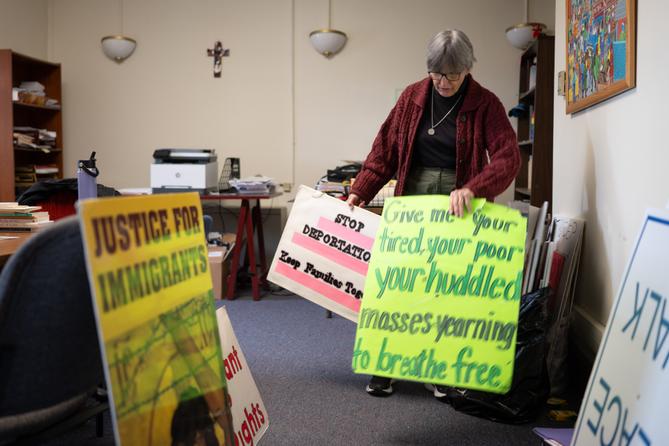
Casa San José has trained hundreds of volunteers to monitor and respond to immigration enforcement. Public Source followed them through raids, courthouse watches and late-night calls.
July 31, 2025 – As federal immigration enforcement intensifies across the country, a local response has quickly scaled up across the Pittsburgh region. In Beechview, the nonprofit Casa San José has built a Rapid Response Network of trained volunteers who monitor and document ICE activity across Allegheny County and beyond.
The network launched during the first Trump administration but has ramped up since January. As of July 30, it includes more than 250 trained volunteers — with nearly 175 more signed up for future training.
Casa San José, founded in 2013, focuses on immigrant rights and the Pittsburgh region’s Latino community — a mission amplified as the Trump administration rolls back protections for immigrants and directs federal resources toward a crackdown and mass deportations.
Organizers traverse city neighborhoods, gather in church basements and empty parking lots, and educate residents about their rights and federal immigration tactics. Along with trained volunteers, who are prepared to legally observe, document and accompany people at risk of being detained by Immigration and Customs Enforcement [ICE], they respond in real time to sightings, arrests and raids.
Pittsburgh’s Public Source spent more than a month embedded with Casa San José’s organizers and volunteers, tracking their efforts from the courthouse to restaurants as they responded to immigration enforcement and supported families under threat.
Photo: June 14 at the City-County Building, Downtown
Monica Ruiz, executive director of Casa San José, speaks to thousands of people gathered in front of the City-County Building in Downtown during a day of nationwide protest against the Trump administration.
“They are disappearing our people. This is our reality. Every single day. Just because you don’t see it doesn’t mean it’s not happening. We cannot continue to allow this to happen in our communities,” said Casa San José Executive Director Monica Ruiz.
“Casa San José is the only organization on this side of the state that is doing this kind of work.”
Ruiz said she has received five death threats since November, forcing her to relocate Casa San José’s office and to reconsider speaking publicly.
Photo: June 17 at Emiliano’s Mexican Restaurant, Gibsonia
As volunteers monitor the scene, Jaime Martinez, community defense organizer at Casa San José, speaks by phone with nine workers sheltering inside the restaurant — part of the network’s effort to document enforcement activity and support those at risk.
Sharon Bonavoglia was the first to arrive at a quiet strip mall in Gibsonia late on June 17. She had received the call because she lives nearby, and because she’s one of a growing network of volunteers responding to reports of federal immigration enforcement in and around Allegheny County.
June 11, 2025 – The state House voted along party lines Wednesday to raise the minimum wage to $15 for most Pennsylvanians, and to $12 for those working in smaller, rural counties.
It’s a significant step in the latest effort by Democrats to get it above the federal rate of $7.25.
Pennsylvania’s minimum wage has not been hiked since 2008 and is lower than all surrounding states — New York, Ohio, New Jersey, West Virginia, Maryland and Delaware.
The measure’s sponsor, House Labor and Industry Committee chair Jason Dawkins (D-Philadelphia), said the bill is in an attempt to compromise with Republicans who have long warned about the potential impacts on businesses, especially in smaller counties with a lower cost of living.
“Since I’ve been chair, we’ve been trying to figure out a different approach to get this done,” Dawkins told the Capital-Star. “This time around, we had a little bit more insight into where our challenges lie, one particularly being that some of our counties were worried about moving too quickly, and some were not comfortable going over $12.”
A previous bill sponsored by Dawkins passed the House in 2023, but died in the Republican-controlled Senate. And in 2019, the Senate passed a Democratic-led bill to raise it to $9.25, which died in the then-GOP-controlled House.
Dawkins’ latest bill would see the minimum wage rise gradually each year, reaching $15 in most counties on Jan. 1, 2028. It would also raise the tipped minimum wage from $2.83 to 60% of the minimum.
Counties with populations below 210,000, with the exception of Centre, Monroe and Pike counties, would only see the minimum wage rise to $12 in the same timeframe. A spokesperson for the House Democratic Caucus said the three smaller counties were put in the $15 bracket at the request of Democratic members who represent them.
One exception to the gradual rise to $15 would be Philadelphia County, which Dawkins represents. There, the minimum wage would rise to $15 on January 1, 2026.
“Philadelphia has the highest population of folks who are in what we call deep poverty levels,” Dawkins said.
He added there is particular urgency given the possibility some of those people may lose access to federal benefits like Medicaid and food assistance under a proposed bill moving through the GOP-controlled U.S. Congress.
“We wanted to have some type of safety net there because we know those folks might be losing benefits and other services,” he said.
But Dawkins’ attempt to offer an olive branch to GOP lawmakers in the form of gradual wage hike and a lower target in small counties appears to have failed in his own chamber. Every House Republican voted against the bill, and many criticized it during a two-hour debate on the floor Wednesday afternoon.
“Not every wage is designed to be a livable wage,” Minority Leader Jesse Topper (R-Bedford) “My 16-year-old son is not working for a livable wage. Someone who is retired and is helping out part-time, that is not necessarily a livable wage.”
He also warned that raising the minimum wage could result in the elimination of low wage jobs and harm small businesses in particular.
Others opposed the very provisions Dawkins said were intended to earn bipartisan support.
Rep. Kate Klunk (R-York) warned that creating different minimum wages across counties could lead to confusion for businesses that cross county lines, or encourage business owners to set up shop where the wage is lower.
“This county-based patchwork of minimum wages is going to be a mess,” Klunk said. She used examples of businesses with locations in York and Adams counties as examples, including golf courses that straddle the border between them.
“This bill is truly unworkable,” she said. “It is a compliance nightmare.”
Rep. Mike Jones (R-York) was one of few Republicans to signal openness to raising the minimum wage during debate, but said he could not support Dawkins’ bill.
“I do commend the majority chair for what I think is a good faith attempt at a reasonable compromise,” he said.
However, he added that he would want to see exceptions to the minimum wage for nonprofits and high-school aged employees.
‘Potential to find middle ground’
To become law, the bill will have to pass the Republican-controlled Senate.
Senate Majority Leader Joe Pittman (R-Indiana) said that there may be room for compromise on a minimum wage increase, especially if paired with Republican-backed deregulation efforts he said could help grow “maximum wage jobs.”
“Making sure working families have access to good, family-sustaining jobs is key to helping our commonwealth grow and thrive,” Pittman told the Capital-Star in a statement. “There is potential to finding [sic] a middle ground for an increase, but any possible action would need to be a commonsense adjustment, and sensitive to the impact changes would have on small businesses and non-profit organizations.”
Republican Sen. Dan Laughlin (R-Erie), who has previously introduced a bill to raise the minimum wage to $15, commended the House’s effort, but said he would not support a bill with a county-by-county approach.
“While I appreciate that the House is trying to advance the conversation, I do not support HB 1549 in its current form,” Laughlin said in an emailed statement. “A minimum wage tied to county size just deepens the economic divides we’re supposed to be addressing. If we’re going to get serious about raising the minimum wage, we need to do it uniformly across the state, not with a patchwork approach that leaves people behind based on where they live.”
Laughlin was an early Republican supporter of raising the minimum wage to $15 in Pennsylvania. But national trends may indicate more openness from members of his party this time around.
On Tuesday, conservative U.S. Sen. Josh Hawley (R-Missouri) introduced a bill to raise the minimum wage to $15 for all Americans.
He told NBC News, “If we’re going to be a working people’s party, we have to do something for working people. And working people haven’t gotten a raise in years. So they need a raise.”
His comments reflect an openness to his party’s increasing appeal to working class voters that was made apparent in the latest general election, which saw them move away from their traditional support of Democrats.
Dawkins, the Pennsylvania bill’s sponsor, is also aware of the shift, and hopes that it will help the bill earn the support that it needs to pass.
“I’m excited by the prospects, but I’m also disappointed that there could be a federal minimum wage that’s gonna be higher than the state minimum wage — and it’s being offered by one of the most conservative members of Congress,” he joked. “But I’m hopeful it’ll help folks come around to the idea.”
“This is what I believe we got elected to do,” he added.
Ian Karbal covers state government for the Pennsylvania Capital-Star. He’s particularly interested in the influence of money in politics and how arcane policies affect Pennsylvanians across the state.
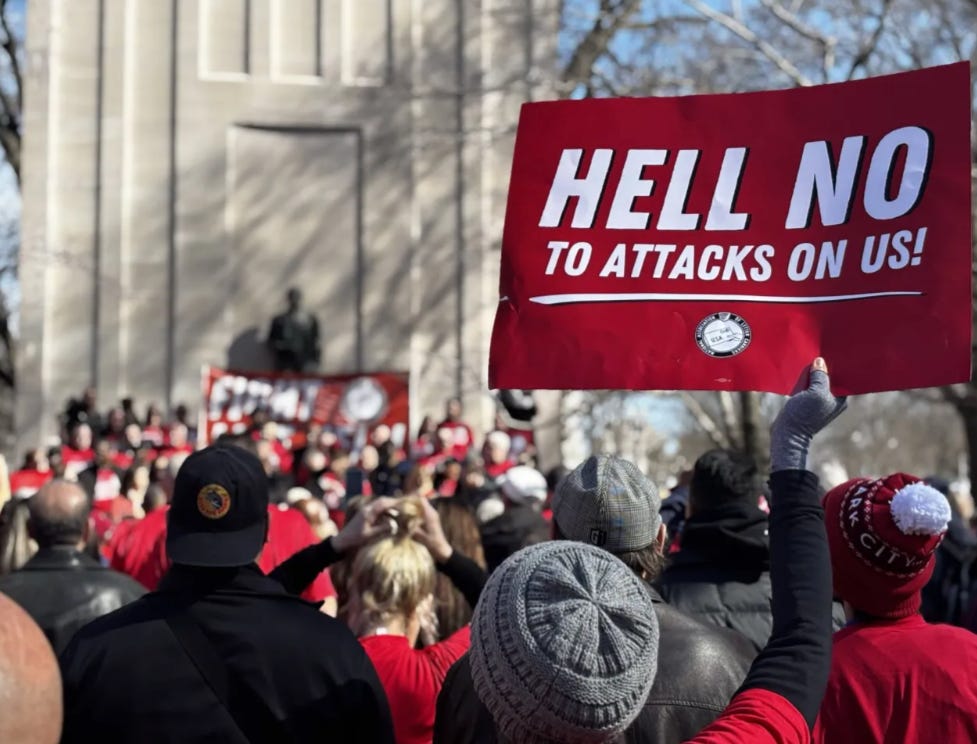
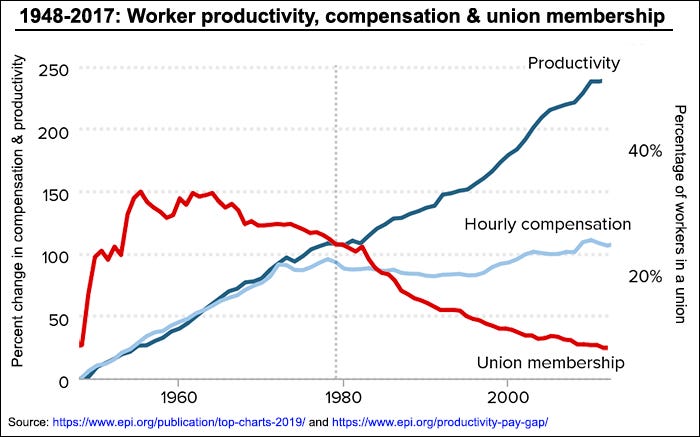
Over the course of the first 100 days, appropriate attention has been paid to Trump’s attacks on the judiciary, law firms, universities, philanthropy, non-profit groups and the media as dangerous in their own right, but more importantly as essential elements of authoritarian consolidation. Yet almost no one has mentioned the attacks on an equally proven constraint on oligarchy and autocracy: unions. Trump and Elon Musk’s destructive ransacking of our government should remind us of what previous generations of Americans understood intuitively: that “we may have democracy, or we may have wealth concentrated in the hands of a few, but we cannot have both,” as Supreme Court Justice Louis Brandeis put it. Like other attacks on civil society, the Trump regime’s attacks on unions and working people do not just injure those directly targeted, but all of us, as the labor movement is one of the most essential bulwarks against authoritarianism.
If we all have a stake in unions as bulwarks against authoritarianism whether we belong to one or not, the same is true because of how unions foster shared prosperity and a healthy society, which I elaborate on here and here. In that regard, it is crucial to recognize the Trump actions as coming from the same playbook as Reagan’s decisive firing of over 11,000 striking air traffic controllers. It was more than punitive—it communicated a clear, aggressive stance against unions nationwide. The immediate aftermath saw corporate America follow Reagan’s lead, significantly increasing anti-union activities and adopting overt union-busting strategies.1 Reagan further entrenched anti-unionism by reshaping the NLRB into a body less protective of labor rights, reversing precedents that had previously safeguarded union activities.2
As it did then, today’s federal war on working people comes at a key inflection point. Then it was the rush to globalization, coupled with financialization and deindustrialization. Now it is the imminent transition to artificial intelligence in the workplace. Musk’s firings are providing a new playbook for that transition—fire everyone so as to be able to start from scratch with AI with as little friction from a legacy workforce as possible. And, although not the topic today, it’s important to note here that with respect to DOGE cleaning house to make way for AI, it’s also cleaning house to make way for even more of the government to be privatized—providing a vast market for the tech companies’ AI products and services. Although this future is not certain, it seems to be Musk’s plan: first trash the government, then when the government fails, privatize.
Today, I’ll lay out some of the most egregious actions taken by the Trump regime in the first 100 days to attack unions and working people in both the public and private sectors. Much of this is based on indispensable research by the Economic Policy Institute and its just released 100 Days, 100 Ways Trump Hurt Workers. (For more great reports like this, you can subscribe to EPI here.)
Then I’ll document the robust pushback unions are mounting against the Trump regime’s war on working people in the courts. Unions have also been in the forefront of mobilizing public action, most notably the AFL-CIO’s Department of People Who Work for a Living, which in addition to leading and participating in protests3, has organized town halls across the country.4 AFL-CIO President Liz Shuler declared:
The labor movement is not about to let Trump and an unelected billionaire destroy what we’ve fought for generations to build. We will fight this outrageous attack on our members with every fiber of our collective being.
And, significantly, even sectors mistakenly thought to be pro-Trump like the Building Trades powerfully responded to Trump’s executive order eviscerating collective bargaining for federal workers:
This executive order is an unprecedented assault on worker freedom and a direct attack on those fundamental rights. Americans know that patriotic blue-collar workers built this country, not billionaires. They also know that one of the last best chances to make it to the middle class is collective bargaining. NABTU and our affiliated unions will stand shoulder to shoulder with the entire labor movement to fight this head-on — and we will not back down.
Photo: La Roche University, Friday, Feb. 10, 2023, in McCandless. (Photo by Stephanie Strasburg/PublicSource)
By Maddy Franklin Public Source
April 11, 2025 – Here’s how President Donald Trump’s administration has roiled higher ed, and how the University of Pittsburgh, Carnegie Mellon University and other local colleges and universities have responded.
This timeline will be updated as developments occur.
April 11 A visa held by an undergraduate student at La Roche University is revoked, a university administrator shared with PublicSource.
Revocations and wipes of international students’ records through a Department of Homeland Security system have been widespread over the week. Much of this is occurring, schools and students report, without communication from the government and with no reasons provided.
U.S. Secretary of State Marco Rubio said last month that there’s “no right to a student visa” and argued that visas would be cancelled in cases the government finds “appropriate,” such as participation in pro-Palestinian demonstrations.
Without legal status, students with terminated visas risk deportation.
We are local reporters who tell local stories. Subscribe now to our free newsletter to get important Pittsburgh stories sent to your inbox three times a week.
April 9 Visas held by two recent graduates and one current Pitt student are revoked, according to an email sent by a university administrator. The administrator said no known immigration agencies or authorities have been on campus, and the students were offered unspecified “support.”
PublicSource reached out to Duquesne, Point Park, La Roche, Carlow, Chatham and Robert Morris universities to ask if students or recent graduates have been impacted by sudden visa terminations. Spokespeople for Duquesne, Point Park, Carlow and Chatham said there haven’t been any changes. RMU did not immediately respond.
April 7 Visas held by five recent graduates and two current CMU students are revoked, following a trend seen at universities across the country. The university reports that no immigration authorities have been on campus, and the students were connected with legal resources.
March 19 A congressional committee sends letters to six universities, including CMU, requesting information regarding Chinese students to assess national security risks. The letter states that U.S. higher ed institutions “are increasingly used as conduits for foreign adversaries to illegally gain access to critical research and advanced technology” and sets an April 1 deadline to turn over the details.
March 14 The U.S. Department of Education Office for Civil Rights opens investigations into CMU and 44 other universities nationwide for alleged Civil Rights Act violations following the guidance set out in the department’s “Dear Colleague” letter. The department said these institutions engaged in “race-exclusionary” practices within their grad programs by partnering with The Ph.D. Project, which “limits eligibility based on the race of participants.”
March 13 After Pitt paused faculty and staff hiring, administrators say that federal actions are not the only reason for the freeze. At a university faculty assembly meeting, Pitt’s Chief Financial Officer Dwayne Pinkney says enrollment trends, inflation and flat state funding were also behind the decision. The freeze would’ve happened “a little later” if not for recent events, he says — federal funding uncertainty was simply the catalyst.






 By
By