Tag Archives: ice

In a Deep Red PA Town, Locals Vent Over a Planned ICE Detention Center

The Tremont, Pa., area has roughly 2,000 residents and limited resources. The Trump administration plans to convert a warehouse there to hold nearly four times as many people.

Photos: The Department of Homeland Security plans to turn a warehouse in Tremont, Pa., into an immigrant detention center, but many local residents complain that they have been given little input. Credit…Rachel Wisniewski for The New York Times

Tom Pribilla, wearing a grayish sweatshirt, stands in an aisle of a store containing tools and other hardware.
Tom Pribilla, at his hardware store, is one of the residents opposed to the detention center. “We don’t need that,” he said. Credit…Rachel Wisniewski for The New York Times
Chris Hippensteel

By Chris Hippensteel

The New York Times

Reporting from Tremont and Pottsville, Pa.

  • April 9, 2026 – When the coal industry unraveled around Tremont, Pa., generations ago, it didn’t leave much behind. Nestled in the valleys of central Pennsylvania, the old mining town today has no hospital and no independent police force. A Family Dollar serves as its only grocery store. For years, the water supply has been so tight that trucks have at times hauled water in to keep the taps from running dry.

But this year, the Trump administration determined that the Tremont area — already creaking under the weight of its roughly 2,000 residents — could support one of its new mega immigrant detention centers, larger than any currently in operation.

In January, the Department of Homeland Security bought, without public notice, a vacant warehouse two miles down Tremont’s main street to house up to 7,500 detainees. With the site tentatively scheduled to open within the year, residents have been left to wonder how their area will sustain a captive population nearly four times its size, plus an accompanying work force.

“We don’t need that,” said Tom Pribilla, who has run a hardware store in Tremont for decades. “The community, the area, is not going to be able to absorb the costs

The Tremont warehouse is one of about a dozen that D.H.S. has purchased nationwide, all in an effort to build enough immigrant detention centers to support President Trump’s mass deportation pipeline. Another planned processing center, in Berks County, Pa., just 30 minutes from Tremont, would hold up to 1,500 additional people.

A two-lane road cuts through a small town, with a tree-covered hill in the background.
The planned facility is a couple miles from Tremont’s main street. Credit…Rachel Wisniewski for The New York Times

Across the country, the plans to convert warehouses into detention spaces have been met with fierce local blowback, even in deep-red areas, like Tremont, that have backed Mr. Trump. Recently, D.H.S. abandoned plans to purchase warehouses in places like Tennessee and Mississippi.

The Tremont project has become more muddled as D.H.S., under its new secretary, Markwayne Mullin, reviews the entire nationwide plan. But it has also maintained that it is still moving ahead with the warehouses it has acquired, as D.H.S. grapples with a shortage of detention space and an increase in apprehensions.

Whatever the outcome, the backlash in Tremont shows how the push to expand detention space is bringing the repercussions of the president’s mass deportation campaign to some of his typical strongholds. In Schuylkill County, Pa., (pronounced SKOOK-ul) which contains Tremont, more than 70 percent of the vote went to Mr. Trump in 2024, helpin g tip the scales in a critical swing state. (Continued)
PA County Jails Earn Millions of Dollars Detaining Immigrants for ICE

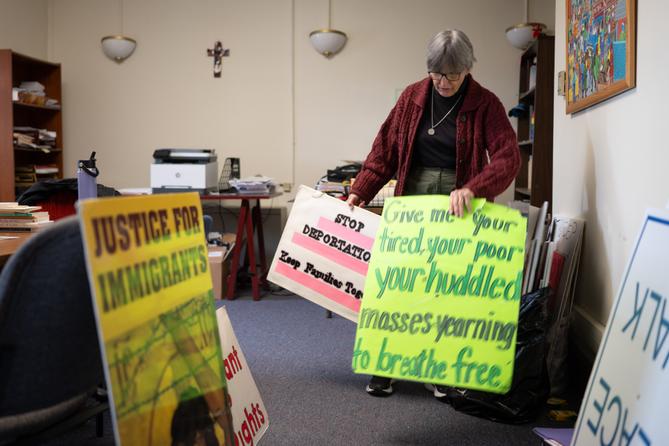
Sister Anne McCarthy with the Benedictine Sisters of Erie looks through her signs protesting President Donald Trump’s nationwide immigration crackdown.

By Kate Huangpu and Danielle Ohl

Spotlight PA

April 6, 2026 HARRISBURG — A group of Pennsylvania counties has billed the federal government more than $21 million in recent years to detain immigrants in their jails, a first-of-its-kind review by Spotlight PA has found.

While these agreements predate the second Trump administration by years or even decades, they are receiving new attention as the president executes a mass deportation campaign that relies heavily on local partners.

They also highlight how counties in Pennsylvania already cooperate with ICE and other federal agencies to detain immigrants. Earlier this year, the Department of Homeland Security purchased two Pennsylvania warehouses to turn them into detention centers capable of holding 9,000 people collectively.

In those cases, local and county lawmakers say they were blindsided by the planned facilities, which they have limited power to block. The detention agreements involving jails that Spotlight PA has identified require the backing of elected county leaders, prison oversight boards, or both.

Five county jails have or recently had agreements with federal immigration enforcement agencies to hold people in their jails, sometimes for months, in exchange for significant fees, Spotlight PA found.

Clinton, Erie, Franklin, and Pike Counties collectively charged more than $21 million for detention in 2024 and 2025, invoices obtained by Spotlight PA show. A fifth county, Cambria, has a similar detention arrangement, according to federal records and a county official — but denied Spotlight PA’s September 2025 request seeking payment information because ICE did not start sending detainees to its jail until later in the month.

Local government officials in favor of the agreements told Spotlight PA that the revenue generated supports services such as the county jail or general fund expenses.

“You’re always going to have pushback one way or another, but we haven’t really experienced it to this point,” Cambria County Commissioner Scott Hunt told Spotlight PA in early March. “This is a relationship that has gone back many years.

“So I realize that emotions are kind of flared now, but this is something we’ve been a part of for years,” he added, “and I don’t see a reason why it wouldn’t continue.”

At least one county leader concerned about ICE’s actions nationally told Spotlight PA the payments have become a crucial source of income that would take careful study and planning to replace.

But at a time when ICE and other federal immigration agencies face scrutiny for aggressive and sometimes deadly tactics during sweeping enforcement operations, Pennsylvanians have pushed back against local government collaboration.

During a February meeting of the Erie County Council, dozens testified for or against the county jail’s contract to hold people for federal immigration agencies.

“We believe that participating in any way in the enhanced enforcement is immoral,” said Sister Anne McCarthy with the Benedictine Sisters of Erie, a monastery that has vocally opposed local cooperation with Trump’s nationwide immigration crackdown.

Others at the meeting asked the county council to keep the agreement intact.

Federal agents won’t stop enforcing the law just because Erie County stops holding people, they argued.

Ending the agreement could draw the ire of the president, one speaker speculated. Another suggested ending local detention would increase the number of people being sent to other jails hundreds of miles away.

And multiple speakers asked: What about the money the county stands to lose?

“ICE will find a different location to house their detainees,” said Fred Petrini, a Wesleyville resident and borough council member. “We will just be out a half a million dollars in funds that could help the county with expenses.”

Spotlight PA sent public records requests to more than 30 counties for invoices showing payments in exchange for arresting, detaining, holding, or processing people for ICE. The news organization also reviewed federal detention data. (Continued)

On The Ground With The Volunteers Tracking ICE Across The Pittsburgh Region

A group of people and a dog stand in a circle, talking, in a parking lot at night in front of a strip mall.
Jaime Martinez, community defense organizer at Casa San José, coordinates with Rapid Response Network volunteers outside Emiliano’s Mexican Restaurant in Gibsonia on June 17, after reports that federal agents were idling nearby in unmarked vehicles.

Casa San José has trained hundreds of volunteers to monitor and respond to immigration enforcement. Public Source followed them through raids, courthouse watches and late-night calls.

Avatar photoBy Quinn Glabicki

Public Source

July 31, 2025 – As federal immigration enforcement intensifies across the country, a local response has quickly scaled up across the Pittsburgh region. In Beechview, the nonprofit Casa San José has built a Rapid Response Network of trained volunteers who monitor and document ICE activity across Allegheny County and beyond.

The network launched during the first Trump administration but has ramped up since January. As of July 30, it includes more than 250 trained volunteers — with nearly 175 more signed up for future training.

Lea este artículo en español aquí.

Casa San José, founded in 2013, focuses on immigrant rights and the Pittsburgh region’s Latino community — a mission amplified as the Trump administration rolls back protections for immigrants and directs federal resources toward a crackdown and mass deportations.

Organizers traverse city neighborhoods, gather in church basements and empty parking lots, and educate residents about their rights and federal immigration tactics. Along with trained volunteers, who are prepared to legally observe, document and accompany people at risk of being detained by Immigration and Customs Enforcement [ICE], they respond in real time to sightings, arrests and raids.

Pittsburgh’s Public Source spent more than a month embedded with Casa San José’s organizers and volunteers, tracking their efforts from the courthouse to restaurants as they responded to immigration enforcement and supported families under threat.

Photo: June 14 at the City-County Building, Downtown 

Monica Ruiz, executive director of Casa San José, speaks to thousands of people gathered in front of the City-County Building in Downtown during a day of nationwide protest against the Trump administration.

“They are disappearing our people. This is our reality. Every single day. Just because you don’t see it doesn’t mean it’s not happening. We cannot continue to allow this to happen in our communities,” said Casa San José Executive Director Monica Ruiz.

“Casa San José is the only organization on this side of the state that is doing this kind of work.” 

Ruiz said she has received five death threats since November, forcing her to relocate Casa San José’s office and to reconsider speaking publicly.

Photo: June 17 at Emiliano’s Mexican Restaurant, Gibsonia

As volunteers monitor the scene, Jaime Martinez, community defense organizer at Casa San José, speaks by phone with nine workers sheltering inside the restaurant — part of the network’s effort to document enforcement activity and support those at risk.

Sharon Bonavoglia was the first to arrive at a quiet strip mall in Gibsonia late on June 17. She had received the call because she lives nearby, and because she’s one of a growing network of volunteers responding to reports of federal immigration enforcement in and around Allegheny County.