Photo: Democratic presidential nominee, U.S. Vice President Kamala Harris takes a selfie with Sen. John Fetterman (D-PA) and his wife Gisele Barreto Fetterman after greeting supporters at John Murtha Johnstown-Cambria Airport on September 13, 2024 in Johnstown, Pennsylvania. (Andrew Harnik/Getty Images)
September 13, 2024 – WILKES-BARRE — Vice President Kamala Harris, the Democratic nominee for president, has spent most of the last two weeks in Pennsylvania starting with a Labor Day rally in Pittsburgh, where she returned a few days later to hunker down for debate prep. She debated former President Donald Trump, the GOP nominee for president, in Philadelphia on Tuesday, and on Friday she campaigned in Johnstown and Wilkes-Barre, two areas that have swung Republican in recent elections.
“I will be continuing to travel around the state to make sure that I’m listening as much as we are talking,” Harris said during the Johnstown visit, according to pool reports. “And ultimately I feel very strongly that you’ve got to earn every vote, and that means spending time with folks in the communities where they live. And so that’s why I’m here and we’re going to be spending a lot more time in Pennsylvania.”
Luzerne County, where Wilkes-Barre is located. was once a Democratic stronghold, and is near President Joe Biden’s childhood hometown of Scranton. But Hillary Clinton lost the county by nearly 20 points in 2016, and Trump beat Biden but nearly 15 points in 2020.
Harris touched on familiar themes in her address to the audience at the McHale Athletic Center at Wilkes University, praising small business owners as the “backbone of America’s economy,” pledging to protect reproductive rights, and reiterating that her campaign for president was informed by her middle-class background.
“People sometimes just need the opportunity, because we as Americans do not lack for ambition, for aspiration, for dreams, for the preparedness to do hard work,” Harris said. She said if elected, her economic plan calls for building 3 million new homes by the end of her first term, and said she would take on corporate price-gouging, and expand the child tax credit.
Harris also said she would “get rid of unnecessary degree requirements for federal jobs to increase jobs for folks without a four year degree” and would “challenge the private sector to do the same.”
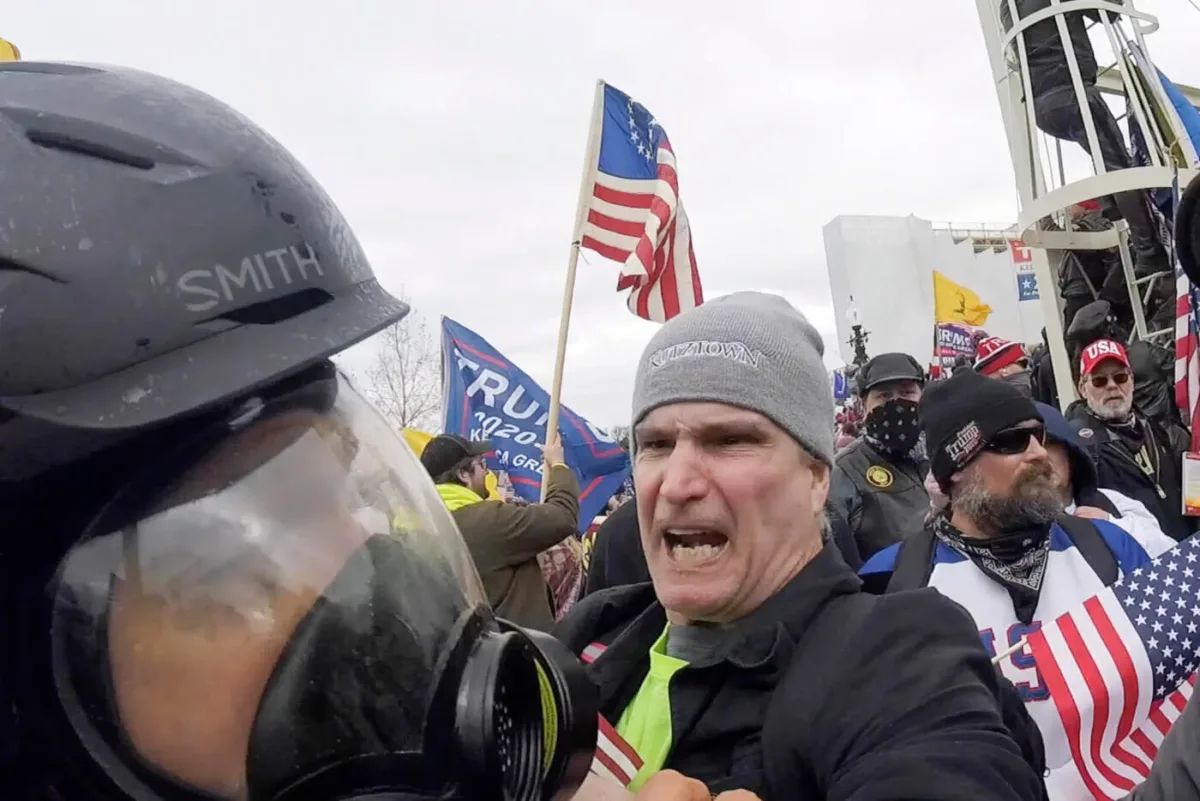
In this image from video, Alan William Byerly, center, attacks an Associated Press photographer during a riot at the U.S. Capitol in Washington, Jan. 6, 2021. On Sunday, Oct. 9, 2022, federal prosecutors recommended a prison sentence of nearly four years for Byerly, of Fleetwood, who pleaded guilty to assaulting the AP photographer and using a stun gun against police officers during a mob’s attack on the U.S. Capitol. (AP Photo/Julio Cortez, File)
By The Keystone Staff
January 4, 2024
Democracy didn’t die in Washington, D.C. on Jan. 6, 2021, despite the efforts of state Republicans like Doug Mastriano and Scott Perry, and the 85 Pennsylvanians who have been arrested to date for participating in the deadly attack on the US Capitol.
Pennsylvania is inextricably linked to the deadly Jan. 6, 2021 attack on the United States Capitol, in which five people died and dozens were seriously injured after a swarm of Donald Trump supporters — fresh from being told to “fight like hell” by the former president at a nearby “Stop the Steal” rally — descended upon the Capitol with the intent to upend democracy by any means necessary.
Major political players in the state, such as state Sen. Doug Mastriano (R-Franklin) and US Rep. Scott Perry (R-Dauphin), allegedly played significant roles in Trump’s effort to overturn the 2020 election — a failed criminal venture that led to the attack on the Capitol.
Then there is the role that Pennsylvanians played on the ground in the Jan. 6 attack. Some 85 Pennsylvania residents were arrested for taking part in the insurrection, tying the commonwealth with Texas for the second highest total among states. According to arrest records from the Department of Justice, 95 Floridians were arrested for participating in the attack, the highest total of any state.
To date, 52 Pennsylvanians have been sentenced, with others expected to be sentenced this month. Three died (two by suicide) while awaiting sentencing, and two others, a married couple, moved out of state before being sentenced.
Overall, according to the DOJ, more than 1,230 defendants have been arrested in nearly all 50 states and Washington, D.C. in connection with the attack, accused of crimes ranging from trespassing, a misdemeanor, to seditious conspiracy, a felony. More than 350 cases are still pending. Around 170 people have been convicted at trial, while only two people have been fully acquitted. Approximately 710 people have pleaded guilty and among those, around 210 pleaded guilty to felony offenses.
Here’s where things stand with each of the 85 Pennsylvanians arrested to date in the Jan. 6, 2021 attack.
Terry Allen – Spring Mills
Allen was arrested in July 2023 and faces charges including entering or remaining in any restricted building or grounds without lawful authority; disorderly and disruptive conduct in a restricted building or grounds; engaging in physical violence in restricted building or on restricted grounds; obstruction of law enforcement during civil disorder; and assaulting a federal officer.
Melanie Archer – Shaler
Archer pleaded guilty in October 2022 to parading, demonstrating, or picketing in a Capitol building. She is awaiting sentencing.
Mark Roderick Aungst – South Williamsport
Aungst pleaded guilty in June 2022 to one count of parading, demonstrating, or picketing in a Capitol building. He died by suicide in July 2022 while awaiting sentencing.
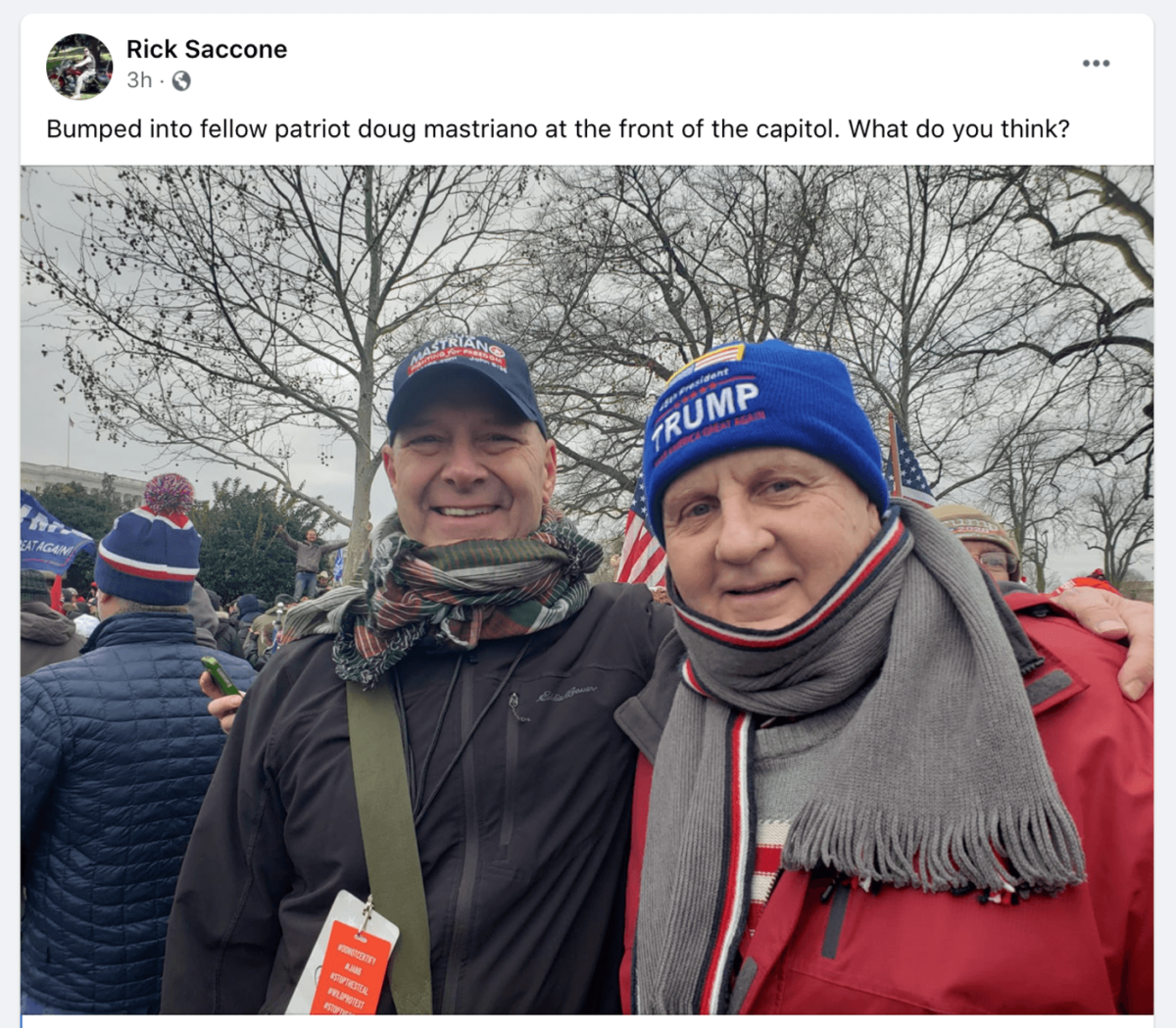
State Sen. Doug Mastriano and former state Rep. Rick Saccone, outside the US Capitol, Jan. 6, 2021 (Facebook screen grab).
Dawn Bancroft – Doylestown
Bancroft was sentenced in July 2022 to 60 days of incarceration, three years of probation, 100 hours of community service, and $500 in restitution for charges including disorderly and disruptive conduct in a restricted building or grounds.
Steven Boyd Barber – Scranton
Barber was arrested in July 2023 and faces charges including entering and remaining in a restricted building or grounds; disorderly and disruptive conduct in a restricted building or grounds; disorderly conduct in a Capitol building or grounds; and parading, demonstrating, or picketing in a Capitol building.
Pauline Bauer – Kane
Bauer pleaded not guilty in May 2021 to charges including obstruction of justice and Congress. Bauer was near then-House Speaker Nancy Pelosi’s office suite during the riot when she yelled at police officers to bring out the California Democrat so the mob of Donald Trump supporters could hang her. She was sentenced in January 2023 to more than two years in prison.
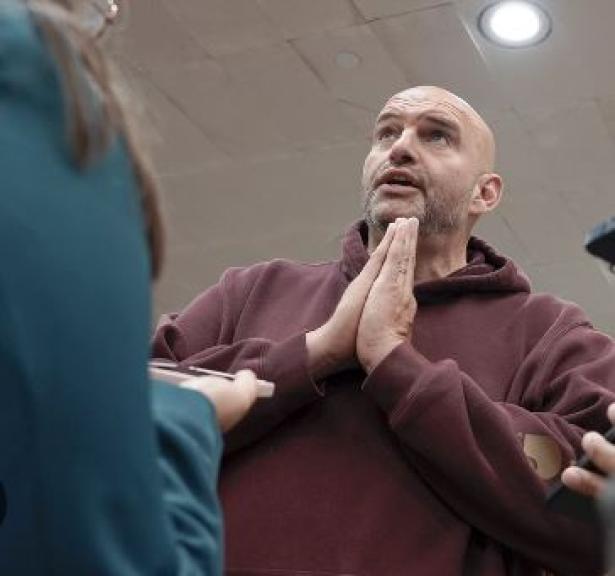
PA Democratic Senator John Fetterman on December 6 defended ‘reasonable’ border talks. This follows his staunch support for Israel’s war in Gaza, which has also befuddled some of his typical allies on the left.,(Photo credit: Politico)
“I’m not a progressive. I’m just a regular Democrat.” Fetterman is in the first year of a six-year term. He has time to repair relations with progressives or sever ties altogether. At this point, the latter is rapidly happening anyway.
By Ross Barkan
Political Currents
Dec 21, 2023 – Labels in the American political system have always been slippery. Progressive, liberal, leftist, conservative, hard-right, and hard-left can mean very different things to very different audiences. MAGA, perhaps, offers the most clarity—an unabashed supporter of Donald Trump. But even then, within the vast array of Republicans who back Trump, are disparate political views. Some want a national abortion ban. Some, like Trump himself, don’t quite know what they want.
Others strive to shed labels altogether. Many politicians, for somewhat obvious reasons, embrace them when they’re convenient—rounding up votes in primaries, appealing to activists, and raising cash—and abandoning them once they become a burden. The burden, or perceived burden, arrives when a politician has to campaign in a competitive general election. John Fetterman, the famous senator from Pennsylvania, is deep into his rebrand, and seemingly considering how to position himself when he faces voters again in 2028. His campaign proudly promoted a clip from the 2022 Democratic primary when he told a journalist who asked if he’s a progressive that “no, I’m just a Democrat that has always run on what I believe and know to be true.” Interestingly enough, Fetterman’s social media account doesn’t quote this verbatim. Instead, the post above the clip reads “I’m not a progressive, I’m just a regular Democrat.”
It’s a notable approach from a politician who has caught heat, of late, for his hawkish views on Israel. Fetterman, unlike several other Democratic senators, has not called for a ceasefire or denounced the Israeli military for slaughtering thousands of civilians in Gaza. As pressure has grown on the Biden administration to do more to curb Benjamin Netanyahu’s military ambitions, Fetterman’s rhetoric has been mostly indistinguishable from Mike Johnson or any other conservative Republican. His simultaneous embrace of tougher immigration laws has led NBC News to label him a “maverick” for breaking with progressive Democrats.
Calling Fetterman a maverick is understandable, if inaccurate. A maverick politician—few hardly exist anymore, and John McCain barely qualified—will break with their party on major policy questions. Imagine a Republican who loudly supports abortion rights or a Democrat who denounced the first or second impeachment of Trump. Strengthening the border doesn’t count; Democrats themselves have a range of views on immigration and Biden himself has pushed for more border fencing of late. Fetterman, unlike Trump, has not said immigrants are poisoning the blood of America. That would be one way, in a far darker manner, to become a maverick. And defending Israel at all costs certainly doesn’t qualify. The Democratic Party, these days, might be less hawkish on Israel than the GOP, but staunch Zionists occupy all the leadership posts. There is no daylight between Fetterman and Hakeem Jeffries, the House minority leader, or Chuck Schumer, the Senate majority leader, when it comes to Israel.
But Fetterman is punching left. There’s nothing new to this—see Sister Souljah—and Fetterman might even be earnest. His staff has certainly argued his views on Israel are decades-old, solidified in graduate school. What is more obvious, and helpfully collated on X, is that Fetterman used to happilyidentify as a progressive. He called himself one in 2016, 2018, and 2020. He inched away from the label in 2022, when he became the frontrunner in the Democratic primary for Senate, but never disavowed the movement of left-leaning activists and organizations that backed him earlier in his career. Fetterman ran unsuccessfully for the Senate in 2016 as a Bernie Sanders supporter and remained close to Sanders when he was elected lieutenant governor in 2018. He benefited from Sanders’ enormous network of online donors in all of his statewide campaigns. He took the Vermont senator’s endorsement multiple times and championed key planks of his platform: a $15 federal minimum wage, Medicare for All, and new wealth taxes. He never identified as a socialist or embraced the more confrontational flavor of leftist politics favored by the Squad, but he was, undeniably, a member of his party’s progressive wing.
It would have been plausible for Fetterman to back a higher minimum wage without calling himself a progressive. “I just want people to make more money and have cheap healthcare” would have been enough. “It’s common-sense,” he might have said, to “make the wealthy pay their fair share. There’s nothing progressive or liberal about that. It’s how we should run a country.” But that would have been less exciting to the donors and activists who were going to power Fetterman’s early campaigns. Fetterman wanted to raise cash and he wanted to win. Hence, the Sanders associations were useful. When Dr. Oz, in the 2022 general election, tried to scare moderate Democrats away, the pivot began. He hasn’t looked back.
If Fetterman were being honest, he could simply declare he is no longer a progressive. He could say he used to be one in 2016 and 2018 and 2020 but he feels differently now. He doesn’t like how progressives talk about Israel or the border or some other hot button issue that might matter to a cross-pressured Pennsylvanian and he’s decided he’s going to operate separately from them. He could say he used to believe in Bernie Sanders and now he’s less sure. But doing that would permanently alienate the activist infrastructure that lifted him to prominence in the first place. Fetterman probably believes this is the safer route: to state, against all available evidence, he was never a progressive. This is dishonest and, in the long run, may not even be good politics. It’s not like Trump, when he was first running for president, ever sought to hide that he used to be a Democrat or pal around with the Clintons. If anything, he used his unscrupulousness to his advantage, boasting about how easy it was for him, as a well-heeled donor, to buy Democrats off. Fetterman needn’t be so venal, but he could acknowledge the past and point the way forward.
Politically, all of this can only matter so much. Fetterman is in the first year of a six-year term. He has time to repair relations with progressives or sever ties altogether. At this point, the latter is rapidly happening anyway. For the Pennsylvania activist class, Fetterman is increasingly persona non grata. Since he also needs to appeal to centrists and Israel-supporting Jews in the Philadelphia and Pittsburgh metropolitan areas, he might not care at all. If he does go down this path, though, he’ll have to find a new way to raise cash and wrangle volunteers. There are many young people who showed up to canvass for Fetterman 2022 that will not bother for Fetterman 2028. They’ll have long memories—and other heroes by then.