The 3rd Congressional District contenders both became state lawmakers in 2017 and have made their records central to their campaigns.
By Sam Janesch
Philadelphia Inquirer
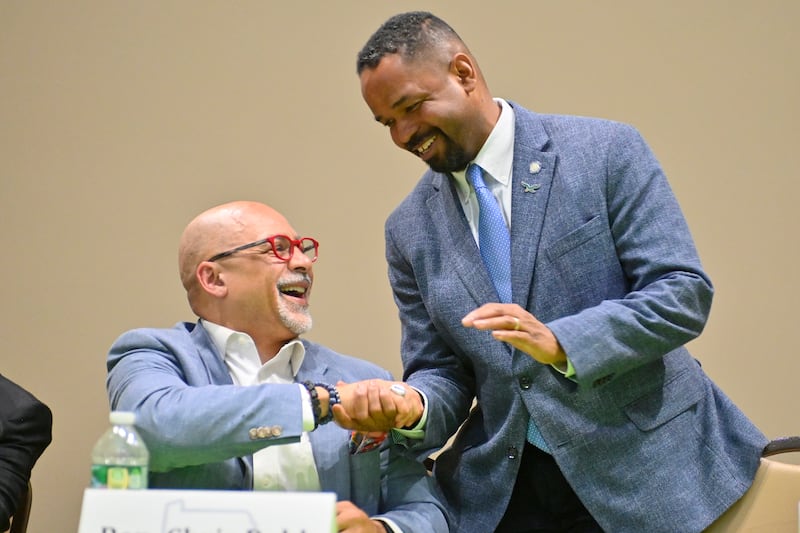
May 13, 2026 – Nearly a decade ago, Chris Rabb and Sharif Street walked into the Pennsylvania Capitol for the first time as elected officials and quickly staked their ground in different ways.
Street, a lawyer and scion of a powerful political family, went to work introducing bills to make technical changes in areas like election and vandalism laws, to decriminalize the possession of small amounts of cannabis, and to end life sentences without the possibility of parole.
Rabb, who had taken on a local Democratic machine to get to Harrisburg in the first place, put out feelers for legislation that would make lawmakers pay a $100,000 fine if they are convicted of a crime, increase taxes on wealthier Pennsylvanians, and limit police assisting U.S. Immigration and Customs Enforcement at the start of President Donald Trump’s first term.
The two Philadelphia Democrats would both go on to have more losses than wins. In a closely divided General Assembly where Republicans have kept unilateral control for six of the last 10 years, relatively few Democratic-led bills cross the finish line.
But as Street and Rabb face off in Tuesday’s tightly contested race to represent the 3rd Congressional District, the candidates’ legislative records — and their distinct governing styles — have become central to their pitches as they pursue one of the most Democratic-leaning seats in the country. (Continued)
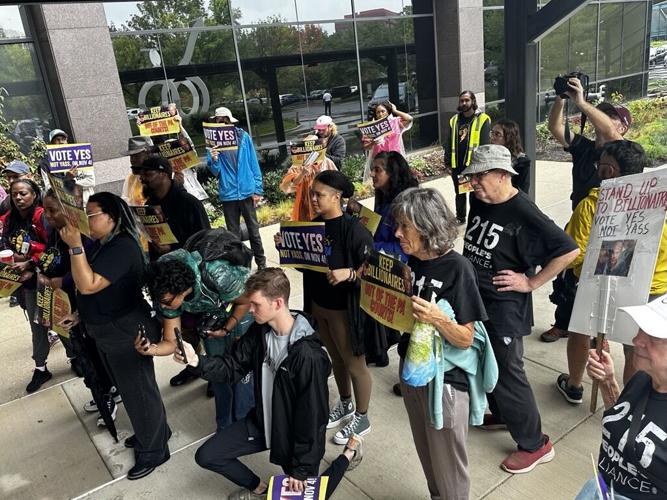
PA. Democrats decry Jeffrey Yass spending in judicial races, compare him to Elon Musk | Politics | lancasteronline.com
A coalition of progressive and pro-worker, pro-woman organizations in Pennsylvania did the impossible and radically expanded the amount of voters engaged in a critical, but easily ignored, State Supreme Court race.
By Jeffrey Lichtenstein and Steve Paul
Convergence Magazine
April 28, 2026 – The most important question on the 2025 Pennsylvania general election ballot, retention of State Supreme Court judges, was buried halfway down the back page.
But thanks to a strategic, multipronged coalition effort, voters in this battleground state retained three Democratic justices and kept the Democrats’ five-to-two majority on the court. This win will be critical for protecting reproductive freedom, workers’ rights and environmental regulations, as well as voting rights and fair legislative maps.
In odd-numbered election years, significant numbers of Pennsylvania voters do not vote their entire ballot, a phenomenon typically referred to as roll-off. Ordinarily, as many as 30% of voters will skip offices or questions closer to the end of their ballot that seem less important or recognizable.
But a network of Pennsylvania organizations including One Pennsylvania (One PA), Make The Road PA, Asian Pacific Islander Political Alliance and other members of the Working Families Party–with support from our state donor table–brought roll-off down from 30% in 2021 to 2% in this election–the lowest rate ever.
We named villains without flinching
Our coalition used diverse but integrated tactics throughout the spring, summer, and fall of 2025. This included paid, earned and new media alongside door knocking, volunteer organizing, and greeting voters at the polls. We worked to be sure we didn’t flinch from clearly naming villains, and we attempted to bring an organizing approach to every tactic, thinking as much about who is carrying our message and why they care, as much as how well it is polling. We centered working people’s political instincts and prized their established networks of trust.
Our message needed to be clear about what was at stake and who was to blame. And our tactics focused first on winning over leaders of various types who could then carry the message to the communities whose trust they’d already earned. Because we used strategies that sought to move power into regular people’s hands–rather than relying solely on professional consultants and vended programs–we defended a critical bastion in the fight against authoritarianism.
Who and where
The Working Families Party of Pennsylvania is both a movement coalition and a political party, with 10 organizational members, including One PA, who collectively represent 100,000 commonwealth residents. The member organizations include unions and community groups. Their strongest bases are Philadelphia, Allegheny County (home to Pittsburgh), and the Lehigh Valley, but they’re active in several smaller places as well, especially deindustrialized working-class towns and towns with a majority of people of color–which are often the same.
Recognizing that many in our communities get their information from social media, we also launched an effort to organize online content creators…
One PA in particular is rooted in working-class, majority-Black communities in Allegheny, Dauphin, Delaware and Philadelphia Counties. The PA Working Families Party has been active in elections since 2018; our coordination in this election built on collaborations in several previous fights. These include the election and re-election of Philadelphia City Council member Kendra Brooks in 2019 and 2023; the 2021 elections of Philadelphia District Attorney Larry Krasner and Pittsburgh Mayor Ed Gainey; US Rep. Summer Lee’s win in 2022 and Philadelphia City Council member Nic O’Rourke’s in 2023, and Helen Gym’s run in the 2023 Philadelphia mayoral primary. (Continued)
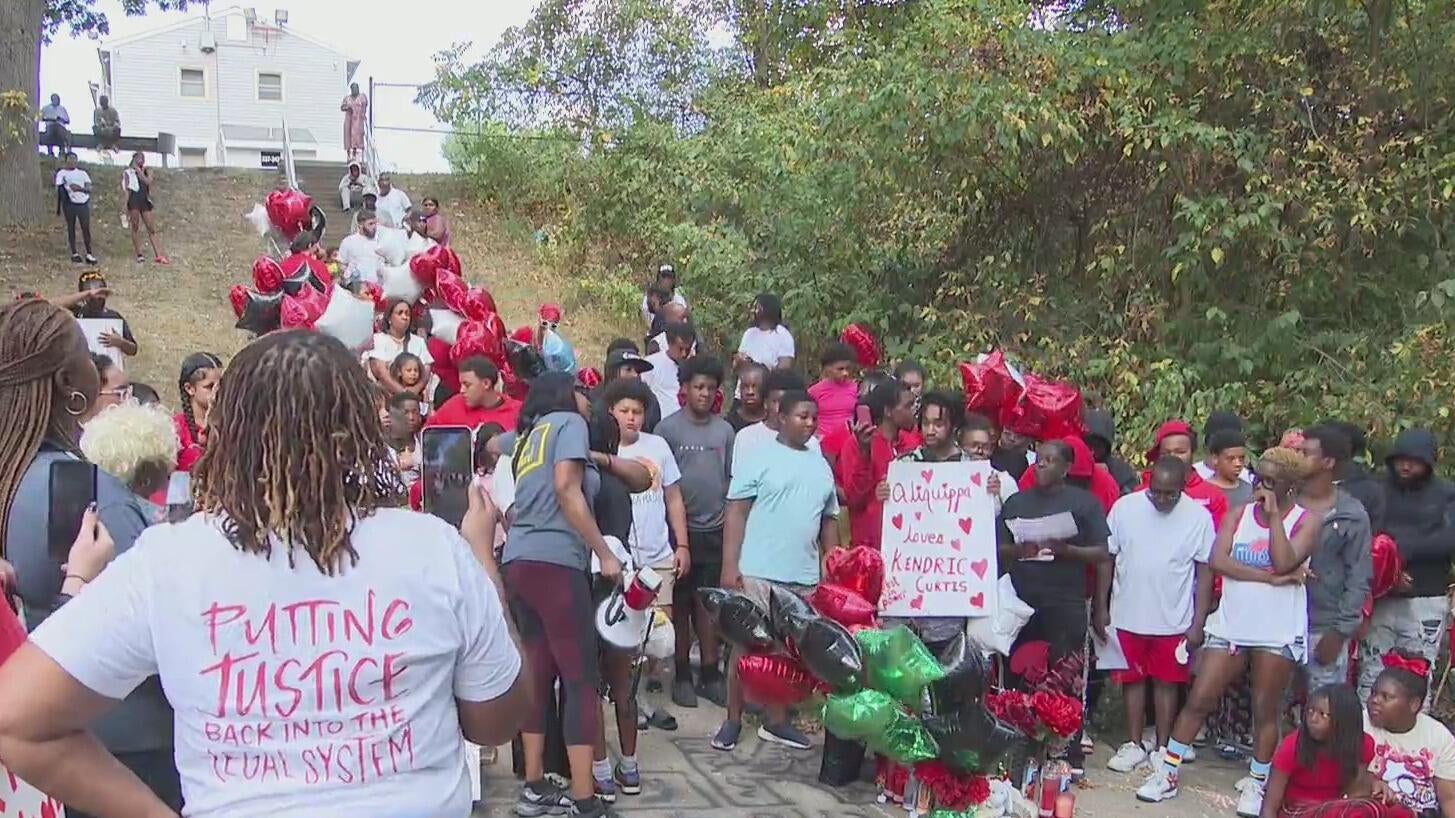
Sept 21, 2025 – Aliquippa community comes together to remember 18-year-old shot and killed by ATF agent 02:17 The Aliquippa community both honored the life of 18-year-old Kendric Curtis and called for accountability and transparency during a vigil on Sunday.
An ATF agent shot and killed the Aliquippa High School student on Thursday after state police say Curtis shot at an officer in Aliquippa’s Linmar Terrace neighborhood.
The emotional vigil featured Curtis’ sisters and girlfriend.
“When I heard what happened, it felt like it ripped my heart out, and it took a part of my soul,” Curtis’ girlfriend said. “I just want answers for my boyfriend.”
While the event focused heavily on Curtis’s life, the bubbling anger in the community was also present.
Pennsylvania State Police say officers ahead of the shooting tried to make contact with Curtis before he ran away and shot at them. The ATF and FBI were working on a joint investigation when the shooting took place.
His sisters said their brother was being painted in a bad light, calling him a “good person” who “everyone loved.”
“I feel like my son was targeted and wrongfully killed by the police,” Curtis’ father wrote in a letter that was read aloud at the vigil. “I don’t know what happened, but I know my son is not here to share his side of the story.”
Neighbors told KDKA-TV on the night of the shooting that the ATF agent, whom they believed had shot Curtis, was in plain clothes.
Community leaders have asked for patience as more information comes out. Skeptical community members, some of whom don’t believe law enforcement’s version of what happened, want more information now.
“We demand an answer why, we demand that answer why. Give us that answer,” said organizer George Powell. “Give us those cameras, give us that man in handcuffs who took that little kid’s life. It’s been three days and we’ve heard nothing.”
Neighbors hoped to change more than just a narrative about Curtis.
“We have to stand up and show everyone that Aliquippa is not just about guns, drugs, death, murder, football, [or] sports,” said one of the speakers. “We got young men growing up and dying daily, and we’re going to stand up.”
Aug 14, 2025 – As the Trump administration aims to bolster fossil fuels at the expense of clean energy expansion, new research shows the oil and gas sector has so far failed to become a major jobs creator for heavily fracked areas of northern Appalachia.
“To the degree that we allocate resources to help develop that industry, we’re diverting those resources from other industries that actually could deliver” more jobs and higher per-capita incomes, said Sean O’Leary, author of the recent report from the Ohio River Valley Institute.
The report uses the term “Frackalachia” to describe 30 top oil- and gas-producing counties in Ohio, Pennsylvania, and West Virginia. As a group, the counties have smaller populations and a net loss in the number of jobs compared to 2008, just before Appalachia’s shale-gas boom began.
The counties’ growth in per-capita income also has lagged behind the national average, even as their nominal gross domestic product nearly doubled, increasing their share of the country’s GDP by 6%. Basically, comparatively high economic output from the counties did not produce higher-than-average incomes for their residents.
“Despite immense economic growth as measured by GDP, Frackalachia is in a position of actually having lost jobs since the beginning of the natural-gas boom,” O’Leary said. In his view, the numbers contradict pro-industry pitches for more oil and gas development.
“Whatever else it is, the natural-gas boom is not an engine for economic prosperity,” O’Leary said. He thinks the gas industry is “structurally incapable” of delivering lasting growth in jobs and income for the people living in heavily fracked areas. The Frackalachia counties have also seen relatively few jobs from “downstream” industries, such as the production of plastics, he added.
Oil and gas development is “highly capital-intensive, but not very labor-intensive,” O’Leary explained. Most earnings go to shareholders, investors, and suppliers based far from where fossil fuels are extracted, so only a small share of project income stays in the community to stimulate more economic activity.
Completed wells don’t need many permanent employees, O’Leary said. And many people who work in drilling and fracking come from outside the local area.
Canary Media’s review of data from the Ohio Department of Job and Family Services is consistent with that observation. From 2012 through 2022, the agency issued annual reports about the economic impact of the state’s oil and gas industry, including data for both “core” jobs and “ancillary” industries, which support oil and gas development.
Truck moves through old J&L Tunnel at the intersection
By Rachel Pierce
WPXI Pittsburgh
Changes may be on the horizon for Route 51 (Constitution Boulevard) and the Route 3016 Franklin Avenue interchange in Aliquippa.
PennDOT says the potential changes will allow for safer access to downtown Aliquippa and the Aliquippa Industrial Park.
Aliquippa Mayor Dwan Walker says he would like to see the Route 51 land bridge demolished, and then the creation of an intersection with traffic lights.
“I’m born and raised here, 50 years of my life. I’ve been here and this has been a headache for the city as a whole and it’s residents,” Walker said. “It’s an all-hands-on-deck callout to get this done.”
Walker says this redesign could help open up Aliquippa and spur economic growth.
“Instead of just passing Aliquippa, you can actually take a visit to us,” Walker said.
Walker says the busy intersection gives drivers little space to accelerate and decelerate, including trucks from the industrial park. Walker says the intersection is also a prime spot for speeding.
Walter says these changes are a matter of life and death.
“We’ve had countless accidents, a loss of life, NyKasia Johnson. She lost her life and the goal is to name this street after her, to honor her,” said Walker.
PennDOT says the project could cost up to $19 million, with a projected start date in the spring of 2027.
PennDOT and Walker encourage the public to voice their opinions on the proposed changes here.
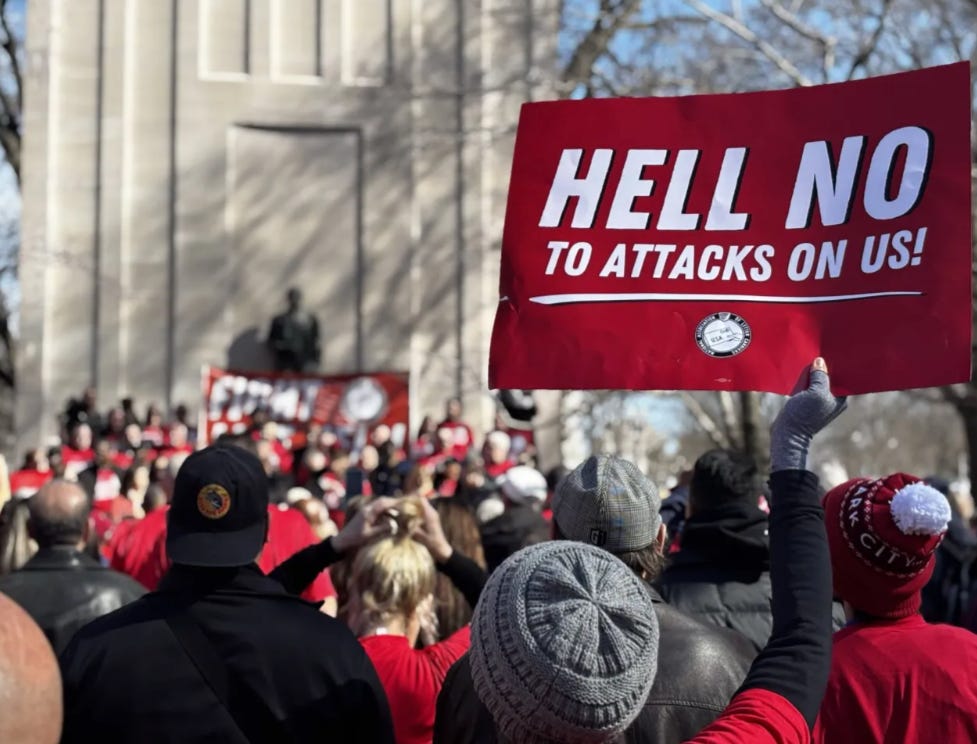
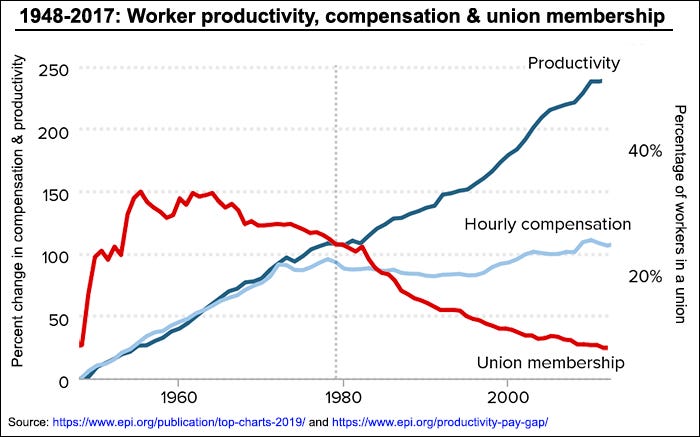
Over the course of the first 100 days, appropriate attention has been paid to Trump’s attacks on the judiciary, law firms, universities, philanthropy, non-profit groups and the media as dangerous in their own right, but more importantly as essential elements of authoritarian consolidation. Yet almost no one has mentioned the attacks on an equally proven constraint on oligarchy and autocracy: unions. Trump and Elon Musk’s destructive ransacking of our government should remind us of what previous generations of Americans understood intuitively: that “we may have democracy, or we may have wealth concentrated in the hands of a few, but we cannot have both,” as Supreme Court Justice Louis Brandeis put it. Like other attacks on civil society, the Trump regime’s attacks on unions and working people do not just injure those directly targeted, but all of us, as the labor movement is one of the most essential bulwarks against authoritarianism.
If we all have a stake in unions as bulwarks against authoritarianism whether we belong to one or not, the same is true because of how unions foster shared prosperity and a healthy society, which I elaborate on here and here. In that regard, it is crucial to recognize the Trump actions as coming from the same playbook as Reagan’s decisive firing of over 11,000 striking air traffic controllers. It was more than punitive—it communicated a clear, aggressive stance against unions nationwide. The immediate aftermath saw corporate America follow Reagan’s lead, significantly increasing anti-union activities and adopting overt union-busting strategies.1 Reagan further entrenched anti-unionism by reshaping the NLRB into a body less protective of labor rights, reversing precedents that had previously safeguarded union activities.2
As it did then, today’s federal war on working people comes at a key inflection point. Then it was the rush to globalization, coupled with financialization and deindustrialization. Now it is the imminent transition to artificial intelligence in the workplace. Musk’s firings are providing a new playbook for that transition—fire everyone so as to be able to start from scratch with AI with as little friction from a legacy workforce as possible. And, although not the topic today, it’s important to note here that with respect to DOGE cleaning house to make way for AI, it’s also cleaning house to make way for even more of the government to be privatized—providing a vast market for the tech companies’ AI products and services. Although this future is not certain, it seems to be Musk’s plan: first trash the government, then when the government fails, privatize.
Today, I’ll lay out some of the most egregious actions taken by the Trump regime in the first 100 days to attack unions and working people in both the public and private sectors. Much of this is based on indispensable research by the Economic Policy Institute and its just released 100 Days, 100 Ways Trump Hurt Workers. (For more great reports like this, you can subscribe to EPI here.)
Then I’ll document the robust pushback unions are mounting against the Trump regime’s war on working people in the courts. Unions have also been in the forefront of mobilizing public action, most notably the AFL-CIO’s Department of People Who Work for a Living, which in addition to leading and participating in protests3, has organized town halls across the country.4 AFL-CIO President Liz Shuler declared:
The labor movement is not about to let Trump and an unelected billionaire destroy what we’ve fought for generations to build. We will fight this outrageous attack on our members with every fiber of our collective being.
And, significantly, even sectors mistakenly thought to be pro-Trump like the Building Trades powerfully responded to Trump’s executive order eviscerating collective bargaining for federal workers:
This executive order is an unprecedented assault on worker freedom and a direct attack on those fundamental rights. Americans know that patriotic blue-collar workers built this country, not billionaires. They also know that one of the last best chances to make it to the middle class is collective bargaining. NABTU and our affiliated unions will stand shoulder to shoulder with the entire labor movement to fight this head-on — and we will not back down.
Mar 23, 2025 –PITTSBURGH —Letter carriers in Pittsburgh participated in a nationwide rally Sunday in an effort to protect the United States Postal Service from what they say President Donald Trump’s proposed budget cuts and privatization could do to the organization and its workers.
The rally was held by the local union of Branch 84 alongside the National Association of Letter Carriers in the North Shore, which represents 2,800 carries in Allegheny, Washington, and Beaver counties.
“We’re here to gather together to say no,” Paul Rozzi, president of the Pennsylvania State Association of Letter Carriers, told Pittsburgh’s Action News 4. “We don’t want any of those things to happen. It doesn’t only affect us, but it affects every patron.”
The rallies across the nation come as Trump proposed moving the U.S. Postal Service under the control of the Commerce Department in what would be an executive branch takeover of the agency, which has operated as an independent entity since 1970.
Trump made the remarks at the swearing-in of Commerce Secretary Howard Lutnick. He called the move a way to stop losses at the $78 billion-a-year agency, which has struggled to balance the books with the decline of first-class mail.
“We hope that the Trump administration hears this message and we’re not at war, but we’re prepared to fight like hell,” president of Branch 84 National Association of Letter Carriers of Pittsburgh Ted Lee said.
USPS says about 640,000 people would be affected by these changes if passed.
Town halls have become potent political theater early in Donald Trump’s second term, and Lee told a friendly crowd that Democrats must try different tactics in a “failing democracy.”
U.S. Rep. Summer Lee speaks at Ebenezer Baptist Church in Pittsburgh’s Hill District on March 20, 2025, in a town hall meeting. (Photo by Cameron Croston/PublicSource)
U.S. Rep. Summer Lee made a case for bolder action from elected Democrats at a town hall event Thursday evening, speaking to hundreds of constituents as her party tries to find its footing during the chaotic first months of Donald Trump’s second term as president.
Lee, a second-term Democrat from Swissvale, took questions at Ebenezer Baptist Church in Pittsburgh’s Hill District. Constituents asked questions about Trump’s moves to drastically change federal policy on education and housing, potential cuts to Medicaid and Social Security and environmental issues.
U.S. Rep. Summer Lee, D-Swissvale, speaks at Ebenezer Baptist Church in Pittsburgh on March 20, in a town hall event to solicit input and answer questions about the federal government two months into the second administration of President Donald Trump. (Photo by Cameron Croston/PublicSource)
It was a friendly crowd for Lee in the historical heart of Black Pittsburgh, a neighborhood and city that reliably vote overwhelmingly Democratic. The crowd applauded and shouted in agreement at many points throughout Lee’s remarks.
Lee argued that Democrats in Congress largely aren’t doing enough to push back on Trump’s agenda so far, echoing widespread criticism from the party’s rank and file that intensified after Senate Democrats provided votes to pass Trump’s budget measure last week.
Her comments were in response to a question from audience member Veronica Pratt, who said that most elected Democrats “are not meeting the moment.”
“There are a lot of people in Congress,” Lee said, “… who have been there for a very long time. Institutional knowledge is typically very important. But the things that worked for us even two years ago cannot work in a failing democracy. And we are in a failing democracy right now.”
U.S. Rep. Summer Lee, D-Swissvale, speaks to town hall meeting attendees at Ebenezer Baptist Church in Pittsburgh’s Hill District on March 20, 2025. (Photo by Cameron Croston/PublicSource)
An attendee at a town hall meeting holds a sign while waiting in line outside Ebenezer Baptist Church in the Hill District. U.S. Rep. Summer Lee, D-Swissvale, held the meeting to hear concerns about changes in the federal government since President Donald Trump’s inauguration two months prior. (Photo by Cameron Croston/PublicSource)
Attendees hold up signs in front of Ebenezer Baptist Church in the Hill District while waiting in line for a town hall meeting with U.S. Rep. Summer Lee, D-Swissvale, on March 20. (Photo by Cameron Croston/PublicSource)
U.S. Rep. Summer Lee, D-Swissvale, speaks to town hall meeting attendees at Ebenezer Baptist Church in Pittsburgh’s Hill District on March 20, 2025. (Photo by Cameron Croston/PublicSource)
An attendee at a town hall meeting holds a sign while waiting in line outside Ebenezer Baptist Church in the Hill District. U.S. Rep. Summer Lee, D-Swissvale, held the meeting to hear concerns about changes in the federal government since President Donald Trump’s inauguration two months prior. (Photo by Cameron Croston/PublicSource)
In what may have been a veiled reference to Senate Minority Leader Chuck Schumer, D-New York, Lee said “there’s no shame” in elder leaders stepping aside.
“If you’ve served for 40 years, if you’ve served your time and this isn’t the moment you’re willing to fight back … then maybe it’s OK to step aside,” she said.
The gathering was the latest representation of local opposition to the White House, where President Donald Trump has used his first two months back in power to begin a sweeping remaking of the federal government, shut down refugee resettlement and launch a large-scale deportation campaign.
Activist-led protests have occurred on city streets at times since the Jan.
“We’re going to see actions and they’re going to escalate across the country,” Lee said.
Long an unassuming part of American democracy, town hall meetings have gained added significance this year. Republican congressional leadership observed a surge in protests at town halls held by GOP lawmakers, and urged them to stop holding the meetings. Democrats, meanwhile, have seen the open gatherings as opportunities to galvanize opposition to Trump.
Summer Lee, D-Swissvale, speaks at a town hall meeting at Ebenezer Baptist Church in Pittsburgh’s Hill District on March 20. (Photo by Cameron Croston/PublicSource)
In sharp contrast to the Trump administration’s focus on removing any references to diversity and multiculturalism from government spaces, Thursday’s town hall began with a rendition of “Lift Every Voice and Sing,” commonly referred to as the Black national anthem.
The first question from the audience concerned Trump’s move just hours earlier to attempt to begin shutting down the federal Department of Education via executive order.
Lee predicted dire implications for residents, noting that the federal government provides thousands of dollars per student for Pittsburgh schools and predicting that if that money stops, schools will falter or the cost will be passed onto local property taxpayers.
“If you cut and you gut public education, any child can be left behind,” Lee said. “… What does that mean for the future of America?”
Another audience member asked about the influence of billionaire and Tesla CEO Elon Musk on the government. Musk was Trump’s biggest campaign backer last year, spending a quarter billion dollars to boost his candidacy and those of other Republicans, and now has a wide-ranging role in shaping White House policy. Musk and the Musk-inspired Department of Government Efficiency have focused on making significant cuts to the federal workforce, sometimes going further than federal judges will allow and leading to lapses in federal services.
Lee railed against the “idiocracy of Elon Musk and those babies he has working for him” and said she would use her seat on the House Oversight Committee to probe his business conflicts of interest.
Charlie Wolfson is PublicSource’s local government reporter. He can be reached at charlie@publicsource.org.
Photo: High voltage electrical equipment at the University of Pittsburgh’s GRID Institute at the Energy Innovation Center in Pittsburgh’s Hill District on Feb. 10. (Photo by Quinn Glabicki/PublicSource)
As research and investment flow to the region, Pittsburgh strives to develop a workforce to build the green energy future.
By Quinn Glabicki and Alice Crow PublicSource
February 24, 2025 -Brandon Grainger stood beneath a towering, 13,800-volt webwork of power lines and transformers constructed inside a laboratory at the Energy Innovation Center in the Hill District, home to the University of Pittsburgh’s GRID Institute. Solar panels layer the sawtooth roof and a prototype wind turbine spins high above the parking lot. Both provide energy to the lab, and a research opportunity for those seeking to understand how to best integrate renewable energy.
As power demands increase from booming tech and AI development, the GRID Institute studies how to efficiently get electricity where it’s needed, and Grainger and other professors prepare students to eventually work in advanced industry.
But concerns persist, and a question remains: Do we have enough labor — from doctoral candidates to electricians — to meet the demands of the future?
“Well, the answer is no,” said Granger, an associate professor of electrical engineering. His graduate students, mostly electrical engineers, are being hired nearly eight months before they graduate, he said, and undergraduates, too, are being scooped up by industry well before they leave campus.
Industrial electrical equipment with interconnected metal structures and cylindrical components in a facility.
Southwestern Pennsylvania has the industrial capacity and hard-working heritage to be a bedrock of green energy manufacturing and development at a time when climate-friendly projects awaiting connection to the grid could go a long way toward addressing energy supply challenges.
Research and investment is already flowing to the region, but as green energy development accelerates, the local stock of legacy labor might not match the demand for workers, potentially posing a serious risk to the sector’s development amid quality control issues and delays. At the same time, local efforts are striving to train and graduate new workers to help meet the need. (Next page)
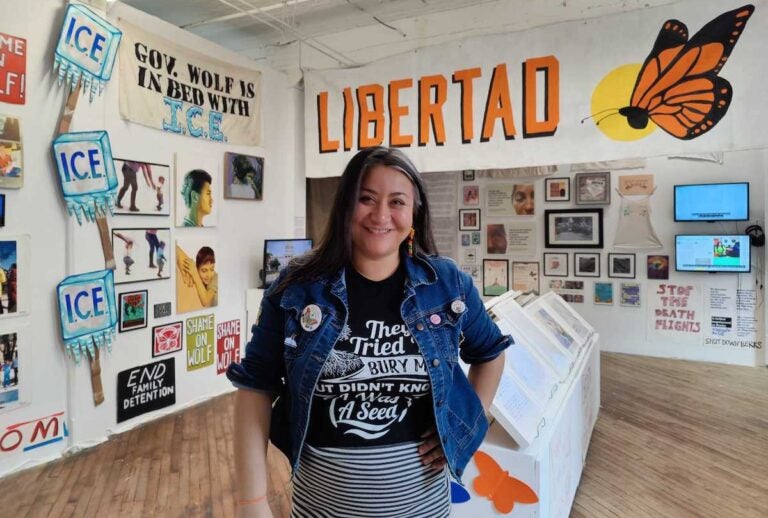
Photo: Jasmine Rivera was an organizer with the Shut Down Berks Coalition, and curated the exhibition “Queremos Justicia: Cómo cerramos Berks,” at the Vox Populi gallery in Philadelphia in 2023. (Peter Crimmins/WHYY)
By Jeffrey Lichtenstein
One PA
Jan 7, 2025 – We’re holding several big questions as we move into 2025 that we hope to learn and struggle through together with our funding partners. All of our work, especially our organizing, advocacy, and outreach efforts, will be working through these questions.
Quality vs Quantity of Doors
Where and when can we initiate and join conversations about the quality of field work rather than simply the quantity of door knock and phone call attempts? The efficacy of canvassing in low-salience elections is statistically unquestionable but in presidential election cycles there is suddenly a great amount of noise. Some of this noise is the result of large-scale vended field programs with weak quality control practices or very low contact rates.
What could it look like to move toward an eco-system wide model for field work that prioritizes the number and quality of conversations, volunteers recruited, and leaders trained? One PA prides itself on high contact rates and rigorous quality control but we still have much to learn. We hope to share and leverage best practices across locally rooted partners and begin to shift the paradigm around field work from quantity alone, to quality and quantity.
Making organizing power more legible
Even the strongest most rigorous electoral field program faces structural challenges with management, hiring and training under conditions of limited funding and time. These efforts also, by their nature, are demobilized and dismantled after an election, even when we know there is another election just around the corner, not to mention countless other opportunities for voters to flex their voice in government and strengthen their civic participation. Political and civic organizing, unlike electoral campaign mobilizations, grow rather than diminish in efficacy and power over time. What would it look like to quantify, validate, resource and scale the civic power of organizing? One PA was successful in 2024 in using every door conversation to begin an organizing pathway. We identified 33,000 hot leads to join One PA. We’re proud of this work, but we have real areas of growth in learning how to maximize the conversion between hot leads and new volunteers.
Dimensions and Cost of Building Precinct Based Structure
The term ‘organizing’ has been stretched in recent years to mean all manner of engagement. At One PA we are working with multiple battle-tested organizing models in an attempt to integrate the best practices of each in a way that can be quantified, studied and validated at every stage using contemporary data tools and tech. Our model combines dues-based membership, structure based organizing units, systematic leadership development, polarizing campaigns and experimentation. We are proud of our work in 2024 to launch a guardians of democracy and elections captains program.
In the year ahead we plan to scale the program by a factor of five, and are holding questions about what level of resource and training this will require at each level of the organizing structure. Independent Voice It is clear our movement must get upstream of elections in the battle to make meaning out of our communities’ lived realities. By the time candidates win their primaries, the ability to shape what that election will be about is out of the hands of most people except the elite few with an extraordinary amount of influence on the candidates. We are asking ourselves the question: what capacities and practices do we need as a movement to help frame the questions in front of people long before an election?
How can we roll into a cycle with voters broadly knowing already that housing is too high because of slumlords and rollbacks on government investment, not because of immigrants? We know part of the answer is an independent voice for Black and multi-racial working class communities, to help compensate for brand weakness in the Democratic party, to ensure voters feel they are heard, and to guarantee a more healthy mix of ideas about what it will take to fix this country. How can we build the power and independence of this voice in a way that our more traditional and conservative allies won’t attempt to smother in its cradle?
Winning the Internet
We’re also holding questions about how to respond to the reality that the Internet is increasingly becoming a place our communities rely on for social and political queues. Cynical or hateful voices have a head start in offering narrative frames in the digital space. We are holding questions about what it looks like to bring an organizing approach and significant investment in mass communications to organize our base in digital space, win over leaders and taste makers in non-legacy media, and contest for narrative primacy on the internet.
Training to Win next quarter and next decade
Training is critical for nearly every aspect of our plan, especially the proposition that we grow in capacity and power over time, and the responsibility to rebuild a majority. We are clear that we must level up the rigor and scale of our training program, and sit with the question about what kind of training school and content will meet the need. We know curricula must include a breakdown of the structures and histories of power and resistance; song, poetry and other forms of culture that bring people together at an emotional register; practical application of ideas through repetition of organizing, storytelling, writing and other skill practice. We’re sitting with the question: how can all those pieces best fit together and what kind of resourcing will it take to hold a training program sustainably that can meet these goals?
A renewed tech advantage
We’re also holding a question about technology. For about 20 years, democratic institutions and networks held an advantage in the use of tech in politics – the VAN, click-to-call tools, ActBlue and early P2P text platforms are all examples. But today republican networks and institutions have caught up or surpassed. What kind of tools allow us to easily give an inspired volunteer a list of the 50 closest target people to them, to register them to vote, get them to sign a petition, or have a persuasive conversation about candidates? How do we move away from site-based voter registration only, and use contemporary data to scale door to door registration programs? How do we use new models, like the Steven Phillips “New Majority Index,” to help us assess opportunities and threats?
Cities: Most of our base lives in cities.
Cities are the places where the housing and homelessness crises are worst. Cities are some of the places with the highest income inequality and violent crime. It’s difficult to live in cities unless you’re rich. There is a relationship between our bases’ weakened sense of political agency and their perception of the corruption of government on one hand, and the way our cities are being run on the other. What does it look like to have an intentional plan to broadcast positive accountability messaging when city leaders accomplish something that improves peoples lives? How do we combine that with real resourcing for primary campaigns to support candidates who are committed to using the government to deliver material gains for working class people.’ And what does it look like to add real resourcing for advocacy and pressure campaigns to encourage local leaders on the fence to move toward policies that will demonstrate in real terms how democratic governance is good for people?
Alignment
Last, we’re holding a question about how to build alignment between progressive base-building organizations to have sufficient power to help win the fights that each of us aren’t strong enough to win on our own. We’re proud of the work that we’ve done to build unity through the cycle of the last several races with several partners, especially PA United , Working Families Party , APIPA, Make The Road, 215 People’s Alliance and UniteHERE. How do we strengthen and build on these existing relationships?






 U.S. Rep. Summer Lee, D-Swissvale, speaks to town hall meeting attendees at Ebenezer Baptist Church in Pittsburgh’s Hill District on March 20, 2025. (Photo by Cameron Croston/PublicSource)
 An attendee at a town hall meeting holds a sign while waiting in line outside Ebenezer Baptist Church in the Hill District. U.S. Rep. Summer Lee, D-Swissvale, held the meeting to hear concerns about changes in the federal government since President Donald Trump’s inauguration two months prior. (Photo by Cameron Croston/PublicSource)
 Attendees hold up signs in front of Ebenezer Baptist Church in the Hill District while waiting in line for a town hall meeting with U.S. Rep. Summer Lee, D-Swissvale, on March 20. (Photo by Cameron Croston/PublicSource)