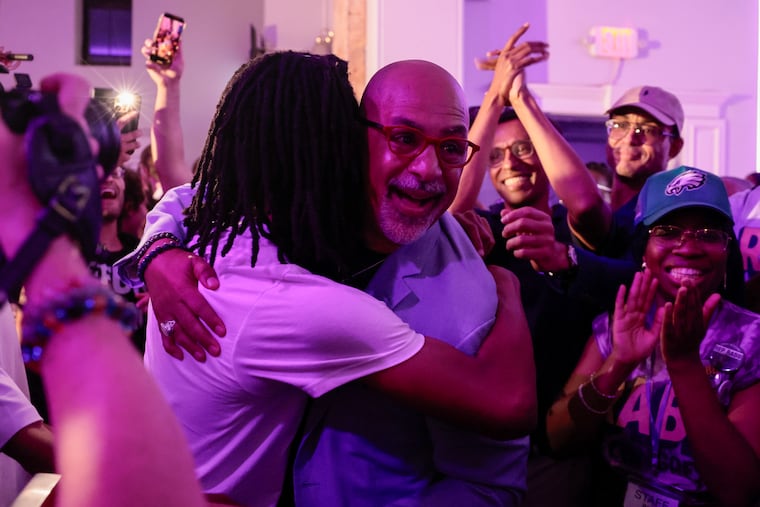
State Rep. Chris Rabb is hugged by his son, Issa Rabb, during his primary election night event at Victorian Banquet Hall Tuesday, May 19, 2026, in Philadelphia.Read moreElizabeth Robertson / Staff Photographer
Rabb is now all but certain to win a two-year term to represent Pennsylvania’s 3rd Congressional District, a seat that has been held for a decade by retiring U.S. Rep. Dwight Evans.
State Rep. Chris Rabb, a democratic socialist who has repeatedly challenged Philadelphia’s political establishment, has won the tightly contested 3rd Congressional District primary — a striking victory for the city’s left-leaning coalition after a combative and rare open contest.
The Associated Press called the race at 10:42 p.m. on Tuesday. Rabb, a five-term state lawmaker from East Mount Airy, handily defeated two other top contenders in the hard-fought race, according to unofficial returns.
In the bluest district in the country, the result sets Rabb on an almost guaranteed path to succeeding U.S. Rep. Dwight Evans, who is retiring after a decade in the seat. Rabb’s election would mark a significant shift from half of Philadelphia voters being represented by a more mainstream Democratic voice to one in the most left-wing faction of Congress.
Rabb’s election night party at Victorian Banquet Hall in Germantown erupted as his victory appeared near. The candidate danced and hugged his way through the crowd.
“I did not win tonight. We won,” he said from the stage. “This is just the beginning.”
The win represented a major blow to leaders of Philadelphia’s Democratic Party, who largely rallied around the other candidates and have clashed with Rabb for years. And it was something of a turnaround for Rabb, whose campaign nearly ran out of money after he said his former treasurer embezzled more than $160,000 in contributions.
“There was a moment a couple of months ago, not long ago, that I was on the precipice of withdrawing from this race,” Rabb said Tuesday night. “And there were people who showed up for me at my worst, in depths of adversity.” (continued)
The 3rd Congressional District contenders both became state lawmakers in 2017 and have made their records central to their campaigns.
By Sam Janesch
Philadelphia Inquirer
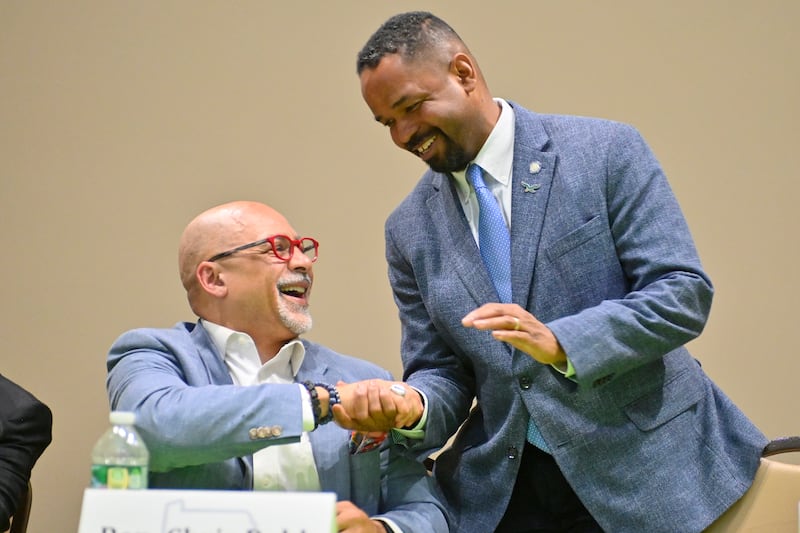
May 13, 2026 – Nearly a decade ago, Chris Rabb and Sharif Street walked into the Pennsylvania Capitol for the first time as elected officials and quickly staked their ground in different ways.
Street, a lawyer and scion of a powerful political family, went to work introducing bills to make technical changes in areas like election and vandalism laws, to decriminalize the possession of small amounts of cannabis, and to end life sentences without the possibility of parole.
Rabb, who had taken on a local Democratic machine to get to Harrisburg in the first place, put out feelers for legislation that would make lawmakers pay a $100,000 fine if they are convicted of a crime, increase taxes on wealthier Pennsylvanians, and limit police assisting U.S. Immigration and Customs Enforcement at the start of President Donald Trump’s first term.
The two Philadelphia Democrats would both go on to have more losses than wins. In a closely divided General Assembly where Republicans have kept unilateral control for six of the last 10 years, relatively few Democratic-led bills cross the finish line.
But as Street and Rabb face off in Tuesday’s tightly contested race to represent the 3rd Congressional District, the candidates’ legislative records — and their distinct governing styles — have become central to their pitches as they pursue one of the most Democratic-leaning seats in the country. (Continued)
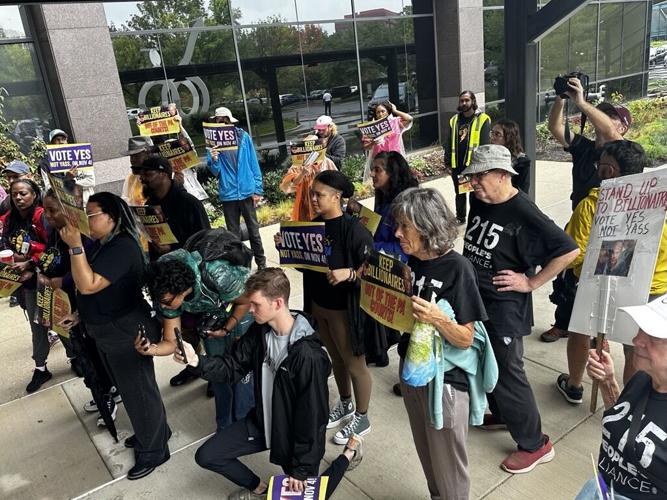
PA. Democrats decry Jeffrey Yass spending in judicial races, compare him to Elon Musk | Politics | lancasteronline.com
A coalition of progressive and pro-worker, pro-woman organizations in Pennsylvania did the impossible and radically expanded the amount of voters engaged in a critical, but easily ignored, State Supreme Court race.
By Jeffrey Lichtenstein and Steve Paul
Convergence Magazine
April 28, 2026 – The most important question on the 2025 Pennsylvania general election ballot, retention of State Supreme Court judges, was buried halfway down the back page.
But thanks to a strategic, multipronged coalition effort, voters in this battleground state retained three Democratic justices and kept the Democrats’ five-to-two majority on the court. This win will be critical for protecting reproductive freedom, workers’ rights and environmental regulations, as well as voting rights and fair legislative maps.
In odd-numbered election years, significant numbers of Pennsylvania voters do not vote their entire ballot, a phenomenon typically referred to as roll-off. Ordinarily, as many as 30% of voters will skip offices or questions closer to the end of their ballot that seem less important or recognizable.
But a network of Pennsylvania organizations including One Pennsylvania (One PA), Make The Road PA, Asian Pacific Islander Political Alliance and other members of the Working Families Party–with support from our state donor table–brought roll-off down from 30% in 2021 to 2% in this election–the lowest rate ever.
We named villains without flinching
Our coalition used diverse but integrated tactics throughout the spring, summer, and fall of 2025. This included paid, earned and new media alongside door knocking, volunteer organizing, and greeting voters at the polls. We worked to be sure we didn’t flinch from clearly naming villains, and we attempted to bring an organizing approach to every tactic, thinking as much about who is carrying our message and why they care, as much as how well it is polling. We centered working people’s political instincts and prized their established networks of trust.
Our message needed to be clear about what was at stake and who was to blame. And our tactics focused first on winning over leaders of various types who could then carry the message to the communities whose trust they’d already earned. Because we used strategies that sought to move power into regular people’s hands–rather than relying solely on professional consultants and vended programs–we defended a critical bastion in the fight against authoritarianism.
Who and where
The Working Families Party of Pennsylvania is both a movement coalition and a political party, with 10 organizational members, including One PA, who collectively represent 100,000 commonwealth residents. The member organizations include unions and community groups. Their strongest bases are Philadelphia, Allegheny County (home to Pittsburgh), and the Lehigh Valley, but they’re active in several smaller places as well, especially deindustrialized working-class towns and towns with a majority of people of color–which are often the same.
Recognizing that many in our communities get their information from social media, we also launched an effort to organize online content creators…
One PA in particular is rooted in working-class, majority-Black communities in Allegheny, Dauphin, Delaware and Philadelphia Counties. The PA Working Families Party has been active in elections since 2018; our coordination in this election built on collaborations in several previous fights. These include the election and re-election of Philadelphia City Council member Kendra Brooks in 2019 and 2023; the 2021 elections of Philadelphia District Attorney Larry Krasner and Pittsburgh Mayor Ed Gainey; US Rep. Summer Lee’s win in 2022 and Philadelphia City Council member Nic O’Rourke’s in 2023, and Helen Gym’s run in the 2023 Philadelphia mayoral primary. (Continued)
Photo; PA Rep Malcolm Kenyatta speaking to protestors in Harrisburg. By Bethany Rodgers
Protests against President Trump and his agenda, including the involvement of Elon Musk, took place nationwide.
Many protestors believe there is a renewed sense of urgency to oppose Trump’s policies in his second term.
By Bethany Rodgers USA TODAY NETWORK
Feb. 5, 2025 – HARRISBURG — Scores of protestors gathered outside the Pennsylvania state capitol Wednesday as part of nationwide demonstrations against President Donald Trump’s administration and the Project 2025 agenda.
The gathering was part of a nationwide wave of protests coordinated by the 50501 movement, short for “50 Protests, 50 States, One Day.” In Pennsylvania, demonstrations were also planned for Philadelphia and Pittsburgh.
Attendees waved signs calling for Trump’s impeachment, rainbow banners and American flags. A number of them also aimed their ire at Elon Musk, the billionaire who has assailed federal government agencies in recent days with the immense powers Trump has granted him.
Mari-Beth DeLucia, of Harrisburg, said she knows someone who works for the U.S. Agency for International Development, a government humanitarian arm that Musk has called a “criminal” organization and sought to dismantle. Employees at the agency are being placed on administrative leave, and Trump’s team has frozen foreign aid distributed by the office.
The damage Trump and Musk are doing will reverberate through charities, businesses and communities across the U.S., DeLucia predicts. But up to this point, she thinks people have been too stunned to mount the type of protests that spilled into the street when Trump was elected for his first term in 2016.
“Why aren’t we marching? Where is everybody?” DeLucia said she’s wondered lately. “I think it was kind of shell shock.”
More:’Don’t let democracy die’: Anti-Trump protesters rally in cities across US
She’s hopeful that Wednesday’s gathering is a sign that people are again raising their voices.
Savannah Bellem, a volunteer who brought snacks and drinks to the Harrisburg demonstration, said it was her first time participating in a protest. Back in 2016, she thought the answer was to wait out Trump’s term.
Pennsylvania Rep. Malcolm Kenyatta, D-Philadelphia, speaks to a group of protestors in Harrisburg, Pennsylvania, on Feb. 5, 2025. The demonstration against President Donald Trump’s administration was part of nationwide rallies coordinated by the 50501 movement. “It’s four years — what can happen?” the New Cumberland resident remembers telling her husband.
She now sees that attitude as naive, and this time around she feels a heightened sense of urgency. A gay couple in her family are frightened they could lose their child. She said she is angry that her young daughter now has fewer rights than she did at the same age.
“We’re not going to stand for it,” she said. “We need to get back more into taking care of our community and each other.”
State Rep. Malcolm Kenyatta also emphasized the importance of local action in a speech to the crowd, urging them to focus on city councils and school boards in addition to politicians in Washington, D.C.
“There is no one, and I mean it, no one, coming to save us,” the Philadelphia Democrat said. “But here is the good news, my friends: We are going to save ourselves.”
Bethany Rodgers is a USA TODAY Network Pennsylvania capital bureau investigative journalist.
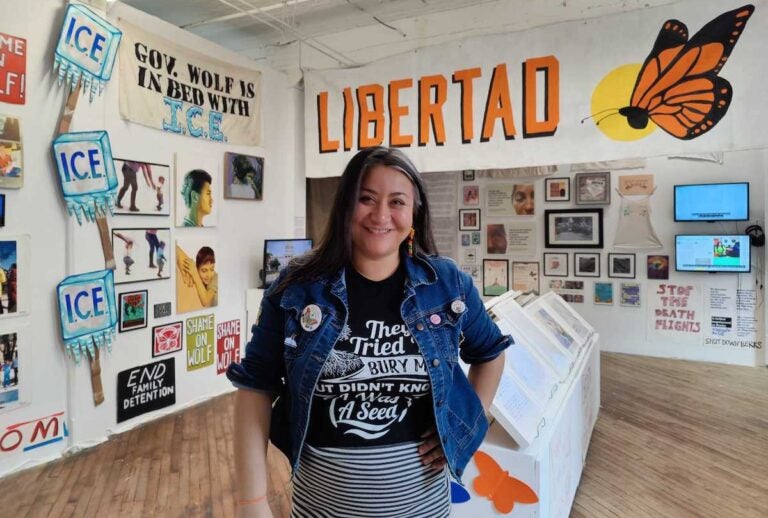
Photo: Jasmine Rivera was an organizer with the Shut Down Berks Coalition, and curated the exhibition “Queremos Justicia: Cómo cerramos Berks,” at the Vox Populi gallery in Philadelphia in 2023. (Peter Crimmins/WHYY)
By Jeffrey Lichtenstein
One PA
Jan 7, 2025 – We’re holding several big questions as we move into 2025 that we hope to learn and struggle through together with our funding partners. All of our work, especially our organizing, advocacy, and outreach efforts, will be working through these questions.
Quality vs Quantity of Doors
Where and when can we initiate and join conversations about the quality of field work rather than simply the quantity of door knock and phone call attempts? The efficacy of canvassing in low-salience elections is statistically unquestionable but in presidential election cycles there is suddenly a great amount of noise. Some of this noise is the result of large-scale vended field programs with weak quality control practices or very low contact rates.
What could it look like to move toward an eco-system wide model for field work that prioritizes the number and quality of conversations, volunteers recruited, and leaders trained? One PA prides itself on high contact rates and rigorous quality control but we still have much to learn. We hope to share and leverage best practices across locally rooted partners and begin to shift the paradigm around field work from quantity alone, to quality and quantity.
Making organizing power more legible
Even the strongest most rigorous electoral field program faces structural challenges with management, hiring and training under conditions of limited funding and time. These efforts also, by their nature, are demobilized and dismantled after an election, even when we know there is another election just around the corner, not to mention countless other opportunities for voters to flex their voice in government and strengthen their civic participation. Political and civic organizing, unlike electoral campaign mobilizations, grow rather than diminish in efficacy and power over time. What would it look like to quantify, validate, resource and scale the civic power of organizing? One PA was successful in 2024 in using every door conversation to begin an organizing pathway. We identified 33,000 hot leads to join One PA. We’re proud of this work, but we have real areas of growth in learning how to maximize the conversion between hot leads and new volunteers.
Dimensions and Cost of Building Precinct Based Structure
The term ‘organizing’ has been stretched in recent years to mean all manner of engagement. At One PA we are working with multiple battle-tested organizing models in an attempt to integrate the best practices of each in a way that can be quantified, studied and validated at every stage using contemporary data tools and tech. Our model combines dues-based membership, structure based organizing units, systematic leadership development, polarizing campaigns and experimentation. We are proud of our work in 2024 to launch a guardians of democracy and elections captains program.
In the year ahead we plan to scale the program by a factor of five, and are holding questions about what level of resource and training this will require at each level of the organizing structure. Independent Voice It is clear our movement must get upstream of elections in the battle to make meaning out of our communities’ lived realities. By the time candidates win their primaries, the ability to shape what that election will be about is out of the hands of most people except the elite few with an extraordinary amount of influence on the candidates. We are asking ourselves the question: what capacities and practices do we need as a movement to help frame the questions in front of people long before an election?
How can we roll into a cycle with voters broadly knowing already that housing is too high because of slumlords and rollbacks on government investment, not because of immigrants? We know part of the answer is an independent voice for Black and multi-racial working class communities, to help compensate for brand weakness in the Democratic party, to ensure voters feel they are heard, and to guarantee a more healthy mix of ideas about what it will take to fix this country. How can we build the power and independence of this voice in a way that our more traditional and conservative allies won’t attempt to smother in its cradle?
Winning the Internet
We’re also holding questions about how to respond to the reality that the Internet is increasingly becoming a place our communities rely on for social and political queues. Cynical or hateful voices have a head start in offering narrative frames in the digital space. We are holding questions about what it looks like to bring an organizing approach and significant investment in mass communications to organize our base in digital space, win over leaders and taste makers in non-legacy media, and contest for narrative primacy on the internet.
Training to Win next quarter and next decade
Training is critical for nearly every aspect of our plan, especially the proposition that we grow in capacity and power over time, and the responsibility to rebuild a majority. We are clear that we must level up the rigor and scale of our training program, and sit with the question about what kind of training school and content will meet the need. We know curricula must include a breakdown of the structures and histories of power and resistance; song, poetry and other forms of culture that bring people together at an emotional register; practical application of ideas through repetition of organizing, storytelling, writing and other skill practice. We’re sitting with the question: how can all those pieces best fit together and what kind of resourcing will it take to hold a training program sustainably that can meet these goals?
A renewed tech advantage
We’re also holding a question about technology. For about 20 years, democratic institutions and networks held an advantage in the use of tech in politics – the VAN, click-to-call tools, ActBlue and early P2P text platforms are all examples. But today republican networks and institutions have caught up or surpassed. What kind of tools allow us to easily give an inspired volunteer a list of the 50 closest target people to them, to register them to vote, get them to sign a petition, or have a persuasive conversation about candidates? How do we move away from site-based voter registration only, and use contemporary data to scale door to door registration programs? How do we use new models, like the Steven Phillips “New Majority Index,” to help us assess opportunities and threats?
Cities: Most of our base lives in cities.
Cities are the places where the housing and homelessness crises are worst. Cities are some of the places with the highest income inequality and violent crime. It’s difficult to live in cities unless you’re rich. There is a relationship between our bases’ weakened sense of political agency and their perception of the corruption of government on one hand, and the way our cities are being run on the other. What does it look like to have an intentional plan to broadcast positive accountability messaging when city leaders accomplish something that improves peoples lives? How do we combine that with real resourcing for primary campaigns to support candidates who are committed to using the government to deliver material gains for working class people.’ And what does it look like to add real resourcing for advocacy and pressure campaigns to encourage local leaders on the fence to move toward policies that will demonstrate in real terms how democratic governance is good for people?
Alignment
Last, we’re holding a question about how to build alignment between progressive base-building organizations to have sufficient power to help win the fights that each of us aren’t strong enough to win on our own. We’re proud of the work that we’ve done to build unity through the cycle of the last several races with several partners, especially PA United , Working Families Party , APIPA, Make The Road, 215 People’s Alliance and UniteHERE. How do we strengthen and build on these existing relationships?