Several hundreds gathered outside of the William S. Moorhead Federal Building this afternoon to protest as part of the national 50501 “No King’s Day” demonstrations on President’s Day.
Protesters marched downtown, calling out President Trump and Elon Musk, chanting, “Not my president” and “Human rights are meant for all.”
The demonstration lasted for over an hour, ending in front of the City Council building where organizers offered participants important election information and petitions to sign.
Photo; PA Rep Malcolm Kenyatta speaking to protestors in Harrisburg. By Bethany Rodgers
Protests against President Trump and his agenda, including the involvement of Elon Musk, took place nationwide.
Many protestors believe there is a renewed sense of urgency to oppose Trump’s policies in his second term.
By Bethany Rodgers USA TODAY NETWORK
Feb. 5, 2025 – HARRISBURG — Scores of protestors gathered outside the Pennsylvania state capitol Wednesday as part of nationwide demonstrations against President Donald Trump’s administration and the Project 2025 agenda.
The gathering was part of a nationwide wave of protests coordinated by the 50501 movement, short for “50 Protests, 50 States, One Day.” In Pennsylvania, demonstrations were also planned for Philadelphia and Pittsburgh.
Attendees waved signs calling for Trump’s impeachment, rainbow banners and American flags. A number of them also aimed their ire at Elon Musk, the billionaire who has assailed federal government agencies in recent days with the immense powers Trump has granted him.
Mari-Beth DeLucia, of Harrisburg, said she knows someone who works for the U.S. Agency for International Development, a government humanitarian arm that Musk has called a “criminal” organization and sought to dismantle. Employees at the agency are being placed on administrative leave, and Trump’s team has frozen foreign aid distributed by the office.
The damage Trump and Musk are doing will reverberate through charities, businesses and communities across the U.S., DeLucia predicts. But up to this point, she thinks people have been too stunned to mount the type of protests that spilled into the street when Trump was elected for his first term in 2016.
“Why aren’t we marching? Where is everybody?” DeLucia said she’s wondered lately. “I think it was kind of shell shock.”
More:’Don’t let democracy die’: Anti-Trump protesters rally in cities across US
She’s hopeful that Wednesday’s gathering is a sign that people are again raising their voices.
Savannah Bellem, a volunteer who brought snacks and drinks to the Harrisburg demonstration, said it was her first time participating in a protest. Back in 2016, she thought the answer was to wait out Trump’s term.
Pennsylvania Rep. Malcolm Kenyatta, D-Philadelphia, speaks to a group of protestors in Harrisburg, Pennsylvania, on Feb. 5, 2025. The demonstration against President Donald Trump’s administration was part of nationwide rallies coordinated by the 50501 movement. “It’s four years — what can happen?” the New Cumberland resident remembers telling her husband.
She now sees that attitude as naive, and this time around she feels a heightened sense of urgency. A gay couple in her family are frightened they could lose their child. She said she is angry that her young daughter now has fewer rights than she did at the same age.
“We’re not going to stand for it,” she said. “We need to get back more into taking care of our community and each other.”
State Rep. Malcolm Kenyatta also emphasized the importance of local action in a speech to the crowd, urging them to focus on city councils and school boards in addition to politicians in Washington, D.C.
“There is no one, and I mean it, no one, coming to save us,” the Philadelphia Democrat said. “But here is the good news, my friends: We are going to save ourselves.”
Bethany Rodgers is a USA TODAY Network Pennsylvania capital bureau investigative journalist.
Pittsburgh Mayor Ed Gainey said during an event in Harrisburg Monday that his administration will not work with U.S. Immigration and Customs Enforcement.
Our news partners at the Trib said Gainey’s comments come amid heightened concerns from local immigrant communities about ICE raids.
“My administration will not work with ICE,” Gainey said during a Pennsylvania Press Club event Monday. “We will do whatever’s necessary to make our city more welcoming. That’s what we’re built on.”
President Donald Trump has issued “quotas for the immigration enforcement agency to ramp up arrests,” the Trib said, attributing the Washington Post. Trump’s remarks include enforcement at schools and other “sensitive sites.”
“ICE is not going to end the situation of a failed immigration policy — it’s not going to do it,” Gainey said. “What it’s going to do is create more situations where people feel scared, where people don’t feel safe, where people will do things that they normally wouldn’t do.
“If the federal government wants to be serious about what they want to do to reform the immigration law, then they need to create a pathway to citizenship.”
Vanessa Caruso, a Pittsburgh-based immigration attorney, told the Trib that she has been taking calls “all day, every day” from people who are worried about ICE actions.
“The concern is real,” she said to the Trib, and it’s growing as the Trump administration looks to crack down on immigration.
Gainey’s press secretary, Olga George, said in a statement to Pittsburgh’s Action News 4 on Monday evening that the city was unaware of any ICE raids.
“Currently, the city of Pittsburgh has no evidence of ICE activity occurring within city limits and has not been asked to assist the agency in any way,” the statement said. “ICE is a federal law enforcement agency that works outside of city control. Public Safety and the Bureau of Police will adhere to bureau policies.”
According to the Trib, the policy says city police are unable to arrest someone just to investigate their immigration status.
In a statement posted to the @PGHController X account on Tuesday, City Controller Rachael Heisler said, in part, “The Pittsburgh Bureau of Police has long upheld a policy of not arresting or detaining people solely to investigate immigration status. PBP officers are not immigration agents, and enforcing federal civil immigration warrants is not the job they’re trained to do.
“Pittsburgh police will follow procedure for criminal warrants regardless of immigration status. But under current PBP policy, police do not arrest or detain people based on civil immigration or administrative warrants in NCIC.”
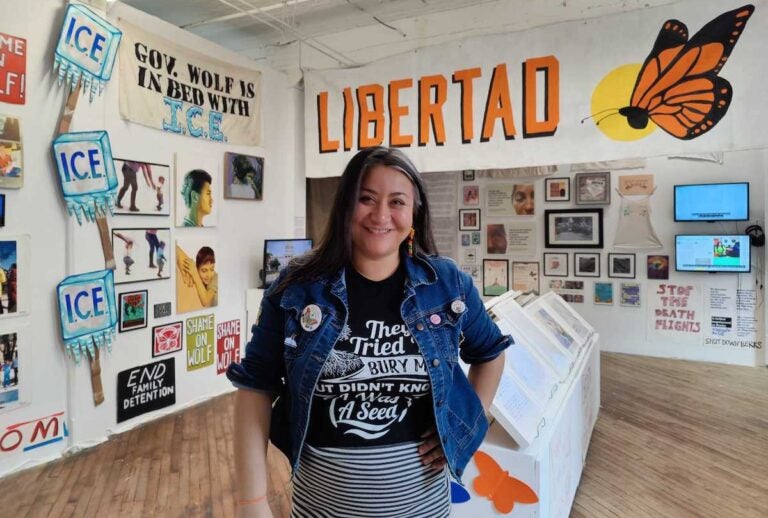
Photo: Jasmine Rivera was an organizer with the Shut Down Berks Coalition, and curated the exhibition “Queremos Justicia: Cómo cerramos Berks,” at the Vox Populi gallery in Philadelphia in 2023. (Peter Crimmins/WHYY)
By Jeffrey Lichtenstein
One PA
Jan 7, 2025 – We’re holding several big questions as we move into 2025 that we hope to learn and struggle through together with our funding partners. All of our work, especially our organizing, advocacy, and outreach efforts, will be working through these questions.
Quality vs Quantity of Doors
Where and when can we initiate and join conversations about the quality of field work rather than simply the quantity of door knock and phone call attempts? The efficacy of canvassing in low-salience elections is statistically unquestionable but in presidential election cycles there is suddenly a great amount of noise. Some of this noise is the result of large-scale vended field programs with weak quality control practices or very low contact rates.
What could it look like to move toward an eco-system wide model for field work that prioritizes the number and quality of conversations, volunteers recruited, and leaders trained? One PA prides itself on high contact rates and rigorous quality control but we still have much to learn. We hope to share and leverage best practices across locally rooted partners and begin to shift the paradigm around field work from quantity alone, to quality and quantity.
Making organizing power more legible
Even the strongest most rigorous electoral field program faces structural challenges with management, hiring and training under conditions of limited funding and time. These efforts also, by their nature, are demobilized and dismantled after an election, even when we know there is another election just around the corner, not to mention countless other opportunities for voters to flex their voice in government and strengthen their civic participation. Political and civic organizing, unlike electoral campaign mobilizations, grow rather than diminish in efficacy and power over time. What would it look like to quantify, validate, resource and scale the civic power of organizing? One PA was successful in 2024 in using every door conversation to begin an organizing pathway. We identified 33,000 hot leads to join One PA. We’re proud of this work, but we have real areas of growth in learning how to maximize the conversion between hot leads and new volunteers.
Dimensions and Cost of Building Precinct Based Structure
The term ‘organizing’ has been stretched in recent years to mean all manner of engagement. At One PA we are working with multiple battle-tested organizing models in an attempt to integrate the best practices of each in a way that can be quantified, studied and validated at every stage using contemporary data tools and tech. Our model combines dues-based membership, structure based organizing units, systematic leadership development, polarizing campaigns and experimentation. We are proud of our work in 2024 to launch a guardians of democracy and elections captains program.
In the year ahead we plan to scale the program by a factor of five, and are holding questions about what level of resource and training this will require at each level of the organizing structure. Independent Voice It is clear our movement must get upstream of elections in the battle to make meaning out of our communities’ lived realities. By the time candidates win their primaries, the ability to shape what that election will be about is out of the hands of most people except the elite few with an extraordinary amount of influence on the candidates. We are asking ourselves the question: what capacities and practices do we need as a movement to help frame the questions in front of people long before an election?
How can we roll into a cycle with voters broadly knowing already that housing is too high because of slumlords and rollbacks on government investment, not because of immigrants? We know part of the answer is an independent voice for Black and multi-racial working class communities, to help compensate for brand weakness in the Democratic party, to ensure voters feel they are heard, and to guarantee a more healthy mix of ideas about what it will take to fix this country. How can we build the power and independence of this voice in a way that our more traditional and conservative allies won’t attempt to smother in its cradle?
Winning the Internet
We’re also holding questions about how to respond to the reality that the Internet is increasingly becoming a place our communities rely on for social and political queues. Cynical or hateful voices have a head start in offering narrative frames in the digital space. We are holding questions about what it looks like to bring an organizing approach and significant investment in mass communications to organize our base in digital space, win over leaders and taste makers in non-legacy media, and contest for narrative primacy on the internet.
Training to Win next quarter and next decade
Training is critical for nearly every aspect of our plan, especially the proposition that we grow in capacity and power over time, and the responsibility to rebuild a majority. We are clear that we must level up the rigor and scale of our training program, and sit with the question about what kind of training school and content will meet the need. We know curricula must include a breakdown of the structures and histories of power and resistance; song, poetry and other forms of culture that bring people together at an emotional register; practical application of ideas through repetition of organizing, storytelling, writing and other skill practice. We’re sitting with the question: how can all those pieces best fit together and what kind of resourcing will it take to hold a training program sustainably that can meet these goals?
A renewed tech advantage
We’re also holding a question about technology. For about 20 years, democratic institutions and networks held an advantage in the use of tech in politics – the VAN, click-to-call tools, ActBlue and early P2P text platforms are all examples. But today republican networks and institutions have caught up or surpassed. What kind of tools allow us to easily give an inspired volunteer a list of the 50 closest target people to them, to register them to vote, get them to sign a petition, or have a persuasive conversation about candidates? How do we move away from site-based voter registration only, and use contemporary data to scale door to door registration programs? How do we use new models, like the Steven Phillips “New Majority Index,” to help us assess opportunities and threats?
Cities: Most of our base lives in cities.
Cities are the places where the housing and homelessness crises are worst. Cities are some of the places with the highest income inequality and violent crime. It’s difficult to live in cities unless you’re rich. There is a relationship between our bases’ weakened sense of political agency and their perception of the corruption of government on one hand, and the way our cities are being run on the other. What does it look like to have an intentional plan to broadcast positive accountability messaging when city leaders accomplish something that improves peoples lives? How do we combine that with real resourcing for primary campaigns to support candidates who are committed to using the government to deliver material gains for working class people.’ And what does it look like to add real resourcing for advocacy and pressure campaigns to encourage local leaders on the fence to move toward policies that will demonstrate in real terms how democratic governance is good for people?
Alignment
Last, we’re holding a question about how to build alignment between progressive base-building organizations to have sufficient power to help win the fights that each of us aren’t strong enough to win on our own. We’re proud of the work that we’ve done to build unity through the cycle of the last several races with several partners, especially PA United , Working Families Party , APIPA, Make The Road, 215 People’s Alliance and UniteHERE. How do we strengthen and build on these existing relationships?
For months the proposed sale of USSteel to Nippon Steel has been front page news. The Committee on Foreign Investments in the United States (CFIUS), that reviews the national security implications of these global transactions is reportedly at an impasse and unable to come to a determination.
The reality is that what CFIUS decides (or doesn’t) is irrelevant. Both the incumbent President and the President-elect have said they will not approve the deal. It’s slowly dawning on people that this deal isn’t likely to happen.
We shouldn’t be surprised. Opposing the Nippon/USSteel deal is the logical response to all that we have learned about the steel industry, the “free trade” model of global trade, the importance of maintaining domestic control over critical supply chains and how the big money vultures strip-mine our stable industrial/manufacturing enterprises. It isn’t, as Nippon/USSteel would like us to believe, something that must happen or USSteel will collapse. Once this bad deal is gone, we know there are a number of options to retain and enhance USSteel’s assets.
To understand what’s happening we have to start with the global steel overcapacity. The OECD reports a global steel overcapacity exceeding 500 million metric tons, with some estimates reaching as high as 630 million metric tons. This has nations with overcapacity (China in the lead) looking for places to dump their steel production. Our nation is a lucrative place to offload unneeded steel. Interestingly, Nippon is reportedly looking to do deals in other nations with lucrative steel consumption, as the USSteel deal falters.
It’s fantasy to believe that once Nippon owns USSteel it won’t use it to move its overcapacity here. Simply look at the cases that the USW and the Steel Industry have won at the International Trade Commission, to get a flavor of how blatant other nations have violated our trade laws to gain access our steel market. The failure of Nippon to offer credible and enforceable commitments to continue American domestic production, should convince us of their real intent. This is the heart of the national security concern. That if Nippon is allowed to own such a large part of American steel capacity, the will result will be steel shutdowns here and less ability to supply our own needs of this critical economic sector.
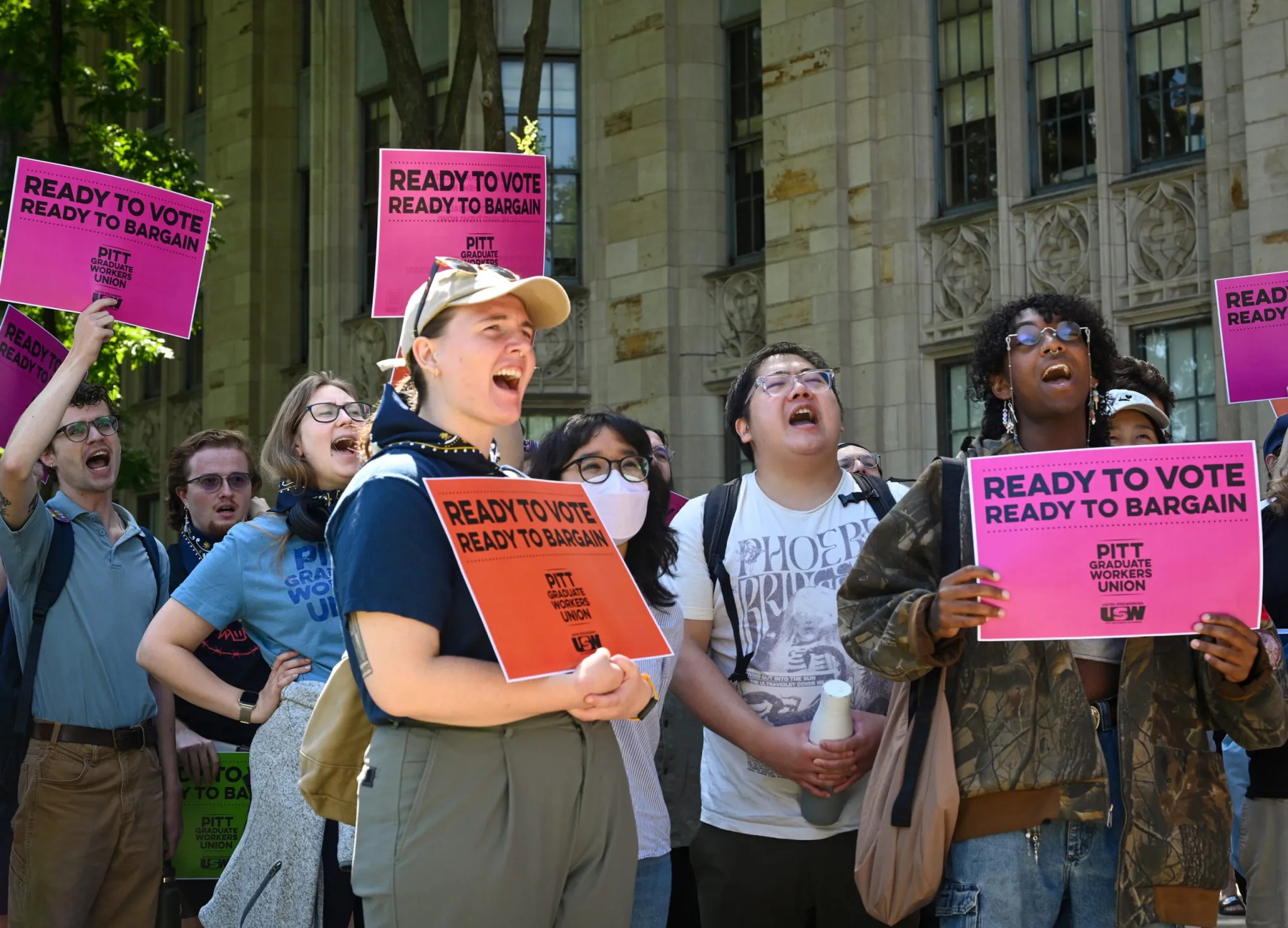
The University of Pittsburgh’s graduate student workers narrowly declined unionization in 2019, but this week’s overwhelming vote has the Oakland campus riding a wave of higher ed organizing.
Nov 22, 2024 – Throughout the week, more than 1,000 graduate student workers at the University of Pittsburgh made their way to a nondescript ballroom in the O’Hara Student Center to vote on whether to unionize.
Supporters sought everything from more transparency on the part of university administration to pay equity, better vacation time and health insurance.
The line outside the ballroom stretched, at times, down the stairs of the center. “People are so excited … I’ve never seen engineers this excited,” said Lauren Wewer, a materials science and engineering Ph.D. student and organizer at Pitt.
On Friday, organizers announced the results: a 1033-28 vote to unionize with the United Steelworkers [USW]. The Pennsylvania Labor Relations Board had not yet confirmed the vote count as of mid-afternoon.
With this win, Pitt grad student workers become the latest employees to undergo a successful union bid at a U.S. higher education institution, continuing an upward trend in the sector’s organizing activity over the last few years. They also join faculty and staff at the university which unionized with the USW in 2021 and September, respectively.
Pat Healy, an information science Ph.D. student at Pitt, said the wide margin of support reflected in the vote, “aligns with how most of the grad union votes [in the country] have gone the last couple of years.” Healy has been organizing at the university since 2019, which was the last time grad student workers attempted to unionize. Then, the pro-union students lost by fewer than 40 votes. For them, the impact of this year’s vote stretches beyond Pitt’s campus.
“I’m happy for the movement [and] looking forward to some other grad unions popping up, I’m sure inspired by us, because that always happens,” Healy said.
After Thanksgiving, they said organizers will begin setting up for bargaining with Pitt’s administration.
In a statement after the vote count, the university said, “While first contract negotiations can be complex, please know that we will come to the table in good faith and be there to support all graduate students throughout and beyond the process.”
Immediately following the loss in 2019, any efforts to restart conversations about unionizing would meet with “a kind of extreme hesitancy,” Healy said, blaming “a lack of understanding of what a union was.”
This year felt different, Healy said. There are likely a few reasons why.
Five years after failed vote, Pitt grad students unionize EQT’s ‘bulldog’ has D.C. in his grip, with profits — and maybe higher gas bills — on the horizon
A wave of change
From 2021 to 2023, nearly 64,000 U.S. grad student workers joined unions. By comparison, only 20,394 students unionized from 2013 through 2020. Today, four in 10 grad student employees belong to labor groups.
This trend was, experts say, driven in part by the pandemic and by the administration change from Donald Trump to Joe Biden in 2021, which ushered in a National Labor Relations Board more amenable to organizers.
Adrienne Eaton, professor of labor studies and employment relations at Rutgers University, noticed COVID-19-driven layoffs and research funding losses on campus in New Jersey that eventually led to a faculty and grad student strike last year. She describes this time as an “active moment” in American higher ed, with students advocating for change across the board at universities and colleges. And with grad students, there’s another factor at play: “The faltering job market in academia.”
“A high percentage of students no longer [are] confident that they have a future as tenure-track professors, in particular, or potentially as academic faculty at all,” Eaton said. “So, I think it really changes the way that graduate students look at their assistantships that they get.”
They urged Democratic lawmakers to pass legislation to make the commonwealth more welcoming
By: Peter Hall
Penncapitol-Star
Nov 14, 2024 – President-elect Donald Trump’s plan to carry out mass deportations of undocumented immigrants would lead to population loss, exacerbate workforce shortages and increase tax burdens for Pennsylvania residents and businesses, the Democratic state lawmakers heard Wednesday.
Advocates for the immigrant community testified before the state House Democratic Policy Committee that although the federal government maintains exclusive authority over immigration policy, which is expected to take a draconian shift under a second Trump administration, state lawmakers can make Pennsylvania a more welcoming place.
“It’s been laid out very clearly. Unfortunately, it’s going to be immigrant detention and deportations on the horizon,” Julio Rodriguez, political director of the Pennsylvania Immigration and Citizenship Coalition, said. “So now it’s crucial that this legislature not only has welcoming policies to support immigrants, but to fight back against these proposals.”
The hearing on the last day of the 2023-2024 legislative session was convened by state Rep. Danilo Burgos (D-Philadelphia), who serves as chairperson of the Pennsylvania Legislative Latino Caucus.
Pennsylvania ranks fourth in the nation in population loss, Rodriguez said. In 2021, the net decrease in population between births and deaths was more than 23,000.
“We didn’t see that impact, because net international migration, also known as immigrants moving here, was 25,721,” Rodriguez said “Had it not been for immigrants, we would have seen a drastic population decline.”
A state’s population determines its number of representatives in Congress. Rodriguez noted that Pennsylvania lost one congressional seat after the 2020 census and could lose another in 2030. It would also result in Pennsylvania receiving less federal funding.
But more immediately, the loss of a portion of the commonwealth’s 978,000 immigrant residents would worsen the labor shortage in the agricultural sector, driving up grocery store prices. Undocumented workers also contribute billions in taxes and in the state’s gross domestic product, Rodriguez said.
Photo: U.S. Rep. Chris Deluzio (PA-17) speaks to reporters at an event highlighting the Biden Administration’s investment in infrastructure at the Kingsley Center Pittsburgh’s Larimer neighborhood on Tuesday, Feb. 20, 2024. (Steve Mellon/Pittsburgh Union Progress)
By Kim Lyons
Pennsylvania Capitol-Star
November 12, 2024 – We’re analyzing the results of the 2024 election by taking a closer look at some of the pivotal or unexpected outcomes. First up is an interview with U.S. Rep. Chris Deluzio (D-17th District) who held off a GOP challenger in a key swing district.
Pennsylvania’s U.S. House delegation lost two Democrats in last Tuesday’s election, and promising Democratic challengers in two hard-fought House districts in the central and eastern part of the state failed to unseat longtime Republican incumbents.
But in western Pennsylvania, Democrats in the House fared better. Incumbent Reps. Summer Lee (12th District) and Chris Deluzio (17th District) both won reelection. After Lee won a contentious primary against challenger Bhavini Patel in April, she was widely expected to win the general election, which she did, beating GOP challenger James Hayes 56.1% to 43.9%, according to unofficial results.
But Deluzio’s reelection to a second term representing the district that includes parts of blue Allegheny and red Beaver counties was much more uncertain. The National Republican Congressional Committee (NRCC) put the race on its list of seats to flip in 2024.
His opponent, state Rep. Rob Mercuri (R-Allegheny) received a key endorsement from the conservative Americans for Prosperity (AFP) Action super PAC. Even his own party considered it to be a swing district; the Democratic Congressional Campaign Committee (DCCC) named Deluzio as one of the “vulnerable” incumbents it sought to protect this cycle, adding him to its Frontline list of candidates.
He’s the only one of the three U.S. House candidates from Pennsylvania on the Frontline list who won reelection.
“I’m very proud of the win,” Deluzio told the Capital-Star. “I’m really proud we increased the margin, and especially in Beaver County, which moved to the right at the top of the ticket, but we moved it towards me.”
Deluzio also increased the margins from his first election in 2022, when he won by 6.8% over challenger Jeremy Shaffer. This election, he won by 7.3% over Mercuri.
Deluzio refrained from the blame game going on within some parts of the Democratic Party reeling from Harris’ loss to Trump, but said as a representative of a Rust Belt district, he understands the frustration that many voters have with those in power.
“Whether it’s powerful folks or forces or companies who hurt people or who are making life worse, I think there’s a tendency among some in my party to always look for win-win framing,” he said. “And you know what? Sometimes there’s a bad guy and you’ve got to kick his ass.”
PITTSBURGH — Nurses at UPMC Western Psychiatric Hospital said they have “won a historic union contract” following months of negotiations with UPMC over concerns of closures and rising mental health cases.
In a statement Sunday, the nurses’ union said the contract agreement will guarantee a “first-ever guaranteed wage rate above $40 for nurses with a Bachelor of Nursing anywhere in UPMC,” which will be an incentive towards “improving staffing so beds that were previously closed can reopen.”
“Together, we have proven that when UPMC nurses unite, we can achieve historic improvements for our patients, our families, our community and our profession,” Chris Hunter, who has been a nurse at Western Psych for eight years, said in the statement. “Even though we’re a smaller hospital and UPMC has deprioritized us for years, we were able to hold executives accountable and create groundbreaking progress.”
The contract comes weeks after the nurses’ union unanimously authorized a strike after concerns over UPMC’s closure of beds, understaffing, and policy changes.
“The historic contract invests in recruitment, retention, and respect to ensure quality care and address the growing mental health crisis,” the statement read.
Nurses at UPMC Western Psychiatric Hospital had been negotiating a new union contract with UPMC since Aug. 1 after their previous contract expired in September.
“The stunning victory follows on the heels of a rally and unanimous strike vote, and includes groundbreaking pay raises that are unprecedented within the UPMC system,” the statement said Sunday.
Photo: Thomas Ross (left) and Austin Wise give a tutorial to students who have never canvassed before on Saturday, Sept. 21, 2024, at Schenley Plaza in Oakland. (Photo by Anastasia Busby/PublicSource)
Democratic organizers say student political engagement has soared since Kamala Harris took over their party’s presidential ticket. Their Republican counterparts report backlash for supporting candidates and views they say are controversial on campuses.
By Spencer Levering
Public Source
October 3, 2024 – Thomas Ross didn’t realize that the political interest on Pitt’s campus was “electric,” as he characterized it, until the semester’s first door-knocking event for Pitt Students for Harris brought 34 volunteers — more than double the number he expected.
“Having 34 volunteers on our first canvass literally blew my mind,” said Ross, a University of Pittsburgh junior studying history and political science. “Everyone that I’ve spoken with has been very excited about the election.” Other Democratic students echoed this, saying they’re seeing new levels of excitement from their peers.
Just up Forbes Avenue, Anthony Cacciato is aiming to make the Carnegie Mellon University College Republicans a space where students can speak freely about their conservative values. Cacciato, president of the chapter, said with election season sparking student’s political intrigue, he’s preparing for a “barrage of negative backlash.”
At colleges around Pittsburgh, political clubs are organizing students to gear up for the upcoming November elections. Club leaders cited Pennsylvania’s influence on national politics as a key reason why they’re trying to mobilize the youth vote as Republican Donald Trump and Democrat Kamala Harris vie for Electoral College votes.
Organizing through socializing
As on-campus political groups look to activate students this fall, many said they are trying to mix political outreach efforts with social events to appeal to young voters.
Cacciato said group outings, such as seeing the new movie “Reagan,” help prevent students from burning out over organizing.
“We’re a space where you can feel comfortable with talking about who you are, but also feel comfortable in knowing that you’re surrounded by friends,” Cacciato said.
The club’s membership increased by 20% this semester, according to Cacciato, because of Pennsylvania’s outsize impact on national politics.
“When you have that knives-edge margin, any little bit of outreach can mean the difference between 10,000 people staying home and not voting and them going out and voting and flipping a precinct, flipping a state House seat, flipping the state, and flipping the country,” Cacciato said.
At Pitt, Sam Podnar, co-president of the Pitt College Democrats, said she creates an environment in which students can meet new people and break out of political apathy.
“We want to let people know that getting involved doesn’t have to be hard, it doesn’t have to be stressful. We just want them to keep showing up,” Podnar said.
She said President Joe Biden’s decision to drop out of the race and endorse Vice President Harris has energized students to get involved in Democratic organizing. General body meetings, weekend canvasses and the club’s presidential debate watch party have all drawn new participants.
“We’ve seen a really, really big surge in membership that just has honestly blown everyone away,” Podnar said.
Avalon Sueiro, president of the CMU College Democrats, said finding a balance between doing work and building a community helps draw students to attend the club’s events. When election day gets nearer, she plans on bringing therapy dogs to campus to calm students’ nerves.
Making it pop
Among Democratic student organizers, leaders are leaning into memes and pop culture as they try to energize college voters. When the semester began, the Instagram pages for Pitt Students for Harris and Pitt College Democrats both had profile photos referencing Charli XCX’s “brat” album. The pop star’s viral summer tweet calling the vice president “brat” spawned a flurry of online memes, which the Harris campaign embraced as an early branding strategy.