Aug 14, 2025 – As the Trump administration aims to bolster fossil fuels at the expense of clean energy expansion, new research shows the oil and gas sector has so far failed to become a major jobs creator for heavily fracked areas of northern Appalachia.
“To the degree that we allocate resources to help develop that industry, we’re diverting those resources from other industries that actually could deliver” more jobs and higher per-capita incomes, said Sean O’Leary, author of the recent report from the Ohio River Valley Institute.
The report uses the term “Frackalachia” to describe 30 top oil- and gas-producing counties in Ohio, Pennsylvania, and West Virginia. As a group, the counties have smaller populations and a net loss in the number of jobs compared to 2008, just before Appalachia’s shale-gas boom began.
The counties’ growth in per-capita income also has lagged behind the national average, even as their nominal gross domestic product nearly doubled, increasing their share of the country’s GDP by 6%. Basically, comparatively high economic output from the counties did not produce higher-than-average incomes for their residents.
“Despite immense economic growth as measured by GDP, Frackalachia is in a position of actually having lost jobs since the beginning of the natural-gas boom,” O’Leary said. In his view, the numbers contradict pro-industry pitches for more oil and gas development.
“Whatever else it is, the natural-gas boom is not an engine for economic prosperity,” O’Leary said. He thinks the gas industry is “structurally incapable” of delivering lasting growth in jobs and income for the people living in heavily fracked areas. The Frackalachia counties have also seen relatively few jobs from “downstream” industries, such as the production of plastics, he added.
Oil and gas development is “highly capital-intensive, but not very labor-intensive,” O’Leary explained. Most earnings go to shareholders, investors, and suppliers based far from where fossil fuels are extracted, so only a small share of project income stays in the community to stimulate more economic activity.
Completed wells don’t need many permanent employees, O’Leary said. And many people who work in drilling and fracking come from outside the local area.
Canary Media’s review of data from the Ohio Department of Job and Family Services is consistent with that observation. From 2012 through 2022, the agency issued annual reports about the economic impact of the state’s oil and gas industry, including data for both “core” jobs and “ancillary” industries, which support oil and gas development.
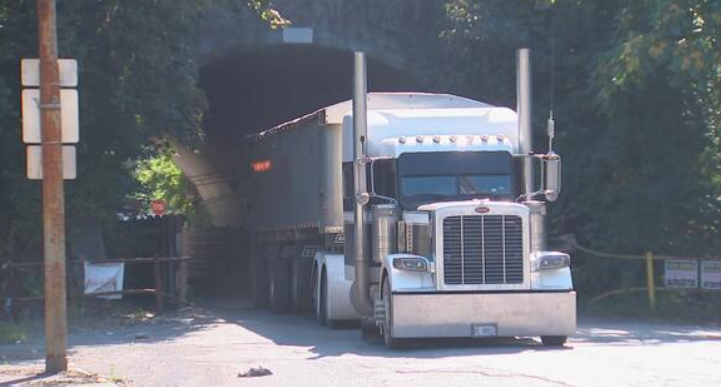
Truck moves through old J&L Tunnel at the intersection
By Rachel Pierce
WPXI Pittsburgh
Changes may be on the horizon for Route 51 (Constitution Boulevard) and the Route 3016 Franklin Avenue interchange in Aliquippa.
PennDOT says the potential changes will allow for safer access to downtown Aliquippa and the Aliquippa Industrial Park.
Aliquippa Mayor Dwan Walker says he would like to see the Route 51 land bridge demolished, and then the creation of an intersection with traffic lights.
“I’m born and raised here, 50 years of my life. I’ve been here and this has been a headache for the city as a whole and it’s residents,” Walker said. “It’s an all-hands-on-deck callout to get this done.”
Walker says this redesign could help open up Aliquippa and spur economic growth.
“Instead of just passing Aliquippa, you can actually take a visit to us,” Walker said.
Walker says the busy intersection gives drivers little space to accelerate and decelerate, including trucks from the industrial park. Walker says the intersection is also a prime spot for speeding.
Walter says these changes are a matter of life and death.
“We’ve had countless accidents, a loss of life, NyKasia Johnson. She lost her life and the goal is to name this street after her, to honor her,” said Walker.
PennDOT says the project could cost up to $19 million, with a projected start date in the spring of 2027.
PennDOT and Walker encourage the public to voice their opinions on the proposed changes here.
Jaime Martinez, community defense organizer at Casa San José, coordinates with Rapid Response Network volunteers outside Emiliano’s Mexican Restaurant in Gibsonia on June 17, after reports that federal agents were idling nearby in unmarked vehicles.
Casa San José has trained hundreds of volunteers to monitor and respond to immigration enforcement. Public Source followed them through raids, courthouse watches and late-night calls.
July 31, 2025 – As federal immigration enforcement intensifies across the country, a local response has quickly scaled up across the Pittsburgh region. In Beechview, the nonprofit Casa San José has built a Rapid Response Network of trained volunteers who monitor and document ICE activity across Allegheny County and beyond.
The network launched during the first Trump administration but has ramped up since January. As of July 30, it includes more than 250 trained volunteers — with nearly 175 more signed up for future training.
Casa San José, founded in 2013, focuses on immigrant rights and the Pittsburgh region’s Latino community — a mission amplified as the Trump administration rolls back protections for immigrants and directs federal resources toward a crackdown and mass deportations.
Organizers traverse city neighborhoods, gather in church basements and empty parking lots, and educate residents about their rights and federal immigration tactics. Along with trained volunteers, who are prepared to legally observe, document and accompany people at risk of being detained by Immigration and Customs Enforcement [ICE], they respond in real time to sightings, arrests and raids.
Pittsburgh’s Public Source spent more than a month embedded with Casa San José’s organizers and volunteers, tracking their efforts from the courthouse to restaurants as they responded to immigration enforcement and supported families under threat.
Photo: June 14 at the City-County Building, Downtown
Monica Ruiz, executive director of Casa San José, speaks to thousands of people gathered in front of the City-County Building in Downtown during a day of nationwide protest against the Trump administration.
“They are disappearing our people. This is our reality. Every single day. Just because you don’t see it doesn’t mean it’s not happening. We cannot continue to allow this to happen in our communities,” said Casa San José Executive Director Monica Ruiz.
“Casa San José is the only organization on this side of the state that is doing this kind of work.”
Ruiz said she has received five death threats since November, forcing her to relocate Casa San José’s office and to reconsider speaking publicly.
Photo: June 17 at Emiliano’s Mexican Restaurant, Gibsonia
As volunteers monitor the scene, Jaime Martinez, community defense organizer at Casa San José, speaks by phone with nine workers sheltering inside the restaurant — part of the network’s effort to document enforcement activity and support those at risk.
Sharon Bonavoglia was the first to arrive at a quiet strip mall in Gibsonia late on June 17. She had received the call because she lives nearby, and because she’s one of a growing network of volunteers responding to reports of federal immigration enforcement in and around Allegheny County.
June 11, 2025 – The state House voted along party lines Wednesday to raise the minimum wage to $15 for most Pennsylvanians, and to $12 for those working in smaller, rural counties.
It’s a significant step in the latest effort by Democrats to get it above the federal rate of $7.25.
Pennsylvania’s minimum wage has not been hiked since 2008 and is lower than all surrounding states — New York, Ohio, New Jersey, West Virginia, Maryland and Delaware.
The measure’s sponsor, House Labor and Industry Committee chair Jason Dawkins (D-Philadelphia), said the bill is in an attempt to compromise with Republicans who have long warned about the potential impacts on businesses, especially in smaller counties with a lower cost of living.
“Since I’ve been chair, we’ve been trying to figure out a different approach to get this done,” Dawkins told the Capital-Star. “This time around, we had a little bit more insight into where our challenges lie, one particularly being that some of our counties were worried about moving too quickly, and some were not comfortable going over $12.”
A previous bill sponsored by Dawkins passed the House in 2023, but died in the Republican-controlled Senate. And in 2019, the Senate passed a Democratic-led bill to raise it to $9.25, which died in the then-GOP-controlled House.
Dawkins’ latest bill would see the minimum wage rise gradually each year, reaching $15 in most counties on Jan. 1, 2028. It would also raise the tipped minimum wage from $2.83 to 60% of the minimum.
Counties with populations below 210,000, with the exception of Centre, Monroe and Pike counties, would only see the minimum wage rise to $12 in the same timeframe. A spokesperson for the House Democratic Caucus said the three smaller counties were put in the $15 bracket at the request of Democratic members who represent them.
One exception to the gradual rise to $15 would be Philadelphia County, which Dawkins represents. There, the minimum wage would rise to $15 on January 1, 2026.
“Philadelphia has the highest population of folks who are in what we call deep poverty levels,” Dawkins said.
He added there is particular urgency given the possibility some of those people may lose access to federal benefits like Medicaid and food assistance under a proposed bill moving through the GOP-controlled U.S. Congress.
“We wanted to have some type of safety net there because we know those folks might be losing benefits and other services,” he said.
But Dawkins’ attempt to offer an olive branch to GOP lawmakers in the form of gradual wage hike and a lower target in small counties appears to have failed in his own chamber. Every House Republican voted against the bill, and many criticized it during a two-hour debate on the floor Wednesday afternoon.
“Not every wage is designed to be a livable wage,” Minority Leader Jesse Topper (R-Bedford) “My 16-year-old son is not working for a livable wage. Someone who is retired and is helping out part-time, that is not necessarily a livable wage.”
He also warned that raising the minimum wage could result in the elimination of low wage jobs and harm small businesses in particular.
Others opposed the very provisions Dawkins said were intended to earn bipartisan support.
Rep. Kate Klunk (R-York) warned that creating different minimum wages across counties could lead to confusion for businesses that cross county lines, or encourage business owners to set up shop where the wage is lower.
“This county-based patchwork of minimum wages is going to be a mess,” Klunk said. She used examples of businesses with locations in York and Adams counties as examples, including golf courses that straddle the border between them.
“This bill is truly unworkable,” she said. “It is a compliance nightmare.”
Rep. Mike Jones (R-York) was one of few Republicans to signal openness to raising the minimum wage during debate, but said he could not support Dawkins’ bill.
“I do commend the majority chair for what I think is a good faith attempt at a reasonable compromise,” he said.
However, he added that he would want to see exceptions to the minimum wage for nonprofits and high-school aged employees.
‘Potential to find middle ground’
To become law, the bill will have to pass the Republican-controlled Senate.
Senate Majority Leader Joe Pittman (R-Indiana) said that there may be room for compromise on a minimum wage increase, especially if paired with Republican-backed deregulation efforts he said could help grow “maximum wage jobs.”
“Making sure working families have access to good, family-sustaining jobs is key to helping our commonwealth grow and thrive,” Pittman told the Capital-Star in a statement. “There is potential to finding [sic] a middle ground for an increase, but any possible action would need to be a commonsense adjustment, and sensitive to the impact changes would have on small businesses and non-profit organizations.”
Republican Sen. Dan Laughlin (R-Erie), who has previously introduced a bill to raise the minimum wage to $15, commended the House’s effort, but said he would not support a bill with a county-by-county approach.
“While I appreciate that the House is trying to advance the conversation, I do not support HB 1549 in its current form,” Laughlin said in an emailed statement. “A minimum wage tied to county size just deepens the economic divides we’re supposed to be addressing. If we’re going to get serious about raising the minimum wage, we need to do it uniformly across the state, not with a patchwork approach that leaves people behind based on where they live.”
Laughlin was an early Republican supporter of raising the minimum wage to $15 in Pennsylvania. But national trends may indicate more openness from members of his party this time around.
On Tuesday, conservative U.S. Sen. Josh Hawley (R-Missouri) introduced a bill to raise the minimum wage to $15 for all Americans.
He told NBC News, “If we’re going to be a working people’s party, we have to do something for working people. And working people haven’t gotten a raise in years. So they need a raise.”
His comments reflect an openness to his party’s increasing appeal to working class voters that was made apparent in the latest general election, which saw them move away from their traditional support of Democrats.
Dawkins, the Pennsylvania bill’s sponsor, is also aware of the shift, and hopes that it will help the bill earn the support that it needs to pass.
“I’m excited by the prospects, but I’m also disappointed that there could be a federal minimum wage that’s gonna be higher than the state minimum wage — and it’s being offered by one of the most conservative members of Congress,” he joked. “But I’m hopeful it’ll help folks come around to the idea.”
“This is what I believe we got elected to do,” he added.
Ian Karbal covers state government for the Pennsylvania Capital-Star. He’s particularly interested in the influence of money in politics and how arcane policies affect Pennsylvanians across the state.
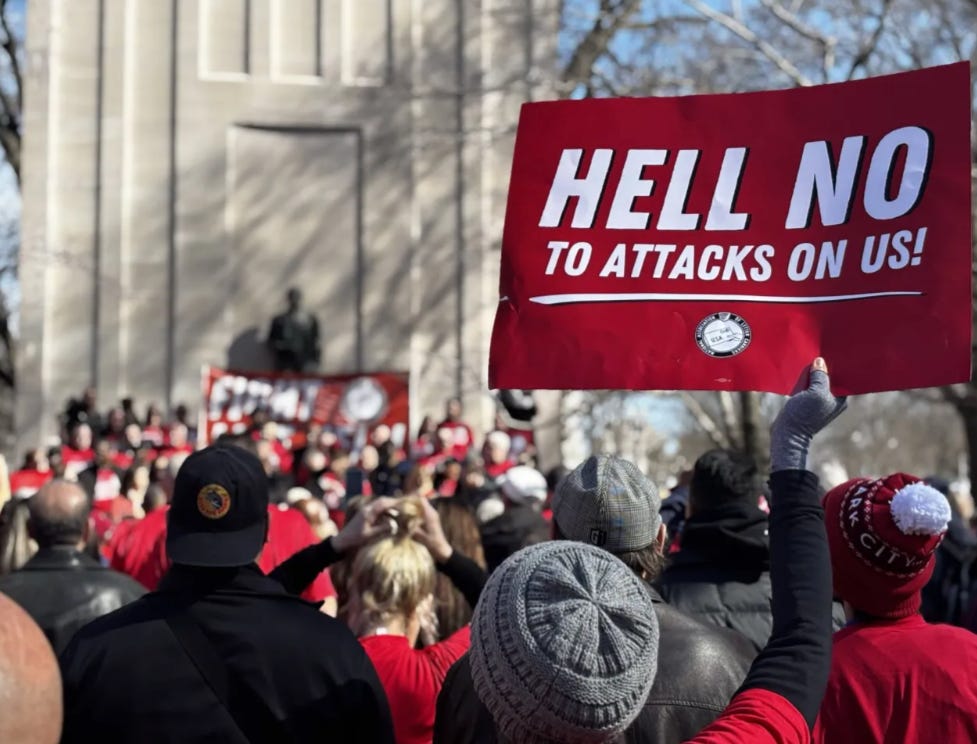
Over the course of the first 100 days, appropriate attention has been paid to Trump’s attacks on the judiciary, law firms, universities, philanthropy, non-profit groups and the media as dangerous in their own right, but more importantly as essential elements of authoritarian consolidation. Yet almost no one has mentioned the attacks on an equally proven constraint on oligarchy and autocracy: unions. Trump and Elon Musk’s destructive ransacking of our government should remind us of what previous generations of Americans understood intuitively: that “we may have democracy, or we may have wealth concentrated in the hands of a few, but we cannot have both,” as Supreme Court Justice Louis Brandeis put it. Like other attacks on civil society, the Trump regime’s attacks on unions and working people do not just injure those directly targeted, but all of us, as the labor movement is one of the most essential bulwarks against authoritarianism.
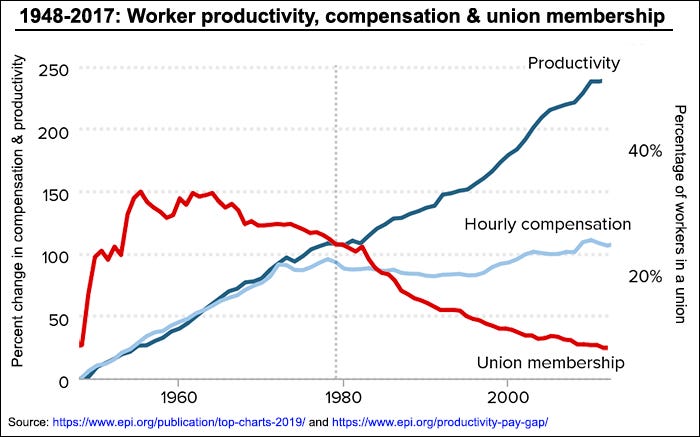
If we all have a stake in unions as bulwarks against authoritarianism whether we belong to one or not, the same is true because of how unions foster shared prosperity and a healthy society, which I elaborate on here and here. In that regard, it is crucial to recognize the Trump actions as coming from the same playbook as Reagan’s decisive firing of over 11,000 striking air traffic controllers. It was more than punitive—it communicated a clear, aggressive stance against unions nationwide. The immediate aftermath saw corporate America follow Reagan’s lead, significantly increasing anti-union activities and adopting overt union-busting strategies.1 Reagan further entrenched anti-unionism by reshaping the NLRB into a body less protective of labor rights, reversing precedents that had previously safeguarded union activities.2
As it did then, today’s federal war on working people comes at a key inflection point. Then it was the rush to globalization, coupled with financialization and deindustrialization. Now it is the imminent transition to artificial intelligence in the workplace. Musk’s firings are providing a new playbook for that transition—fire everyone so as to be able to start from scratch with AI with as little friction from a legacy workforce as possible. And, although not the topic today, it’s important to note here that with respect to DOGE cleaning house to make way for AI, it’s also cleaning house to make way for even more of the government to be privatized—providing a vast market for the tech companies’ AI products and services. Although this future is not certain, it seems to be Musk’s plan: first trash the government, then when the government fails, privatize.
Today, I’ll lay out some of the most egregious actions taken by the Trump regime in the first 100 days to attack unions and working people in both the public and private sectors. Much of this is based on indispensable research by the Economic Policy Institute and its just released 100 Days, 100 Ways Trump Hurt Workers. (For more great reports like this, you can subscribe to EPI here.)
Then I’ll document the robust pushback unions are mounting against the Trump regime’s war on working people in the courts. Unions have also been in the forefront of mobilizing public action, most notably the AFL-CIO’s Department of People Who Work for a Living, which in addition to leading and participating in protests3, has organized town halls across the country.4 AFL-CIO President Liz Shuler declared:
The labor movement is not about to let Trump and an unelected billionaire destroy what we’ve fought for generations to build. We will fight this outrageous attack on our members with every fiber of our collective being.
And, significantly, even sectors mistakenly thought to be pro-Trump like the Building Trades powerfully responded to Trump’s executive order eviscerating collective bargaining for federal workers:
This executive order is an unprecedented assault on worker freedom and a direct attack on those fundamental rights. Americans know that patriotic blue-collar workers built this country, not billionaires. They also know that one of the last best chances to make it to the middle class is collective bargaining. NABTU and our affiliated unions will stand shoulder to shoulder with the entire labor movement to fight this head-on — and we will not back down.
Photo: La Roche University, Friday, Feb. 10, 2023, in McCandless. (Photo by Stephanie Strasburg/PublicSource)
By Maddy Franklin Public Source
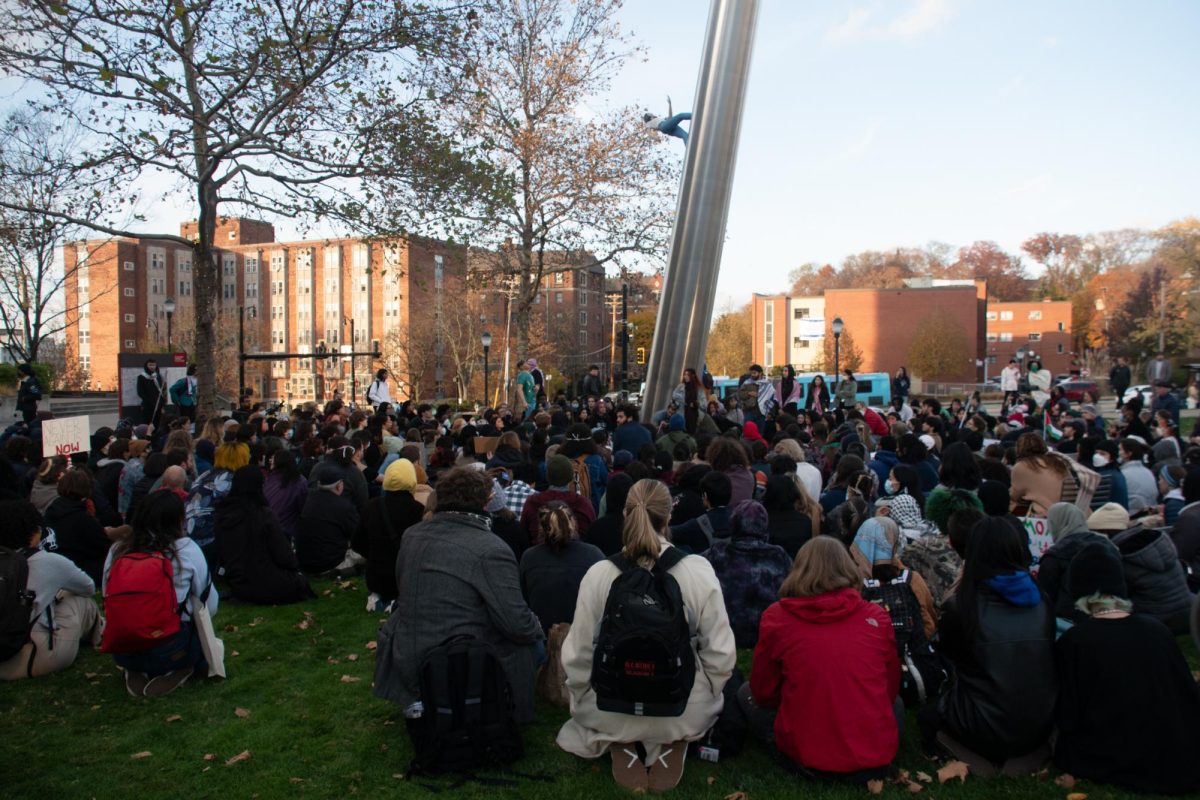
April 11, 2025 – Here’s how President Donald Trump’s administration has roiled higher ed, and how the University of Pittsburgh, Carnegie Mellon University and other local colleges and universities have responded.
This timeline will be updated as developments occur.
April 11 A visa held by an undergraduate student at La Roche University is revoked, a university administrator shared with PublicSource.
Revocations and wipes of international students’ records through a Department of Homeland Security system have been widespread over the week. Much of this is occurring, schools and students report, without communication from the government and with no reasons provided.
U.S. Secretary of State Marco Rubio said last month that there’s “no right to a student visa” and argued that visas would be cancelled in cases the government finds “appropriate,” such as participation in pro-Palestinian demonstrations.
Without legal status, students with terminated visas risk deportation.
We are local reporters who tell local stories. Subscribe now to our free newsletter to get important Pittsburgh stories sent to your inbox three times a week.
April 9 Visas held by two recent graduates and one current Pitt student are revoked, according to an email sent by a university administrator. The administrator said no known immigration agencies or authorities have been on campus, and the students were offered unspecified “support.”
PublicSource reached out to Duquesne, Point Park, La Roche, Carlow, Chatham and Robert Morris universities to ask if students or recent graduates have been impacted by sudden visa terminations. Spokespeople for Duquesne, Point Park, Carlow and Chatham said there haven’t been any changes. RMU did not immediately respond.
April 7 Visas held by five recent graduates and two current CMU students are revoked, following a trend seen at universities across the country. The university reports that no immigration authorities have been on campus, and the students were connected with legal resources.
March 19 A congressional committee sends letters to six universities, including CMU, requesting information regarding Chinese students to assess national security risks. The letter states that U.S. higher ed institutions “are increasingly used as conduits for foreign adversaries to illegally gain access to critical research and advanced technology” and sets an April 1 deadline to turn over the details.
March 14 The U.S. Department of Education Office for Civil Rights opens investigations into CMU and 44 other universities nationwide for alleged Civil Rights Act violations following the guidance set out in the department’s “Dear Colleague” letter. The department said these institutions engaged in “race-exclusionary” practices within their grad programs by partnering with The Ph.D. Project, which “limits eligibility based on the race of participants.”
March 13 After Pitt paused faculty and staff hiring, administrators say that federal actions are not the only reason for the freeze. At a university faculty assembly meeting, Pitt’s Chief Financial Officer Dwayne Pinkney says enrollment trends, inflation and flat state funding were also behind the decision. The freeze would’ve happened “a little later” if not for recent events, he says — federal funding uncertainty was simply the catalyst.
Mar 23, 2025 –PITTSBURGH —Letter carriers in Pittsburgh participated in a nationwide rally Sunday in an effort to protect the United States Postal Service from what they say President Donald Trump’s proposed budget cuts and privatization could do to the organization and its workers.
The rally was held by the local union of Branch 84 alongside the National Association of Letter Carriers in the North Shore, which represents 2,800 carries in Allegheny, Washington, and Beaver counties.
“We’re here to gather together to say no,” Paul Rozzi, president of the Pennsylvania State Association of Letter Carriers, told Pittsburgh’s Action News 4. “We don’t want any of those things to happen. It doesn’t only affect us, but it affects every patron.”
The rallies across the nation come as Trump proposed moving the U.S. Postal Service under the control of the Commerce Department in what would be an executive branch takeover of the agency, which has operated as an independent entity since 1970.
Trump made the remarks at the swearing-in of Commerce Secretary Howard Lutnick. He called the move a way to stop losses at the $78 billion-a-year agency, which has struggled to balance the books with the decline of first-class mail.
“We hope that the Trump administration hears this message and we’re not at war, but we’re prepared to fight like hell,” president of Branch 84 National Association of Letter Carriers of Pittsburgh Ted Lee said.
USPS says about 640,000 people would be affected by these changes if passed.
Town halls have become potent political theater early in Donald Trump’s second term, and Lee told a friendly crowd that Democrats must try different tactics in a “failing democracy.”
U.S. Rep. Summer Lee speaks at Ebenezer Baptist Church in Pittsburgh’s Hill District on March 20, 2025, in a town hall meeting. (Photo by Cameron Croston/PublicSource)
U.S. Rep. Summer Lee made a case for bolder action from elected Democrats at a town hall event Thursday evening, speaking to hundreds of constituents as her party tries to find its footing during the chaotic first months of Donald Trump’s second term as president.
Lee, a second-term Democrat from Swissvale, took questions at Ebenezer Baptist Church in Pittsburgh’s Hill District. Constituents asked questions about Trump’s moves to drastically change federal policy on education and housing, potential cuts to Medicaid and Social Security and environmental issues.
U.S. Rep. Summer Lee, D-Swissvale, speaks at Ebenezer Baptist Church in Pittsburgh on March 20, in a town hall event to solicit input and answer questions about the federal government two months into the second administration of President Donald Trump. (Photo by Cameron Croston/PublicSource)
It was a friendly crowd for Lee in the historical heart of Black Pittsburgh, a neighborhood and city that reliably vote overwhelmingly Democratic. The crowd applauded and shouted in agreement at many points throughout Lee’s remarks.
Lee argued that Democrats in Congress largely aren’t doing enough to push back on Trump’s agenda so far, echoing widespread criticism from the party’s rank and file that intensified after Senate Democrats provided votes to pass Trump’s budget measure last week.
Her comments were in response to a question from audience member Veronica Pratt, who said that most elected Democrats “are not meeting the moment.”
“There are a lot of people in Congress,” Lee said, “… who have been there for a very long time. Institutional knowledge is typically very important. But the things that worked for us even two years ago cannot work in a failing democracy. And we are in a failing democracy right now.”
U.S. Rep. Summer Lee, D-Swissvale, speaks to town hall meeting attendees at Ebenezer Baptist Church in Pittsburgh’s Hill District on March 20, 2025. (Photo by Cameron Croston/PublicSource)
An attendee at a town hall meeting holds a sign while waiting in line outside Ebenezer Baptist Church in the Hill District. U.S. Rep. Summer Lee, D-Swissvale, held the meeting to hear concerns about changes in the federal government since President Donald Trump’s inauguration two months prior. (Photo by Cameron Croston/PublicSource)
Attendees hold up signs in front of Ebenezer Baptist Church in the Hill District while waiting in line for a town hall meeting with U.S. Rep. Summer Lee, D-Swissvale, on March 20. (Photo by Cameron Croston/PublicSource)
U.S. Rep. Summer Lee, D-Swissvale, speaks to town hall meeting attendees at Ebenezer Baptist Church in Pittsburgh’s Hill District on March 20, 2025. (Photo by Cameron Croston/PublicSource)
An attendee at a town hall meeting holds a sign while waiting in line outside Ebenezer Baptist Church in the Hill District. U.S. Rep. Summer Lee, D-Swissvale, held the meeting to hear concerns about changes in the federal government since President Donald Trump’s inauguration two months prior. (Photo by Cameron Croston/PublicSource)
In what may have been a veiled reference to Senate Minority Leader Chuck Schumer, D-New York, Lee said “there’s no shame” in elder leaders stepping aside.
“If you’ve served for 40 years, if you’ve served your time and this isn’t the moment you’re willing to fight back … then maybe it’s OK to step aside,” she said.
The gathering was the latest representation of local opposition to the White House, where President Donald Trump has used his first two months back in power to begin a sweeping remaking of the federal government, shut down refugee resettlement and launch a large-scale deportation campaign.
Activist-led protests have occurred on city streets at times since the Jan.
“We’re going to see actions and they’re going to escalate across the country,” Lee said.
Long an unassuming part of American democracy, town hall meetings have gained added significance this year. Republican congressional leadership observed a surge in protests at town halls held by GOP lawmakers, and urged them to stop holding the meetings. Democrats, meanwhile, have seen the open gatherings as opportunities to galvanize opposition to Trump.
Summer Lee, D-Swissvale, speaks at a town hall meeting at Ebenezer Baptist Church in Pittsburgh’s Hill District on March 20. (Photo by Cameron Croston/PublicSource)
In sharp contrast to the Trump administration’s focus on removing any references to diversity and multiculturalism from government spaces, Thursday’s town hall began with a rendition of “Lift Every Voice and Sing,” commonly referred to as the Black national anthem.
The first question from the audience concerned Trump’s move just hours earlier to attempt to begin shutting down the federal Department of Education via executive order.
Lee predicted dire implications for residents, noting that the federal government provides thousands of dollars per student for Pittsburgh schools and predicting that if that money stops, schools will falter or the cost will be passed onto local property taxpayers.
“If you cut and you gut public education, any child can be left behind,” Lee said. “… What does that mean for the future of America?”
Another audience member asked about the influence of billionaire and Tesla CEO Elon Musk on the government. Musk was Trump’s biggest campaign backer last year, spending a quarter billion dollars to boost his candidacy and those of other Republicans, and now has a wide-ranging role in shaping White House policy. Musk and the Musk-inspired Department of Government Efficiency have focused on making significant cuts to the federal workforce, sometimes going further than federal judges will allow and leading to lapses in federal services.
Lee railed against the “idiocracy of Elon Musk and those babies he has working for him” and said she would use her seat on the House Oversight Committee to probe his business conflicts of interest.
Charlie Wolfson is PublicSource’s local government reporter. He can be reached at charlie@publicsource.org.
Mr. Deluzio represents Pennsylvania’s 17th Congressional District.
The New York Times Op-Ed
March 7, 2025 – Democrats have wasted no time rejecting President Trump’s tariffs as “damaging” and “unnecessary.” My colleagues have lampooned them as “irresponsible,” “bad economics” and purely a tax on consumers. This anti-tariff absolutism is a mistake.
I’m a Rust Belt Democrat from a swing district in Western Pennsylvania — where lousy trade deals like NAFTA stripped us for parts.
Many of my constituents support smart tariffs, particularly ones that target China, and so do I. Watching my colleagues on the Hill, it’s clear we’re missing the mark. Democrats need to break free from the wrong-for-decades zombie horde of neoliberal economists who think tariffs are always bad.
Mr. Trump’s tariff approach has been chaotic and inconsistent. There’s no doubt about that. But the answer isn’t to condemn tariffs across the board. That risks putting the Democrats even further out of touch with the hard-working people who used to be the lifeblood of the party — people like my constituents.
Instead, Democrats should embrace tariffs as one component of a broader industrial strategy to revitalize American manufacturing and make whole communities that have been hollowed out by decades of bad trade policy. This isn’t just about making the economy work for more Americans; it’s also about earning back the trust and faith of the people we need to win elections and who ought to be at the heart of the Democratic Party.
Since the 1990s, presidents from both parties pushed trade agreements that were great for corporate bosses and their Wall Street overlords, but a disaster for districts like mine. American companies offshored production to take advantage of cheap labor in countries like Mexico, which for decades have crushed independent unions to keep wages rock bottom. Later, firms shifted production to China and Vietnam, which are often called out for employing beggar-thy-neighbor tactics like wage suppression, enormous subsidies and currency manipulation to jack up their exports.
For too long, we absorbed these unfair imports and created a chronic trade deficit that deindustrialized our nation and fueled income inequality. In 2004, the grandfather of modern trade economics, Nobel Laureate Paul Samuelson, revealed how offshoring could cost American workers more in relative wages than they gained from cheaper imported goods, making the current trade regime a bad deal for most Americans.
Tariffs are one of a few tools that can break this cycle: They force mercantilist countries to increase their domestic consumption of what they produce because they can no longer dump it in the United States. Increasingly, policymakers — of all political stripes — recognize that tariffs can help protect industries that are key to our economic and national security, boost American production and wages, and safeguard workers’ rights as well as our air and water by incentivizing firms to raise their labor and environmental standards.
If you oppose all tariffs, you are essentially signaling that you are comfortable with exploited foreign workers making your stuff at the expense of American workers. I am not and neither are most voters. Many polls show that Americans — especially the three-fifths without college degrees — support tariffs in part, economists have suggested, because communities harmed by global competition view them “as a sign of political solidarity.” The Biden administration, to its credit, tripled tariffs on Chinese steel and aluminum imports. So, why is the Democrats’ only message on tariffs that they raise prices? That was the play during the 2024 election and it flopped. Just last month, a CBS poll found that a majority of Americans one, thought Mr. Trump was not focused enough on lowering prices, two, believed that tariffs could increase prices and three, still wanted tariffs on China.
Rather than reflexively condemning all tariffs, Democrats should be highlighting how Mr. Trump’s scattershot threats, unanchored to any real industrial strategy, will not deliver on the goals of rebuilding American manufacturing, raising wages or rebalancing trade.
For one thing, tariffs are effective only when used in a predictable and stable way — and the Trump administration’s approach has been anything but. On Feb. 1, Mr. Trump announced he was imposing new 10 percent tariffs on China and fixing part of a trade scam that allows four million packages to enter the United States daily without facing tariffs, taxes or meaningful inspection — simply because they’re labeled “low value.” Not only does this “de minimis” loophole undermine U.S. producers and retailers, but traffickers also often exploit it to sneak in deadly fentanyl-laced pills and fentanyl precursor chemicals. Days after his announcement, Mr. Trump flip-flopped and reopened the loophole. He raised China tariffs another 10 percent on March 4 — good! But still, the loophole means billions in Chinese imports can evade tariffs and inspections.
Mr. Trump’s chaotic tariff two-step — imposing, delaying, threatening and then again imposing tariffs, including on allies like Canada with whom we mainly have balanced trade — is bad business for America. Entrepreneurs ready to invest in production here sit on the sidelines, wondering where the tariff roller coaster will stop. (Continued)
Photo: High voltage electrical equipment at the University of Pittsburgh’s GRID Institute at the Energy Innovation Center in Pittsburgh’s Hill District on Feb. 10. (Photo by Quinn Glabicki/PublicSource)
As research and investment flow to the region, Pittsburgh strives to develop a workforce to build the green energy future.
By Quinn Glabicki and Alice Crow PublicSource
February 24, 2025 -Brandon Grainger stood beneath a towering, 13,800-volt webwork of power lines and transformers constructed inside a laboratory at the Energy Innovation Center in the Hill District, home to the University of Pittsburgh’s GRID Institute. Solar panels layer the sawtooth roof and a prototype wind turbine spins high above the parking lot. Both provide energy to the lab, and a research opportunity for those seeking to understand how to best integrate renewable energy.
As power demands increase from booming tech and AI development, the GRID Institute studies how to efficiently get electricity where it’s needed, and Grainger and other professors prepare students to eventually work in advanced industry.
But concerns persist, and a question remains: Do we have enough labor — from doctoral candidates to electricians — to meet the demands of the future?
“Well, the answer is no,” said Granger, an associate professor of electrical engineering. His graduate students, mostly electrical engineers, are being hired nearly eight months before they graduate, he said, and undergraduates, too, are being scooped up by industry well before they leave campus.
Industrial electrical equipment with interconnected metal structures and cylindrical components in a facility.
Southwestern Pennsylvania has the industrial capacity and hard-working heritage to be a bedrock of green energy manufacturing and development at a time when climate-friendly projects awaiting connection to the grid could go a long way toward addressing energy supply challenges.
Research and investment is already flowing to the region, but as green energy development accelerates, the local stock of legacy labor might not match the demand for workers, potentially posing a serious risk to the sector’s development amid quality control issues and delays. At the same time, local efforts are striving to train and graduate new workers to help meet the need. (Next page)



 By
By 




 U.S. Rep. Summer Lee, D-Swissvale, speaks to town hall meeting attendees at Ebenezer Baptist Church in Pittsburgh’s Hill District on March 20, 2025. (Photo by Cameron Croston/PublicSource)
 An attendee at a town hall meeting holds a sign while waiting in line outside Ebenezer Baptist Church in the Hill District. U.S. Rep. Summer Lee, D-Swissvale, held the meeting to hear concerns about changes in the federal government since President Donald Trump’s inauguration two months prior. (Photo by Cameron Croston/PublicSource)
 Attendees hold up signs in front of Ebenezer Baptist Church in the Hill District while waiting in line for a town hall meeting with U.S. Rep. Summer Lee, D-Swissvale, on March 20. (Photo by Cameron Croston/PublicSource)


