Harrisburg: GOP Senators Refuse to Seat Democrat and Remove Lt. Gov. Fetterman from Presiding

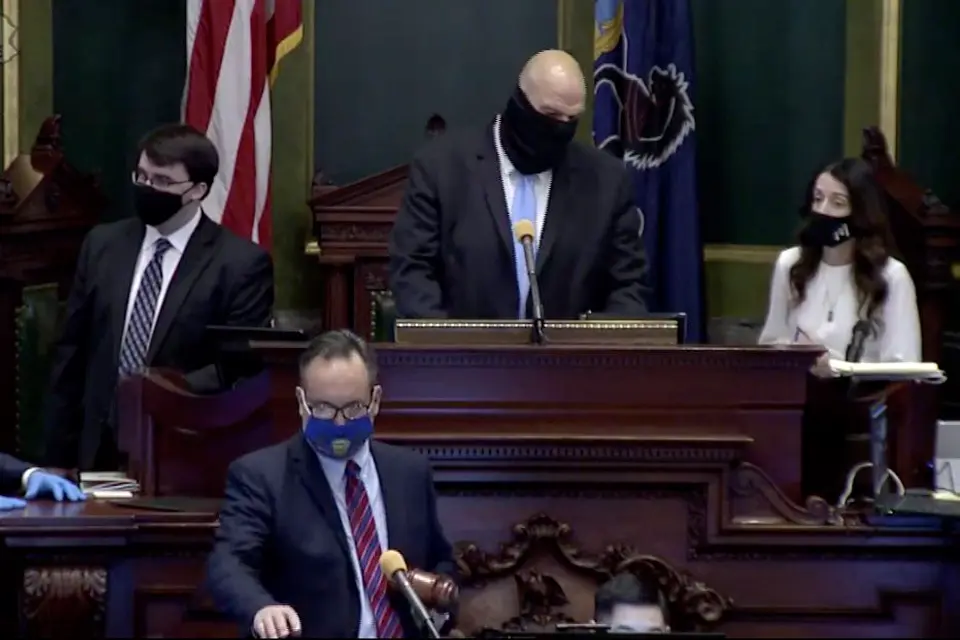
PA GENERAL ASSEMBLY: Lt. Gov. John Fetterman (center) confers with Senate Secretary Megan Martin (right), as Sen. Jake Corman (front, center), takes over the session to conduct a vote to remove Fetterman from residing over the session in Harrisburg on Tuesday, Jan. 5, 2021. Bobby Maggio, Fetterman’s chief of staff, stands to the left.

The Fascist Danger in Our Statehouse

By Angela Couloumbis and Cynthia Fernandez
Spotlight PA

Jan. 5, 2021 – HARRISBURG — The new session of the Pennsylvania Senate got off to a chaotic start Tuesday, with Republicans refusing to seat a Democratic senator whose election victory has been certified by state officials.

Amid high emotions and partisan fingerpointing, Republicans also took the rare step of removing the Democratic lieutenant governor, John Fetterman, from presiding over the session. They apparently did so because they did not believe Fetterman was following the rules and recognizing their legislative motions.

Democrats, in turn, responded by refusing to back Sen. Jake Corman (R., Centre) from assuming the chamber’s top leadership position — an unusual maneuver on what is most often a largely ceremonial and bipartisan vote.

The bitterness and rancor on display was a departure from the normally staid and sedate workings of the chamber. And it potentially sets the stage for a tumultuous twoyear session, which will include debate over key legislative priorities such as redistricting.

“With this reckless, outofcontrol, cowboylike behavior, with this Trumpian behavior that we saw today from Republicans … this does not bode well. It does not bode well for the people of Pennsylvania,” said Sen. Vince Hughes of Philadelphia, the ranking Democrat on the Senate Appropriations Committee.

For now, at least, Democratic state Sen. Jim Brewster, of Allegheny County, will not be allowed to take the oath of office, as Republicans believe litigation over the outcome in his race must first play out in federal court. GOP leaders have said the state constitution gives senators the authority to refuse to seat a member if they believe the person does not meet the qualifications to hold office.

Brewster narrowly won reelection over Republican challenger Nicole Ziccarelli, who is asking a federal judge to throw out the election results. At the center of that legal dispute is several hundred mail ballots that lacked a handwritten date on an outer envelope, as required by state law. The Pennsylvania Supreme Court allowed those ballots to be counted, which gave Brewster the edge in the race.

Continue reading Harrisburg: GOP Senators Refuse to Seat Democrat and Remove Lt. Gov. Fetterman from Presiding

PITTSBURGH’S Climate Challenge Awaits Biden as Trump Pushes Through Environmental Policy in Final Days

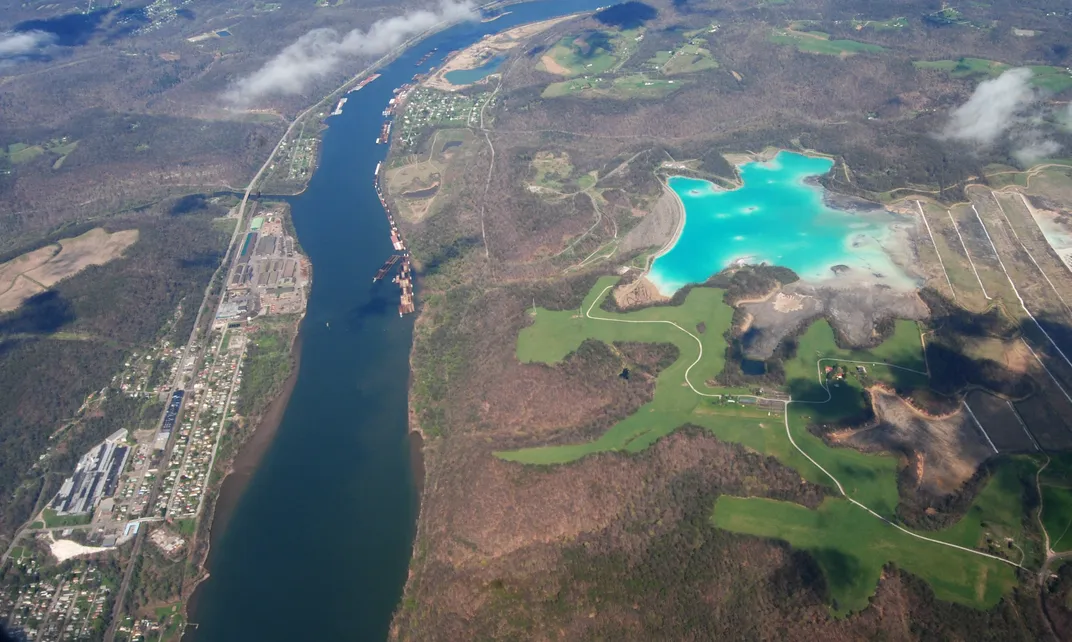
Beaver County’s ‘Little Blue’ waste problem back in the news.

By Daniel Moore
PostGazette Washington Bureau

DEC 31, 2020 WASHINGTON — As President-elect Joe Biden eyes a major federal plan to tackle climate change when he enters the White House next month, his policy team could hit roadblocks as they contend with the breadth of environmental measures rolled back by the Trump administration — and differences within his own party on how to address them.

President Donald Trump has consistently worked through his term to weaken rules put into place by his predecessor — and Mr. Biden’s former boss — former President Barack Obama. Mr. Trump’s penchant for regulatory rollbacks won him support from the energy industry in the Pittsburgh region, headlining natural gas drilling industry conferences and dispatching his environmental chief to Pittsburgh to finalize the repeal of an Obama-era rule limiting the industry’s methane emissions.

Now, Mr. Biden’s climate team, introduced at an event in Delaware this month, will be “ready on day one,” he said, to assess how to wholly address a complex global problem falling under the jurisdiction of a slew of federal agencies.

Mr. Biden, facing a divided Congress with an entrenched political opposition, could face hurdles in translating his much-debated climate change platform into action. As he did during the campaign, Mr. Biden framed environmental protection as an economic driver that will lift up regions like Pittsburgh — and a key part of any plan that helps the nation heal from the COVID19 pandemic.

Trump administration relaxes deadlines on power companies for coal ash cleanup


“Folks, we’re in a crisis,” Mr. Biden said during the Dec. 19 event. “Just like we need to be a unified nation to respond to COVID19, we need a unified national response to climate change.”

As the incoming administration works to build a climate strategy, it will balance demands for stricter rules from the progressive wing of the party with his pledges to invest in jobs in regions dependent on fossil fuels. Fracking was one of the most politically explosive issues on the campaign trail, with Mr. Biden pledging to reach a carbonfree power sector by 2035 and netzero greenhouse gas emissions by 2050.

On the surface, some climate moves could be simple.

Mr. Biden has said he will put the United States back into the Paris climate accord, which Mr. Trump exited in 2017 by declaring he “was elected to represent the citizens of Pittsburgh, not Paris.”

Mr. Biden also could use executive powers to quickly reinstate an array of Obamaera regulations relaxed by Mr. Trump that affect the energy industry, auto manufacturers, construction companies and farmers. He could order federal agencies to consider climate change in their practices and procurement strategies.

Whether Mr. Biden can hit his most ambitious targets, however, will hinge on finding consensus on a comprehensive plan that can pass muster on Capitol Hill.

The president-elect’s plan for a “clean energy revolution” and environmental justice pledges a federal investment of $1.7 trillion over the next decade, leveraging other funding sources to reach more than $5 trillion. Cities like Pittsburgh are hoping that includes money for Ohio River Valley communities to launch a largescale transition to clean energy, as Mayor Bill Peduto called for this month.


Biden’s oil comments fuel long-burning debate over Pa. energy jobs
“The list of things that need to be corrected are daunting,” said Lisa Evans, an attorney specializing in hazardous waste law for Earthjustice, an environmental group.

Ms. Evans, who has advocated for stronger protections around coal ash disposal, criticized the Trump administration when it moved back deadlines for companies to stop dumping the waste in unlined ponds and landfills. She said she wants Mr. Biden to not only reverse those changes but put in place a stronger federal standard than the one Mr. Obama enacted in 2015.

In Pennsylvania, there are 103 coal ash storage and disposal sites, including 20 unlined coal ash ponds and 13 unlined landfills, according to the Center for Coalfield Justice. Coal ash, which contains heavy metals like arsenic, lead and mercury, creates vast sources of potential contamination, as well as huge costs for utility companies that must either retrofit the sites or find alternative storage facilities.

Continue reading PITTSBURGH’S Climate Challenge Awaits Biden as Trump Pushes Through Environmental Policy in Final Days

The Great American Coup Attempt of 2020

Every traitor who participates in Mr. Trump’s failed coup attempt should be remembered.

By Tony Norman
Pittsburgh Post-Gazette Columnist

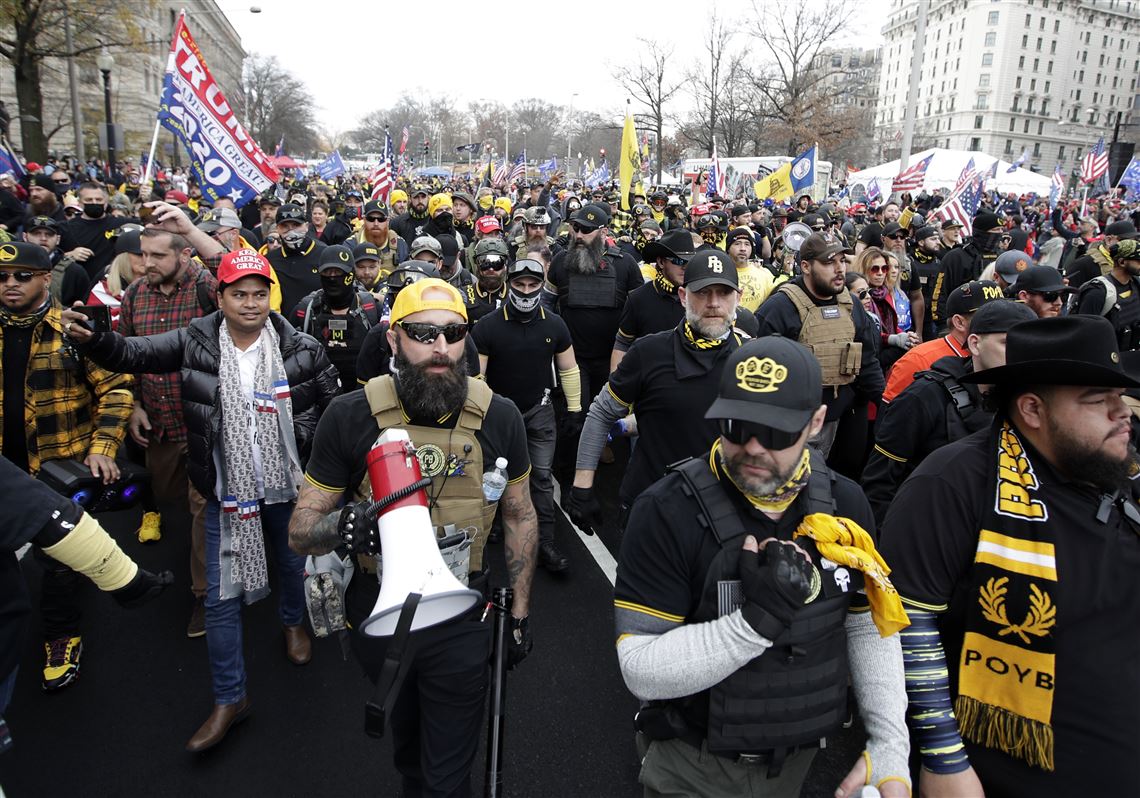
DEC 15, 2020 – Like the fashionable fascists they always strive to be, the contingent of Proud Boys who showed up in D.C. on Saturday to “Stop the Steal” stood out in the madding crowd of revanchist losers pledging their support to Donald Trump, who buzzed them from Marine One overhead.

Rocking black and gold down to the face masks only a few of them wore during the pandemic’s deadliest week, and shouting “All Lives Matter” and “We are Proud Boys,” they looked like a lost tribe of Steelers’ fans, high on hate, trying to score meth outside the Smithsonian.

The Jericho March, as Trump-believers called it, was emceed by conservative talk-radio host Eric Metaxas. The two-fisted evangelical who announced earlier in the week that he would be “happy to die in this fight” for Trump, God, Jesus and liberty — pretty much in that order — did what Jesus surely would’ve under the same circumstances: He asked if anyone had a bazooka he could borrow to blow a news chopper out of the sky.

Over the course of the day, Mr. Metaxas welcomed a who’s who of indicted, convicted, pardoned and guilty-as-hell scoundrels to the stage to ramble on about their love for “Dear Leader.”

The disgraced but recently pardoned Michael Flynn was followed by the always disgraceful Alex Jones, who called Joe Biden a “globalist” and vowed that he “will be removed [from office] one way or another.”

Recently pardoned fixer, dirty trickster and Nixon fetishist Roger Stone was there, as was “eccentric” former congresswoman Michelle Bachmann, who blathered on about a miracle that would soon confirm a second term for Mr. Trump. The list of guest speakers may have been the largest gathering of cultists, ravers and true believers since Jonestown.

Pennsylvania was represented on stage by “Mr. Piety” himself, state Sen. Doug Mastriano, R- Franklin County, who bemoaned the U.S. Supreme Court’s terse dismissal of the Texas lawsuit that would’ve disenfranchised millions of voters in four battleground states, including Pennsylvania, as a “gut shot.” But he vowed to fight on because, well, he’s an irrational fanatic.

We should never forget that 18 attorneys general and more than 120 Republican House members affixed their signatures to an amicus brief asking the Supreme Court to grant Texas’ request to invalidate the outcome of the election in four states that went to Joe Biden.

The following members in the House representing Pennsylvania went along with this mad scheme to disenfranchise their own constituents: Rep. John Joyce of the 13th Congressional District, Rep. Fred Keller of the 12th, Rep. Mike Kelly of the 16th, Rep. Dan Meuser of the 9th, Rep. Guy Reschenthaler of the 14th and Rep. Glenn Thompson of the 15th.

Continue reading The Great American Coup Attempt of 2020

In ‘Marshall Plan’ For Region, Pittsburgh’s Mayor Peduto Hopes Biden Can Pull Spending Plan From Dysfunctional Washington

By Daniel Moore
PostGazette Washington Bureau

DEC 8, 2020 – WASHINGTON — The architects of a newly unveiled 10year, $600 billion climate plan to revitalize Appalachia and the Ohio River Valley region are moving forward with a difficult task of building political willpower in Washington while gaining the trust of rural communities tied to the coal and natural gas industries, Pittsburgh Mayor Bill Peduto told a group of sustainable development advocates Tuesday.

That coalitionbuilding — a communications strategy to be forged over the next six weeks among academic institutions in Pittsburgh and seven other cities — is a critical step toward executing the plan Mr. Peduto described as both idealistic and grounded in reality.

It is also necessary as a divided Congress gears up for a fight next year over PresidentElect Joe Biden’s proposal to pull the country out of an economic downturn while investing in clean energy development. Negotiations between Democrats and Republicans for a COVID19 relief bill have dragged for months, raising the question of whether Mr. Biden’s plan could garner enough support.

“We have been in touch during the [plan’s] research phase with the Biden campaign and their ‘Build Back Better’ authors,” Mr. Peduto said, referring to PresidentElect Joe Biden’s jobs and economic recovery plan.

Peduto joins mayors from W.Va., Ohio, Ky. to call for public/private support in climate-friendly industrial growth

Since Mr. Biden won the White House last month, Mr. Peduto and other local officials “have had contact with the transition team,” he said, “working to see what we can try to be able to get on the radar in Washington during the first 100 days of a new administration, while simultaneously working with grassroots organizations.”

Continue reading In ‘Marshall Plan’ For Region, Pittsburgh’s Mayor Peduto Hopes Biden Can Pull Spending Plan From Dysfunctional Washington

FBI Declared Pittsburgh A New White Supremacy Hub, But It Has Been This Way For Decades

Pittsburghers marching in protest in October 2018 through Squirrel Hill towards the Tree of Life synagogue, where President Trump was making an appearance, three days after a mass shooting took place. CP photo: Jared Wickerham

By Ryan Deto
Pittsburgh City Paper

Nov 15. 2020 – This week at a symposium on domestic terrorism held at Duquesne University, an analyst at the FBI said the Pittsburgh region has now “become a hub for white supremacy” and that it is “important to understand that it is here.”

Considering that the white nationalist group Patriot Front marched down Boulevard of the Allies last weekend, the Ku Klux Klan distributed mailers in Greene County last month, and there have been other selfdescribed militia groups meeting in the area, sporting symbols linked to whitenationalism, acknowledgment from the FBI is a positive sign for those looking to combat hate groups.

However, declarations that Pittsburgh is a new hub for white supremacy ignore decades of history and scores of documented cases of white supremacists gathering and organizing over the years.

Dennis Roddy is a former reporter with the Greensburg TribuneReview and Pittsburgh PostGazette and has written about extremist movements in the region for decades. He says Pittsburgh has always been a hub for white supremacy.

“No, this is not new,” says Roddy. “Just because the FBI is noticing this now, doesn’t make this new.”

Roddy was a reporter for 40 years, and he attended his first KKK rally as a reporter in Fayette County in 1979. He said the rhetoric he heard then was not much different than what he heard among neighbors growing up in Johnstown.

But it’s not just rural parts of Southwestern Pennsylvania where white supremacy has had a significant presence. The National Alliance, which the Southern Poverty Law Center says “was for decades the most dangerous and best organized neoNazi formation in America,” grew out of the Youth for Wallace group that backed Governor George Wallace’s 1968 presidential campaign. Wallace was a prosegregationist and considered one of the most openly racist presidential candidates of the postcivil rights era.

Continue reading FBI Declared Pittsburgh A New White Supremacy Hub, But It Has Been This Way For Decades

How Allegheny County delivered Pennsylvania to Biden

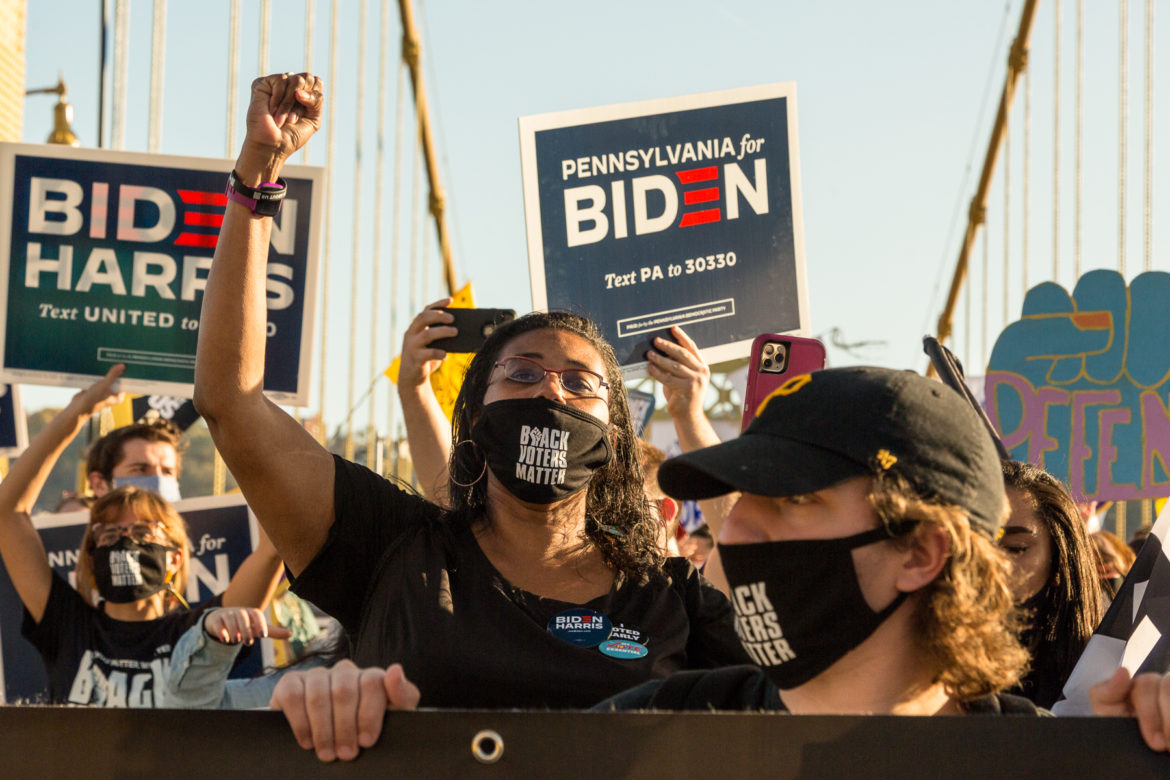
Crowds march across the 10th Street Bridge in celebration of Joe Biden’s victory on Nov. 7, 2020. (Photo by Nick Childers/PublicSource)
Crowds march across the 10th Street Bridge in celebration of Joe Biden’s victory over Donald Trump on Nov. 7, 2020. (Photo by Nick Childers/PublicSource)

While the national media has pointed to voters in Philadelphia or Pennsylvania’s small population centers, Allegheny County was crucial in putting Biden over the top.

By Oliver Morrison
Public Source

Nov 12, 2020 – oe Biden was declared the winner of the 2020 presidential election after the Associated Press and other outlets declared him the winner of Pennsylvania. Although the vote margins are close in Wisconsin, Arizona and Georgia, Pennsylvania was the state that tipped the scale enough to call the election.

So, how did he win Pennsylvania? The New York Times attributed Biden’s win to “counties east of the Appalachians [that] shifted left.” The Washington Post argued that “it wasn’t Pennsylvania’s major urban centers that set the result in 2020.” Instead, they wrote, “It was Erie County and other places like it, where relatively minor shifts across a wide swath of small, industrial cities, growing suburbs and sprawling exurbs.”

But if Allegheny County voted for Biden as predictably as it had for Democratic candidates the past five elections, the results this year could still be uncertain. It was Biden’s unusual, historic performance in Allegheny County, alongside one suburban Philadelphia county, Montgomery County, which provided enough of a margin for Biden to definitively win.

As of Wednesday evening, Allegheny County had already recorded the vast majority of its votes, more than 717,000, the largest number of ballots cast since more than 719,000 votes were cast when Lyndon Johnson was elected in 1964. And the 1964 election was near the peak of the county’s population boom when about 30% more people called Allegheny County home. There are still some provisional and overseas ballots that haven’t yet been included and just under 1,000 additional ballots that were postmarked by Election Day and arrived within three days.

PublicSource looked at how each of the 1,323 precincts in the county voted to tell the story of how Biden won. As the last ballots are counted, it could change the results in single precincts that are close. We’ll update this piece with any changes once all the votes are tabulated.

Five takeaways:

–Allegheny County was one of two counties in Pennsylvania, along with Montgomery County, where Democratic votes increased enough to give Biden a definitive win.


–Both presidential candidates increased the number of votes their party received compared to 2016.

–Biden is winning by nearly 146,000 votes, the biggest margin in Allegheny County since 1964. The urban core and most of the suburbs voted for Biden. Trump’s wins came largely on the edges of the county such as in Findlay, Fawn and Elizabeth townships.


–Some of the biggest gains for Biden from 2016 were in suburban and rural precincts, some of which he still lost. Some of Trump’s biggest improvements were in primarily Black neighborhoods in the urban core, as well as in patches of the Mon Valley. While Trump expanded to the urban core, Biden expanded almost everywhere else and ultimately won the county by the largest percentage since 1992.


–Allegheny County was one of the two most important counties for Biden


As of Wednesday night, Biden led Donald Trump by 51,301 votes in Pennsylvania, according to the state tally, enough votes to prevent an automatic recount and likely enough votes to survive any legal challenges that Trump attempts.

Continue reading How Allegheny County delivered Pennsylvania to Biden

THE RUST BELT BOOM THAT WASN’T: HEARTLAND JOB GROWTH LAGGED UNDER TRUMP

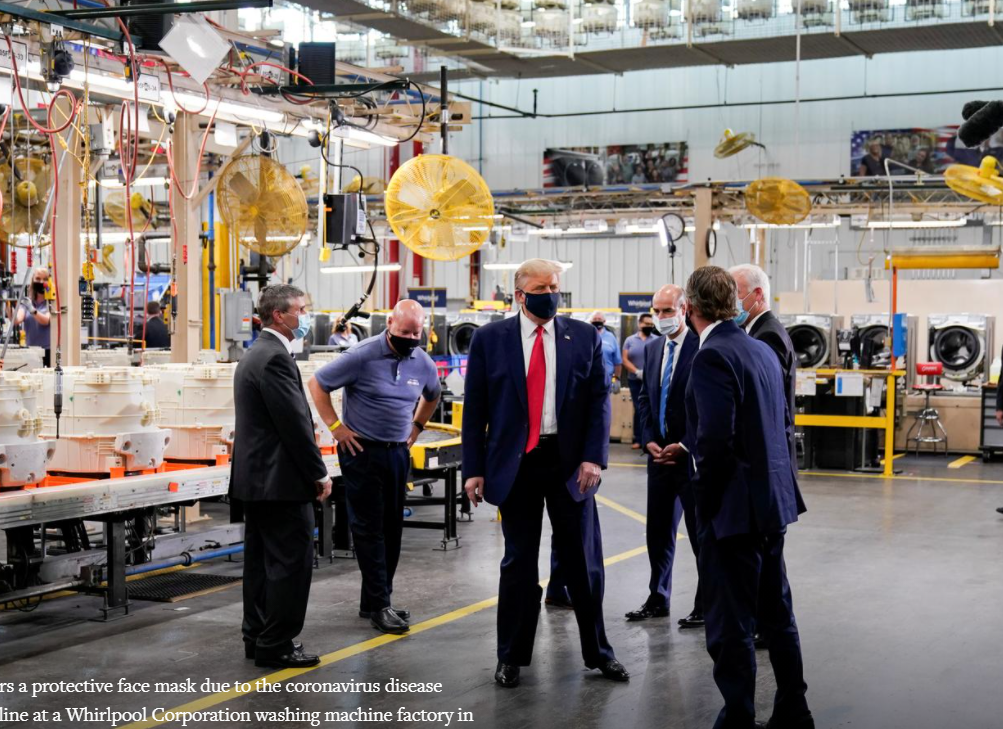
U.S. President Donald Trump wears a protective face mask due to the coronavirus disease (COVID-19) pandemic as he tours the assembly line at a Whirlpool Corporation washing machine factory in Clyde, Ohio, U.S., August 6, 2020. REUTERS/Joshua Roberts/File Photo

By Howard Schneider

Reuters

Oct 27, 2020 – The voters of Monroe County, Michigan, may have expected an economic windfall when they flipped from supporting Democrat Barack Obama to help put Donald Trump in the White House in 2016.

But it went the other way: Through the first three years of the Trump administration the county lost jobs, and brought in slightly less in wages in the first three months of 2020 than in the first three months of 2017 as Trump was taking over.

And that was before the pandemic and the associated recession.

With the U.S. election just a week away, recently released government data and new analysis show just how little progress Trump made in changing the trajectory of the Rust Belt region that propelled his improbable rise to the White House.

While job and wage growth continued nationally under Trump, extending trends that took root under President Obama, the country’s economic weight also continued shifting south and west, according to data from the U.S. Quarterly Census of Employment and Wages that was recently updated to include the first three months of 2020.

Continue reading THE RUST BELT BOOM THAT WASN’T: HEARTLAND JOB GROWTH LAGGED UNDER TRUMP

In This Pennsylvania Town, Racism ‘Was Quiet.’ Then Trump Stoked Fears of Violence

Above: Troy Johnson of Aliquippa speaks up on election turmoil

MILTON, Pa. — Kareem Williams Jr. sits on a park bench in the center of town and waits for the racists to attack. He tells himself he is ready. It’s a cool Saturday morning in fall, and the valley is alive with the rumble of pickups.

When the trucks stop, here at the red light at the corner of Broadway and Front Street, drivers gun their engines. Some glare directly into Williams’ eyes.

Williams is a Black man. The drivers are white. All their passengers are white. Williams returns their gaze with equal ferocity. He tells himself he is ready. He is not. His back faces the Susquehanna River. His car is parked a block away. If these white men jump from their truck, fists or pistols raised, Williams has nowhere to run.

The light turns green. Engine roar blasts the river. Williams follows each truck with his eyes until it’s gone.

“I always knew racism was here. But it was quiet,” said Williams, 24, a factory worker and a corporal in the Pennsylvania National Guard who grew up in Milton. “Now, in this election, people are more openly racist. The dirty looks, middle fingers, the Confederate flags.”

To Williams, and to many non-white people he knows in central Pennsylvania, this rise in overtly racist behavior is linked inextricably to the reelection campaign of President Donald Trump. In yards up and down the Central Susquehanna Valley, Williams sees Confederate flags and Trump flags flying side by side. People with the most Trump bumper stickers seem the most likely to shout hateful things.

As the presidential election approaches, Williams said, such threats grow more common, more passionate.

“On election day I’m going to be in my house. I’m not going anywhere,” said Williams, known by his nickname K.J. “If these racists are looking to protest, they’ll go to Harrisburg or Philadelphia or D.C. If they’re looking to kill people, this will be the place. They’re gonna come here.”

Experts on American racial history agree. For Black people living in towns like Milton, they say, the threat of white terrorism is the highest it’s been in generations.

“Historically, most acts of racial terror have been enacted in rural communities, small towns or medium-sized cities,” said Khalil Muhammad, a history professor at Harvard University. “The conditions for wide-scale anti-Black violence are today more likely than at any point in the last 50 years.”

‘That’s a powder keg’

Within a month, 230 communities in Pennsylvania organized 400 anti-racism events, said Lara Putnam, a historian at the University of Pittsburgh who studies grassroots movements.

“That is an insane number,” Putnam said. “It’s an order of magnitude larger than the number of places that ever held a Tea Party event.”

Many protests happened in towns where African Americans and other non-white people constitute a tiny minority, surrounded by rural communities with virtually no people of color at all. Those areas are overwhelmingly conservative, said Daniel Mallinson, a political science professor at Penn State Harrisburg. Out of 6 million votes cast in Pennsylvania in 2016, Trump won the state by 42,000.

But in Milton he dominated, carrying the surrounding Northumberland County by 69%. In front yards and country fields, Trump flags and Confederate flags comingle.

“Traditionally when we think of political candidates, we think of yard signs. But a lot of Trump flags went up in 2016, and in a lot of places they didn’t come down. It’s a visual representation of tribalism in our politics,” Mallinson said. “There’s a lot of implicit and explicit racial bias in central Pennsylvania.”

As local critics and defenders of the white establishment grow more engaged, state and national politics raise the stakes. Pennsylvania is the likeliest state in the nation to decide the presidential election, according to FiveThirtyEight, a polling and analytics aggregator. Statewide polls place Democrat Joe Biden ahead of Trump by 7%, the same as Hillary Clinton’s lead in Pennsylvania three weeks before the 2016 election.

Large-scale voting fraud has never been detected in modern American politics. Yet Trump often claims he can lose only if the 2020 election is fraudulent, which stokes fear and anger among his core supporters, experts said.

“They fully expect Trump will win,” said John Kennedy, a political science professor at West Chester University outside Philadelphia. “When they hear the results on election night, that’s a powder keg.”

Trump also appears to encourage the more violent factions of his coalition. The president repeatedly has declined to promise a peaceful transition of power. He defended Kyle Rittenhouse for killing an unarmed protester in Kenosha, Wisconsin. During the first presidential debate, Trump appeared to encourage white terrorists, urging the Proud Boys to “stand back and stand by” and insisting that “somebody’s got to do something about Antifa and the left.”

Some white people in central Pennsylvania appear to be following the president’s lead.

“Do I worry about right-wing vigilante violence against peaceful protests if people are protesting Trump after the election? Yes,” Putnam said. “It’s happening. And there’s every reason to think more of it will happen.”

In September, Trump proposed designating the KKK and antifa as terrorist organizations. Antifa is not an organization, however, but rather an idea shared by some on the left to aggressively challenge fascists and Nazis, especially during street protests.

“President Trump has unequivocally denounced hate groups by name on numerous occasions but the media refuses to accurately cover it because that would mean the end of a Democrat Party talking point,” said Samantha Zager, a Trump campaign spokesperson. “The Trump campaign will patiently wait for the media to develop the same intense curiosity on these actual threats to our democracy as it has with regard to hypothetical scenarios from the left.”

In July, neo-Nazis rallied in Williamsport, 20 miles north of Milton. In August, a white person fired into a crowd of civil rights marchers in Schellsburg, Pennsylvania, wounding a man in the face. At a recent event for police reform in Watsontown, three miles north of Milton along the West Branch of the Susquehanna River, white counter-protesters yelled that Black people “live off white people.”

Overlooking the protest, on the balcony of the Mansion House restaurant, white men stood armed with assault rifles.

“They looked like snipers,” Williams said. “Trump is the motivator in all of this. He has a huge following here.”

The last time America witnessed such an open embrace between white supremacists and the White House was the administration of Woodrow Wilson, said Muhammad.

“You have to go back 100 years,” Muhammad said. “We have every reason to be extremely vigilant about the possibility for violence over the next several weeks. Anywhere where people are flying Confederate flags are places where people ought to be mindful of where they move in public.”

Racism in the land of Chef Boyardee

The side streets of downtown Milton end in rich river bottomlands where the autumn corn grows 7 feet tall.

Continue reading In This Pennsylvania Town, Racism ‘Was Quiet.’ Then Trump Stoked Fears of Violence

beyond tactics: Even if Trump Loses, Trumpism Will Live On

A defeat for Donald Trump in next month’s election is unlikely to banish the cultural divisions he has stoked © Saul Loeb/AFP/Getty

The US is too militantly divided for a sweeping repudiation of the president to last. We need to keep on keepin’ on in organization a progressive majority for years ahead.

By Edward Luce
Financial Times Guest Link

OCT 15 2020 – Though few will dare admit it, much of America is preparing to celebrate the end of Donald Trump. Not only would his defeat bring the curtain down on an administration they regard as the worst in modern US history. In their eyes, it would also dispel the MAGA hat-wearing, militia-sympathising deplorables who make up the US president’s base.

It would be a moment of redemption in which not only Mr Trump, but Trumpism also, will be written off as an aberration. After four years of unearned hell, America could pick up where it left off.

That would be a natural reaction. It would also be a blunder. Should Mr Trump lose next month, it would be with the support of up to 45 per cent of expected voters — between roughly 60m and 70m Americans. Even now when Joe Biden’s poll lead is hardening into double digits, a Trump victory cannot be discounted.

Even if he loses, it is highly unlikely to match the sweeping repudiation that Walter Mondale suffered against Ronald Reagan in 1984, or Barry Goldwater to Lyndon Johnson in 1964. America is too militantly divided for that.

A victorious Biden camp would need to take three concerns into account. The first is that the Republican party is Mr Trump’s, even if he departs the scene. Five years ago, many evangelical voters still felt distaste for Mr Trump’s libertine personality. They quickly learned he was the kind of pugilist they wanted.

The likely Supreme Court confirmation next week of Amy Coney Barrett, and that of Brett Kavanaugh and Neil Gorsuch before her, are testaments to that. America’s Christian right has embraced its inner Vladimir Lenin — the end justifies the means.

The same applies to professional Republicans. Self-preservation might imply they would distance themselves from Mr Trump as his likely defeat drew nearer. The opposite has been happening. As an Axios study shows elected Republicans have become steadily more Trumpian over the past four years.

Partly this was because a handful of moderate representatives either retired in Mr Trump’s first two years, or were ejected by hardliners in primaries. Mostly it was because of the visceral power of Trumpism. It turns out there is not much grassroots passion for fiscal conservatism in today’s Republican party — if there ever was. The impetus is with those who fear that America will cease to be America, partly because of the US’s growing ethnic diversity.

Swamp notes

In the countdown to the 2020 election, stay on top of the big campaign issues with our newsletter on US power and politics with columnists Rana Foroohar and Edward Luce. Sign up here

The second point is that America’s information culture is far more degraded today than in 2016. Democrats often blame Mr Trump’s victory on the Russians. Maybe so. But whatever disinformation Russia spread was dwarfed by home-grown material. According to a study this week by the German Marshall Fund, the amount of fake, or disguised fake, news that Americans consume on their social media has more than tripled since 2016.

Facebook is a much greater vehicle for disinformation today. More importantly, US consumer demand for news that is either distorted or plain false — about the pandemic, for example — continues to grow. A dark conspiracy cult such as QAnon would have been hard to imagine a few years ago. Today it reaches tens of millions of Americans.

The evermore disruptive impact of digital technology on public culture makes governing increasingly difficult. A Biden presidency’s first priority would be to roll out a national coronavirus strategy to flatten America’s curve. Little else can happen before that.

Much of its success would depend on Americans following rules such as wearing masks, avoiding crowds and complying with contact tracers. But a Trump defeat is unlikely to banish the cultural divisions he has stoked. Large numbers of Americans say they will reject a vaccine and view masks as a surrender of their freedom. Mr Biden’s fate will partly hinge on the degree to which he can marginalise those sentiments.

Trump vs Biden: who is leading the 2020 election polls?

Use the FT’s interactive calculator to see which states matter most in winning the presidency

His final concern should be on the conditions that gave rise to Trumpism. The ingredients are still there. Hyper-partisanship, blue-collar deaths of despair, the China threat and middle-class insecurity are all worse, or as bad, as four years ago. Most of those looking to follow Mr Trump, such as Mike Pompeo, his secretary of state, or Tom Cotton, the Arkansas senator, are harder-line versions of him without the caprice.

The fixes to America’s problems are manifold, complex, and painstaking. A vaccine will not suddenly banish the pandemic. Nor would Mr. Trump’s defeat magically bring an end to Trumpism.

Pennsylvania Becomes a Battleground over Election Security

By Marc Levy and Christina A. Cassidy
Associated Press

OCT 15, 2020 – HARRISBURG — For anxiety over voting and ballot counting in this year’s presidential election, it’s hard to top Pennsylvania.

Election officials in Philadelphia, home to one-fifth of the state’s Democratic voters, have been sued by President Donald Trump’s campaign, blasted by the president as overseeing a place “where bad things happen” and forced to explain security measures after a theft from a warehouse full of election equipment.

Add to that an investigation into military ballots that were mistakenly discarded in one swing county, partisan sniping in the state Capitol over the processing of what is expected to be an avalanche of mailed-in ballots and an 11th hour attempt by Republican lawmakers to create an election integrity commission.

One of the most hotly contested presidential battleground states is trying to conduct a pandemic election in a hyper-partisan environment where every move related to the voting process faces unrelenting scrutiny from both sides. State and local election officials say they are doing all they can to make sure Pennsylvania doesn’t end up like Florida two decades ago, when the last drawn-out presidential tally ended before the U.S. Supreme Court.

‘A really destructive scenario’: Pennsylvania could hold up outcome of presidential election

“For years, we have trusted our election officials to be reliable and nonpartisan. Why should we suddenly not trust them?” said Eileen Olmsted with the League of Women Voters of Pennsylvania, a nonpartisan organization that advocates to expand access to voting. “A lot of this is based on the perception of voter fraud, which there is absolutely no evidence of.”

Continue reading Pennsylvania Becomes a Battleground over Election Security