Book review: ‘THE MINISTRY for THE FUTURE’

It’s unwise to ignore Mother Nature, and not to find ways to live in harmony with her, and all other beings as well

By Kim Stanley Robinson
Orbit ($28)

Reviewed by Tom Cox

Pittsburgh Post Gazette

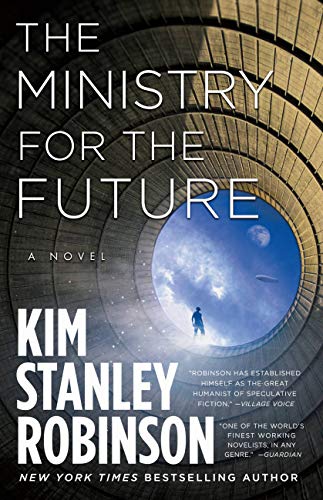
Make no mistake, Kim Stanley Robinson’s new novel, “The Ministry of the Future,” is a good old-fashioned monster story. As with most monster stories, there is an inciting incident witnessed by a few wide-eyed and hysterical nobodies, but their cries are deemed “unreliable.” Who knows what they saw? It only affected those people. And besides, what do they expect us to do, empty the beaches on a holiday weekend just because somebody thinks they saw a shark?

In many of these tales, the monster is a metaphor for something else, such as “Babadook” (grief), “Rosemary’s Baby” (motherhood), “Get Out” (racism), and “Frankenstein” (humanity). But some of the scariest monster stories give us nightmares about the normal things we see in life. Not vampires, werewolves, blobs or radioactive lizards but crazed fans, preppie New York investment bankers or creepy hotel clerks. In “The Ministry of the Future,” Mr. Robinson aims his flashlight into the black waters to reveal just such a monster: climate change. Yeah, we’re going to need a bigger boat.

True to good monster lore, our story begins with an attack: a record-setting Indian heat wave knocks out power and roasts 20 million of the planet’s most vulnerable in two weeks’ time. Enter Mary Murphy, head of the Ministry of the Future, a rather toothless U.N. watchdog agency based in Zurich and created by an international treaty. Nevertheless, Murphy is serious about making a difference in the world and about her agency’s stated mission: “to advocate for the world’s future generations and to protect all living creatures, present and future.” Despite the Indian tragedy, her attempts to enact real and drastic reduction in carbon emissions is resisted. National sovereignties are cited. Fingers of blame are pointed at the long-term carbon culprits, who in turn accuse the most recent contributors. Financial institutions entrench behind privilege and market share. The monster is not our problem.

When the rebuffed Murphy is confronted and briefly held captive in her own home by an addled survivor of the Indian carnage, she recognizes in his frantic demands not a criminal element but perhaps humanity itself (her own humanity?) crying out for drastic steps to be taken — acts of eco-terrorism and even the assassination of select carbon perpetrators. After the man is captured and her safety assured, Murphy finds it hard to dismiss his humble sacrifice and haunted eyes. Does confronting a monster like climate change call for more drastic steps? If black ops are used to fight terrorism, why not this? Maybe it’s time to get our hands dirty. She soon discovers, however, that her darkest notions of such an unauthorized, covert and lethal outfit already exists.

Whereas Mr. Robinson’s earlier novels on climate change, “New York 2140” and “2312,” are set far in the future and deal with the long-term aftermath of the destruction it caused, “The Ministry of the Future” dares to set events within our lifetimes, or at least within the lifetimes of our children. Thirty years from now, the devastation is just beginning. Things can still be done to stop the monster, but only if drastic and expensive steps are immediately undertaken and only if the whole world takes it seriously. If you have met the world, however, you know that this probably isn’t going to go well.

Mr. Robinson’s intrigue and geopolitical drama are well supported by his meticulous research into every sort of environmental theory, proposed solution and geo-engineering possibility, which he deftly incorporates into his work. If you’ve been looking for an environmental monster story in which the heroes are scientists who aren’t above taking off their gloves and getting their hands dirty, this might just be the campfire story for you.

Tom Cox is a writer living in Penn Hills.

Report from Lordstown: Trump Lied to Heartland Workers

Under Trump, we’ve lost 5 million of the 11.6 million net jobs created under Obama. That’s the worst jobs record of any modern president. (Photo: Shutterstock)

Trump is bragging about his jobs record in the Midwest. So why didn’t he lift a finger when 14,000 GM workers were laid off?

By Chuckie Denison
Common Dreams

Sept 24, 2020 – As the election draws near, Donald Trump and Mike Pence are campaigning across Ohio, Michigan, and the rest of the Midwest, making big claims about “bringing back” jobs.

I have one question for them: Why does the Trump administration continue to turn its back on America’s workers?

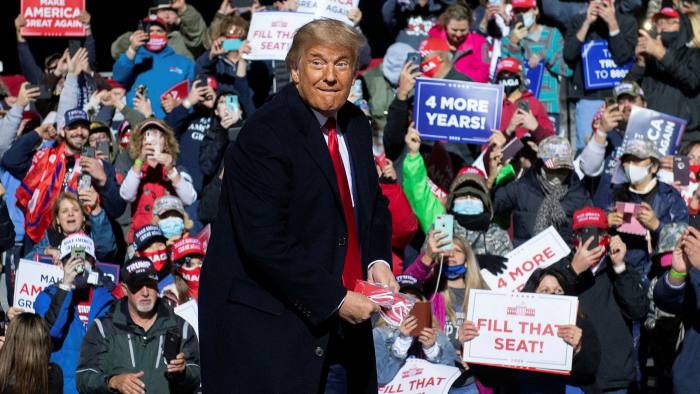
In 2016, Trump won big in the Mahoning Valley, the traditionally blue stronghold in northeast Ohio where I live, helping Trump carry the state after it twice voted for Obama. Blue-collar voters believed Trump when he said he would be the “greatest jobs president that God ever created.”

We deserve the chance to work hard and earn enough to feed our families, afford our own home, go to the doctor when we’re sick, and walk down the street without being afraid of the police.

Four years later, it’s obvious we were duped. Under Trump, we’ve lost 5 million of the 11.6 million net jobs created under Obama. That’s the worst jobs record of any modern president.

My fiancé Cheryl and I met at the General Motors plant in Lordstown. In 2014, we bought our house up the street from the plant because we believed our future with GM was bright.

Today, everything we thought was possible has been replaced by uncertainty.

When GM closed the Lordstown plant in 2019, I took a medical retirement. Cheryl moved hundreds of miles away to Tennessee to work at GM’s Spring Hill plant, leaving her daughter behind to finish high school.

This summer, GM announced they would be permanently eliminating the third shift at the Spring Hill plant, laying off 680 workers. Cheryl doesn’t know how much longer she’ll have a job.

We decided to sell the house that was our American dream. Now, we don’t know where we’re going to live. Ohio, where our community has been devastated by the plant closure and job opportunities are scarce? Or Tennessee, far from our families, where the cost of living is higher and Cheryl’s job could disappear?

GM is a billion-dollar company that was built on the backs of workers like me and Cheryl. If we had a government that stood up to companies like GM and demanded they put their workers first, our lives wouldn’t be decided by the whims of corporate greed.

Instead, we have a president who has broken promise after promise.

Trump visited the Mahoning Valley in 2017 and told workers not to sell their homes. “We’re going to fill up those factories,” he vowed.

But he didn’t lift a finger when GM laid off 14,000 workers across Michigan, Maryland, and Ohio, including me. Instead, the Trump administration let GM continue collecting $700 million in federal contracts and massive tax breaks.

All told, 1,800 factories have disappeared since Trump took office. Even before the pandemic, job growth had already plummeted in Ohio and had fallen to its lowest level in a decade next door in Michigan, the Institute for Policy Studies found recently.

America’s working people are tired of lies and broken promises. We won’t be fooled again. That’s why Our Revolution groups across the Midwest are organizing working people to spread the word about Trump’s broken promises.

America’s working men and women deserve a president that will make our government work for them. We deserve the chance to work hard and earn enough to feed our families, afford our own home, go to the doctor when we’re sick, and walk down the street without being afraid of the police.

We deserve to reclaim the American dream.

Chuckie Denison is a founding member of Our Revolution Mahoning Valley and a former GM Lordstown worker. This op-ed was adapted from a letter to the Warren Tribune-Chronicle and distributed by OtherWords.org.

All Aboard to Defeat Trump: Biden Train Tour in Pennsylvania Steel Country

The “Build Back Better Tour” by Joe Biden originated in Cleveland and made a campaign stop in Alliance, Ohio. Riding into Pennsylvania, Biden made stops in Pittsburgh, Greensburg, New Alexandria, Latrobe, and concluded here in Johnstown.

By Anthony Mangos
People’s World

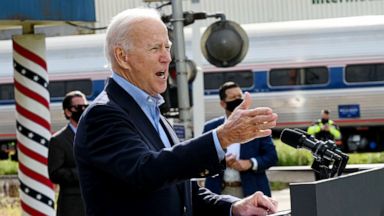
Oct 7, 2020 – A freight train passes by as Democratic presidential candidate former Vice President Joe Biden talks to the crowd at the Amtrak Johnstown Train Station, Sept. 30, 2020, in Johnstown, Pa. | Andrew Harnik / AP

JOHNSTOWN, Penn.— It was an unusually warm autumn evening in Johnstown as Joe Biden’s Amtrak pulled into the city’s historic passenger station, opened in 1916. The station is a unique structure, as trains arrive above the depot on an elevated level. The adjacent wall was adorned with a massive Biden-Harris sign, rising above a very enthusiastic crowd.

This was a drive-in style outside event in Johnstown, with social distancing. It would be highly unlikely for Donald Trump to campaign by rail, as he has continually ignored and sought to defund Amtrak. On the contrary, Biden says he knows how essential passenger train service is, connecting communities like Johnstown, and supports Amtrak faithfully.

It’s common knowledge that “Amtrak Joe” loves trains. He hit the campaign trail on rails Sept. 30 after taking on Trump in the first debate—and before the president’s COVID-19 diagnosis.

The whistle stop campaigning brought to mind the nostalgic tradition of candidates riding the rails through America. On the heels of the debate, for many voters, the arrival of the Biden train seemed the equivalent of comfort food, a signal of Biden’s claim he’d restore decency and accountability in the White House.

The “Build Back Better Tour” originated in Cleveland and made a campaign stop in Alliance, Ohio. Riding into Pennsylvania, Biden made stops in Pittsburgh, Greensburg, New Alexandria, Latrobe, and concluded here in Johnstown. In-person campaigning has been limited during this year of the pandemic. At the whistle stops, attendees were properly spaced out with social distancing and masks.

The involvement by labor unions in the Biden campaign has been strong; AFSCME, USW, and SEIU were just a few unions represented at the Johnstown rally. Local resident Brian Smith, former Navy Seabee and current SEIU member, shared how a good union job enabled his family to remain in Johnstown, before introducing the Democratic candidate.

Biden arrived on stage, to much applause, shouting, “Hello Johnstown!” As he began addressing the crowd, a loud freight train roared past. Turning around and pointing to the train, Biden said, “By the way, that’s a good thing!” Reflecting, he reminded the crowd of his long connection to the nation’s rail system. “I started by taking the train when I got elected as a 29-year-old kid in the United States Senate. I started going back and forth every single day so I could be home in Wilmington every night with my two young boys, and later, with my daughter.”

He talked about riding the train home at night after a debate in the Senate “about fair tax policy, or about health care, or about unions that I was fighting for…and I’d look out…I really mean this…I’d look out like I did coming from Cleveland today. I’d look out at all those homes I’d pass, those middle-class neighborhoods like I was raised in.”

Biden said the view made him wonder whether the families inside were “having the same conversations my mom and dad had when we were growing up…we need four new tires on the car, but we can’t afford it…or maybe we are going to have to worry about whether or not they’re going to turn the electricity off because we’re behind on the bill because the job changed or I lost my health insurance.”

In the midst of the ongoing pandemic and economic collapse, Biden said people today are having the same kind of conversations.

Johnstown was once a thriving steel manufacturing town located in Cambria County, Penn. While a few mills remain, some retaining a unionized workforce, a majority have closed. The city continues to struggle, as it is statistically one of the poorest places in Pennsylvania.

Once a Democratic stronghold, the county’s party affiliation numbers recently revealed that registered Republicans now slightly outnumber Democrats for the first time for as long as local residents can remember. This has been the trend throughout Western Pennsylvania.

In 2016, Trump held a rally in Johnstown and many voters here supported him then. Biden is intent on gaining those supporters back, and the labor movement here is determined to pull people away from Trump.

There is evidence they may succeed with some. When Trump passed through four years ago, he took people’s votes, but then gave nothing back. While fueling division across the nation, he plainly forgot about places like Johnstown. There is a sense here that local citizens are now realizing this.

Due to strict social distancing, Biden’s rally could only accommodate a limited number of attendees. Nonetheless, across the Little Conemaugh River from the train station, many local supporters arrived to glimpse the stage and express their solidarity.

A local pub, adhering to strict health guidelines, provided an outdoor television screen to broadcast the speech. In an encouraging sign, supporters also arrived from surrounding rural areas. An important factor concerning the election outcome in Pennsylvania will be the urban-rural divide, which the Biden campaign seems well aware of.

Johnstown was once home to a thriving steel industry. Here, a woman walks past the Gautier steel buildings in town. Trump’s promise to revive the industry came up flat, and voters have not forgotten. | Carolyn Kaster / AP

Speaking before the candidate, Jill Biden hit on the point. “We’re seeing that our differences are precious and that our similarities are infinite. Democrat and Republican. Urban and rural. Our communities are showing that the heart of this nation still beats with kindness and courage.” Pushing the crowd to look beyond the harshness and division of Trump’s presidency, she argued, “We don’t agree on everything. And we know we don’t have to. We can still love and respect each other. We care more about people than politics.”

Concluding his address, Biden again called out to labor, proclaiming “the middle class built America and unions built the middle class.” He vowed a presidency that would fight for working people and their jobs and families, “not for corporations.” To the residents of this town that’s been feeling hard economic times for years, he pledged to “build back better” after Trump. “It’s all about injecting life and capital back into places like Johnstown.”

Many registered voters in small Western Pennsylvania towns have a deep-rooted history of leaning conservative regarding social issues. This has been a factor in the realigning of the region politically, creating a challenge for uniting voters.

Biden knows this well, and his whistle stop campaigning through what the media calls the “Rust Belt” shows his campaign is reaching out in an effort to bring everyone back on board to defeat Trump.

The Farrell Steel Strike and Medicare for All

by Tina Shannon, President

PA Steel Valley Chapter, Progressive Democrats of America

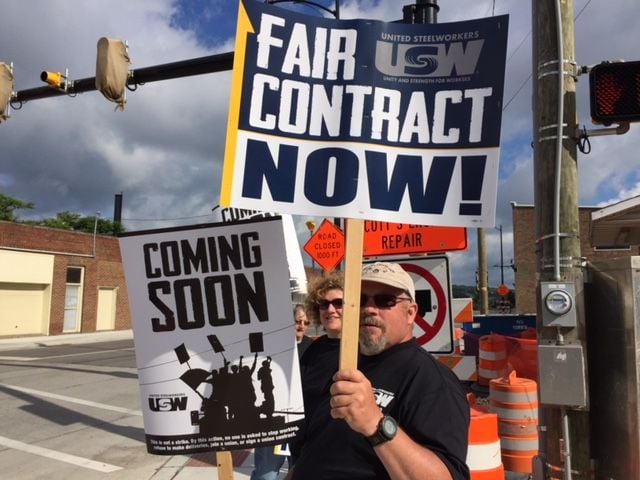
Just up the road from me in W PA, workers at a local steel fabrication plant employing almost 500 have gone on strike. The main issue is their healthcare coverage.

But this also happened there. Imagine this.  Your husband dies in a horrible motorcycle accident. You go to his workplace a week later, to fill out the paperwork for his life insurance and other paperwork requirements. The HR person informs you  that the company canceled your family’s health insurance the very day he died with no notification to you, the bereaved spouse. You and your family have been without healthcare coverage this whole time.

The company did this even though Jackie Vezilli’s husband’s paycheck had been deducted for his share of the healthcare coverage. In Jackie  Verzilli’s own words, “This video is happening because of the lack of respect and disregard for my husband, myself, and my family by this company is indeed all true. This video is happening because my husband worked for this company for 13 years, all the way back when it was called Gibraltar. He worked countless hours of overtime. He was in a  really bad work accident for this company and survived.”

Jackie is struggling with the company about this.

This steel mill, now owned by  NLMK, has been in Farrell, PA for a long time. It is a generational workplace for many families in the area. People who work there have social ties from high school and even elementary school. It is an anchor for the community. People in this part of W PA have built good lives around good union jobs there.

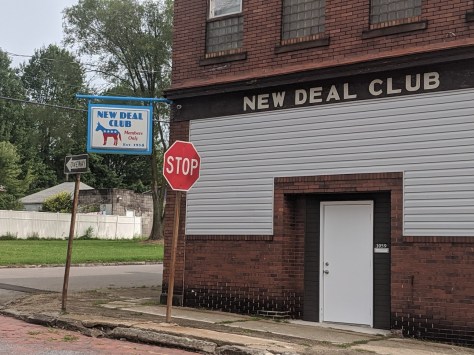
Farrell is home to perhaps the last New Deal Club in the country.

In the days before the steel mills were booming, the first-generation immigrants and their children weathered the Great Depression. Because of that, when they were opening a social club for Democrats, to transcend all the ethnic clubs already in existence, they named it for FDR. In the words of Ed  Nicastro, as recorded in an oral history taken by J. Kasich, “he saved the nation from starving. Ever since that time in 1933 this club has still honored his birthday and went by the rules he made a lot of them.  What he did for the workingman and everything and that’s why there is still a Democratic club left in the country”.

Throughout the prosperous years of busy steel mills hiring workers, and the years of flourishing local economies that resulted, Farrell honored FDR.  At one time, this was a place where one income could support a family. Things have been getting increasingly harder though.

Healthcare is an ever-increasing need for the people around me, a need ever more neglected by the forces controlling the economic system we live in. As people lose their jobs due to a worldwide pandemic, they also lose their healthcare coverage, making a bad situation worse.

I live in a part of the country that already has severe disparities. Pittsburgh is known as a healthcare hub. This is confusing. UPMC, the dominant hospital system in Pittsburgh, has been a pioneer in organ transplants. At the same time, a battle between the UPMC insurance plan and the competing Highmark insurance plan has forced patients to switch doctors and plans. This battle compromised the healthcare of my community. It makes everyone more insecure about their healthcare coverage.

Pittsburgh also has high racial disparity, reflected by the Black infant mortality rate, which is six times higher than white infant mortality.

And that all takes place in Pittsburgh, which is more prosperous than my community and most of the communities around me.

Farrell is in neighboring Mercer County in the de-industrialized Rust Belt outside of Pittsburgh. In Farrell, the owners of this steel fabrication plant are paying $150 million for tariffs they claim were unskillfully placed in an off-hand manner. Some 25% tariffs on foreign steel were abruptly instituted by the Trump administration in 2018.

With no national industrial plan to replace the produced steel this plant needs to service its customers, the survival of this small town in Western PA is being threatened by the current Republican administration.

That is the context of the striking workers’ lives in a small town about an hour outside of Pittsburgh, at the  NLMK steel plant in Farrell.

A unionized worker from that plant recently attended our local  Progressive Democrats meeting to tell us about it. In their previous contract, they had a choice of a PPO, that allows patients to freely see doctors within the plan, or a high deductible plan.  The company wanted to eliminate the PPO.The unionized workers prefer having a choice. I think our experience with high deductible plans leaves us all fearing that the deductibles are always going  to become entirely unaffordable. The existing high deductible plans are already unsustainable. The choice left to us is using healthcare or putting food on the table. These high healthcare costs force workers to rely on high levels of overtime, further deteriorating working people’s family life and time for involvement in their communities.

We need to be secure enough to care for each other.  We need to care for our families. We need to participate in community life. Access to healthcare is a piece of that puzzle. While workers are forced to submit to employers out of fear of losing healthcare,  we see all kinds of ripple effects through our community.

It hurts us in many ways. Wages are lower because unionized workers are forced to fight for their healthcare coverage instead of wages. Low wages mean less buying power in our communities, higher student debt because families can’t afford to help, less opportunities for younger children because their parents are always working, just to name a few.

A healthcare system that covered everyone regardless of employment would be a big step forward in solving these problems. The only way we can afford this will be to eliminate the insurance companies that siphon off profit while adding no value to our healthcare. HR 1384, the Improved and Expanded Medicare for All  Bill, would do this. As support for this idea grows throughout the country, as more and more people lose their healthcare coverage during a pandemic, it’s time to enact this Bill.

We’re going to have to make our elected leaders do this with the coming Democratic administration.  An increasing number of elected progressives in Congress will help. If a shift of control happens in the Senate, this could be the historic period to achieve Medicare for All. We should see this as a real possibility. This is the reason we’re in the political struggle: to win what we need. This is a reason to vote Democrat in 2020.

Op-Ed: Trump Failed Beaver County Workers, Families

By Terri Mitko
Special to The Times

When Pennsylvania elected Donald Trump, our commonwealth took a gamble that an unconventional politician could deliver great results in unconventional ways. Communities like Beaver County trusted him to keep his promises, bring jobs back to our region, and get our economy booming again. But here we are four years later and the truth is, we are worse off than before. And today, Mike Pence is coming to town to try and tell Beaver County workers that he and Trump are on our side. Nothing could be farther from the truth.

Let’s get right to the point: Our economy is in terrible shape. When Donald Trump was elected, unemployment in Beaver County was 5.5%. Today, on his watch, it sits at nearly 16%. That’s not just because of COVID-19; even before the pandemic, Trump had weakened our economy by forcing us into a losing trade war and enacting anti-worker policies that favor the wealthy and well-connected instead of good union jobs.

First, the trade war. Trump talked a big game about his ability to stand up to China, but he’s losing to them — badly. His tariffs have caused everyday families to lose money while raising the price of goods. They’ve led to huge job losses all across the country, including in Beaver County. In June, hundreds of area workers lost their jobs when ATI Midland shuttered its doors because of Trump’s tariffs.

That’s hundreds of families that lost their means to put food on the table. These are the working families that Trump promised to protect. Instead, he let them down with his failed leadership.

The pandemic has only made things worse. It never had to be this bad, but Trump’s failure to manage this crisis has caused great damage to our economy and our region. Area businesses have closed down, including two local factories that sent 550 of our community’s workers home without a job. This is happening all over the country. Since Trump took office, our nation’s economy has lost 4.7 million jobs. Trump is the worst jobs president in modern history.

He claims that the tax bill is one of his greatest achievements, but it was designed to line the pockets of his wealthy donors and CEOs — not the workers of Beaver County. The majority of Pennsylvania’s share of the benefits from his tax bill went to the top 5% of earners in our commonwealth. It even contained a portion that makes it easier for corporations to ship American jobs overseas. That’s a direct attack on our region’s union workers.

So here’s the choice we face in November: It’s either Trump, who has been bad for Beaver County workers, or Joe Biden, who has a specific plan to build our economy back better and create good union jobs.

Here’s what Joe Biden wants to do. He wants to rebuild American manufacturing with a historic Buy American plan. He’s going to invest $400 billion in American products, update the trade rules for Buy American, and make sure our tax dollars are invested in American products instead of foreign companies.

Joe’s not just focused on the big manufacturers either — he has a plan for small and medium-sized manufacturers in Pennsylvania too. He’s going to provide capital so they can invest and compete, pass a tax credit to help them renovate their recently closed facilities and help them compete for Buy American contracts. Meanwhile, Trump and Pence still don’t have any sort of plan for America’s workers or economy.

So instead of coming to town for self-congratulatory photo ops, let’s tell Mike Pence to go back to Washington and actually start working for Beaver County families. Joe Biden already has — and that’s why we’re going to send him to the White House in November.

Terri Mitko is chair of the Beaver County Democratic Party.

NLMK Union Steelworkers Continue Strike in Farrell After Latest Rejection

Over the past few months, union steelworkers of the Farrell Plant and NLMK have been negotiating over a labor agreement that will cover more than 400 union members

By Chandler Blackmond
WKBN Youngstown

Aug 30, 2020 – FARRELL, Pa. (WKBN) – Over the last two weeks, First News has been following the strike led by United Steelworkers against the NLMK. On Sunday, the union gave the latest on their recent negotiation.

Farrell steelworkers strike against NLMK
“We want what’s fair for us, our family and the community, and that’s not what’s being offered at this time,” said Jim Wells, 1016-03 Union President.

Over the past few months, union steelworkers of the Farrell Plant and NLMK have been negotiating over a labor agreement that will cover more than 400 union members.

“The company came in and rejected our last proposal and said they were standing firm on their last proposal they gave us, which is the one we went out on strike on,” Wells said.

After going on strike and allowing their voices to be heard, the NLMK met with the union this past Friday to make a decision, but Wells says the meeting lasted no longer than a half hour.

“The guys are upset with the fact they don’t want to move, so now guys are starting to look for other jobs and go other places because of that,” Wells said.

NLMK union steelworkers continue strike in Farrell over labor agreement.

“It’s impacting me now because I was the bread winner of my household, and now it’s putting the stress on my wife and myself about what we will do about our income and our child’s healthcare,” said union steelworker Chris Summers.

Although the decision didn’t go in their favor, Wells says they will continue their strike until both parties come to an agreement.

“We are going to be doing a prayer vigil Thursday at 8 p.m.,” Wells said. “We invite the community and families to pray for a quick strike to get this over as soon as possible for the families in the community.”

PennFuture ‘Green Stimulus’: Public Works Program Is Key to Rebound

Montgomery Locks and Dam set to be repaired and upgraded

By Chrissy Suttles
Beaver County Times

July 29, 2020 – PennFuture on Tuesday released a report outlining policies climate activists said would amount to $2.8 billion in statewide investments and as many as 389,000 new or preserved jobs.

Leading climate activists want Pennsylvania policymakers to consider a more sustainable approach to the Keystone State’s economic recovery.

Following months of record-high unemployment, PennFuture on Tuesday released a 50-page “green stimulus” report outlining policies the group said would amount to $2.8 billion in statewide investment and as many as 389,000 jobs — including more than 37,000 “shovel-ready” positions.

The road map, in turn, would leverage Pennsylvania’s clean energy and low-carbon industries to reduce pollution, promote a cleaner environment and avoid state budget cuts.

PennFuture’s platform builds on the former Civilian Conservation Corps, a federal public works program that employed millions during the Great Depression. A modern version of the program is popular among environmentalists and some economists.

The group said a Pennsylvania Conservation and Economic Recovery Corps would employ tens of thousands and improve parks, trails and other natural resources.

“Pennsylvania is in a unique spot to do this on it’s own,” said PennFuture executive vice president Matthew Stepp. “We don’t have to wait for federal policymakers.”

Workers would plug abandoned drilling wells, maintain parks, habitats and green stormwater infrastructure, and beautify Main Streets. The state would hire at least 15,000 unemployed Pennsylvanians in the first year for six-month terms, which could be extended based on need.

Gov. Tom Wolf could convene a statewide Green Recovery Summit of local and county officials to develop a sustainable economic recovery framework, creating a priority list of clean infrastructure projects.

Policies identified in the report tackle both short-term recovery and long-term economic strength, Stepp said.

“There are a lot of policies here that have existing bills with bipartisan support, which is good because there’s a foundation for the Legislature to build on,” he said. Continue reading PennFuture ‘Green Stimulus’: Public Works Program Is Key to Rebound

Over A Week Of Black Lives Matter Protests Expose Pittsburgh Police’a Weakness In Safely Managing Demonstrations

By Ryan Deto
Pittsburgh City Paper

June 10, 2020 – There have now been more than a dozen protests across the Pittsburgh region for George Floyd, a Black man killed by Minneapolis Police, and Breonna Taylor, a Black woman killed by Louisville police. The protests are condemning police brutality against Black people; the tens of thousands of Pittsburghers who have marched are calling for swift and decisive reforms to police departments.

The vast majority of the protests have concluded without incident or serious confrontation with police. But there has been a lot of confusion around what happened during protests that took place on May 30 and June 1, both of which ended in confrontations with police and police firing tear gas and sponge rounds or rubber bullets.

Many reports have largely relied on information solely from police. And considering that police admitted lying about using tear gas during the protest on June 1, Pittsburgh City Paper is attempting to document what happened on May 30 and June 1 through its own reporting, videos on social media, and other reports from journalists on the ground during these events.

University of Pittsburgh criminology professor and national policing expert David Harris also provided insight after CP informed him in detail of both what has been reported and what CP witnessed on both May 30 and June 1.

Here is what is known from the protest and events following on May 30:

More than 3,000 people marched for about two hours Downtown to PPG Paints Arena without incident. Shortly after they arrived outside the arena, a 20-year-old white Shaler man allegedly damaged an empty police vehicle, spray-painting it and smashing its windows. Shortly after, more young men, both white and Black, continued to damage the vehicle with blunt instruments like baseball bats. Then, several police officers arrived on horseback and surrounded the vehicle, causing the crowd to recede. Some protesters threw a few water bottles at the officers, hitting at least one in the back. The police officers then rode away from the car toward Downtown.

After mounted officers left, more damage was done to the empty vehicle and then it was set on fire. Calls began for the protest to disperse from some apparent protest organizers. At this point, the vast majority of the crowd left. However, about 200 people remained and began demonstrating on Washington Place in front of several police officers, who had already lined up, in riot gear such as face shields, helmets, and batons. Protesters kneeled en masse, and then were instructed to disperse. Then, one or two tear-gas canisters were fired in front of protesters. Many retreated, but then shortly returned. At that point, police broke their line and retreated from the scene entirely. One empty undercover police vehicle was left behind. A small group of protesters then smashed it and set it on fire.

After this, more protesters dispersed and left the scene, but a group of about 100 remained and marched back Downtown. WESA reported that “store windows were shattered along Smithfield Street, and some looting was reported” and that “police used tear gas and rubber bullets to disperse crowds, as demonstrators again used signage to erect barricades.” Pittsburgh Mayor Peduto tweeted at the time that “those vandalizing Downtown … will be arrested” and protesters who continued Downtown had “turned on the very mission, and more importantly — the people, you supposedly marched for two hours ago.”

Continue reading Over A Week Of Black Lives Matter Protests Expose Pittsburgh Police’a Weakness In Safely Managing Demonstrations

Covid19 and Unions in Beaver County

Covid19 forced Shell to focus on workers’ health &safety at its construction site in Beaver County.

By Randy Shannon
Beaver County Blue

For months 8,000 workers were laboring, eating, and bus riding in close quarters. Some local construction workers said it was the safest cleanest site they had known. When Covid19 came around construction workers were worried but they couldn’t say anything. When a few cases showed up in Beaver County including one at Eaton Corp and one at Anchor-Hocking, then family members – spouses – decided the money Shell paid wasn’t worth risking the lives of their families.

Tina Shannon, the leader of Progressive Democrats of America starting receiving a few messages from people she knows, who had significant others working at Shell. They were concerned that the filth and the packed lunch rooms and buses would spread the virus.

The next day Tina posted a Call-In Day Event Page on Facebook and a massive email, asking people to call the County Commissioners and tell them to demand Shell shut down the construction site. As she publicized the Event, she got a lot of positive feedback. One local union friend did, however, respond by suggesting that her demand would “rob thousands of employees and their families of a living.”

Tina’s response, on March 18th, was: “Drawing everyone from throughout the County into this one place is a recipe of how to spread a virus. This is unconscionable. Take a look at Italy and then compare our very conservative numbers. We’re going to have to have federal legislation to give people income to get through this.”

In two days local folks, including people in Pittsburgh (located downwind) had bombed the County Commissioners with phone calls. The third day the County Commissioners held a press conference announcing that they wanted Shell to shut down construction immediately to prevent spread of Covid19. On March 18th Shell announced it was closing while claiming that it was safe and clean. Continue reading Covid19 and Unions in Beaver County

Trump ‘Sold Out Southwestern Pennsylvania’ With Recent Trade Deal

Sara Innamorato:  Our Democratic Socialist in Harrisburg  Sticking Up for All of Us.

By Sara Innamorato
Pittsburgh City Paper

Frb 14, 2020 – Everyone who grows up in Pittsburgh can narrate the rise and fall of the steel industry: the mills grew as immigrants arrived to take jobs in the blast furnaces, then the Great Strike occurred where industry titans ordered deadly violence upon workers calling for better wages and working conditions; later, the series of federal trade agreements were created, culminating with the North American Free Trade Agreement (NAFTA), that sold out the workers and shut down the mills.

Our city’s population declined by half. Our family-sustaining union jobs crumbled, and our neighborhoods with them. But Pittsburghers are tough — we don’t like to complain, we’ve seen worse. And so we persevered and we adapted, and now Pittsburgh is widely seen as a success story. There is a sense of collective pride in our story of resiliency.

But as I knocked on doors during my 2018 bid for office, my neighbors told a more nuanced story. They told me they were working harder, but making less — getting by day-to-day was a stretch. They told me they were worried about their futures and their children’s futures.

The voters I spoke with, like so many of us in Southwestern Pennsylvania, had watched as previous trade agreements, like NAFTA, pushed local jobs overseas and drove down wages for the jobs that remained. People were fed up, and many voted for President Trump because he said he would “never sign any trade agreement that hurts our workers.”

I am no supporter of President Trump, but for the sake of the people I represent in Allegheny County, I had hoped this was a promise he would keep. Unfortunately, when he signed the United States Mexico Canada Agreement (USMCA) on Wednesday, he broke that promise, betrayed those voters, and sold out Southwestern Pennsylvania.

Continue reading Trump ‘Sold Out Southwestern Pennsylvania’ With Recent Trade Deal