Category Archives: Solidarity

On The Ground With The Volunteers Tracking ICE Across The Pittsburgh Region

A group of people and a dog stand in a circle, talking, in a parking lot at night in front of a strip mall.
Jaime Martinez, community defense organizer at Casa San José, coordinates with Rapid Response Network volunteers outside Emiliano’s Mexican Restaurant in Gibsonia on June 17, after reports that federal agents were idling nearby in unmarked vehicles.

Casa San José has trained hundreds of volunteers to monitor and respond to immigration enforcement. Public Source followed them through raids, courthouse watches and late-night calls.

Avatar photoBy Quinn Glabicki

Public Source

July 31, 2025 – As federal immigration enforcement intensifies across the country, a local response has quickly scaled up across the Pittsburgh region. In Beechview, the nonprofit Casa San José has built a Rapid Response Network of trained volunteers who monitor and document ICE activity across Allegheny County and beyond.

The network launched during the first Trump administration but has ramped up since January. As of July 30, it includes more than 250 trained volunteers — with nearly 175 more signed up for future training.

Lea este artículo en español aquí.

Casa San José, founded in 2013, focuses on immigrant rights and the Pittsburgh region’s Latino community — a mission amplified as the Trump administration rolls back protections for immigrants and directs federal resources toward a crackdown and mass deportations.

Organizers traverse city neighborhoods, gather in church basements and empty parking lots, and educate residents about their rights and federal immigration tactics. Along with trained volunteers, who are prepared to legally observe, document and accompany people at risk of being detained by Immigration and Customs Enforcement [ICE], they respond in real time to sightings, arrests and raids.

Pittsburgh’s Public Source spent more than a month embedded with Casa San José’s organizers and volunteers, tracking their efforts from the courthouse to restaurants as they responded to immigration enforcement and supported families under threat.

Photo: June 14 at the City-County Building, Downtown 

Monica Ruiz, executive director of Casa San José, speaks to thousands of people gathered in front of the City-County Building in Downtown during a day of nationwide protest against the Trump administration.

“They are disappearing our people. This is our reality. Every single day. Just because you don’t see it doesn’t mean it’s not happening. We cannot continue to allow this to happen in our communities,” said Casa San José Executive Director Monica Ruiz.

“Casa San José is the only organization on this side of the state that is doing this kind of work.” 

Ruiz said she has received five death threats since November, forcing her to relocate Casa San José’s office and to reconsider speaking publicly.

Photo: June 17 at Emiliano’s Mexican Restaurant, Gibsonia

As volunteers monitor the scene, Jaime Martinez, community defense organizer at Casa San José, speaks by phone with nine workers sheltering inside the restaurant — part of the network’s effort to document enforcement activity and support those at risk.

Sharon Bonavoglia was the first to arrive at a quiet strip mall in Gibsonia late on June 17. She had received the call because she lives nearby, and because she’s one of a growing network of volunteers responding to reports of federal immigration enforcement in and around Allegheny County.
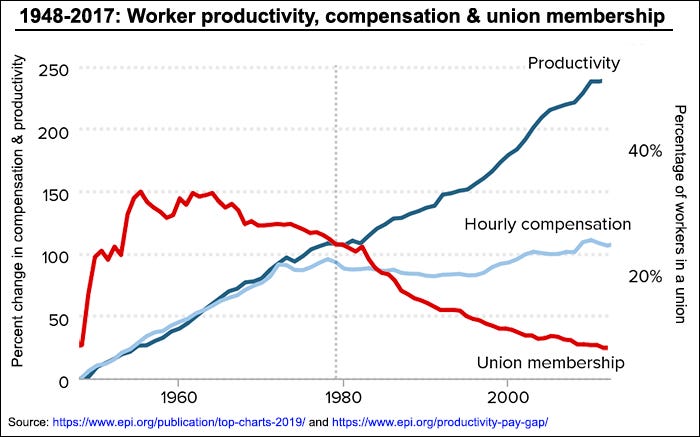
Are Working People Meeting the Moment? Prepare for Battle

https://www.weekendreading.net/p/the-trump-regimes-war-on-working

The Trump Regime’s War on Working People: The First 100 Days

Weekend Reading

How Unions are Resisting Authoritarian Attacks on Workers’ Rights—and Why It Matters for Everyone

By Michael Podhorzer

Apr 28, 2025

Over the course of the first 100 days, appropriate attention has been paid to Trump’s attacks on the judiciary, law firms, universities, philanthropy, non-profit groups and the media as dangerous in their own right, but more importantly as essential elements of authoritarian consolidationYet almost no one has mentioned the attacks on an equally proven constraint on oligarchy and autocracy: unions. Trump and Elon Musk’s destructive ransacking of our government should remind us of what previous generations of Americans understood intuitively: that “we may have democracy, or we may have wealth concentrated in the hands of a few, but we cannot have both,” as Supreme Court Justice Louis Brandeis put it. Like other attacks on civil society, the Trump regime’s attacks on unions and working people do not just injure those directly targeted, but all of us, as the labor movement is one of the most essential bulwarks against authoritarianism.

I’ve covered the indispensable role of unions in creating and protecting democracy and freedom in earlier Weekend Readings (Oligarchs Understand Power. Do We?As Go Unions, So Goes AmericaMore Than the Weekend: Unions, the Past and the Future of Democracy, and Then they came for the trade unionists).

If we all have a stake in unions as bulwarks against authoritarianism whether we belong to one or not, the same is true because of how unions foster shared prosperity and a healthy society, which I elaborate on here and here. In that regard, it is crucial to recognize the Trump actions as coming from the same playbook as Reagan’s decisive firing of over 11,000 striking air traffic controllers. It was more than punitive—it communicated a clear, aggressive stance against unions nationwide. The immediate aftermath saw corporate America follow Reagan’s lead, significantly increasing anti-union activities and adopting overt union-busting strategies.1 Reagan further entrenched anti-unionism by reshaping the NLRB into a body less protective of labor rights, reversing precedents that had previously safeguarded union activities.2

As it did then, today’s federal war on working people comes at a key inflection point. Then it was the rush to globalization, coupled with financialization and deindustrialization. Now it is the imminent transition to artificial intelligence in the workplace. Musk’s firings are providing a new playbook for that transition—fire everyone so as to be able to start from scratch with AI with as little friction from a legacy workforce as possible. And, although not the topic today, it’s important to note here that with respect to DOGE cleaning house to make way for AI, it’s also cleaning house to make way for even more of the government to be privatized—providing a vast market for the tech companies’ AI products and services. Although this future is not certain, it seems to be Musk’s plan: first trash the government, then when the government fails, privatize.

Today, I’ll lay out some of the most egregious actions taken by the Trump regime in the first 100 days to attack unions and working people in both the public and private sectors. Much of this is based on indispensable research by the Economic Policy Institute and its just released 100 Days, 100 Ways Trump Hurt Workers. (For more great reports like this, you can subscribe to EPI here.)

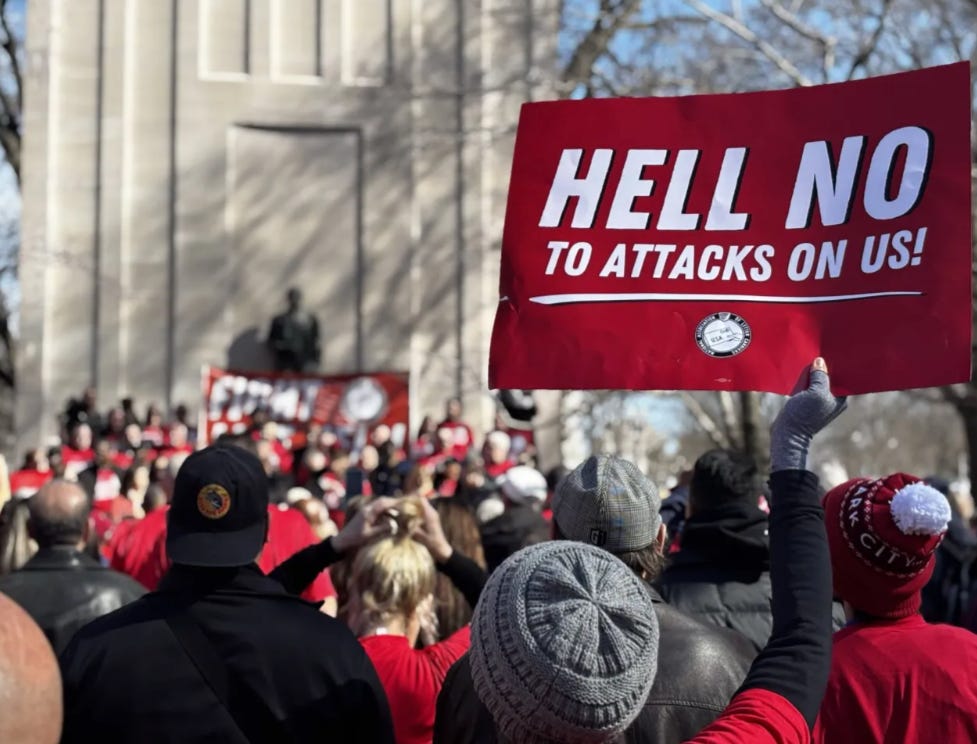
Then I’ll document the robust pushback unions are mounting against the Trump regime’s war on working people in the courts. Unions have also been in the forefront of mobilizing public action, most notably the AFL-CIO’s Department of People Who Work for a Living, which in addition to leading and participating in protests3, has organized town halls across the country.4 AFL-CIO President Liz Shuler declared:

The labor movement is not about to let Trump and an unelected billionaire destroy what we’ve fought for generations to build. We will fight this outrageous attack on our members with every fiber of our collective being.

And, significantly, even sectors mistakenly thought to be pro-Trump like the Building Trades powerfully responded to Trump’s executive order eviscerating collective bargaining for federal workers:

This executive order is an unprecedented assault on worker freedom and a direct attack on those fundamental rights. Americans know that patriotic blue-collar workers built this country, not billionaires. They also know that one of the last best chances to make it to the middle class is collective bargaining. NABTU and our affiliated unions will stand shoulder to shoulder with the entire labor movement to fight this head-on — and we will not back down.

Continue reading Are Working People Meeting the Moment? Prepare for Battle

Hundreds of Protesters March in Downtown Pittsburgh on President’s Day


By Mars Johnson

Pittsburgh City Paper


Several hundreds gathered outside of the William S. Moorhead Federal Building this afternoon to protest as part of the national 50501 “No King’s Day” demonstrations on President’s Day.

Protesters marched downtown, calling out President Trump and Elon Musk, chanting, “Not my president” and “Human rights are meant for all.”

The demonstration lasted for over an hour, ending in front of the City Council building where organizers offered participants important election information and petitions to sign.

Slideshow of 21 Photos:

https://www.pghcitypaper.com/pittsburgh/hundreds-of-protesters-march-downtown-on-presidents-day/Slideshow/27527895/27527916#:~:text=President%27s%20Day%202025.-,PLAY%20SLIDESHOW,-Several%20hundreds%20gathered

‘We Are Going To Save Ourselves’: Anti-Trump Crowd Gathers At PA Capitol In 50501 Rally

Photo; PA Rep Malcolm Kenyatta speaking to protestors in Harrisburg. By Bethany Rodgers

  • Protests against President Trump and his agenda, including the involvement of Elon Musk, took place nationwide.
  • Many protestors believe there is a renewed sense of urgency to oppose Trump’s policies in his second term.

By Bethany Rodgers
USA TODAY NETWORK

Feb. 5, 2025 – HARRISBURG — Scores of protestors gathered outside the Pennsylvania state capitol Wednesday as part of nationwide demonstrations against President Donald Trump’s administration and the Project 2025 agenda.

The gathering was part of a nationwide wave of protests coordinated by the 50501 movement, short for “50 Protests, 50 States, One Day.” In Pennsylvania, demonstrations were also planned for Philadelphia and Pittsburgh.

Attendees waved signs calling for Trump’s impeachment, rainbow banners and American flags. A number of them also aimed their ire at Elon Musk, the billionaire who has assailed federal government agencies in recent days with the immense powers Trump has granted him.

Mari-Beth DeLucia, of Harrisburg, said she knows someone who works for the U.S. Agency for International Development, a government humanitarian arm that Musk has called a “criminal” organization and sought to dismantle. Employees at the agency are being placed on administrative leave, and Trump’s team has frozen foreign aid distributed by the office.

The damage Trump and Musk are doing will reverberate through charities, businesses and communities across the U.S., DeLucia predicts. But up to this point, she thinks people have been too stunned to mount the type of protests that spilled into the street when Trump was elected for his first term in 2016.

“Why aren’t we marching? Where is everybody?” DeLucia said she’s wondered lately. “I think it was kind of shell shock.”

More:’Don’t let democracy die’: Anti-Trump protesters rally in cities across US

She’s hopeful that Wednesday’s gathering is a sign that people are again raising their voices.

Savannah Bellem, a volunteer who brought snacks and drinks to the Harrisburg demonstration, said it was her first time participating in a protest. Back in 2016, she thought the answer was to wait out Trump’s term.

Pennsylvania Rep. Malcolm Kenyatta, D-Philadelphia, speaks to a group of protestors in Harrisburg, Pennsylvania, on Feb. 5, 2025. The demonstration against President Donald Trump’s administration was part of nationwide rallies coordinated by the 50501 movement.
“It’s four years — what can happen?” the New Cumberland resident remembers telling her husband.

She now sees that attitude as naive, and this time around she feels a heightened sense of urgency. A gay couple in her family are frightened they could lose their child. She said she is angry that her young daughter now has fewer rights than she did at the same age.

“We’re not going to stand for it,” she said. “We need to get back more into taking care of our community and each other.”

State Rep. Malcolm Kenyatta also emphasized the importance of local action in a speech to the crowd, urging them to focus on city councils and school boards in addition to politicians in Washington, D.C.

“There is no one, and I mean it, no one, coming to save us,” the Philadelphia Democrat said. “But here is the good news, my friends: We are going to save ourselves.”

Bethany Rodgers is a USA TODAY Network Pennsylvania capital bureau investigative journalist.

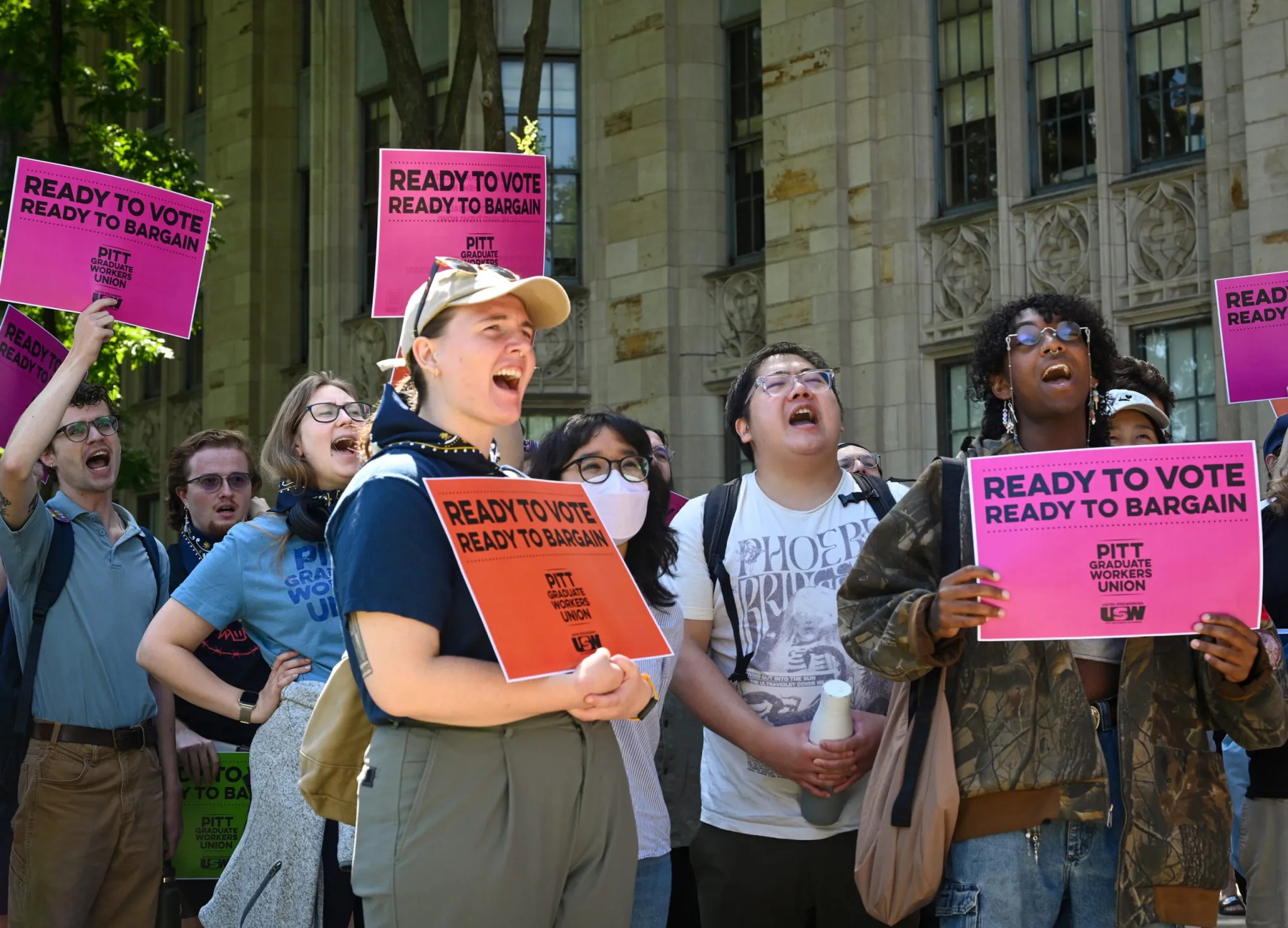
Five Years After Failed Vote, Pitt Grad Students Unionize

The University of Pittsburgh’s graduate student workers narrowly declined unionization in 2019, but this week’s overwhelming vote has the Oakland campus riding a wave of higher ed organizing.

By Maddy Franklin

Public Source

Nov 22, 2024 – Throughout the week, more than 1,000 graduate student workers at the University of Pittsburgh made their way to a nondescript ballroom in the O’Hara Student Center to vote on whether to unionize.

Supporters sought everything from more transparency on the part of university administration to pay equity, better vacation time and health insurance.

The line outside the ballroom stretched, at times, down the stairs of the center. “People are so excited … I’ve never seen engineers this excited,” said Lauren Wewer, a materials science and engineering Ph.D. student and organizer at Pitt.

On Friday, organizers announced the results: a 1033-28 vote to unionize with the United Steelworkers [USW]. The Pennsylvania Labor Relations Board had not yet confirmed the vote count as of mid-afternoon.

With this win, Pitt grad student workers become the latest employees to undergo a successful union bid at a U.S. higher education institution, continuing an upward trend in the sector’s organizing activity over the last few years. They also join faculty and staff at the university which unionized with the USW in 2021 and September, respectively.

Pat Healy, an information science Ph.D. student at Pitt, said the wide margin of support reflected in the vote, “aligns with how most of the grad union votes [in the country] have gone the last couple of years.”
Healy has been organizing at the university since 2019, which was the last time grad student workers attempted to unionize. Then, the pro-union students lost by fewer than 40 votes. For them, the impact of this year’s vote stretches beyond Pitt’s campus.

“I’m happy for the movement [and] looking forward to some other grad unions popping up, I’m sure inspired by us, because that always happens,” Healy said.

After Thanksgiving, they said organizers will begin setting up for bargaining with Pitt’s administration.

In a statement after the vote count, the university said, “While first contract negotiations can be complex, please know that we will come to the table in good faith and be there to support all graduate students throughout and beyond the process.”

Immediately following the loss in 2019, any efforts to restart conversations about unionizing would meet with “a kind of extreme hesitancy,” Healy said, blaming “a lack of understanding of what a union was.”

This year felt different, Healy said. There are likely a few reasons why.

Five years after failed vote, Pitt grad students unionize
EQT’s ‘bulldog’ has D.C. in his grip, with profits — and maybe higher gas bills — on the horizon

A wave of change

From 2021 to 2023, nearly 64,000 U.S. grad student workers joined unions. By comparison, only 20,394 students unionized from 2013 through 2020. Today, four in 10 grad student employees belong to labor groups.

This trend was, experts say, driven in part by the pandemic and by the administration change from Donald Trump to Joe Biden in 2021, which ushered in a National Labor Relations Board more amenable to organizers.

Adrienne Eaton, professor of labor studies and employment relations at Rutgers University, noticed COVID-19-driven layoffs and research funding losses on campus in New Jersey that eventually led to a faculty and grad student strike last year. She describes this time as an “active moment” in American higher ed, with students advocating for change across the board at universities and colleges. And with grad students, there’s another factor at play: “The faltering job market in academia.”

“A high percentage of students no longer [are] confident that they have a future as tenure-track professors, in particular, or potentially as academic faculty at all,” Eaton said. “So, I think it really changes the way that graduate students look at their assistantships that they get.”

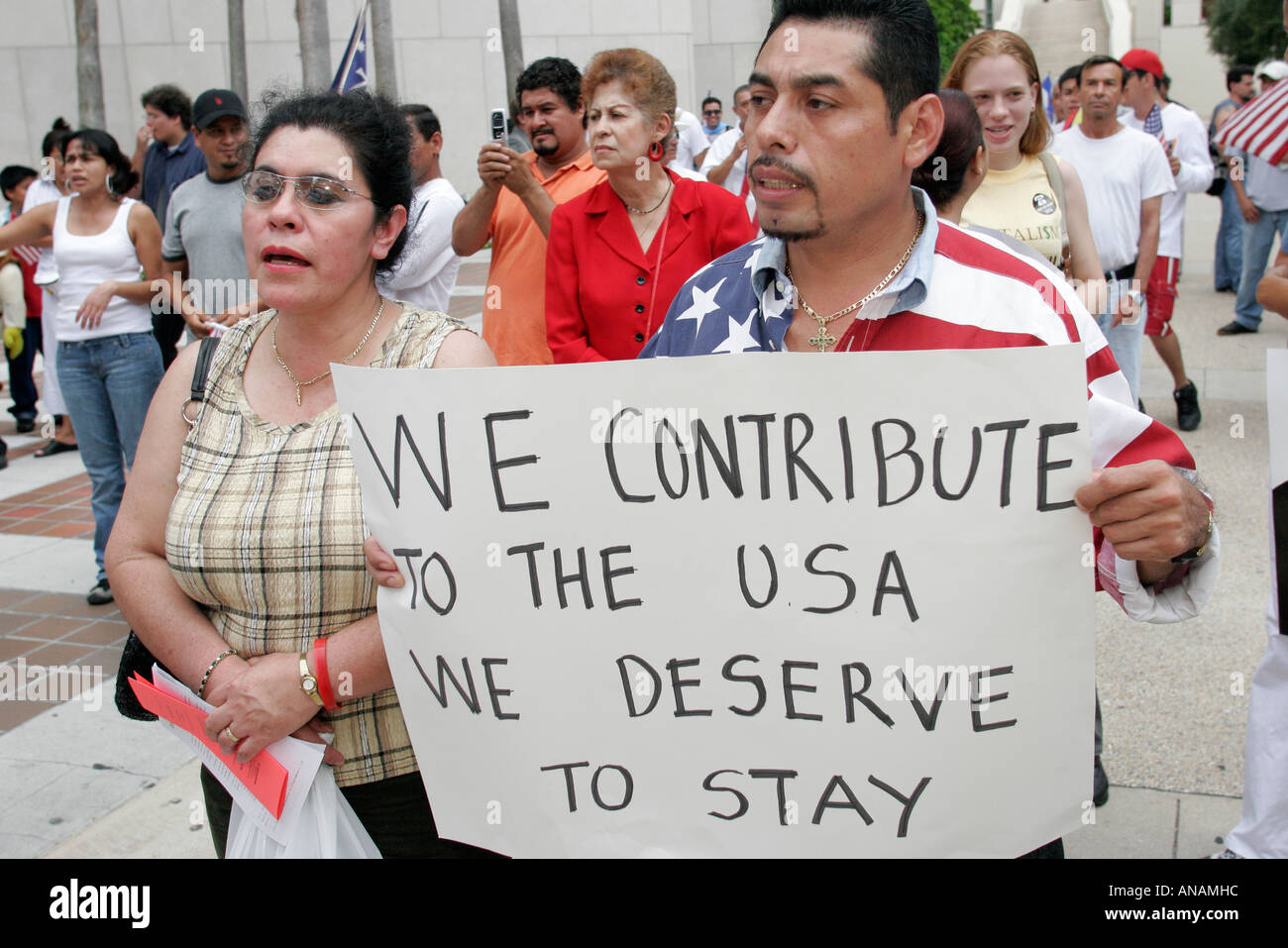
Trump Administration’S Mass Deportation Plan Would Hurt Pennsylvania, Immigrant Advocates Warn

They urged Democratic lawmakers to pass legislation to make the commonwealth more welcoming

By: Peter Hall

Penncapitol-Star

Nov 14, 2024 – President-elect Donald Trump’s plan to carry out mass deportations of undocumented immigrants would lead to population loss, exacerbate workforce shortages and increase tax burdens for Pennsylvania residents and businesses, the Democratic state lawmakers heard Wednesday.

Advocates for the immigrant community testified before the state House Democratic Policy Committee that although the federal government maintains exclusive authority over immigration policy, which is expected to take a draconian shift under a second Trump administration, state lawmakers can make Pennsylvania a more welcoming place.

“It’s been laid out very clearly. Unfortunately, it’s going to be immigrant detention and deportations on the horizon,” Julio Rodriguez, political director of the Pennsylvania Immigration and Citizenship Coalition, said. “So now it’s crucial that this legislature not only has welcoming policies to support immigrants, but to fight back against these proposals.”

The hearing on the last day of the 2023-2024 legislative session was convened by state Rep. Danilo Burgos (D-Philadelphia), who serves as chairperson of the Pennsylvania Legislative Latino Caucus.

Pennsylvania ranks fourth in the nation in population loss, Rodriguez said. In 2021, the net decrease in population between births and deaths was more than 23,000.

“We didn’t see that impact, because net international migration, also known as immigrants moving here, was 25,721,” Rodriguez said “Had it not been for immigrants, we would have seen a drastic population decline.”

A state’s population determines its number of representatives in Congress. Rodriguez noted that Pennsylvania lost one congressional seat after the 2020 census and could lose another in 2030. It would also result in Pennsylvania receiving less federal funding.

But more immediately, the loss of a portion of the commonwealth’s 978,000 immigrant residents would worsen the labor shortage in the agricultural sector, driving up grocery store prices. Undocumented workers also contribute billions in taxes and in the state’s gross domestic product, Rodriguez said.

Trump ‘Sold Out Southwestern Pennsylvania’ With Recent Trade Deal

Sara Innamorato:  Our Democratic Socialist in Harrisburg  Sticking Up for All of Us.

By Sara Innamorato
Pittsburgh City Paper

Frb 14, 2020 – Everyone who grows up in Pittsburgh can narrate the rise and fall of the steel industry: the mills grew as immigrants arrived to take jobs in the blast furnaces, then the Great Strike occurred where industry titans ordered deadly violence upon workers calling for better wages and working conditions; later, the series of federal trade agreements were created, culminating with the North American Free Trade Agreement (NAFTA), that sold out the workers and shut down the mills.

Our city’s population declined by half. Our family-sustaining union jobs crumbled, and our neighborhoods with them. But Pittsburghers are tough — we don’t like to complain, we’ve seen worse. And so we persevered and we adapted, and now Pittsburgh is widely seen as a success story. There is a sense of collective pride in our story of resiliency.

But as I knocked on doors during my 2018 bid for office, my neighbors told a more nuanced story. They told me they were working harder, but making less — getting by day-to-day was a stretch. They told me they were worried about their futures and their children’s futures.

The voters I spoke with, like so many of us in Southwestern Pennsylvania, had watched as previous trade agreements, like NAFTA, pushed local jobs overseas and drove down wages for the jobs that remained. People were fed up, and many voted for President Trump because he said he would “never sign any trade agreement that hurts our workers.”

I am no supporter of President Trump, but for the sake of the people I represent in Allegheny County, I had hoped this was a promise he would keep. Unfortunately, when he signed the United States Mexico Canada Agreement (USMCA) on Wednesday, he broke that promise, betrayed those voters, and sold out Southwestern Pennsylvania.

Continue reading Trump ‘Sold Out Southwestern Pennsylvania’ With Recent Trade Deal

The Return of the Strike

The picketing GM workers and impending Chicago Teachers Union action suggest a dramatic revival of striking as a tactic.

By Sarah Jaffe
The Progressive

Oct 8, 2019 – Friday night on the picket line at the General Motors facility in Langhorne, Pennsylvania involved pizza reheated over a firepit, supporters dropping by with beers and snacks, and a dance party to Carly Rae Jepsen.

It was the eighteenth day of the strike, which shows no signs of ending as of this writing. Spirits were surprisingly high despite the cold. Strikers in their UAW shirts and supporters were cutting up pallets for firewood, and planning a potluck for the following weekend. “Maybe it’ll be a victory celebration!”

The strike at GM, now at twenty-three days the longest in decades at an American auto manufacturer, came as a surprise even to longtime labor observers like me. Certainly, the workers have ample reasons for anger. GM’s CEO made $21.87 million last year while the workforce is splintered into tiers (new hires who do the same work get paid less than longtime employees) and dotted with permatemps. But because the action of the strike has been all but dead in U.S. manufacturing for decades, a massive strike at one of the Big Three car companies has seemed like a pipe dream.

Yet now, the workers are dug in, holding picket lines twenty-four hours a day and determined to see the end of the tiered system and the use of temps, and a revived though still small left is determined to show solidarity.

Of course, we’re still nowhere near the strike frequency levels seen before Ronald Reagan’s crushing of the air traffic controllers’ union in 1981. Acts of rebellion in recent years have been more likely to be occupations, uprisings, the kinds of dispersed mass protests that spread virally from city to city, as in the Occupy movement and the Movement for Black Lives. The Trump era brought back the mass march, alongside more disruptive actions like the airport protests in response to the Muslim ban. But the strike, long considered gone, is creeping back into favor.

Chicago Teachers Took the Lead

It was the Chicago Teachers Union in 2012 that revived the strike in dramatic fashion, defeating state and city officials determined to make teachers’ strikes a thing of the past. In the process, it provided a template for a reshaping of public sector unions that have allowed those unions to survive the 2018 Janus decision, which ruled that union fees in the public sector are unconstitutional. The teachers struck “for the schools Chicago students deserve,” and rallied the community to their side. They reminded us all what it looks like when city streets are filled with workers making demands. Continue reading The Return of the Strike

Sisters of St. Joseph Work with Migrants at U.S.-Mexico Border

Setting an Example of Solidarity with Workers and the Poor

By Daveen Rae Kurutz
Beaver County Times

Aug 10, 2019 – A group of nuns and volunteers from the Sisters of St. Joseph in Baden is working with migrant families and children at the U.S.-Mexico border in Texas.

They called him a liar.

For months, the Venezuelan man waited patiently with his wife and three children for permission to leave their home country, riddled with political unrest and economic free fall in the midst of a humanitarian crisis. Once granted, the family waited for months in Mexico for consent to enter the United States as asylum seekers.

It was a long and difficult journey.

Just hours after finally crossing the border into the United States, he sat last week with Sister Janice Vanderneck, a member of the Sisters of St. Joseph in Baden, at the Catholic Charities of the Rio Grande Valley Humanitarian Respite Center in McAllen, Texas.

“What a privilege it is to be able to be among the first people to welcome this family to our country,” Vanderneck said. “I was glad to be the person empathetic to their story because he told me that immigration officials called him a liar, thinking that he didn’t understand English.”

For one week, three members of St. Joseph — Sister Jeanette Bussen, Sister Patti Rossi and Vanderneck — are working at the respite center in McAllen to meet and serve migrant families seeking asylum. They are accompanied by Maureen Haggarty, former sister and benefactor, and Carol McCracken, who was inspired by the service and mission work of Rossi.

The respite center is the first stop for those released from a nearby U.S. Customs and Border Patrol holding center. Each day, the respite center serves between 500 and 900 families, providing migrants in crisis with a warm meal, clean clothes and a chance to recover from the first part of their long journeys.

How to help

The Sisters of St. Joseph in Baden has donated more than $10,000 to help replenish supplies at the Catholic Charities of the Rio Grande Valley Humanitarian Respite Center in McAllen, Texas. Items include toiletries, baby bottles, diapers, sealed snack foods and phone cards.

To donate, visit https://stjoseph-baden.salsalabs.org/bordercrisis/index.html.

The center’s volunteers work to educate parents about their rights and responsibilities as asylum seekers and help prepare them to navigate the legal process to determine whether they can remain in the United States. Continue reading Sisters of St. Joseph Work with Migrants at U.S.-Mexico Border

Erie, PA: Close To 2,000 Manufacturing Workers Just Went On Strike

After a merger with GE Transportation, the new employer “wants to turn this into an Amazon warehouse,” the union says. ..Bernie Sanders backs strikers

By Dave Jamieson
Huffington Post

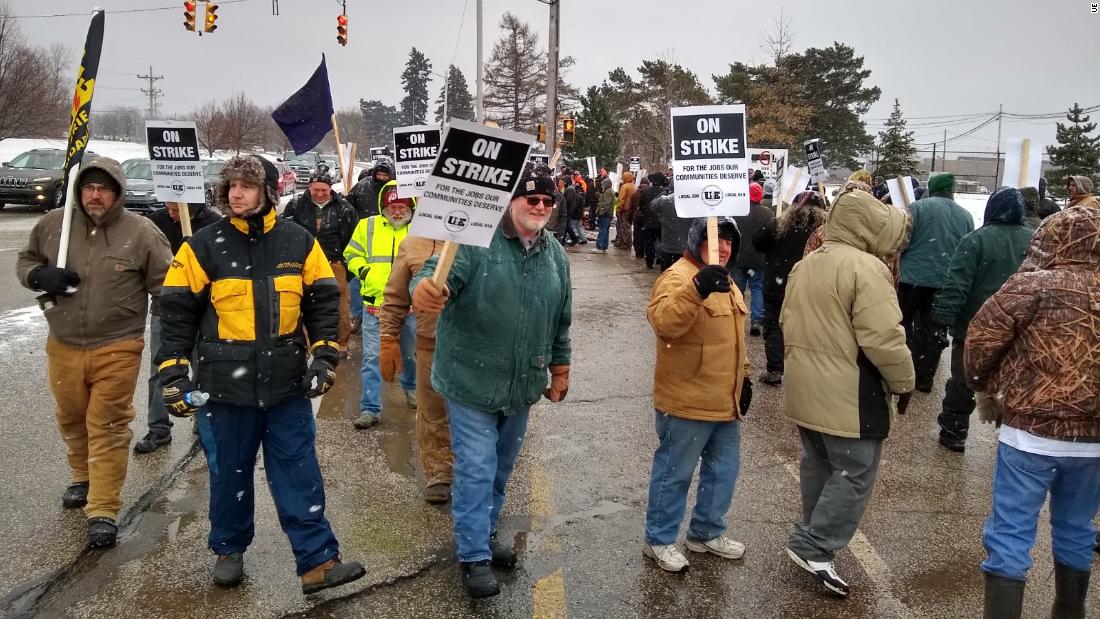
Feb 26, 2019 – Nearly 1,700 workers at a GE Transportation plant in Erie, Pennsylvania, went on strike Tuesday, marking the first large-scale work stoppage in the U.S. manufacturing sector in three years.

Union members with the United Electrical, Radio and Machine Workers of America (UE) say the factory’s incoming owner, Pennsylvania-based Wabtec Corp., is trying to impose mandatory overtime, a lower pay scale for new employees, and the use of temporary workers in the facility.

Wabtec just closed an $11 billion deal to merge with GE’s transportation division, which includes the Erie plant where locals have built locomotives for decades.

Workers authorized the union to wage a strike after they failed to secure an interim agreement with Wabtec extending the terms of their contract with GE. As the new employer at the plant, Wabtec is obligated to recognize the union but has the freedom to negotiate its own new contract.

Union members felt they needed to go on strike in order to protect the middle-class wages and high working standards inside the facility, where pay averages around $35 an hour, said Jonathan Kissam, a union spokesman. He added that many workers already volunteer for overtime work but don’t want it to be mandatory, fearing it could ruin weekends with their families.

He also said introducing lower pay for new hires would create a two-tier system inside the plant, causing rifts between different generations of employees.

“This is a multi-generational plant. Some of them, their grandparents worked there,” Kissam said. “So they’re unwilling to sell out their own children.” Continue reading Erie, PA: Close To 2,000 Manufacturing Workers Just Went On Strike