Tag Archives: trump

On The Ground With The Volunteers Tracking ICE Across The Pittsburgh Region

A group of people and a dog stand in a circle, talking, in a parking lot at night in front of a strip mall.
Jaime Martinez, community defense organizer at Casa San José, coordinates with Rapid Response Network volunteers outside Emiliano’s Mexican Restaurant in Gibsonia on June 17, after reports that federal agents were idling nearby in unmarked vehicles.

Casa San José has trained hundreds of volunteers to monitor and respond to immigration enforcement. Public Source followed them through raids, courthouse watches and late-night calls.

Avatar photoBy Quinn Glabicki

Public Source

July 31, 2025 – As federal immigration enforcement intensifies across the country, a local response has quickly scaled up across the Pittsburgh region. In Beechview, the nonprofit Casa San José has built a Rapid Response Network of trained volunteers who monitor and document ICE activity across Allegheny County and beyond.

The network launched during the first Trump administration but has ramped up since January. As of July 30, it includes more than 250 trained volunteers — with nearly 175 more signed up for future training.

Lea este artículo en español aquí.

Casa San José, founded in 2013, focuses on immigrant rights and the Pittsburgh region’s Latino community — a mission amplified as the Trump administration rolls back protections for immigrants and directs federal resources toward a crackdown and mass deportations.

Organizers traverse city neighborhoods, gather in church basements and empty parking lots, and educate residents about their rights and federal immigration tactics. Along with trained volunteers, who are prepared to legally observe, document and accompany people at risk of being detained by Immigration and Customs Enforcement [ICE], they respond in real time to sightings, arrests and raids.

Pittsburgh’s Public Source spent more than a month embedded with Casa San José’s organizers and volunteers, tracking their efforts from the courthouse to restaurants as they responded to immigration enforcement and supported families under threat.

Photo: June 14 at the City-County Building, Downtown 

Monica Ruiz, executive director of Casa San José, speaks to thousands of people gathered in front of the City-County Building in Downtown during a day of nationwide protest against the Trump administration.

“They are disappearing our people. This is our reality. Every single day. Just because you don’t see it doesn’t mean it’s not happening. We cannot continue to allow this to happen in our communities,” said Casa San José Executive Director Monica Ruiz.

“Casa San José is the only organization on this side of the state that is doing this kind of work.” 

Ruiz said she has received five death threats since November, forcing her to relocate Casa San José’s office and to reconsider speaking publicly.

Photo: June 17 at Emiliano’s Mexican Restaurant, Gibsonia

As volunteers monitor the scene, Jaime Martinez, community defense organizer at Casa San José, speaks by phone with nine workers sheltering inside the restaurant — part of the network’s effort to document enforcement activity and support those at risk.

Sharon Bonavoglia was the first to arrive at a quiet strip mall in Gibsonia late on June 17. She had received the call because she lives nearby, and because she’s one of a growing network of volunteers responding to reports of federal immigration enforcement in and around Allegheny County.
Are Working People Meeting the Moment? Prepare for Battle

https://www.weekendreading.net/p/the-trump-regimes-war-on-working

The Trump Regime’s War on Working People: The First 100 Days

Weekend Reading

How Unions are Resisting Authoritarian Attacks on Workers’ Rights—and Why It Matters for Everyone

By Michael Podhorzer

Apr 28, 2025

Over the course of the first 100 days, appropriate attention has been paid to Trump’s attacks on the judiciary, law firms, universities, philanthropy, non-profit groups and the media as dangerous in their own right, but more importantly as essential elements of authoritarian consolidationYet almost no one has mentioned the attacks on an equally proven constraint on oligarchy and autocracy: unions. Trump and Elon Musk’s destructive ransacking of our government should remind us of what previous generations of Americans understood intuitively: that “we may have democracy, or we may have wealth concentrated in the hands of a few, but we cannot have both,” as Supreme Court Justice Louis Brandeis put it. Like other attacks on civil society, the Trump regime’s attacks on unions and working people do not just injure those directly targeted, but all of us, as the labor movement is one of the most essential bulwarks against authoritarianism.

I’ve covered the indispensable role of unions in creating and protecting democracy and freedom in earlier Weekend Readings (Oligarchs Understand Power. Do We?As Go Unions, So Goes AmericaMore Than the Weekend: Unions, the Past and the Future of Democracy, and Then they came for the trade unionists).

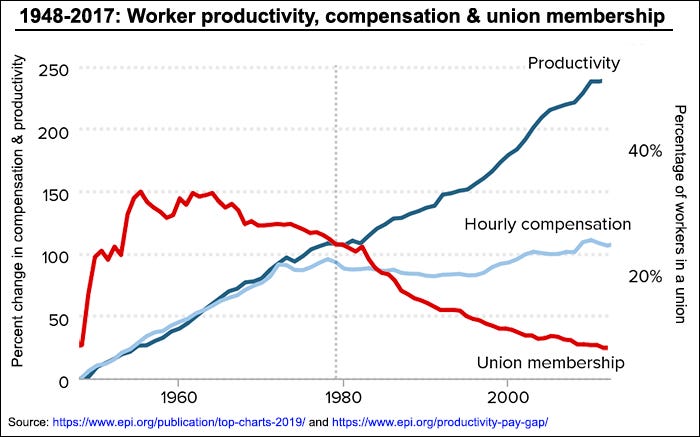
If we all have a stake in unions as bulwarks against authoritarianism whether we belong to one or not, the same is true because of how unions foster shared prosperity and a healthy society, which I elaborate on here and here. In that regard, it is crucial to recognize the Trump actions as coming from the same playbook as Reagan’s decisive firing of over 11,000 striking air traffic controllers. It was more than punitive—it communicated a clear, aggressive stance against unions nationwide. The immediate aftermath saw corporate America follow Reagan’s lead, significantly increasing anti-union activities and adopting overt union-busting strategies.1 Reagan further entrenched anti-unionism by reshaping the NLRB into a body less protective of labor rights, reversing precedents that had previously safeguarded union activities.2

As it did then, today’s federal war on working people comes at a key inflection point. Then it was the rush to globalization, coupled with financialization and deindustrialization. Now it is the imminent transition to artificial intelligence in the workplace. Musk’s firings are providing a new playbook for that transition—fire everyone so as to be able to start from scratch with AI with as little friction from a legacy workforce as possible. And, although not the topic today, it’s important to note here that with respect to DOGE cleaning house to make way for AI, it’s also cleaning house to make way for even more of the government to be privatized—providing a vast market for the tech companies’ AI products and services. Although this future is not certain, it seems to be Musk’s plan: first trash the government, then when the government fails, privatize.

Today, I’ll lay out some of the most egregious actions taken by the Trump regime in the first 100 days to attack unions and working people in both the public and private sectors. Much of this is based on indispensable research by the Economic Policy Institute and its just released 100 Days, 100 Ways Trump Hurt Workers. (For more great reports like this, you can subscribe to EPI here.)

Then I’ll document the robust pushback unions are mounting against the Trump regime’s war on working people in the courts. Unions have also been in the forefront of mobilizing public action, most notably the AFL-CIO’s Department of People Who Work for a Living, which in addition to leading and participating in protests3, has organized town halls across the country.4 AFL-CIO President Liz Shuler declared:

The labor movement is not about to let Trump and an unelected billionaire destroy what we’ve fought for generations to build. We will fight this outrageous attack on our members with every fiber of our collective being.

And, significantly, even sectors mistakenly thought to be pro-Trump like the Building Trades powerfully responded to Trump’s executive order eviscerating collective bargaining for federal workers:

This executive order is an unprecedented assault on worker freedom and a direct attack on those fundamental rights. Americans know that patriotic blue-collar workers built this country, not billionaires. They also know that one of the last best chances to make it to the middle class is collective bargaining. NABTU and our affiliated unions will stand shoulder to shoulder with the entire labor movement to fight this head-on — and we will not back down.

Continue reading Are Working People Meeting the Moment? Prepare for Battle

I’m a Rust Belt Democrat From a Swing District. Anti-Tariff Absolutism Is a Mistake.

A black-and-white photograph of a car’s rearview mirror showing an industrial plant.
Credit…Eli Reed/Magnum Photos

By Chris Deluzio

Mr. Deluzio represents Pennsylvania’s 17th Congressional District.

The New York Times Op-Ed

March 7, 2025 – Democrats have wasted no time rejecting President Trump’s tariffs as “damaging” and “unnecessary.” My colleagues have lampooned them as “irresponsible,” “bad economics” and purely a tax on consumers. This anti-tariff absolutism is a mistake.

I’m a Rust Belt Democrat from a swing district in Western Pennsylvania — where lousy trade deals like NAFTA stripped us for parts.

Many of my constituents support smart tariffs, particularly ones that target China, and so do I. Watching my colleagues on the Hill, it’s clear we’re missing the mark. Democrats need to break free from the wrong-for-decades zombie horde of neoliberal economists who think tariffs are always bad.

Mr. Trump’s tariff approach has been chaotic and inconsistent. There’s no doubt about that. But the answer isn’t to condemn tariffs across the board. That risks putting the Democrats even further out of touch with the hard-working people who used to be the lifeblood of the party — people like my constituents.

Instead, Democrats should embrace tariffs as one component of a broader industrial strategy to revitalize American manufacturing and make whole communities that have been hollowed out by decades of bad trade policy. This isn’t just about making the economy work for more Americans; it’s also about earning back the trust and faith of the people we need to win elections and who ought to be at the heart of the Democratic Party.

Since the 1990s, presidents from both parties pushed trade agreements that were great for corporate bosses and their Wall Street overlords, but a disaster for districts like mine. American companies offshored production to take advantage of cheap labor in countries like Mexico, which for decades have crushed independent unions to keep wages rock bottom. Later, firms shifted production to China and Vietnam, which are often called out for employing beggar-thy-neighbor tactics like wage suppression, enormous subsidies and currency manipulation to jack up their exports.

For too long, we absorbed these unfair imports and created a chronic trade deficit that deindustrialized our nation and fueled income inequality. In 2004, the grandfather of modern trade economics, Nobel Laureate Paul Samuelson, revealed how offshoring could cost American workers more in relative wages than they gained from cheaper imported goods, making the current trade regime a bad deal for most Americans.

Tariffs are one of a few tools that can break this cycle: They force mercantilist countries to increase their domestic consumption of what they produce because they can no longer dump it in the United States. Increasingly, policymakers — of all political stripes — recognize that tariffs can help protect industries that are key to our economic and national security, boost American production and wages, and safeguard workers’ rights as well as our air and water by incentivizing firms to raise their labor and environmental standards.

If you oppose all tariffs, you are essentially signaling that you are comfortable with exploited foreign workers making your stuff at the expense of American workers. I am not and neither are most voters. Many polls show that Americans — especially the three-fifths without college degrees — support tariffs in part, economists have suggested, because communities harmed by global competition view them “as a sign of political solidarity.” The Biden administration, to its credit, tripled tariffs on Chinese steel and aluminum imports. So, why is the Democrats’ only message on tariffs that they raise prices? That was the play during the 2024 election and it flopped. Just last month, a CBS poll found that a majority of Americans one, thought Mr. Trump was not focused enough on lowering prices, two, believed that tariffs could increase prices and three, still wanted tariffs on China.

Rather than reflexively condemning all tariffs, Democrats should be highlighting how Mr. Trump’s scattershot threats, unanchored to any real industrial strategy, will not deliver on the goals of rebuilding American manufacturing, raising wages or rebalancing trade.

For one thing, tariffs are effective only when used in a predictable and stable way — and the Trump administration’s approach has been anything but. On Feb. 1, Mr. Trump announced he was imposing new 10 percent tariffs on China and fixing part of a trade scam that allows four million packages to enter the United States daily without facing tariffs, taxes or meaningful inspection — simply because they’re labeled “low value.” Not only does this “de minimis” loophole undermine U.S. producers and retailers, but traffickers also often exploit it to sneak in deadly fentanyl-laced pills and fentanyl precursor chemicals. Days after his announcement, Mr. Trump flip-flopped and reopened the loophole. He raised China tariffs another 10 percent on March 4 — good! But still, the loophole means billions in Chinese imports can evade tariffs and inspections.

Mr. Trump’s chaotic tariff two-step — imposing, delaying, threatening and then again imposing tariffs, including on allies like Canada with whom we mainly have balanced trade — is bad business for America. Entrepreneurs ready to invest in production here sit on the sidelines, wondering where the tariff roller coaster will stop. (Continued)

‘We Are Going To Save Ourselves’: Anti-Trump Crowd Gathers At PA Capitol In 50501 Rally

Photo; PA Rep Malcolm Kenyatta speaking to protestors in Harrisburg. By Bethany Rodgers

  • Protests against President Trump and his agenda, including the involvement of Elon Musk, took place nationwide.
  • Many protestors believe there is a renewed sense of urgency to oppose Trump’s policies in his second term.

By Bethany Rodgers
USA TODAY NETWORK

Feb. 5, 2025 – HARRISBURG — Scores of protestors gathered outside the Pennsylvania state capitol Wednesday as part of nationwide demonstrations against President Donald Trump’s administration and the Project 2025 agenda.

The gathering was part of a nationwide wave of protests coordinated by the 50501 movement, short for “50 Protests, 50 States, One Day.” In Pennsylvania, demonstrations were also planned for Philadelphia and Pittsburgh.

Attendees waved signs calling for Trump’s impeachment, rainbow banners and American flags. A number of them also aimed their ire at Elon Musk, the billionaire who has assailed federal government agencies in recent days with the immense powers Trump has granted him.

Mari-Beth DeLucia, of Harrisburg, said she knows someone who works for the U.S. Agency for International Development, a government humanitarian arm that Musk has called a “criminal” organization and sought to dismantle. Employees at the agency are being placed on administrative leave, and Trump’s team has frozen foreign aid distributed by the office.

The damage Trump and Musk are doing will reverberate through charities, businesses and communities across the U.S., DeLucia predicts. But up to this point, she thinks people have been too stunned to mount the type of protests that spilled into the street when Trump was elected for his first term in 2016.

“Why aren’t we marching? Where is everybody?” DeLucia said she’s wondered lately. “I think it was kind of shell shock.”

More:’Don’t let democracy die’: Anti-Trump protesters rally in cities across US

She’s hopeful that Wednesday’s gathering is a sign that people are again raising their voices.

Savannah Bellem, a volunteer who brought snacks and drinks to the Harrisburg demonstration, said it was her first time participating in a protest. Back in 2016, she thought the answer was to wait out Trump’s term.

Pennsylvania Rep. Malcolm Kenyatta, D-Philadelphia, speaks to a group of protestors in Harrisburg, Pennsylvania, on Feb. 5, 2025. The demonstration against President Donald Trump’s administration was part of nationwide rallies coordinated by the 50501 movement.
“It’s four years — what can happen?” the New Cumberland resident remembers telling her husband.

She now sees that attitude as naive, and this time around she feels a heightened sense of urgency. A gay couple in her family are frightened they could lose their child. She said she is angry that her young daughter now has fewer rights than she did at the same age.

“We’re not going to stand for it,” she said. “We need to get back more into taking care of our community and each other.”

State Rep. Malcolm Kenyatta also emphasized the importance of local action in a speech to the crowd, urging them to focus on city councils and school boards in addition to politicians in Washington, D.C.

“There is no one, and I mean it, no one, coming to save us,” the Philadelphia Democrat said. “But here is the good news, my friends: We are going to save ourselves.”

Bethany Rodgers is a USA TODAY Network Pennsylvania capital bureau investigative journalist.

Pittsburgh Mayor Ed Gainey: ‘My Administration Will Not Work With ICE’


WTAE

Jan 28, 2025

Pittsburgh Mayor Ed Gainey said during an event in Harrisburg Monday that his administration will not work with U.S. Immigration and Customs Enforcement.

Our news partners at the Trib said Gainey’s comments come amid heightened concerns from local immigrant communities about ICE raids.

“My administration will not work with ICE,” Gainey said during a Pennsylvania Press Club event Monday. “We will do whatever’s necessary to make our city more welcoming. That’s what we’re built on.”

President Donald Trump has issued “quotas for the immigration enforcement agency to ramp up arrests,” the Trib said, attributing the Washington Post. Trump’s remarks include enforcement at schools and other “sensitive sites.”

“ICE is not going to end the situation of a failed immigration policy — it’s not going to do it,” Gainey said. “What it’s going to do is create more situations where people feel scared, where people don’t feel safe, where people will do things that they normally wouldn’t do.

“If the federal government wants to be serious about what they want to do to reform the immigration law, then they need to create a pathway to citizenship.”

Vanessa Caruso, a Pittsburgh-based immigration attorney, told the Trib that she has been taking calls “all day, every day” from people who are worried about ICE actions.

“The concern is real,” she said to the Trib, and it’s growing as the Trump administration looks to crack down on immigration.

Gainey’s press secretary, Olga George, said in a statement to Pittsburgh’s Action News 4 on Monday evening that the city was unaware of any ICE raids.

“Currently, the city of Pittsburgh has no evidence of ICE activity occurring within city limits and has not been asked to assist the agency in any way,” the statement said. “ICE is a federal law enforcement agency that works outside of city control. Public Safety and the Bureau of Police will adhere to bureau policies.”

According to the Trib, the policy says city police are unable to arrest someone just to investigate their immigration status.

In a statement posted to the @PGHController X account on Tuesday, City Controller Rachael Heisler said, in part, “The Pittsburgh Bureau of Police has long upheld a policy of not arresting or detaining people solely to investigate immigration status. PBP officers are not immigration agents, and enforcing federal civil immigration warrants is not the job they’re trained to do.

“Pittsburgh police will follow procedure for criminal warrants regardless of immigration status. But under current PBP policy, police do not arrest or detain people based on civil immigration or administrative warrants in NCIC.”

Trump Administration’S Mass Deportation Plan Would Hurt Pennsylvania, Immigrant Advocates Warn

They urged Democratic lawmakers to pass legislation to make the commonwealth more welcoming

By: Peter Hall

Penncapitol-Star

Nov 14, 2024 – President-elect Donald Trump’s plan to carry out mass deportations of undocumented immigrants would lead to population loss, exacerbate workforce shortages and increase tax burdens for Pennsylvania residents and businesses, the Democratic state lawmakers heard Wednesday.

Advocates for the immigrant community testified before the state House Democratic Policy Committee that although the federal government maintains exclusive authority over immigration policy, which is expected to take a draconian shift under a second Trump administration, state lawmakers can make Pennsylvania a more welcoming place.

“It’s been laid out very clearly. Unfortunately, it’s going to be immigrant detention and deportations on the horizon,” Julio Rodriguez, political director of the Pennsylvania Immigration and Citizenship Coalition, said. “So now it’s crucial that this legislature not only has welcoming policies to support immigrants, but to fight back against these proposals.”

The hearing on the last day of the 2023-2024 legislative session was convened by state Rep. Danilo Burgos (D-Philadelphia), who serves as chairperson of the Pennsylvania Legislative Latino Caucus.

Pennsylvania ranks fourth in the nation in population loss, Rodriguez said. In 2021, the net decrease in population between births and deaths was more than 23,000.

“We didn’t see that impact, because net international migration, also known as immigrants moving here, was 25,721,” Rodriguez said “Had it not been for immigrants, we would have seen a drastic population decline.”

A state’s population determines its number of representatives in Congress. Rodriguez noted that Pennsylvania lost one congressional seat after the 2020 census and could lose another in 2030. It would also result in Pennsylvania receiving less federal funding.

But more immediately, the loss of a portion of the commonwealth’s 978,000 immigrant residents would worsen the labor shortage in the agricultural sector, driving up grocery store prices. Undocumented workers also contribute billions in taxes and in the state’s gross domestic product, Rodriguez said.

85 Pennsylvanians have been arrested to date in the Jan. 6 attack on the US Capitol

In this image from video, Alan William Byerly, center, attacks an Associated Press photographer during a riot at the U.S. Capitol in Washington, Jan. 6, 2021. On Sunday, Oct. 9, 2022, federal prosecutors recommended a prison sentence of nearly four years for Byerly, of Fleetwood, who pleaded guilty to assaulting the AP photographer and using a stun gun against police officers during a mob’s attack on the U.S. Capitol. (AP Photo/Julio Cortez, File)

By The Keystone Staff

January 4, 2024

Democracy didn’t die in Washington, D.C. on Jan. 6, 2021, despite the efforts of state Republicans like Doug Mastriano and Scott Perry, and the 85 Pennsylvanians who have been arrested to date for participating in the deadly attack on the US Capitol.

Pennsylvania is inextricably linked to the deadly Jan. 6, 2021 attack on the United States Capitol, in which five people died and dozens were seriously injured after a swarm of Donald Trump supporters — fresh from being told to “fight like hell” by the former president at a nearby “Stop the Steal” rally — descended upon the Capitol with the intent to upend democracy by any means necessary. 

Major political players in the state, such as state Sen. Doug Mastriano (R-Franklin) and US Rep. Scott Perry (R-Dauphin), allegedly played significant roles in Trump’s effort to overturn the 2020 election — a failed criminal venture that led to the attack on the Capitol. 

Mastriano was recently named in a Senate ethics complaint regarding his actions to undermine the commonwealth’s 2020 election results. He also chartered a bus on the day of the insurrection, using campaign funds, and took followers to the rally. Perry’s communications with Trump officials and Pennsylvania Republicans have placed him at the center of Trump’s efforts to overturn the commonwealth’s 2020 election results.

Then there is the role that Pennsylvanians played on the ground in the Jan. 6 attack. Some 85 Pennsylvania residents were arrested for taking part in the insurrection, tying the commonwealth with Texas for the second highest total among states. According to arrest records from the Department of Justice, 95 Floridians were arrested for participating in the attack, the highest total of any state.

To date, 52 Pennsylvanians have been sentenced, with others expected to be sentenced this month. Three died (two by suicide) while awaiting sentencing, and two others, a married couple, moved out of state before being sentenced. 

Overall, according to the DOJ, more than 1,230 defendants have been arrested in nearly all 50 states and Washington, D.C. in connection with the attack, accused of crimes ranging from trespassing, a misdemeanor, to seditious conspiracy, a felony. More than 350 cases are still pending. Around 170 people have been convicted at trial, while only two people have been fully acquitted. Approximately 710 people have pleaded guilty and among those, around 210 pleaded guilty to felony offenses.

Here’s where things stand with each of the 85 Pennsylvanians arrested to date in the Jan. 6, 2021 attack.

Terry Allen – Spring Mills

Allen was arrested in July 2023 and faces charges including entering or remaining in any restricted building or grounds without lawful authority; disorderly and disruptive conduct in a restricted building or grounds; engaging in physical violence in restricted building or on restricted grounds; obstruction of law enforcement during civil disorder; and assaulting a federal officer.

Melanie Archer – Shaler

Archer pleaded guilty in October 2022 to parading, demonstrating, or picketing in a Capitol building. She is awaiting sentencing.

Mark Roderick Aungst – South Williamsport

Aungst pleaded guilty in June 2022 to one count of parading, demonstrating, or picketing in a Capitol building. He died by suicide in July 2022 while awaiting sentencing.

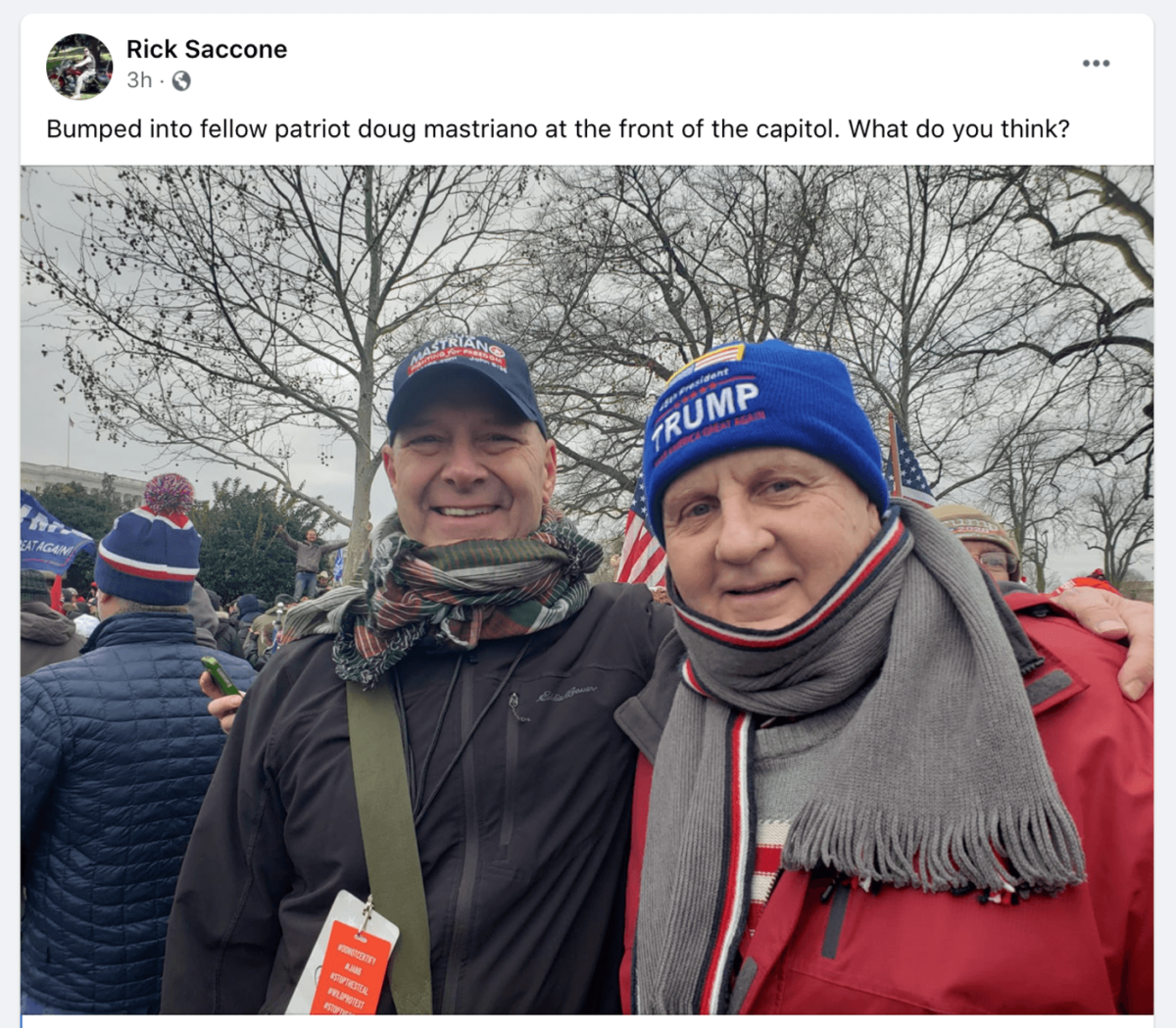
State Sen. Doug Mastriano and former state Rep. Rick Saccone, outside the US Capitol, Jan. 6, 2021 (Facebook screen grab).

Dawn Bancroft – Doylestown

Bancroft was sentenced in July 2022 to 60 days of incarceration, three years of probation, 100 hours of community service, and $500 in restitution for charges including disorderly and disruptive conduct in a restricted building or grounds.

Steven Boyd Barber – Scranton

Barber was arrested in July 2023 and faces charges including entering and remaining in a restricted building or grounds; disorderly and disruptive conduct in a restricted building or grounds; disorderly conduct in a Capitol building or grounds; and parading, demonstrating, or picketing in a Capitol building.

Pauline Bauer – Kane

Bauer pleaded not guilty in May 2021 to charges including obstruction of justice and Congress. Bauer was near then-House Speaker Nancy Pelosi’s office suite during the riot when she yelled at police officers to bring out the California Democrat so the mob of Donald Trump supporters could hang her. She was sentenced in January 2023 to more than two years in prison.

Continue reading 85 Pennsylvanians have been arrested to date in the Jan. 6 attack on the US Capitol