Category Archives: trade unions

Are Working People Meeting the Moment? Prepare for Battle

https://www.weekendreading.net/p/the-trump-regimes-war-on-working

The Trump Regime’s War on Working People: The First 100 Days

Weekend Reading

How Unions are Resisting Authoritarian Attacks on Workers’ Rights—and Why It Matters for Everyone

By Michael Podhorzer

Apr 28, 2025

Over the course of the first 100 days, appropriate attention has been paid to Trump’s attacks on the judiciary, law firms, universities, philanthropy, non-profit groups and the media as dangerous in their own right, but more importantly as essential elements of authoritarian consolidationYet almost no one has mentioned the attacks on an equally proven constraint on oligarchy and autocracy: unions. Trump and Elon Musk’s destructive ransacking of our government should remind us of what previous generations of Americans understood intuitively: that “we may have democracy, or we may have wealth concentrated in the hands of a few, but we cannot have both,” as Supreme Court Justice Louis Brandeis put it. Like other attacks on civil society, the Trump regime’s attacks on unions and working people do not just injure those directly targeted, but all of us, as the labor movement is one of the most essential bulwarks against authoritarianism.

I’ve covered the indispensable role of unions in creating and protecting democracy and freedom in earlier Weekend Readings (Oligarchs Understand Power. Do We?As Go Unions, So Goes AmericaMore Than the Weekend: Unions, the Past and the Future of Democracy, and Then they came for the trade unionists).

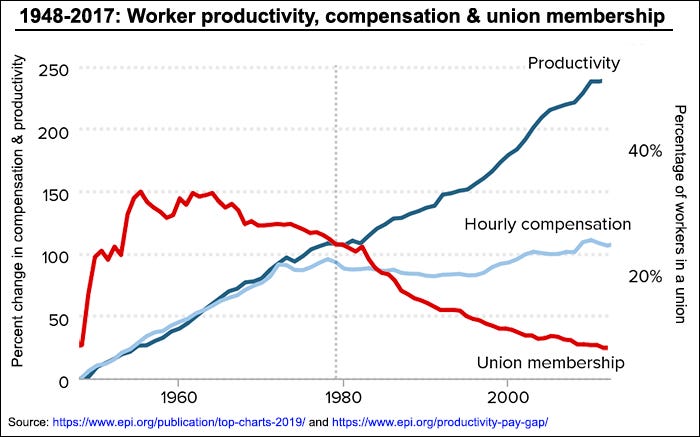
If we all have a stake in unions as bulwarks against authoritarianism whether we belong to one or not, the same is true because of how unions foster shared prosperity and a healthy society, which I elaborate on here and here. In that regard, it is crucial to recognize the Trump actions as coming from the same playbook as Reagan’s decisive firing of over 11,000 striking air traffic controllers. It was more than punitive—it communicated a clear, aggressive stance against unions nationwide. The immediate aftermath saw corporate America follow Reagan’s lead, significantly increasing anti-union activities and adopting overt union-busting strategies.1 Reagan further entrenched anti-unionism by reshaping the NLRB into a body less protective of labor rights, reversing precedents that had previously safeguarded union activities.2

As it did then, today’s federal war on working people comes at a key inflection point. Then it was the rush to globalization, coupled with financialization and deindustrialization. Now it is the imminent transition to artificial intelligence in the workplace. Musk’s firings are providing a new playbook for that transition—fire everyone so as to be able to start from scratch with AI with as little friction from a legacy workforce as possible. And, although not the topic today, it’s important to note here that with respect to DOGE cleaning house to make way for AI, it’s also cleaning house to make way for even more of the government to be privatized—providing a vast market for the tech companies’ AI products and services. Although this future is not certain, it seems to be Musk’s plan: first trash the government, then when the government fails, privatize.

Today, I’ll lay out some of the most egregious actions taken by the Trump regime in the first 100 days to attack unions and working people in both the public and private sectors. Much of this is based on indispensable research by the Economic Policy Institute and its just released 100 Days, 100 Ways Trump Hurt Workers. (For more great reports like this, you can subscribe to EPI here.)

Then I’ll document the robust pushback unions are mounting against the Trump regime’s war on working people in the courts. Unions have also been in the forefront of mobilizing public action, most notably the AFL-CIO’s Department of People Who Work for a Living, which in addition to leading and participating in protests3, has organized town halls across the country.4 AFL-CIO President Liz Shuler declared:

The labor movement is not about to let Trump and an unelected billionaire destroy what we’ve fought for generations to build. We will fight this outrageous attack on our members with every fiber of our collective being.

And, significantly, even sectors mistakenly thought to be pro-Trump like the Building Trades powerfully responded to Trump’s executive order eviscerating collective bargaining for federal workers:

This executive order is an unprecedented assault on worker freedom and a direct attack on those fundamental rights. Americans know that patriotic blue-collar workers built this country, not billionaires. They also know that one of the last best chances to make it to the middle class is collective bargaining. NABTU and our affiliated unions will stand shoulder to shoulder with the entire labor movement to fight this head-on — and we will not back down.

Continue reading Are Working People Meeting the Moment? Prepare for Battle

Five Years After Failed Vote, Pitt Grad Students Unionize

The University of Pittsburgh’s graduate student workers narrowly declined unionization in 2019, but this week’s overwhelming vote has the Oakland campus riding a wave of higher ed organizing.

By Maddy Franklin

Public Source

Nov 22, 2024 – Throughout the week, more than 1,000 graduate student workers at the University of Pittsburgh made their way to a nondescript ballroom in the O’Hara Student Center to vote on whether to unionize.

Supporters sought everything from more transparency on the part of university administration to pay equity, better vacation time and health insurance.

The line outside the ballroom stretched, at times, down the stairs of the center. “People are so excited … I’ve never seen engineers this excited,” said Lauren Wewer, a materials science and engineering Ph.D. student and organizer at Pitt.

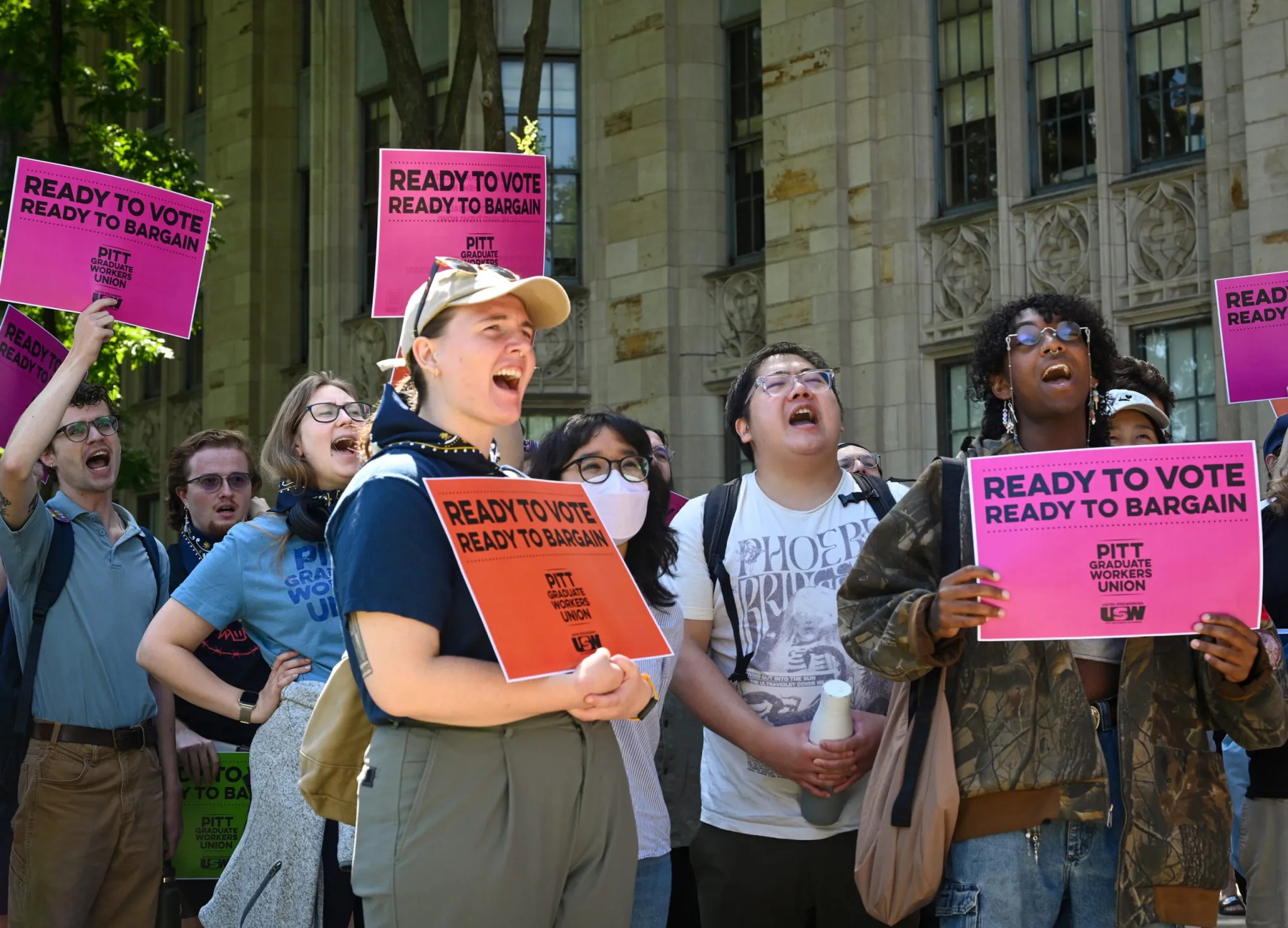
On Friday, organizers announced the results: a 1033-28 vote to unionize with the United Steelworkers [USW]. The Pennsylvania Labor Relations Board had not yet confirmed the vote count as of mid-afternoon.

With this win, Pitt grad student workers become the latest employees to undergo a successful union bid at a U.S. higher education institution, continuing an upward trend in the sector’s organizing activity over the last few years. They also join faculty and staff at the university which unionized with the USW in 2021 and September, respectively.

Pat Healy, an information science Ph.D. student at Pitt, said the wide margin of support reflected in the vote, “aligns with how most of the grad union votes [in the country] have gone the last couple of years.”
Healy has been organizing at the university since 2019, which was the last time grad student workers attempted to unionize. Then, the pro-union students lost by fewer than 40 votes. For them, the impact of this year’s vote stretches beyond Pitt’s campus.

“I’m happy for the movement [and] looking forward to some other grad unions popping up, I’m sure inspired by us, because that always happens,” Healy said.

After Thanksgiving, they said organizers will begin setting up for bargaining with Pitt’s administration.

In a statement after the vote count, the university said, “While first contract negotiations can be complex, please know that we will come to the table in good faith and be there to support all graduate students throughout and beyond the process.”

Immediately following the loss in 2019, any efforts to restart conversations about unionizing would meet with “a kind of extreme hesitancy,” Healy said, blaming “a lack of understanding of what a union was.”

This year felt different, Healy said. There are likely a few reasons why.

Five years after failed vote, Pitt grad students unionize
EQT’s ‘bulldog’ has D.C. in his grip, with profits — and maybe higher gas bills — on the horizon

A wave of change

From 2021 to 2023, nearly 64,000 U.S. grad student workers joined unions. By comparison, only 20,394 students unionized from 2013 through 2020. Today, four in 10 grad student employees belong to labor groups.

This trend was, experts say, driven in part by the pandemic and by the administration change from Donald Trump to Joe Biden in 2021, which ushered in a National Labor Relations Board more amenable to organizers.

Adrienne Eaton, professor of labor studies and employment relations at Rutgers University, noticed COVID-19-driven layoffs and research funding losses on campus in New Jersey that eventually led to a faculty and grad student strike last year. She describes this time as an “active moment” in American higher ed, with students advocating for change across the board at universities and colleges. And with grad students, there’s another factor at play: “The faltering job market in academia.”

“A high percentage of students no longer [are] confident that they have a future as tenure-track professors, in particular, or potentially as academic faculty at all,” Eaton said. “So, I think it really changes the way that graduate students look at their assistantships that they get.”

Penn State Reaches Tentative Deal With Union Days After Teamsters OK Strike

7496245_web1_PTR-BRANCH1-062523

Photo: LOUIS B. RUEDIGER | TRIBUNE-REVIEW Unions representing workers at Penn State University’s main and branch campuses, including New Kensington, seen here, said they have reached a tentative four-year labor pact.

By BILL SCHACKNER

Pittsburgh Tribune-Review

Monday, July 1, 2024 – Union members will vote in the coming weeks on a tentative contract agreement with management covering 2,500 employees on Penn State University branches statewide and the main University Park campus.

The deal, if ratified, could offer a measure of labor peace at a time of heightened workplace anxiety across Penn State generally, and its branches in particular, over university-wide budget cuts and a 10% faculty and staff reduction through buyouts this spring on those branches, where enrollment has fallen sharply since 2010.

Teamsters Local 8 represents employees in custodial service, emergency medical response, food service, housing service, trades, science, athletics, agriculture, research, printing, engineering, transportation, airport services, information technology and media.

Its members on Wednesday had authorized leaders to call a strike if necessary.

The previous contract with Teamsters Local 8 was due to expire Sunday. The union announced the tentative four-year contract on social media Saturday night.

“The new deal includes 20% wage increases (21.79% compounded) over the life of the contract. More details will be shared during the forthcoming ratification meetings,” it read. “This effort was only made possible by the nearly 1,900 members who authorized strike action and showed the University that WE WERE READY!”

The contract would run through June 30, 2028, and will be retroactive to Monday.

Jonathan Light, president of Teamsters Local 8, could not immediately be reached Monday for additional comment on the agreement.

Penn State President Neeli Bendapudi welcomed the tentative pact, and in a statement, said pay raises included are comparable to deals recently reached by Penn State with Service Employees International Union Local 668 and the American Federation of State, County and Municipal Employees (AFSCME) Local 13.

“These are the employees who keep Penn State operational,” said Jennifer Wilkes, vice president for human resources and chief human resources officer. “They maintain our facilities and grounds, provide food and services for our students, and clear the snow and ice during weather emergencies. During the COVID-19 pandemic, they were essential workers, serving on the front lines while the rest of the university was working remotely ….”

The branches statewide covered by the tentative agreement include Penn State New Kensington, Greater Allegheny, Beaver, Fayette and Shenango in Southwestern Pennsylvania.

Collectively, most of the branches have faced enrollment losses between 16% and 50% the last 10 years, officials said. They were expected to bear the brunt of $94 million in cuts announced in January to further reduce a university-wide deficit that at one point was $140 million.

Leadership on a number of those branches, which Penn State calls its Commonwealth system, is also being restructured. Multiple campuses will report to one chancellor under those changes.

On Wednesday, 91% of the 2,053 Teamsters who cast ballots on the strike authorization measure voted to approve it, said Light.

Union members will vote in the coming weeks on a tentative contract agreement with management covering 2,500 employees on Penn State University branches statewide and the main University Park campus.

The deal, if ratified, could offer a measure of labor peace at a time of heightened workplace anxiety across Penn State generally, and its branches in particular, over university-wide budget cuts and a 10% faculty and staff reduction through buyouts this spring on those branches, where enrollment has fallen sharply since 2010.

Teamsters Local 8 represents employees in custodial service, emergency medical response, food service, housing service, trades, science, athletics, agriculture, research, printing, engineering, transportation, airport services, information technology and media.

Its members on Wednesday had authorized leaders to call a strike if necessary.

The previous contract with Teamsters Local 8 was due to expire Sunday. The union announced the tentative four-year contract on social media Saturday night.

“The new deal includes 20% wage increases (21.79% compounded) over the life of the contract. More details will be shared during the forthcoming ratification meetings,” it read. “This effort was only made possible by the nearly 1,900 members who authorized strike action and showed the University that WE WERE READY!”

The contract would run through June 30, 2028, and will be retroactive to Monday.

Jonathan Light, president of Teamsters Local 8, could not immediately be reached Monday for additional comment on the agreement.

Penn State President Neeli Bendapudi welcomed the tentative pact, and in a statement, said pay raises included are comparable to deals recently reached by Penn State with Service Employees International Union Local 668 and the American Federation of State, County and Municipal Employees (AFSCME) Local 13.

“These are the employees who keep Penn State operational,” said Jennifer Wilkes, vice president for human resources and chief human resources officer. “They maintain our facilities and grounds, provide food and services for our students, and clear the snow and ice during weather emergencies. During the COVID-19 pandemic, they were essential workers, serving on the front lines while the rest of the university was working remotely ….”

The branches statewide covered by the tentative agreement include Penn State New Kensington, Greater Allegheny, Beaver, Fayette and Shenango in Southwestern Pennsylvania.

Collectively, most of the branches have faced enrollment losses between 16% and 50% the last 10 years, officials said. They were expected to bear the brunt of $94 million in cuts announced in January to further reduce a university-wide deficit that at one point was $140 million.

Leadership on a number of those branches, which Penn State calls its Commonwealth system, is also being restructured. Multiple campuses will report to one chancellor under those changes.

On Wednesday, 91% of the 2,053 Teamsters who cast ballots on the strike authorization measure voted to approve it, said Light.

Bill Schackner is a TribLive reporter covering higher education. Raised in New England, he joined the Trib in 2022 after 29 years at the Pittsburgh Post-Gazette, where he was part of a Pulitzer Prize-winning team. He can be reached at bschackner@triblive.com.

volume_off

-2:12

sd

share

closed_caption

fullscreen

Auto (360p)

225p

360p

Subtitles Off

Subtitles EN

EU Summit: Leaders Set to Finalize Top Jobs Deal

2:23

Orban Forms EU Alliance, Expands Populist Power

1:51

Von der Leyen to Stay on as EU Commission Head 

2:26

China Miscalculated With Europe in Backing Russia, US Ambassador Says

0:55

Road to White House Goes Through NC, Wiley Says

2:07

arrow_back_ios_new

arrow_forward_ios

Bill Schackner is a TribLive reporter covering higher education. Raised in New England, he joined the Trib in 2022 after 29 years at the Pittsburgh Post-Gazette, where he was part of a Pulitzer Prize-winning team. Previously, he has written for newspapers in Connecticut, New York, Pennsylvania and Rhode Island. He can be reached at bschackner@triblive.com.

VP Harris Continues Biden Campaign Focus On Courting Union Voters In Philadelphia Visit

Vice President Kamala Harris addresses the SEIU convention in Philadelphia May 21, 2024

The vice president addressed the SEIU a day after it elected its first Black woman president.


BY JOHN COLE

Penn-Capitol-Star

MAY 21, 2024 – PHILADELPHIA — Vice President Kamala Harris returned to Pennsylvania on Tuesday, continuing the Biden-Harris campaign’s focus on earning the support of labor unions. Harris delivered the keynote address to the Service Employees International Union (SEIU) gathering at the Pennsylvania Convention Center.

“Since your founding SEIU, you have been on the front lines of every major expansion of rights for the American people,” Harris said.

She spoke to the SEIU a day after the organization elected April Verrett its first Black woman president. “Talk about a phenomenal woman and a powerful fighter for justice and fairness,” Harris said of Verrett. “I know firsthand that April is a leader who is always guided by an uncompromising focus on worker empowerment and their rights.”

Harris reiterated the Biden administration’s defense of Affordable Care Act, which she said they want to strengthen. She blasted former President Donald Trump’s unsuccessful efforts to repeal and replace the healthcare law while he was in office. And she touched on other familiar campaign talking points: noting the Biden administration’s efforts to reduce prescription drug costs and to reduce student debt.

“We have already canceled nearly $160 billion in student loan debt for more than four and a half million Americans,” she said. And, she vowed support for a pathway to citizenship for Dreamers, participants in the Deferred Action for Childhood Arrivals program, or DACA.

Harris also called out the use of the phrase “unified reich” in a video Trump posted to social media and later deleted.

“This kind of rhetoric is unsurprising coming from the former president and it is appalling,” Harris said. “And we’ve got to tell him who we are. And once again it shows that our freedom and our very democracy are at stake.”

Steve Catanese, president of SEIU Local 668, told the Capital-Star that during the convention, attendees heard stories from members about ongoing efforts to form and join unions. He noted that the Biden administration had taken steps to reform the National Labor Relations Board. Harris reiterated the administration’s support for the Protecting the Right to Organize, (PRO) Act on Tuesday which would amend the National Labor Relations Act to make it easier for workers to organize, and stiffen penalties against employers who violate it.

“At least hearing it from the audience, I think the biggest cheer really came up when she talked about making it easier to form and join a union,” Catanese said after the vice president’s remarks.

Competing chants from the audience of “free Palestine” and “four more years” broke out numerous times during Harris’s 20-minute speech.

“There were a lot of workers up there that were clearly excited for the Biden-Harris campaign and chanting favorably about Kamala Harris,” Catanese told the Capital-Star. “There were workers that walked in and had protests in the back and I think their protests came from a place of moral stance of what they think is right.”

The SEIU passed a resolution on Monday during the convention calling for a ceasefire in Gaza, Catanese added.

“Many of the workers felt very strongly about that and wanted to express that,” Catanese said. “They have the right to express those opinions and our goal is to make sure that they had the freedom to express that and that the other workers who wanted to express their appreciation for the administration could do that as well.”

He added that workers within the SEIU respect each other. “We live in a robust democracy and their voice should be respected.”

After departing the convention center, Harris made an unannounced stop at Jim’s West for a cheesesteak. She tried to order two cheesesteaks with provolone, according to pool reports, but was persuaded to try one with Whiz. She was joined at Jim’s by state Sen. Vincent Hughes (D-Philadelphia) and U.S. Rep. Brendan Boyle (D-2nd District).

Continue reading VP Harris Continues Biden Campaign Focus On Courting Union Voters In Philadelphia Visit

Hopewell Teachers Rally For New Contract

Amid contract negotiations, Hopewell Area School District teachers flood school board meeting

BY JENNIFER BORRASSO

MARCH 28, 2023

CBS PITTSBURGH

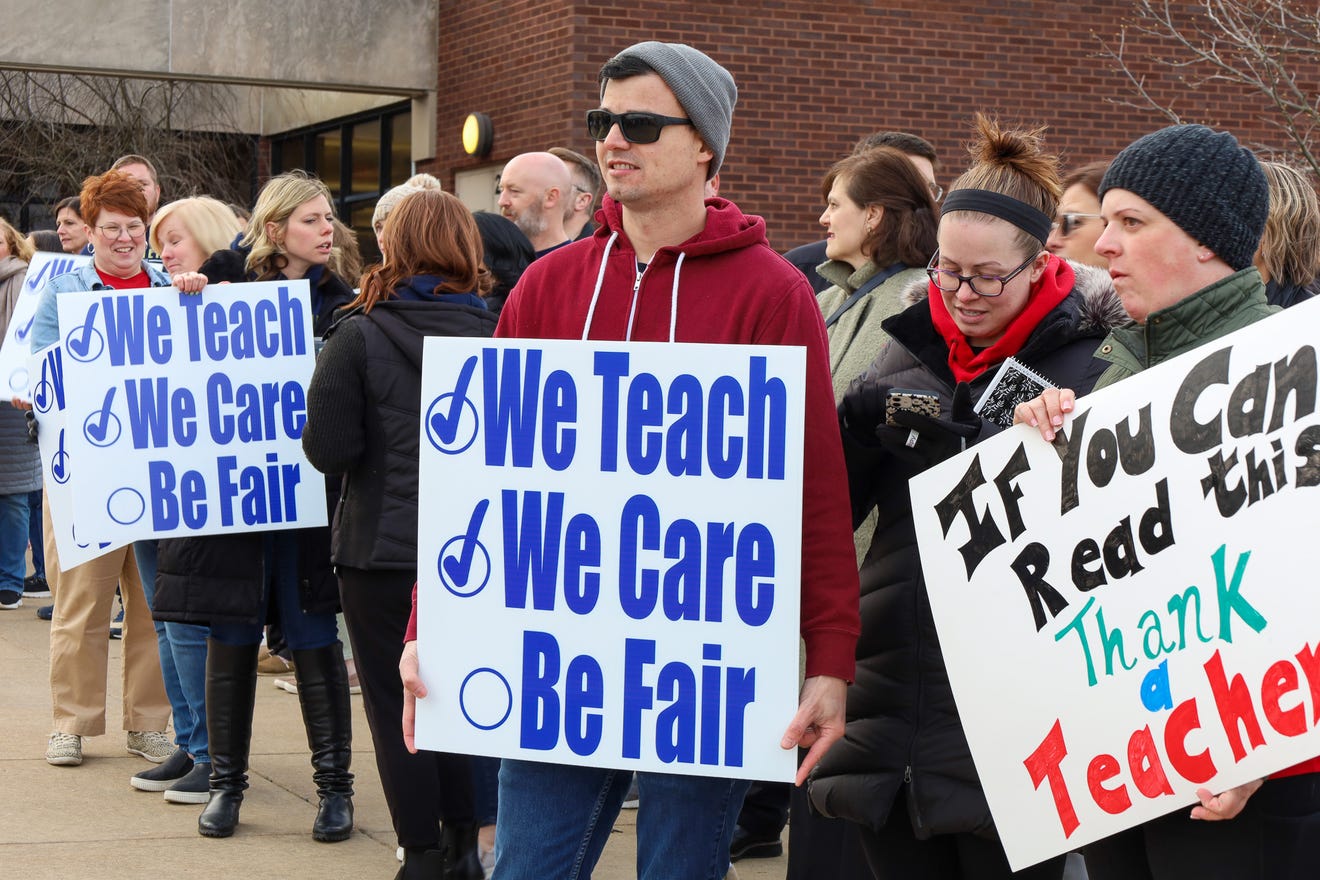
HOPEWELL, Pa. (KDKA) — A group of teachers crashed the Hopewell Area School Board meeting on Tuesday to put pressure on the board.

The president of the teachers union said teachers have gone without a contract since July 1, 2022. About 200 people showed up Tuesday to the meeting, including parents.

“I want to make sure they know they are valued and thank them for what they are doing for our students,” one parent said.

“All I’m asking for is our teachers get a fair contract. We need to do whatever it is to keep our kids in school,” another parent said.

Hopewell Education Association Union President Jeffrey Homziak said so far there have been 15 negotiating sessions since November 2020 but no deal has been reached.

Homziak said they want a five-year deal and a meaningful pay increase, more than the 2 percent increase the district is offering. They also don’t want to pay more for their health care and don’t want to work longer hours and not be compensated, Homziak added.

“Salary and health care are the biggest sticking points for any district,” Homziak said. “They want an extended school year and more time throughout the week for us to work without giving us salary.”

School board president Danny Santia talked to KDKA-TV after the meeting.

“Be fair to the community, be fair to the taxpayers and the teachers,” Santia said. “I want to give them a fair contract, but it has to be fair to the whole community.”

Between 1,800 and 2,000 students attend schools in the district.

KDKA-TV’s Jennifer Borrasso: “Are these teachers prepared to strike?”

Homziak: If it comes down to that. … We don’t want to do that to our students. We want to be in the classroom.”

There are three more negotiating meetings scheduled, with both sides back at the bargaining table on Thursday.

NLMK Union Steelworkers Continue Strike in Farrell After Latest Rejection

Over the past few months, union steelworkers of the Farrell Plant and NLMK have been negotiating over a labor agreement that will cover more than 400 union members

By Chandler Blackmond
WKBN Youngstown

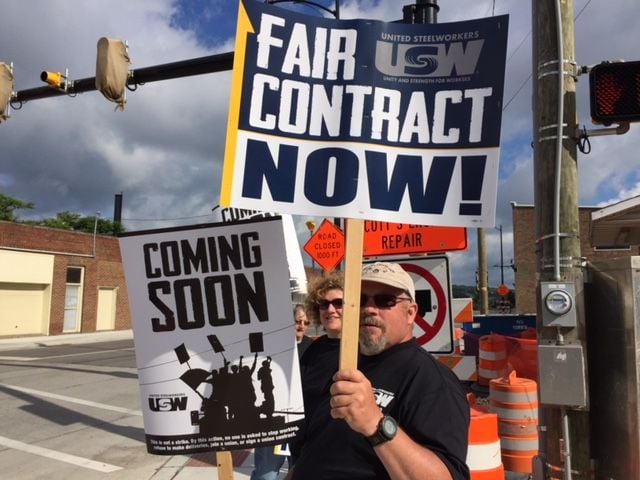
Aug 30, 2020 – FARRELL, Pa. (WKBN) – Over the last two weeks, First News has been following the strike led by United Steelworkers against the NLMK. On Sunday, the union gave the latest on their recent negotiation.

Farrell steelworkers strike against NLMK
“We want what’s fair for us, our family and the community, and that’s not what’s being offered at this time,” said Jim Wells, 1016-03 Union President.

Over the past few months, union steelworkers of the Farrell Plant and NLMK have been negotiating over a labor agreement that will cover more than 400 union members.

“The company came in and rejected our last proposal and said they were standing firm on their last proposal they gave us, which is the one we went out on strike on,” Wells said.

After going on strike and allowing their voices to be heard, the NLMK met with the union this past Friday to make a decision, but Wells says the meeting lasted no longer than a half hour.

“The guys are upset with the fact they don’t want to move, so now guys are starting to look for other jobs and go other places because of that,” Wells said.

NLMK union steelworkers continue strike in Farrell over labor agreement.

“It’s impacting me now because I was the bread winner of my household, and now it’s putting the stress on my wife and myself about what we will do about our income and our child’s healthcare,” said union steelworker Chris Summers.

Although the decision didn’t go in their favor, Wells says they will continue their strike until both parties come to an agreement.

“We are going to be doing a prayer vigil Thursday at 8 p.m.,” Wells said. “We invite the community and families to pray for a quick strike to get this over as soon as possible for the families in the community.”

‘We’re the Sacrificial Lamb’: Lordstown Workers On the UAW Plant Closures

By Carter Eugene Adams
Organizing Work via Portside


Nov 11, 2019 – The Monday after Thanksgiving last year, workers at the General Motors Lordstown Assembly Plant in Ohio were called in for a 9 a.m. meeting. This was a rare occurrence.

“I don’t know, was it three sentences long maybe? ‘Hey, you’re unallocated.’ …No one had ever heard of ‘unallocated’,” says John Sandquist, Jr., a 25-year employee of GM. “We didn’t know what that term meant… Basically, it meant ‘you guys are closing.’”

The Lordstown plant is the former home of the Chevy Cruze and 1,600 workers. For almost a year now, no product has been coming out of the plant, with workers transferred, forced into early retirement or just out of work. Over the past year, GM has transferred over 700 workers from Lordstown to various plants across the country, mostly out of Ohio. According to the tentative agreement between GM and the UAW, the plant closure will be permanent.

Sonya Woods, a 25-year employee of GM, who was transferred to Bowling Green Kentucky, says she had to either move, or lose everything she’s worked towards.

“Gotta go or I lose my pension, lose my benefits,” said Woods. “They got us screwed. There’s a big group that have ‘95 seniority, 25 years, and we lose a lot if we don’t follow it. We don’t have much choice.”

Last week, outside of the shuttered factory, four workers held the picket line, along with 49,000 other GM employees still on strike, even as news of the proposed agreement between GM and the UAW started to circulate. The four were getting ready to transition to other plants when the strike was called. The locals at their new plants allowed them to come back to Ohio to do their strike duty at their home plant, as the Lordstown plant closure was one of the issues on the table between GM and the UAW.

At the picket, workers stood around a burn barrel. Harsh orange streetlamps illuminated an empty, fenced-in parking lot. The 6.2 million-square-foot behemoth factory acted as an eerie monument to what was once an industrial hub in northeastern Ohio. It was silent except for the drone of trucks driving by on the Ohio Turnpike.

“This used to be non-stop traffic, non-stop. Look, nothing!” said Agnes Hernandez, a 23-year GM employee.

“This is the truck gate,” added Sandquist.

“There would be lines, remember?” replied Hernandez. “We’d have lines of trucks coming out here.”

After a moment, Hernandez realized Sandquist didn’t have his signature clothing item: his orange vest.

“Go get your vest on! Come on, OVS!” Agnes jokingly shouted.

This group of friends, who spent nearly every day together in this plant for decades, called themselves the “Orange Vest Society.” The orange vest is standard attire for workers in the plant. But whether or not a given worker was wearing orange was semantics. Those in OVS felt they had another layer of protection between them and management. Having the solidarity and at times friendship of those on the shop floor gave workers a sense of “you watch my back, I watch yours.”

The origins of this group are vague, but as Dan Santangelo, a 25-year employee of GM put it, the roots of it are solidarity and comradery. “Management would start something with one of us, and it just started as a joke: ‘You mess with one person in Orange Vest you mess with us all.’ We don’t know who came up with it, maybe it might have been Jeff” — OVS member and fellow worker on the picket line – “came up and said, ‘we should call ourselves the Orange Vest Society.’ So, that’s what we did. On our last day here, we spray painted it on the wall behind out team center.”

The proposed contract appears set for ratification. Besides the plant in Lordstown, it cements the closure of two more GM facilities — Warren transmission and Baltimore transmission — three of the four that were on the table.

GM’s stated the reason for the Lordstown closure was the Cruze’s poor sales performance in the United States, with consumers opting for larger SUVs and trucks. But months after the shuttering, GM announced the production of a strikingly similar vehicle , the Onix, to be built and sold in Mexico. GM has also announced its revitalized production of the Chevy Blazer in Mexico, shortly after shuttering the Janesville, Wisconsin plant where it used to be made.

Workers think the production of the Onix could have taken place at Lordstown Assembly and kept the plant open. Sandquist feels the continued closure of Lordstown has little to do with the product they produced and more to do with GM attempting to fracture worker power and solidarity.

“This community, this plant — we’ve always built a good product here for 53 years,” said Sandquist. “I believe it’s something personal they have against the local 1112, it’s something personal against this plant because the union was strong here and we cared about the community. They’re more concerned about profits.”

For workers in Lordstown, transfers to plants hours from home, buyouts and early retirements are their consolation prize.

In 2007, workers were understanding of concessions needed to keep the company alive and acted accordingly. 12 years later, with record profits recorded and salaries for company executives in the tens of millions, workers want what they’re owed.

But trying to negotiate that has been difficult. The six weeks of the strike have seen agreements proposed and then removed in the same day. Negotiations stalled, started and stalled again. The latest draft of the proposed contract is four volumes long.

As Parma, Ohio UAW Local 1005 President Mike Caldwell explains, it’s necessary. “Every single thing in [our] shop was negotiated,” said Caldwell. “At one point in time, someone had to fight for it and negotiate for it.”

The new contract between the UAW and GM meets many demands that sent workers to the picket line. Those include a revised healthcare plan; gradual wage increases and a path for temporary workers to be hired on full-time.

By not pushing further on running product through Lordstown, UAW officials in Detroit have affectively abandoned shuttered plants in pursuit of other demands. Lordstown assembly, Warren transmission and Baltimore transmission plants are the union’s biggest concessions.

“We’re the sacrificial lamb in this one,” Sandquist said. “They’re gonna sacrifice Lordstown for the good of the whole, and the whole UAW membership. I get their point, but it sucks for us, and I’m pissed off about it.”

Caldwell weighed in on Lordstown remaining closed after members of local 1005 voted to ratify the contract, 438 for, 404 against. “It’s still kind of a sad spot for everyone that that plant is still slated to close,” he said. “It’s very disappointing, with that plant closing, that destroys that entire community.”

Keeping the Lordstown plant closed means workers have a difficult decision to make: either lose their jobs or transfer to another plant. Workers who did not qualify for early retirement were given the one-time offer to transfer and continue working until they’re eligible to collect their pensions and retirement benefits. The new proposed agreement offers a buyout, but according to the highlights of the agreement, distributed by UAW, that buyout doesn’t offer much.

For workers who choose the buyout option, they agree to terminate their employment and benefits, save for some pension benefits. In return, they’re offered a sum of money, between $7,500 and $75,000, based on years of service.

While that may seem like a lot offered, that money is just that: money. No benefits, no health care. And for people living paycheck-to-paycheck, those benefits are all they have. For those with more seniority, they’re choosing between cash or decades worth of pension and retirement benefits.

The four members of the Orange Vest Society decided to transfer so they can make it to their pension and keep their benefits. They’ll be eight hours from Lordstown in Bowling Green, Kentucky and six hours away in Bedford, Indiana — leaving their families and their community.

“It sucks. Every one of these people right here around this burn barrel is going through that,” said Sandquist. “He has a family that is here and he’s gonna be eight hours away, same with Agnes, same with this man Dan over here. He’s got a wife, two kids. Agnes has got grandkids now for Christ’s sake, she ain’t gonna see them grow up.”

“What do I do now? Facetime?” said Hernandez. “I mean you can’t see everything on Facetime. You know, it’s like my grandson, he’ll be two in January and he looks at me through the phone it’s almost like he has to do a double-take to see and hear my voice. Just so he knows me, I have to keep repeating who I am. It’s so, it’s horrible. It’s like, ‘oh my god, he’s gonna forget me.’ Being that young he’s gonna forget who I am, you know, and that to me is just heartbreaking.”

In addition to uprooting their entire lives and leaving family here in Ohio, this also means the end of the Orange Vest Society.

Even off the shop floor, through the upheaval of the plant closure, OVS became a way for workers to look out for each other.

“I went through a very bad time before I had to go to Bedford (Indiana), I was almost as low as killing myself, that’s how low I was.” said Santangelo, as a result of having to leave his family, his home and his community. “Not only did my blood family reach out to me, but these guys did as well,” he said. “Jeff would call every other day to check in. ‘How you doing?’ He would try to get me talking. That’s. That’s the Orange Vest Society.”

 I think this was our mentality.We came to work to have fun and to work. In that order,” explained Santangelo. “We made it enjoyable. We made it worth our while to be here.”

“Yeah, but the place is so miserable you had to do something,” added Sandquist.

As the night goes on, the conversation shifts and changes, from heated discussions about the proposed contract to jokes about how many liquor bars and sex shops there are in Kentucky. The remaining OVS members talk about home, about what, and who, they’re leaving in order to provide. There are also long moments of silence on the picket line, between the jokes and contract talk. Against the backdrop of the shuttered plant, there’s this feeling that this is the end of an era.

“It was like a second family,” said Hernandez. “I mean we hung out together, we’ve known each other for 2o-plus years. These are my brothers.”

Agnes and Jeff go into the Styrofoam cooler next to the wood pile under a small nylon canopy. After a few minutes the two emerge with plastic cups. Dan had declined the offer earlier and joins the toast emptyhanded.

After the toast, the group sits and talks for a while longer before slowly, one by one, leaving.

Shortly after midnight, Sandquist is packing up his chairs and getting ready to head back to the union hall to sign out before finally going home. Before he heads out, he reflects on the future of the Orange Vest Society. “We might end up having a little chapter down in Bowling Green, one in Bedford, some of our friends up in Toledo will have a little — there’s a couple of us everywhere but the original core group is split up,” he says.

“That’s the stuff that pisses you off even more, you know, it’s the friendships, your family, your secondary family. You’re not gonna spend time with them no more, or you know, have them relationships. Talk on the phone or text, see what’s up with them but not like you use to. Kinda at the end, it’s over and it’s sad.”

Continue reading ‘We’re the Sacrificial Lamb’: Lordstown Workers On the UAW Plant Closures

The Return of the Strike

The picketing GM workers and impending Chicago Teachers Union action suggest a dramatic revival of striking as a tactic.

By Sarah Jaffe
The Progressive

Oct 8, 2019 – Friday night on the picket line at the General Motors facility in Langhorne, Pennsylvania involved pizza reheated over a firepit, supporters dropping by with beers and snacks, and a dance party to Carly Rae Jepsen.

It was the eighteenth day of the strike, which shows no signs of ending as of this writing. Spirits were surprisingly high despite the cold. Strikers in their UAW shirts and supporters were cutting up pallets for firewood, and planning a potluck for the following weekend. “Maybe it’ll be a victory celebration!”

The strike at GM, now at twenty-three days the longest in decades at an American auto manufacturer, came as a surprise even to longtime labor observers like me. Certainly, the workers have ample reasons for anger. GM’s CEO made $21.87 million last year while the workforce is splintered into tiers (new hires who do the same work get paid less than longtime employees) and dotted with permatemps. But because the action of the strike has been all but dead in U.S. manufacturing for decades, a massive strike at one of the Big Three car companies has seemed like a pipe dream.

Yet now, the workers are dug in, holding picket lines twenty-four hours a day and determined to see the end of the tiered system and the use of temps, and a revived though still small left is determined to show solidarity.

Of course, we’re still nowhere near the strike frequency levels seen before Ronald Reagan’s crushing of the air traffic controllers’ union in 1981. Acts of rebellion in recent years have been more likely to be occupations, uprisings, the kinds of dispersed mass protests that spread virally from city to city, as in the Occupy movement and the Movement for Black Lives. The Trump era brought back the mass march, alongside more disruptive actions like the airport protests in response to the Muslim ban. But the strike, long considered gone, is creeping back into favor.

Chicago Teachers Took the Lead

It was the Chicago Teachers Union in 2012 that revived the strike in dramatic fashion, defeating state and city officials determined to make teachers’ strikes a thing of the past. In the process, it provided a template for a reshaping of public sector unions that have allowed those unions to survive the 2018 Janus decision, which ruled that union fees in the public sector are unconstitutional. The teachers struck “for the schools Chicago students deserve,” and rallied the community to their side. They reminded us all what it looks like when city streets are filled with workers making demands. Continue reading The Return of the Strike

SEIU President Rallies Workers in Pittsburgh on Labor Day

By Marylynne Pitz

Pittsburgh Post Gazette

Mary Kay Henry, president of the Service Employees International Union for nearly 10 years, organized health care employees during the late 1990s at a major Catholic hospital system in California.

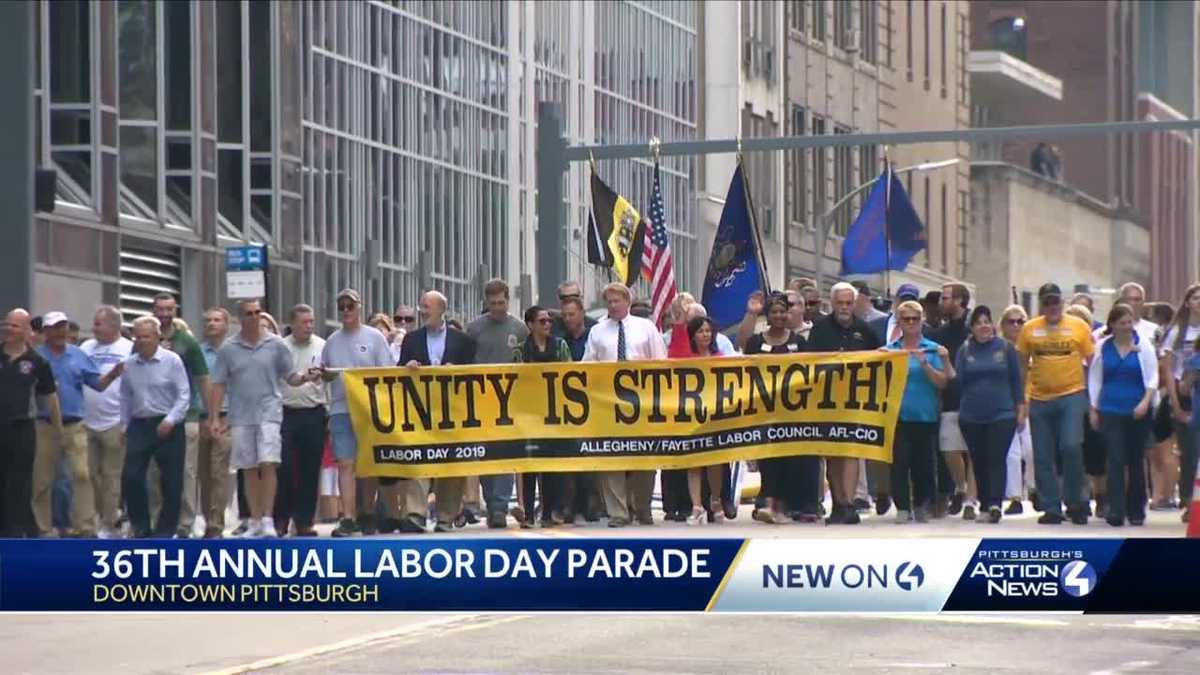
Before Pittsburgh’s Labor Day Parade began, Ms. Henry urged local union members during a rally at Freedom Corner in the Hill District to continue fighting, despite the legal odds.

“The right to organize doesn’t exist any longer in the U.S. We have an 80-year-old law that is broken,” Ms. Henry on Monday told a large crowd that included boilermakers, carpenters, journalists, postal carriers, shipbuilders and steamfitters.

“UPMC workers have been trying to form a union since 2012. Ten thousand hospital workers have been trying to get to a bargaining table,” Ms. Henry said.

UPMC has announced that its hourly workers will earn $15 an hour in 2021.

The SEIU’s plan, called Unions for All, envisions workers organizing and bargaining across industries instead of the workplace-by-workplace system currently used in the U.S.

“Bargaining by industry, where workers from multiple companies sit across a table from the largest employers in their industry to negotiate nationwide for wages and benefits, is standard practice in almost every developed country in the world,” Ms. Henry said.

The SEIU also wants to ensure that every public dollar creates union jobs and that every federal worker and contractor earns at least $15 an hour and has the chance to join a union.

One of the UPMC employees who marched in the parade was Nila Payton of East Hills, who belongs to Hospital Workers Rising.

A UPMC receptionist for 13½ years, Ms. Payton said a union survey found that at least 5,000 UPMC employees are in debt to their employer for medical care.

“They steer us to Medicaid. Some of us make too much to get Medicaid. Some people are actually scared of going to the doctor for fear of going into medical debt,” Ms. Payton said.

U.S. Rep. Conor Lamb, D-Mt. Lebanon, said federal labor law is “in urgent need of an update” because employers can play “lots of tricks” to delay bargaining.

“We need to level the playing field, ” Mr. Lamb said.

Lt. Gov. John Fetterman, the former mayor of Braddock, served as the parade’s grand marshal. Other politicians attending included Allegheny County Executive Rich Fitzgerald and state Sen. Jay Costa, D-Forest Hills.

Marchers walked down Grant Street, past the historic marker for Henry Clay Frick, just outside the building named for the industrialist.

Many trade unionists remember Frick for provoking violence by hiring 300 Pinkerton agents armed with Winchester Rifles during the bloody Homestead steel strike of 1892.

On the Boulevard of the Allies, where the parade ended, marchers passed the Red Door, where volunteers at St. Mary’s Parish were giving sandwiches to the homeless.

Continue reading SEIU President Rallies Workers in Pittsburgh on Labor Day

Bernie Sanders endorsed by Pittsburgh-based United Electrical Workers

By Christina Suttles
Beaver County Times

Aug 26, 2019 – Vermont Sen. Bernie Sanders nabbed a presidential endorsement from the Pittsburgh-based United Electrical, Radio and Machine Workers of America on Monday, following a speech at the union’s convention.

PITTSBURGH — Vermont Sen. Bernie Sanders nabbed a presidential endorsement from the Pittsburgh-based United Electrical, Radio and Machine Workers of America on Monday, following a speech at the union’s convention.

Sanders is the second 2020 Democratic candidate publicly supported by a national labor union; the International Association of Fire Fighters endorsed former Vice President Joe Biden earlier this year.

During his speech at downtown Pittsburgh’s Wyndham Grand Hotel, Sanders told hundreds of local workers his plans to protect middle-class families and tackle corporate greed.

“We can have a nation where all of our people live with security and dignity,” he said. “We can have a nation which does not have a huge gap between the very rich and everybody else, where income and wealth inequality is growing …”

Union leadership said Sanders has been a longtime supporter of workplace actions, including a nine-day strike in Erie earlier this year involving 1,700 locomotive plant workers.

“Bernie understands the need for workers to have a democratic, independent union movement that is unafraid to challenge corporate America’s stranglehold on our economy,” said UE General President Peter Knowlton a statement. The union also supports Sanders’ plans to expand organized labor, end right-to-work laws and implement “Medicare for All.”

The UE represents about 35,000 workers across a variety of sectors, including Beaver County residents working throughout the state, a spokesperson for UE said. Other unions with ties to the region have yet to endorse a candidate. Continue reading Bernie Sanders endorsed by Pittsburgh-based United Electrical Workers