Jaime Martinez, community defense organizer at Casa San José, coordinates with Rapid Response Network volunteers outside Emiliano’s Mexican Restaurant in Gibsonia on June 17, after reports that federal agents were idling nearby in unmarked vehicles.
Casa San José has trained hundreds of volunteers to monitor and respond to immigration enforcement. Public Source followed them through raids, courthouse watches and late-night calls.
July 31, 2025 – As federal immigration enforcement intensifies across the country, a local response has quickly scaled up across the Pittsburgh region. In Beechview, the nonprofit Casa San José has built a Rapid Response Network of trained volunteers who monitor and document ICE activity across Allegheny County and beyond.
The network launched during the first Trump administration but has ramped up since January. As of July 30, it includes more than 250 trained volunteers — with nearly 175 more signed up for future training.
Casa San José, founded in 2013, focuses on immigrant rights and the Pittsburgh region’s Latino community — a mission amplified as the Trump administration rolls back protections for immigrants and directs federal resources toward a crackdown and mass deportations.
Organizers traverse city neighborhoods, gather in church basements and empty parking lots, and educate residents about their rights and federal immigration tactics. Along with trained volunteers, who are prepared to legally observe, document and accompany people at risk of being detained by Immigration and Customs Enforcement [ICE], they respond in real time to sightings, arrests and raids.
Pittsburgh’s Public Source spent more than a month embedded with Casa San José’s organizers and volunteers, tracking their efforts from the courthouse to restaurants as they responded to immigration enforcement and supported families under threat.
Photo: June 14 at the City-County Building, Downtown
Monica Ruiz, executive director of Casa San José, speaks to thousands of people gathered in front of the City-County Building in Downtown during a day of nationwide protest against the Trump administration.
“They are disappearing our people. This is our reality. Every single day. Just because you don’t see it doesn’t mean it’s not happening. We cannot continue to allow this to happen in our communities,” said Casa San José Executive Director Monica Ruiz.
“Casa San José is the only organization on this side of the state that is doing this kind of work.”
Ruiz said she has received five death threats since November, forcing her to relocate Casa San José’s office and to reconsider speaking publicly.
Photo: June 17 at Emiliano’s Mexican Restaurant, Gibsonia
As volunteers monitor the scene, Jaime Martinez, community defense organizer at Casa San José, speaks by phone with nine workers sheltering inside the restaurant — part of the network’s effort to document enforcement activity and support those at risk.
Sharon Bonavoglia was the first to arrive at a quiet strip mall in Gibsonia late on June 17. She had received the call because she lives nearby, and because she’s one of a growing network of volunteers responding to reports of federal immigration enforcement in and around Allegheny County.
Several hundreds gathered outside of the William S. Moorhead Federal Building this afternoon to protest as part of the national 50501 “No King’s Day” demonstrations on President’s Day.
Protesters marched downtown, calling out President Trump and Elon Musk, chanting, “Not my president” and “Human rights are meant for all.”
The demonstration lasted for over an hour, ending in front of the City Council building where organizers offered participants important election information and petitions to sign.
Photo; PA Rep Malcolm Kenyatta speaking to protestors in Harrisburg. By Bethany Rodgers
Protests against President Trump and his agenda, including the involvement of Elon Musk, took place nationwide.
Many protestors believe there is a renewed sense of urgency to oppose Trump’s policies in his second term.
By Bethany Rodgers USA TODAY NETWORK
Feb. 5, 2025 – HARRISBURG — Scores of protestors gathered outside the Pennsylvania state capitol Wednesday as part of nationwide demonstrations against President Donald Trump’s administration and the Project 2025 agenda.
The gathering was part of a nationwide wave of protests coordinated by the 50501 movement, short for “50 Protests, 50 States, One Day.” In Pennsylvania, demonstrations were also planned for Philadelphia and Pittsburgh.
Attendees waved signs calling for Trump’s impeachment, rainbow banners and American flags. A number of them also aimed their ire at Elon Musk, the billionaire who has assailed federal government agencies in recent days with the immense powers Trump has granted him.
Mari-Beth DeLucia, of Harrisburg, said she knows someone who works for the U.S. Agency for International Development, a government humanitarian arm that Musk has called a “criminal” organization and sought to dismantle. Employees at the agency are being placed on administrative leave, and Trump’s team has frozen foreign aid distributed by the office.
The damage Trump and Musk are doing will reverberate through charities, businesses and communities across the U.S., DeLucia predicts. But up to this point, she thinks people have been too stunned to mount the type of protests that spilled into the street when Trump was elected for his first term in 2016.
“Why aren’t we marching? Where is everybody?” DeLucia said she’s wondered lately. “I think it was kind of shell shock.”
More:’Don’t let democracy die’: Anti-Trump protesters rally in cities across US
She’s hopeful that Wednesday’s gathering is a sign that people are again raising their voices.
Savannah Bellem, a volunteer who brought snacks and drinks to the Harrisburg demonstration, said it was her first time participating in a protest. Back in 2016, she thought the answer was to wait out Trump’s term.
Pennsylvania Rep. Malcolm Kenyatta, D-Philadelphia, speaks to a group of protestors in Harrisburg, Pennsylvania, on Feb. 5, 2025. The demonstration against President Donald Trump’s administration was part of nationwide rallies coordinated by the 50501 movement. “It’s four years — what can happen?” the New Cumberland resident remembers telling her husband.
She now sees that attitude as naive, and this time around she feels a heightened sense of urgency. A gay couple in her family are frightened they could lose their child. She said she is angry that her young daughter now has fewer rights than she did at the same age.
“We’re not going to stand for it,” she said. “We need to get back more into taking care of our community and each other.”
State Rep. Malcolm Kenyatta also emphasized the importance of local action in a speech to the crowd, urging them to focus on city councils and school boards in addition to politicians in Washington, D.C.
“There is no one, and I mean it, no one, coming to save us,” the Philadelphia Democrat said. “But here is the good news, my friends: We are going to save ourselves.”
Bethany Rodgers is a USA TODAY Network Pennsylvania capital bureau investigative journalist.
Photo: Thomas Ross (left) and Austin Wise give a tutorial to students who have never canvassed before on Saturday, Sept. 21, 2024, at Schenley Plaza in Oakland. (Photo by Anastasia Busby/PublicSource)
Democratic organizers say student political engagement has soared since Kamala Harris took over their party’s presidential ticket. Their Republican counterparts report backlash for supporting candidates and views they say are controversial on campuses.
By Spencer Levering
Public Source
October 3, 2024 – Thomas Ross didn’t realize that the political interest on Pitt’s campus was “electric,” as he characterized it, until the semester’s first door-knocking event for Pitt Students for Harris brought 34 volunteers — more than double the number he expected.
“Having 34 volunteers on our first canvass literally blew my mind,” said Ross, a University of Pittsburgh junior studying history and political science. “Everyone that I’ve spoken with has been very excited about the election.” Other Democratic students echoed this, saying they’re seeing new levels of excitement from their peers.
Just up Forbes Avenue, Anthony Cacciato is aiming to make the Carnegie Mellon University College Republicans a space where students can speak freely about their conservative values. Cacciato, president of the chapter, said with election season sparking student’s political intrigue, he’s preparing for a “barrage of negative backlash.”
At colleges around Pittsburgh, political clubs are organizing students to gear up for the upcoming November elections. Club leaders cited Pennsylvania’s influence on national politics as a key reason why they’re trying to mobilize the youth vote as Republican Donald Trump and Democrat Kamala Harris vie for Electoral College votes.
Organizing through socializing
As on-campus political groups look to activate students this fall, many said they are trying to mix political outreach efforts with social events to appeal to young voters.
Cacciato said group outings, such as seeing the new movie “Reagan,” help prevent students from burning out over organizing.
“We’re a space where you can feel comfortable with talking about who you are, but also feel comfortable in knowing that you’re surrounded by friends,” Cacciato said.
The club’s membership increased by 20% this semester, according to Cacciato, because of Pennsylvania’s outsize impact on national politics.
“When you have that knives-edge margin, any little bit of outreach can mean the difference between 10,000 people staying home and not voting and them going out and voting and flipping a precinct, flipping a state House seat, flipping the state, and flipping the country,” Cacciato said.
At Pitt, Sam Podnar, co-president of the Pitt College Democrats, said she creates an environment in which students can meet new people and break out of political apathy.
“We want to let people know that getting involved doesn’t have to be hard, it doesn’t have to be stressful. We just want them to keep showing up,” Podnar said.
She said President Joe Biden’s decision to drop out of the race and endorse Vice President Harris has energized students to get involved in Democratic organizing. General body meetings, weekend canvasses and the club’s presidential debate watch party have all drawn new participants.
“We’ve seen a really, really big surge in membership that just has honestly blown everyone away,” Podnar said.
Avalon Sueiro, president of the CMU College Democrats, said finding a balance between doing work and building a community helps draw students to attend the club’s events. When election day gets nearer, she plans on bringing therapy dogs to campus to calm students’ nerves.
Making it pop
Among Democratic student organizers, leaders are leaning into memes and pop culture as they try to energize college voters. When the semester began, the Instagram pages for Pitt Students for Harris and Pitt College Democrats both had profile photos referencing Charli XCX’s “brat” album. The pop star’s viral summer tweet calling the vice president “brat” spawned a flurry of online memes, which the Harris campaign embraced as an early branding strategy.
Photo: Democratic presidential nominee, U.S. Vice President Kamala Harris takes a selfie with Sen. John Fetterman (D-PA) and his wife Gisele Barreto Fetterman after greeting supporters at John Murtha Johnstown-Cambria Airport on September 13, 2024 in Johnstown, Pennsylvania. (Andrew Harnik/Getty Images)
September 13, 2024 – WILKES-BARRE — Vice President Kamala Harris, the Democratic nominee for president, has spent most of the last two weeks in Pennsylvania starting with a Labor Day rally in Pittsburgh, where she returned a few days later to hunker down for debate prep. She debated former President Donald Trump, the GOP nominee for president, in Philadelphia on Tuesday, and on Friday she campaigned in Johnstown and Wilkes-Barre, two areas that have swung Republican in recent elections.
“I will be continuing to travel around the state to make sure that I’m listening as much as we are talking,” Harris said during the Johnstown visit, according to pool reports. “And ultimately I feel very strongly that you’ve got to earn every vote, and that means spending time with folks in the communities where they live. And so that’s why I’m here and we’re going to be spending a lot more time in Pennsylvania.”
Luzerne County, where Wilkes-Barre is located. was once a Democratic stronghold, and is near President Joe Biden’s childhood hometown of Scranton. But Hillary Clinton lost the county by nearly 20 points in 2016, and Trump beat Biden but nearly 15 points in 2020.
Harris touched on familiar themes in her address to the audience at the McHale Athletic Center at Wilkes University, praising small business owners as the “backbone of America’s economy,” pledging to protect reproductive rights, and reiterating that her campaign for president was informed by her middle-class background.
“People sometimes just need the opportunity, because we as Americans do not lack for ambition, for aspiration, for dreams, for the preparedness to do hard work,” Harris said. She said if elected, her economic plan calls for building 3 million new homes by the end of her first term, and said she would take on corporate price-gouging, and expand the child tax credit.
Harris also said she would “get rid of unnecessary degree requirements for federal jobs to increase jobs for folks without a four year degree” and would “challenge the private sector to do the same.”
By Candy Woodall Pennsylvania State Capital Bureau via Beaver County Times
Feb 8, 2021 – Pennsylvania Lt. Gov. John Fetterman on Monday officially entered the 2022 U.S. Senate race, vying for a hotly contested seat that could determine the chamber’s balance of power in the midterms.
The formal bid comes after Fetterman raised more than a $1 million in less than a month after he said he was eyeing a run.
“Thank you to all 35,000 of the folks who chipped in a few dollars and encouraged me to run for Senate, today I am excited to announce that I am running, and I am glad to have the support of people in all 67 of Pennsylvania’s counties,” Fetterman, 51, said in a statement Monday.
He is running for a seat that will be left vacant by U.S. Sen. Pat Toomey, RLehigh Valley, who is retiring upon a selfimposed term limit.
Analysts say it’s the top U.S. Senate race to watch in the 2022 midterms.
“The sole tossup Senate race to start the 2022 cycle is Pennsylvania,” said J. Miles Coleman, associate editor of Sabato’s Crystal Ball, the nonpartisan newsletter at the University of Virginia Center for Politics.
The U.S. Senate race in Pennsylvania is expected to be one of the most expensive in the country and could eclipse the $164 million spent in 2016 when Toomey was challenged by Democrat Katie McGinty.
McGinty defeated Fetterman in the 2016 Democratic primary.
A rising profile for Fetterman
Lt. Gov. John Fetterman went on a tour of all 67 Pennsylvania counties to get feedback from residents on recreational marijuana legalization. He is in favor of legalizing the drug.
At the time, he was mostly known in western Pennsylvania, where he was the mayor of Braddock, an old, bluecollar industrial town Fetterman was working to rehabilitate.
Since then, Fetterman has become better known to voters statewide after running a successful campaign to become Pennsylvania’s lieutenant governor in 2018. He was also a frequent guest on national news programs during the pandemic and 2020 presidential election, and he has built a robust social media following.
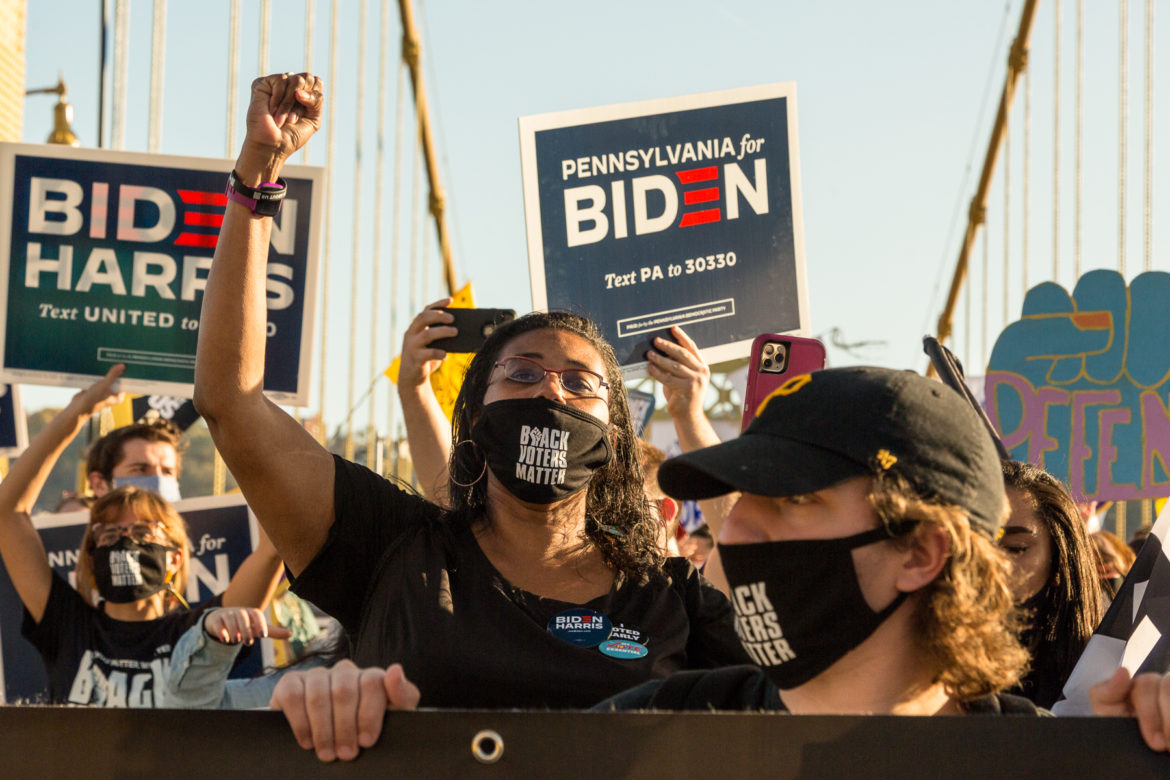
Crowds march across the 10th Street Bridge in celebration of Joe Biden’s victory on Nov. 7, 2020. (Photo by Nick Childers/PublicSource) Crowds march across the 10th Street Bridge in celebration of Joe Biden’s victory over Donald Trump on Nov. 7, 2020. (Photo by Nick Childers/PublicSource)
While the national media has pointed to voters in Philadelphia or Pennsylvania’s small population centers, Allegheny County was crucial in putting Biden over the top.
By Oliver Morrison Public Source
Nov 12, 2020 – oe Biden was declared the winner of the 2020 presidential election after the Associated Press and other outlets declared him the winner of Pennsylvania. Although the vote margins are close in Wisconsin, Arizona and Georgia, Pennsylvania was the state that tipped the scale enough to call the election.
So, how did he win Pennsylvania? The New York Times attributed Biden’s win to “counties east of the Appalachians [that] shifted left.” The Washington Post argued that “it wasn’t Pennsylvania’s major urban centers that set the result in 2020.” Instead, they wrote, “It was Erie County and other places like it, where relatively minor shifts across a wide swath of small, industrial cities, growing suburbs and sprawling exurbs.”
But if Allegheny County voted for Biden as predictably as it had for Democratic candidates the past five elections, the results this year could still be uncertain. It was Biden’s unusual, historic performance in Allegheny County, alongside one suburban Philadelphia county, Montgomery County, which provided enough of a margin for Biden to definitively win.
As of Wednesday evening, Allegheny County had already recorded the vast majority of its votes, more than 717,000, the largest number of ballots cast since more than 719,000 votes were cast when Lyndon Johnson was elected in 1964. And the 1964 election was near the peak of the county’s population boom when about 30% more people called Allegheny County home. There are still some provisional and overseas ballots that haven’t yet been included and just under 1,000 additional ballots that were postmarked by Election Day and arrived within three days.
PublicSource looked at how each of the 1,323 precincts in the county voted to tell the story of how Biden won. As the last ballots are counted, it could change the results in single precincts that are close. We’ll update this piece with any changes once all the votes are tabulated.
Five takeaways:
–Allegheny County was one of two counties in Pennsylvania, along with Montgomery County, where Democratic votes increased enough to give Biden a definitive win.
–Both presidential candidates increased the number of votes their party received compared to 2016.
–Biden is winning by nearly 146,000 votes, the biggest margin in Allegheny County since 1964. The urban core and most of the suburbs voted for Biden. Trump’s wins came largely on the edges of the county such as in Findlay, Fawn and Elizabeth townships.
–Some of the biggest gains for Biden from 2016 were in suburban and rural precincts, some of which he still lost. Some of Trump’s biggest improvements were in primarily Black neighborhoods in the urban core, as well as in patches of the Mon Valley. While Trump expanded to the urban core, Biden expanded almost everywhere else and ultimately won the county by the largest percentage since 1992.
–Allegheny County was one of the two most important counties for Biden
As of Wednesday night, Biden led Donald Trump by 51,301 votes in Pennsylvania, according to the state tally, enough votes to prevent an automatic recount and likely enough votes to survive any legal challenges that Trump attempts.
The US is too militantly divided for a sweeping repudiation of the president to last. We need to keep on keepin’ on in organization a progressive majority for years ahead.
OCT 15 2020 – Though few will dare admit it, much of America is preparing to celebrate the end of Donald Trump. Not only would his defeat bring the curtain down on an administration they regard as the worst in modern US history. In their eyes, it would also dispel the MAGA hat-wearing, militia-sympathising deplorables who make up the US president’s base.
It would be a moment of redemption in which not only Mr Trump, but Trumpism also, will be written off as an aberration. After four years of unearned hell, America could pick up where it left off.
That would be a natural reaction. It would also be a blunder. Should Mr Trump lose next month, it would be with the support of up to 45 per cent of expected voters — between roughly 60m and 70m Americans. Even now when Joe Biden’s poll lead is hardening into double digits, a Trump victory cannot be discounted.
Even if he loses, it is highly unlikely to match the sweeping repudiation that Walter Mondale suffered against Ronald Reagan in 1984, or Barry Goldwater to Lyndon Johnson in 1964. America is too militantly divided for that.
A victorious Biden camp would need to take three concerns into account. The first is that the Republican party is Mr Trump’s, even if he departs the scene. Five years ago, many evangelical voters still felt distaste for Mr Trump’s libertine personality. They quickly learned he was the kind of pugilist they wanted.
The likely Supreme Court confirmation next week of Amy Coney Barrett, and that of Brett Kavanaugh and Neil Gorsuch before her, are testaments to that. America’s Christian right has embraced its inner Vladimir Lenin — the end justifies the means.
The same applies to professional Republicans. Self-preservation might imply they would distance themselves from Mr Trump as his likely defeat drew nearer. The opposite has been happening. As an Axios study shows elected Republicans have become steadily more Trumpian over the past four years.
Partly this was because a handful of moderate representatives either retired in Mr Trump’s first two years, or were ejected by hardliners in primaries. Mostly it was because of the visceral power of Trumpism. It turns out there is not much grassroots passion for fiscal conservatism in today’s Republican party — if there ever was. The impetus is with those who fear that America will cease to be America, partly because of the US’s growing ethnic diversity.
Swamp notes
In the countdown to the 2020 election, stay on top of the big campaign issues with our newsletter on US power and politics with columnists Rana Foroohar and Edward Luce. Sign up here
The second point is that America’s information culture is far more degraded today than in 2016. Democrats often blame Mr Trump’s victory on the Russians. Maybe so. But whatever disinformation Russia spread was dwarfed by home-grown material. According to a study this week by the German Marshall Fund, the amount of fake, or disguised fake, news that Americans consume on their social media has more than tripled since 2016.
Facebook is a much greater vehicle for disinformation today. More importantly, US consumer demand for news that is either distorted or plain false — about the pandemic, for example — continues to grow. A dark conspiracy cult such as QAnon would have been hard to imagine a few years ago. Today it reaches tens of millions of Americans.
The evermore disruptive impact of digital technology on public culture makes governing increasingly difficult. A Biden presidency’s first priority would be to roll out a national coronavirus strategy to flatten America’s curve. Little else can happen before that.
Much of its success would depend on Americans following rules such as wearing masks, avoiding crowds and complying with contact tracers. But a Trump defeat is unlikely to banish the cultural divisions he has stoked. Large numbers of Americans say they will reject a vaccine and view masks as a surrender of their freedom. Mr Biden’s fate will partly hinge on the degree to which he can marginalise those sentiments.
Trump vs Biden: who is leading the 2020 election polls?
Use the FT’s interactive calculator to see which states matter most in winning the presidency
His final concern should be on the conditions that gave rise to Trumpism. The ingredients are still there. Hyper-partisanship, blue-collar deaths of despair, the China threat and middle-class insecurity are all worse, or as bad, as four years ago. Most of those looking to follow Mr Trump, such as Mike Pompeo, his secretary of state, or Tom Cotton, the Arkansas senator, are harder-line versions of him without the caprice.
The fixes to America’s problems are manifold, complex, and painstaking. A vaccine will not suddenly banish the pandemic. Nor would Mr. Trump’s defeat magically bring an end to Trumpism.
Covid19 forced Shell to focus on workers’ health &safety at its construction site in Beaver County.
By Randy Shannon Beaver County Blue
For months 8,000 workers were laboring, eating, and bus riding in close quarters. Some local construction workers said it was the safest cleanest site they had known. When Covid19 came around construction workers were worried but they couldn’t say anything. When a few cases showed up in Beaver County including one at Eaton Corp and one at Anchor-Hocking, then family members – spouses – decided the money Shell paid wasn’t worth risking the lives of their families.
Tina Shannon, the leader of Progressive Democrats of America starting receiving a few messages from people she knows, who had significant others working at Shell. They were concerned that the filth and the packed lunch rooms and buses would spread the virus.
The next day Tina posted a Call-In Day Event Page on Facebook and a massive email, asking people to call the County Commissioners and tell them to demand Shell shut down the construction site. As she publicized the Event, she got a lot of positive feedback. One local union friend did, however, respond by suggesting that her demand would “rob thousands of employees and their families of a living.”
Tina’s response, on March 18th, was: “Drawing everyone from throughout the County into this one place is a recipe of how to spread a virus. This is unconscionable. Take a look at Italy and then compare our very conservative numbers. We’re going to have to have federal legislation to give people income to get through this.”
In two days local folks, including people in Pittsburgh (located downwind) had bombed the County Commissioners with phone calls. The third day the County Commissioners held a press conference announcing that they wanted Shell to shut down construction immediately to prevent spread of Covid19. On March 18th Shell announced it was closing while claiming that it was safe and clean. Continue reading Covid19 and Unions in Beaver County→
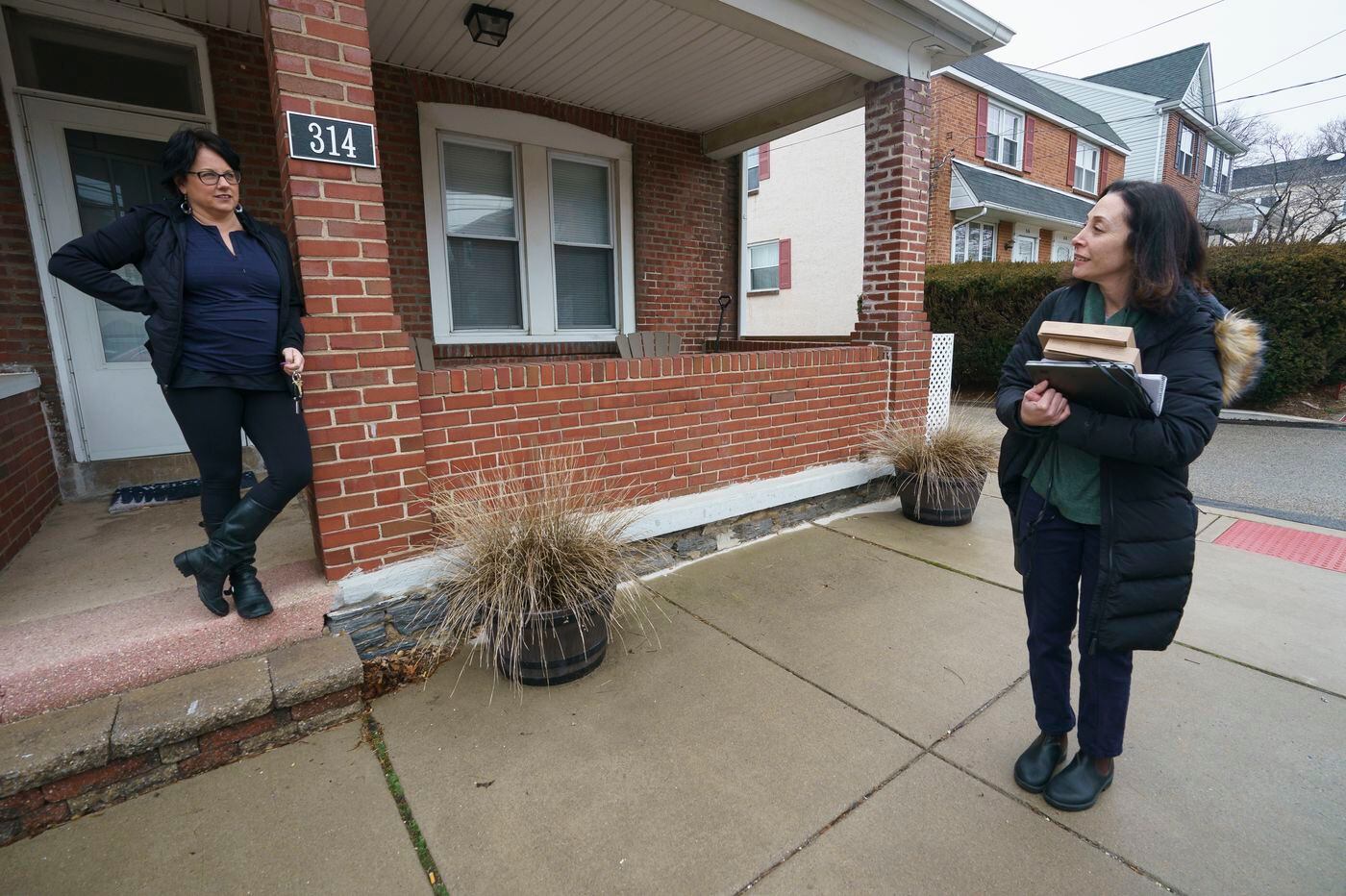
Feb 15, 2020 – I meet Jamie Perrapato on a sidewalk in Conshohocken. The 48-year-old ex-commercial litigator, wife, mom, and cat owner is in black lycra and battle-ready leather boots — the kind with chunky heels perfect for pounding the pavement as you tell Republican incumbents across Pennsylvania: We are coming for you.
She’s the woman who, when she’d taken my call a few days earlier, had moved onto the ice-cold porch outside her Bala Cynwyd house while hunching over a laptop. I’d asked if everything was OK when I heard emergency sirens. Yep; she was just restlessly looking for a spreadsheet with voter-registration splits in towns where her troops are doing battle this year.
“You look for a Republican in the Southeast,” she’d said in a no-nonsense murmur. “We’re coming.”
This same Formerly Nonpolitical Citizen, in her sardonic rasp of a voice, describes the moderate Republicans she’s helped bounce out of GOP control in recent years as though they were nothing more than outdated G.I. Joe toys: “We picked a lot of the fiscal Republicans up.”
President Trump may be the Teflon beast who gets stronger the more radioactive hits he takes, but look at the Godzilla he’s awakened in Pennsylvania: Women-insurgents like Jamie Perrapato in the formerly saltine-bland suburbs of Philadelphia.
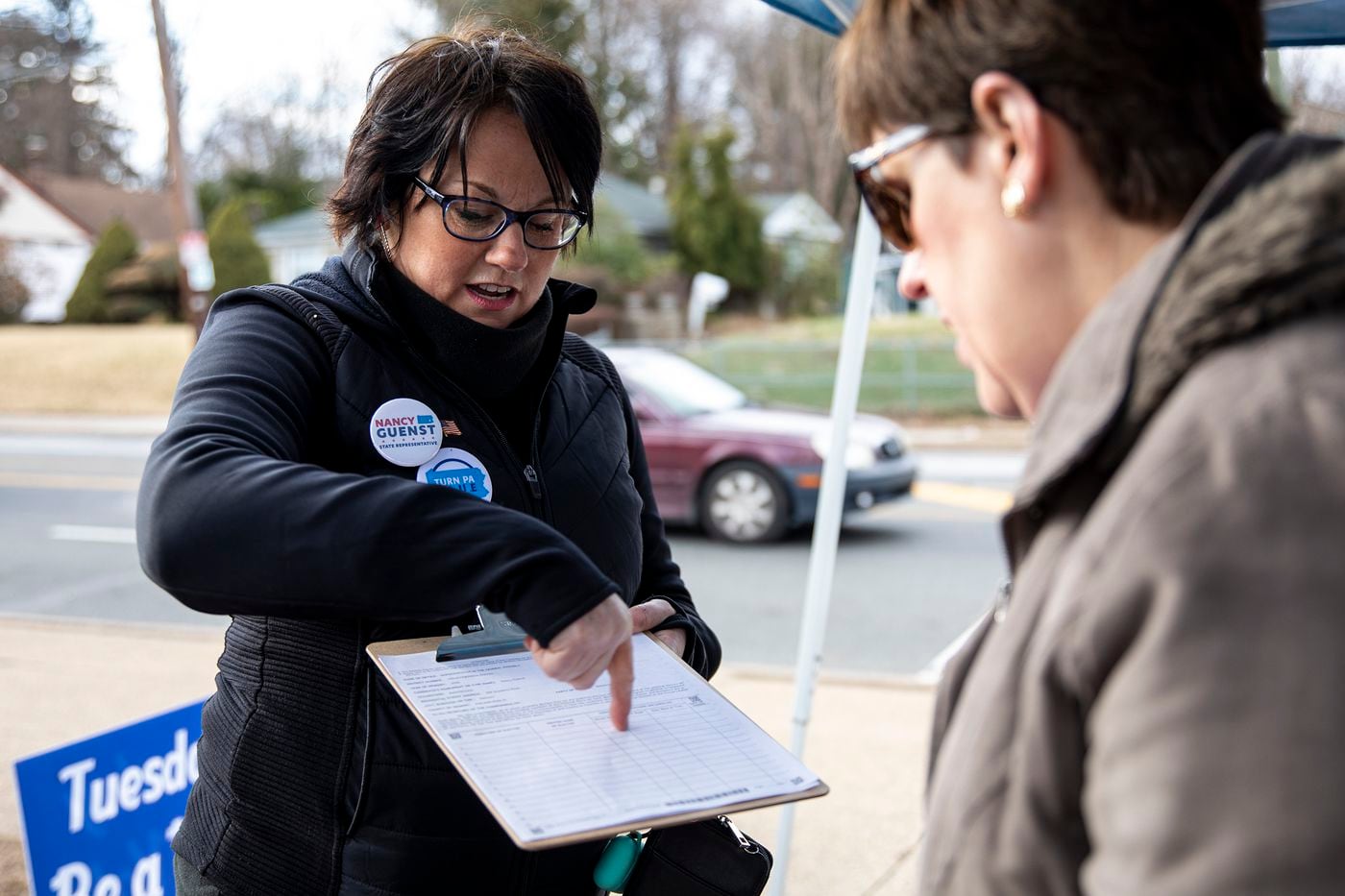
Jamie Perrapato, 48, of Bala Cynwyd, Pa., Executive Director for Turn PA Blue, instructs a volunteer canvassing door-to-door for Democratic electoral candidates in Northeast Philadelphia on Saturday, Feb. 8, 2020. TYGER WILLIAMS / STAFF PHOTOGRAPHER
These are I’m-no-longer-staying-quiet women. And they’ve formed a PAC that is throwing knockout punches.


 By
By 


 Crowds march across the 10th Street Bridge in celebration of Joe Biden’s victory on Nov. 7, 2020. (Photo by Nick Childers/PublicSource)

 Beaver County Blue: Voice of the 17th CD of Progressive Democrats of America