Category Archives: fair trade

Are Working People Meeting the Moment? Prepare for Battle

https://www.weekendreading.net/p/the-trump-regimes-war-on-working

The Trump Regime’s War on Working People: The First 100 Days

Weekend Reading

How Unions are Resisting Authoritarian Attacks on Workers’ Rights—and Why It Matters for Everyone

By Michael Podhorzer

Apr 28, 2025

Over the course of the first 100 days, appropriate attention has been paid to Trump’s attacks on the judiciary, law firms, universities, philanthropy, non-profit groups and the media as dangerous in their own right, but more importantly as essential elements of authoritarian consolidationYet almost no one has mentioned the attacks on an equally proven constraint on oligarchy and autocracy: unions. Trump and Elon Musk’s destructive ransacking of our government should remind us of what previous generations of Americans understood intuitively: that “we may have democracy, or we may have wealth concentrated in the hands of a few, but we cannot have both,” as Supreme Court Justice Louis Brandeis put it. Like other attacks on civil society, the Trump regime’s attacks on unions and working people do not just injure those directly targeted, but all of us, as the labor movement is one of the most essential bulwarks against authoritarianism.

I’ve covered the indispensable role of unions in creating and protecting democracy and freedom in earlier Weekend Readings (Oligarchs Understand Power. Do We?As Go Unions, So Goes AmericaMore Than the Weekend: Unions, the Past and the Future of Democracy, and Then they came for the trade unionists).

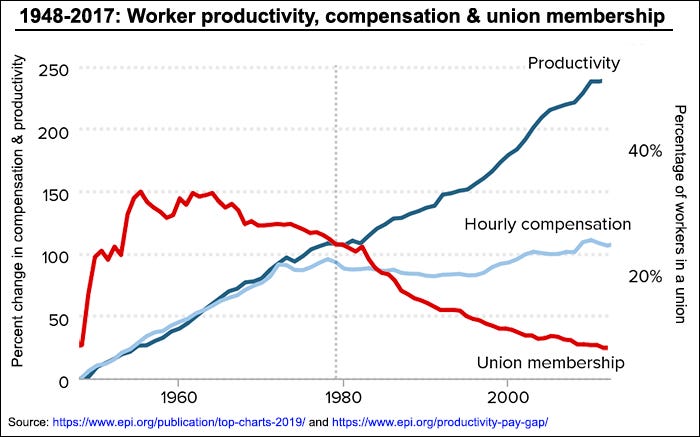
If we all have a stake in unions as bulwarks against authoritarianism whether we belong to one or not, the same is true because of how unions foster shared prosperity and a healthy society, which I elaborate on here and here. In that regard, it is crucial to recognize the Trump actions as coming from the same playbook as Reagan’s decisive firing of over 11,000 striking air traffic controllers. It was more than punitive—it communicated a clear, aggressive stance against unions nationwide. The immediate aftermath saw corporate America follow Reagan’s lead, significantly increasing anti-union activities and adopting overt union-busting strategies.1 Reagan further entrenched anti-unionism by reshaping the NLRB into a body less protective of labor rights, reversing precedents that had previously safeguarded union activities.2

As it did then, today’s federal war on working people comes at a key inflection point. Then it was the rush to globalization, coupled with financialization and deindustrialization. Now it is the imminent transition to artificial intelligence in the workplace. Musk’s firings are providing a new playbook for that transition—fire everyone so as to be able to start from scratch with AI with as little friction from a legacy workforce as possible. And, although not the topic today, it’s important to note here that with respect to DOGE cleaning house to make way for AI, it’s also cleaning house to make way for even more of the government to be privatized—providing a vast market for the tech companies’ AI products and services. Although this future is not certain, it seems to be Musk’s plan: first trash the government, then when the government fails, privatize.

Today, I’ll lay out some of the most egregious actions taken by the Trump regime in the first 100 days to attack unions and working people in both the public and private sectors. Much of this is based on indispensable research by the Economic Policy Institute and its just released 100 Days, 100 Ways Trump Hurt Workers. (For more great reports like this, you can subscribe to EPI here.)

Then I’ll document the robust pushback unions are mounting against the Trump regime’s war on working people in the courts. Unions have also been in the forefront of mobilizing public action, most notably the AFL-CIO’s Department of People Who Work for a Living, which in addition to leading and participating in protests3, has organized town halls across the country.4 AFL-CIO President Liz Shuler declared:

The labor movement is not about to let Trump and an unelected billionaire destroy what we’ve fought for generations to build. We will fight this outrageous attack on our members with every fiber of our collective being.

And, significantly, even sectors mistakenly thought to be pro-Trump like the Building Trades powerfully responded to Trump’s executive order eviscerating collective bargaining for federal workers:

This executive order is an unprecedented assault on worker freedom and a direct attack on those fundamental rights. Americans know that patriotic blue-collar workers built this country, not billionaires. They also know that one of the last best chances to make it to the middle class is collective bargaining. NABTU and our affiliated unions will stand shoulder to shoulder with the entire labor movement to fight this head-on — and we will not back down.

Continue reading Are Working People Meeting the Moment? Prepare for Battle

I’m a Rust Belt Democrat From a Swing District. Anti-Tariff Absolutism Is a Mistake.

A black-and-white photograph of a car’s rearview mirror showing an industrial plant.
Credit…Eli Reed/Magnum Photos

By Chris Deluzio

Mr. Deluzio represents Pennsylvania’s 17th Congressional District.

The New York Times Op-Ed

March 7, 2025 – Democrats have wasted no time rejecting President Trump’s tariffs as “damaging” and “unnecessary.” My colleagues have lampooned them as “irresponsible,” “bad economics” and purely a tax on consumers. This anti-tariff absolutism is a mistake.

I’m a Rust Belt Democrat from a swing district in Western Pennsylvania — where lousy trade deals like NAFTA stripped us for parts.

Many of my constituents support smart tariffs, particularly ones that target China, and so do I. Watching my colleagues on the Hill, it’s clear we’re missing the mark. Democrats need to break free from the wrong-for-decades zombie horde of neoliberal economists who think tariffs are always bad.

Mr. Trump’s tariff approach has been chaotic and inconsistent. There’s no doubt about that. But the answer isn’t to condemn tariffs across the board. That risks putting the Democrats even further out of touch with the hard-working people who used to be the lifeblood of the party — people like my constituents.

Instead, Democrats should embrace tariffs as one component of a broader industrial strategy to revitalize American manufacturing and make whole communities that have been hollowed out by decades of bad trade policy. This isn’t just about making the economy work for more Americans; it’s also about earning back the trust and faith of the people we need to win elections and who ought to be at the heart of the Democratic Party.

Since the 1990s, presidents from both parties pushed trade agreements that were great for corporate bosses and their Wall Street overlords, but a disaster for districts like mine. American companies offshored production to take advantage of cheap labor in countries like Mexico, which for decades have crushed independent unions to keep wages rock bottom. Later, firms shifted production to China and Vietnam, which are often called out for employing beggar-thy-neighbor tactics like wage suppression, enormous subsidies and currency manipulation to jack up their exports.

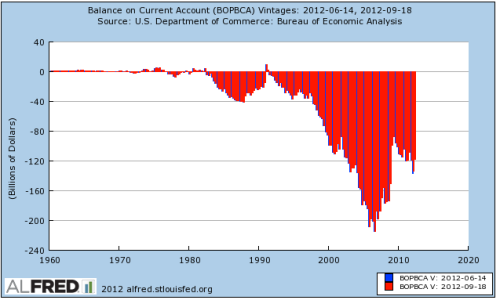
For too long, we absorbed these unfair imports and created a chronic trade deficit that deindustrialized our nation and fueled income inequality. In 2004, the grandfather of modern trade economics, Nobel Laureate Paul Samuelson, revealed how offshoring could cost American workers more in relative wages than they gained from cheaper imported goods, making the current trade regime a bad deal for most Americans.

Tariffs are one of a few tools that can break this cycle: They force mercantilist countries to increase their domestic consumption of what they produce because they can no longer dump it in the United States. Increasingly, policymakers — of all political stripes — recognize that tariffs can help protect industries that are key to our economic and national security, boost American production and wages, and safeguard workers’ rights as well as our air and water by incentivizing firms to raise their labor and environmental standards.

If you oppose all tariffs, you are essentially signaling that you are comfortable with exploited foreign workers making your stuff at the expense of American workers. I am not and neither are most voters. Many polls show that Americans — especially the three-fifths without college degrees — support tariffs in part, economists have suggested, because communities harmed by global competition view them “as a sign of political solidarity.” The Biden administration, to its credit, tripled tariffs on Chinese steel and aluminum imports. So, why is the Democrats’ only message on tariffs that they raise prices? That was the play during the 2024 election and it flopped. Just last month, a CBS poll found that a majority of Americans one, thought Mr. Trump was not focused enough on lowering prices, two, believed that tariffs could increase prices and three, still wanted tariffs on China.

Rather than reflexively condemning all tariffs, Democrats should be highlighting how Mr. Trump’s scattershot threats, unanchored to any real industrial strategy, will not deliver on the goals of rebuilding American manufacturing, raising wages or rebalancing trade.

For one thing, tariffs are effective only when used in a predictable and stable way — and the Trump administration’s approach has been anything but. On Feb. 1, Mr. Trump announced he was imposing new 10 percent tariffs on China and fixing part of a trade scam that allows four million packages to enter the United States daily without facing tariffs, taxes or meaningful inspection — simply because they’re labeled “low value.” Not only does this “de minimis” loophole undermine U.S. producers and retailers, but traffickers also often exploit it to sneak in deadly fentanyl-laced pills and fentanyl precursor chemicals. Days after his announcement, Mr. Trump flip-flopped and reopened the loophole. He raised China tariffs another 10 percent on March 4 — good! But still, the loophole means billions in Chinese imports can evade tariffs and inspections.

Mr. Trump’s chaotic tariff two-step — imposing, delaying, threatening and then again imposing tariffs, including on allies like Canada with whom we mainly have balanced trade — is bad business for America. Entrepreneurs ready to invest in production here sit on the sidelines, wondering where the tariff roller coaster will stop. (Continued)

On Why the USW, Biden and Trump are Right about the Nippon/USSteel Ripoff

By Ike Gittlen

https://ikegittlen.substack.com/

For months the proposed sale of USSteel to Nippon Steel has been front page news. The Committee on Foreign Investments in the United States (CFIUS), that reviews the national security implications of these global transactions is reportedly at an impasse and unable to come to a determination.

The reality is that what CFIUS decides (or doesn’t) is irrelevant. Both the incumbent President and the President-elect have said they will not approve the deal. It’s slowly dawning on people that this deal isn’t likely to happen.

We shouldn’t be surprised. Opposing the Nippon/USSteel deal is the logical response to all that we have learned about the steel industry, the “free trade” model of global trade, the importance of maintaining domestic control over critical supply chains and how the big money vultures strip-mine our stable industrial/manufacturing enterprises. It isn’t, as Nippon/USSteel would like us to believe, something that must happen or USSteel will collapse. Once this bad deal is gone, we know there are a number of options to retain and enhance USSteel’s assets.

To understand what’s happening we have to start with the global steel overcapacity. The OECD reports a global steel overcapacity exceeding 500 million metric tons, with some estimates reaching as high as 630 million metric tons. This has nations with overcapacity (China in the lead) looking for places to dump their steel production. Our nation is a lucrative place to offload unneeded steel. Interestingly, Nippon is reportedly looking to do deals in other nations with lucrative steel consumption, as the USSteel deal falters.

It’s fantasy to believe that once Nippon owns USSteel it won’t use it to move its overcapacity here. Simply look at the cases that the USW and the Steel Industry have won at the International Trade Commission, to get a flavor of how blatant other nations have violated our trade laws to gain access our steel market. The failure of Nippon to offer credible and enforceable commitments to continue American domestic production, should convince us of their real intent. This is the heart of the national security concern. That if Nippon is allowed to own such a large part of American steel capacity, the will result will be steel shutdowns here and less ability to supply our own needs of this critical economic sector.

Trump ‘Sold Out Southwestern Pennsylvania’ With Recent Trade Deal

Sara Innamorato:  Our Democratic Socialist in Harrisburg  Sticking Up for All of Us.

By Sara Innamorato
Pittsburgh City Paper

Frb 14, 2020 – Everyone who grows up in Pittsburgh can narrate the rise and fall of the steel industry: the mills grew as immigrants arrived to take jobs in the blast furnaces, then the Great Strike occurred where industry titans ordered deadly violence upon workers calling for better wages and working conditions; later, the series of federal trade agreements were created, culminating with the North American Free Trade Agreement (NAFTA), that sold out the workers and shut down the mills.

Our city’s population declined by half. Our family-sustaining union jobs crumbled, and our neighborhoods with them. But Pittsburghers are tough — we don’t like to complain, we’ve seen worse. And so we persevered and we adapted, and now Pittsburgh is widely seen as a success story. There is a sense of collective pride in our story of resiliency.

But as I knocked on doors during my 2018 bid for office, my neighbors told a more nuanced story. They told me they were working harder, but making less — getting by day-to-day was a stretch. They told me they were worried about their futures and their children’s futures.

The voters I spoke with, like so many of us in Southwestern Pennsylvania, had watched as previous trade agreements, like NAFTA, pushed local jobs overseas and drove down wages for the jobs that remained. People were fed up, and many voted for President Trump because he said he would “never sign any trade agreement that hurts our workers.”

I am no supporter of President Trump, but for the sake of the people I represent in Allegheny County, I had hoped this was a promise he would keep. Unfortunately, when he signed the United States Mexico Canada Agreement (USMCA) on Wednesday, he broke that promise, betrayed those voters, and sold out Southwestern Pennsylvania.

Continue reading Trump ‘Sold Out Southwestern Pennsylvania’ With Recent Trade Deal

‘We’re the Sacrificial Lamb’: Lordstown Workers On the UAW Plant Closures

By Carter Eugene Adams
Organizing Work via Portside


Nov 11, 2019 – The Monday after Thanksgiving last year, workers at the General Motors Lordstown Assembly Plant in Ohio were called in for a 9 a.m. meeting. This was a rare occurrence.

“I don’t know, was it three sentences long maybe? ‘Hey, you’re unallocated.’ …No one had ever heard of ‘unallocated’,” says John Sandquist, Jr., a 25-year employee of GM. “We didn’t know what that term meant… Basically, it meant ‘you guys are closing.’”

The Lordstown plant is the former home of the Chevy Cruze and 1,600 workers. For almost a year now, no product has been coming out of the plant, with workers transferred, forced into early retirement or just out of work. Over the past year, GM has transferred over 700 workers from Lordstown to various plants across the country, mostly out of Ohio. According to the tentative agreement between GM and the UAW, the plant closure will be permanent.

Sonya Woods, a 25-year employee of GM, who was transferred to Bowling Green Kentucky, says she had to either move, or lose everything she’s worked towards.

“Gotta go or I lose my pension, lose my benefits,” said Woods. “They got us screwed. There’s a big group that have ‘95 seniority, 25 years, and we lose a lot if we don’t follow it. We don’t have much choice.”

Last week, outside of the shuttered factory, four workers held the picket line, along with 49,000 other GM employees still on strike, even as news of the proposed agreement between GM and the UAW started to circulate. The four were getting ready to transition to other plants when the strike was called. The locals at their new plants allowed them to come back to Ohio to do their strike duty at their home plant, as the Lordstown plant closure was one of the issues on the table between GM and the UAW.

At the picket, workers stood around a burn barrel. Harsh orange streetlamps illuminated an empty, fenced-in parking lot. The 6.2 million-square-foot behemoth factory acted as an eerie monument to what was once an industrial hub in northeastern Ohio. It was silent except for the drone of trucks driving by on the Ohio Turnpike.

“This used to be non-stop traffic, non-stop. Look, nothing!” said Agnes Hernandez, a 23-year GM employee.

“This is the truck gate,” added Sandquist.

“There would be lines, remember?” replied Hernandez. “We’d have lines of trucks coming out here.”

After a moment, Hernandez realized Sandquist didn’t have his signature clothing item: his orange vest.

“Go get your vest on! Come on, OVS!” Agnes jokingly shouted.

This group of friends, who spent nearly every day together in this plant for decades, called themselves the “Orange Vest Society.” The orange vest is standard attire for workers in the plant. But whether or not a given worker was wearing orange was semantics. Those in OVS felt they had another layer of protection between them and management. Having the solidarity and at times friendship of those on the shop floor gave workers a sense of “you watch my back, I watch yours.”

The origins of this group are vague, but as Dan Santangelo, a 25-year employee of GM put it, the roots of it are solidarity and comradery. “Management would start something with one of us, and it just started as a joke: ‘You mess with one person in Orange Vest you mess with us all.’ We don’t know who came up with it, maybe it might have been Jeff” — OVS member and fellow worker on the picket line – “came up and said, ‘we should call ourselves the Orange Vest Society.’ So, that’s what we did. On our last day here, we spray painted it on the wall behind out team center.”

The proposed contract appears set for ratification. Besides the plant in Lordstown, it cements the closure of two more GM facilities — Warren transmission and Baltimore transmission — three of the four that were on the table.

GM’s stated the reason for the Lordstown closure was the Cruze’s poor sales performance in the United States, with consumers opting for larger SUVs and trucks. But months after the shuttering, GM announced the production of a strikingly similar vehicle , the Onix, to be built and sold in Mexico. GM has also announced its revitalized production of the Chevy Blazer in Mexico, shortly after shuttering the Janesville, Wisconsin plant where it used to be made.

Workers think the production of the Onix could have taken place at Lordstown Assembly and kept the plant open. Sandquist feels the continued closure of Lordstown has little to do with the product they produced and more to do with GM attempting to fracture worker power and solidarity.

“This community, this plant — we’ve always built a good product here for 53 years,” said Sandquist. “I believe it’s something personal they have against the local 1112, it’s something personal against this plant because the union was strong here and we cared about the community. They’re more concerned about profits.”

For workers in Lordstown, transfers to plants hours from home, buyouts and early retirements are their consolation prize.

In 2007, workers were understanding of concessions needed to keep the company alive and acted accordingly. 12 years later, with record profits recorded and salaries for company executives in the tens of millions, workers want what they’re owed.

But trying to negotiate that has been difficult. The six weeks of the strike have seen agreements proposed and then removed in the same day. Negotiations stalled, started and stalled again. The latest draft of the proposed contract is four volumes long.

As Parma, Ohio UAW Local 1005 President Mike Caldwell explains, it’s necessary. “Every single thing in [our] shop was negotiated,” said Caldwell. “At one point in time, someone had to fight for it and negotiate for it.”

The new contract between the UAW and GM meets many demands that sent workers to the picket line. Those include a revised healthcare plan; gradual wage increases and a path for temporary workers to be hired on full-time.

By not pushing further on running product through Lordstown, UAW officials in Detroit have affectively abandoned shuttered plants in pursuit of other demands. Lordstown assembly, Warren transmission and Baltimore transmission plants are the union’s biggest concessions.

“We’re the sacrificial lamb in this one,” Sandquist said. “They’re gonna sacrifice Lordstown for the good of the whole, and the whole UAW membership. I get their point, but it sucks for us, and I’m pissed off about it.”

Caldwell weighed in on Lordstown remaining closed after members of local 1005 voted to ratify the contract, 438 for, 404 against. “It’s still kind of a sad spot for everyone that that plant is still slated to close,” he said. “It’s very disappointing, with that plant closing, that destroys that entire community.”

Keeping the Lordstown plant closed means workers have a difficult decision to make: either lose their jobs or transfer to another plant. Workers who did not qualify for early retirement were given the one-time offer to transfer and continue working until they’re eligible to collect their pensions and retirement benefits. The new proposed agreement offers a buyout, but according to the highlights of the agreement, distributed by UAW, that buyout doesn’t offer much.

For workers who choose the buyout option, they agree to terminate their employment and benefits, save for some pension benefits. In return, they’re offered a sum of money, between $7,500 and $75,000, based on years of service.

While that may seem like a lot offered, that money is just that: money. No benefits, no health care. And for people living paycheck-to-paycheck, those benefits are all they have. For those with more seniority, they’re choosing between cash or decades worth of pension and retirement benefits.

The four members of the Orange Vest Society decided to transfer so they can make it to their pension and keep their benefits. They’ll be eight hours from Lordstown in Bowling Green, Kentucky and six hours away in Bedford, Indiana — leaving their families and their community.

“It sucks. Every one of these people right here around this burn barrel is going through that,” said Sandquist. “He has a family that is here and he’s gonna be eight hours away, same with Agnes, same with this man Dan over here. He’s got a wife, two kids. Agnes has got grandkids now for Christ’s sake, she ain’t gonna see them grow up.”

“What do I do now? Facetime?” said Hernandez. “I mean you can’t see everything on Facetime. You know, it’s like my grandson, he’ll be two in January and he looks at me through the phone it’s almost like he has to do a double-take to see and hear my voice. Just so he knows me, I have to keep repeating who I am. It’s so, it’s horrible. It’s like, ‘oh my god, he’s gonna forget me.’ Being that young he’s gonna forget who I am, you know, and that to me is just heartbreaking.”

In addition to uprooting their entire lives and leaving family here in Ohio, this also means the end of the Orange Vest Society.

Even off the shop floor, through the upheaval of the plant closure, OVS became a way for workers to look out for each other.

“I went through a very bad time before I had to go to Bedford (Indiana), I was almost as low as killing myself, that’s how low I was.” said Santangelo, as a result of having to leave his family, his home and his community. “Not only did my blood family reach out to me, but these guys did as well,” he said. “Jeff would call every other day to check in. ‘How you doing?’ He would try to get me talking. That’s. That’s the Orange Vest Society.”

 I think this was our mentality.We came to work to have fun and to work. In that order,” explained Santangelo. “We made it enjoyable. We made it worth our while to be here.”

“Yeah, but the place is so miserable you had to do something,” added Sandquist.

As the night goes on, the conversation shifts and changes, from heated discussions about the proposed contract to jokes about how many liquor bars and sex shops there are in Kentucky. The remaining OVS members talk about home, about what, and who, they’re leaving in order to provide. There are also long moments of silence on the picket line, between the jokes and contract talk. Against the backdrop of the shuttered plant, there’s this feeling that this is the end of an era.

“It was like a second family,” said Hernandez. “I mean we hung out together, we’ve known each other for 2o-plus years. These are my brothers.”

Agnes and Jeff go into the Styrofoam cooler next to the wood pile under a small nylon canopy. After a few minutes the two emerge with plastic cups. Dan had declined the offer earlier and joins the toast emptyhanded.

After the toast, the group sits and talks for a while longer before slowly, one by one, leaving.

Shortly after midnight, Sandquist is packing up his chairs and getting ready to head back to the union hall to sign out before finally going home. Before he heads out, he reflects on the future of the Orange Vest Society. “We might end up having a little chapter down in Bowling Green, one in Bedford, some of our friends up in Toledo will have a little — there’s a couple of us everywhere but the original core group is split up,” he says.

“That’s the stuff that pisses you off even more, you know, it’s the friendships, your family, your secondary family. You’re not gonna spend time with them no more, or you know, have them relationships. Talk on the phone or text, see what’s up with them but not like you use to. Kinda at the end, it’s over and it’s sad.”

Continue reading ‘We’re the Sacrificial Lamb’: Lordstown Workers On the UAW Plant Closures

TPP Trade Deal Puts U.S. Workers’ Rights and Jobs at Risk


A dangerous deal for labor, the Trans Pacific Partnership free trade agreement, gained a key endorsement from the NYTimes on the eve of VP Biden’s trip to China. Ed Schultz and Leo Gerard discuss the effect.

"A US-led trade deal is currently being negotiated that could increase the price of prescription drugs, weaken financial regulations and even allow partner countries to challenge American laws. But few know its substance."

The Top Secret Trade Deal You Need to Know About

Nov 1, 2013 – Secrets… The innocent lives lost in drone wars and the trade deal Washington and big business are trying to hide. From Bill Moyers’ show, ‘Moyers% Company’

Pitt Students in Solidarity with Garment Workers


University of Pittsburgh heats up over sweatshops

By Alex Zimmerman

Pittsburgh Post-Gazette

Feb. 24, 2013 – When Joe Thomas dropped off a letter signed by 25 student organizations at University of Pittsburgh chancellor Mark Nordenberg’s office, he thought he’d get a response.

When he didn’t get one, he helped persuade 24 more student organizations — including Pitt’s student government board — to drop off letters themselves.

"We were dropping off letters just about every day," Mr. Thomas said.

The letters ask Pitt to affiliate with the Worker Rights Consortium, an independent monitoring organization that works with 180 universities across the country to investigate factories where university-licensed apparel is manufactured.

Continue reading Pitt Students in Solidarity with Garment Workers

PDA Greets Inaugural with ‘Progressive Central 3’ in DC, Vows to Fight for Jobs and Fair Trade

Discussing Fair and Unfair Jobs, and MORE!

Dear Beaver County Progressives:

Guest Speakers and Staff at Progressive Central

PDA’s January 19th pre-inaugural event in Washington DC–Progressive Central III–alerted us to a hazardous new trade agreement in the making.

The Trans-Pacific Partnership (TPP), negotiated in deep secrecy, would supersede environmental regulations, labor rights, and consumer safety. This agreement would make it even more difficult to regulate the financial industry.

‘Buy American’ would be outlawed.

Ms. Lori Wallach from Public Citizen’s Global Trade Watch, as a Progressive Central panelist, delivered a concise and highly informative explanation of what this pending trade agreement contains. She will be our special guest on our next Economic and Social Justice call.

Pennsylvania has been one of the states hardest hit by corporate trade agreements.

We would like to think that President Obama will take a more progressive approach to trade. However, we are acutely aware that trade agreements have been controlled by the top financial corporations and have exclusively benefited the 1%.

Members and friends of PDA in Pennsylvania will want to stay current on these trade talks and prepared to take action along with our allies to prevent more damage to our economy and our social stability.

I hope you’ll consider joining PDA in our “Educate Congress” campaign each month. You can visit with or do a letter drop at a local Congressional office, or back up those who do with phone calls. Our coalition is growing and we are working in conjunction with the Jobs Not Wars campaign to educate Congress on what the people of Pennsylvania and America, really need:

Prosperity Not Austerity.

Contact conor@pdamerica.org to get involved! You can also work with an issue organizing team (like our Economic and Social Justice Team) and / or help to start or connect with a local chapter in your area. Please help support our organizing with a contribution. Feel free to email me at pennsylvania@pdamerica.org with any questions.

Please watch Lori Wallach’s comments from Progressive Central (coming soon), as well as the rest of the exciting videos from this great event at the PDA YouTube channel!

In solidarity,

Randy Shannon
PDA PA State Coordinator
Economic and Social Justice Team Coordinator

Update Your PDA Profile

Find out more about Progressive Democrats of America
You are subscribed to Progressive Democrats of America as rwshannon3@gmail.com

Privacy Policy

Click here to unsubscribe


Follow PDA

empowered by Salsa

Exporting Gas And Oil Will Not Erase The Trade Deficit

Western PA as a Case in Point

US trade deficit 2012

By EMS News
Beaver County Blue via Culture of Life News

The US continues the program of selling commodity raw materials while importing manufactured goods.  This futile trade deal is also not working because always, the value-added labor that goes into production is lost when a country trades this way.  If a country has a small population and lots of raw materials, it can get rich doing this but not a country with 350 million people.  Even Saudi Arabia, due to making birth control illegal, has a rapidly growing population that is eating into oil export values and soon will erase it entirely.  Japan, with half the population of the US, is seeing its trade decline, too.  While importing energy due to Fukushima.

The trade deficit was hardly mentioned during the last election.  It is as if it doesn’t exist.  Even though it is the core problem within our economy, one that has been papered over, literally, by the US printing trillions of extra dollars.  Inflation has been kept down due entirely to trade partners holding excess US dollars in FOREX accounts overseas.  But the US is desperate to generate some funds to cover the river of red ink flowing through our economy so of course, we do this by exporting lumber, gasoline, gas and oil as well as other primitive commodity products.

Naturally, this doesn’t plug the giant hole in our economy! Nonetheless, DC pundits and politicians tell us gravely, we must do this more and more and eventually it will fix things. Here is the latest delusional story from DC misleading people about the trade deficit: Natural gas exports: A boon to the economy – The Washington Post

Continue reading Exporting Gas And Oil Will Not Erase The Trade Deficit