For months the proposed sale of USSteel to Nippon Steel has been front page news. The Committee on Foreign Investments in the United States (CFIUS), that reviews the national security implications of these global transactions is reportedly at an impasse and unable to come to a determination.
The reality is that what CFIUS decides (or doesn’t) is irrelevant. Both the incumbent President and the President-elect have said they will not approve the deal. It’s slowly dawning on people that this deal isn’t likely to happen.
We shouldn’t be surprised. Opposing the Nippon/USSteel deal is the logical response to all that we have learned about the steel industry, the “free trade” model of global trade, the importance of maintaining domestic control over critical supply chains and how the big money vultures strip-mine our stable industrial/manufacturing enterprises. It isn’t, as Nippon/USSteel would like us to believe, something that must happen or USSteel will collapse. Once this bad deal is gone, we know there are a number of options to retain and enhance USSteel’s assets.
To understand what’s happening we have to start with the global steel overcapacity. The OECD reports a global steel overcapacity exceeding 500 million metric tons, with some estimates reaching as high as 630 million metric tons. This has nations with overcapacity (China in the lead) looking for places to dump their steel production. Our nation is a lucrative place to offload unneeded steel. Interestingly, Nippon is reportedly looking to do deals in other nations with lucrative steel consumption, as the USSteel deal falters.
It’s fantasy to believe that once Nippon owns USSteel it won’t use it to move its overcapacity here. Simply look at the cases that the USW and the Steel Industry have won at the International Trade Commission, to get a flavor of how blatant other nations have violated our trade laws to gain access our steel market. The failure of Nippon to offer credible and enforceable commitments to continue American domestic production, should convince us of their real intent. This is the heart of the national security concern. That if Nippon is allowed to own such a large part of American steel capacity, the will result will be steel shutdowns here and less ability to supply our own needs of this critical economic sector.
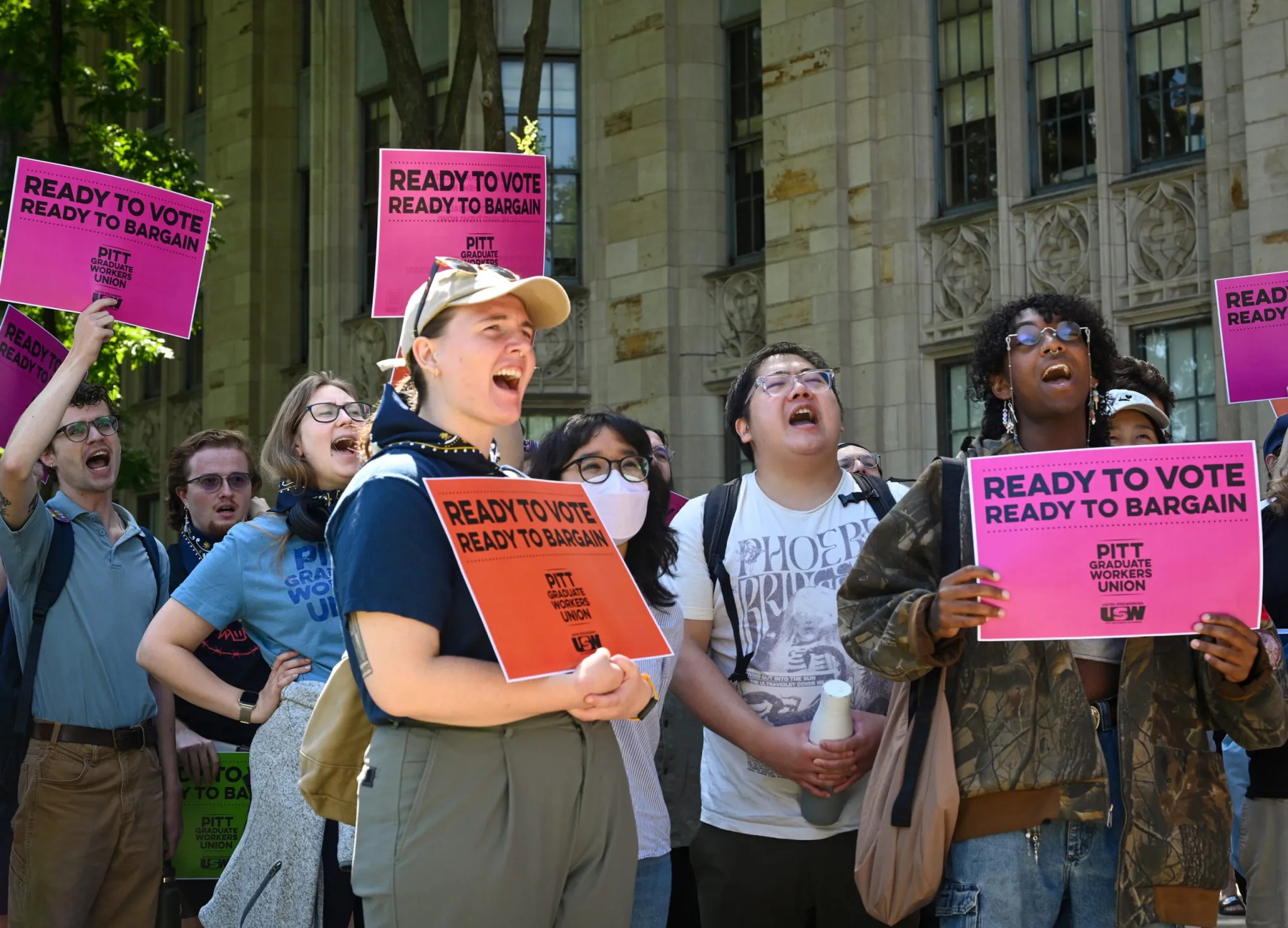
The University of Pittsburgh’s graduate student workers narrowly declined unionization in 2019, but this week’s overwhelming vote has the Oakland campus riding a wave of higher ed organizing.
Nov 22, 2024 – Throughout the week, more than 1,000 graduate student workers at the University of Pittsburgh made their way to a nondescript ballroom in the O’Hara Student Center to vote on whether to unionize.
Supporters sought everything from more transparency on the part of university administration to pay equity, better vacation time and health insurance.
The line outside the ballroom stretched, at times, down the stairs of the center. “People are so excited … I’ve never seen engineers this excited,” said Lauren Wewer, a materials science and engineering Ph.D. student and organizer at Pitt.
On Friday, organizers announced the results: a 1033-28 vote to unionize with the United Steelworkers [USW]. The Pennsylvania Labor Relations Board had not yet confirmed the vote count as of mid-afternoon.
With this win, Pitt grad student workers become the latest employees to undergo a successful union bid at a U.S. higher education institution, continuing an upward trend in the sector’s organizing activity over the last few years. They also join faculty and staff at the university which unionized with the USW in 2021 and September, respectively.
Pat Healy, an information science Ph.D. student at Pitt, said the wide margin of support reflected in the vote, “aligns with how most of the grad union votes [in the country] have gone the last couple of years.” Healy has been organizing at the university since 2019, which was the last time grad student workers attempted to unionize. Then, the pro-union students lost by fewer than 40 votes. For them, the impact of this year’s vote stretches beyond Pitt’s campus.
“I’m happy for the movement [and] looking forward to some other grad unions popping up, I’m sure inspired by us, because that always happens,” Healy said.
After Thanksgiving, they said organizers will begin setting up for bargaining with Pitt’s administration.
In a statement after the vote count, the university said, “While first contract negotiations can be complex, please know that we will come to the table in good faith and be there to support all graduate students throughout and beyond the process.”
Immediately following the loss in 2019, any efforts to restart conversations about unionizing would meet with “a kind of extreme hesitancy,” Healy said, blaming “a lack of understanding of what a union was.”
This year felt different, Healy said. There are likely a few reasons why.
Five years after failed vote, Pitt grad students unionize EQT’s ‘bulldog’ has D.C. in his grip, with profits — and maybe higher gas bills — on the horizon
A wave of change
From 2021 to 2023, nearly 64,000 U.S. grad student workers joined unions. By comparison, only 20,394 students unionized from 2013 through 2020. Today, four in 10 grad student employees belong to labor groups.
This trend was, experts say, driven in part by the pandemic and by the administration change from Donald Trump to Joe Biden in 2021, which ushered in a National Labor Relations Board more amenable to organizers.
Adrienne Eaton, professor of labor studies and employment relations at Rutgers University, noticed COVID-19-driven layoffs and research funding losses on campus in New Jersey that eventually led to a faculty and grad student strike last year. She describes this time as an “active moment” in American higher ed, with students advocating for change across the board at universities and colleges. And with grad students, there’s another factor at play: “The faltering job market in academia.”
“A high percentage of students no longer [are] confident that they have a future as tenure-track professors, in particular, or potentially as academic faculty at all,” Eaton said. “So, I think it really changes the way that graduate students look at their assistantships that they get.”
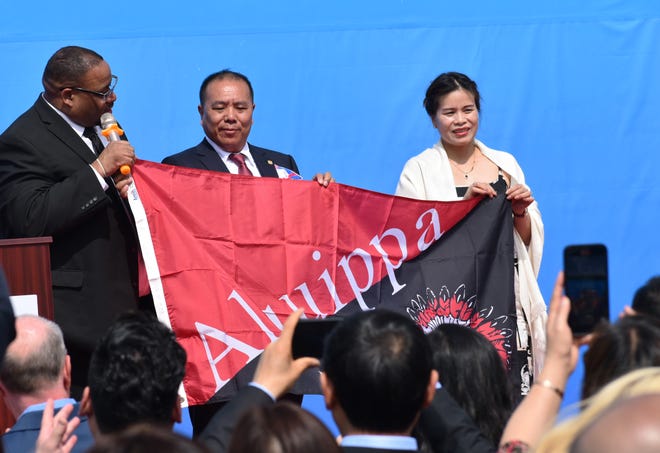
Groundbreaking ceremony in Aliquippa, May 16, 2023
By Chrissy Suttles Beaver County Times
ALIQUIPPA – A New York-based company plans to revive Aliquippa steel production with a $218 million advanced manufacturing facility on land once occupied by J&L Steel’s tin mill.
72 Steel, founded in 2016 by Chinese-American entrepreneurs, committed Tuesday to purchase the land owned by developer Chuck Betters to build a steel fabrication plant on 44 acres of the historic Aliquippa Works site along the Ohio River.
The operation will include an electric-arc furnace — a steelmaking technology with lower carbon intensity than traditional methods — to melt scrap steel and produce 500,000 tons of rebar, or reinforcement steel, annually for a variety of industries. Its production capacity and output value are expected to reach $400 million.
Artist rendering of the new mill
Once complete, the company expects to hire 300 to 400 permanent employees, but hundreds of construction workers will be needed to build the facility, roadways, parking space, product storage areas and ancillary buildings. Regional union leadership could not immediately comment on whether they’re in talks with 72 Steel to hire union builders and/or operators. The plant’s anticipated completion is 2025; it will be 72 Steel’s first manufacturing site.
72 Steel plans to use “energy-saving and environmental protection technologies” during production, including air and water pollution control equipment and an electric-arc furnace from Italian technology supplier Tenova.
Xiaoyan Zhang, senior business adviser at 72 Steel, said the company’s decision to build was prompted by the 2021 federal Bipartisan Infrastructure Law that included $110 billion in new funds for roads, bridges and other major projects. The company toured sites in West Virginia, Ohio and North Carolina before settling on Beaver County due to its river and rail access and the Pittsburgh region’s enduring history of steelmaking.
The company’s $218 million investment is “an initial investment,” Zhang said. “Maybe, down the road, there would be some additional (investment).” Company leadership, he said, “feels proud as Chinese Americans about making America great and supporting the infrastructure bill.”
The old J&L
The move has been in the works for months; 72 Steel leadership toured the proposed facility late last year alongside landowner Chuck Betters, state and local officials and members of the Allegheny Conference on Community Development. State business filings show 72 Steel registered with Pennsylvania in June 2022.
“Pittsburgh has a celebrated history as the manufacturing powerhouse that built the modern world,” said Matt Smith, chief growth officer at the Allegheny Conference. “Today, we are positioned as the region where the next-generation of manufacturing is happening now – spanning advanced, additive, green manufacturing and more.”
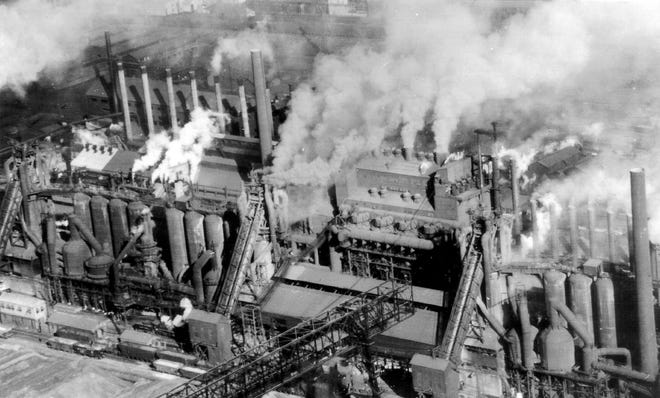
J&L Steel’s mill at 611 Woodlawn Road opened in 1910 and expanded in 1947 for tin plate production. It operated until the 1980s when Aliquippa Works, by that time owned by LTV Corp., closed amid the region’s steel collapse.
Aliquippa Works at one time employed more than 10,000 workers; nearly 8,000 people were out of jobs when the site closed, leaving former company town Aliquippa financially ruined with a disintegrated tax base. The site was later demolished and, in recent years, served as a staging area for Shell’s ethane cracker plant in Potter Township.
Mayor Walker congratulating a partner.
“My dad put 18 years in at this very site,” said Aliquippa Mayor Dwan Walker during a Tuesday groundbreaking ceremony. “My father walked out of this mill in ‘86 thinking steel was never going to come back. I was so emotional this morning thinking about the possibility of what will be … I can’t wait to see cars come through that tunnel with stickers: ‘My kid goes to Hopewell,’ ‘My kid goes to Beaver Falls,’ or ‘My kid goes to New Brighton.’ I can’t wait to see those stickers come through that tunnel like when my dad was working here.”
72 Steel has not yet closed on the deal, but Betters said they’re on their way. The Beaver County developer pledged to invest $1.5 million of his own money into the project within seven days of closing.
“I’m comfortable you’re very honorable people,” he told 72 Steel leadership. Once the deal closes, planning and environmental permitting will begin.
Most of the remaining Aliquippa Works land is now owned by cellular PVC manufacturer Versatex and U.S. Minerals, which makes roofing and abrasive products like coal slag abrasives, iron silicate roofing granules and mineral fillers.
Tuesday’s groundbreaking featured speakers from 72 Steel and state, county and local lawmakers and figureheads.
“It’s always about jobs, jobs and more jobs,” said state Rep. Rob Matzie, D-16, Harmony Township. “There were some close calls on this property, suitors have come and gone, and we are hopeful … we will see construction. I live across the river, growing up in the ‘70s and ‘80s, I was able to see the J&L smokestack on this property. I still live up on that hill, and I’ll be able to see this new construction when it’s complete, hopefully, sooner rather than later.”
Stephanie Sun, executive director of former Gov. Tom Wolf’s Advisory Commission on Asian/Pacific American Affairs, called Tuesday’s event a milestone for Chinese Americans living in Pennsylvania, noting that May is Asian/Pacific American Heritage Month and Asian Americans are the fastest-growing racial or ethnic group in the United States.
“The Asian/Pacific American community is also the fastest-growing population in the United States with a strong international network of investment and business opportunities,” she said, adding it’s been just 80 years since the repeal of the federal Chinese Exclusion Act.
Mayor Walker with new steel officials.
Beaver County Commissioners’ Chairman Dan Camp said the groundbreaking marked a new era of Beaver County steel, adding Beaver County is “always open for business.”
“We want to bring more work to the area, and assist communities where they can raise a family,” Camp said. “To make Beaver County what it was when the steel mills were running 24 hours a day, seven days a week with a strong focus on economic growth and creation of good-paying jobs. Just like (Walker’s) father, my relatives and many other Beaver Countians who worked tirelessly on this very ground to help create the rich history that Beaver County has today.”
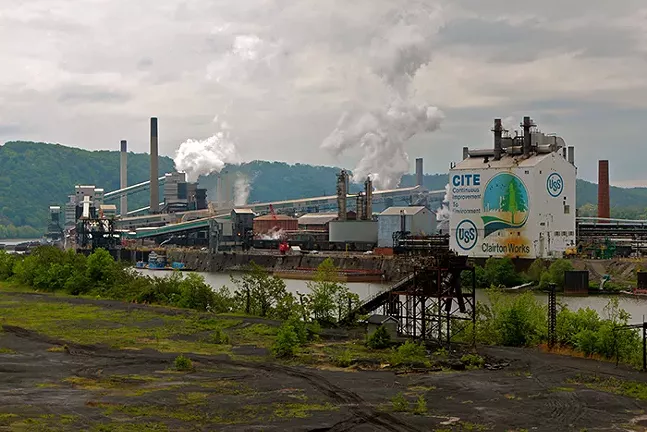
April 30, 2021 – U.S. Steel Corporation is cancelling its $1 billion upgrades to its Mon Valley Works facilities, which includes Edgar Thomson Works in Braddock, Irvin Plant in West Mifflin, and the Clairton Coke Works in Clairton. While the cancellation will likely result in some job losses in the region, it will also reduce the levels of harmful air pollution in the Mon Valley and beyond.
The upgrades, which were announced May 2019, would have included a casting and rolling facility and a cogeneration plant. After several delays due to COVID in 2020 that increased the upgrade costs to a promised $1.5 billion, U.S. Steel pushed the start date of those upgrades to the fourth quarter of 2022. But today, the company announced it would be scrapping those plans entirely.
In addition to cancelling these updates, U.S. Steel plans to permanently idle batteries one through three at Clairton Coke Works by the first quarter of 2023. Batteries one through three are the oldest at the Coke Works and can allow twotothree times more emissions than the rest of the facility, according to environmental groups.
According to the EPA’s National Air Toxics Assessment, toxic air pollution contributes to high risk of cancer, and Clairton Coke Works is responsible for many of the airborne carcinogens in the region. Asthma rates among children in Clairton are three times higher than in the rest of the county.
“For too long, U.S. Steel has run roughshod over our environmental protections and churned out dangerous levels of harmful air pollution,” says PennEnvironment Research & Policy Center clean air advocate Zachary Barber. “Closing these batteries is a necessary and longoverdue step toward reducing that damage and cleaning our region’s air.”
Clairton Coke Works received a $1 million fine from the Allegheny County Health Department in 2019, as well as another $383,450 fine in March 2021. A study from the University of Pittsburgh also confirmed this week that the fire at the Coke Works in December 2018, which destroyed pollution controls, increased asthma exacerbations for residents in the surrounding area.
U.S. Steel President and CEO David Burritt cites the goal for the company to become carbon neutral by 2050 as a motivation for canceling the plan upgrades. As part of that goal, U.S. Steel will shift toward electric arc furnaces, such as Big River Steel, of which U.S. Steel bought a minority share in 2019, in Arkansas.
There are currently about 130 fulltime workers at the three Clairton Coke Works batteries that will be idled. U.S. Steel plans to avoid layoffs by reducing the workforce through retirements and reassignments. According to Pittsburgh Works Together, a cooperative venture mostly comprised of fossilfuel companies and the labor unions that represent their workers, the closures will result in the loss of hundreds of potential construction jobs for the region.
“I am deeply disappointed that the company has broken its promise to the Mon Valley and its own workers by scrapping a plan that would have made the Mon Valley Works the first project of its kind, provided cleaner air for our community and good jobs that would have helped this area prosper for decades,” says state Rep. Austin Davis (DMckeesport), whose district includes the Clairton Coke Works. “I believe that we can create familysustaining jobs and a clean environment.”
From March 30 to April 7, the Mon Valley was one of the top10 worst places for air quality in America. Advocates such as Barber have long criticized Clairton Coke Works’ dangerous emissions, and PennEnvironment had previously called for the batteries to be taken offline when air quality was poor.
“While we are pleased by this development, we still must remain vigilant — especially in light of U.S. Steel’s decadeslong history of legal violations and broken promises,” Barber says. “Local leaders must keep working to ratchet down industrial pollution to ensure that everyone has clean air to breathe every day of the year.”
And it’s possible these upgrade cancellations will have longterm effects on U.S. Steel’s future in the Mon Valley and the Pittsburgh region. As University of Pittsburgh economist Chris Briem notes on Twitter, the status of the Clairton Coke Works and the Edgar Thompson Works is bleak without any upgrades to those legacy facilities.
Over the past few months, union steelworkers of the Farrell Plant and NLMK have been negotiating over a labor agreement that will cover more than 400 union members
By Chandler Blackmond WKBN Youngstown
Aug 30, 2020 – FARRELL, Pa. (WKBN) – Over the last two weeks, First News has been following the strike led by United Steelworkers against the NLMK. On Sunday, the union gave the latest on their recent negotiation.
Farrell steelworkers strike against NLMK
“We want what’s fair for us, our family and the community, and that’s not what’s being offered at this time,” said Jim Wells, 1016-03 Union President.
Over the past few months, union steelworkers of the Farrell Plant and NLMK have been negotiating over a labor agreement that will cover more than 400 union members.
“The company came in and rejected our last proposal and said they were standing firm on their last proposal they gave us, which is the one we went out on strike on,” Wells said.
After going on strike and allowing their voices to be heard, the NLMK met with the union this past Friday to make a decision, but Wells says the meeting lasted no longer than a half hour.
“The guys are upset with the fact they don’t want to move, so now guys are starting to look for other jobs and go other places because of that,” Wells said.
NLMK union steelworkers continue strike in Farrell over labor agreement.
“It’s impacting me now because I was the bread winner of my household, and now it’s putting the stress on my wife and myself about what we will do about our income and our child’s healthcare,” said union steelworker Chris Summers.
Although the decision didn’t go in their favor, Wells says they will continue their strike until both parties come to an agreement.
“We are going to be doing a prayer vigil Thursday at 8 p.m.,” Wells said. “We invite the community and families to pray for a quick strike to get this over as soon as possible for the families in the community.”
White-collar workers join with United Steelworkers for collective bargaining rights.
By Vasuki R Liberation News
Sep 11, 2019 – Last week, the Pittsburgh Association of Tech Professionals filed a petition on behalf of tech employees at HCL Technologies, a contractor for Google in Pittsburgh.
These 90 employees perform essential work for the Google Shopping platform alongside full-time employees, but with reduced benefits, pay and job security. Through this mechanism of sub-contract work, Google has maintained its reputation as a generous and fair employer — despite the fact that temps, vendors and contractors form a “labor underclass” that comprises over half of Google’s global workforce.
Over two thirds of the workers at HCL signed cards seeking union representation. They organized on the basis of directly improving their working conditions, hoping to bargain for better wages and benefits.
HCL employee Josh Borden drew attention to the lack of job security, noting that he and his co-workers “constantly worry about being downsized at any moment while watching our benefits slowly slip away.” With no severance policy and a recession looming, contract workers are stuck in a position of permanent instability. At other contractor sites, the prospect of permanent employment with Google is used to lure white-collar workers into abusive wage theft.
PATP is an arm of the United Steelworkers, formed to fight for better working conditions in the city of Pittsburgh and raise the voices of tech professionals. While workplace activism has long been prominent at Google, this campaign marks a qualitative shift in organizing for tech and contract workers.
Since the announcement of the union drive, USW organizer Damon Di Cicco has seen a surge of interest around the PATP. Unionizing efforts elsewhere in the industry have yet to succeed, but the workers at HCL are demonstrating an actionable path for tech and games workers subjected to miserable working conditions. The date for their union representation election has been tentatively set for the 24th of September.
The path forward will not be without resistance: recently, HCL recently hired consultants from the union-busting law firm Ogletree Deakins. Despite stonewalling requests by workers for better wages, the company is willing to pay exorbitant legal fees to attempt to stop their workers from organizing. Ogletree specializes in defending bosses against discrimination lawsuits, yet was itself sued by a shareholder for gender discrimination before forcing the plaintiff into arbitration.
Forced arbitration is a mechanism by which employees waive their right to a trial as part of their contract, with workplace issues instead adjudicated by third-party arbiters that favor management; ending this loophole nationally has been a key plank of tech worker organizing.
Ogletree has set up space at a hotel near the office, with the classic strategy of trying to create division within the campaign by dissuading workers one by one. Working closely with Ogletree is the Labor Relations Institute, a “preeminent firm in countering union organizing campaigns”, which boasts a client list that includes Kronos Foods and Trump Hotel. These firms have been brought on as “neutral advisors that will educate workers about their rights”, despite overtly advertising “union avoidance” services.
HCL has clearly demonstrated little respect for the legal right of workers to organize themselves, and it remains to be seen whether Google itself will directly intervene with its own anti-worker retaliation apparatus. In these crucial coming weeks, solidarity and militancy will keep the workers united as they fight for democracy and the ability to collectively bargain.
To follow the campaign and stay updated on the best ways to support the workers, sign up for email updates at pghtechprofessionals.org/join
Twenty years have passed since the Struggles premiered at the Sundance Film Festival. We are trying to find out what to the children and grandchildren of steelworkers who lost their jobs.
MIDLAND. Dec 9. 2016 – — Tony Tepsic doesn’t have a Twitter account but, if he did, he would tell Donald Trump just when and where to find him.
Tepsic, president of the United Steelworkers Local 1212 in Midland, took offense to the fact that the president-elect earlier this week attacked a fellow United Steelworkers local president in Indiana.
The feud started when Trump claimed he helped save 1,100 jobs from leaving Indiana. Chuck Jones, president of United Steelworkers Local 1999 based in Indianapolis, called Trump a liar and said the real number of jobs saved was around 800.
Trump took to Twitter to fire back, saying Jones has done a “terrible job representing workers” while adding “no wonder companies flee (our) country!”
For Trump, it was just another 15 seconds on Twitter. Jones, however, started receiving anonymous phone calls that threatened his children.
“Nothing that says they’re going to kill me, but, you know, you better keep your eye on your kids,” Jones told MSNBC, according to the Associated Press. “I’ve been doing this job for 30 years, and I’ve heard everything from people who want to burn my house down or shoot me … I can deal with people that make stupid statements and move on.”Continue reading Midland Labor Leader Offended by Trump’s Attack on United Steelworkers→
Many battles have been fought in western Pennsylvania in the last 300 years, but one in particular had far-reaching consequences that forever shaped the labor and workers-rights movement in the United States.
Indeed, workers’ rights might not even exist today if it weren’t for a U.S. Supreme Court case that unfolded in Aliquippa in 1937. The case was the last to challenge the legality of labor unions, mostly because the Supreme Court had the final word and deemed the practice constitutional.
Generations of workers have benefited since, but many have forgotten the significant role played by Beaver County workers to ensure those rights.
While residents celebrate Labor Day, it’s important to remember and pay homage to those who came before us, those who fought for their rights and won them in the highest court in the land.
Rededicating the monument
Ten men vs. Jones & Laughlin
It was in 1935 when Congress passed the National Labor Relations Act, commonly referred to as the Wagner Act. Among other things, the legislation guaranteed the basic rights of private-sector employees to organize into unions, to engage in collective bargaining and to strike.
The act also created the National Labor Relations Board.
But just because Congress passes a law doesn’t mean everyone adheres to it. Such was the case with Jones & Laughlin Corp., the gigantic steel company located along the Ohio River in Aliquippa.
Less than a year after the Wagner Act passed, a group of J&L employees decided to join the emerging Steel Workers Organizing Committee, a group of steelworkers who organized in Pittsburgh in 1936.
That action didn’t go unnoticed by J&L officials, who promptly fired the 10 employees who worked at the Aliquippa plant.
However, the newly formed National Labor Relations Board was there to advocate for the workers and ruled the company had to reinstate the fired employees while also giving them back pay.
J&L officials vehemently rejected that opinion, however, and said the company would not conform to the laws laid out in the Wagner Act, because those officials considered the act unconstitutional.
So set the stage for a court battle that went all the way to the Supreme Court. It didn’t take long for the court to hear the case in 1937, and it also didn’t take long for the justices to return their verdict.
The court ruled by a 5-4 vote that the Wagner Act was indeed constitutional. The Steel Workers Organizing Committee flourished, and in 1942 it disbanded and became the United Steelworkers of America.
It was the birth of a labor movement that still exists and is stronger than ever today.
Ramifications of the decision
For Hopewell Township resident Gino Piroli, the 1937 Supreme Court decision was more than just a blurb in history books. It changed his life, and the lives of countless other Beaver County residents.
Piroli was only 10 years old when the decision came down, meaning he remembers a time before labor unions were even legal.
“It gave the working man dignity,” Piroli, 90, said. “Companies had abused workers ethnically, by race when it came to job promotions. That was a big thing.”
Locked out ATI Flat-Rolled Division workers and family members yell at a tractor-trailer truck driver leaving ATI’s Vandergrift plant during a family picket at the entrance to the plant on Wednesday, Nov. 4, 2015.
Nov. 5, 2015 – Anyone going in or out of the ATI steel plant in Vandergrift on Wednesday evening drove through a wall of emotion.
The union workers, whom the company has locked out of their jobs since Aug. 15, were in greater numbers than usual.
That’s because the Wives of Steel, a group of steelworkers’ wives, called a rally at the plant entrance that started at 4:30 and continued for at least two hours.
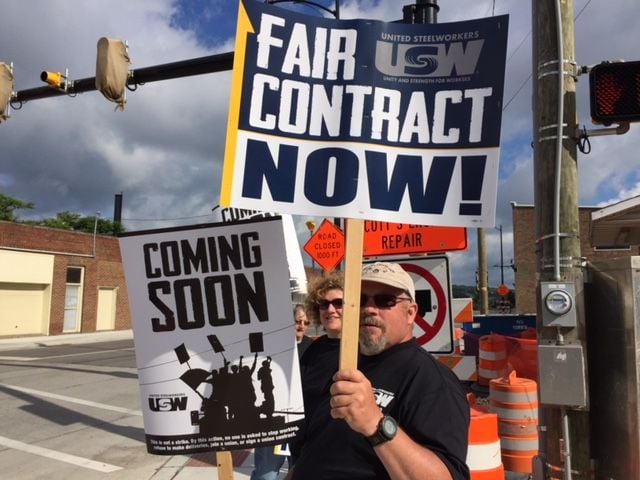
About 200 steelworkers and their families, most carrying signs demanding a fair contract from ATI, stayed on the move as they picketed. They walked back and forth — slowly — pausing on the driveway when vehicles approached the plant entrance, forcing them to slow down.
At the same time, they hurled verbal abuse and vented their anger, particularly at the vans carrying the people who have taken their jobs. The most frequent insult heard was the ultimate for union members — “scab.”
Yelling into a bullhorn, a steelworker shouted at a truck driver, “Hey dude, you’re a scab! You’re a piece of garbage!”
“Do you think they get the idea that we don’t like what they’re doing?” asked Russ Gainor of West Leechburg, who attended the picket line, even though he retired from ATI in June after 36 years rather than risk the lockout.
A thick white line freshly painted across the edge of the driveway served as the plant’s boundary from the public sidewalk.
As the steelworkers rallied on one side of the stripe, ATI security guards in khaki uniforms and ball caps videotaped the proceedings from inside the plant property.
ATI spokesman Dan Greenfield said the company had no reaction or comment on the rally.
When asked if there was any news about contract negotiations resuming, Greenfield said, “We’ve had contact with the mediator about trying to get talks going again, but so far it hasn’t been successful.”
Regina Stinson of New Kensington, who heads the five-member Wives of Steel at United Steelworkers Local 1138 in Leechburg, said the large turnout is an indicator of the stress the steelworkers and their families are dealing with.
The lockout enters its 83rd day Thursday. While some of the locked-out workers have found temporary work, many are receiving only unemployment compensation, which is a fraction of what they normally earn.







 Beaver County Blue: Voice of the 17th CD of Progressive Democrats of America