Jaime Martinez, community defense organizer at Casa San José, coordinates with Rapid Response Network volunteers outside Emiliano’s Mexican Restaurant in Gibsonia on June 17, after reports that federal agents were idling nearby in unmarked vehicles.
Casa San José has trained hundreds of volunteers to monitor and respond to immigration enforcement. Public Source followed them through raids, courthouse watches and late-night calls.
July 31, 2025 – As federal immigration enforcement intensifies across the country, a local response has quickly scaled up across the Pittsburgh region. In Beechview, the nonprofit Casa San José has built a Rapid Response Network of trained volunteers who monitor and document ICE activity across Allegheny County and beyond.
The network launched during the first Trump administration but has ramped up since January. As of July 30, it includes more than 250 trained volunteers — with nearly 175 more signed up for future training.
Casa San José, founded in 2013, focuses on immigrant rights and the Pittsburgh region’s Latino community — a mission amplified as the Trump administration rolls back protections for immigrants and directs federal resources toward a crackdown and mass deportations.
Organizers traverse city neighborhoods, gather in church basements and empty parking lots, and educate residents about their rights and federal immigration tactics. Along with trained volunteers, who are prepared to legally observe, document and accompany people at risk of being detained by Immigration and Customs Enforcement [ICE], they respond in real time to sightings, arrests and raids.
Pittsburgh’s Public Source spent more than a month embedded with Casa San José’s organizers and volunteers, tracking their efforts from the courthouse to restaurants as they responded to immigration enforcement and supported families under threat.
Photo: June 14 at the City-County Building, Downtown
Monica Ruiz, executive director of Casa San José, speaks to thousands of people gathered in front of the City-County Building in Downtown during a day of nationwide protest against the Trump administration.
“They are disappearing our people. This is our reality. Every single day. Just because you don’t see it doesn’t mean it’s not happening. We cannot continue to allow this to happen in our communities,” said Casa San José Executive Director Monica Ruiz.
“Casa San José is the only organization on this side of the state that is doing this kind of work.”
Ruiz said she has received five death threats since November, forcing her to relocate Casa San José’s office and to reconsider speaking publicly.
Photo: June 17 at Emiliano’s Mexican Restaurant, Gibsonia
As volunteers monitor the scene, Jaime Martinez, community defense organizer at Casa San José, speaks by phone with nine workers sheltering inside the restaurant — part of the network’s effort to document enforcement activity and support those at risk.
Sharon Bonavoglia was the first to arrive at a quiet strip mall in Gibsonia late on June 17. She had received the call because she lives nearby, and because she’s one of a growing network of volunteers responding to reports of federal immigration enforcement in and around Allegheny County.
Mar 23, 2025 –PITTSBURGH —Letter carriers in Pittsburgh participated in a nationwide rally Sunday in an effort to protect the United States Postal Service from what they say President Donald Trump’s proposed budget cuts and privatization could do to the organization and its workers.
The rally was held by the local union of Branch 84 alongside the National Association of Letter Carriers in the North Shore, which represents 2,800 carries in Allegheny, Washington, and Beaver counties.
“We’re here to gather together to say no,” Paul Rozzi, president of the Pennsylvania State Association of Letter Carriers, told Pittsburgh’s Action News 4. “We don’t want any of those things to happen. It doesn’t only affect us, but it affects every patron.”
The rallies across the nation come as Trump proposed moving the U.S. Postal Service under the control of the Commerce Department in what would be an executive branch takeover of the agency, which has operated as an independent entity since 1970.
Trump made the remarks at the swearing-in of Commerce Secretary Howard Lutnick. He called the move a way to stop losses at the $78 billion-a-year agency, which has struggled to balance the books with the decline of first-class mail.
“We hope that the Trump administration hears this message and we’re not at war, but we’re prepared to fight like hell,” president of Branch 84 National Association of Letter Carriers of Pittsburgh Ted Lee said.
USPS says about 640,000 people would be affected by these changes if passed.
Several hundreds gathered outside of the William S. Moorhead Federal Building this afternoon to protest as part of the national 50501 “No King’s Day” demonstrations on President’s Day.
Protesters marched downtown, calling out President Trump and Elon Musk, chanting, “Not my president” and “Human rights are meant for all.”
The demonstration lasted for over an hour, ending in front of the City Council building where organizers offered participants important election information and petitions to sign.
Photo; PA Rep Malcolm Kenyatta speaking to protestors in Harrisburg. By Bethany Rodgers
Protests against President Trump and his agenda, including the involvement of Elon Musk, took place nationwide.
Many protestors believe there is a renewed sense of urgency to oppose Trump’s policies in his second term.
By Bethany Rodgers USA TODAY NETWORK
Feb. 5, 2025 – HARRISBURG — Scores of protestors gathered outside the Pennsylvania state capitol Wednesday as part of nationwide demonstrations against President Donald Trump’s administration and the Project 2025 agenda.
The gathering was part of a nationwide wave of protests coordinated by the 50501 movement, short for “50 Protests, 50 States, One Day.” In Pennsylvania, demonstrations were also planned for Philadelphia and Pittsburgh.
Attendees waved signs calling for Trump’s impeachment, rainbow banners and American flags. A number of them also aimed their ire at Elon Musk, the billionaire who has assailed federal government agencies in recent days with the immense powers Trump has granted him.
Mari-Beth DeLucia, of Harrisburg, said she knows someone who works for the U.S. Agency for International Development, a government humanitarian arm that Musk has called a “criminal” organization and sought to dismantle. Employees at the agency are being placed on administrative leave, and Trump’s team has frozen foreign aid distributed by the office.
The damage Trump and Musk are doing will reverberate through charities, businesses and communities across the U.S., DeLucia predicts. But up to this point, she thinks people have been too stunned to mount the type of protests that spilled into the street when Trump was elected for his first term in 2016.
“Why aren’t we marching? Where is everybody?” DeLucia said she’s wondered lately. “I think it was kind of shell shock.”
More:’Don’t let democracy die’: Anti-Trump protesters rally in cities across US
She’s hopeful that Wednesday’s gathering is a sign that people are again raising their voices.
Savannah Bellem, a volunteer who brought snacks and drinks to the Harrisburg demonstration, said it was her first time participating in a protest. Back in 2016, she thought the answer was to wait out Trump’s term.
Pennsylvania Rep. Malcolm Kenyatta, D-Philadelphia, speaks to a group of protestors in Harrisburg, Pennsylvania, on Feb. 5, 2025. The demonstration against President Donald Trump’s administration was part of nationwide rallies coordinated by the 50501 movement. “It’s four years — what can happen?” the New Cumberland resident remembers telling her husband.
She now sees that attitude as naive, and this time around she feels a heightened sense of urgency. A gay couple in her family are frightened they could lose their child. She said she is angry that her young daughter now has fewer rights than she did at the same age.
“We’re not going to stand for it,” she said. “We need to get back more into taking care of our community and each other.”
State Rep. Malcolm Kenyatta also emphasized the importance of local action in a speech to the crowd, urging them to focus on city councils and school boards in addition to politicians in Washington, D.C.
“There is no one, and I mean it, no one, coming to save us,” the Philadelphia Democrat said. “But here is the good news, my friends: We are going to save ourselves.”
Bethany Rodgers is a USA TODAY Network Pennsylvania capital bureau investigative journalist.
They urged Democratic lawmakers to pass legislation to make the commonwealth more welcoming
By: Peter Hall
Penncapitol-Star
Nov 14, 2024 – President-elect Donald Trump’s plan to carry out mass deportations of undocumented immigrants would lead to population loss, exacerbate workforce shortages and increase tax burdens for Pennsylvania residents and businesses, the Democratic state lawmakers heard Wednesday.
Advocates for the immigrant community testified before the state House Democratic Policy Committee that although the federal government maintains exclusive authority over immigration policy, which is expected to take a draconian shift under a second Trump administration, state lawmakers can make Pennsylvania a more welcoming place.
“It’s been laid out very clearly. Unfortunately, it’s going to be immigrant detention and deportations on the horizon,” Julio Rodriguez, political director of the Pennsylvania Immigration and Citizenship Coalition, said. “So now it’s crucial that this legislature not only has welcoming policies to support immigrants, but to fight back against these proposals.”
The hearing on the last day of the 2023-2024 legislative session was convened by state Rep. Danilo Burgos (D-Philadelphia), who serves as chairperson of the Pennsylvania Legislative Latino Caucus.
Pennsylvania ranks fourth in the nation in population loss, Rodriguez said. In 2021, the net decrease in population between births and deaths was more than 23,000.
“We didn’t see that impact, because net international migration, also known as immigrants moving here, was 25,721,” Rodriguez said “Had it not been for immigrants, we would have seen a drastic population decline.”
A state’s population determines its number of representatives in Congress. Rodriguez noted that Pennsylvania lost one congressional seat after the 2020 census and could lose another in 2030. It would also result in Pennsylvania receiving less federal funding.
But more immediately, the loss of a portion of the commonwealth’s 978,000 immigrant residents would worsen the labor shortage in the agricultural sector, driving up grocery store prices. Undocumented workers also contribute billions in taxes and in the state’s gross domestic product, Rodriguez said.
U.S. Rep. Summer Lee (D-12th District) speaks to the Pennsylvania delegates at the Democratic National Convention in Chicago Aug. 22, 2024 (Capital-Star photo by Kim Lyons)
Delegates and candidates turn to the work of keeping the battleground state blue
By: Kim Lyons
Penn-Capital Star
August 25, 2024 – CHICAGO — Pennsylvania was the most popular kid in the class at the 2024 Democratic National Convention, and the battleground state and its 19 electoral votes were well represented in Chicago and on the convention’s nightly broadcasts. Each night featured a speaker from the Keystone State, with Lt. Gov. Austin Davis on Monday; state Rep. Malcolm Kenyatta on Tuesday; Gov. Josh Shapiro on Wednesday and U.S. Sen. Bob Casey on Thursday.
Shapiro was unquestionably the biggest Pennsylvania presence at the DNC, due in part to his status as a runner-up to be presidential nominee Vice President Kamala Harris’ running mate. He was constantly booked during the week, speaking at numerous state delegations’ breakfasts, attracting the ire of GOP nominee former President Donald Trump, and appearing regularly on cable news channels.
Project 2025 played a key role at the convention, as Democrats continued to try to link the conservative policy plan to reshape the federal government and increase presidential authority with Trump.
Kenyatta, a candidate for state Auditor General held the giant Project 2025 book on stage Tuesday night,, and told the audience it was a “radical plan to drag us backwards, bankrupt the middle class and raise prices on working families like yours and mine.”
Trump has tried to distance himself from Project 2025 but several members of his administration were involved with helping to craft it.
“It’s a big, heavy book full of bad ideas, and it was one of these moments where we’re able to really get people to understand with the visual how serious Trump and this administration are about doubling down on his flawed theory of the case,” Kenyatta told the Capital-Star on the final day of the convention.
Our vote is the highest demonstration of the collective power we have… The purpose of this moment is to use our collective power to elect somebody who gives a damn about us, and then to work side by side with her to help implement the things that she’s talking about.
He added Project 2025 should serve as a warning to Democrats about what they believe a second Trump term would look like.
“When Trump burst onto the political scene, he did so with the thesis that ‘America sucks,’ and that it sucks in large part because our neighbors, the people in our community, people we don’t know — they’re somehow a part of bringing America down,” Kenyatta said, “and the only way we fix it is if we give him all the power.”
While Trump’s first term saw the former president “flailing around,” Kenyatta said, the architects of Project 2025 mapped out a plan for how to reach some of the goals of the far-right wing of the party, such as a national abortion ban and abolishing the U.S. Department of Education.
Kenyatta added he doesn’t believe in the political concept of giving all the power to one person to fix everything.
“Our vote is the highest demonstration of the collective power we have,” he said. “If we elect Kamala Harris in November and then say, ‘OK, we’ll see you in four years at the next convention. Hope you fix all the problems!’ then we’ve missed the thread. The purpose of this moment is to use our collective power to elect somebody who gives a damn about us, and then to work side by side with her to help implement the things that she’s talking about.”
At the final Pennsylvania delegates’ breakfast on Thursday, U.S. Rep. Summer Lee (D-12th District) urged the battleground state delegates to keep up the convention’s momentum.
“We’re here honing our tools so that we can go out and do the very hard work, not for Kamala Harris. We’re not doing hard work for Summer Lee or any of my colleagues,” Lee said, but rather for marginalized and vulnerable people. “Think about that person whose name is in that book over the hundreds and hundreds of pages of Project 2025, who do we see there that we need to make sure is not touched by the evil and the horrors that they have lined up and ready for them.”
Davis, Pennsylvania’s youngest and first-ever Black lieutenant governor, addressed the convention on Monday night and spoke about the importance of building bridges. He appeared on stage with Wisconsin Lt. Gov. Sarah Rodriguez, Harris County, Texas Executive Lena Hidalgo, and California Lt. Gov. Eleni Kounalakis, all of whom shared stories about how Harris had made an impact on their communities.
“I grew up with working class parents in a small steel town in southwestern Pennsylvania, and to have the opportunity to speak on a national stage like that was incredibly humbling,” Davis told the Capital-Star. “It was just an example of how someone can live the American dream, so I hope folks who saw me saw that America should be a place where every person has that same opportunity.”
Davis said the question he heard most often over the course of the convention was whether Democrats can win Pennsylvania. “And I tell them, absolutely, we just have to keep showing up everywhere, competing in places that sometimes it’s not easy to be a Democrat,” he said.
Asked if there were “red” areas of the state he saw as possible to flip blue, he pointed to central Pennsylvania as having the most potential, particularly the race in the 10th Congressional District between former WGAL anchor Janelle Stelson and Republican U.S. Rep. Scott Perry.
“I think we have a great candidate in Janelle Stelson,” he said. “I think there’s a lot of energy also with [state Rep.] Patty Kim running for state Senate. So I think Dauphin, Lancaster, Cumberland — an area Governor Shapiro won when we were running on the ballot.”
Davis said not everyone was completely impressed with his star turn on television, however. His daughter Harper, whose 1st birthday is next month, was asleep by the time he appeared Monday night. “We’re going to replay it for her but she doesn’t care,” he said. “She only cares when I FaceTime her and she’s like, ‘Daddy, when are you coming home?’”
In this image from video, Alan William Byerly, center, attacks an Associated Press photographer during a riot at the U.S. Capitol in Washington, Jan. 6, 2021. On Sunday, Oct. 9, 2022, federal prosecutors recommended a prison sentence of nearly four years for Byerly, of Fleetwood, who pleaded guilty to assaulting the AP photographer and using a stun gun against police officers during a mob’s attack on the U.S. Capitol. (AP Photo/Julio Cortez, File)
By The Keystone Staff
January 4, 2024
Democracy didn’t die in Washington, D.C. on Jan. 6, 2021, despite the efforts of state Republicans like Doug Mastriano and Scott Perry, and the 85 Pennsylvanians who have been arrested to date for participating in the deadly attack on the US Capitol.
Pennsylvania is inextricably linked to the deadly Jan. 6, 2021 attack on the United States Capitol, in which five people died and dozens were seriously injured after a swarm of Donald Trump supporters — fresh from being told to “fight like hell” by the former president at a nearby “Stop the Steal” rally — descended upon the Capitol with the intent to upend democracy by any means necessary.
Major political players in the state, such as state Sen. Doug Mastriano (R-Franklin) and US Rep. Scott Perry (R-Dauphin), allegedly played significant roles in Trump’s effort to overturn the 2020 election — a failed criminal venture that led to the attack on the Capitol.
Then there is the role that Pennsylvanians played on the ground in the Jan. 6 attack. Some 85 Pennsylvania residents were arrested for taking part in the insurrection, tying the commonwealth with Texas for the second highest total among states. According to arrest records from the Department of Justice, 95 Floridians were arrested for participating in the attack, the highest total of any state.
To date, 52 Pennsylvanians have been sentenced, with others expected to be sentenced this month. Three died (two by suicide) while awaiting sentencing, and two others, a married couple, moved out of state before being sentenced.
Overall, according to the DOJ, more than 1,230 defendants have been arrested in nearly all 50 states and Washington, D.C. in connection with the attack, accused of crimes ranging from trespassing, a misdemeanor, to seditious conspiracy, a felony. More than 350 cases are still pending. Around 170 people have been convicted at trial, while only two people have been fully acquitted. Approximately 710 people have pleaded guilty and among those, around 210 pleaded guilty to felony offenses.
Here’s where things stand with each of the 85 Pennsylvanians arrested to date in the Jan. 6, 2021 attack.
Terry Allen – Spring Mills
Allen was arrested in July 2023 and faces charges including entering or remaining in any restricted building or grounds without lawful authority; disorderly and disruptive conduct in a restricted building or grounds; engaging in physical violence in restricted building or on restricted grounds; obstruction of law enforcement during civil disorder; and assaulting a federal officer.
Melanie Archer – Shaler
Archer pleaded guilty in October 2022 to parading, demonstrating, or picketing in a Capitol building. She is awaiting sentencing.
Mark Roderick Aungst – South Williamsport
Aungst pleaded guilty in June 2022 to one count of parading, demonstrating, or picketing in a Capitol building. He died by suicide in July 2022 while awaiting sentencing.
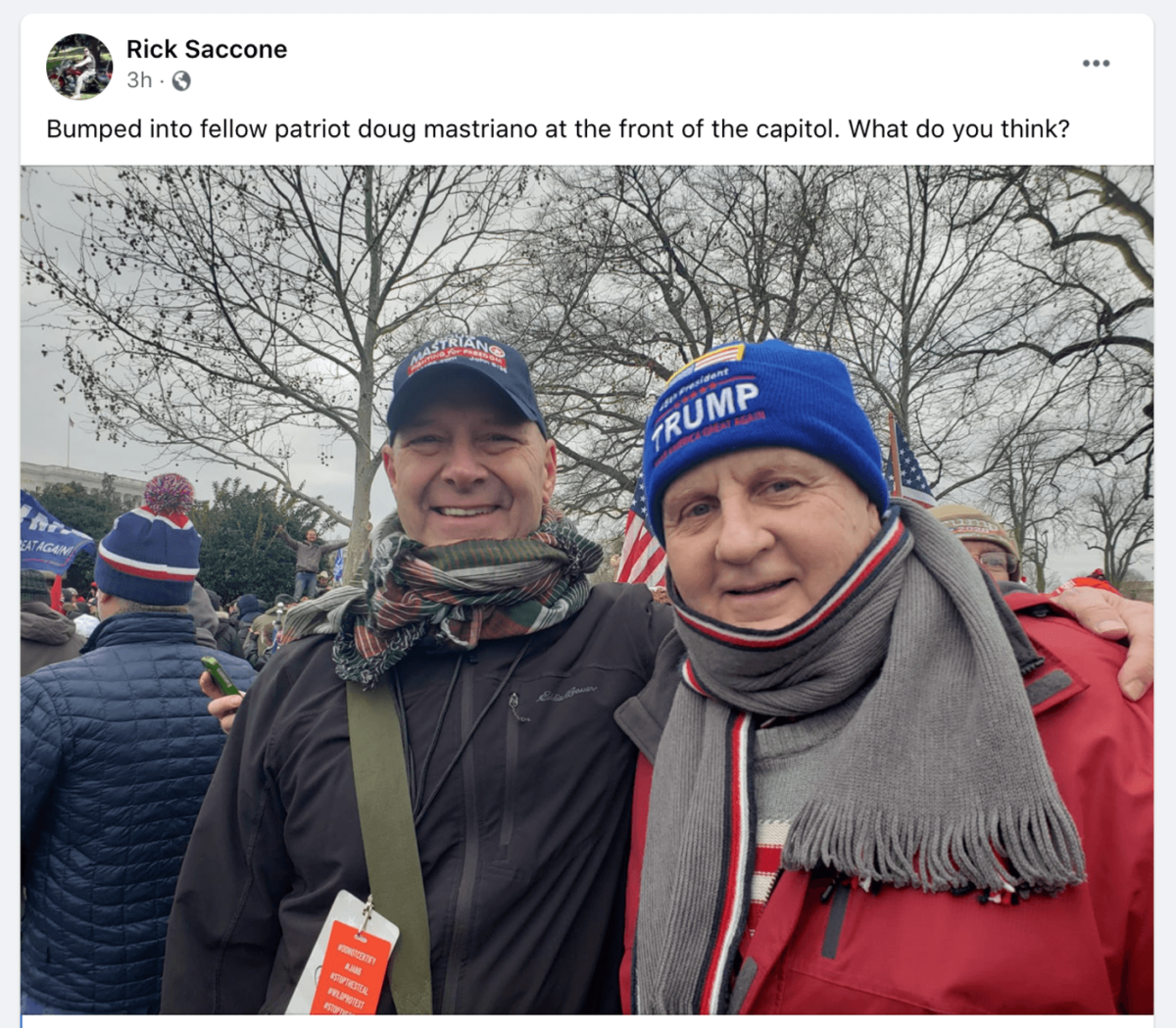
State Sen. Doug Mastriano and former state Rep. Rick Saccone, outside the US Capitol, Jan. 6, 2021 (Facebook screen grab).
Dawn Bancroft – Doylestown
Bancroft was sentenced in July 2022 to 60 days of incarceration, three years of probation, 100 hours of community service, and $500 in restitution for charges including disorderly and disruptive conduct in a restricted building or grounds.
Steven Boyd Barber – Scranton
Barber was arrested in July 2023 and faces charges including entering and remaining in a restricted building or grounds; disorderly and disruptive conduct in a restricted building or grounds; disorderly conduct in a Capitol building or grounds; and parading, demonstrating, or picketing in a Capitol building.
Pauline Bauer – Kane
Bauer pleaded not guilty in May 2021 to charges including obstruction of justice and Congress. Bauer was near then-House Speaker Nancy Pelosi’s office suite during the riot when she yelled at police officers to bring out the California Democrat so the mob of Donald Trump supporters could hang her. She was sentenced in January 2023 to more than two years in prison.
Republican state Rep. Rob Mercuri announced Tuesday he’ll run against first-term Democratic incumbent U.S. Rep. Chris Deluzio in what may be the state’s most competitive U.S. House race — Pennsylvania’s 17th congressional district. He’s the second Republican veteran to declare his candidacy in this race.
Mercuri currently represents the 28th district in the Pennsylvania House of Representatives. A graduate of the U.S. Military Academy in West Point, N.Y. who deployed for two tours in Iraq, Mercuri owns a pack-and-ship business in Wexford.
“As a veteran, I know that America is worth fighting for. As a father, I care deeply about our future. As a small business owner, I know that anything is possible here with hard work. I’m running for Congress to help restore the promise of prosperity to our region and to revive the American dream so each one of us has the opportunity to thrive,” Mercuri said in a news release.
His statehouse platform: fiscal responsibility, energy expansion, educational choices and economic development. He’s authored legislation in the areas of education, finance, autonomous transportation, and data privacy.
WESA Politics Newsletter
Mercuri joins another lesser-known Republican veteran in the race: pastor and retired law enforcement officer Jim Nelson. Nelson is running on what he says is a “common sense” platform with priorities that include school safety, tax reform and economic development. A U.S. Air Force veteran and African American, Nelson says he wants to represent his very diverse district.
The 17th is a swing district that joins Beaver County to a suburban swath of Allegheny County, and its geography encompasses college-educated suburbs as well as working-class industrial and post-industrial communities.
Deluzio is a U.S. Navy veteran and lawyer who has worked as the policy director for a University of Pittsburgh center focused on cyber law and security. Prior to that, he worked in election security for the Brennan Center.
The general election is scheduled for Tuesday, Nov. 5, 2024.
Butler Focus: Will the Real G.O.P. Please Stand Up? A National Power Struggle Goes Local.
In one deep-red pocket of rural Pennsylvania, three warring factions each claim to represent the Republican Party. Tensions boiled over in a scuffle over a booth at a farm show.
BUTLER, Pa. — Zach Scherer, a 20-year-old car salesman and Republican activist in Pennsylvania’s Butler County, decided to run for a seat on the county commission this year — a move that ordinarily would mean seeking the endorsement of local Republican Party leaders.
In Butler County, this raised an unusual question: Which Republican Party?
Last spring, the officially recognized Butler County Republican Committee was divided by a right-wing grass-roots insurgency, then divided again by a power struggle among the insurgents. There have been a lawsuit, an intervention by the state Republican Party and a dispute over a booth at the local farm show.
Butler, a rural county in western Pennsylvania where Donald J. Trump won nearly twice as many votes as Joseph R. Biden Jr. in 2020, now has three organizations claiming to be the true tribune of local Republicans. All of them consider the others illegitimate.
“There is, in effect, no committee,” said Al Lindsay, a four-decade veteran of the local party, who was ousted as committee chairman last year.
The partisans in Pennsylvania agree about one thing, if not much else: Their fight is a microcosm of the national struggle for control over the Republican Party, one that began with Mr. Trump but has been inflamed by the party’s weak showing in the midterm elections.
That struggle has played out in national arenas like Kevin McCarthy’s days-long fight to win the speakership of the U.S. House of Representatives, and in a contentious race for the chair of the Republican National Committee ahead of this week’s meeting.
But it is being fought just as intensely at state and county levels, as Trump loyalists and right-wing activists who took control of party organizations in recent years face resistance from rivals who blame them for the party’s losses in November.
Such conflicts often occur below the radar of even local news outlets. But they are likely to shape state parties’ abilities to raise money, recruit candidates, settle on a 2024 presidential nominee and generally chart a path out of the party’s post-Trump presidency malaise.
“We believe that the way we’re going to change our national scene is by changing our local committees,” said Bill Halle, the leader of one of the two insurgent factions within the Butler party.
What to Know About the Trump Investigations
Card 1 of 6
Numerous inquiries. Since leaving office, former President Donald J. Trump has been facing several investigations into his business dealings and political activities. Here is a look at some notable cases:
Jan. 6 investigations. In a series of public hearings, the House committee investigating the Jan. 6 attack laid out a comprehensive narrative of Mr. Trump’s efforts to overturn the 2020 election. This evidence could allow federal prosecutors, who are conducting a parallel criminal investigation, to indict Mr. Trump.
Georgia election interference case. Fani T. Willis, the Atlanta-area district attorney, has been leading a wide-ranging criminal investigation into the efforts of Mr. Trump and his allies to overturn his 2020 election loss in Georgia. This case could pose the most immediate legal peril for the former president and his associates.
New York State’s civil case. Letitia James, the New York attorney general, has accused Mr. Trump, his family business and his three adult children of lying to lenders and insurers, fraudulently inflating the value of his assets. The allegations, included in a sweeping lawsuit, are the culmination of a yearslong civil investigation.
Manhattan criminal case. Alvin L. Bragg, the Manhattan district attorney, has been investigating whether, among other things, Mr. Trump or his family business intentionally submitted false property values to potential lenders. As a result of the inquiry, the Trump Organization was convicted on Dec. 6 of tax fraud and other crimes.
Tensions Flare After Midterm Losses
The current rifts date most directly to Mr. Trump’s loss in 2020, when his relentless claims of a stolen election divided Republican leaders between those who took up Mr. Trump’s cause and those who wanted to move on.
In several closely contested states, state party leaders loudly supported his election claims, and backed the Republican candidates who earned Mr. Trump’s endorsements by doing the same. But many of those candidates were extreme or erratic politicians who would go on to lose in November, and their nominations have caused enduring divisions.
A sign for the Butler PA Patriots, a grass-roots group involved in challenging county Republicans’ leadership.Credit…Justin Merriman for The New York Times
In Michigan, major G.O.P. donors pulled back after the state party co-chair, Meshawn Maddock, took the unusual step of openly supporting election deniers favored by Mr. Trump ahead of the party’s nominating convention. Those candidates all lost in a statewide G.O.P. rout in November.
In Georgia, Brian Kemp, the Republican governor seeking re-election, went so far as to build his own political organization separate from the state Republican Party, whose chairman, David Shafer, backed Trump-endorsed Republican primary candidates. Mr. Shafer is among the targets of a special grand jury investigating whether Mr. Trump and his allies interfered in the 2020 election.
“I think it’s unforgivable,” Jay Morgan, the Georgia party’s executive director in the 1980s, said of Mr. Shafer’s handling of the party. Mr. Morgan, who is now a lobbyist in Atlanta, said he has not recommended that any of his corporate clients donate to the state party. “It breaks my heart,” he said.
Mr. Shafer did not respond to a request for comment.
In Nevada, multiple former officials in the state party have called on its current chair, Michael McDonald, to resign after the party backed several losing election-denying candidates.
“The Republican Party could be great here; it really could,” said Amy Tarkanian, the former chairwoman of the Nevada G.O.P., who was expelled from her county Republican committee after endorsing the Democratic attorney general candidate last summer. “But they made themselves irrelevant with their toxicity.”
House Republican Leader Bryan Cutler, R-Lancaster, speaks to reporters beside a map of three vacant Allegheny County legislative districts that will be the subjects of special elections next year. (Capitol-Star photo by Peter Hall)
Long-delayed justice for abuse victims has become hostage to the GOP’s partisan attack on voting, abortion rights
By J.J. Abbott
PA Cap[itol-Star
Jan 11, 2023 – Last week, Harrisburg Republicans, who suffered an overwhelming defeat at the ballot box in 2022, celebrated the election of new state House Speaker Mark Rozzi. We’ve learned in the days since that they did so not for Rozzi, a Berks County Democrat, or the hope of finding bipartisan consensus but for their own cynical, purely political reasons.
Rozzi, nominated and supported by both Republicans and Democrats, ran for speaker to advance his life’s work: creating an opportunity for justice for fellow adult victims of child sexual abuse. GOP leaders calculated, instead, that Rozzi’s election to the speakership would further their own political goal of advancing a series of unrelated constitutional amendments covering partisan policy proposals that failed to garner enough support to become law through the usual channels.
In 2022, this GOP package included two election changes borne out of the GOP’s 2020 election denialism, a legislative power-grab around regulations, and a complete ban on abortion rights without any exceptions. Then Republicans lost the governor’s race, nearly all competitive federal races, and 12 House seats and their majority in the state House
The amendment allowing victims of childhood sexual abuse an extended window to sue their attackers garnered wide bipartisan support in three previous legislative sessions. However, the GOP, fresh off losing up-and-down the ticket, now seems to be threatening to withhold their support for a final vote unless they leverage it to add their hyper-partisan agenda into the state constitution, effectively holding victims of abuse hostage to conspiracies spun by former President Donald Trump.
To assuage the fears of victims and advocates and try to prevent bitter fights over unrelated policies, Gov. TomWolf – with Rozzi’s backing – called a special session to focus on getting the window to justice on the ballot by the May primary. Some thought this would help avoid partisan fights over elections and abortion amendments that lack the same urgency or consensus.
Republican leaders were incensed at the prospect of losing this leverage and immediately attacked the governor for calling the special session. Senate Republicans went as far as to say their politically-charged amendments were “equally important” as justice for these victims.
According to a report by NBC10 in Philadelphia, “House Republican Leader Bryan Cutler says there are other, more urgent things they need to prioritize ahead of child sex abuse.”
Seriously? Have they no shame?
In openly admitting they want to hold justice hostage, GOP leaders justified the need for a special session focused on the most urgent matter: justice for these victims.
In addition to no moral comparison between their partisan amendments and justice for abuse victims, there is no urgent need or policy rationale for these election and regulation changes other than the political goals of the Republican Party.
Pennsylvania law already requires ID to vote and mandates state-run audits of every election. Voter impersonation almost never happens and audits typically find only small computation errors, if anything at all. So while nearly three-in-four Pennsylvania voters said in 2022 exit polls that they were confident PA had fair elections, GOP leaders continue to push these amendments because Republicans think they will help them win elections.
For years, Pennsylvania’s counties outlined urgently needed election policy updates. Unfortunately, in a similar act of political gamesmanship, those bipartisan, consensus changes also remain victims to GOP hostage-taking.
A much more responsible approach would be to engage in the traditional legislative process of building consensus towards some sort of comprehensive elections reform bill, instead of ramming bad policy into the constitution because you failed to pass it the right way.
GOP leaders seem ready to force their members to engage in a raw political exercise of derailing and delaying justice for abuse victims over these other amendments.
In 2018, four incumbent Republican senators lost re-election after they voted against a statutory change similar to the proposed constitutional amendment. The GOP’s latest legislating by hostage-taking creates a tough partisan pill for these members to swallow with huge political risks.
This unseemly approach is a reminder of why voters overwhelmingly rejected the GOP last election after decades of their control of Harrisburg lawmaking.
Voters are tired of business as usual in Harrisburg and clearly rejected the GOP’s extreme agenda in 2022. But Republican leaders in Harrisburg prove once again that they don’t care what the voters think.
J.J. Abbott served as press secretary and deputy press Secretary for Gov. Tom Wolf from 2015 until 2020. He now serves as executive director of Commonwealth Communications, a Pennsylvania progressive communications non-profit.


 By
By 







 Beaver County Blue: Voice of the 17th CD of Progressive Democrats of America