Category Archives: Manufacturing

I’m a Rust Belt Democrat From a Swing District. Anti-Tariff Absolutism Is a Mistake.

A black-and-white photograph of a car’s rearview mirror showing an industrial plant.
Credit…Eli Reed/Magnum Photos

By Chris Deluzio

Mr. Deluzio represents Pennsylvania’s 17th Congressional District.

The New York Times Op-Ed

March 7, 2025 – Democrats have wasted no time rejecting President Trump’s tariffs as “damaging” and “unnecessary.” My colleagues have lampooned them as “irresponsible,” “bad economics” and purely a tax on consumers. This anti-tariff absolutism is a mistake.

I’m a Rust Belt Democrat from a swing district in Western Pennsylvania — where lousy trade deals like NAFTA stripped us for parts.

Many of my constituents support smart tariffs, particularly ones that target China, and so do I. Watching my colleagues on the Hill, it’s clear we’re missing the mark. Democrats need to break free from the wrong-for-decades zombie horde of neoliberal economists who think tariffs are always bad.

Mr. Trump’s tariff approach has been chaotic and inconsistent. There’s no doubt about that. But the answer isn’t to condemn tariffs across the board. That risks putting the Democrats even further out of touch with the hard-working people who used to be the lifeblood of the party — people like my constituents.

Instead, Democrats should embrace tariffs as one component of a broader industrial strategy to revitalize American manufacturing and make whole communities that have been hollowed out by decades of bad trade policy. This isn’t just about making the economy work for more Americans; it’s also about earning back the trust and faith of the people we need to win elections and who ought to be at the heart of the Democratic Party.

Since the 1990s, presidents from both parties pushed trade agreements that were great for corporate bosses and their Wall Street overlords, but a disaster for districts like mine. American companies offshored production to take advantage of cheap labor in countries like Mexico, which for decades have crushed independent unions to keep wages rock bottom. Later, firms shifted production to China and Vietnam, which are often called out for employing beggar-thy-neighbor tactics like wage suppression, enormous subsidies and currency manipulation to jack up their exports.

For too long, we absorbed these unfair imports and created a chronic trade deficit that deindustrialized our nation and fueled income inequality. In 2004, the grandfather of modern trade economics, Nobel Laureate Paul Samuelson, revealed how offshoring could cost American workers more in relative wages than they gained from cheaper imported goods, making the current trade regime a bad deal for most Americans.

Tariffs are one of a few tools that can break this cycle: They force mercantilist countries to increase their domestic consumption of what they produce because they can no longer dump it in the United States. Increasingly, policymakers — of all political stripes — recognize that tariffs can help protect industries that are key to our economic and national security, boost American production and wages, and safeguard workers’ rights as well as our air and water by incentivizing firms to raise their labor and environmental standards.

If you oppose all tariffs, you are essentially signaling that you are comfortable with exploited foreign workers making your stuff at the expense of American workers. I am not and neither are most voters. Many polls show that Americans — especially the three-fifths without college degrees — support tariffs in part, economists have suggested, because communities harmed by global competition view them “as a sign of political solidarity.” The Biden administration, to its credit, tripled tariffs on Chinese steel and aluminum imports. So, why is the Democrats’ only message on tariffs that they raise prices? That was the play during the 2024 election and it flopped. Just last month, a CBS poll found that a majority of Americans one, thought Mr. Trump was not focused enough on lowering prices, two, believed that tariffs could increase prices and three, still wanted tariffs on China.

Rather than reflexively condemning all tariffs, Democrats should be highlighting how Mr. Trump’s scattershot threats, unanchored to any real industrial strategy, will not deliver on the goals of rebuilding American manufacturing, raising wages or rebalancing trade.

For one thing, tariffs are effective only when used in a predictable and stable way — and the Trump administration’s approach has been anything but. On Feb. 1, Mr. Trump announced he was imposing new 10 percent tariffs on China and fixing part of a trade scam that allows four million packages to enter the United States daily without facing tariffs, taxes or meaningful inspection — simply because they’re labeled “low value.” Not only does this “de minimis” loophole undermine U.S. producers and retailers, but traffickers also often exploit it to sneak in deadly fentanyl-laced pills and fentanyl precursor chemicals. Days after his announcement, Mr. Trump flip-flopped and reopened the loophole. He raised China tariffs another 10 percent on March 4 — good! But still, the loophole means billions in Chinese imports can evade tariffs and inspections.

Mr. Trump’s chaotic tariff two-step — imposing, delaying, threatening and then again imposing tariffs, including on allies like Canada with whom we mainly have balanced trade — is bad business for America. Entrepreneurs ready to invest in production here sit on the sidelines, wondering where the tariff roller coaster will stop. (Continued)

On Why the USW, Biden and Trump are Right about the Nippon/USSteel Ripoff

By Ike Gittlen

https://ikegittlen.substack.com/

For months the proposed sale of USSteel to Nippon Steel has been front page news. The Committee on Foreign Investments in the United States (CFIUS), that reviews the national security implications of these global transactions is reportedly at an impasse and unable to come to a determination.

The reality is that what CFIUS decides (or doesn’t) is irrelevant. Both the incumbent President and the President-elect have said they will not approve the deal. It’s slowly dawning on people that this deal isn’t likely to happen.

We shouldn’t be surprised. Opposing the Nippon/USSteel deal is the logical response to all that we have learned about the steel industry, the “free trade” model of global trade, the importance of maintaining domestic control over critical supply chains and how the big money vultures strip-mine our stable industrial/manufacturing enterprises. It isn’t, as Nippon/USSteel would like us to believe, something that must happen or USSteel will collapse. Once this bad deal is gone, we know there are a number of options to retain and enhance USSteel’s assets.

To understand what’s happening we have to start with the global steel overcapacity. The OECD reports a global steel overcapacity exceeding 500 million metric tons, with some estimates reaching as high as 630 million metric tons. This has nations with overcapacity (China in the lead) looking for places to dump their steel production. Our nation is a lucrative place to offload unneeded steel. Interestingly, Nippon is reportedly looking to do deals in other nations with lucrative steel consumption, as the USSteel deal falters.

It’s fantasy to believe that once Nippon owns USSteel it won’t use it to move its overcapacity here. Simply look at the cases that the USW and the Steel Industry have won at the International Trade Commission, to get a flavor of how blatant other nations have violated our trade laws to gain access our steel market. The failure of Nippon to offer credible and enforceable commitments to continue American domestic production, should convince us of their real intent. This is the heart of the national security concern. That if Nippon is allowed to own such a large part of American steel capacity, the will result will be steel shutdowns here and less ability to supply our own needs of this critical economic sector.

Deluzio Win In Western Pennsylvania Keeps Swing District In Democratic Control

Photo: U.S. Rep. Chris Deluzio (PA-17) speaks to reporters at an event highlighting the Biden Administration’s investment in infrastructure at the Kingsley Center Pittsburgh’s Larimer neighborhood on Tuesday, Feb. 20, 2024. (Steve Mellon/Pittsburgh Union Progress)

By Kim Lyons

Pennsylvania Capitol-Star

November 12, 2024 – We’re analyzing the results of the 2024 election by taking a closer look at some of the pivotal or unexpected outcomes. First up is an interview with U.S. Rep. Chris Deluzio (D-17th District) who held off a GOP challenger in a key swing district.

Pennsylvania’s U.S. House delegation lost two Democrats in last Tuesday’s election, and promising Democratic challengers in two hard-fought House districts in the central and eastern part of the state failed to unseat longtime Republican incumbents.

But in western Pennsylvania, Democrats in the House fared better. Incumbent Reps. Summer Lee (12th District) and Chris Deluzio (17th District) both won reelection. After Lee won a contentious primary against challenger Bhavini Patel in April, she was widely expected to win the general election, which she did, beating GOP challenger James Hayes 56.1% to 43.9%, according to unofficial results.

But Deluzio’s reelection to a second term representing the district that includes parts of blue Allegheny and red Beaver counties was much more uncertain. The National Republican Congressional Committee (NRCC) put the race on its list of seats to flip in 2024.

His opponent, state Rep. Rob Mercuri (R-Allegheny) received a key endorsement from the conservative Americans for Prosperity (AFP) Action super PAC. Even his own party considered it to be a swing district; the Democratic Congressional Campaign Committee (DCCC) named Deluzio as one of the “vulnerable” incumbents it sought to protect this cycle, adding him to its Frontline list of candidates.

He’s the only one of the three U.S. House candidates from Pennsylvania on the Frontline list who won reelection.

“I’m very proud of the win,” Deluzio told the Capital-Star. “I’m really proud we increased the margin, and especially in Beaver County, which moved to the right at the top of the ticket, but we moved it towards me.”

Deluzio also increased the margins from his first election in 2022, when he won by 6.8% over challenger Jeremy Shaffer. This election, he won by 7.3% over Mercuri.

Deluzio refrained from the blame game going on within some parts of the Democratic Party reeling from Harris’ loss to Trump, but said as a representative of a Rust Belt district, he understands the frustration that many voters have with those in power.

“Whether it’s powerful folks or forces or companies who hurt people or who are making life worse, I think there’s a tendency among some in my party to always look for win-win framing,” he said. “And you know what? Sometimes there’s a bad guy and you’ve got to kick his ass.”

More Details: Company To Build $218 Million Steel Plant On Former J&L Land In Aliquippa

Groundbreaking ceremony in Aliquippa, May 16, 2023

By Chrissy Suttles
Beaver County Times

ALIQUIPPA – A New York-based company plans to revive Aliquippa steel production with a $218 million advanced manufacturing facility on land once occupied by J&L Steel’s tin mill.

72 Steel, founded in 2016 by Chinese-American entrepreneurs, committed Tuesday to purchase the land owned by developer Chuck Betters to build a steel fabrication plant on 44 acres of the historic Aliquippa Works site along the Ohio River.

The operation will include an electric-arc furnace — a steelmaking technology with lower carbon intensity than traditional methods — to melt scrap steel and produce 500,000 tons of rebar, or reinforcement steel, annually for a variety of industries. Its production capacity and output value are expected to reach $400 million.

An artist's rendering of the proposed 72 Steel plant on the former site of J&L Steel Aliquippa Works.
Artist rendering of the new mill

Once complete, the company expects to hire 300 to 400 permanent employees, but hundreds of construction workers will be needed to build the facility, roadways, parking space, product storage areas and ancillary buildings. Regional union leadership could not immediately comment on whether they’re in talks with 72 Steel to hire union builders and/or operators. The plant’s anticipated completion is 2025; it will be 72 Steel’s first manufacturing site.

72 Steel plans to use “energy-saving and environmental protection technologies” during production, including air and water pollution control equipment and an electric-arc furnace from Italian technology supplier Tenova.

Xiaoyan Zhang, senior business adviser at 72 Steel, said the company’s decision to build was prompted by the 2021 federal Bipartisan Infrastructure Law that included $110 billion in new funds for roads, bridges and other major projects. The company toured sites in West Virginia, Ohio and North Carolina before settling on Beaver County due to its river and rail access and the Pittsburgh region’s enduring history of steelmaking.

https://f5e32e578b895ba9f2e95edab680b6ba.safeframe.googlesyndication.com/safeframe/1-0-40/html/container.html

The company’s $218 million investment is “an initial investment,” Zhang said. “Maybe, down the road, there would be some additional (investment).” Company leadership, he said, “feels proud as Chinese Americans about making America great and supporting the infrastructure bill.”

The Jones & Laughlin Steel Mill in Aliquippa.
The old J&L

The move has been in the works for months; 72 Steel leadership toured the proposed facility late last year alongside landowner Chuck Betters, state and local officials and members of the Allegheny Conference on Community Development. State business filings show 72 Steel registered with Pennsylvania in June 2022.

“Pittsburgh has a celebrated history as the manufacturing powerhouse that built the modern world,” said Matt Smith, chief growth officer at the Allegheny Conference. “Today, we are positioned as the region where the next-generation of manufacturing is happening now – spanning advanced, additive, green manufacturing and more.”

J&L Steel’s mill at 611 Woodlawn Road opened in 1910 and expanded in 1947 for tin plate production. It operated until the 1980s when Aliquippa Works, by that time owned by LTV Corp., closed amid the region’s steel collapse.

Aliquippa Works at one time employed more than 10,000 workers; nearly 8,000 people were out of jobs when the site closed, leaving former company town Aliquippa financially ruined with a disintegrated tax base. The site was later demolished and, in recent years, served as a staging area for Shell’s ethane cracker plant in Potter Township.

Aliquippa Mayor Dwan Walker hugs developer Chuck Betters at a 72 Steel groundbreaking ceremony.
Mayor Walker congratulating a partner.

“My dad put 18 years in at this very site,” said Aliquippa Mayor Dwan Walker during a Tuesday groundbreaking ceremony. “My father walked out of this mill in ‘86 thinking steel was never going to come back. I was so emotional this morning thinking about the possibility of what will be … I can’t wait to see cars come through that tunnel with stickers: ‘My kid goes to Hopewell,’ ‘My kid goes to Beaver Falls,’ or ‘My kid goes to New Brighton.’ I can’t wait to see those stickers come through that tunnel like when my dad was working here.”

72 Steel has not yet closed on the deal, but Betters said they’re on their way. The Beaver County developer pledged to invest $1.5 million of his own money into the project within seven days of closing.

“I’m comfortable you’re very honorable people,” he told 72 Steel leadership. Once the deal closes, planning and environmental permitting will begin.

Most of the remaining Aliquippa Works land is now owned by cellular PVC manufacturer Versatex and U.S. Minerals, which makes roofing and abrasive products like coal slag abrasives, iron silicate roofing granules and mineral fillers.

Tuesday’s groundbreaking featured speakers from 72 Steel and state, county and local lawmakers and figureheads.

“It’s always about jobs, jobs and more jobs,” said state Rep. Rob Matzie, D-16, Harmony Township. “There were some close calls on this property, suitors have come and gone, and we are hopeful … we will see construction. I live across the river, growing up in the ‘70s and ‘80s, I was able to see the J&L smokestack on this property. I still live up on that hill, and I’ll be able to see this new construction when it’s complete, hopefully, sooner rather than later.”

https://f5e32e578b895ba9f2e95edab680b6ba.safeframe.googlesyndication.com/safeframe/1-0-40/html/container.html

Stephanie Sun, executive director of former Gov. Tom Wolf’s Advisory Commission on Asian/Pacific American Affairs, called Tuesday’s event a milestone for Chinese Americans living in Pennsylvania, noting that May is Asian/Pacific American Heritage Month and Asian Americans are the fastest-growing racial or ethnic group in the United States.

“The Asian/Pacific American community is also the fastest-growing population in the United States with a strong international network of investment and business opportunities,” she said, adding it’s been just 80 years since the repeal of the federal Chinese Exclusion Act.

Aliquippa Mayor Dwan Walker honors Huabin Lin, chairman of 72 Steel, with an Aliquippa flag.
Mayor Walker with new steel officials.

Beaver County Commissioners’ Chairman Dan Camp said the groundbreaking marked a new era of Beaver County steel, adding Beaver County is “always open for business.”

“We want to bring more work to the area, and assist communities where they can raise a family,” Camp said. “To make Beaver County what it was when the steel mills were running 24 hours a day, seven days a week with a strong focus on economic growth and creation of good-paying jobs. Just like (Walker’s) father, my relatives and many other Beaver Countians who worked tirelessly on this very ground to help create the rich history that Beaver County has today.”

U.S. Steel Cancels $1 Billion Upgrades to Local Facilities; Plans to Close High Emissions Batteries at Clairton Coke Works

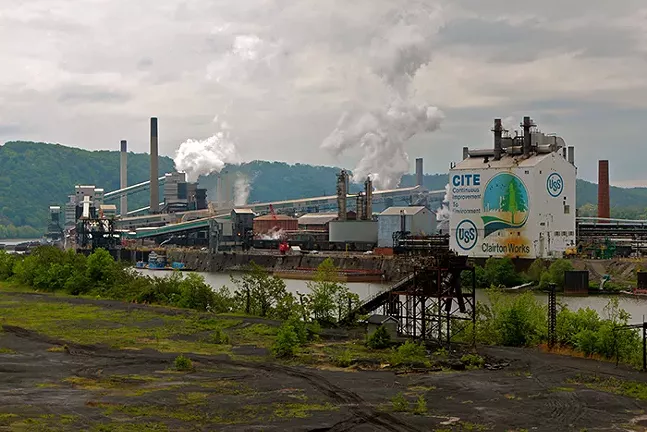
Clairton Coke Works

By Kimberly Rooney
Pittsburgh City Paper

April 30, 2021 – U.S. Steel Corporation is cancelling its $1 billion upgrades to its Mon Valley Works facilities, which includes Edgar Thomson Works in Braddock, Irvin Plant in West Mifflin, and the Clairton Coke Works in Clairton. While the cancellation will likely result in some job losses in the region, it will also reduce the levels of harmful air pollution in the Mon Valley and beyond.

The upgrades, which were announced May 2019, would have included a casting and rolling facility and a cogeneration plant. After several delays due to COVID in 2020 that increased the upgrade costs to a promised $1.5 billion, U.S. Steel pushed the start date of those upgrades to the fourth quarter of 2022. But today, the company announced it would be scrapping those plans entirely.

In addition to cancelling these updates, U.S. Steel plans to permanently idle batteries one through three at Clairton Coke Works by the first quarter of 2023. Batteries one through three are the oldest at the Coke Works and can allow twotothree times more emissions than the rest of the facility, according to environmental groups.

According to the EPA’s National Air Toxics Assessment, toxic air pollution contributes to high risk of cancer, and Clairton Coke Works is responsible for many of the airborne carcinogens in the region. Asthma rates among children in Clairton are three times higher than in the rest of the county.

“For too long, U.S. Steel has run roughshod over our environmental protections and churned out dangerous levels of harmful air pollution,” says PennEnvironment Research & Policy Center clean air advocate Zachary Barber. “Closing these batteries is a necessary and longoverdue step toward reducing that damage and cleaning our region’s air.”

Clairton Coke Works received a $1 million fine from the Allegheny County Health Department in 2019, as well as another $383,450 fine in March 2021. A study from the University of Pittsburgh also confirmed this week that the fire at the Coke Works in December 2018, which destroyed pollution controls, increased asthma exacerbations for residents in the surrounding area.

U.S. Steel President and CEO David Burritt cites the goal for the company to become carbon neutral by 2050 as a motivation for canceling the plan upgrades. As part of that goal, U.S. Steel will shift toward electric arc furnaces, such as Big River Steel, of which U.S. Steel bought a minority share in 2019, in Arkansas.

There are currently about 130 fulltime workers at the three Clairton Coke Works batteries that will be idled. U.S. Steel plans to avoid layoffs by reducing the workforce through retirements and reassignments. According to Pittsburgh Works Together, a cooperative venture mostly comprised of fossilfuel companies and the labor unions that represent their workers, the closures will result in the loss of hundreds of potential construction jobs for the region.

“I am deeply disappointed that the company has broken its promise to the Mon Valley and its own workers by scrapping a plan that would have made the Mon Valley Works the first project of its kind, provided cleaner air for our community and good jobs that would have helped this area prosper for decades,” says state Rep. Austin Davis (DMckeesport), whose district includes the Clairton Coke Works. “I believe that we can create familysustaining jobs and a clean environment.”

From March 30 to April 7, the Mon Valley was one of the top10 worst places for air quality in America. Advocates such as Barber have long criticized Clairton Coke Works’ dangerous emissions, and PennEnvironment had previously called for the batteries to be taken offline when air quality was poor.

“While we are pleased by this development, we still must remain vigilant — especially in light of U.S. Steel’s decadeslong history of legal violations and broken promises,” Barber says. “Local leaders must keep working to ratchet down industrial pollution to ensure that everyone has clean air to breathe every day of the year.”

And it’s possible these upgrade cancellations will have longterm effects on U.S. Steel’s future in the Mon Valley and the Pittsburgh region. As University of Pittsburgh economist Chris Briem notes on Twitter, the status of the Clairton Coke Works and the Edgar Thompson Works is bleak without any upgrades to those legacy facilities.

THE RUST BELT BOOM THAT WASN’T: HEARTLAND JOB GROWTH LAGGED UNDER TRUMP

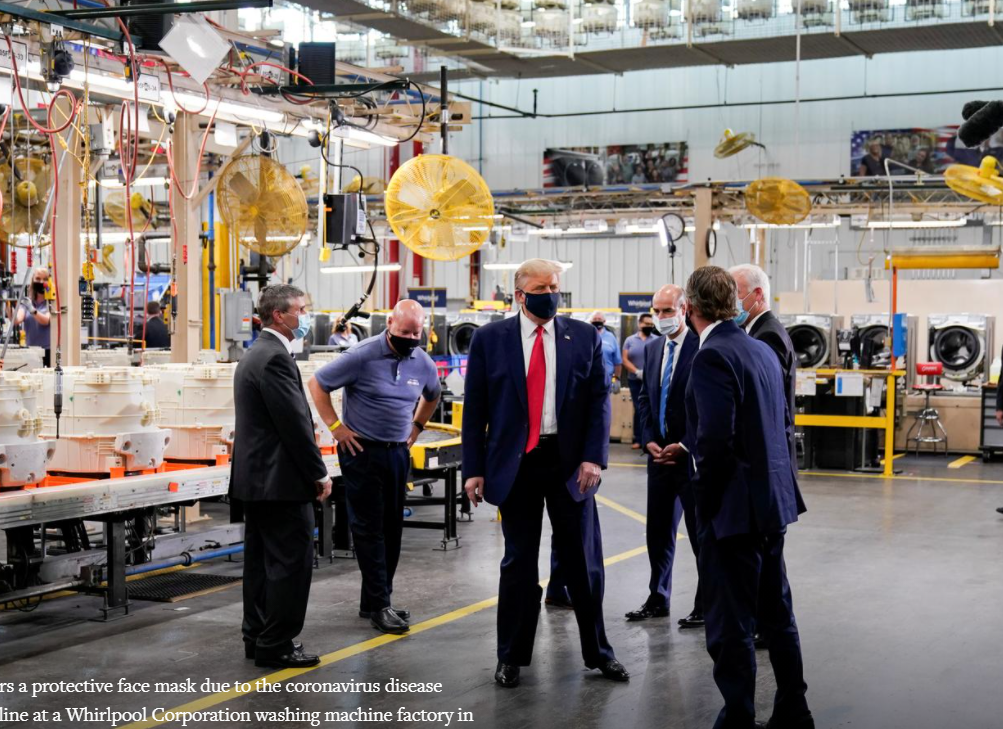
U.S. President Donald Trump wears a protective face mask due to the coronavirus disease (COVID-19) pandemic as he tours the assembly line at a Whirlpool Corporation washing machine factory in Clyde, Ohio, U.S., August 6, 2020. REUTERS/Joshua Roberts/File Photo

By Howard Schneider

Reuters

Oct 27, 2020 – The voters of Monroe County, Michigan, may have expected an economic windfall when they flipped from supporting Democrat Barack Obama to help put Donald Trump in the White House in 2016.

But it went the other way: Through the first three years of the Trump administration the county lost jobs, and brought in slightly less in wages in the first three months of 2020 than in the first three months of 2017 as Trump was taking over.

And that was before the pandemic and the associated recession.

With the U.S. election just a week away, recently released government data and new analysis show just how little progress Trump made in changing the trajectory of the Rust Belt region that propelled his improbable rise to the White House.

While job and wage growth continued nationally under Trump, extending trends that took root under President Obama, the country’s economic weight also continued shifting south and west, according to data from the U.S. Quarterly Census of Employment and Wages that was recently updated to include the first three months of 2020.

Continue reading THE RUST BELT BOOM THAT WASN’T: HEARTLAND JOB GROWTH LAGGED UNDER TRUMP

Donald Trump Campaigned on Restoring Manufacturing Jobs in Pennsylvania

Steel plant in Clairton, PA

Has He Kept That Promise?

By Laura Olsen
The Morning Call / Lehigh Valley

Dec 9, 2019 – Booming. Thriving. The best economy ever.

President Donald Trump loves to tout job numbers, particularly when he’s in Pennsylvania. When he returns to the state for a campaign rally Tuesday, fresh off a national jobs report showing strong gains, expect to hear a lot about the economy and manufacturing during his tenure.

“Since President Trump’s election, Pennsylvania has added 157,800 new jobs, including 2,900 manufacturing jobs,” Michael Glassner, the chief operating officer for Trump’s re-election campaign, said in a statement ahead of the rally. “President Trump is delivering on his promises.”

Democrats, however, have sketched out a much different economic picture in Pennsylvania. They point to a report showing Pennsylvania had lost the most manufacturing jobs of any state in the country — roughly 8,000 — between August 2018 and August 2019.

So who is right?

The data

When Trump took office in January 2017, Pennsylvania had 561,200 manufacturing jobs, according to data from the federal Bureau of Labor Statistics. That’s roughly the same number as in 2009, after employment plunged amid the Great Recession. State manufacturing crept back to 570,000 jobs by late 2014, before dipping again over the next two years.

During the first two years of Trump’s term, manufacturing jobs showed gains in Pennsylvania, peaking in October 2018 at 572,500. But the trend reversed, dropping back to 561,600 in July of this year before ticking back up again to 562,800 in October.

The Trump campaign’s 2,900 figure for manufacturing jobs gained counts gains made during the months between his November victory and January, when he actually became president. Pennsylvania had 559,900 manufacturing jobs in November 2016, according to BLS figures.

Looking beyond manufacturing, overall job growth in Pennsylvania has shown a steadier upward climb during that same period, rising from 5.9 million jobs in January 2017 to nearly 6.1 million jobs in October. Unemployment in the state has fallen since 2017, hitting a record low in April at 3.8% before rising slightly to 4.2% in October.

Tariff ripple effects

One factor that has caused uncertainty for employers in manufacturing and other sectors has been the Trump administration’s escalating trade war and broad use of tariffs. Continue reading Donald Trump Campaigned on Restoring Manufacturing Jobs in Pennsylvania

‘We’re the Sacrificial Lamb’: Lordstown Workers On the UAW Plant Closures

By Carter Eugene Adams
Organizing Work via Portside


Nov 11, 2019 – The Monday after Thanksgiving last year, workers at the General Motors Lordstown Assembly Plant in Ohio were called in for a 9 a.m. meeting. This was a rare occurrence.

“I don’t know, was it three sentences long maybe? ‘Hey, you’re unallocated.’ …No one had ever heard of ‘unallocated’,” says John Sandquist, Jr., a 25-year employee of GM. “We didn’t know what that term meant… Basically, it meant ‘you guys are closing.’”

The Lordstown plant is the former home of the Chevy Cruze and 1,600 workers. For almost a year now, no product has been coming out of the plant, with workers transferred, forced into early retirement or just out of work. Over the past year, GM has transferred over 700 workers from Lordstown to various plants across the country, mostly out of Ohio. According to the tentative agreement between GM and the UAW, the plant closure will be permanent.

Sonya Woods, a 25-year employee of GM, who was transferred to Bowling Green Kentucky, says she had to either move, or lose everything she’s worked towards.

“Gotta go or I lose my pension, lose my benefits,” said Woods. “They got us screwed. There’s a big group that have ‘95 seniority, 25 years, and we lose a lot if we don’t follow it. We don’t have much choice.”

Last week, outside of the shuttered factory, four workers held the picket line, along with 49,000 other GM employees still on strike, even as news of the proposed agreement between GM and the UAW started to circulate. The four were getting ready to transition to other plants when the strike was called. The locals at their new plants allowed them to come back to Ohio to do their strike duty at their home plant, as the Lordstown plant closure was one of the issues on the table between GM and the UAW.

At the picket, workers stood around a burn barrel. Harsh orange streetlamps illuminated an empty, fenced-in parking lot. The 6.2 million-square-foot behemoth factory acted as an eerie monument to what was once an industrial hub in northeastern Ohio. It was silent except for the drone of trucks driving by on the Ohio Turnpike.

“This used to be non-stop traffic, non-stop. Look, nothing!” said Agnes Hernandez, a 23-year GM employee.

“This is the truck gate,” added Sandquist.

“There would be lines, remember?” replied Hernandez. “We’d have lines of trucks coming out here.”

After a moment, Hernandez realized Sandquist didn’t have his signature clothing item: his orange vest.

“Go get your vest on! Come on, OVS!” Agnes jokingly shouted.

This group of friends, who spent nearly every day together in this plant for decades, called themselves the “Orange Vest Society.” The orange vest is standard attire for workers in the plant. But whether or not a given worker was wearing orange was semantics. Those in OVS felt they had another layer of protection between them and management. Having the solidarity and at times friendship of those on the shop floor gave workers a sense of “you watch my back, I watch yours.”

The origins of this group are vague, but as Dan Santangelo, a 25-year employee of GM put it, the roots of it are solidarity and comradery. “Management would start something with one of us, and it just started as a joke: ‘You mess with one person in Orange Vest you mess with us all.’ We don’t know who came up with it, maybe it might have been Jeff” — OVS member and fellow worker on the picket line – “came up and said, ‘we should call ourselves the Orange Vest Society.’ So, that’s what we did. On our last day here, we spray painted it on the wall behind out team center.”

The proposed contract appears set for ratification. Besides the plant in Lordstown, it cements the closure of two more GM facilities — Warren transmission and Baltimore transmission — three of the four that were on the table.

GM’s stated the reason for the Lordstown closure was the Cruze’s poor sales performance in the United States, with consumers opting for larger SUVs and trucks. But months after the shuttering, GM announced the production of a strikingly similar vehicle , the Onix, to be built and sold in Mexico. GM has also announced its revitalized production of the Chevy Blazer in Mexico, shortly after shuttering the Janesville, Wisconsin plant where it used to be made.

Workers think the production of the Onix could have taken place at Lordstown Assembly and kept the plant open. Sandquist feels the continued closure of Lordstown has little to do with the product they produced and more to do with GM attempting to fracture worker power and solidarity.

“This community, this plant — we’ve always built a good product here for 53 years,” said Sandquist. “I believe it’s something personal they have against the local 1112, it’s something personal against this plant because the union was strong here and we cared about the community. They’re more concerned about profits.”

For workers in Lordstown, transfers to plants hours from home, buyouts and early retirements are their consolation prize.

In 2007, workers were understanding of concessions needed to keep the company alive and acted accordingly. 12 years later, with record profits recorded and salaries for company executives in the tens of millions, workers want what they’re owed.

But trying to negotiate that has been difficult. The six weeks of the strike have seen agreements proposed and then removed in the same day. Negotiations stalled, started and stalled again. The latest draft of the proposed contract is four volumes long.

As Parma, Ohio UAW Local 1005 President Mike Caldwell explains, it’s necessary. “Every single thing in [our] shop was negotiated,” said Caldwell. “At one point in time, someone had to fight for it and negotiate for it.”

The new contract between the UAW and GM meets many demands that sent workers to the picket line. Those include a revised healthcare plan; gradual wage increases and a path for temporary workers to be hired on full-time.

By not pushing further on running product through Lordstown, UAW officials in Detroit have affectively abandoned shuttered plants in pursuit of other demands. Lordstown assembly, Warren transmission and Baltimore transmission plants are the union’s biggest concessions.

“We’re the sacrificial lamb in this one,” Sandquist said. “They’re gonna sacrifice Lordstown for the good of the whole, and the whole UAW membership. I get their point, but it sucks for us, and I’m pissed off about it.”

Caldwell weighed in on Lordstown remaining closed after members of local 1005 voted to ratify the contract, 438 for, 404 against. “It’s still kind of a sad spot for everyone that that plant is still slated to close,” he said. “It’s very disappointing, with that plant closing, that destroys that entire community.”

Keeping the Lordstown plant closed means workers have a difficult decision to make: either lose their jobs or transfer to another plant. Workers who did not qualify for early retirement were given the one-time offer to transfer and continue working until they’re eligible to collect their pensions and retirement benefits. The new proposed agreement offers a buyout, but according to the highlights of the agreement, distributed by UAW, that buyout doesn’t offer much.

For workers who choose the buyout option, they agree to terminate their employment and benefits, save for some pension benefits. In return, they’re offered a sum of money, between $7,500 and $75,000, based on years of service.

While that may seem like a lot offered, that money is just that: money. No benefits, no health care. And for people living paycheck-to-paycheck, those benefits are all they have. For those with more seniority, they’re choosing between cash or decades worth of pension and retirement benefits.

The four members of the Orange Vest Society decided to transfer so they can make it to their pension and keep their benefits. They’ll be eight hours from Lordstown in Bowling Green, Kentucky and six hours away in Bedford, Indiana — leaving their families and their community.

“It sucks. Every one of these people right here around this burn barrel is going through that,” said Sandquist. “He has a family that is here and he’s gonna be eight hours away, same with Agnes, same with this man Dan over here. He’s got a wife, two kids. Agnes has got grandkids now for Christ’s sake, she ain’t gonna see them grow up.”

“What do I do now? Facetime?” said Hernandez. “I mean you can’t see everything on Facetime. You know, it’s like my grandson, he’ll be two in January and he looks at me through the phone it’s almost like he has to do a double-take to see and hear my voice. Just so he knows me, I have to keep repeating who I am. It’s so, it’s horrible. It’s like, ‘oh my god, he’s gonna forget me.’ Being that young he’s gonna forget who I am, you know, and that to me is just heartbreaking.”

In addition to uprooting their entire lives and leaving family here in Ohio, this also means the end of the Orange Vest Society.

Even off the shop floor, through the upheaval of the plant closure, OVS became a way for workers to look out for each other.

“I went through a very bad time before I had to go to Bedford (Indiana), I was almost as low as killing myself, that’s how low I was.” said Santangelo, as a result of having to leave his family, his home and his community. “Not only did my blood family reach out to me, but these guys did as well,” he said. “Jeff would call every other day to check in. ‘How you doing?’ He would try to get me talking. That’s. That’s the Orange Vest Society.”

 I think this was our mentality.We came to work to have fun and to work. In that order,” explained Santangelo. “We made it enjoyable. We made it worth our while to be here.”

“Yeah, but the place is so miserable you had to do something,” added Sandquist.

As the night goes on, the conversation shifts and changes, from heated discussions about the proposed contract to jokes about how many liquor bars and sex shops there are in Kentucky. The remaining OVS members talk about home, about what, and who, they’re leaving in order to provide. There are also long moments of silence on the picket line, between the jokes and contract talk. Against the backdrop of the shuttered plant, there’s this feeling that this is the end of an era.

“It was like a second family,” said Hernandez. “I mean we hung out together, we’ve known each other for 2o-plus years. These are my brothers.”

Agnes and Jeff go into the Styrofoam cooler next to the wood pile under a small nylon canopy. After a few minutes the two emerge with plastic cups. Dan had declined the offer earlier and joins the toast emptyhanded.

After the toast, the group sits and talks for a while longer before slowly, one by one, leaving.

Shortly after midnight, Sandquist is packing up his chairs and getting ready to head back to the union hall to sign out before finally going home. Before he heads out, he reflects on the future of the Orange Vest Society. “We might end up having a little chapter down in Bowling Green, one in Bedford, some of our friends up in Toledo will have a little — there’s a couple of us everywhere but the original core group is split up,” he says.

“That’s the stuff that pisses you off even more, you know, it’s the friendships, your family, your secondary family. You’re not gonna spend time with them no more, or you know, have them relationships. Talk on the phone or text, see what’s up with them but not like you use to. Kinda at the end, it’s over and it’s sad.”

Continue reading ‘We’re the Sacrificial Lamb’: Lordstown Workers On the UAW Plant Closures

High-Tech Manufacturing: Aliquippa Summer Camp Opens New World to Students

Kordell Boose, 17, of Aliquippa takes instruction on finishing an aluminum cast during the Titans of Pittsburgh Summer Camp’s field trip Wednesday to Robert Morris University’s engineering lab. [Lucy Schaly/For BCT]

Learning about career opportunities in the manufacturing industry is the purpose of the pilot Titans of Pittsburgh Summer Program developed by Catalyst Connection and Southwestern Pennsylvania BotsIQ.

By Marsha Keefer
Beaver County Times

Aug 10, 2019 – MOON TWP. — Students, most of them from Aliquippa, gathered Wednesday at a robotic work cell in an engineering lab at Robert Morris University’s John Jay Center for the School of Engineering, Mathematics and Science.

For most, it was a seminal moment. The two previous days, they sat at computers at the Family Life Center housed in the Church in the Round in Aliquippa, and used software to design a product. Now, those drafts would be programmed into a computer-controlled milling machine to carve their designs in a rectangular block of aluminum — a process that took all of seven minutes.

What had been merely a concept would come to life.

Most of the 23 students enrolled in the four-day summer camp — high school juniors and seniors and a few recent graduates — had never worked with computer-aided design (CAD) programs and certainly not computer numerical control (CNC) routers, said Scott Dietz, director of workforce initiatives at Catalyst Connection, an economic development organization based in Pittsburgh that helps small- to medium-sized manufacturers improve competitive performance.

“We’re seeing sparks happening already this week in the few days we’ve had with them,” he said. “We’re seeing light bulbs going off. The students are seeing stuff they haven’t been exposed to before. We think the program is definitely a success.”

Essentially, learning about career opportunities in the manufacturing industry, is the purpose of the pilot Titans of Pittsburgh Summer Program developed by Catalyst Connection and Southwestern Pennsylvania BotsIQ, a manufacturing workforce development program that engages high school students in robotics competitions to stimulate interest in manufacturing careers.

Catalyst Connection works with 2,800 manufacturing companies across 12 counties in western Pennsylvania, Beaver County included, Dietz said.

“When we go in their doors, the first thing they tell us when we ask ‘what is their biggest pain point’ is workforce — lack of workforce,” he said.

Dietz estimated 30 percent of the current workforce will retire in the next 10 years and that’s compounded by the large number of job needs now.

“We recently did a survey of 100 of those manufacturers who told us they have 2,300 job openings,” he said. Extrapolating those numbers, Catalyst Connection projects a shortage of about 20,000 workers, Dietz said. Continue reading High-Tech Manufacturing: Aliquippa Summer Camp Opens New World to Students

U.S. Steel’s Market Value Drops $5.5 Billion Thanks to Trump’s Tariffs 

Pittsburgh City Paper
According to several reports, Pittsburgh’s largest steel company — and the second largest in the country, has lost about 70 percent of its market value thanks to forces put into place by President Donald Trump’s steel tariffs.

Since Trump announced tariffs on foreign-made steel 16 months ago, U.S. Steel’s market value has dropped by $5.5 billion. Even though steelworkers at U.S. Steel lauded the tariffs when Trump announced them last year, the Los Angeles Times points out how the dynamics set in motion by those tariffs actually hurt steel companies with legacy steel mills with blast furnaces, like U.S. Steel.

From the LA Times: “Exuberance over the levies dramatically boosted U.S. output just as the global economy was cooling, undercutting demand. That dropped prices, creating a stark divide between companies such as Nucor Corp., which uses cheaper-to-run electric-arc furnaces to recycle scrap into steel products, and those including U.S. Steel Corp., with more costly legacy blast furnaces.”

The tariffs boosted steel production for all domestic steel producers in the short term, but as actual demand for steel dropped, U.S. Steel struggled to compete with lower-cost competitors like Nucor Corp. With international steel nudged out of the market by the tariffs, domestic steelmakers responded to fill those gaps, but U.S. Steel got beat in the market by steelmakers with more efficient electric-arc furnaces. Basically, the tariffs created a new market of mostly domestic steelmakers, but the new market actually gave more advantages to Nucor and less to U.S. Steel.

Bank of America analyst Timna Tanners told the LA Times it was “ironic” that the tariffs are “punishing some steel companies.” She also noted the dangers of the steel industry to add capacity without sufficient demand.

Since March 2018, U.S. Steel has idled two of its steel mills in Michigan and Indiana. In the past, U.S. Steel had voiced support from Trump’s tariffs.

Another steel company in the region is also claiming negative effects from the tariffs. Last week, steel producer NLMK USA in Mercer County laid off between 80 and 100 workers. According to WESA, the CEO of NLMK USA blamed the cuts on Trump’s steel tariffs, saying that the Russian-owned company faced steep prices on Russian-imported steel slabs.

Pennsylvania U.S. Sen. Pat Toomey (R-Lehigh), who has been critical of Trump’s tariffs, says both situations show the tariffs are not working as promised.

“As out-of-work steelworkers, like those at NLMK in Sharon, can attest, the administration’s protectionist steel tariffs have not resulted in the promised financial gains even for steel companies,” says Toomey. “This outcome demonstrates that imposing arbitrary taxes on imported products can distort prices, disrupt supply chains, destroy jobs, and increase prices for consumers without sufficiently offsetting benefits.”

Even though U.S. Steel has lost most of its market value since the tariffs started, the company still reported a large fourth-quarter profit last year, netting $592 million.

In May, the company announced a $1 billion investment to upgrade its facilities in West Mifflin, Braddock, and Clairton. With the upgrades, these three facilities will become the central source for high-strength, lightweight steel used for the automobile sector.

But with the upgrade comes an increase in efficiency, and experts told the Pittsburgh Post-Gazette that U.S. Steel will likely cut jobs at the Mon Valley facilities in the future.

And it appears Trump’s tariffs haven’t had that positive of an impact on steel jobs nationwide. According to the Washington Post, the tariffs “didn’t lead to a major increase in manufacturing jobs, largely because modern mills don’t require more manpower to operate at a higher capacity.”

Continue reading U.S. Steel’s Market Value Drops $5.5 Billion Thanks to Trump’s Tariffs