Jaime Martinez, community defense organizer at Casa San José, coordinates with Rapid Response Network volunteers outside Emiliano’s Mexican Restaurant in Gibsonia on June 17, after reports that federal agents were idling nearby in unmarked vehicles.
Casa San José has trained hundreds of volunteers to monitor and respond to immigration enforcement. Public Source followed them through raids, courthouse watches and late-night calls.
July 31, 2025 – As federal immigration enforcement intensifies across the country, a local response has quickly scaled up across the Pittsburgh region. In Beechview, the nonprofit Casa San José has built a Rapid Response Network of trained volunteers who monitor and document ICE activity across Allegheny County and beyond.
The network launched during the first Trump administration but has ramped up since January. As of July 30, it includes more than 250 trained volunteers — with nearly 175 more signed up for future training.
Casa San José, founded in 2013, focuses on immigrant rights and the Pittsburgh region’s Latino community — a mission amplified as the Trump administration rolls back protections for immigrants and directs federal resources toward a crackdown and mass deportations.
Organizers traverse city neighborhoods, gather in church basements and empty parking lots, and educate residents about their rights and federal immigration tactics. Along with trained volunteers, who are prepared to legally observe, document and accompany people at risk of being detained by Immigration and Customs Enforcement [ICE], they respond in real time to sightings, arrests and raids.
Pittsburgh’s Public Source spent more than a month embedded with Casa San José’s organizers and volunteers, tracking their efforts from the courthouse to restaurants as they responded to immigration enforcement and supported families under threat.
Photo: June 14 at the City-County Building, Downtown
Monica Ruiz, executive director of Casa San José, speaks to thousands of people gathered in front of the City-County Building in Downtown during a day of nationwide protest against the Trump administration.
“They are disappearing our people. This is our reality. Every single day. Just because you don’t see it doesn’t mean it’s not happening. We cannot continue to allow this to happen in our communities,” said Casa San José Executive Director Monica Ruiz.
“Casa San José is the only organization on this side of the state that is doing this kind of work.”
Ruiz said she has received five death threats since November, forcing her to relocate Casa San José’s office and to reconsider speaking publicly.
Photo: June 17 at Emiliano’s Mexican Restaurant, Gibsonia
As volunteers monitor the scene, Jaime Martinez, community defense organizer at Casa San José, speaks by phone with nine workers sheltering inside the restaurant — part of the network’s effort to document enforcement activity and support those at risk.
Sharon Bonavoglia was the first to arrive at a quiet strip mall in Gibsonia late on June 17. She had received the call because she lives nearby, and because she’s one of a growing network of volunteers responding to reports of federal immigration enforcement in and around Allegheny County.
June 11, 2025 – The state House voted along party lines Wednesday to raise the minimum wage to $15 for most Pennsylvanians, and to $12 for those working in smaller, rural counties.
It’s a significant step in the latest effort by Democrats to get it above the federal rate of $7.25.
Pennsylvania’s minimum wage has not been hiked since 2008 and is lower than all surrounding states — New York, Ohio, New Jersey, West Virginia, Maryland and Delaware.
The measure’s sponsor, House Labor and Industry Committee chair Jason Dawkins (D-Philadelphia), said the bill is in an attempt to compromise with Republicans who have long warned about the potential impacts on businesses, especially in smaller counties with a lower cost of living.
“Since I’ve been chair, we’ve been trying to figure out a different approach to get this done,” Dawkins told the Capital-Star. “This time around, we had a little bit more insight into where our challenges lie, one particularly being that some of our counties were worried about moving too quickly, and some were not comfortable going over $12.”
A previous bill sponsored by Dawkins passed the House in 2023, but died in the Republican-controlled Senate. And in 2019, the Senate passed a Democratic-led bill to raise it to $9.25, which died in the then-GOP-controlled House.
Dawkins’ latest bill would see the minimum wage rise gradually each year, reaching $15 in most counties on Jan. 1, 2028. It would also raise the tipped minimum wage from $2.83 to 60% of the minimum.
Counties with populations below 210,000, with the exception of Centre, Monroe and Pike counties, would only see the minimum wage rise to $12 in the same timeframe. A spokesperson for the House Democratic Caucus said the three smaller counties were put in the $15 bracket at the request of Democratic members who represent them.
One exception to the gradual rise to $15 would be Philadelphia County, which Dawkins represents. There, the minimum wage would rise to $15 on January 1, 2026.
“Philadelphia has the highest population of folks who are in what we call deep poverty levels,” Dawkins said.
He added there is particular urgency given the possibility some of those people may lose access to federal benefits like Medicaid and food assistance under a proposed bill moving through the GOP-controlled U.S. Congress.
“We wanted to have some type of safety net there because we know those folks might be losing benefits and other services,” he said.
But Dawkins’ attempt to offer an olive branch to GOP lawmakers in the form of gradual wage hike and a lower target in small counties appears to have failed in his own chamber. Every House Republican voted against the bill, and many criticized it during a two-hour debate on the floor Wednesday afternoon.
“Not every wage is designed to be a livable wage,” Minority Leader Jesse Topper (R-Bedford) “My 16-year-old son is not working for a livable wage. Someone who is retired and is helping out part-time, that is not necessarily a livable wage.”
He also warned that raising the minimum wage could result in the elimination of low wage jobs and harm small businesses in particular.
Others opposed the very provisions Dawkins said were intended to earn bipartisan support.
Rep. Kate Klunk (R-York) warned that creating different minimum wages across counties could lead to confusion for businesses that cross county lines, or encourage business owners to set up shop where the wage is lower.
“This county-based patchwork of minimum wages is going to be a mess,” Klunk said. She used examples of businesses with locations in York and Adams counties as examples, including golf courses that straddle the border between them.
“This bill is truly unworkable,” she said. “It is a compliance nightmare.”
Rep. Mike Jones (R-York) was one of few Republicans to signal openness to raising the minimum wage during debate, but said he could not support Dawkins’ bill.
“I do commend the majority chair for what I think is a good faith attempt at a reasonable compromise,” he said.
However, he added that he would want to see exceptions to the minimum wage for nonprofits and high-school aged employees.
‘Potential to find middle ground’
To become law, the bill will have to pass the Republican-controlled Senate.
Senate Majority Leader Joe Pittman (R-Indiana) said that there may be room for compromise on a minimum wage increase, especially if paired with Republican-backed deregulation efforts he said could help grow “maximum wage jobs.”
“Making sure working families have access to good, family-sustaining jobs is key to helping our commonwealth grow and thrive,” Pittman told the Capital-Star in a statement. “There is potential to finding [sic] a middle ground for an increase, but any possible action would need to be a commonsense adjustment, and sensitive to the impact changes would have on small businesses and non-profit organizations.”
Republican Sen. Dan Laughlin (R-Erie), who has previously introduced a bill to raise the minimum wage to $15, commended the House’s effort, but said he would not support a bill with a county-by-county approach.
“While I appreciate that the House is trying to advance the conversation, I do not support HB 1549 in its current form,” Laughlin said in an emailed statement. “A minimum wage tied to county size just deepens the economic divides we’re supposed to be addressing. If we’re going to get serious about raising the minimum wage, we need to do it uniformly across the state, not with a patchwork approach that leaves people behind based on where they live.”
Laughlin was an early Republican supporter of raising the minimum wage to $15 in Pennsylvania. But national trends may indicate more openness from members of his party this time around.
On Tuesday, conservative U.S. Sen. Josh Hawley (R-Missouri) introduced a bill to raise the minimum wage to $15 for all Americans.
He told NBC News, “If we’re going to be a working people’s party, we have to do something for working people. And working people haven’t gotten a raise in years. So they need a raise.”
His comments reflect an openness to his party’s increasing appeal to working class voters that was made apparent in the latest general election, which saw them move away from their traditional support of Democrats.
Dawkins, the Pennsylvania bill’s sponsor, is also aware of the shift, and hopes that it will help the bill earn the support that it needs to pass.
“I’m excited by the prospects, but I’m also disappointed that there could be a federal minimum wage that’s gonna be higher than the state minimum wage — and it’s being offered by one of the most conservative members of Congress,” he joked. “But I’m hopeful it’ll help folks come around to the idea.”
“This is what I believe we got elected to do,” he added.
Ian Karbal covers state government for the Pennsylvania Capital-Star. He’s particularly interested in the influence of money in politics and how arcane policies affect Pennsylvanians across the state.
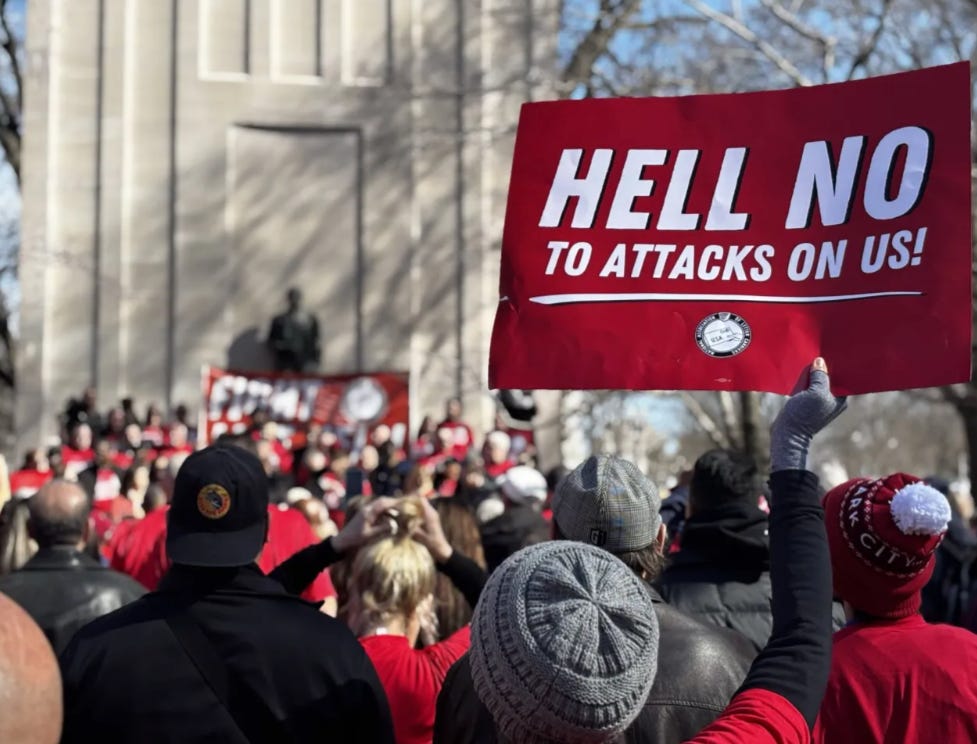
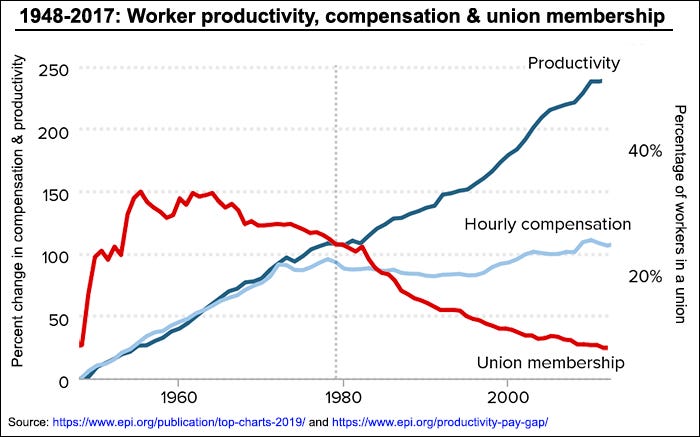
Over the course of the first 100 days, appropriate attention has been paid to Trump’s attacks on the judiciary, law firms, universities, philanthropy, non-profit groups and the media as dangerous in their own right, but more importantly as essential elements of authoritarian consolidation. Yet almost no one has mentioned the attacks on an equally proven constraint on oligarchy and autocracy: unions. Trump and Elon Musk’s destructive ransacking of our government should remind us of what previous generations of Americans understood intuitively: that “we may have democracy, or we may have wealth concentrated in the hands of a few, but we cannot have both,” as Supreme Court Justice Louis Brandeis put it. Like other attacks on civil society, the Trump regime’s attacks on unions and working people do not just injure those directly targeted, but all of us, as the labor movement is one of the most essential bulwarks against authoritarianism.
If we all have a stake in unions as bulwarks against authoritarianism whether we belong to one or not, the same is true because of how unions foster shared prosperity and a healthy society, which I elaborate on here and here. In that regard, it is crucial to recognize the Trump actions as coming from the same playbook as Reagan’s decisive firing of over 11,000 striking air traffic controllers. It was more than punitive—it communicated a clear, aggressive stance against unions nationwide. The immediate aftermath saw corporate America follow Reagan’s lead, significantly increasing anti-union activities and adopting overt union-busting strategies.1 Reagan further entrenched anti-unionism by reshaping the NLRB into a body less protective of labor rights, reversing precedents that had previously safeguarded union activities.2
As it did then, today’s federal war on working people comes at a key inflection point. Then it was the rush to globalization, coupled with financialization and deindustrialization. Now it is the imminent transition to artificial intelligence in the workplace. Musk’s firings are providing a new playbook for that transition—fire everyone so as to be able to start from scratch with AI with as little friction from a legacy workforce as possible. And, although not the topic today, it’s important to note here that with respect to DOGE cleaning house to make way for AI, it’s also cleaning house to make way for even more of the government to be privatized—providing a vast market for the tech companies’ AI products and services. Although this future is not certain, it seems to be Musk’s plan: first trash the government, then when the government fails, privatize.
Today, I’ll lay out some of the most egregious actions taken by the Trump regime in the first 100 days to attack unions and working people in both the public and private sectors. Much of this is based on indispensable research by the Economic Policy Institute and its just released 100 Days, 100 Ways Trump Hurt Workers. (For more great reports like this, you can subscribe to EPI here.)
Then I’ll document the robust pushback unions are mounting against the Trump regime’s war on working people in the courts. Unions have also been in the forefront of mobilizing public action, most notably the AFL-CIO’s Department of People Who Work for a Living, which in addition to leading and participating in protests3, has organized town halls across the country.4 AFL-CIO President Liz Shuler declared:
The labor movement is not about to let Trump and an unelected billionaire destroy what we’ve fought for generations to build. We will fight this outrageous attack on our members with every fiber of our collective being.
And, significantly, even sectors mistakenly thought to be pro-Trump like the Building Trades powerfully responded to Trump’s executive order eviscerating collective bargaining for federal workers:
This executive order is an unprecedented assault on worker freedom and a direct attack on those fundamental rights. Americans know that patriotic blue-collar workers built this country, not billionaires. They also know that one of the last best chances to make it to the middle class is collective bargaining. NABTU and our affiliated unions will stand shoulder to shoulder with the entire labor movement to fight this head-on — and we will not back down.
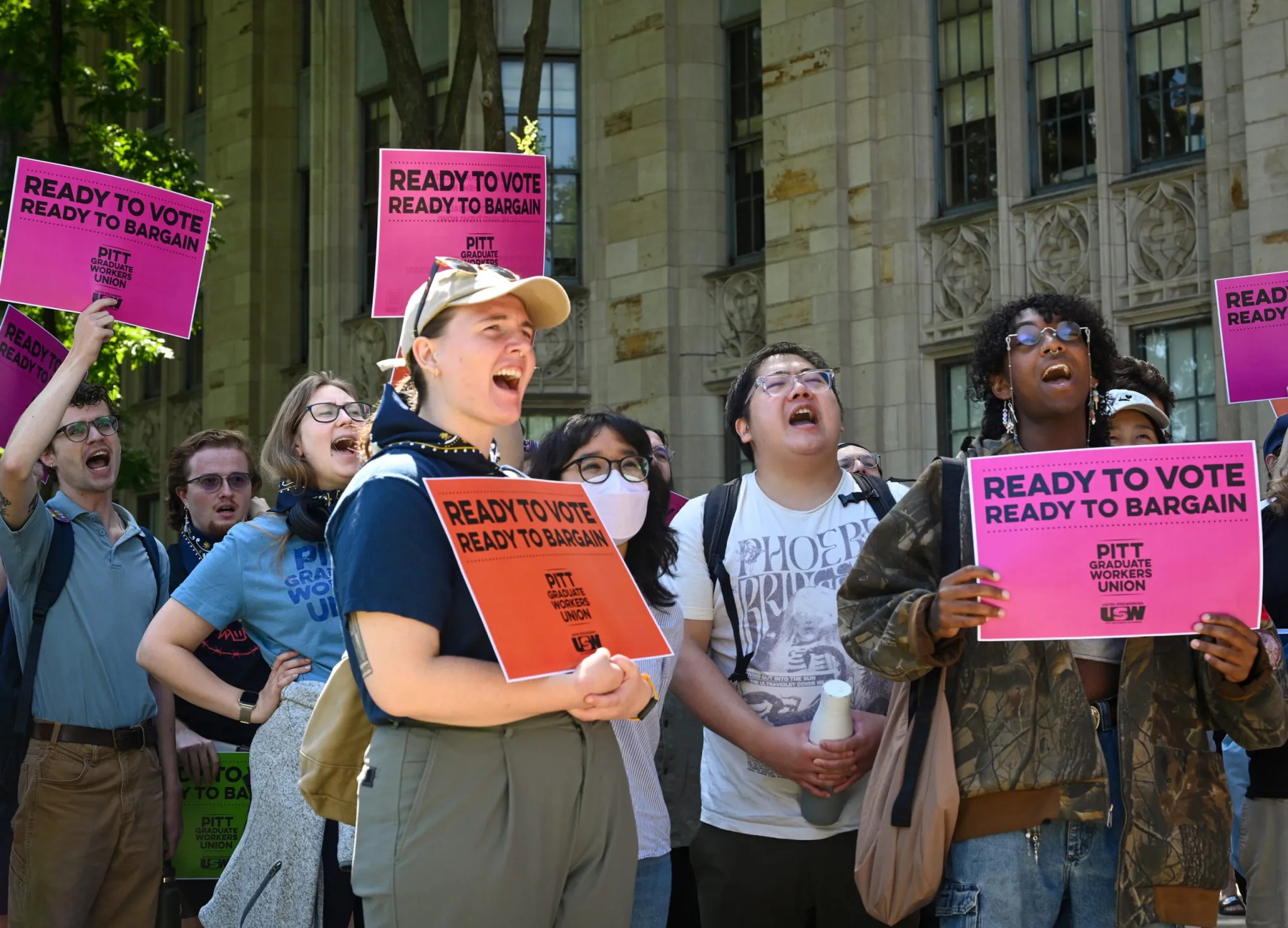
The University of Pittsburgh’s graduate student workers narrowly declined unionization in 2019, but this week’s overwhelming vote has the Oakland campus riding a wave of higher ed organizing.
Nov 22, 2024 – Throughout the week, more than 1,000 graduate student workers at the University of Pittsburgh made their way to a nondescript ballroom in the O’Hara Student Center to vote on whether to unionize.
Supporters sought everything from more transparency on the part of university administration to pay equity, better vacation time and health insurance.
The line outside the ballroom stretched, at times, down the stairs of the center. “People are so excited … I’ve never seen engineers this excited,” said Lauren Wewer, a materials science and engineering Ph.D. student and organizer at Pitt.
On Friday, organizers announced the results: a 1033-28 vote to unionize with the United Steelworkers [USW]. The Pennsylvania Labor Relations Board had not yet confirmed the vote count as of mid-afternoon.
With this win, Pitt grad student workers become the latest employees to undergo a successful union bid at a U.S. higher education institution, continuing an upward trend in the sector’s organizing activity over the last few years. They also join faculty and staff at the university which unionized with the USW in 2021 and September, respectively.
Pat Healy, an information science Ph.D. student at Pitt, said the wide margin of support reflected in the vote, “aligns with how most of the grad union votes [in the country] have gone the last couple of years.” Healy has been organizing at the university since 2019, which was the last time grad student workers attempted to unionize. Then, the pro-union students lost by fewer than 40 votes. For them, the impact of this year’s vote stretches beyond Pitt’s campus.
“I’m happy for the movement [and] looking forward to some other grad unions popping up, I’m sure inspired by us, because that always happens,” Healy said.
After Thanksgiving, they said organizers will begin setting up for bargaining with Pitt’s administration.
In a statement after the vote count, the university said, “While first contract negotiations can be complex, please know that we will come to the table in good faith and be there to support all graduate students throughout and beyond the process.”
Immediately following the loss in 2019, any efforts to restart conversations about unionizing would meet with “a kind of extreme hesitancy,” Healy said, blaming “a lack of understanding of what a union was.”
This year felt different, Healy said. There are likely a few reasons why.
Five years after failed vote, Pitt grad students unionize EQT’s ‘bulldog’ has D.C. in his grip, with profits — and maybe higher gas bills — on the horizon
A wave of change
From 2021 to 2023, nearly 64,000 U.S. grad student workers joined unions. By comparison, only 20,394 students unionized from 2013 through 2020. Today, four in 10 grad student employees belong to labor groups.
This trend was, experts say, driven in part by the pandemic and by the administration change from Donald Trump to Joe Biden in 2021, which ushered in a National Labor Relations Board more amenable to organizers.
Adrienne Eaton, professor of labor studies and employment relations at Rutgers University, noticed COVID-19-driven layoffs and research funding losses on campus in New Jersey that eventually led to a faculty and grad student strike last year. She describes this time as an “active moment” in American higher ed, with students advocating for change across the board at universities and colleges. And with grad students, there’s another factor at play: “The faltering job market in academia.”
“A high percentage of students no longer [are] confident that they have a future as tenure-track professors, in particular, or potentially as academic faculty at all,” Eaton said. “So, I think it really changes the way that graduate students look at their assistantships that they get.”
Nov 6, 2019 – In Pennsylvania, it’s not uncommon to hear politicians dog whistle to nativism, especially when it comes to labor.
Last month at the Shale Insight conference in Downtown, President Donald Trump received a large applause when he told the crowd he would “always put America first.” In a special election for state senate earlier this year, attack ads were levied against candidate D. Raja (R-Mt. Lebanon), an Indian-American businessman who runs a software company that employs workers from his native India and in Allegheny County, for “outsourcing” jobs and “importing talent.”
And now, a new law has hit Pennsylvania’s books that harks back to similar themes.
On paper, the Construction Industry Employee Verification Act, aka House Bill 1170 (HB 1170) — known more commonly as the E-Verify law — looks to tackle problems associated with labor fairness and to ensure everyone is following the same rules.
It passed with overwhelming support on Oct. 7, moving swiftly through the legislature before Gov. Tom Wolf (D-York) let it lapse into law without signing. (When Pennsylvania governors don’t veto bills within 10 days of reaching the governor’s desk, they become law.)
But there are disagreements on whether the law, which will require employees of construction companies to be run through a verification system to determine if they are legally allowed to work in the U.S., will be able to accomplish those goals.
The bill requires all private construction employers statewide to run new hires through a federal E-Verify system, an electronic database that checks the legal work-status of new hires by comparing the employees’ information to that of the Social Security Administration and federal immigration officials. More than 20 states have mandated the use of E-Verify in some or all industries.
Proponents of the law say it helps catch violators who employ off-the-book workers and thus avoid paying taxes and workers’ compensation fees. But opponents say the law will disproportionately hurt immigrants, noting the ineffectiveness of similar laws in other states and arguing it could lead to the deportation of undocumented immigrants and exacerbate a labor shortage. Labor unions and immigrant advocates are now wondering why the E-Verify law passed so quickly, and why these potential shortcomings were not fully vetted. Continue reading What’s Really Behind the Creation of Pennsylvania’s New E-Verify Law?→
Wolf’s State Human Services Secretary Denounces Measure
By J.D. Prose Beaver County Times
Sept 23, 2019 – Calling the Trump administration’s proposed changes to a federal food assistance program “cruel and mean-spirited,” a cabinet secretary for Gov. Tom Wolf said Monday that 200,000 Pennsylvanians could lose their benefits.
“The Wolf administration vehemently opposes this change,” said Pennsylvania Human Services Secretary Teresa Miller in a conference call with reporters about the possible changes to eligibility for the Supplemental Nutrition Assistance Program (SNAP), more commonly known as food stamps.
Miller’s department estimates that 2,544 Beaver County residents and 1,564 Lawrence County residents could lose their benefits under the plan.
President Donald Trump’s administration has proposed prohibiting states from raising or eliminating income limits that allows them to give federally-funded food benefits to people who would not otherwise qualify.
The U.S. Department of Agriculture estimates the change would save $2.5 billion a year, but supporters of the current system say it would hurt struggling low-income families, children, seniors and the disabled.
Trump administration officials have also argued that changing the rule would help reduce cases of fraud, but Miller said that in Pennsylvania the fraud rate in SNAP is just 1 percent and “lower than every other human services program.”
Miller said that a Pennsylvania family of four is eligible for SNAP benefits if it earns a maximum of $40,000 annually. However, under the Trump administration’s proposed change, that same family would only be allowed to earn $32,000 or less to be eligible, leaving many families without access to food.
Setting an Example of Solidarity with Workers and the Poor
By Daveen Rae Kurutz Beaver County Times
Aug 10, 2019 – A group of nuns and volunteers from the Sisters of St. Joseph in Baden is working with migrant families and children at the U.S.-Mexico border in Texas.
They called him a liar.
For months, the Venezuelan man waited patiently with his wife and three children for permission to leave their home country, riddled with political unrest and economic free fall in the midst of a humanitarian crisis. Once granted, the family waited for months in Mexico for consent to enter the United States as asylum seekers.
It was a long and difficult journey.
Just hours after finally crossing the border into the United States, he sat last week with Sister Janice Vanderneck, a member of the Sisters of St. Joseph in Baden, at the Catholic Charities of the Rio Grande Valley Humanitarian Respite Center in McAllen, Texas.
“What a privilege it is to be able to be among the first people to welcome this family to our country,” Vanderneck said. “I was glad to be the person empathetic to their story because he told me that immigration officials called him a liar, thinking that he didn’t understand English.”
For one week, three members of St. Joseph — Sister Jeanette Bussen, Sister Patti Rossi and Vanderneck — are working at the respite center in McAllen to meet and serve migrant families seeking asylum. They are accompanied by Maureen Haggarty, former sister and benefactor, and Carol McCracken, who was inspired by the service and mission work of Rossi.
The respite center is the first stop for those released from a nearby U.S. Customs and Border Patrol holding center. Each day, the respite center serves between 500 and 900 families, providing migrants in crisis with a warm meal, clean clothes and a chance to recover from the first part of their long journeys.
How to help
The Sisters of St. Joseph in Baden has donated more than $10,000 to help replenish supplies at the Catholic Charities of the Rio Grande Valley Humanitarian Respite Center in McAllen, Texas. Items include toiletries, baby bottles, diapers, sealed snack foods and phone cards.
In this March 8, 2016, file photo, Pennsylvania Gov. Tom Wolf meets with diner patrons before discussing his executive order to increase the minimum wage for state government employees and workers on jobs contracted by the state, during a news conference at the Trolley Car Cafe in Philadelphia. (Photo11: Matt Rourke / AP)
By York Dispatch Editorial Board
Feb. 22, 2019 – Pennsylvania’s minimum wage is $7.25 an hour. That’s $58 a day; $290 a week; $1,160 a month. Before taxes.
It hasn’t gone up a penny in 10 years. And it was only increased in 2009 because the federal government mandated it. Neither federal nor state lawmakers have added to this pittance since. They should be embarrassed.
In fact, $7.25 an hour was insufficient 10 years ago; it is insulting today.
Gov. Tom Wolf would like to rectify this shameful situation. Republican lawmakers who control the General Assembly, unfortunately, are evidently shameless.
The governor is again proposing an increase in the state’s minimum wage — something he has done each year since he took office in 2015. His proposed $34.1 billion spending plan would hike the lowest legal wage to $12 an hour this year, then nudge it by annual 50-cent-an-hour increments to $15 an hour by 2025.
Unfortunately, more livable wages are something many GOP lawmakers believe Pennsylvania can live without.
PITTSBURGH — No 29, 2016 – Thousands of workers are walking off the job and marching Tuesday in cities across the country, including Pittsburgh, where morning protests will be followed by a larger downtown rally in the afternoon.
The Service Employees International Union is targeting McDonald’s restaurants and UPMC with marches demanding a $15 minimum wage and union representation.
Organizers began their "Day of Disruption" marches at McDonald’s on Penn Avenue in East Liberty. Demonstrators went inside to voice their demands, then began circling the restaurant outside and chanting slogans like "Hold your burgers, hold your fries. We want wages supersized."
"I want to be able to take care of my family, to take care of myself, to pay bills," McDonald’s employee Aaron McCollum said. "You can’t possibly do that on $7.25, $7.35 an hour."
The protest then moved to a McDonald’s restaurant on North Euclid Avenue.
"It’s about workers, but it’s also recognizing that workers are more than who they are in between when they clock in and clock out, but that they’re our community members, they’re our neighbors, they’re humans," said Kai Pang, an organizer with Pittsburgh United. "We should have the right to not only survive but thrive in this city."
The group plans a similar protest near a McDonald’s and the federal building downtown during the evening rush hour.
"I’m just trying to fight for something that I believe in," McCollum said.
A press release on behalf of the group added, "Giant Eagle workers will also join the Fight for $15 today, asking that the company start paying family-sustaining wages and stop interfering with Giant Eagle employees’ right to organize."
The union contends UPMC shuttle bus workers have also gone on strike seeking union representation.
UPMC previously announced plans to increase the minimum starting wage for entry-level jobs at most of its facilities to $15 per hour by 2021.
But the union says UPMC needs to move faster, and it accused the network of trying to silence workers and union organizers.
UPMC hasn’t commented on Tuesday’s activity.
"I think more now than ever that we’re standing up for worker’s rights, for economic justice at a time when income inequality is very high and only grows higher," said Pang.
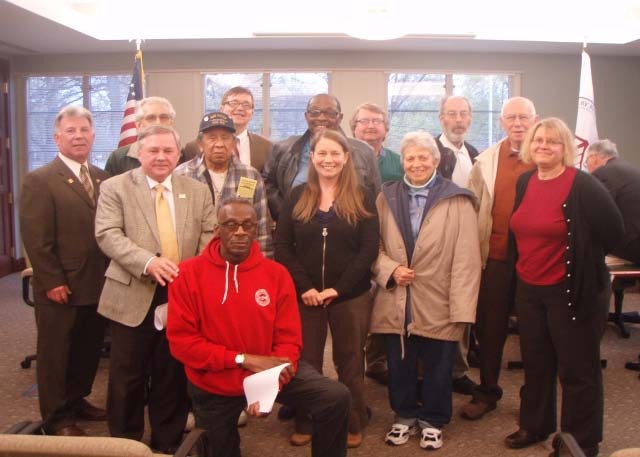
Kneeling: T. Berry; Standing First Row: Commissioner Tony Amadio; Alex de la Cruz; Tina Shannon; Myra Fabrizio; Janet Hill; Second Row: Commissioner Joe Spanik; Randy Shannon; Steven Kocherzat; Linwood Alford; Mark Benkart; Peter Deutsch; Rev. Ed Heist
By Linwood Alford Council Director of Civil Rights and Economic Development
I want to thank the Beaver County Commissioners Tony Amadio and Joe Spanik for supporting a resolution "urging the state legislature to approve a raise in the Pennsylvania minimum wage from the pre-sent $7.25 per hour to $10.10 per hour". The resolution was approved by their two votes, with Com-missioner Dennis Nichols abstaining, at the Commissioners’ meeting of April 23rd.
The Labor Council approved a resolution calling for a raise in the minimum wage to $10.10 per hour at its November membership meeting. SEIU Healthcare Pa. staff representative and Labor Council Trustee Kerrianne Theuerl arranged transportation for Council members to attend "Raise the Wage" rallies in Harrisburg in February and Pittsburgh in April.
The minimum wage resolution was placed on the Commissioners’ meeting agenda thanks to the efforts of Mark Benkart, Labor Council Com-munity Services Director and our local Moral Mondays chair-person, and Tina Shannon, president of the 12th C.D. Chapter of Progressive Demo-rats of America (PDA).
Mark and Tina spoke in favor of the resolution at the Com-missioners’ meeting. Also speaking in favor of the resolution were Janet Hill, national vice-president of CLUW, Rev. Ed Heist and your writer.
Minimum wage jobs destroy the morale of those who are unable to support their families even though they are working full time. A raise in the mini-mum wage to $10.10 per hour will build the self-esteem of these workers by assuring them that they can support their families.
Poverty is a weapon of mass destruction that makes people angry against each other be-cause self-preservation will always be the first law of nature. If we can work to eliminate weapons of mass destruction in other countries, why can’t we work to eliminate poverty at home?
I am truly thankful for all those of us who really believe in liberty and justice for all.


 By
By 





 Beaver County Blue: Voice of the 17th CD of Progressive Democrats of America