Category Archives: labor

PA. House Passes Bill To Raise The Minimum Wage

Signs are Senate Republicans may be more open to a hike this time around.

 Photo: State Rep. Roni Green (D-Philadelphia) speaks at a rally in the Capitol rotunda on Tuesday, on raising the state’s minimum wage to $20 an hour

By: Ian Karbal 

PennCapital-Star

June 11, 2025  – The state House voted along party lines Wednesday to raise the minimum wage to $15 for most Pennsylvanians, and to $12 for those working in smaller, rural counties.

It’s a significant step in the latest effort by Democrats to get it above the federal rate of $7.25. 

Pennsylvania’s minimum wage has not been hiked since 2008 and is lower than all surrounding states — New York, Ohio, New Jersey, West Virginia, Maryland and Delaware.

The measure’s sponsor, House Labor and Industry Committee chair Jason Dawkins (D-Philadelphia), said the bill is in an attempt to compromise with Republicans who have long warned about the potential impacts on businesses, especially in smaller counties with a lower cost of living.

“Since I’ve been chair, we’ve been trying to figure out a different approach to get this done,”  Dawkins told the Capital-Star. “This time around, we had a little bit more insight into where our challenges lie, one particularly being that some of our counties were worried about moving too quickly, and some were not comfortable going over $12.”

previous bill sponsored by Dawkins passed the House in 2023, but died in the Republican-controlled Senate. And in 2019, the Senate passed a Democratic-led bill to raise it to $9.25, which died in the then-GOP-controlled House.

Dawkins’ latest bill would see the minimum wage rise gradually each year, reaching $15 in most counties on Jan. 1, 2028. It would also raise the tipped minimum wage from $2.83 to 60% of the minimum.

Counties with populations below 210,000, with the exception of Centre, Monroe and Pike counties, would only see the minimum wage rise to $12 in the same timeframe. A spokesperson for the House Democratic Caucus said the three smaller counties were put in the $15 bracket at the request of Democratic members who represent them.

One exception to the gradual rise to $15 would be Philadelphia County, which Dawkins represents. There, the minimum wage would rise to $15 on January 1, 2026.

“Philadelphia has the highest population of folks who are in what we call deep poverty levels,” Dawkins said. 

He added there is particular urgency given the possibility some of those people may lose access to federal benefits like Medicaid and food assistance under a proposed bill moving through the GOP-controlled U.S. Congress.

“We wanted to have some type of safety net there because we know those folks might be losing benefits and other services,” he said.

But Dawkins’ attempt to offer an olive branch to GOP lawmakers in the form of gradual wage hike and a lower target in small counties appears to have failed in his own chamber. Every House Republican voted against the bill, and many criticized it during a two-hour debate on the floor Wednesday afternoon.

“Not every wage is designed to be a livable wage,” Minority Leader Jesse Topper (R-Bedford) “My 16-year-old son is not working for a livable wage. Someone who is retired and is helping out part-time, that is not necessarily a livable wage.”

He also warned that raising the minimum wage could result in the elimination of low wage jobs and harm small businesses in particular.

Others opposed the very provisions Dawkins said were intended to earn bipartisan support.

Rep. Kate Klunk (R-York) warned that creating different minimum wages across counties could lead to confusion for businesses that cross county lines, or encourage business owners to set up shop where the wage is lower.

“This county-based patchwork of minimum wages is going to be a mess,” Klunk said. She used examples of businesses with locations in York and Adams counties as examples, including golf courses that straddle the border between them.

“This bill is truly unworkable,” she said. “It is a compliance nightmare.”

Rep. Mike Jones (R-York) was one of few Republicans to signal openness to raising the minimum wage during debate, but said he could not support Dawkins’ bill.

“I do commend the majority chair for what I think is a good faith attempt at a reasonable compromise,” he said.

However, he added that he would want to see exceptions to the minimum wage for nonprofits and high-school aged employees.

 ‘Potential to find middle ground’

To become law, the bill will have to pass the Republican-controlled Senate.

Senate Majority Leader Joe Pittman (R-Indiana) said that there may be room for compromise on a minimum wage increase, especially if paired with Republican-backed deregulation efforts he said could help grow “maximum wage jobs.”

“Making sure working families have access to good, family-sustaining jobs is key to helping our commonwealth grow and thrive,” Pittman told the Capital-Star in a statement. “There is potential to finding [sic] a middle ground for an increase, but any possible action would need to be a commonsense adjustment, and sensitive to the impact changes would have on small businesses and non-profit organizations.”

Republican Sen. Dan Laughlin (R-Erie), who has previously introduced a bill to raise the minimum wage to $15, commended the House’s effort, but said he would not support a bill with a county-by-county approach.

“While I appreciate that the House is trying to advance the conversation, I do not support HB 1549 in its current form,” Laughlin said in an emailed statement. “A minimum wage tied to county size just deepens the economic divides we’re supposed to be addressing. If we’re going to get serious about raising the minimum wage, we need to do it uniformly across the state, not with a patchwork approach that leaves people behind based on where they live.”

Laughlin was an early Republican supporter of raising the minimum wage to $15 in Pennsylvania. But national trends may indicate more openness from members of his party this time around.

On Tuesday, conservative U.S. Sen. Josh Hawley (R-Missouri) introduced a bill to raise the minimum wage to $15 for all Americans.

He told NBC News, “If we’re going to be a working people’s party, we have to do something for working people. And working people haven’t gotten a raise in years. So they need a raise.”

His comments reflect an openness to his party’s increasing appeal to working class voters that was made apparent in the latest general election, which saw them move away from their traditional support of Democrats.

Dawkins, the Pennsylvania bill’s sponsor, is also aware of the shift, and hopes that it will help the bill earn the support that it needs to pass.

“I’m excited by the prospects, but I’m also disappointed that there could be a federal minimum wage that’s gonna be higher than the state minimum wage — and it’s being offered by one of the most conservative members of Congress,” he joked. “But I’m hopeful it’ll help folks come around to the idea.”

“This is what I believe we got elected to do,” he added. 

Ian Karbal covers state government for the Pennsylvania Capital-Star. He’s particularly interested in the influence of money in politics and how arcane policies affect Pennsylvanians across the state.
Are Working People Meeting the Moment? Prepare for Battle

https://www.weekendreading.net/p/the-trump-regimes-war-on-working

The Trump Regime’s War on Working People: The First 100 Days

Weekend Reading

How Unions are Resisting Authoritarian Attacks on Workers’ Rights—and Why It Matters for Everyone

By Michael Podhorzer

Apr 28, 2025

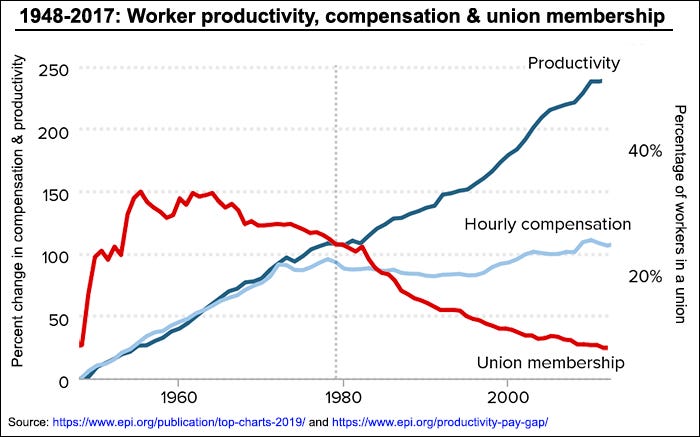
Over the course of the first 100 days, appropriate attention has been paid to Trump’s attacks on the judiciary, law firms, universities, philanthropy, non-profit groups and the media as dangerous in their own right, but more importantly as essential elements of authoritarian consolidationYet almost no one has mentioned the attacks on an equally proven constraint on oligarchy and autocracy: unions. Trump and Elon Musk’s destructive ransacking of our government should remind us of what previous generations of Americans understood intuitively: that “we may have democracy, or we may have wealth concentrated in the hands of a few, but we cannot have both,” as Supreme Court Justice Louis Brandeis put it. Like other attacks on civil society, the Trump regime’s attacks on unions and working people do not just injure those directly targeted, but all of us, as the labor movement is one of the most essential bulwarks against authoritarianism.

I’ve covered the indispensable role of unions in creating and protecting democracy and freedom in earlier Weekend Readings (Oligarchs Understand Power. Do We?As Go Unions, So Goes AmericaMore Than the Weekend: Unions, the Past and the Future of Democracy, and Then they came for the trade unionists).

If we all have a stake in unions as bulwarks against authoritarianism whether we belong to one or not, the same is true because of how unions foster shared prosperity and a healthy society, which I elaborate on here and here. In that regard, it is crucial to recognize the Trump actions as coming from the same playbook as Reagan’s decisive firing of over 11,000 striking air traffic controllers. It was more than punitive—it communicated a clear, aggressive stance against unions nationwide. The immediate aftermath saw corporate America follow Reagan’s lead, significantly increasing anti-union activities and adopting overt union-busting strategies.1 Reagan further entrenched anti-unionism by reshaping the NLRB into a body less protective of labor rights, reversing precedents that had previously safeguarded union activities.2

As it did then, today’s federal war on working people comes at a key inflection point. Then it was the rush to globalization, coupled with financialization and deindustrialization. Now it is the imminent transition to artificial intelligence in the workplace. Musk’s firings are providing a new playbook for that transition—fire everyone so as to be able to start from scratch with AI with as little friction from a legacy workforce as possible. And, although not the topic today, it’s important to note here that with respect to DOGE cleaning house to make way for AI, it’s also cleaning house to make way for even more of the government to be privatized—providing a vast market for the tech companies’ AI products and services. Although this future is not certain, it seems to be Musk’s plan: first trash the government, then when the government fails, privatize.

Today, I’ll lay out some of the most egregious actions taken by the Trump regime in the first 100 days to attack unions and working people in both the public and private sectors. Much of this is based on indispensable research by the Economic Policy Institute and its just released 100 Days, 100 Ways Trump Hurt Workers. (For more great reports like this, you can subscribe to EPI here.)

Then I’ll document the robust pushback unions are mounting against the Trump regime’s war on working people in the courts. Unions have also been in the forefront of mobilizing public action, most notably the AFL-CIO’s Department of People Who Work for a Living, which in addition to leading and participating in protests3, has organized town halls across the country.4 AFL-CIO President Liz Shuler declared:

The labor movement is not about to let Trump and an unelected billionaire destroy what we’ve fought for generations to build. We will fight this outrageous attack on our members with every fiber of our collective being.

And, significantly, even sectors mistakenly thought to be pro-Trump like the Building Trades powerfully responded to Trump’s executive order eviscerating collective bargaining for federal workers:

This executive order is an unprecedented assault on worker freedom and a direct attack on those fundamental rights. Americans know that patriotic blue-collar workers built this country, not billionaires. They also know that one of the last best chances to make it to the middle class is collective bargaining. NABTU and our affiliated unions will stand shoulder to shoulder with the entire labor movement to fight this head-on — and we will not back down.

Continue reading Are Working People Meeting the Moment? Prepare for Battle

‘Fight Like Hell:’ Pittsburgh Letter Carriers Organize Rally To Save Usps Amid Trump Proposed Cuts, Privatizatio

By Caitlyn Scott 

WTAE

Mar 23, 2025 –PITTSBURGH —Letter carriers in Pittsburgh participated in a nationwide rally Sunday in an effort to protect the United States Postal Service from what they say President Donald Trump’s proposed budget cuts and privatization could do to the organization and its workers.

The rally was held by the local union of Branch 84 alongside the National Association of Letter Carriers in the North Shore, which represents 2,800 carries in Allegheny, Washington, and Beaver counties.

“We’re here to gather together to say no,” Paul Rozzi, president of the Pennsylvania State Association of Letter Carriers, told Pittsburgh’s Action News 4. “We don’t want any of those things to happen. It doesn’t only affect us, but it affects every patron.”

The rallies across the nation come as Trump proposed moving the U.S. Postal Service under the control of the Commerce Department in what would be an executive branch takeover of the agency, which has operated as an independent entity since 1970.

Trump made the remarks at the swearing-in of Commerce Secretary Howard Lutnick. He called the move a way to stop losses at the $78 billion-a-year agency, which has struggled to balance the books with the decline of first-class mail.

“We hope that the Trump administration hears this message and we’re not at war, but we’re prepared to fight like hell,” president of Branch 84 National Association of Letter Carriers of Pittsburgh Ted Lee said.

USPS says about 640,000 people would be affected by these changes if passed.

I’m a Rust Belt Democrat From a Swing District. Anti-Tariff Absolutism Is a Mistake.

A black-and-white photograph of a car’s rearview mirror showing an industrial plant.
Credit…Eli Reed/Magnum Photos

By Chris Deluzio

Mr. Deluzio represents Pennsylvania’s 17th Congressional District.

The New York Times Op-Ed

March 7, 2025 – Democrats have wasted no time rejecting President Trump’s tariffs as “damaging” and “unnecessary.” My colleagues have lampooned them as “irresponsible,” “bad economics” and purely a tax on consumers. This anti-tariff absolutism is a mistake.

I’m a Rust Belt Democrat from a swing district in Western Pennsylvania — where lousy trade deals like NAFTA stripped us for parts.

Many of my constituents support smart tariffs, particularly ones that target China, and so do I. Watching my colleagues on the Hill, it’s clear we’re missing the mark. Democrats need to break free from the wrong-for-decades zombie horde of neoliberal economists who think tariffs are always bad.

Mr. Trump’s tariff approach has been chaotic and inconsistent. There’s no doubt about that. But the answer isn’t to condemn tariffs across the board. That risks putting the Democrats even further out of touch with the hard-working people who used to be the lifeblood of the party — people like my constituents.

Instead, Democrats should embrace tariffs as one component of a broader industrial strategy to revitalize American manufacturing and make whole communities that have been hollowed out by decades of bad trade policy. This isn’t just about making the economy work for more Americans; it’s also about earning back the trust and faith of the people we need to win elections and who ought to be at the heart of the Democratic Party.

Since the 1990s, presidents from both parties pushed trade agreements that were great for corporate bosses and their Wall Street overlords, but a disaster for districts like mine. American companies offshored production to take advantage of cheap labor in countries like Mexico, which for decades have crushed independent unions to keep wages rock bottom. Later, firms shifted production to China and Vietnam, which are often called out for employing beggar-thy-neighbor tactics like wage suppression, enormous subsidies and currency manipulation to jack up their exports.

For too long, we absorbed these unfair imports and created a chronic trade deficit that deindustrialized our nation and fueled income inequality. In 2004, the grandfather of modern trade economics, Nobel Laureate Paul Samuelson, revealed how offshoring could cost American workers more in relative wages than they gained from cheaper imported goods, making the current trade regime a bad deal for most Americans.

Tariffs are one of a few tools that can break this cycle: They force mercantilist countries to increase their domestic consumption of what they produce because they can no longer dump it in the United States. Increasingly, policymakers — of all political stripes — recognize that tariffs can help protect industries that are key to our economic and national security, boost American production and wages, and safeguard workers’ rights as well as our air and water by incentivizing firms to raise their labor and environmental standards.

If you oppose all tariffs, you are essentially signaling that you are comfortable with exploited foreign workers making your stuff at the expense of American workers. I am not and neither are most voters. Many polls show that Americans — especially the three-fifths without college degrees — support tariffs in part, economists have suggested, because communities harmed by global competition view them “as a sign of political solidarity.” The Biden administration, to its credit, tripled tariffs on Chinese steel and aluminum imports. So, why is the Democrats’ only message on tariffs that they raise prices? That was the play during the 2024 election and it flopped. Just last month, a CBS poll found that a majority of Americans one, thought Mr. Trump was not focused enough on lowering prices, two, believed that tariffs could increase prices and three, still wanted tariffs on China.

Rather than reflexively condemning all tariffs, Democrats should be highlighting how Mr. Trump’s scattershot threats, unanchored to any real industrial strategy, will not deliver on the goals of rebuilding American manufacturing, raising wages or rebalancing trade.

For one thing, tariffs are effective only when used in a predictable and stable way — and the Trump administration’s approach has been anything but. On Feb. 1, Mr. Trump announced he was imposing new 10 percent tariffs on China and fixing part of a trade scam that allows four million packages to enter the United States daily without facing tariffs, taxes or meaningful inspection — simply because they’re labeled “low value.” Not only does this “de minimis” loophole undermine U.S. producers and retailers, but traffickers also often exploit it to sneak in deadly fentanyl-laced pills and fentanyl precursor chemicals. Days after his announcement, Mr. Trump flip-flopped and reopened the loophole. He raised China tariffs another 10 percent on March 4 — good! But still, the loophole means billions in Chinese imports can evade tariffs and inspections.

Mr. Trump’s chaotic tariff two-step — imposing, delaying, threatening and then again imposing tariffs, including on allies like Canada with whom we mainly have balanced trade — is bad business for America. Entrepreneurs ready to invest in production here sit on the sidelines, wondering where the tariff roller coaster will stop. (Continued)

Questions One PA brings into 2025 and 2026

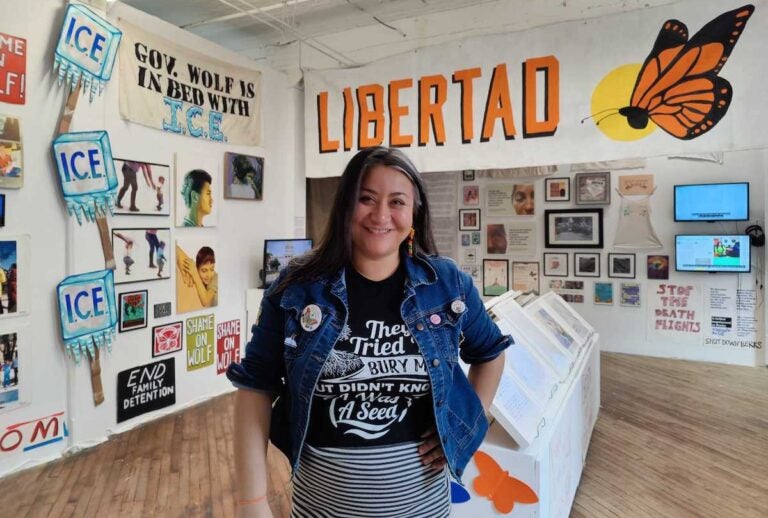
Photo: Jasmine Rivera was an organizer with the Shut Down Berks Coalition, and curated the exhibition “Queremos Justicia: Cómo cerramos Berks,” at the Vox Populi gallery in Philadelphia in 2023. (Peter Crimmins/WHYY)

By Jeffrey Lichtenstein

One PA

Jan 7, 2025 – We’re holding several big questions as we move into 2025 that we hope to learn and struggle through together with our funding partners. All of our work, especially our organizing, advocacy, and outreach efforts, will be working through these questions.

 Quality vs Quantity of Doors

Where and when can we initiate and join conversations about the quality of field work rather than simply the quantity of door knock and phone call attempts? The efficacy of canvassing in low-salience elections is statistically unquestionable but in presidential election cycles there is suddenly a great amount of noise. Some of this noise is the result of large-scale vended field programs with weak quality control practices or very low contact rates.

What could it look like to move toward an eco-system wide model for field work that prioritizes the number and quality of conversations, volunteers recruited, and leaders trained? One PA prides itself on high contact rates and rigorous quality control but we still have much to learn. We hope to share and leverage best practices across locally rooted partners and begin to shift the paradigm around field work from quantity alone, to quality and quantity.

Making organizing power more legible

Even the strongest most rigorous electoral field program faces structural challenges with management, hiring and training under conditions of limited funding and time. These efforts also, by their nature, are demobilized and dismantled after an election, even when we know there is another election just around the corner, not to mention countless other opportunities for voters to flex their voice in government and strengthen their civic participation. Political and civic organizing, unlike electoral campaign mobilizations, grow rather than diminish in efficacy and power over time. What would it look like to quantify, validate, resource and scale the civic power of organizing? One PA was successful in 2024 in using every door conversation to begin an organizing pathway. We identified 33,000 hot leads to join One PA. We’re proud of this work, but we have real areas of growth in learning how to maximize the conversion between hot leads and new volunteers. 

Dimensions and Cost of Building Precinct Based Structure

The term ‘organizing’ has been stretched in recent years to mean all manner of engagement. At One PA we are working with multiple battle-tested organizing models in an attempt to integrate the best practices of each in a way that can be quantified, studied and validated at every stage using contemporary data tools and tech. Our model combines dues-based membership, structure based organizing units, systematic leadership development, polarizing campaigns and experimentation. We are proud of our work in 2024 to launch a guardians of democracy and elections captains program.

In the year ahead we plan to scale the program by a factor of five, and are holding questions about what level of resource and training this will require at each level of the organizing structure. Independent Voice It is clear our movement must get upstream of elections in the battle to make meaning out of our communities’ lived realities. By the time candidates win their primaries, the ability to shape what that election will be about is out of the hands of most people except the elite few with an extraordinary amount of influence on the candidates. We are asking ourselves the question: what capacities and practices do we need as a movement to help frame the questions in front of people long before an election?

How can we roll into a cycle with voters broadly knowing already that housing is too high because of slumlords and rollbacks on government investment, not because of immigrants? We know part of the answer is an independent voice for Black and multi-racial working class communities, to help compensate for brand weakness in the Democratic party, to ensure voters feel they are heard, and to guarantee a more healthy mix of ideas about what it will take to fix this country. How can we build the power and independence of this voice in a way that our more traditional and conservative allies won’t attempt to smother in its cradle?

Winning the Internet

We’re also holding questions about how to respond to the reality that the Internet is increasingly becoming a place our communities rely on for social and political queues. Cynical or hateful voices have a head start in offering narrative frames in the digital space. We are holding questions about what it looks like to bring an organizing approach and significant investment in mass communications to organize our base in digital space, win over leaders and taste makers in non-legacy media, and contest for narrative primacy on the internet.

Training to Win next quarter and next decade

Training is critical for nearly every aspect of our plan, especially the proposition that we grow in capacity and power over time, and the responsibility to rebuild a majority. We are clear that we must level up the rigor and scale of our training program, and sit with the question about what kind of training school and content will meet the need. We know curricula must include a breakdown of the structures and histories of power and resistance; song, poetry and other forms  of culture that bring people together at an emotional register; practical application of ideas through repetition of organizing, storytelling, writing and other skill practice. We’re sitting with the question: how can all those pieces best fit together and what kind of resourcing will it take to hold a training program sustainably that can meet these goals?

A renewed tech advantage

We’re also holding a question about technology. For about 20 years, democratic institutions and networks held an advantage in the use of tech in politics – the VAN, click-to-call tools, ActBlue and early P2P text platforms are all examples. But today republican networks and institutions have caught up or surpassed. What kind of tools allow us to easily give an inspired volunteer a list of the 50 closest target people to them, to register them to vote, get them to sign a petition, or have a persuasive conversation about candidates? How do we move away from site-based voter registration only, and use contemporary data to scale door to door registration programs? How do we use new models, like the Steven Phillips “New Majority Index,” to help us assess opportunities and threats?

Cities: Most of our base lives in cities.

Cities are the places where the housing and homelessness crises are worst. Cities are some of the places with the highest income inequality and violent crime. It’s difficult to live in cities unless you’re rich. There is a relationship between our bases’ weakened sense of political agency and their perception of the corruption of government on one hand, and the way our cities are being run on the other. What does it look like to have an intentional plan to broadcast positive accountability messaging when city leaders accomplish something that improves peoples lives? How do we combine that with real resourcing for primary campaigns to support candidates who are committed to using the government to deliver material gains for working class people.’ And what does it look like to add real resourcing for advocacy and pressure campaigns to encourage local leaders on the fence to move toward policies that will demonstrate in real terms how democratic governance is good for people?

Alignment

Last, we’re holding a question about how to build alignment between progressive base-building organizations to have sufficient power to help win the fights that each of us aren’t strong enough to win on our own. We’re proud of the work that we’ve done to build unity through the cycle of the last several races with several partners, especially PA United , Working Families Party , APIPA, Make The Road, 215 People’s Alliance and UniteHERE. How do we strengthen and build on these existing relationships?

On Why the USW, Biden and Trump are Right about the Nippon/USSteel Ripoff

By Ike Gittlen

https://ikegittlen.substack.com/

For months the proposed sale of USSteel to Nippon Steel has been front page news. The Committee on Foreign Investments in the United States (CFIUS), that reviews the national security implications of these global transactions is reportedly at an impasse and unable to come to a determination.

The reality is that what CFIUS decides (or doesn’t) is irrelevant. Both the incumbent President and the President-elect have said they will not approve the deal. It’s slowly dawning on people that this deal isn’t likely to happen.

We shouldn’t be surprised. Opposing the Nippon/USSteel deal is the logical response to all that we have learned about the steel industry, the “free trade” model of global trade, the importance of maintaining domestic control over critical supply chains and how the big money vultures strip-mine our stable industrial/manufacturing enterprises. It isn’t, as Nippon/USSteel would like us to believe, something that must happen or USSteel will collapse. Once this bad deal is gone, we know there are a number of options to retain and enhance USSteel’s assets.

To understand what’s happening we have to start with the global steel overcapacity. The OECD reports a global steel overcapacity exceeding 500 million metric tons, with some estimates reaching as high as 630 million metric tons. This has nations with overcapacity (China in the lead) looking for places to dump their steel production. Our nation is a lucrative place to offload unneeded steel. Interestingly, Nippon is reportedly looking to do deals in other nations with lucrative steel consumption, as the USSteel deal falters.

It’s fantasy to believe that once Nippon owns USSteel it won’t use it to move its overcapacity here. Simply look at the cases that the USW and the Steel Industry have won at the International Trade Commission, to get a flavor of how blatant other nations have violated our trade laws to gain access our steel market. The failure of Nippon to offer credible and enforceable commitments to continue American domestic production, should convince us of their real intent. This is the heart of the national security concern. That if Nippon is allowed to own such a large part of American steel capacity, the will result will be steel shutdowns here and less ability to supply our own needs of this critical economic sector.

UPMC Western Psychiatric Hospital Nurses ‘win Historic Union Contract, ‘demand Raised Standards For All Nurses

By Caitlyn Scott

WTAE

PITTSBURGH — Nurses at UPMC Western Psychiatric Hospital said they have “won a historic union contract” following months of negotiations with UPMC over concerns of closures and rising mental health cases.

In a statement Sunday, the nurses’ union said the contract agreement will guarantee a “first-ever guaranteed wage rate above $40 for nurses with a Bachelor of Nursing anywhere in UPMC,” which will be an incentive towards “improving staffing so beds that were previously closed can reopen.”

“Together, we have proven that when UPMC nurses unite, we can achieve historic improvements for our patients, our families, our community and our profession,” Chris Hunter, who has been a nurse at Western Psych for eight years, said in the statement. “Even though we’re a smaller hospital and UPMC has deprioritized us for years, we were able to hold executives accountable and create groundbreaking progress.”

The contract comes weeks after the nurses’ union unanimously authorized a strike after concerns over UPMC’s closure of beds, understaffing, and policy changes.

“The historic contract invests in recruitment, retention, and respect to ensure quality care and address the growing mental health crisis,” the statement read.

Nurses at UPMC Western Psychiatric Hospital had been negotiating a new union contract with UPMC since Aug. 1 after their previous contract expired in September.

“The stunning victory follows on the heels of a rally and unanimous strike vote, and includes groundbreaking pay raises that are unprecedented within the UPMC system,” the statement said Sunday.

Pennsylvania Democrats Had a Good Week at the DNC. What’s Next?

 U.S. Rep. Summer Lee (D-12th District) speaks to the Pennsylvania delegates at the Democratic National Convention in Chicago Aug. 22, 2024 (Capital-Star photo by Kim Lyons)


Delegates and candidates turn to the work of keeping the battleground state blue


By: Kim Lyons

Penn-Capital Star

August 25, 2024 – CHICAGO — Pennsylvania was the most popular kid in the class at the 2024 Democratic National Convention, and the battleground state and its 19 electoral votes were well represented in Chicago and on the convention’s nightly broadcasts. Each night featured a speaker from the Keystone State, with Lt. Gov. Austin Davis on Monday; state Rep. Malcolm Kenyatta on Tuesday; Gov. Josh Shapiro on Wednesday and U.S. Sen. Bob Casey on Thursday

Shapiro was unquestionably the biggest Pennsylvania presence at the DNC, due in part to his status as a runner-up to be presidential nominee Vice President Kamala Harris’ running mate. He was constantly booked during the week, speaking at numerous state delegations’ breakfasts, attracting the ire of GOP nominee former President Donald Trump, and appearing regularly on cable news channels. 

Project 2025 played a key role at the convention, as Democrats continued to try to link the conservative policy plan to reshape the federal government and increase presidential authority with Trump.

Kenyatta, a candidate for state Auditor General held the giant Project 2025 book on stage Tuesday night,, and told the audience it was a “radical plan to drag us backwards, bankrupt the middle class and raise prices on working families like yours and mine.”

Trump has tried to distance himself from Project 2025 but several members of his administration were involved with helping to craft it. 

“It’s a big, heavy book full of bad ideas, and it was one of these moments where we’re able to really get people to understand with the visual how serious Trump and this administration are about doubling down on his flawed theory of the case,” Kenyatta told the Capital-Star on the final day of the convention. 

Our vote is the highest demonstration of the collective power we have… The purpose of this moment is to use our collective power to elect somebody who gives a damn about us, and then to work side by side with her to help implement the things that she’s talking about.

He added Project 2025 should serve as a warning to Democrats about what they believe a second Trump term would look like.

 “When Trump burst onto the political scene, he did so with the thesis that ‘America sucks,’ and that it sucks in large part because our neighbors, the people in our community, people we don’t know — they’re somehow a part of bringing America down,” Kenyatta said, “and the only way we fix it is if we give him all the power.” 

While Trump’s first term saw the former president “flailing around,” Kenyatta said, the architects of Project 2025 mapped out a plan for how to reach some of the goals of the far-right wing of the party, such as a national abortion ban and abolishing the U.S. Department of Education.

Kenyatta added he doesn’t believe in the political concept of giving all the power to one person to fix everything. 

“Our vote is the highest demonstration of the collective power we have,” he said. “If we elect Kamala Harris in November and then say, ‘OK, we’ll see you in four years at the next convention. Hope you fix all the problems!’ then we’ve missed the thread. The purpose of this moment is to use our collective power to elect somebody who gives a damn about us, and then to work side by side with her to help implement the things that she’s talking about.”

At the final Pennsylvania delegates’ breakfast on Thursday, U.S. Rep. Summer Lee (D-12th District) urged the battleground state delegates to keep up the convention’s momentum. 

“We’re here honing our tools so that we can go out and do the very hard work, not for Kamala Harris. We’re not doing hard work for Summer Lee or any of my colleagues,” Lee said, but rather for marginalized and vulnerable people. “Think about that person whose name is in that book over the hundreds and hundreds of pages of Project 2025, who do we see there that we need to make sure is not touched by the evil and the horrors that they have lined up and ready for them.”

Davis, Pennsylvania’s youngest and first-ever Black lieutenant governor, addressed the convention on Monday night and spoke about the importance of building bridges. He appeared on stage with Wisconsin Lt. Gov. Sarah Rodriguez, Harris County, Texas Executive Lena Hidalgo, and California Lt. Gov. Eleni Kounalakis, all of whom shared stories about how Harris had made an impact on their communities. 

“I grew up with working class parents in a small steel town in southwestern Pennsylvania, and to have the opportunity to speak on a national stage like that was incredibly humbling,” Davis told the Capital-Star.  “It was just an example of how someone can live the American dream,  so I hope folks who saw me saw that America should be a place where every person has that same opportunity.”

https://penncapital-star.com/briefs/pennsylvania-lt-gov-austin-davis-speaks-at-dnc-on-importance-of-building-bridges/embed/#?secret=dvE4HAFAjU#?secret=1U3QjmQcR8

Davis said the question he heard most often over the course of the convention was whether Democrats can win Pennsylvania. “And I tell them, absolutely, we just have to keep showing up everywhere, competing in places that sometimes it’s not easy to be a Democrat,” he said. 

Asked if there were “red” areas of the state he saw as possible to flip blue, he pointed to central Pennsylvania as having the most potential, particularly the race in the 10th Congressional District between former WGAL anchor Janelle Stelson and Republican U.S. Rep. Scott Perry. 

“I think we have a great candidate in Janelle Stelson,” he said. “I think there’s a lot of energy also with [state Rep.] Patty Kim running for state Senate. So I think Dauphin, Lancaster, Cumberland — an area Governor Shapiro won when we were running on the ballot.”

Davis said not everyone was completely impressed with his star turn on television, however. His daughter Harper, whose 1st birthday is next month, was asleep by the time he appeared Monday night. “We’re going to replay it for her but she doesn’t care,” he said. “She only cares when I FaceTime her and she’s like, ‘Daddy, when are you coming home?’” 

Hopewell Teachers Rally For New Contract

Amid contract negotiations, Hopewell Area School District teachers flood school board meeting

BY JENNIFER BORRASSO

MARCH 28, 2023

CBS PITTSBURGH

HOPEWELL, Pa. (KDKA) — A group of teachers crashed the Hopewell Area School Board meeting on Tuesday to put pressure on the board.

The president of the teachers union said teachers have gone without a contract since July 1, 2022. About 200 people showed up Tuesday to the meeting, including parents.

“I want to make sure they know they are valued and thank them for what they are doing for our students,” one parent said.

“All I’m asking for is our teachers get a fair contract. We need to do whatever it is to keep our kids in school,” another parent said.

Hopewell Education Association Union President Jeffrey Homziak said so far there have been 15 negotiating sessions since November 2020 but no deal has been reached.

Homziak said they want a five-year deal and a meaningful pay increase, more than the 2 percent increase the district is offering. They also don’t want to pay more for their health care and don’t want to work longer hours and not be compensated, Homziak added.

“Salary and health care are the biggest sticking points for any district,” Homziak said. “They want an extended school year and more time throughout the week for us to work without giving us salary.”

School board president Danny Santia talked to KDKA-TV after the meeting.

“Be fair to the community, be fair to the taxpayers and the teachers,” Santia said. “I want to give them a fair contract, but it has to be fair to the whole community.”

Between 1,800 and 2,000 students attend schools in the district.

KDKA-TV’s Jennifer Borrasso: “Are these teachers prepared to strike?”

Homziak: If it comes down to that. … We don’t want to do that to our students. We want to be in the classroom.”

There are three more negotiating meetings scheduled, with both sides back at the bargaining table on Thursday.

Beaver Falls Native Linwood Alford Has Always Been ‘Called to Serve’

By Timothy Cox
Beaver County Times

BEAVER FALLS, March 7, 2022 — For older generations in the city, the name Linwood Alford has been a constant for several years.

As a Google subject, his name quickly arises as the childhood friend of NFL Hall of Fame quarterback Joe Willie Namath.

Boating buddies Linwood Alford (Left) and Joe Namath. The Beaver Falls natives have known each other since childhood. Alford is best known outside Beaver County for his friendship with Namath, but county residents tout his service to his community.


Now, The Times provides Alford a chance to recite his own story – including his early years, in connection with the world-renowned professional athlete.

Service to the community


As a career, for many years, Alford has focused his energies in support of those who may have difficulties helping themselves. A self-described “union man” and proud Democrat, Alford initially worked in the construction industry before serving on boards while committing his life to the continuous improvement of Beaver Countians, in all phases, regardless of ethnicity, creed or culture.

Linwood Alford as member of board of directors for the Larry Bruno Foundation Pictured are, first row, l-r, Ron Main, Artie DeSisto; second row, Linwood Alford, Pete Pietrandrea, Ed DeRose, Bob Ricci; and third row, Jim Carbone, Judge Richard Mancini and Steve Higgins.
In recent years, Alford has served as vice president of Lincoln Park (Midland Innovation Technology) Charter School; vice president of Beaver County Democratic Board; director of Civil Rights Labor Council; Job Training Board and (I-DAC) aka Individual Diversity Awareness Council; and as an official with the Beaver-Lawrence Central Labor Council.

He’s also a member of the Aliquippa Council of Men and Fathers.

In addition to Namath, Linwood has several local notables of which he considers close friends and associates including Senior Beaver County Judge Richard Mancini, Ambridge attorney Steve Kocherzat, area broadcast notable Chris Shovlin, Beaver Valley NAACP President Mtume Imani and another lifelong friend, Victor Freddie Mannerino.

“I’ve known him for many years – but respected him, even before I knew him,” Mancini said.

If it pleases the court


“I’ve always called Linwood a gem for our local community. Regardless of creed, color or religion – he’s just been a good person. Of course, many people know him as Joe Namath’s original friend, but there’s so much more to him than that. It goes back to his upbringing. Real Beaver Falls residents know,” added Mancini, 68, himself a Beaver Falls native.

In his spare time, Alford works as a tip staffer at the Beaver County Courthouse, under the auspices of Mancini. He describes his courtroom role as similar to a bailiff, adding that he often introduces the judge to courtroom attendees.

“He’s a natural in this position,” Mancini said. “Linwood is a people person and it takes someone with personality in order to be effective in this role.”

Sixth Street Brothers’


Linwood was born Jan. 5, 1944 – the youngest of eight siblings to Clifford and Mary Lee Coleman Alford.

Having recently turned 78, Alford admits he’s humbled and blessed to have maintained a sharp memory, enough to still recall significant past episodes of his life.

Having joined Tabernacle Baptist Church at age 13, Alford said he remains forever thankful that his parents provided him with a spiritual foundation that has kept him in safe, protective environments “especially during his 14-month” U.S. Army stint in Vietnam.

Continue reading Beaver Falls Native Linwood Alford Has Always Been ‘Called to Serve’