Western PA Labor Lawyer Checks Out Election in Venezuela

Robin Alexander, second from right

In Venezuela for the Election, I Learned a Lesson in Democracy

By Robin Alexander
Beaver County Blue via UE News

I had the opportunity to accompany* the presidential election in Venezuela as part of a delegation of 245 members of government, election commissions, journalists, professors, judges and representatives of women’s, human rights, and other NGOs from across the world.** As our election approaches and I have watched with outrage the efforts by the Republican Party to limit access and the right to vote here in Pennsylvania and a variety of other states, I find myself wishing that our system here in the US was as fair and democratic as that in Venezuela.

Finger dipped in ink to show that you voted Elections are held on Sundays to make it easier for working people to vote. A major outreach effort has resulted in the registration of 96.5% of eligible voters. Although voting is not compulsory, 81% of the population voted in the last election. Sophisticated technology is used to eliminate all possibilities of fraud or manipulation of data. In addition, the voting machines issue a receipt that can be viewed by the voter to confirm that his or her vote has been properly registered. These papers are then placed by the voters in more traditional ballot boxes and, after the polls close, an astounding 54% of those boxes are counted manually to ensure that the final tape from the voting machine is correct.

The election was hard fought, but Hugo Chávez was re-elected with an 11% margin and the process was so unquestionably democratic that the opposition candidate, Henrique Capriles, conceded defeat gracefully, stating “The will of the people is sacred.”

Continue reading Western PA Labor Lawyer Checks Out Election in Venezuela

Exporting Gas And Oil Will Not Erase The Trade Deficit

Western PA as a Case in Point

US trade deficit 2012

By EMS News
Beaver County Blue via Culture of Life News

The US continues the program of selling commodity raw materials while importing manufactured goods.  This futile trade deal is also not working because always, the value-added labor that goes into production is lost when a country trades this way.  If a country has a small population and lots of raw materials, it can get rich doing this but not a country with 350 million people.  Even Saudi Arabia, due to making birth control illegal, has a rapidly growing population that is eating into oil export values and soon will erase it entirely.  Japan, with half the population of the US, is seeing its trade decline, too.  While importing energy due to Fukushima.

The trade deficit was hardly mentioned during the last election.  It is as if it doesn’t exist.  Even though it is the core problem within our economy, one that has been papered over, literally, by the US printing trillions of extra dollars.  Inflation has been kept down due entirely to trade partners holding excess US dollars in FOREX accounts overseas.  But the US is desperate to generate some funds to cover the river of red ink flowing through our economy so of course, we do this by exporting lumber, gasoline, gas and oil as well as other primitive commodity products.

Naturally, this doesn’t plug the giant hole in our economy! Nonetheless, DC pundits and politicians tell us gravely, we must do this more and more and eventually it will fix things. Here is the latest delusional story from DC misleading people about the trade deficit: Natural gas exports: A boon to the economy – The Washington Post

Continue reading Exporting Gas And Oil Will Not Erase The Trade Deficit

The Icelandic Success Story

The Icelandic Success Story

December 8, 2012

http://azizonomics.com/2012/12/08/the-icelandic-success-story/

Emotionally, I love Iceland’s financial policies since the crash of 2008:

Iceland

Iceland went after the people who caused the crisis — the bankers who created and sold the junk products — and tried to shield the general population.

But what Iceland did is not just emotionally satisfying. Iceland is recovering, while the rest of the Western world — which bailed out the bankers and left the general population to pay for the bankers’ excess — is not.

Bloomberg reports:

Few countries blew up more spectacularly than Iceland in the 2008 financial crisis. The local stock market plunged 90 percent; unemployment rose ninefold; inflation shot to more than 18 percent; the country’s biggest banks all failed.

This was no post-Lehman Brothers recession: It was a depression.

Since then, Iceland has turned in a pretty impressive performance. It has repaid International Monetary Fund rescue loans ahead of schedule. Growth this year will be about 2.5 percent, better than most developed economies. Unemployment has fallen by half. In February, Fitch Ratings restored the country’s investment-grade status, approvingly citing its “unorthodox crisis policy response.”

So what exactly did Iceland do?

First, they create an aid package for homeowners:

To homeowners with negative equity, the country offered write-offs that would wipe out debt above 110 percent of the property value. The government also provided means-tested subsidies to reduce mortgage-interest expenses: Those with lower earnings, less home equity and children were granted the most generous support.

Then, they redenominated foreign currency debt into devalued krone, effectively giving creditors a big haircut:

In June 2010, the nation’s Supreme Court gave debtors another break: Bank loans that were indexed to foreign currencies were declared illegal. Because the Icelandic krona plunged 80 percent during the crisis, the cost of repaying foreign debt more than doubled. The ruling let consumers repay the banks as if the loans were in krona.

These policies helped consumers erase debt equal to 13 percent of Iceland’s $14 billion economy. Now, consumers have money to spend on other things. It is no accident that the IMF, which granted Iceland loans without imposing its usual austerity strictures, says the recovery is driven by domestic demand.

Continue reading The Icelandic Success Story

PA Senator Toomey: Cut Medicare and Medicaid

by Randy Shannon

Pennsylvania’s Pat Toomey says cut Medicare and Medicaid. May his first term be his last term. 2016 RIP.

Toomey modifies his plan to include tax hikes on rich

GOP senator wants Democrats to agree to spending cuts, too
December 4, 2012 12:13 am

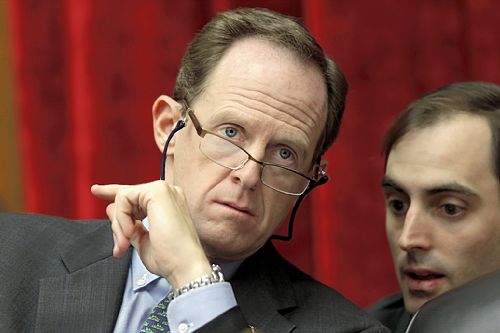
Sen. Pat Toomey
By Tracie Mauriello / Post-Gazette Washington Bureau

WASHINGTON — Tax hikes on the wealthy won’t solve the impending fiscal crisis, said Sen. Pat Toomey, R-Pa., but he’s willing to go there if it will get Democrats to agree to cut spending.

“This is a spending problem, a structural spending problem, and that’s what needs to be fixed,” he told Pennsylvania reporters on a conference call Monday. “But I acknowledge that elections have consequences and the president is fixed on raising taxes.”

President Barack Obama has been touting a plan that would raise taxes on families earning more than $250,000 a year.

The aim is to avoid the so-called “fiscal cliff” or $600 billion worth of tax hikes and spending cuts that, taken together, could devastate the national economy and send the country back into a recession.

Republicans like Mr. Toomey have reluctantly agreed to increase taxes on the wealthiest Americans, but they won’t entertain a separate vote on that measure alone. Rather they want the increase to be part of a sweeping package that also includes spending cuts.

Continue reading PA Senator Toomey: Cut Medicare and Medicaid

AFL-CIO and Senators Oppose Cuts

AFL-CIO Now


Elected Officials and President Trumka Reject Benefit Cuts to Social Security, Medicare and Medicaid

11/15/2012

Kenneth Quinnell

A group of Democratic senators is circulating a letter opposing benefit cuts to programs like Social Security, Medicare and Medicaid and saying that the Bush tax cuts for the wealthy should expire at the end of the year. The letter also calls for increasing revenue, cuts to defense and the closing of tax loopholes for the wealthy and corporations. The letter was drafted by Sen. Jay Rockefeller (W.Va.) and Sen. Tom Harkin (Iowa). The Democratic senators are hoping to get 30 senators to sign the letter.

The letter reads:

We urge you to reject changes to Medicaid, Medicare and Social Security that would cut benefits, shift costs to states, alter the structure of these critical programs or force vulnerable populations to bear the burden of deficit-reduction efforts. Each of these programs is a vital lifeline to the middle class.

Democratic National Committee Chair Debbie Wasserman Schultz also said that we don’t need to cut Social Security or Medicare benefits. She also said that raising the eligibility age would be a benefit cut and should be avoided.

AFL-CIO President Richard Trumka echoed the comments from the Democrats in the House and Senate, rejecting the idea that we even face a “fiscal cliff”:

The most frustrating thing about Washington, D.C., is the way political insiders create a self-reinforcing reality out of nonsense. Take what the media are calling the “fiscal cliff.” There is no fiscal cliff! What we’re facing is an obstacle course within a manufactured crisis that was hastily thrown together in response to inflated rhetoric about our federal deficit.

But all the deficit chatter has distracted us from our real crisis—the immediate crisis of 23 million unemployed or underemployed workers.

It’s time to protect Social Security benefits. It’s time to protect Medicare and Medicaid benefits. And it’s time to raise taxes for the richest 2%, to stop tax breaks that encourage companies to send jobs offshore and to close loopholes that allow some people and corporations to hide income in offshore tax havens.

Voter Suppression Contested in PA Commonwealth Court

Pa. voter ID law far from a done deal

November 14, 2012 12:11 am
  • Early voters leave the Green Tree Municipal Building after casting their ballot.
Print Email Read Later
By Timothy McNulty / Pittsburgh Post-Gazette

While the presidential race is over, Pennsylvania’s voter identification law and the fights over it live on.

The photo ID requirements suspended for last week’s election remain in place for the state’s May 21 primary, when Pittsburgh’s mayor and other local and judicial offices will be on the ballot, and legal challenges to the ID law remain on the docket, too. Commonwealth Court Judge Robert Simpson, who temporarily stayed enforcement of the requirements Oct. 2, will hold a status conference Dec. 13 on efforts to permanently block them.

“Our position is this law is not constitutional and cannot be constitutional without some legislative fixes,” said Witold Walczak, legal director of the American Civil Liberties Union of Pennsylvania.

Wall Street Seeks to Unravel Safety Net

Wall Street Uses Third Way to Lead Its Assault on Social Security

Posted: 11/13/2012 8:51 am
William K. Black

Assoc. Professor, Univ. of Missouri, Kansas City; Sr. regulator during S&L debacle

Third Way, lobbyists for and from Wall Street who are leading the effort to enrich Wall Street by privatizing Social Security, was created by Wall Street to fool some of the people all of the time. I have written previously to expose their fictional claims to be a moderate or liberal Democratic group.

Eric Lautner documented Wall Street’s effort to become even wealthier by privatizing Social Security in articles and his recent book (The People’s Pension: The Struggle to Defend Social Security Since Reagan (AK Press)).

I showed that Third Way makes itself useful by providing a faux “liberal” or “moderate” “Democratic” quote machine that can be used to discredit Democrats and Democratic policies such as the safety net. I gave examples of how Third Way gave aid and comfort to the effort to defeat Elizabeth Warren and the effort to unravel the safety net. Third Way continues to prove that you can fool some of the people all of the time.

The National Journal ran an article on November 8, 2012 entitled “Left Divided over ‘Grand Bargain.'”

“Groups concerned with protecting entitlements such as Social Security and Medicare are finding themselves at odds over whether an overarching fiscal deal during Congress’s end-of-year session would help or hurt their cause.The AFL-CIO organized a day of action on Thursday–part of a broader post-election campaign to protect entitlements–with dozens of events scheduled nationwide to urge lawmakers to avoid such a deal.

A ‘grand bargain’ to prevent the year-end onset of tax hikes and spending cuts ‘could cut Social Security, Medicare and Medicaid benefits, all to give tax cuts to the wealthiest Americans,’ the labor group argued on its organizing site. But the union campaign is being met with resistance from others on the left.

‘We, like you, are ecstatic about the reelection of President Barack Obama and what it means or American growth and prosperity,’ wrote Jim Kessler, senior vice president for policy for Third Way, a liberal think tank with a centrist approach, in an open letter to the groups involved with the day of action. ‘However, as fellow progressives, we were disappointed to learn that you will be leading an effort against the President to impede a balanced grand bargain.’

In order to protect safety-net programs, such as Social Security and Medicare, the left must embrace reform, Kessler writes.”

Let me attempt again to make the basic facts clear. Third Way is not a “liberal think tank.” It does not take “a centrist approach.” It is not run by “fellow progressives.” It is not concerned with “protecting entitlements.” It is not even a “think tank.” Third Way is a creature of Wall Street. It’s version of “protecting” the safety net was made infamous during the Tet offensive in Vietnam when the American officer explained that “it became necessary to destroy the village in order to save it.”

Third Way is the Wall Street wing of the Democratic Party, which seeks to defeat Democratic candidates like Elizabeth Warren running against Wall Street sycophants like Senator Scott Brown and seeks to unravel the safety net programs that are the crown jewels of the Democratic Party. Wall Street’s “natural” party is certainly the Republican Party, but Wall Street has no permanent party or ideology, only permanent interests. Third Way serves its financial interests and the personal interests of its senior executives. Wall Street has always been the enemy of Social Security and its greatest dream is to privatize Social Security. Wall Street’s senior executives live in terror of being held accountable under the criminal laws for their crimes. They became wealthy by leading the “control frauds” that drove the financial crisis and the Great Recession. This is why Wall Street made defeating Warren a top priority.

Continue reading Wall Street Seeks to Unravel Safety Net

Fed Economists Debunk CBO Runaway Medicare Cost Scare

by Randy Shannon

The heart of the argument to cut Medicare is that runaway medical costs will outpace gross domestic product and bankrupt the USA. This argument is based on budget predictions by the Congressional Budget Office (CBO). We heard echoes of this argument in the recent primary and general election: “We will have to do something about Medicare costs.”

These predictions are so bogus that two Federal Reserve economists have debunked the CBO methodology and conclusions as economic malpractice. This is a very significant blow to the “out of control deficit” argument and should be widely discussed and disseminated. Below is commentary on the Fed economists’ paper by economic blogger Yves Smith.

Graph of Healthcare Share of Federal Budget (yellow line) Based on Bogus Congressional Budget Office Predictions

Fed Budgetary Experts Demolish CBO Health Cost Model, the Lynchpin of Budget Hysteria

A remarkably important and persuasive paper that calls into question the need for “reforming” Medicare has not gotten the attention it warrants.An Examination of Health-Spending Growth In The United States: Past Trends And Future Prospects” by Glenn Follette and Louise Sheiner looks at the model used by the Congressional Budgetary Office to estimate long term health care cost increases. Bear in mind that this model is THE driver of virtually all forecasts of future budget deficits.

This paper, although written in typically anodyne economese, is devastating in the range and nature of its criticisms. And the reason this assessment should be taken seriously, independent of the importance of the issues it raises, is that the authors are uniquely qualified to make this critique. Follette is chief of the Fed’s fiscal analysis section. Sheiner, a fellow member of that group, has worked for both the Treasury and the Council of Economic Advisers previously. In other words, the sort of analysis they have made here is the core of what they do on a daily basis.

The argument made by the opponents of the plans to cut Social Security and Medicare generally take this form: concerns about Social Security are greatly exaggerated. They are based on long-term forecasts, which are notoriously inaccurate in outlying years. The most commonly cited, by the Trustees of the Social Security system, projects the exahustion of the famous trust fund in 2033. As several analysts have observed, if Social Security really has a problem, we’ll know it in plenty of time; there’s no need to do anything immediately.

By contrast, conventional wisdom is that Medicare does have a long term cost predicament, but the problem is not demographic, but that of the steep rise of health care costs in general.

The fundamental beef of Follette and Sheiner with the CBO model is that it naively assumes past growth in health care spending as the basis for its long-term projections. The result is that it shows that trees will grow to the sky. One of the things anyone who has build forecasting models will tell you is you come up with assumptions that look reasonable and then sanity check the output. The Fed economists point out numerous ways that the model output flies in the face of what amounts to common sense in the world of long term budget forecasting.

Continue reading Fed Economists Debunk CBO Runaway Medicare Cost Scare