Progressive Caucus Head Rejects “Chained CPI” Cut in Social Security Benefits

Grijalva.j[gFOR IMMEDIATE RELEASE

December 18, 2012

Grijalva Rejects Potential Social Security Benefit Cuts Through “Chained CPI” in Latest Floated Year-End Financial Agreement

Washington, D.C. – Rep. Raúl M. Grijalva today released the following statement on the potential inclusion of a so-called chained Consumer Price Index feature in the latest floated version of a financial agreement.

“Federal law has always prohibited Social Security from contributing to the deficit. Any talk of shrinking the program to ‘save money’ is flawed from the start because Social Security is not part of the national budget in the same way as military spending – it’s paid for through a dedicated payroll tax separate from general budgeting.

“Some have suggested that Social Security benefits should be based on a chained Consumer Price Index (CPI), which assumes that when the price of one item rises, people buy something else – no matter how popular or necessary that original item might be. If this change goes into effect, Social Security benefits would stop reflecting the rising prices of popular goods.

“The average Social Security recipient rakes in a whopping $13,000 a year. If we pass chained CPI, projected annual cuts for a typical retiree would be about $560 a year by age 75, $984 a year by age 85 and $1,400 a year by age 95.

“The less money our Social Security recipients – including 9 million veterans – are able to spend, the less money goes to the businesses that create jobs. Chained CPI makes life harder for millions of retirees, weakens Social Security and doesn’t reduce the deficit by a penny. It’s a Beltway fig leaf that I will never support, and I call on my colleagues to make their feelings known as soon as possible before this becomes yet another piece of conventional wisdom that makes things worse.

“Lifting the cap on high earners paying into Social Security is a real fix that would make the program solvent indefinitely. If we want to talk about solutions, let’s talk about that, not inventing reasons to take money from American retirees.”

Snapshots of Ourselves, the Working Class

Who are the 23 Million ‘Underemployed’ Workers?

By Heidi Shierholz
Beaver County Blue via EPI.org

Nov 28, 2012 – The number 23 million is often loosely used in public debate to mean the number of people “looking for work.”

But who does this number count and not count? First, it includes 12.3 million people who meet the official definition of unemployment: jobless workers who are actively seeking work.

Second, it includes the 8.3 million workers who are working part time but who want and are available for full-time work (“involuntary” part-timers).

Third, it includes the 2.5 million people who want a job and are available to work, but have given up actively seeking work (“marginally attached” workers). These three groups together—23.1 million strong—make up the group commonly referred to as the “underemployed.”

Who is not counted in that 23 million? Workers who are underemployed in a “skills or experience” sense (e.g., a mechanical engineer working as a barista). Unfortunately, there is no official measure that counts people who are underemployed in this way.

The figure below shows how the number of “underemployed” workers has evolved since 2000. The number of underemployed workers increased over the weak business cycle of 2000–2007 from 10.0 million in the fourth quarter of 2000 to 13.2 million in the fourth quarter of 2007. It then shot up in the Great Recession to a peak of 26.9 million in Oct. 2009 before modestly improving to its current level.

Here We Go Again, Get Ready for Round Two

Judge Expects Summer Trial on Pennsylvania’s Voter ID Law

By Karen Langley
Beaver County Blue via Pittsburgh Post-Gazette

HARRISBURG, Dec 13, 2012 – The legal battle over the Pennsylvania voter ID law is set to continue for months after a judge this morning said he anticipates a summer trial on a request for a permanent injunction.

The law requiring photo identification at the polls was the subject of an extended courtroom battle that resulted in an order lifting the requirement for the election last month while postponing a decision on permanently stopping the law.

Commonwealth Court Judge Robert Simpson, who issued the temporary injunction, said he expects to issue an order in the coming days scheduling a trial for the summer. The schedule would be intended to allow time for the Supreme Court to review the decision before the November 2013 elections.

Senior Deputy Attorney General Patrick Cawley, arguing for the state, suggested holding the trial sooner so the future of the law could be resolved before the May 21 municipal primary. But attorneys for the parties challenging the law argued more time is needed for legal discovery.

The parties referred to the possibility of a hearing in the spring to determine whether the law will be enforced during the May primary election. Karen Langley: klangley@post-gazette.com or 717-787-2141 .

Western PA Labor Lawyer Checks Out Election in Venezuela

Robin Alexander, second from right

In Venezuela for the Election, I Learned a Lesson in Democracy

By Robin Alexander
Beaver County Blue via UE News

I had the opportunity to accompany* the presidential election in Venezuela as part of a delegation of 245 members of government, election commissions, journalists, professors, judges and representatives of women’s, human rights, and other NGOs from across the world.** As our election approaches and I have watched with outrage the efforts by the Republican Party to limit access and the right to vote here in Pennsylvania and a variety of other states, I find myself wishing that our system here in the US was as fair and democratic as that in Venezuela.

Finger dipped in ink to show that you voted Elections are held on Sundays to make it easier for working people to vote. A major outreach effort has resulted in the registration of 96.5% of eligible voters. Although voting is not compulsory, 81% of the population voted in the last election. Sophisticated technology is used to eliminate all possibilities of fraud or manipulation of data. In addition, the voting machines issue a receipt that can be viewed by the voter to confirm that his or her vote has been properly registered. These papers are then placed by the voters in more traditional ballot boxes and, after the polls close, an astounding 54% of those boxes are counted manually to ensure that the final tape from the voting machine is correct.

The election was hard fought, but Hugo Chávez was re-elected with an 11% margin and the process was so unquestionably democratic that the opposition candidate, Henrique Capriles, conceded defeat gracefully, stating “The will of the people is sacred.”

Continue reading Western PA Labor Lawyer Checks Out Election in Venezuela

Exporting Gas And Oil Will Not Erase The Trade Deficit

Western PA as a Case in Point

US trade deficit 2012

By EMS News
Beaver County Blue via Culture of Life News

The US continues the program of selling commodity raw materials while importing manufactured goods.  This futile trade deal is also not working because always, the value-added labor that goes into production is lost when a country trades this way.  If a country has a small population and lots of raw materials, it can get rich doing this but not a country with 350 million people.  Even Saudi Arabia, due to making birth control illegal, has a rapidly growing population that is eating into oil export values and soon will erase it entirely.  Japan, with half the population of the US, is seeing its trade decline, too.  While importing energy due to Fukushima.

The trade deficit was hardly mentioned during the last election.  It is as if it doesn’t exist.  Even though it is the core problem within our economy, one that has been papered over, literally, by the US printing trillions of extra dollars.  Inflation has been kept down due entirely to trade partners holding excess US dollars in FOREX accounts overseas.  But the US is desperate to generate some funds to cover the river of red ink flowing through our economy so of course, we do this by exporting lumber, gasoline, gas and oil as well as other primitive commodity products.

Naturally, this doesn’t plug the giant hole in our economy! Nonetheless, DC pundits and politicians tell us gravely, we must do this more and more and eventually it will fix things. Here is the latest delusional story from DC misleading people about the trade deficit: Natural gas exports: A boon to the economy – The Washington Post

Continue reading Exporting Gas And Oil Will Not Erase The Trade Deficit

The Icelandic Success Story

The Icelandic Success Story

December 8, 2012

http://azizonomics.com/2012/12/08/the-icelandic-success-story/

Emotionally, I love Iceland’s financial policies since the crash of 2008:

Iceland

Iceland went after the people who caused the crisis — the bankers who created and sold the junk products — and tried to shield the general population.

But what Iceland did is not just emotionally satisfying. Iceland is recovering, while the rest of the Western world — which bailed out the bankers and left the general population to pay for the bankers’ excess — is not.

Bloomberg reports:

Few countries blew up more spectacularly than Iceland in the 2008 financial crisis. The local stock market plunged 90 percent; unemployment rose ninefold; inflation shot to more than 18 percent; the country’s biggest banks all failed.

This was no post-Lehman Brothers recession: It was a depression.

Since then, Iceland has turned in a pretty impressive performance. It has repaid International Monetary Fund rescue loans ahead of schedule. Growth this year will be about 2.5 percent, better than most developed economies. Unemployment has fallen by half. In February, Fitch Ratings restored the country’s investment-grade status, approvingly citing its “unorthodox crisis policy response.”

So what exactly did Iceland do?

First, they create an aid package for homeowners:

To homeowners with negative equity, the country offered write-offs that would wipe out debt above 110 percent of the property value. The government also provided means-tested subsidies to reduce mortgage-interest expenses: Those with lower earnings, less home equity and children were granted the most generous support.

Then, they redenominated foreign currency debt into devalued krone, effectively giving creditors a big haircut:

In June 2010, the nation’s Supreme Court gave debtors another break: Bank loans that were indexed to foreign currencies were declared illegal. Because the Icelandic krona plunged 80 percent during the crisis, the cost of repaying foreign debt more than doubled. The ruling let consumers repay the banks as if the loans were in krona.

These policies helped consumers erase debt equal to 13 percent of Iceland’s $14 billion economy. Now, consumers have money to spend on other things. It is no accident that the IMF, which granted Iceland loans without imposing its usual austerity strictures, says the recovery is driven by domestic demand.

Continue reading The Icelandic Success Story

PA Senator Toomey: Cut Medicare and Medicaid

by Randy Shannon

Pennsylvania’s Pat Toomey says cut Medicare and Medicaid. May his first term be his last term. 2016 RIP.

Toomey modifies his plan to include tax hikes on rich

GOP senator wants Democrats to agree to spending cuts, too
December 4, 2012 12:13 am

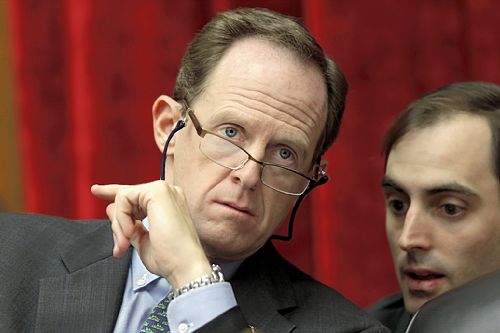
Sen. Pat Toomey
By Tracie Mauriello / Post-Gazette Washington Bureau

WASHINGTON — Tax hikes on the wealthy won’t solve the impending fiscal crisis, said Sen. Pat Toomey, R-Pa., but he’s willing to go there if it will get Democrats to agree to cut spending.

“This is a spending problem, a structural spending problem, and that’s what needs to be fixed,” he told Pennsylvania reporters on a conference call Monday. “But I acknowledge that elections have consequences and the president is fixed on raising taxes.”

President Barack Obama has been touting a plan that would raise taxes on families earning more than $250,000 a year.

The aim is to avoid the so-called “fiscal cliff” or $600 billion worth of tax hikes and spending cuts that, taken together, could devastate the national economy and send the country back into a recession.

Republicans like Mr. Toomey have reluctantly agreed to increase taxes on the wealthiest Americans, but they won’t entertain a separate vote on that measure alone. Rather they want the increase to be part of a sweeping package that also includes spending cuts.

Continue reading PA Senator Toomey: Cut Medicare and Medicaid

AFL-CIO and Senators Oppose Cuts

AFL-CIO Now


Elected Officials and President Trumka Reject Benefit Cuts to Social Security, Medicare and Medicaid

11/15/2012

Kenneth Quinnell

A group of Democratic senators is circulating a letter opposing benefit cuts to programs like Social Security, Medicare and Medicaid and saying that the Bush tax cuts for the wealthy should expire at the end of the year. The letter also calls for increasing revenue, cuts to defense and the closing of tax loopholes for the wealthy and corporations. The letter was drafted by Sen. Jay Rockefeller (W.Va.) and Sen. Tom Harkin (Iowa). The Democratic senators are hoping to get 30 senators to sign the letter.

The letter reads:

We urge you to reject changes to Medicaid, Medicare and Social Security that would cut benefits, shift costs to states, alter the structure of these critical programs or force vulnerable populations to bear the burden of deficit-reduction efforts. Each of these programs is a vital lifeline to the middle class.

Democratic National Committee Chair Debbie Wasserman Schultz also said that we don’t need to cut Social Security or Medicare benefits. She also said that raising the eligibility age would be a benefit cut and should be avoided.

AFL-CIO President Richard Trumka echoed the comments from the Democrats in the House and Senate, rejecting the idea that we even face a “fiscal cliff”:

The most frustrating thing about Washington, D.C., is the way political insiders create a self-reinforcing reality out of nonsense. Take what the media are calling the “fiscal cliff.” There is no fiscal cliff! What we’re facing is an obstacle course within a manufactured crisis that was hastily thrown together in response to inflated rhetoric about our federal deficit.

But all the deficit chatter has distracted us from our real crisis—the immediate crisis of 23 million unemployed or underemployed workers.

It’s time to protect Social Security benefits. It’s time to protect Medicare and Medicaid benefits. And it’s time to raise taxes for the richest 2%, to stop tax breaks that encourage companies to send jobs offshore and to close loopholes that allow some people and corporations to hide income in offshore tax havens.