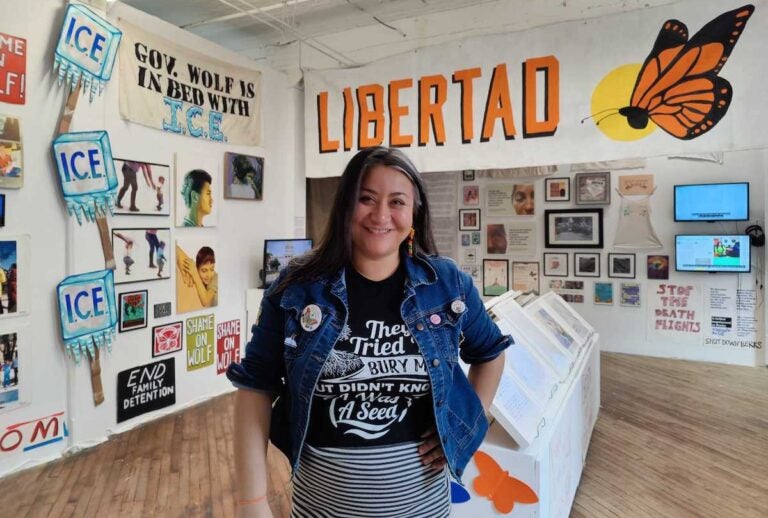
Photo: Jasmine Rivera was an organizer with the Shut Down Berks Coalition, and curated the exhibition “Queremos Justicia: Cómo cerramos Berks,” at the Vox Populi gallery in Philadelphia in 2023. (Peter Crimmins/WHYY)
By Jeffrey Lichtenstein
One PA
Jan 7, 2025 – We’re holding several big questions as we move into 2025 that we hope to learn and struggle through together with our funding partners. All of our work, especially our organizing, advocacy, and outreach efforts, will be working through these questions.
Quality vs Quantity of Doors
Where and when can we initiate and join conversations about the quality of field work rather than simply the quantity of door knock and phone call attempts? The efficacy of canvassing in low-salience elections is statistically unquestionable but in presidential election cycles there is suddenly a great amount of noise. Some of this noise is the result of large-scale vended field programs with weak quality control practices or very low contact rates.
What could it look like to move toward an eco-system wide model for field work that prioritizes the number and quality of conversations, volunteers recruited, and leaders trained? One PA prides itself on high contact rates and rigorous quality control but we still have much to learn. We hope to share and leverage best practices across locally rooted partners and begin to shift the paradigm around field work from quantity alone, to quality and quantity.
Making organizing power more legible
Even the strongest most rigorous electoral field program faces structural challenges with management, hiring and training under conditions of limited funding and time. These efforts also, by their nature, are demobilized and dismantled after an election, even when we know there is another election just around the corner, not to mention countless other opportunities for voters to flex their voice in government and strengthen their civic participation. Political and civic organizing, unlike electoral campaign mobilizations, grow rather than diminish in efficacy and power over time. What would it look like to quantify, validate, resource and scale the civic power of organizing? One PA was successful in 2024 in using every door conversation to begin an organizing pathway. We identified 33,000 hot leads to join One PA. We’re proud of this work, but we have real areas of growth in learning how to maximize the conversion between hot leads and new volunteers.
Dimensions and Cost of Building Precinct Based Structure
The term ‘organizing’ has been stretched in recent years to mean all manner of engagement. At One PA we are working with multiple battle-tested organizing models in an attempt to integrate the best practices of each in a way that can be quantified, studied and validated at every stage using contemporary data tools and tech. Our model combines dues-based membership, structure based organizing units, systematic leadership development, polarizing campaigns and experimentation. We are proud of our work in 2024 to launch a guardians of democracy and elections captains program.
In the year ahead we plan to scale the program by a factor of five, and are holding questions about what level of resource and training this will require at each level of the organizing structure. Independent Voice It is clear our movement must get upstream of elections in the battle to make meaning out of our communities’ lived realities. By the time candidates win their primaries, the ability to shape what that election will be about is out of the hands of most people except the elite few with an extraordinary amount of influence on the candidates. We are asking ourselves the question: what capacities and practices do we need as a movement to help frame the questions in front of people long before an election?
How can we roll into a cycle with voters broadly knowing already that housing is too high because of slumlords and rollbacks on government investment, not because of immigrants? We know part of the answer is an independent voice for Black and multi-racial working class communities, to help compensate for brand weakness in the Democratic party, to ensure voters feel they are heard, and to guarantee a more healthy mix of ideas about what it will take to fix this country. How can we build the power and independence of this voice in a way that our more traditional and conservative allies won’t attempt to smother in its cradle?
Winning the Internet
We’re also holding questions about how to respond to the reality that the Internet is increasingly becoming a place our communities rely on for social and political queues. Cynical or hateful voices have a head start in offering narrative frames in the digital space. We are holding questions about what it looks like to bring an organizing approach and significant investment in mass communications to organize our base in digital space, win over leaders and taste makers in non-legacy media, and contest for narrative primacy on the internet.
Training to Win next quarter and next decade
Training is critical for nearly every aspect of our plan, especially the proposition that we grow in capacity and power over time, and the responsibility to rebuild a majority. We are clear that we must level up the rigor and scale of our training program, and sit with the question about what kind of training school and content will meet the need. We know curricula must include a breakdown of the structures and histories of power and resistance; song, poetry and other forms of culture that bring people together at an emotional register; practical application of ideas through repetition of organizing, storytelling, writing and other skill practice. We’re sitting with the question: how can all those pieces best fit together and what kind of resourcing will it take to hold a training program sustainably that can meet these goals?
A renewed tech advantage
We’re also holding a question about technology. For about 20 years, democratic institutions and networks held an advantage in the use of tech in politics – the VAN, click-to-call tools, ActBlue and early P2P text platforms are all examples. But today republican networks and institutions have caught up or surpassed. What kind of tools allow us to easily give an inspired volunteer a list of the 50 closest target people to them, to register them to vote, get them to sign a petition, or have a persuasive conversation about candidates? How do we move away from site-based voter registration only, and use contemporary data to scale door to door registration programs? How do we use new models, like the Steven Phillips “New Majority Index,” to help us assess opportunities and threats?
Cities: Most of our base lives in cities.
Cities are the places where the housing and homelessness crises are worst. Cities are some of the places with the highest income inequality and violent crime. It’s difficult to live in cities unless you’re rich. There is a relationship between our bases’ weakened sense of political agency and their perception of the corruption of government on one hand, and the way our cities are being run on the other. What does it look like to have an intentional plan to broadcast positive accountability messaging when city leaders accomplish something that improves peoples lives? How do we combine that with real resourcing for primary campaigns to support candidates who are committed to using the government to deliver material gains for working class people.’ And what does it look like to add real resourcing for advocacy and pressure campaigns to encourage local leaders on the fence to move toward policies that will demonstrate in real terms how democratic governance is good for people?
Alignment
Last, we’re holding a question about how to build alignment between progressive base-building organizations to have sufficient power to help win the fights that each of us aren’t strong enough to win on our own. We’re proud of the work that we’ve done to build unity through the cycle of the last several races with several partners, especially PA United , Working Families Party , APIPA, Make The Road, 215 People’s Alliance and UniteHERE. How do we strengthen and build on these existing relationships?
September 22, 2024 – PITTSBURGH — With just 44 days until the 2024 election, U.S. Reps. Summer Lee (D-Pa.) and Alexandria Ocasio-Cortez (D-NY) rallied young voters for the Harris-Walz ticket at Carnegie Mellon University on Sunday.
Young people, Lee told the audience “are not the voices of the future,” but rather “the voices of right now.”
“We are all in the most powerful room in the country,” she said. “This is the most powerful room because we are in Western Pennsylvania, we’re in Western Pennsylvania, and the road to the White House, the road to the Senate and the road to the House all leads right here through y’all’s campuses.”
Pennsylvania is key for both Vice President Kamala Harris, the Democrats’ nominee, and former President Donald Trump, the GOP nominee. With its 19 electoral votes, the Keystone State is the biggest prize of the “blue wall” battleground states for either candidate.
According to the Pew Research Center, about two-thirds of registered voters ages 18 to 24 align with Democrats. In 2023, the Center for Information & Research on Civic Learning and Engagement estimated around 41 million members of Gen Z would be eligible to vote in the 2024 election.
Sunday’s event was co-hosted by College Democrats at Pitt, the CMU College Democrats and the Young Democrats of Allegheny County.
“When I talk about what our job is in the next 40-something days, your job is to take care of each other because that’s who I’m voting for,” Lee said. “I’m going to go and vote for the most marginalized person in my life. Because it’s my job, it’s my responsibility, to make sure that I’m creating the conditions that we all can survive in, not just survive, that we can all thrive in.”
Ocasio-Cortez followed Lee with a list of the issues that young voters might be most concerned with: climate change, school shootings and the cost of rent and healthcare.
“We have been aging and growing in a world that our predecessors have left to us,” Ocasio-Cortez said. “Respectfully, a lot of what has been left to us is messed up, is really messed up, and it’s messed up not even on a partisan basis, it’s messed up generationally.”
Ocasio-Cortez told a story of her time at Boston University when Barack Obama began his candidacy, and her absentee ballot did not arrive in time. She said she took a bus back home to New York City to cast her vote for the future president.
She not only encouraged students to register to vote in Pennsylvania with their on-campus address, but also to sign up for a shift with the Harris-Walz campaign, go door-to-door and ensure a Democratic victory at every level in the election.
Those calls-to-action were the theme of the speakers at Sunday’s event, with Pittsburgh Mayor Ed Gainey, Allegheny County Executive Sara Innamorato, CMU College Democrats President Avalon Sueiro and Harris-Walz campus organizer Agatha Prairie all taking the stage.
Prairie encouraged attendees to convince five friends to vote and Sueiro said to knock on classmates’ doors and “have those tough conversations” about the stakes of the election.
Gainey took a more somber approach.
“We should all be tired. I’m tired of someone that can stand on the stage in a debate and say to the American people and the world that immigrants that are here in our country eat dogs and cats,” he said in reference to former President Donald Trump’s false claim that Haitian immigrants were eating pets in Springfield, Ohio. “I’m tired of that level of hate.”
Trump’s running mate, U.S. Sen. J.D. Vance (R-Ohio) campaigned in Berks County on Saturday, and mentioned Springfield in his remarks. His job “as the United States Senator representing the people of Ohio is to listen to American citizens and fight for them,” Vance said.
“So our message to Kamala Harris and Democrats is we’re going to keep on complaining about their politics because this is America and we have the right to speak our minds,” he added.
Innamorato pointed out that a satellite voting location at the Soldiers & Sailors Memorial Hall in Oakland will be open from 8 a.m. to 4 p.m. from Oct. 15-17. Satellite locations offer residents the ability to register to vote, request a mail-in ballot, complete and return it in one place.
“A Pennsylvania victory runs through Allegheny County, and it runs through young people,” Innamorato said. “I’m asking for all of you to do what you can, to knock doors, to volunteer, to make phone calls, to talk to your weird cousin, to get your classmates on board, because we got a lot of work to do over the next 44 days.”
Photo: Democratic presidential nominee, U.S. Vice President Kamala Harris takes a selfie with Sen. John Fetterman (D-PA) and his wife Gisele Barreto Fetterman after greeting supporters at John Murtha Johnstown-Cambria Airport on September 13, 2024 in Johnstown, Pennsylvania. (Andrew Harnik/Getty Images)
September 13, 2024 – WILKES-BARRE — Vice President Kamala Harris, the Democratic nominee for president, has spent most of the last two weeks in Pennsylvania starting with a Labor Day rally in Pittsburgh, where she returned a few days later to hunker down for debate prep. She debated former President Donald Trump, the GOP nominee for president, in Philadelphia on Tuesday, and on Friday she campaigned in Johnstown and Wilkes-Barre, two areas that have swung Republican in recent elections.
“I will be continuing to travel around the state to make sure that I’m listening as much as we are talking,” Harris said during the Johnstown visit, according to pool reports. “And ultimately I feel very strongly that you’ve got to earn every vote, and that means spending time with folks in the communities where they live. And so that’s why I’m here and we’re going to be spending a lot more time in Pennsylvania.”
Luzerne County, where Wilkes-Barre is located. was once a Democratic stronghold, and is near President Joe Biden’s childhood hometown of Scranton. But Hillary Clinton lost the county by nearly 20 points in 2016, and Trump beat Biden but nearly 15 points in 2020.
Harris touched on familiar themes in her address to the audience at the McHale Athletic Center at Wilkes University, praising small business owners as the “backbone of America’s economy,” pledging to protect reproductive rights, and reiterating that her campaign for president was informed by her middle-class background.
“People sometimes just need the opportunity, because we as Americans do not lack for ambition, for aspiration, for dreams, for the preparedness to do hard work,” Harris said. She said if elected, her economic plan calls for building 3 million new homes by the end of her first term, and said she would take on corporate price-gouging, and expand the child tax credit.
Harris also said she would “get rid of unnecessary degree requirements for federal jobs to increase jobs for folks without a four year degree” and would “challenge the private sector to do the same.”
Photo: A gun rights advocate with an “I VOTED” sticker on his holster gathers with others for an annual rally on the steps of the state Capitol in Harrisburg, Pa., Monday, May 6, 2019. (AP Photo/Matt Rourke)
Two Pennsylvania lawmakers introduced a bill in February that would prohibit guns inside a building where votes were being cast
By Matt Vasilogambros And Kim Lyons
Penn-Capital- Star
March 24, 2024 – Two Pennsylvania lawmakers introduced a bill in February that would prohibit guns inside a building where votes were being cast.
Facing increased threats to election workers and superheated political rhetoric from former President Donald Trump and his supporters, more states are considering firearm bans at polling places and ballot drop boxes ahead of November’s presidential election.
This month, New Mexico became the latest state to restrict guns where people vote or hand in ballots, joining at least 21 other states with similar laws — some banning either open or concealed carry but most banning both.
Nine of those prohibitions were enacted in the past two years, as states have sought to prevent voter intimidation or even violence at the polls driven by Trump’s false claims of election rigging. At least six states are debating bills that would ban firearms at polling places or expand existing bans to include more locations.
In Pennsylvania, state Reps. Tim Brennan (D-Bucks) and Mary Jo Daley (D-Montgomery) introduced a bill in February that would prohibit the carrying of firearms at all polling places. House Bill 2077 would not apply to law enforcement or military personnel on duty at polling places, and anyone licensed to carry a firearm could keep the firearm in their vehicle while voting, but not bring it into the building where votes are being cast.
“Over the years, we have heard more and more about voters and election workers being threatened, harassed, or intimidated at polling places,” the two write in a memo for HB 2077. “As a result, many voters have expressed concerns about voting in person at their assigned polling location, and many voting districts have struggled to find or retain volunteers to work at such locations.”
Daley told the Capital-Star that when she was a committee member in the 1990s she remembers someone coming to a polling place with a gun and it frightened the poll workers. “And we were in a much more peaceful time then,” she said. Daley added she has introduced similar legislation several times but with Democrats in the minority in the House until 2022, there was little chance of it moving forward.
HB 2077 was referred to the House State Government committee March 5. “I think it’d be great to bring it up because quite honestly, we have some members who talk about the value of life, but that doesn’t seem to bear out all lives,” Daley said.
“When you think of elections in Pennsylvania, it’s a community activity,” Daley added. “But it doesn’t mean that some communities aren’t really struggling with this issue.”
New Mexico law The New Mexico measure, which was supported entirely by Democrats, applies to within 100 feet of polling places and 50 feet of ballot drop boxes. People who violate the law are subject to a petty misdemeanor charge that could result in six months in jail.
“Our national climate is increasingly polarized,” said Democratic state Rep. Reena Szczepanski, one of the bill’s sponsors. “Anything we can do to turn the temperature down and allow for the safe operation of our very basic democratic right, voting, is critical.”
She told Stateline that she and her co-sponsors were inspired to introduce the legislation after concerned Santa Fe poll workers, who faced harassment by people openly carrying firearms during the 2020 presidential election, reached out to them.
Our national climate is increasingly polarized. Anything we can do to turn the temperature down and allow for the safe operation of our very basic democratic right, voting, is critical.
The bill carved out an exception for people with concealed carry permits and members of law enforcement. Still, every Republican in the New Mexico legislature opposed the measure; many said they worried that gun owners might get charged with a crime for accidentally bringing their firearm to the polling place.
“We have a lot of real crime problems in this state,” said House Minority Floor Leader Ryan Lane, a Republican, during a House Judiciary Committee hearing last month. “It’s puzzling to me why we’re making this a priority.”
But over the past several years, national voting rights and gun violence prevention advocates have been sounding the alarm over increased threats around elections, pointing to ballooning disinformation, looser gun laws, record firearm sales and vigilantism at polling locations and ballot tabulation centers.
In February, Pennsylvania Secretary of the Commonwealth Al Schmidt said that the that the turnover among experienced election officials in Pennsylvania counties is “a real concern” ahead of the 2024 elections. Some 70 senior directors or those directly underneath them have left, Schmidt said.
National surveys show that election officials have left the field in droves because of the threats they’re facing, and many who remain in their posts are concerned for their safety.
Add in aggressive rhetoric from Trump, the presumptive Republican presidential nominee, and it becomes “a storm” that makes it essential for states to pass laws that prohibit guns at polling places, said Robyn Sanders, a Democracy Program counsel for the Brennan Center for Justice, a voting rights group based at the New York University School of Law.
“Our democracy has come under new and unnerving pressure based on the emergence of the election denial movement, disinformation and false narratives about the integrity of our elections,” said Sanders, who co-authored a September report on how to protect elections from gun violence. The report was a partnership between the Brennan Center and the Giffords Law Center to Prevent Gun Violence.
“The presence of guns in these places presents a risk of violence,” she added.
Dem Governor Josh Shapiro campaigning in Beaver County
By less than 100 voters, but Dems need to get busy with new registrations.
By Chrissy Suttles Beaver County Times
BEAVER — County Republicans hit a milestone decades in the making this week.
Beaver County now has more registered Republican voters than Democrats – an inflection point in a county considered a Democratic stronghold for the better part of a century.
Pennsylvania Department of State data shows that among Beaver County’s 111,725 registered voters, 48,170 are registered Republicans and 48,079 are registered Democrats – a difference of 91 registrations. That’s 43.1% Republican voters, 43% Democratic voters and 13.9% third party or unaffiliated voters.
Beaver County has steadily grown more supportive of Republican candidates and conservative principles in recent years.
As a traditionally blue-collar county once grounded in steel and a unionized workforce, Beaver has long had more registered Democrats than Republicans. A portion of those Democrats started voting Republican in the 1980s for former President Ronald Reagan, but kept their Democratic party affiliation. Still, Beaver County voters supported Democratic presidential candidates for much of the 20th century.
That changed in 2008, when Republican John McCain outperformed former President Barack Obama in the county. In 2012, Mitt Romney bested the former president again. Former President Donald Trump beat Hillary Clinton 58% to 39% in 2016 and President Joe Biden 57.9% to 40.3% in 2020 – despite Beaver County holding a clear but shrinking Democratic majority among registrations.
The county marked another clear shift in 2016, when Republicans took the Beaver County Board of Commissioners for the first time since 1958.
Beaver County Republican Chairman Roman Kozak said Tuesday the emergent Republican majority is “validation of the hard work of our Republican elected county team.”
“Ten to 20 years ago, most of us could never imagine this happening,” he said. “From our judiciary to our county commissioners and row offices, and down to our municipal offices and school directors, Republican-led government continues to represent true Beaver County values. The people of Beaver County are telling us they want a government that is responsive to them as well as one that is professionally and responsibly managed.”
Beaver County Democratic Chairwoman Erin Gabriel said the Democratic Party is “always excited to see more folks register to vote, and will continue our efforts to register voters across the county.
“Certainly, there will be ebbs and flows in which party has the majority of registrations in a tightly contested county like Beaver, and the margins really couldn’t be tighter in terms of registration,” she said. “I think that’s part of what makes us such an interesting county for politicos, but it also presents us with the necessary opportunity for bipartisan discussions.”
Gabriel noted Democrat Nate Bible’s win over two-term Republican incumbent David Lozier in this year’s Beaver County District Attorney race and shared enthusiasm for Gov. Josh Shapiro’s automatic voter registration initiative, adding that the party is focused on protecting voters’ rights “instead of trying to make it more difficult to vote,” because “this country works best when more people participate.”
The Democratic party will “continue to be a welcoming, safe and supportive space for all of our community members, regardless of the color of your skin, where you came from, how you worship or who you love,” she added. “In too many cases this year, with significant encouragement from the Republican party, we saw the politics of racism, bigotry and hate on full display through divisive rhetoric, race-baiting mailers coming from both the Republican party as well as directly from their candidates for county offices.”
House Republican Leader Bryan Cutler, R-Lancaster, speaks to reporters beside a map of three vacant Allegheny County legislative districts that will be the subjects of special elections next year. (Capitol-Star photo by Peter Hall)
Long-delayed justice for abuse victims has become hostage to the GOP’s partisan attack on voting, abortion rights
By J.J. Abbott
PA Cap[itol-Star
Jan 11, 2023 – Last week, Harrisburg Republicans, who suffered an overwhelming defeat at the ballot box in 2022, celebrated the election of new state House Speaker Mark Rozzi. We’ve learned in the days since that they did so not for Rozzi, a Berks County Democrat, or the hope of finding bipartisan consensus but for their own cynical, purely political reasons.
Rozzi, nominated and supported by both Republicans and Democrats, ran for speaker to advance his life’s work: creating an opportunity for justice for fellow adult victims of child sexual abuse. GOP leaders calculated, instead, that Rozzi’s election to the speakership would further their own political goal of advancing a series of unrelated constitutional amendments covering partisan policy proposals that failed to garner enough support to become law through the usual channels.
In 2022, this GOP package included two election changes borne out of the GOP’s 2020 election denialism, a legislative power-grab around regulations, and a complete ban on abortion rights without any exceptions. Then Republicans lost the governor’s race, nearly all competitive federal races, and 12 House seats and their majority in the state House
The amendment allowing victims of childhood sexual abuse an extended window to sue their attackers garnered wide bipartisan support in three previous legislative sessions. However, the GOP, fresh off losing up-and-down the ticket, now seems to be threatening to withhold their support for a final vote unless they leverage it to add their hyper-partisan agenda into the state constitution, effectively holding victims of abuse hostage to conspiracies spun by former President Donald Trump.
To assuage the fears of victims and advocates and try to prevent bitter fights over unrelated policies, Gov. TomWolf – with Rozzi’s backing – called a special session to focus on getting the window to justice on the ballot by the May primary. Some thought this would help avoid partisan fights over elections and abortion amendments that lack the same urgency or consensus.
Republican leaders were incensed at the prospect of losing this leverage and immediately attacked the governor for calling the special session. Senate Republicans went as far as to say their politically-charged amendments were “equally important” as justice for these victims.
According to a report by NBC10 in Philadelphia, “House Republican Leader Bryan Cutler says there are other, more urgent things they need to prioritize ahead of child sex abuse.”
Seriously? Have they no shame?
In openly admitting they want to hold justice hostage, GOP leaders justified the need for a special session focused on the most urgent matter: justice for these victims.
In addition to no moral comparison between their partisan amendments and justice for abuse victims, there is no urgent need or policy rationale for these election and regulation changes other than the political goals of the Republican Party.
Pennsylvania law already requires ID to vote and mandates state-run audits of every election. Voter impersonation almost never happens and audits typically find only small computation errors, if anything at all. So while nearly three-in-four Pennsylvania voters said in 2022 exit polls that they were confident PA had fair elections, GOP leaders continue to push these amendments because Republicans think they will help them win elections.
For years, Pennsylvania’s counties outlined urgently needed election policy updates. Unfortunately, in a similar act of political gamesmanship, those bipartisan, consensus changes also remain victims to GOP hostage-taking.
A much more responsible approach would be to engage in the traditional legislative process of building consensus towards some sort of comprehensive elections reform bill, instead of ramming bad policy into the constitution because you failed to pass it the right way.
GOP leaders seem ready to force their members to engage in a raw political exercise of derailing and delaying justice for abuse victims over these other amendments.
In 2018, four incumbent Republican senators lost re-election after they voted against a statutory change similar to the proposed constitutional amendment. The GOP’s latest legislating by hostage-taking creates a tough partisan pill for these members to swallow with huge political risks.
This unseemly approach is a reminder of why voters overwhelmingly rejected the GOP last election after decades of their control of Harrisburg lawmaking.
Voters are tired of business as usual in Harrisburg and clearly rejected the GOP’s extreme agenda in 2022. But Republican leaders in Harrisburg prove once again that they don’t care what the voters think.
J.J. Abbott served as press secretary and deputy press Secretary for Gov. Tom Wolf from 2015 until 2020. He now serves as executive director of Commonwealth Communications, a Pennsylvania progressive communications non-profit.
By Bruce Siwy The Times: Pennsylvania State Capital Bureau
Three prominent Pennsylvania Republicans have been identified as “a grave danger to American democracy” in a new report.
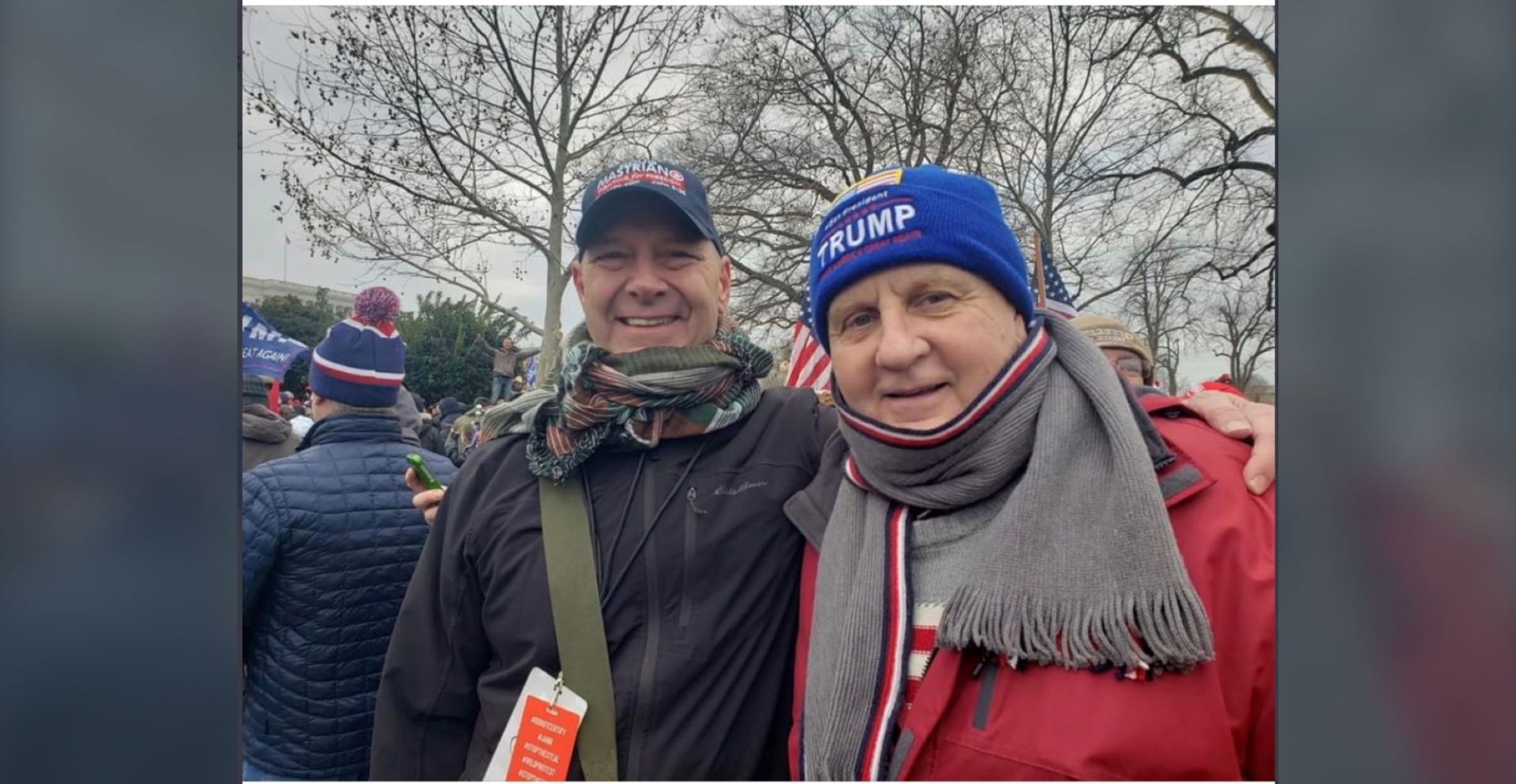
The report — expected to be issued this week by the Defend Democracy Project, an organization founded by two men who worked for the Obama campaign and administration — gives these distinctions to state senator and gubernatorial nominee Doug Mastriano, U.S. Rep. Scott Perry (R-10) and U.S. Rep. Mike Kelly (R-16). Authors cited the trio’s involvement in an array of activities related to former President Donald Trump’s efforts to challenge the 2020 election results.
“These three individuals all took part in unprecedented attempts to overturn the will of American voters, but that is not all they have in common — Mastriano, Perry, and Kelly continue to pose a grave danger to American democracy,” the report states. “Together with other MAGA Republicans, they are leading a scorched earth campaign to consolidate power over elections for decades to come, both in Pennsylvania and across the country.”
Michael Berman, a state director for the Defend Democracy Project, characterized Trump and some of his allies as part of an “ongoing, violent criminal conspiracy” in a call with reporters Tuesday.
The organization’s mission is to “work with leading organizations, noted experts and critical validators to make sure this plot to overturn elections can’t go forward under the cover of darkness,” according to its website. It’s working in six other states besides Pennsylvania — Arizona, Georgia, Michigan, Nevada, North Carolina and Wisconsin.
A “wanted” flier distributed by activists with the 10th District Network that accuses U.S. Rep Scott Perry (R-10) of sedition.
In their rationale for Mastriano’s inclusion, the Defend Democracy Project listed the following concerns:
His call for treating the popular vote as non-binding for presidential electors if the “election was compromised.”
His legally questionable proposal to force all Pennsylvanians to re-register to vote.]
His use of campaign cash to bus supporters to the U.S. Capitol on Jan. 6, 2021.
And his attempts to bring an election audit to Pennsylvania, similar to what was conducted in Arizona.
Mastriano — who’s demonstrated a routine avoidance of media outside of explicitly right-wing circles — has consistently doubled down on unproven claims of widespread voter fraud. Earlier this year his bill to expand the use of poll watchers across the commonwealth was vetoed by Gov. Tom Wolf, a Democrat, who cited concern that the measure would undermine “the integrity of our election process and (encourage) voter intimidation.”
Regarding Perry, the nonprofit noted:
Testimony from former White House aide Cassidy Hutchinson stating that Perry met with Trump officials bent on overturning the 2020 election.
His use of conspiracy theories to urge investigations from White House Chief of Staff Mark Meadows, according to records provided by Meadows.
His work as a liaison between the White House and Pennsylvania Legislature in coordinating efforts to delay or object to the commonwealth’s Electoral College votes for now-President Joe Biden.
Perry’s office did not return a call by press deadline. Earlier this year he said he’d done nothing wrong in relation to these matters.
“My conversations with the president or the Assistant Attorney General, as they have been with all with whom I’ve engaged following the election, were a reiteration of the many concerns about the integrity of our elections, and that those allegations should at least be investigated to ease the minds of the voters that they had, indeed, participated in a free and fair election,” Perry said in a statement in January.
House investigators said May 12, 2022, that they have issued subpoenas to House Republican Leader Kevin McCarthy and four other GOP lawmakers, including Perry, as part of their probe into the violent Jan. 6 insurrection, an extraordinary step that has little precedent and is certain to further inflame partisan tensions over the 2021 attack. (AP
Kelly, meanwhile, was cited for:
His unsuccessful court challenge to the legality of 2020 mail ballots in Pennsylvania.
His vote to overturn the 2020 election results. An allegation by U.S. Sen. Ron Johnson (R-WI) that he helped to orchestrate a false elector scheme.
Comments such as his claim that former President Barack Obama “is to run a shadow government that is gonna totally upset the new (Trump) agenda.”
Asked in July if he still believed that the election was stolen from Trump, Kelly told an Erie Times-News reporter: “Well, we’re already what, almost two years into this administration? So I think that’s past tense. There’s no use discussing it today. Nothing’s going to change today. I stated my opinions back when it took place.”
Kelly’s office did not return a phone call by press deadline.
What’s on voters’ minds:’In a whirlwind of trouble’: PA poll reveals top concerns (spoiler: It’s the economy…)
About the Defend Democracy Project The Defend Democracy Project describes its mission as ensuring that “American voters determine the outcome of elections.” It was established earlier this year.
According to Berman, the organization was founded by Leslie Dach and Brad Woodhouse.
An online bio for Dach states that he served as senior counselor to the secretary of the Department of Health and Human Services as its global Ebola coordinator. He’s also served as senior adviser to six presidential campaigns, including Hillary Clinton’s 2016 run.
Woodhouse, in his bio, is characterized as “a longtime Democratic strategist, having previously served as President of some of the nation’s leading progressive groups including Correct the Record, American Bridge 21st Century, and Americans United for Change.” It also states that he worked as a senior strategist for the Obama campaign and communications director for the Democratic National Committee.
Berman said the Defend Democracy Project examined the public records and statements of politicians across the country and compiled its list based on those who objected to certifying the 2020 election or implied that it was “stolen” from Trump.
Bruce Siwy is a reporter for the USA TODAY Network’s Pennsylvania state capital bureau. He can be reached at bsiwy@gannett.com or on Twitter at @BruceSiwy.
Photo: Pennsylvania Republican gubernatorial candidate Doug Mastriano speaks during a rally at Archery Addictions on May 13, 2022 in Lehighton, Pennsylvania. With less than a week until Pennsylvania’s primary election on Tuesday May 17, polls have Republican candidate Doug Mastriano as the front runner in the Governor’s primary race. (Photo by Michael M. Santiago/Getty Images)
Stop the Steal is only a pretense for seizing control.
By Amanda Carpenter
The Bulwark
JULY 5, 2022 – By now, political junkies are familiar with the rucksack of election-denying baggage that Pennsylvania GOP gubernatorial candidate Doug Mastriano schleps around: He organized a faux post-election legal hearing for Rudy Giuliani in Gettysburg; he asked Congress to deny Pennsylvania’s electors; he spent thousands of campaign funds busing people to the Capitol on Jan. 6th; he was filmed crossing police barricades; some of his supporters were arrested for their activities that day, and he visited Arizona to observe its disastrous Cyber Ninjas audit in hopes of replicating it in Pennsylvania.
Those are only the highlights of what Mastriano has done in the past. But what about the future? People like Mastriano are never going to let Donald Trump’s 2020 election loss go. If anything, Trump’s “Stop the Steal” lies provide a pretext for actions intended to ensure MAGA types win in future elections.
How will they do it? Well, Mastriano has some ideas. (Well above and beyond hiring Trump’s throne-sniffing flack Jenna Ellis as his legal adviser.)
Although Mastriano evades scrutiny by blockading typical media interviews, with some help from his insurrection-friendly friends, he doesn’t hesitate to talk about his plans when he feels comfortable. Put those snippets together, and it shows Mastriano has a pretty well-thought-out election takeover plan in mind.
His platform includes the following:
–loosening restrictions on poll watchers to make it easier to challenge votes;
–repealing vote-by-mail laws;
–appointing a fellow 2020 election-denier to be secretary of state who could enable him to decertify every voting machine “with a stroke of a pen”;
–forcing all Pennsylvania voters to re-register;
–and defunding the Pennsylvania Supreme Court.
Let’s take them one by one.
Last month, Mastriano’s legislation to loosen restrictions on poll watchers passed both houses of the General Assembly. Its passage on party-line votes by the GOP-controlled legislature is not surprising, since one of the problems that frustrated Trump supporters in 2020 is that they could not recruit in-county residents in blue areas, such as Philadelphia, to serve as poll workers and make challenges to votes. Mastriano’s bill changes that.
If the bill were signed into law—which Democratic Gov. Tom Wolf has said he will not do—it would increase the number of poll watchers permitted by candidates from two to three, kill in-county residency requirements for poll watchers, and give poll watchers a “clear line of sight to view and hear” election workers and voters “at a distance of six feet or less.”
What could these poll watchers do with this increased capacity? Per Pennsylvania state guidance, poll watchers are empowered to “make good faith challenges to an elector’s identity, continued residence in the election district, or qualifications as an eligible voter.”
Such challenges are directed to the judge of elections, who “has the obligation to determine if the challenge is based on actual evidence and whether there is a good faith basis to believe that the person is not or may not be a qualified elector.” Democratic critics of the bill object that the close proximity of poll watchers brought in from out of the county raises the likelihood of voter intimidation.
In a statement, Trump encouraged Pennsylvania Republicans to tie passage of this bill and other election-related restrictions to the state budget:
Just as Trump called for, Mastriano has also promoted legislation to ban dropboxes and private funding for elections, as well as to eliminate “no excuse” mail-in voting and the permanent absentee voter list.
But Mastriano’s potential powers as governor far exceed that of a state senator when it comes to controlling Pennsylvania’s elections.
Unlike many other states where the secretary of state is an elected position, in Pennsylvania, the governor gets to make an appointment for the position. Mastriano already has his pick in mind and, although he hasn’t provided a name, he has teased that with this appointment and his powers, he could “decertify every machine in the state with a stroke of a pen via the secretary of state.” He said, as captured via audio, here:
“I’m Doug Mastriano, and I get to appoint the secretary of state, who’s delegated from me the power to make the corrections to elections, the voting logs, and everything. I could decertify every machine in the state with the, you know, with the stroke of a pen via my secretary of state. I already have the secretary of state picked out. It’s a world-class person that knows voting integrity better than anyone else in the nation, I think, and I already have a team that’s gonna be built around that individual.”
This is why Mastriano probably feels like he has a sporting chance to reset the voter rolls and force all of Pennsylvania’s 9 million voters to submit new voter applications to re-register to vote.
Federal voting laws prohibit such a practice, but that doesn’t deter Mastriano from campaigning on it and may not prevent Governor Mastriano from trying it—and creating a massive tangle of legal problems in the face of looming election deadlines.
Where would those legal challenges be decided? Most likely, in the Pennsylvania Supreme Court. And for that, Mastriano has another idea in mind in case things don’t go his way.
If the state’s highest court doesn’t do as he pleases, he thinks it should be defunded, which is something he’s called for after the 2020 election. Here he is on a podcast* in November 2020:
“I wish the General Assembly, we would do our darn job here, and make them feel some pain. We could, we could, rein in elements. Even, we even, budget and fund the Pennsylvania Supreme Court. If we are so, we’re out there as you know, shouting outrage about how they’re rewriting law, then, okay, maybe we should defund them. And let them figure out how they’re going to run a business without a budget. …” Read More
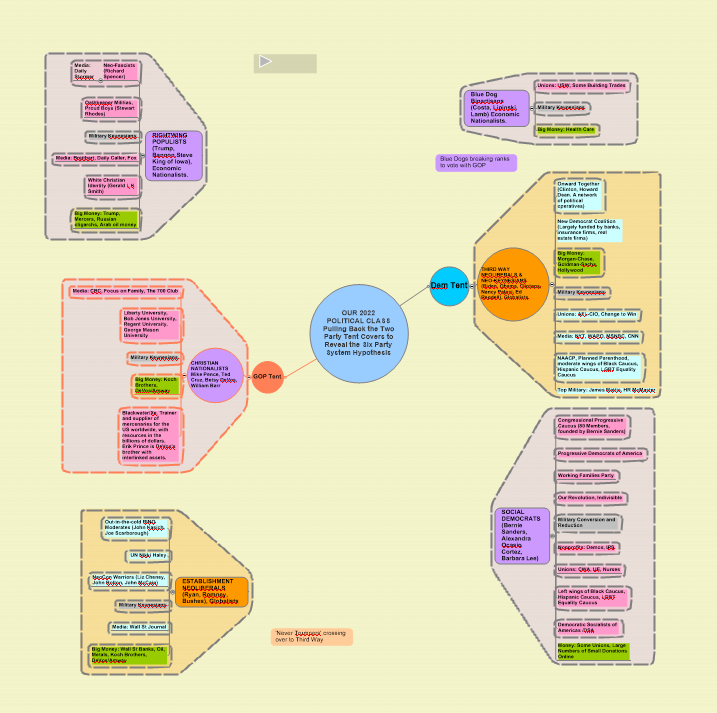
To win political campaigns, we need a good assessment of the overall terrain. The chart below of six clusters and their features may be helpful. To enlarge or adjust the view, CLICK HERE.
We can best understand the major political parties in the U.S. as constantly changing coalitions with no firm commitment to program or discipline.
The electoral strategic terrain is constantly changing, and we don’t want to be stuck with old maps and faulty models. In 2014, I first suggested setting aside the traditional “two-party system” frame for US politics, which obscures far more than it reveals, and making use of a “six-party” model instead. Every two years, I’ve revised the model, and now, with the November 2022 elections coming up, it’s time for another update. What follows is an abbreviated version of the explanation; you can read it in full here.
Some critics have objected to my use of the term “party” for factional or interest group clusters. The point is taken, but I would also argue that the major parties in the U.S., in general, are not ideological parties in the European sense. Instead, they are constantly changing coalitions of these clusters with no firm commitment to program or discipline.
The Democratic and the Republican Party each contain three such clusters, as they have since 2016. Under the Democratic tent, the three main groups remain the Blue Dogs, the Third Way Centrists and the Rainbow Social Democrats. The GOP umbrella covers Donald Trump’s Rightwing Populists, the Christian Nationalists, and the Never-Trumpers.
But since our last update in 2018, the question of a clear and present danger of fascism has moved from the margins to the center of political discourse. Far from an ongoing abstract debate, we are now watching its hidden elements come to light every day in the media. We also see the ongoing machinations in the GOP hierarchy and in state legislatures reshaping election laws in their favor. Now, the question is not whether a fascist danger exists, but how to fight and defeat it.
So here’s the new snapshot of the range of forces for today.
The Six-Party System
The Right-wing Populists
This “party,” as mentioned, has taken over the GOP and is now tightening its grip.
The economic core of right-wing populism remains anti-global “producerism versus parasitism.” Employed workers, business owners, real estate developers, small bankers are all “producers.” They oppose “parasite” groups above and below, but mainly those below them—the unemployed (“Get a Job!” as an epithet), the immigrants, poor people of color, Muslims, and “the Other” generally. When they attack those above, the target is usually George Soros, a Jew.
Recall that Trump entered politics by declaring Obama to be an illegal alien and an illegitimate officeholder (a parasite above), but quickly shifted to Mexicans and Muslims and anyone associated with Black Lives Matter. This aimed to pull out the fascist and white supremacist groups of the “Alt Right”–using Breitbart and worse to widen their circles, bringing them closer to Trump’s core. With these fascists as ready reserves, Trump reached further into Blue Dog territory, and its better-off workers, retirees, and business owners conflicted with white identity issues—immigration, Islamophobia, misogyny, and more. Today they still largely make up the audience at his mass rallies.
Trump’s outlook is not new. It has deep roots in American history, from the anti-Indian ethnic cleansing of President Andrew Jackson to the nativism of the Know-Nothings, to the nullification theories of John C. Calhoun, to the lynch terror of the KKK, to the anti-elitism and segregation of George Wallace and the Dixiecrats. Internationally, Trump combines aggressive jingoism, threats of trade wars, and an isolationist ‘economic nationalism’ aimed at getting others abroad to fight your battles for you. At the same time, your team picks up the loot (“We should have seized and kept the oil!”).
Trump’s GOP still contains his internal weaknesses: the volatile support of distressed white workers and small producers. At present, they are still forming a key social base. But the problem is that Trump did not implement any substantive programs apart from tax cuts. These mainly benefited the top 10% and created an unstable class contradiction in his operation. Most of what Trump has paid out is what WEB Dubois called the “psychological wage” of “whiteness,” a dubious status position. Trump’s white supremacist demagogy and misogyny will also continue to unite a wide array of all nationalities of color and many women and youth against him.
Trump’s religious ignorance, sexual assaults and a porn star scandal always pained his alliance with the Christian Nationalist faction (Mike Pence, Betsy DeVos, et. al.), and the DeVos family (Amway fortune). They were willing to go along with Trump’s amoral lifestyle for the sake of his pending judicial appointments. The Feb 7, 2022 5-4 Supreme Court ruling on gerrymandering against Black voters in Alabama is only one case in point. The Trump-Christian alliance, nonetheless, has become more frayed since Jan. 6 and the ‘Hang Mike Pence’ spectacle.
2. The Christian Nationalists
This “party” grew from a subset of the former Tea Party bloc. It’s made up of several Christian rightist trends developed over decades, which gained more coherence under Vice President Mike Pence. It includes conservative evangelicals seeking to recast a patriarchal and racist John Wayne into a new warrior version of Jesus.
A good number of Christian nationalists are Protestant theocracy-minded fundamentalists, especially the “Dominionist” sects in which Ted Cruz’s father was active. The ‘End Times’ Domininists present themselves as the only true, “values-centered” (Biblical) conservatives. They argue against any kind of compromise with the globalist “liberal-socialist bloc,” which ranges, in their view, from the GOP’s Mitt Romney to Bernie Sanders. They are more akin to classical liberalism than neoliberalism in economic policy. This means abandoning nearly all regulations, much of the safety net, overturning Roe v. Wade, getting rid of marriage equality (in the name of ‘religious liberty’) and abolishing the IRS and any progressive taxation in favor of a single flat tax.
The classic liberalism of most Christian Nationalist is also a key reason they attract money from the Koch Brothers networks. While the Kochs hold Trump and his populists in some contempt, the Christian Nationalist faction has access to Koch funds and its American Legislative Exchange Council (ALEC) legislative projects, along with access to the DeVos fortunes. Effectively, Christian nationalist prosperity economics amounts to affirmative action for the better-off, where the rise of the rich is supposed to pull everyone else upwards. Those below must also pay their tithes and pull upward with their “bootstraps.” They argue for neo-isolationism on some matters of foreign policy. But as “Christian Zionists” they favor an all-out holy war on “radical Islamic terrorism,” to the point of “making the sand glow” with the use of nuclear weapons. They pushed for moving the U.S. Embassy in Israel to Jerusalem and ripping up the Iran nuclear deal. All this is aimed at greasing the skids for the “End Times” and the “Second Coming.” With Cruz, Pence and DeVos as leaders, they have become the second most powerful grouping under the GOP tent, and the one with the most reactionary platform and outlook, even more so than Trump himself in some ways.
3. The Establishment Neoliberal ‘RINOs’
This is the name now widely used in the media for what we previously labeled the Multinationalists. It’s mainly the upper crust and neoliberal business elites that have owned and run the GOP for years, but they are now largely out in the cold. This neoliberal grouping included the quasi-libertarian House Freedom Caucus, the smaller group of NeoCons on foreign policy (John Bolton and John McCain), and the shrinking number of RINO (Republican In Name Only) moderates in The Lincoln Project. The Establishment also favors a globalist, U.S. hegemonist, and even, at times, a unilateralist approach abroad, with some still defending the Bush-Cheney disaster in Iraq. Their prominent voice today is Liz Cheney of Wyoming.
We also need to keep in mind the global backdrop to these shifts. The worldwide process of technology-driven financialization has divided the ruling class of late capitalism in every major country into three—a local sector of the transnational capitalist class, the nation-based multinationals, and an anti-globalist national sector. Thus among traditional U.S. neoliberals, some are U.S. hegemonists, but many have a transnational globalist understanding of the world with vast amounts of their money in foreign stock. China and global value chains integrate them with other global capitalists. This is why Trump’s trade policy is so controversial with Wall Street elites of both Republican and Democratic leanings. U.S. economic hegemony makes no sense at this financial and productive integration level. The global three-way division also serves to explain why Trump’s rightwing populism, despite its American characteristics, is connected to the rightwing nationalist-populist rise in all European countries. He is not ‘explainable’ in American terms alone.
This subordination is a big change for the traditional GOP top dogs. They would like to purge a weakened Trump from the party and rebuild, but so far lack the ability. They could try to form a new party with neoliberal Dems. Or, more likely, they could join the Dems and try to push out or smother those to the left of the Third Way grouping. At the moment, however, the much-weakened GOP’s old Establishment is left with the choice of surrender, or crossing over to the Third Way bloc under the Dem tent. A good number already did so to vote for Biden in the Dem 2020 primary and general, expanding the Dem electorate to the right.
Now let’s turn to the Dem tent, starting at the top of the graphic.
4. The Blue Dogs
The Blue Dog grouping has close ties to big corporate interests, including the fossil fuel and health insurance industries and Big Pharma. It has PACs “that raise millions of dollars every cycle from hundreds of corporate PACs, then send maximum donations of $10,000 back out to their members and more business-friendly Democratic House candidates.”
This small “party” has persisted and gained some energy. The recent effort of West Virginia’s Senator Joe Manchin to block or gut Biden’s reforms is a case in point. One earlier reason was that the United Steel Workers and a few craft unions had decided to work with Trump on tariffs and trade. The USW also got firmly behind Connor Lamb (D-PA) for Congress. Lamb won a narrow victory in a rural, conservative Western Pennsylvania congressional district, but with many USW members’ votes. He was endorsed by the Blue Dog PAC, although he is not a formal member of the caucus. Getting into a nearly physical floor fight with the GOP over Jan. 6 “radicalized” Lamb a bit, moving him leftward.
But the small Blue Dog resurgence may not last. On the one hand, the DNC Third Way gang currently loves people like Lamb, and wants to see more candidates leaning to the center and even the right. On the other hand, an unstable Trump out of office has little to offer on major infrastructure plans save for “Build The Wall” chanting at rallies. His potential votes among USW and other union members may shrink.
5. The Third Way New Democrats
First formed by the Clintons, with international assistance from Tony Blair and others, this dominant “party” was funded by Wall Street finance capitalists. The founding idea was to move toward neoliberalism by creating distance between themselves and the traditional Left-labor-liberal bloc, i.e., the traditional unions and civil rights groups still connected to the New Deal legacy. Another part of Third Way thinking was to shift the key social base away from the core of the working class toward college-educated suburban voters, but keeping alliances with Black and women’s groups still functional.
Thus the Third Way had tried to temper the harsher neoliberalism of the GOP by ‘triangulating’ to find neo-Keynesian and left-Keynesian compromise policies. The overall effect has been to move Democrats and their platform generally rightward. With Hillary Clinton’s narrow defeat, the Third Way’s power in the party diminished somewhat, but it gained clout with the Biden victory.
As mentioned above, its labor alliances have weakened, with unions now going in three directions. Most of labor has remained with the Third Way. Some moved rightward to the Blue Dogs while others—Communications Workers, National Nurses United, and the U.E.—endorsed Bernie Sanders and are part of the social-democratic bloc. Regarding the current relation of forces in the party apparatus, the Third Way has about 60% of the positions and still controls the major money.
The key test was the November 2020 battle with Trump: Which political grouping under the Dem tent in 2020 inspired and mobilized new forces within the much-needed ‘Blue Wave’, gave it focus and put the right numbers in the right places? This question brings us to the last of the six “parties.”
6..The Rainbow Social Democrats
This description is better than simply calling it the Congressional Progressive Caucus (CPC), as this article’s first version did. I’ve kept the “Rainbow” designation because of the dynamic energy of Alexandria Ocasio-Cortez and the Squad. (The Third Way has kept the older and more pragmatic voters of the rainbow groupings under its centrist influence.)
The “Social Democrat” title doesn’t mean each leader or activist here is in a social-democrat or democratic socialist group like DSA. It means the core groups–the Congressional Progressive Caucus, Progressive Democrats of America (PDA), Working Families Party (WFP), Democratic Socialists of America (DSA), Justice Democrats and Our Revolution and Indivisible—all have platforms that are roughly similar to the left social democrat groupings in Europe. Germany’s Die Linke’s election platform, for example, is not that different from Bernie’s or the Working Families Party. This is made even more evident with AOC and Bernie’s self-descriptions as “democratic socialists” in the 2020 primaries and the general election, where it only seemed to help. The platform, however, is not socialist itself, but best described as a common front against finance capital, war, and the white supremacist and fascist right. This is true of groups like Die Linke as well, which met recently with PDA and Congressional Progressive Caucus members.
This grouping has also been energized by the dramatic growth of the DSA since the 2016 Sanders campaign. Now with nearly 100.000 members and chapters in every state, DSA has already won a few local and statehouse races. They are now an important player in their own right within these local clusters.
This overall growth of this “party” is all for the good. The common front approach of the Social Democratic bloc can unite more than a militant minority of people who identify as socialists. It can draw a progressive majority together around both immediate needs and structural reforms, expressed in a platform like the “Third Reconstruction” program championed by the Poor People’s Campaign.
What does it all mean?
With this brief descriptive and analytical mapping of American politics, many things are falling into place. The formerly subaltern rightist groupings in the GOP have risen in revolt against the Neoliberal Establishment of the Cheneys, Romneys and the Bushes. Now they have rightwing populist and white nationalist hegemony. The GOP, then, can be accurately called the party of the neo-Confederates and the main target of a popular, anti-fascist front. Under the other tent, the Third Way is seeking a new post-neoliberal platform, through President Joe Biden’s reforms. The progressive-center unity of the earlier Obama coalition, with all its constituency alliances, is still in place. At the same time, the Third Way still wants to co-opt and control the Social Democrats as an energetic but critical secondary ally. The Sanders forces have few illusions about this pressure on them, and don’t want to be anyone’s subaltern without a fight. So we on the Left are continuing to press all our issues, but adapting some policies to the common front against the fascist right. If we work well, we will build more base organizations, more alliances, and more clout as we go.
A longer version of this article can be found HERE at the Online University of the Left
The map slightly favors Republicans — with some important wins for Democrats.
Pennsylvania’s new congressional map, as chosen by the state Supreme Court.
By Jonathan Lai Philadelphia Inquirer
Feb 23, 2022 – The Pennsylvania Supreme Court has selected a new congressional map that will shape power and politics for the next decade, one that’s largely based on the current map and slightly favors Republicans — but with some important wins for Democrats.
In a 4-3 decision Wednesday, the court chose a map that was drawn by a Stanford professor and proposed by Democratic plaintiffs. It’s a major decision for the justices, one that will draw intense political scrutiny for the court’s elected Democratic majority. It also left the state’s May 17 primary in place, despite worries it would need to be delayed.
Congressional maps are redrawn every decade to reflect changes in population, and Pennsylvania has a history of partisan gerrymandering — drawing maps to unfairly favor one political party. With the state losing one of its 18 seats in the House of Representatives, the new districts will help determine control of Congress and how communities are represented in the years to come.
With at least four competitive House districts, Pennsylvania is a key battleground in this year’s campaign for control of Congress, with Republicans needing to gain just five seats nationwide to take the majority.
The new map was drawn by Jonathan Rodden, a well-known Stanford expert on redistricting and political geography. Rodden drew the map based on the current one, using a “least-change” approach.
It creates nine districts that voted for Donald Trump in 2016 and 2020, and eight that voted for Hillary Clinton and Joe Biden, according to a detailed data analysis conducted for The Inquirer by the nonpartisan Princeton Gerrymandering Project. It slightly favors Republicans on multiple measures of partisan skew, according to the analysis.
Looking at the two-party vote share in the two most recent presidential and U.S. Senate elections, The Inquirer classifies six of the districts as strongly Republican, five as strongly Democratic, and three each as leaning Democratic and Republican. Four districts in the new map are so closely divided that either party could realistically win them, the same as in the previous version, and a few others could become competitive in wave elections.
Unlike redistricting in some other states this year, the new Pennsylvania map doesn’t reduce the number of competitive swing seats.
But there are some individual winners and losers within the parties.





/cloudfront-us-east-1.images.arcpublishing.com/pmn/JB5KDQAKGRFWBHZTPKXKFFZVBA.png)
 Beaver County Blue: Voice of the 17th CD of Progressive Democrats of America