Category Archives: safety net

Are Working People Meeting the Moment? Prepare for Battle

https://www.weekendreading.net/p/the-trump-regimes-war-on-working

The Trump Regime’s War on Working People: The First 100 Days
Weekend Reading

How Unions are Resisting Authoritarian Attacks on Workers’ Rights—and Why It Matters for Everyone

By Michael Podhorzer

Apr 28, 2025

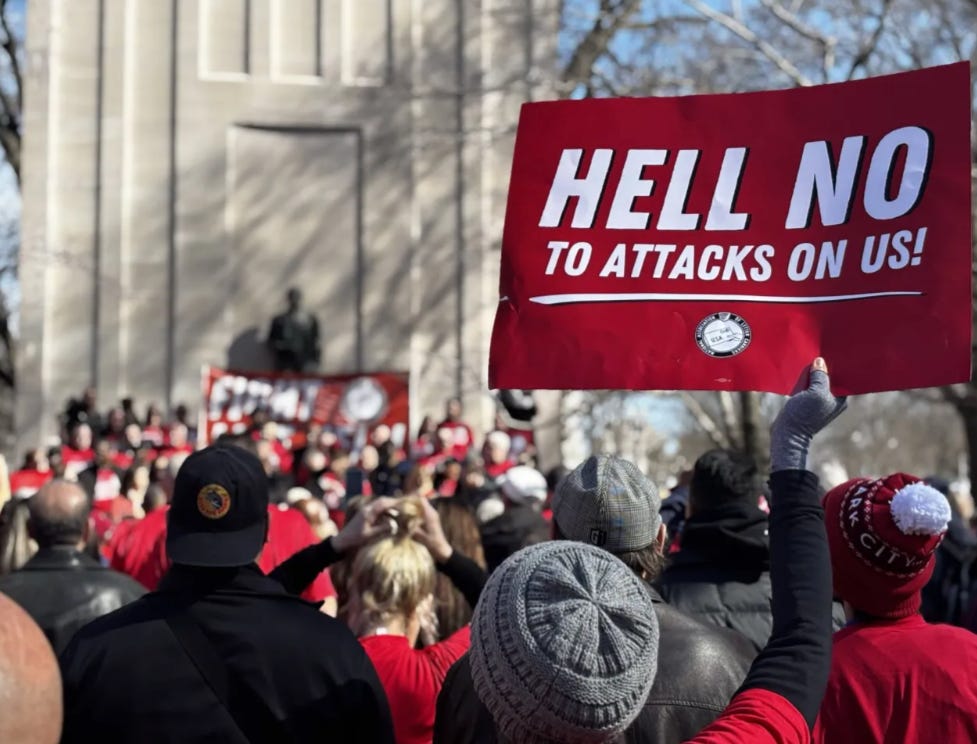
Over the course of the first 100 days, appropriate attention has been paid to Trump’s attacks on the judiciary, law firms, universities, philanthropy, non-profit groups and the media as dangerous in their own right, but more importantly as essential elements of authoritarian consolidationYet almost no one has mentioned the attacks on an equally proven constraint on oligarchy and autocracy: unions. Trump and Elon Musk’s destructive ransacking of our government should remind us of what previous generations of Americans understood intuitively: that “we may have democracy, or we may have wealth concentrated in the hands of a few, but we cannot have both,” as Supreme Court Justice Louis Brandeis put it. Like other attacks on civil society, the Trump regime’s attacks on unions and working people do not just injure those directly targeted, but all of us, as the labor movement is one of the most essential bulwarks against authoritarianism.

I’ve covered the indispensable role of unions in creating and protecting democracy and freedom in earlier Weekend Readings (Oligarchs Understand Power. Do We?As Go Unions, So Goes AmericaMore Than the Weekend: Unions, the Past and the Future of Democracy, and Then they came for the trade unionists).

If we all have a stake in unions as bulwarks against authoritarianism whether we belong to one or not, the same is true because of how unions foster shared prosperity and a healthy society, which I elaborate on here and here. In that regard, it is crucial to recognize the Trump actions as coming from the same playbook as Reagan’s decisive firing of over 11,000 striking air traffic controllers. It was more than punitive—it communicated a clear, aggressive stance against unions nationwide. The immediate aftermath saw corporate America follow Reagan’s lead, significantly increasing anti-union activities and adopting overt union-busting strategies.1 Reagan further entrenched anti-unionism by reshaping the NLRB into a body less protective of labor rights, reversing precedents that had previously safeguarded union activities.2
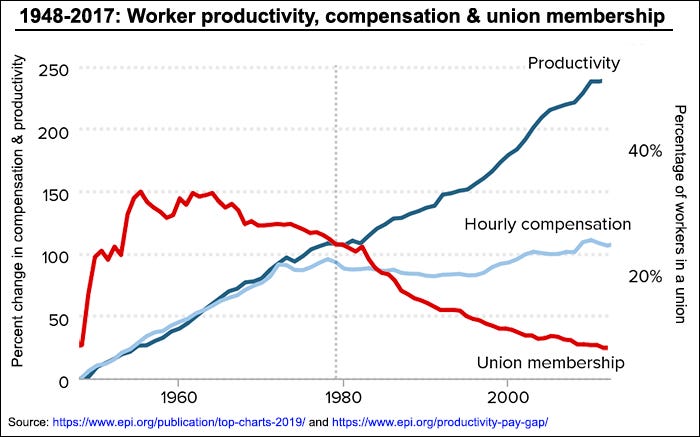
As it did then, today’s federal war on working people comes at a key inflection point. Then it was the rush to globalization, coupled with financialization and deindustrialization. Now it is the imminent transition to artificial intelligence in the workplace. Musk’s firings are providing a new playbook for that transition—fire everyone so as to be able to start from scratch with AI with as little friction from a legacy workforce as possible. And, although not the topic today, it’s important to note here that with respect to DOGE cleaning house to make way for AI, it’s also cleaning house to make way for even more of the government to be privatized—providing a vast market for the tech companies’ AI products and services. Although this future is not certain, it seems to be Musk’s plan: first trash the government, then when the government fails, privatize.

Today, I’ll lay out some of the most egregious actions taken by the Trump regime in the first 100 days to attack unions and working people in both the public and private sectors. Much of this is based on indispensable research by the Economic Policy Institute and its just released 100 Days, 100 Ways Trump Hurt Workers. (For more great reports like this, you can subscribe to EPI here.)

Then I’ll document the robust pushback unions are mounting against the Trump regime’s war on working people in the courts. Unions have also been in the forefront of mobilizing public action, most notably the AFL-CIO’s Department of People Who Work for a Living, which in addition to leading and participating in protests3, has organized town halls across the country.4 AFL-CIO President Liz Shuler declared:

The labor movement is not about to let Trump and an unelected billionaire destroy what we’ve fought for generations to build. We will fight this outrageous attack on our members with every fiber of our collective being.

And, significantly, even sectors mistakenly thought to be pro-Trump like the Building Trades powerfully responded to Trump’s executive order eviscerating collective bargaining for federal workers:

This executive order is an unprecedented assault on worker freedom and a direct attack on those fundamental rights. Americans know that patriotic blue-collar workers built this country, not billionaires. They also know that one of the last best chances to make it to the middle class is collective bargaining. NABTU and our affiliated unions will stand shoulder to shoulder with the entire labor movement to fight this head-on — and we will not back down.

Continue reading Are Working People Meeting the Moment? Prepare for Battle

Trump Administration’S Mass Deportation Plan Would Hurt Pennsylvania, Immigrant Advocates Warn

They urged Democratic lawmakers to pass legislation to make the commonwealth more welcoming

By: Peter Hall

Penncapitol-Star

Nov 14, 2024 – President-elect Donald Trump’s plan to carry out mass deportations of undocumented immigrants would lead to population loss, exacerbate workforce shortages and increase tax burdens for Pennsylvania residents and businesses, the Democratic state lawmakers heard Wednesday.

Advocates for the immigrant community testified before the state House Democratic Policy Committee that although the federal government maintains exclusive authority over immigration policy, which is expected to take a draconian shift under a second Trump administration, state lawmakers can make Pennsylvania a more welcoming place.

“It’s been laid out very clearly. Unfortunately, it’s going to be immigrant detention and deportations on the horizon,” Julio Rodriguez, political director of the Pennsylvania Immigration and Citizenship Coalition, said. “So now it’s crucial that this legislature not only has welcoming policies to support immigrants, but to fight back against these proposals.”

The hearing on the last day of the 2023-2024 legislative session was convened by state Rep. Danilo Burgos (D-Philadelphia), who serves as chairperson of the Pennsylvania Legislative Latino Caucus.

Pennsylvania ranks fourth in the nation in population loss, Rodriguez said. In 2021, the net decrease in population between births and deaths was more than 23,000.

“We didn’t see that impact, because net international migration, also known as immigrants moving here, was 25,721,” Rodriguez said “Had it not been for immigrants, we would have seen a drastic population decline.”

A state’s population determines its number of representatives in Congress. Rodriguez noted that Pennsylvania lost one congressional seat after the 2020 census and could lose another in 2030. It would also result in Pennsylvania receiving less federal funding.

But more immediately, the loss of a portion of the commonwealth’s 978,000 immigrant residents would worsen the labor shortage in the agricultural sector, driving up grocery store prices. Undocumented workers also contribute billions in taxes and in the state’s gross domestic product, Rodriguez said.

Despite Trump, State Progressives Advance Pro-Worker Policies

trump-mouth

While the president goes on the attack, Democratic-controlled states and municipalities forge ahead

By Justin Miller
American Propect

July 11, 2017 – In the face of the Trump administration’s predictably antagonistic stance on pro-worker policies, coupled with the escalating onslaught against worker power in Republican-controlled states, progressives are racing ahead to enact innovative labor laws to help working people in the places where they can.

Over the past eight years, Democrats’ control of government has receded to 1920s-levels, severely hindering progressives’ ability to advance pro-worker labor policy in Washington, D.C., or in the states. As of now, the Democratic Party controls the governorship and legislature in just six states, while progressive power is most concentrated in a few dozen municipalities.

It’s in those places in recent weeks that lawmakers have pushed forward a number of innovative labor laws that present a clear contrast to the Chamber of Commerce-influenced, deregulation-driven labor agenda in the White House.
Improving Home Care

Last week, Hawaii passed a law establishing a cash assistance program for people who are struggling to take care of a sick or elderly family member while maintaining a full-time job. The policy, the first of its kind in the country, takes aim at the increasingly urgent elder care crisis as the massive boomer generation ages and their children struggle to care for them.

“Every eight seconds, somebody turns 65 in America,” Ai-jen Poo, co-director of Caring Across Generations, a group that advocates for policies that improve home care, said on a call with reporters Monday. “It’s a great thing; we’ve extended longevity. And we are wholly unprepared for what the implications are in terms of care.”

Fully half of the workforce will be called on to provide care for an elder within the next five years, the group says. And that’s not a small commitment. Of the 45 million people who currently provide some level of unpaid home care to a relative, more than half are spending about 20 hours a week while also holding down a full-time job.

The Kapuna (the Hawaiian word for elder) Caregiver program would establish a fund to provide full-time workers who are providing care to a dependent elder $70 a day to help offset the burden. A recipient could use that money to help pay for health care, a caregiver, or transportation to a doctor’s appointment.

There are more than 150,000 unpaid caregivers in Hawaii currently, according to estimates by the AARP. And while in-home care or assisted living is expensive, costing between $5,000 and $10,000 a month in the state, the $70-a-day benefit is a small step to helping caregivers balance their lives.

The legislature has provided an initial $600,000 for the program and advocates say they will return to the statehouse next year to bolster funding. Continue reading Despite Trump, State Progressives Advance Pro-Worker Policies

Raise the Minimum wage!


Our County Commissioners agree!

They will be passing a resolution on Thursday evening at their regularly scheduled meeting to support raising the minimum wage.

They have invited us to attend.

THURSDAY 4/23/15 BEAVER COUNTY COURTHOUSE 6:00 PM

Here in Beaver County, we once had a wonderful standard of living. One wage earner made enough to support an entire family. That money flowed through our community, making life better for everyone. We and our neighbors had money for the services that a proliferation of small businesses offered. Our children went to college and happily shopped for their supplies. Hobbies and recreation abounded. Now we have more minimum wage jobs in our County than ever. More of our neighbors are struggling just to pay rent and put food on the table. If their car breaks down, or they get sick and miss work, their family experiences a crisis. On an everyday basis they have trouble buying warm school clothes for their children. More and more of us are winding up in this position.

Continue reading Raise the Minimum wage!

Bernie Sanders Lights a Fire under Pennsylvania Democrats at Keystone Progress’s Annual Summit in Harrisburg

By Carl Davidson

BeaverCountyBlue.org

Feb 8, 2015, Harrisburg, PA. If the vote were taken for the Democratic presidential candidate at the Harrisburg Hilton on Saturday, Feb. 7, Senator Bernie Sanders, Independent of Vermont, would likely have won by a landslide.

That was the spirit in the hotel ballroom as Sanders addressed the 800 people gathered for the PA Progressive Summit. The annual meeting, sponsored by Keystone Progress, brought together progressive activists—community and trade union organizers, women’s right and civil rights groups, hopeful candidates and door knockers—all of whom made up the democratic wing of the Democratic Party, from all across the Keystone State.

“I’m going to try something a little different this morning,” said Sanders to start things rolling, “I’m going to tell you the truth.” He got a wave of laughter and cheers from people who often got something else from politicians.

Sanders with Tina Shannon

Sanders started off with the ‘Citizen United’ Supreme Court decision taking limits off the superrich in funding elections and candidates. “It will go down is history as one of the worse ever made in modern times” Sanders said by way of description. “By a five-to-four vote, it undermined the very foundations of democracy. I know you think the situation is bad, believe me, it’s worse than you think it is.” Billionaires are not satisfied with owning the economy, he explained. They were buying government as well.”

The Koch Brothers, with 85 billion in wealth, were taken as the case in point. Sanders explained that they alone intended to spend over 900 million dollars on the 2016 election—more than the combined total of Obama and Romney in 2012. This meant these “counter-revolutionaries with a far right agenda” would wield more power than both political parties in the recent past.

Turning to the economy, Sanders said while the economy was clearly in better shape than when Obama, first took office, it was still clearly in bad shape. He explained the different meanings of official unemployment figures, with 5.8 percent being the most common number cited, but double that, near 12%, was more accurate.

Then he broke it down further: “We talk a lot about Ferguson, as we should. But we also need to talk more about Black youth unemployment, which is 30 percent. Nobody should be satisfied with where we are today. We have 45 million people living in poverty, another word we need to talk more about today.”

For those worried about deficits, Sanders noted that they had been reduced under Obama. But he also insisted that if they were truly concerned about deficits, they would have stood up against the Iraq war. This remark got wild cheers and everyone out of their seats.

Unfair Impact of Technological Change

Sanders went on to examine ‘the explosion in technology,’ not only i-Phones and i-Pads, but robotics in factories. “All of this has led to a tremendous growth in productivity on the part of American workers.” Such changes logically might suggest workers were paid more or worked shorter hours, he added, “but all of you know, tens of millions of Americans today are working longer hours for less pay.”

This meant anger and stress among workers—impacting both men and women, even if in slightly different ways—needed discussion as a national issue. There was a time, “ancient history” said Sanders, when one worker could work 40 hours and support a family reasonably well. Now women were working along with men, sometimes at two or three jobs, at long hours and low pay, to hobble together enough to support a family. “This causes a lot of anger, and often it’s being angry at the wrong people for the wrong reasons,” he added. “The average male worker, right in the center of the economy, now makes $800 a year less in inflation adjusted dollars than he did 40 years ago. The average female worker in the center makes $1300 a year, even less. They have a lot to be angry about. They want to know why, and our job is to explain it to them.”

Continue reading Bernie Sanders Lights a Fire under Pennsylvania Democrats at Keystone Progress’s Annual Summit in Harrisburg

Beaver County Aid Providers Experience Tough Decisions During Poverty Simulation

Poverty Simulation

A poverty simulation experience presented by Aliquippa Weed and Seed, in conjunction with the Franklin Center’s Disproportionate Minority Contact Project, was held Friday at the Church in the Round. The simulation experience is designed to help participants begin to understand what it might be like to live in a typical low-income family trying to survive month to month. Here, the Rev. Marvin C. Moreland calls to be let out of "jail" during the simulation.

By Daveen Rae Kurutz

Beaver County Times

Nov. 4, 2014 ALIQUIPPA — Food, medicine or utilities.

It’s one of several stressful choices low-income families have to make each month. Keeping a budget in balance when necessary costs — such as housing, transportation and food — require almost all income is just one stressor that leaves people frustrated and looking for help.

That’s the situation several dozen Beaver County-area human-service providers found themselves in last week during a poverty simulation conducted by Aliquippa Weed and Seed and the Franklin Center of Beaver County. The program put participants in the shoes of a family living in poverty.

Participants were assigned to family roles — parents, children and grandparents — and given a budget and a series of responsibilities as part of Missouri’s Community Action Poverty Simulation.

“The whole idea is for human-service providers to have an idea what their clients go through,” said Jonathan Pettis, executive director at the Franklin Center. “They can take the lessons they learned back to their agencies. It’s really powerful.”

The simulation included representatives from Children and Youth Services, county Behavioral Health Services, Uncommon Grounds and other human-service organizations; members of the clergy; and officials from Aliquippa, Midland, Baden and the Blackhawk School District.

Groups were given different scenarios that low-income families regularly experience. Some families had absentee fathers or included children being raised by their grandparents. Other families struggled with divorce, affording college and teen pregnancy.

“The needs are very great,” said Abigail Young, virtual visitation coordinator for Trails Ministries Inc. in Beaver Falls, a faith-based re-entry ministry that works with incarcerated individuals and their families. “There is so much we all can do.”

Young, two of her co-workers and another participant played the roles of the Zuppot family — grandparents “Zola” and “Zeke” and children “Zenobia” and “Zander” — who struggled for four weeks in poverty.

Week One

A cashier at the local grocery store, Zola is the breadwinner for the family. Her husband has limited mobility and has to stay at home unless someone can help him travel.

The family was not able to buy food this week. There weren’t enough transportation passes to get Zola to work, the market and the Paycheck Advance office. When she did make it to cash her check, the office closed before workers could cash the check.

“Even when this family has cash, they can’t get where they need to go,” said Lola Thomas, a family coach with Trails Ministries who portrayed Zeke.

Week Two

The family still can’t buy food. Zola never made it to work after she and Zeke visited an interfaith service where workers gave them all-day transportation passes that they used to get to the bank to cash Zola’s paycheck and Zeke’s disability check.

Continue reading Beaver County Aid Providers Experience Tough Decisions During Poverty Simulation

‘Moral Mondays’ Launched in Western PA

Protesters Rally for Officials to ‘Do the Right Thing’

People gather at the Beaver County Courthouse to raise awareness of several social and economic issues.

By Kirstin Kennedy

Beaver County Times

Oct 28, 2014 – BEAVER — Everyone knows the First Amendment gives citizens the right to assemble. Few regularly exercise it.

But that wasn’t the case Monday evening on the steps of the Beaver County Courthouse, when over 30 people gathered with signs and chants.

Willie Sallis, president of the NAACP in Beaver County, said he helped to gather the protest to pressure elected officials to "just do the right thing."

"What is the moral thing to do? … That’s what we’re trying to keep alive with the union and the civil rights leaders," he said. Sallis paired with several other organizations — including members of local labor unions — for the rally, with the hope of raising awareness of several social and economic issues.

Inspired by a recent lecture given locally by the Rev. William Barber, president of the North Carolina State Conference of the NAACP, Sallis dubbed the rally Moral Monday.

"What’s the right thing to do for the poor?" Sallis said. "What’s the right thing to do for health benefits? What’s the right thing to do when it comes to jobs? What’s the right thing to do when it comes to minimum wages? All we’re saying is, ‘Look, do the right thing.’"

On the courthouse lawn, participants chanted, "Keep it fair; we care."

Continue reading ‘Moral Mondays’ Launched in Western PA

Oct 27: ‘Moral Monday’ Rally at the Courthouse Monday Evening!

From Tina Shannon:

Friends,

Monday, October 27th, is a big day for Beaver County.

It’s the day we’ll have our first Moral Monday rally at the Beaver County Court House.

At 6:00 PM we’ll all gather on the steps of the Court House in Beaver to announce our intentions. We intend to follow our moral compass & use our energy to address the issues facing Beaver County & Pennsylvania.

Public education is under attack. It’s harder than ever to make a living because unions are under attack too. There aren’t enough jobs. Our very water is being threatened because of cuts to the agencies that are supposed to protect it. Inequality is at an all time high, with our brothers & sisters in the African American community suffering the worst. We intend to gather people together & address these issues & other issues that hurt our beloved community.

Please please join us. It’s the beginning of coming together. It’s the beginning of reaching out. It’s the beginning of standing & listening to each other & finding the way forward.

With love & solidarity,

Tina Shannon, 12th CD Progressive Democrats of America
Read more on Moral Mondays:

http://www.thenation.com/article/180491/how-moral-mondays-fusion-coalition-taking-north-carolina-back#
Activists to Watch: Rev. Dr. William J. Barber | BillMoyers.com

The Right Wing’s ALEC Takes a Hit in Harrisburg

Preserving Democracy in Pennsylvania

By: Ellen Bravo

Beaver County Blue via FireDogLake

Oct. 17, 2014 – It had all the trappings of an ALEC-backed attack on democracy:  Push out a bill prohibiting local governments from passing workplace protections in their own communities. If all else failed, tack the measure onto some popular bill as an amendment and hope the supporters of that bill would want it badly enough to allow the hostile amendment to stand.

Only this time the strategy didn’t work, thanks to the strong stand of progressive legislators and the smart organizing of a broad coalition – particularly the leadership of anti-violence advocates.

In this case, the state was Pennsylvania. The preemption attempt was aimed at stopping future passage of a municipal paid sick days ordinance. And the popular bill held hostage was one to aid those who experience domestic violence.

First Rep. Seth Grove, a member of the American Legislative Exchange Council or “ALEC,”  tried to pass a stand-alone bill that would take away the right of local units of government to pass laws ensuring workers could earn paid sick days – or even unpaid leave. Other legislators added multiple amendments to the bill that would have required every elected official to take votes that might have been unpopular with their constituents. The measure didn’t move.

So another ALEC member, John Eichelberger, decided to try a different tack:  stick the preemption provision as an amendment onto a bipartisan bill to help those experiencing domestic violence.  HB 1796 was written to exempt victims of domestic violence from “nuisance ordinances” that allow landlords to evict those who call 911 more than a certain number of times within a given period. The bill had passed the House with broad bipartisan support.

Continue reading The Right Wing’s ALEC Takes a Hit in Harrisburg

Beaver County Still Battling Poverty Problem

Pickup day at a food pantry

By J.D. Prose
Beaver County Times

Sept 28, 2014 – Pastor Avril Vreen doesn’t need newly released data from the U.S. Census Bureau to tell her that poverty is a problem in Beaver County.

All she had to do was watch two young brothers split a free lunch at her Holy Spirit Fellowship Church in New Brighton this past summer. One of the boys agonized over precisely dividing a slice of bread, “which suggested to me that this child has done it before,” she said.

“Right there, I said, ‘This is more necessary than we thought,’” Vreen said of her church’s summer lunch program that served about 2,500 meals to children this year.

According to data recently released by the Census’ American Community Survey, nearly 20,700 Beaver County residents, or 12.4 percent, live below the poverty line, including 6,700 children. That total number represents about a 33 percent increase from 2007, when the county’s poverty rate was 9.1 percent.

In Allegheny County, nearly 13 percent of its 1.19 million residents, or more than 151,000 people, live below the poverty line while almost 14 percent of Lawrence County residents, about 12,200 people, do.
RELATED: How is the poverty level in Beaver County different from the state average? (Info graphic)

The national poverty rate is 14.5 percent, representing about 45 million Americans, according to TalkPoverty.org.

The government’s poverty line is based on annual income. For 2012, the poverty line for a family of four was $23,050 regardless of where the family lives in the United States.

Maj. Richard Lyle, the commander of the Salvation Army in Beaver Falls, said he’s seen the effects of poverty firsthand in the Army’s food pantries and soup kitchens. Five years ago in Beaver Falls the Salvation Army was servicing about 2,000 families a month, but that crept up before making “a significant jump” to about 2,600 18 months ago.

Continue reading Beaver County Still Battling Poverty Problem