Category Archives: Minimum Wage

PA. House Passes Bill To Raise The Minimum Wage

Signs are Senate Republicans may be more open to a hike this time around.

 Photo: State Rep. Roni Green (D-Philadelphia) speaks at a rally in the Capitol rotunda on Tuesday, on raising the state’s minimum wage to $20 an hour

By: Ian Karbal 

PennCapital-Star

June 11, 2025  – The state House voted along party lines Wednesday to raise the minimum wage to $15 for most Pennsylvanians, and to $12 for those working in smaller, rural counties.

It’s a significant step in the latest effort by Democrats to get it above the federal rate of $7.25. 

Pennsylvania’s minimum wage has not been hiked since 2008 and is lower than all surrounding states — New York, Ohio, New Jersey, West Virginia, Maryland and Delaware.

The measure’s sponsor, House Labor and Industry Committee chair Jason Dawkins (D-Philadelphia), said the bill is in an attempt to compromise with Republicans who have long warned about the potential impacts on businesses, especially in smaller counties with a lower cost of living.

“Since I’ve been chair, we’ve been trying to figure out a different approach to get this done,”  Dawkins told the Capital-Star. “This time around, we had a little bit more insight into where our challenges lie, one particularly being that some of our counties were worried about moving too quickly, and some were not comfortable going over $12.”

previous bill sponsored by Dawkins passed the House in 2023, but died in the Republican-controlled Senate. And in 2019, the Senate passed a Democratic-led bill to raise it to $9.25, which died in the then-GOP-controlled House.

Dawkins’ latest bill would see the minimum wage rise gradually each year, reaching $15 in most counties on Jan. 1, 2028. It would also raise the tipped minimum wage from $2.83 to 60% of the minimum.

Counties with populations below 210,000, with the exception of Centre, Monroe and Pike counties, would only see the minimum wage rise to $12 in the same timeframe. A spokesperson for the House Democratic Caucus said the three smaller counties were put in the $15 bracket at the request of Democratic members who represent them.

One exception to the gradual rise to $15 would be Philadelphia County, which Dawkins represents. There, the minimum wage would rise to $15 on January 1, 2026.

“Philadelphia has the highest population of folks who are in what we call deep poverty levels,” Dawkins said. 

He added there is particular urgency given the possibility some of those people may lose access to federal benefits like Medicaid and food assistance under a proposed bill moving through the GOP-controlled U.S. Congress.

“We wanted to have some type of safety net there because we know those folks might be losing benefits and other services,” he said.

But Dawkins’ attempt to offer an olive branch to GOP lawmakers in the form of gradual wage hike and a lower target in small counties appears to have failed in his own chamber. Every House Republican voted against the bill, and many criticized it during a two-hour debate on the floor Wednesday afternoon.

“Not every wage is designed to be a livable wage,” Minority Leader Jesse Topper (R-Bedford) “My 16-year-old son is not working for a livable wage. Someone who is retired and is helping out part-time, that is not necessarily a livable wage.”

He also warned that raising the minimum wage could result in the elimination of low wage jobs and harm small businesses in particular.

Others opposed the very provisions Dawkins said were intended to earn bipartisan support.

Rep. Kate Klunk (R-York) warned that creating different minimum wages across counties could lead to confusion for businesses that cross county lines, or encourage business owners to set up shop where the wage is lower.

“This county-based patchwork of minimum wages is going to be a mess,” Klunk said. She used examples of businesses with locations in York and Adams counties as examples, including golf courses that straddle the border between them.

“This bill is truly unworkable,” she said. “It is a compliance nightmare.”

Rep. Mike Jones (R-York) was one of few Republicans to signal openness to raising the minimum wage during debate, but said he could not support Dawkins’ bill.

“I do commend the majority chair for what I think is a good faith attempt at a reasonable compromise,” he said.

However, he added that he would want to see exceptions to the minimum wage for nonprofits and high-school aged employees.

 ‘Potential to find middle ground’

To become law, the bill will have to pass the Republican-controlled Senate.

Senate Majority Leader Joe Pittman (R-Indiana) said that there may be room for compromise on a minimum wage increase, especially if paired with Republican-backed deregulation efforts he said could help grow “maximum wage jobs.”

“Making sure working families have access to good, family-sustaining jobs is key to helping our commonwealth grow and thrive,” Pittman told the Capital-Star in a statement. “There is potential to finding [sic] a middle ground for an increase, but any possible action would need to be a commonsense adjustment, and sensitive to the impact changes would have on small businesses and non-profit organizations.”

Republican Sen. Dan Laughlin (R-Erie), who has previously introduced a bill to raise the minimum wage to $15, commended the House’s effort, but said he would not support a bill with a county-by-county approach.

“While I appreciate that the House is trying to advance the conversation, I do not support HB 1549 in its current form,” Laughlin said in an emailed statement. “A minimum wage tied to county size just deepens the economic divides we’re supposed to be addressing. If we’re going to get serious about raising the minimum wage, we need to do it uniformly across the state, not with a patchwork approach that leaves people behind based on where they live.”

Laughlin was an early Republican supporter of raising the minimum wage to $15 in Pennsylvania. But national trends may indicate more openness from members of his party this time around.

On Tuesday, conservative U.S. Sen. Josh Hawley (R-Missouri) introduced a bill to raise the minimum wage to $15 for all Americans.

He told NBC News, “If we’re going to be a working people’s party, we have to do something for working people. And working people haven’t gotten a raise in years. So they need a raise.”

His comments reflect an openness to his party’s increasing appeal to working class voters that was made apparent in the latest general election, which saw them move away from their traditional support of Democrats.

Dawkins, the Pennsylvania bill’s sponsor, is also aware of the shift, and hopes that it will help the bill earn the support that it needs to pass.

“I’m excited by the prospects, but I’m also disappointed that there could be a federal minimum wage that’s gonna be higher than the state minimum wage — and it’s being offered by one of the most conservative members of Congress,” he joked. “But I’m hopeful it’ll help folks come around to the idea.”

“This is what I believe we got elected to do,” he added. 

Ian Karbal covers state government for the Pennsylvania Capital-Star. He’s particularly interested in the influence of money in politics and how arcane policies affect Pennsylvanians across the state.

PA Minimum Wage No Longer Defensible

In this March 8, 2016, file photo, Pennsylvania Gov. Tom Wolf meets with diner patrons before discussing his executive order to increase the minimum wage for state government employees and workers on jobs contracted by the state, during a news conference at the Trolley Car Cafe in Philadelphia. (Photo11: Matt Rourke / AP)

By York Dispatch Editorial Board

Feb. 22, 2019 – Pennsylvania’s minimum wage is $7.25 an hour. That’s $58 a day; $290 a week; $1,160 a month. Before taxes.

It hasn’t gone up a penny in 10 years. And it was only increased in 2009 because the federal government mandated it. Neither federal nor state lawmakers have added to this pittance since. They should be embarrassed.

In fact, $7.25 an hour was insufficient 10 years ago; it is insulting today.

Gov. Tom Wolf would like to rectify this shameful situation. Republican lawmakers who control the General Assembly, unfortunately, are evidently shameless.

The governor is again proposing an increase in the state’s minimum wage — something he has done each year since he took office in 2015. His proposed $34.1 billion spending plan would hike the lowest legal wage to $12 an hour this year, then nudge it by annual 50-cent-an-hour increments to $15 an hour by 2025.

Unfortunately, more livable wages are something many GOP lawmakers believe Pennsylvania can live without.

As Wolf’s budget plan began wending its way through Harrisburg’s legislative gauntlet, his minimum wage proposal attracted many a critical GOP eye. Continue reading PA Minimum Wage No Longer Defensible

As Pittsburgh Grapples With A Changing Workforce, The Fight For 15 Comes To Town


2851873691_47cf10c24a_o

In this photo, Pittsburgh’s U.S. Steel Tower, whose upper reaches bear the initials of the city’s largest employer. Flickr Creative Commons/Adam Sacco

By Cole Strangler

International Business Times

Oct 22, 2015 – The tallest building in Pittsburgh owes its title to the industrial giant that made the city famous. But instead of its floundering namesake, the U.S. Steel Tower now displays the initials of a different sort of employer: the University of Pittsburgh Medical Center, or UPMC.

When the signage went up eight years ago, it seemed, as the New York Times noted, to perfectly epitomize the evolution of a city and its labor force — from an economy once world-renowned for its manufacturing might to one focused on “eds and meds”; a place where the working classes flock to booming research institutions and hospitals, not coke plants or blast furnaces.

In the old economy, steelworkers won pay raises and benefits that transformed what used to be a grueling, low-wage job into a virtual ticket to the middle class. But according to policymakers and labor advocates, too many workers in the new Pittsburgh are still struggling to make ends meet.

At hearings slated to kick off Thursday, a newly-formed, city council-backed wage committee plans to shed light on the problem — and consider a potential remedy: Whether to follow the examples set by Seattle, San Francisco, and Los Angeles and adopt a $15 hourly minimum wage, more than double the current statewide minimum of $7.25. This is the core demand of the Fight For 15, the protest movement backed by the powerful Service Employees International Union (SEIU).

“We’ve been talking about the need to increase the minimum wage, but we’ve not really linked that to the benefits it can bring to the city or to workers and their families in a succinct way,” says Reverend Ricky Burgess, the committee’s architect and lone representative from city council. “What I want to do is provide some data.”

In addition to testimony from economists and poverty experts, the data will likely come first-hand from low-wage workers themselves — people like Justin Sheldon, 34. He’s one of 62,000 people who work at the University of Pittsburgh Medical Center, the largest private employer in Pennsylvania, and by far, the largest employer of any kind in the Pittsburgh metropolitan area.

Medical residents at the hospitals tend to earn over $50,000 a year, according to the employee review site Glassdoor. But the more than 10,000 service workers — the people who staff cafeterias, transport patients and sterilize equipment, among other things — earn substantially less. They make an average of $12.81 an hour, UPMC said last year. The health care provider did not respond to request for comment.

“My reason [for supporting $15] is pretty simple,” says Sheldon, a housekeeper at the UPMC Presbyterian hospital. “I want to be able to support my family — properly.”

Sheldon makes $12.52 an hour and works 48 hours a week, cleaning doctor’s offices, conference rooms and restrooms. He says he can barely pay the bills for his household, which includes two young children, ages six and four. His wife is visually impaired and receives Social Security disability payments, about $700 a month, he says. They pay $600 a month to rent a house in McKees Rocks, a blue-collar community that overlooks the Ohio River.

“Anything I save up usually ends up getting used” he says. Within a week of the next paycheck, “I’m usually down to $30 or less.”

Continue reading As Pittsburgh Grapples With A Changing Workforce, The Fight For 15 Comes To Town

Minimum Wage Debate Heats Up in Pennsylvania

Meagan Gemperlein, 25, is a part-time tipped worker at Pittsburgh’s Wigle Whiskey. Wigle owners say they pay each of the workers at least twice the tipped minimum wage of $2.83.

By Molly Duerig
Beaver County Times

Sept 1, 2015 – PITTSBURGH — Cori Shetter is a college graduate and aspiring actress who’s worked minimum-wage jobs for 15 years.

“It’s like swinging from Tarzan vine to Tarzan vine. One vine’s about to end and break, so you just grab the next one, but you’re never really putting your feet on solid ground,” said the 31-year-old Pittsburgh resident.

Living in her Lawrenceville home is only possible because her parents own it, and Shetter pays them as much of the mortgage and other expenses as she can.

The one major thing she could do to further her career goals — auditioning — has fallen by the wayside as she invests most of her time in serving jobs for small, but reliable, paychecks. She supplements that by cutting hair for up to 10 clients a month at home.

Many servers, like Shetter, earn Pennsylvania’s tipped minimum wage of $2.83 per hour. The standard minimum wage, both state and federal, is $7.25.

Many believe the minimum wage hasn’t kept up with the times, and movements to raise it are being led by grassroots groups and governments in communities across the nation. In June, Los Angeles became the biggest city in the country to raise its minimum wage to $15 by 2020.

Nineteen U.S. cities and counties experienced mandated wage increases this year; 29 states and Washington, D.C., already require employers to pay workers more than $7.25.

Pennsylvania isn’t part of this group – yet.

There are five bills pending in the state Legislature proposing to raise the minimum wage, with different methods and standards ranging from $8.75 to $15. Some politicians and business owners said they worry that putting this mandate on employers could mean fewer job openings and other cutbacks in the business community.

“If minimum wage is hiked, many of these jobs will vanish, or work hours will be drastically cut,” state Rep. Stephen Bloom, R-Cumberland, wrote in an email. “Employers simply find less costly alternatives, either through automation, technology or other means.”

Even economists, who also have opinions, disagree about the impact. Although some studies indicate a minimum-wage increase would cause job losses, other studies show just the opposite, said Sean Flaherty, the economics chair at Franklin & Marshall College in Lancaster.

“There’s just no strong consensus evidence that this is a significant problem when you have a modest increase in the minimum wage, done in stepwise fashion,” Flaherty said.

The proposals

The federal wage hasn’t increased since 2009, when it rose from $6.55 to $7.25. In 2008, it rose from $5.85.

Several states, counties and cities are taking the matter into their own hands.

In Pennsylvania, the most ambitious proposed bill is from Sen. Daylin Leach, D-Delaware, Montgomery. His “One Fair Wage” bill would raise the wage to $15 an hour and tie it to inflation across the board, for regular and tipped employees.

Continue reading Minimum Wage Debate Heats Up in Pennsylvania

Beaver County Commissioners Urge Raise in Minimum Wage


Union-bug

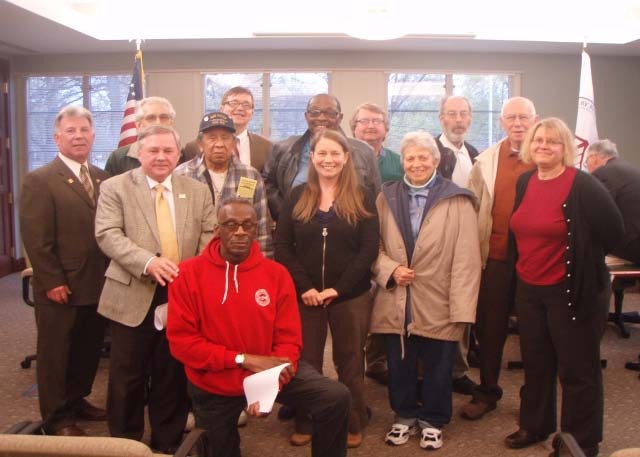
Kneeling: T. Berry; Standing First Row: Commissioner Tony Amadio; Alex de la Cruz; Tina Shannon; Myra Fabrizio; Janet Hill; Second Row: Commissioner Joe Spanik; Randy Shannon; Steven Kocherzat; Linwood Alford; Mark Benkart; Peter Deutsch; Rev. Ed Heist

By Linwood Alford
Council Director of Civil Rights and Economic Development

I want to thank the Beaver County Commissioners Tony Amadio and Joe  Spanik for supporting a resolution "urging the state legislature to approve a raise in the Pennsylvania minimum wage from the pre-sent $7.25 per hour to $10.10 per hour". The resolution was approved by their two votes, with Com-missioner Dennis Nichols abstaining, at the Commissioners’ meeting of April 23rd.

The Labor Council approved a resolution calling for a raise in the minimum wage to $10.10 per hour at its November membership meeting. SEIU Healthcare Pa. staff representative and Labor Council Trustee Kerrianne Theuerl arranged transportation for Council members to attend "Raise the Wage" rallies in Harrisburg in February and Pittsburgh in April.

The minimum wage resolution was placed on the Commissioners’ meeting agenda thanks to the efforts of Mark Benkart, Labor Council Com-munity Services Director and our local Moral Mondays chair-person, and Tina Shannon, president of the 12th C.D. Chapter of Progressive Demo-rats of America (PDA).

Mark and Tina spoke in favor of the resolution at the Com-missioners’ meeting. Also speaking in favor of the resolution were Janet Hill, national vice-president of CLUW, Rev. Ed Heist and your writer.

Minimum wage jobs destroy the morale of those who are unable to support their families even though they are working full time. A raise in the mini-mum wage to $10.10 per hour will build the self-esteem of these workers by assuring them that they can support their families.

Poverty is a weapon of mass destruction that makes people angry against each other be-cause self-preservation will always be the first law of nature. If we can work to eliminate weapons of mass destruction in other countries, why can’t we work to eliminate poverty at home?

I am truly thankful for all those of us who really believe in liberty and justice for all.