“No Fracking Way! No Fracking Way!” was the chant resounding off the steel, granite and glass walls in downtown Pittsburgh on the sunny afternoon on Nov. 3, as nearly 500 environmental activists headed for the David Lawrence Convention Center. Their target was a gathering of 2000 natural gas drillers being addressed by Karl Rove, advisor to former President George W Bush.
Inside, the industry executives were meeting to discuss the “future” of hydro-fracking gas drilling and planning to use heavy explosives to blast apart the 4000-foot-deep Marcellus Shale formation to get the natural gas beneath.
“Only a dying soul,” said Stephen Cleghorn, “can contemplate the destruction of life that they’re discussing in that building right now!” Cleghorn is Reynoldsville, PA farmer, and his views reflected those of many semi-rural residents of Pennsylvania and other nearby states, where water was polluted and cattle died.
“They promise people all sorts of money,” said Bob Schmetzer, “but what’s your home worth if you have bad water? Nothing!” Schmetzer, carrying a placard demanding ‘prosecute the polluters,’ is the council president of South Heights in Beaver County, and the vice president of the 4th CD Progressive Democrats of America.
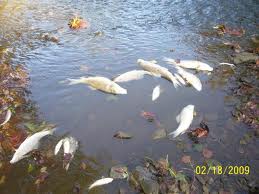
Fish Killed by Frack Fluid Discharge into Mon tributary Dunkard Creek
Rep. Jim Christiana Misrepresents the 15th District
by Bob Schmetzer, V.P.
PA 4th CD Chapter, PDA
I met with the PA 15th Legislative District State Representative on Tuesday Sept. 21st in Harrisburg and on Friday Sept. 24th in Monaca. I presented him with information about the effect of Marcellus shale drilling on our area.
I asked if my name was on the PA Homeland Security list. I read that attendees of the Marcellus Shale informational breakfast in Georgetown were listed. I wanted my name removed. He said he had other names removed in the past. He didn’t say if it was listed or not.
I spoke about the well in Marion Township, Beaver County. My wife and I went past in the truck and got a mouth full of the burn-off fumes from the stack. The fire raged about 50 feet over to the trees along the field. It took about a half hour for the sandy foul taste and uneasy feeling to clear out of our mouths, throats and lungs.
Rep. Christiana argued that none of the residents complained. He could care less about us, nor showed any compassion. I told him of my concerns about the deadly volatile chemicals that were being used, both in the earth and on top. He said the industry is very careful not to spill any of the frack fluid. “But accidents will happen, so what?” was the attitude.
I asked about the fish kills around the state. He assured me that a fishing group from the Susquehanna River said the fish are fine. I asked the name of the club. He stumbled and floundered and could not come up with a name. Earlier I had spoken to a member of the PA Fish Commission. He told me that the Monongahela River was the best Musky fishing in the USA. Now, they are all dead because of the recent water pollution from disposing partially treated fracking mud into the river.
I asked Rep. Christiana about the Impact Fee on gas drillers. He called it a severance Tax and blamed the Democrats for the budget problems. I said I had spoken to the fish commissioner who told me that their only income is through License fees and Federal Excise tax. That the fish commission is depleting its resources dealing with drilling and problems with water and fish kills. There is no help from the state.
Representative Christiana said that the fish commission doesn’t need to be out there. I suppose if no reports are written, then nothing happened. I told him that I was a life member of Trout Unlimited, and we have been cleaning up Pennsylvania streams for 50 years from the last ecological disaster. He noted that we are still cleaning the streams up.
I then said that I am a life member of the Viet-Nam Veterans and that I would never believe my government again that the chemicals won’t hurt me! This brought him to silence. So I left and he said he didn’t think he had my vote. I smiled.
Now lets go to work to replace him. He misrepresents the 15th legislative district. Any help and all help would be greatly appreciated.
The movie “Gasland” — about the environmental hazards of drilling and “fracking” shale for natural gas — has become a national sensation.
The documentary has aired repeatedly on HBO in recent months. Critics, including some Pennsylvania government officials, say it’s a piece of propaganda riddled with inaccuracies. Fans say it opened their eyes to what really happens when drillers come to town.
Either way, it has become a force to be reckoned with in the ongoing political debate over Marcellus Shale in Pennsylvania. The film will be shown outdoors Tuesday in Reservoir Park.
Director Josh Fox is a native of Wayne County, and much of the film focuses on Pennsylvania problems and policies. In an interview last week, Fox spoke about the film’s impact.
08/23/10 – The United Auto Workers is the latest union to join the BlueGreen Alliance, which unites labor and environmental groups pushing for greenhouse gas limits and other policies to create “green” jobs.
The UAW — also known as the International Union, United Automobile, Aerospace and Agricultural Implement Workers of America — claims to have more than 390,000 active members.
“UAW members produce best-in-class cars and trucks, key vehicle components, and top quality heavy-duty trucks, and we know that we can rebuild the American auto industry by building cleaner, more efficient vehicles — and developing the technologies that will get us there,” UAW President Bob King said in a statement Monday about joining the BlueGreen Alliance.
“We have enormous opportunities to revitalize this industry, and the American economy, by embracing the clean energy economy of the future,” he said.
DEP secretary issues warning at Marcellus shale conference at Duquesne University
Tuesday, May 04, 2010
By Don Hopey, Pittsburgh Post-Gazette
Pennsylvania needs tougher regulations for Marcellus shale gas drilling, aggressive, independent enforcement, and a severance tax on the gas extracted, according to state Department of Environmental Protection Secretary John Hanger.
And yesterday would not be soon enough to get all of that done and “done right” to protect the state’s water resources, said Mr. Hanger in a forceful keynote speech opening the Marcellus Shale Policy Conference at Duquesne University on Monday.
“Let me be clear: Self-regulation doesn’t work. That’s not contestable,” Mr. Hanger told the audience of about 250, including a significant number of gas industry representatives. “We’ve made mistakes before. We have to get this right or the costs will overwhelm the benefits.”
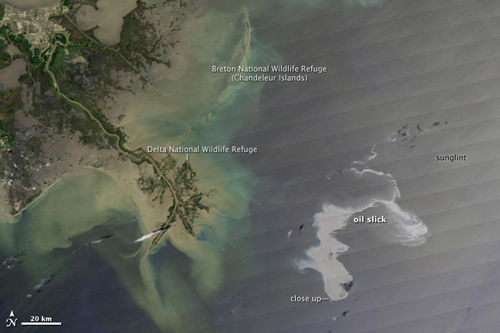
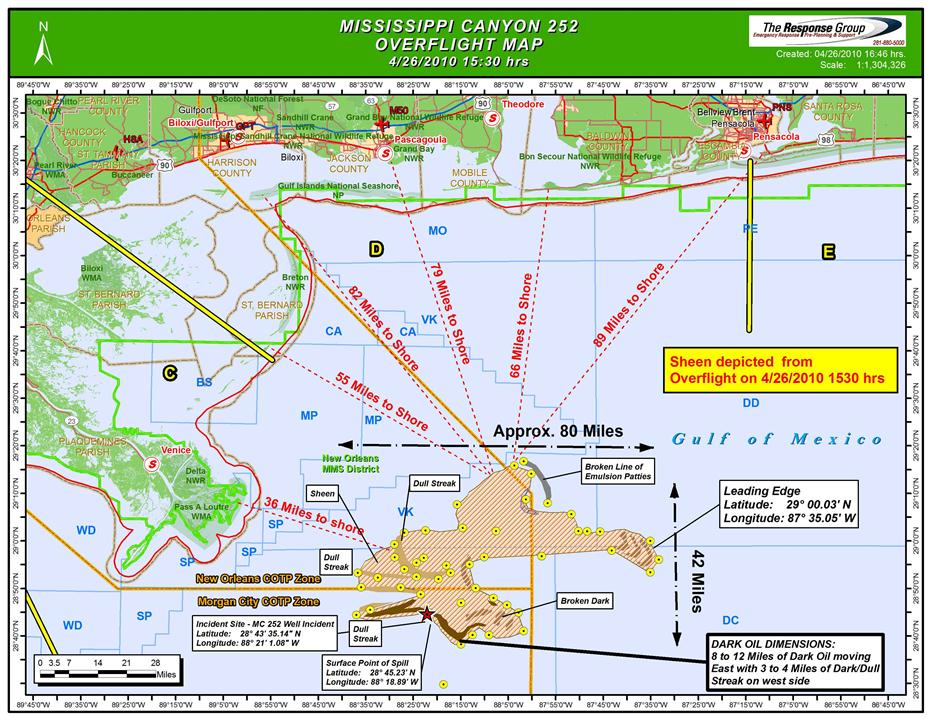
The Deep Horizons ultra-deepwater dynamic positioned semi-submersible oil drilling rig, lying upside down a mile below sea level, was built and owned by Transocean Limited of Vernier, Switzerland. This rig was the most technologically advanced drilling machine on earth, designed to tap oil reserves miles below the ocean’s surface. It was completed in 2001 by Hyundai Heavy Industries in Ulsan, South Korea. British Petroleum was leasing the rig at a cost of one-half million dollars per day to exploit oil and gas trapped under tremendous pressure miles below.
Just as Secretary of Defense Robert McNamara thought that advanced technology would allow U.S. weaponry to defeat the people of Vietnam in the 1970s, the Wall Street banks now believe that current ‘advanced technology’ will allow them to tap unknown forces of nature…at a profit.
They justify this endeavor with the argument that exploiting natural resources always involves some endemic risk and that they are insured to protect their investors. Wall Street and their oil industry allies believe that, as in the past, disasters are a cost of business and that once the cleanup is done there will be a return to profitability.
Profits from deepwater drilling, as well as the fracking of the Marcellus shale in Pennsylvania and New York, are projected to be enormous, to create dazzling new fortunes for those who are bold, hardy, and carefree enough to get there first. These expectations of great wealth from expensive and refractory resources are based on the knowledge that the world, but especially the United States, is rapidly using up, and to a great degree wasting, petroleum and gas reserves. As the reserves shrink and become more expensive to exploit, the push to find and exploit them intensifies.
Feb 5, 2010 – The green-collar jobs movement just got another major boost: a groundbreaking new report underscores how the growing green economy can provide high quality jobs for those who need them most. The author, Professor Raquel Rivera Pinderhughes of San Francisco State University, is a leading national expert on green-collar jobs.
This report deepens our understanding of how to harness green business growth to build pathways out of poverty. Prof. Pinderhughes’ research provides us with critical guidance as we develop the Oakland Green Jobs Corps, the nation’s first attempt to carry out the model that Professor Pinderhughes describes in her report. Continue reading Green Jobs – Invest Where We Need It Most→
It feels more like Halloween than Thanksgiving for many Pennsylvanians.
Poverty is worse than first believed. Using a formula that accounts for rising Medicare premiums, deductibles and a coverage gap in the drug benefit costs, a recent report said almost 47.5 million Americans lived last year in poverty, seven million more than the government’s official figure.
PDA Endorses Direct Carbon Pricing with Revenue Recycling
October 22, 2009, Washington, DC
On October 21, Progressive Democrats of America finalized a months-long process with our endorsement of direct carbon pricing, with revenue recycling as the preferred method for reducing carbon dioxide in the Earth’s atmosphere. Read the statement here.



 ‘A force to be reckoned with’