Category Archives: Economy

Are Working People Meeting the Moment? Prepare for Battle

https://www.weekendreading.net/p/the-trump-regimes-war-on-working

The Trump Regime’s War on Working People: The First 100 Days
Weekend Reading

How Unions are Resisting Authoritarian Attacks on Workers’ Rights—and Why It Matters for Everyone

By Michael Podhorzer

Apr 28, 2025

Over the course of the first 100 days, appropriate attention has been paid to Trump’s attacks on the judiciary, law firms, universities, philanthropy, non-profit groups and the media as dangerous in their own right, but more importantly as essential elements of authoritarian consolidationYet almost no one has mentioned the attacks on an equally proven constraint on oligarchy and autocracy: unions. Trump and Elon Musk’s destructive ransacking of our government should remind us of what previous generations of Americans understood intuitively: that “we may have democracy, or we may have wealth concentrated in the hands of a few, but we cannot have both,” as Supreme Court Justice Louis Brandeis put it. Like other attacks on civil society, the Trump regime’s attacks on unions and working people do not just injure those directly targeted, but all of us, as the labor movement is one of the most essential bulwarks against authoritarianism.

I’ve covered the indispensable role of unions in creating and protecting democracy and freedom in earlier Weekend Readings (Oligarchs Understand Power. Do We?As Go Unions, So Goes AmericaMore Than the Weekend: Unions, the Past and the Future of Democracy, and Then they came for the trade unionists).

If we all have a stake in unions as bulwarks against authoritarianism whether we belong to one or not, the same is true because of how unions foster shared prosperity and a healthy society, which I elaborate on here and here. In that regard, it is crucial to recognize the Trump actions as coming from the same playbook as Reagan’s decisive firing of over 11,000 striking air traffic controllers. It was more than punitive—it communicated a clear, aggressive stance against unions nationwide. The immediate aftermath saw corporate America follow Reagan’s lead, significantly increasing anti-union activities and adopting overt union-busting strategies.1 Reagan further entrenched anti-unionism by reshaping the NLRB into a body less protective of labor rights, reversing precedents that had previously safeguarded union activities.2
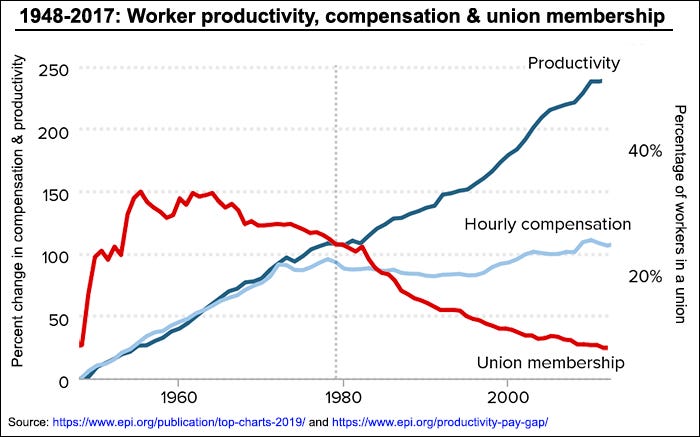
As it did then, today’s federal war on working people comes at a key inflection point. Then it was the rush to globalization, coupled with financialization and deindustrialization. Now it is the imminent transition to artificial intelligence in the workplace. Musk’s firings are providing a new playbook for that transition—fire everyone so as to be able to start from scratch with AI with as little friction from a legacy workforce as possible. And, although not the topic today, it’s important to note here that with respect to DOGE cleaning house to make way for AI, it’s also cleaning house to make way for even more of the government to be privatized—providing a vast market for the tech companies’ AI products and services. Although this future is not certain, it seems to be Musk’s plan: first trash the government, then when the government fails, privatize.

Today, I’ll lay out some of the most egregious actions taken by the Trump regime in the first 100 days to attack unions and working people in both the public and private sectors. Much of this is based on indispensable research by the Economic Policy Institute and its just released 100 Days, 100 Ways Trump Hurt Workers. (For more great reports like this, you can subscribe to EPI here.)

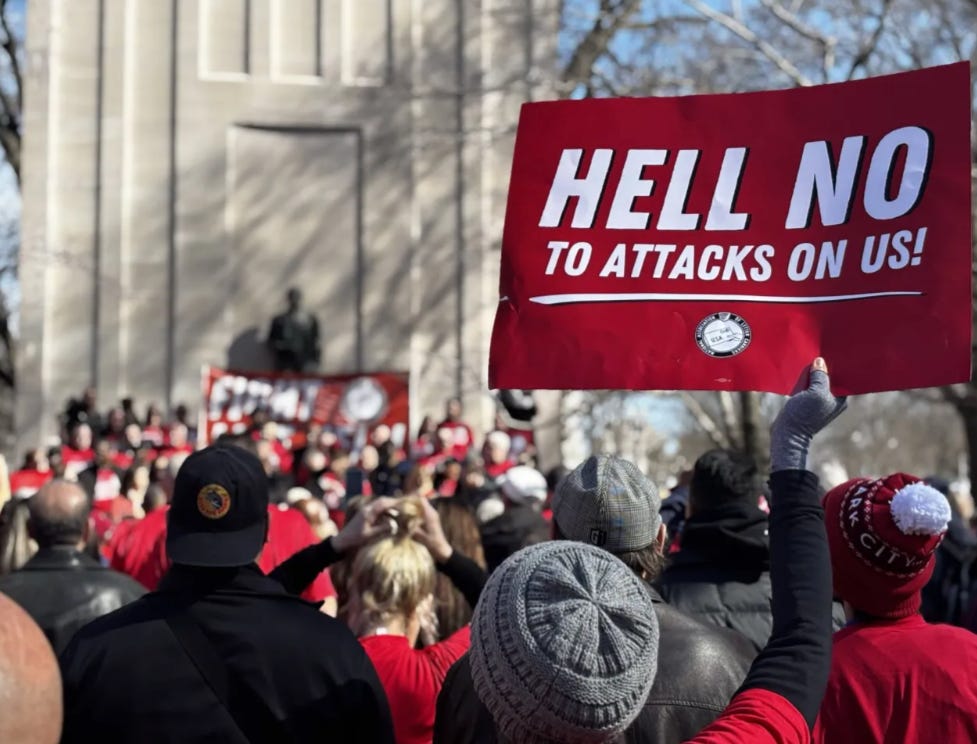
Then I’ll document the robust pushback unions are mounting against the Trump regime’s war on working people in the courts. Unions have also been in the forefront of mobilizing public action, most notably the AFL-CIO’s Department of People Who Work for a Living, which in addition to leading and participating in protests3, has organized town halls across the country.4 AFL-CIO President Liz Shuler declared:

The labor movement is not about to let Trump and an unelected billionaire destroy what we’ve fought for generations to build. We will fight this outrageous attack on our members with every fiber of our collective being.

And, significantly, even sectors mistakenly thought to be pro-Trump like the Building Trades powerfully responded to Trump’s executive order eviscerating collective bargaining for federal workers:

This executive order is an unprecedented assault on worker freedom and a direct attack on those fundamental rights. Americans know that patriotic blue-collar workers built this country, not billionaires. They also know that one of the last best chances to make it to the middle class is collective bargaining. NABTU and our affiliated unions will stand shoulder to shoulder with the entire labor movement to fight this head-on — and we will not back down.

Continue reading Are Working People Meeting the Moment? Prepare for Battle

I’m a Rust Belt Democrat From a Swing District. Anti-Tariff Absolutism Is a Mistake.

A black-and-white photograph of a car’s rearview mirror showing an industrial plant.
Credit…Eli Reed/Magnum Photos

By Chris Deluzio

Mr. Deluzio represents Pennsylvania’s 17th Congressional District.

The New York Times Op-Ed

March 7, 2025 – Democrats have wasted no time rejecting President Trump’s tariffs as “damaging” and “unnecessary.” My colleagues have lampooned them as “irresponsible,” “bad economics” and purely a tax on consumers. This anti-tariff absolutism is a mistake.

I’m a Rust Belt Democrat from a swing district in Western Pennsylvania — where lousy trade deals like NAFTA stripped us for parts.

Many of my constituents support smart tariffs, particularly ones that target China, and so do I. Watching my colleagues on the Hill, it’s clear we’re missing the mark. Democrats need to break free from the wrong-for-decades zombie horde of neoliberal economists who think tariffs are always bad.

Mr. Trump’s tariff approach has been chaotic and inconsistent. There’s no doubt about that. But the answer isn’t to condemn tariffs across the board. That risks putting the Democrats even further out of touch with the hard-working people who used to be the lifeblood of the party — people like my constituents.

Instead, Democrats should embrace tariffs as one component of a broader industrial strategy to revitalize American manufacturing and make whole communities that have been hollowed out by decades of bad trade policy. This isn’t just about making the economy work for more Americans; it’s also about earning back the trust and faith of the people we need to win elections and who ought to be at the heart of the Democratic Party.

Since the 1990s, presidents from both parties pushed trade agreements that were great for corporate bosses and their Wall Street overlords, but a disaster for districts like mine. American companies offshored production to take advantage of cheap labor in countries like Mexico, which for decades have crushed independent unions to keep wages rock bottom. Later, firms shifted production to China and Vietnam, which are often called out for employing beggar-thy-neighbor tactics like wage suppression, enormous subsidies and currency manipulation to jack up their exports.

For too long, we absorbed these unfair imports and created a chronic trade deficit that deindustrialized our nation and fueled income inequality. In 2004, the grandfather of modern trade economics, Nobel Laureate Paul Samuelson, revealed how offshoring could cost American workers more in relative wages than they gained from cheaper imported goods, making the current trade regime a bad deal for most Americans.

Tariffs are one of a few tools that can break this cycle: They force mercantilist countries to increase their domestic consumption of what they produce because they can no longer dump it in the United States. Increasingly, policymakers — of all political stripes — recognize that tariffs can help protect industries that are key to our economic and national security, boost American production and wages, and safeguard workers’ rights as well as our air and water by incentivizing firms to raise their labor and environmental standards.

If you oppose all tariffs, you are essentially signaling that you are comfortable with exploited foreign workers making your stuff at the expense of American workers. I am not and neither are most voters. Many polls show that Americans — especially the three-fifths without college degrees — support tariffs in part, economists have suggested, because communities harmed by global competition view them “as a sign of political solidarity.” The Biden administration, to its credit, tripled tariffs on Chinese steel and aluminum imports. So, why is the Democrats’ only message on tariffs that they raise prices? That was the play during the 2024 election and it flopped. Just last month, a CBS poll found that a majority of Americans one, thought Mr. Trump was not focused enough on lowering prices, two, believed that tariffs could increase prices and three, still wanted tariffs on China.

Rather than reflexively condemning all tariffs, Democrats should be highlighting how Mr. Trump’s scattershot threats, unanchored to any real industrial strategy, will not deliver on the goals of rebuilding American manufacturing, raising wages or rebalancing trade.

For one thing, tariffs are effective only when used in a predictable and stable way — and the Trump administration’s approach has been anything but. On Feb. 1, Mr. Trump announced he was imposing new 10 percent tariffs on China and fixing part of a trade scam that allows four million packages to enter the United States daily without facing tariffs, taxes or meaningful inspection — simply because they’re labeled “low value.” Not only does this “de minimis” loophole undermine U.S. producers and retailers, but traffickers also often exploit it to sneak in deadly fentanyl-laced pills and fentanyl precursor chemicals. Days after his announcement, Mr. Trump flip-flopped and reopened the loophole. He raised China tariffs another 10 percent on March 4 — good! But still, the loophole means billions in Chinese imports can evade tariffs and inspections.

Mr. Trump’s chaotic tariff two-step — imposing, delaying, threatening and then again imposing tariffs, including on allies like Canada with whom we mainly have balanced trade — is bad business for America. Entrepreneurs ready to invest in production here sit on the sidelines, wondering where the tariff roller coaster will stop. (Continued)

Pittsburgh Could Be A Green Energy Hub. But Does It Have The Workers?

Photo: High voltage electrical equipment at the University of Pittsburgh’s GRID Institute at the Energy Innovation Center in Pittsburgh’s Hill District on Feb. 10. (Photo by Quinn Glabicki/PublicSource)

As research and investment flow to the region, Pittsburgh strives to develop a workforce to build the green energy future.

By Quinn Glabicki and Alice Crow
PublicSource

February 24, 2025 -Brandon Grainger stood beneath a towering, 13,800-volt webwork of power lines and transformers constructed inside a laboratory at the Energy Innovation Center in the Hill District, home to the University of Pittsburgh’s GRID Institute. Solar panels layer the sawtooth roof and a prototype wind turbine spins high above the parking lot. Both provide energy to the lab, and a research opportunity for those seeking to understand how to best integrate renewable energy.

As power demands increase from booming tech and AI development, the GRID Institute studies how to efficiently get electricity where it’s needed, and Grainger and other professors prepare students to eventually work in advanced industry.

But concerns persist, and a question remains: Do we have enough labor — from doctoral candidates to electricians — to meet the demands of the future?

“Well, the answer is no,” said Granger, an associate professor of electrical engineering. His graduate students, mostly electrical engineers, are being hired nearly eight months before they graduate, he said, and undergraduates, too, are being scooped up by industry well before they leave campus.

Industrial electrical equipment with interconnected metal structures and cylindrical components in a facility.

Southwestern Pennsylvania has the industrial capacity and hard-working heritage to be a bedrock of green energy manufacturing and development at a time when climate-friendly projects awaiting connection to the grid could go a long way toward addressing energy supply challenges.

Research and investment is already flowing to the region, but as green energy development accelerates, the local stock of legacy labor might not match the demand for workers, potentially posing a serious risk to the sector’s development amid quality control issues and delays. At the same time, local efforts are striving to train and graduate new workers to help meet the need. (Next page)

On Why the USW, Biden and Trump are Right about the Nippon/USSteel Ripoff

By Ike Gittlen

https://ikegittlen.substack.com/

For months the proposed sale of USSteel to Nippon Steel has been front page news. The Committee on Foreign Investments in the United States (CFIUS), that reviews the national security implications of these global transactions is reportedly at an impasse and unable to come to a determination.

The reality is that what CFIUS decides (or doesn’t) is irrelevant. Both the incumbent President and the President-elect have said they will not approve the deal. It’s slowly dawning on people that this deal isn’t likely to happen.

We shouldn’t be surprised. Opposing the Nippon/USSteel deal is the logical response to all that we have learned about the steel industry, the “free trade” model of global trade, the importance of maintaining domestic control over critical supply chains and how the big money vultures strip-mine our stable industrial/manufacturing enterprises. It isn’t, as Nippon/USSteel would like us to believe, something that must happen or USSteel will collapse. Once this bad deal is gone, we know there are a number of options to retain and enhance USSteel’s assets.

To understand what’s happening we have to start with the global steel overcapacity. The OECD reports a global steel overcapacity exceeding 500 million metric tons, with some estimates reaching as high as 630 million metric tons. This has nations with overcapacity (China in the lead) looking for places to dump their steel production. Our nation is a lucrative place to offload unneeded steel. Interestingly, Nippon is reportedly looking to do deals in other nations with lucrative steel consumption, as the USSteel deal falters.

It’s fantasy to believe that once Nippon owns USSteel it won’t use it to move its overcapacity here. Simply look at the cases that the USW and the Steel Industry have won at the International Trade Commission, to get a flavor of how blatant other nations have violated our trade laws to gain access our steel market. The failure of Nippon to offer credible and enforceable commitments to continue American domestic production, should convince us of their real intent. This is the heart of the national security concern. That if Nippon is allowed to own such a large part of American steel capacity, the will result will be steel shutdowns here and less ability to supply our own needs of this critical economic sector.

More Details: Company To Build $218 Million Steel Plant On Former J&L Land In Aliquippa

Groundbreaking ceremony in Aliquippa, May 16, 2023

By Chrissy Suttles
Beaver County Times

ALIQUIPPA – A New York-based company plans to revive Aliquippa steel production with a $218 million advanced manufacturing facility on land once occupied by J&L Steel’s tin mill.

72 Steel, founded in 2016 by Chinese-American entrepreneurs, committed Tuesday to purchase the land owned by developer Chuck Betters to build a steel fabrication plant on 44 acres of the historic Aliquippa Works site along the Ohio River.

The operation will include an electric-arc furnace — a steelmaking technology with lower carbon intensity than traditional methods — to melt scrap steel and produce 500,000 tons of rebar, or reinforcement steel, annually for a variety of industries. Its production capacity and output value are expected to reach $400 million.

An artist's rendering of the proposed 72 Steel plant on the former site of J&L Steel Aliquippa Works.
Artist rendering of the new mill

Once complete, the company expects to hire 300 to 400 permanent employees, but hundreds of construction workers will be needed to build the facility, roadways, parking space, product storage areas and ancillary buildings. Regional union leadership could not immediately comment on whether they’re in talks with 72 Steel to hire union builders and/or operators. The plant’s anticipated completion is 2025; it will be 72 Steel’s first manufacturing site.

72 Steel plans to use “energy-saving and environmental protection technologies” during production, including air and water pollution control equipment and an electric-arc furnace from Italian technology supplier Tenova.

Xiaoyan Zhang, senior business adviser at 72 Steel, said the company’s decision to build was prompted by the 2021 federal Bipartisan Infrastructure Law that included $110 billion in new funds for roads, bridges and other major projects. The company toured sites in West Virginia, Ohio and North Carolina before settling on Beaver County due to its river and rail access and the Pittsburgh region’s enduring history of steelmaking.

https://f5e32e578b895ba9f2e95edab680b6ba.safeframe.googlesyndication.com/safeframe/1-0-40/html/container.html

The company’s $218 million investment is “an initial investment,” Zhang said. “Maybe, down the road, there would be some additional (investment).” Company leadership, he said, “feels proud as Chinese Americans about making America great and supporting the infrastructure bill.”

The Jones & Laughlin Steel Mill in Aliquippa.
The old J&L

The move has been in the works for months; 72 Steel leadership toured the proposed facility late last year alongside landowner Chuck Betters, state and local officials and members of the Allegheny Conference on Community Development. State business filings show 72 Steel registered with Pennsylvania in June 2022.

“Pittsburgh has a celebrated history as the manufacturing powerhouse that built the modern world,” said Matt Smith, chief growth officer at the Allegheny Conference. “Today, we are positioned as the region where the next-generation of manufacturing is happening now – spanning advanced, additive, green manufacturing and more.”

J&L Steel’s mill at 611 Woodlawn Road opened in 1910 and expanded in 1947 for tin plate production. It operated until the 1980s when Aliquippa Works, by that time owned by LTV Corp., closed amid the region’s steel collapse.

Aliquippa Works at one time employed more than 10,000 workers; nearly 8,000 people were out of jobs when the site closed, leaving former company town Aliquippa financially ruined with a disintegrated tax base. The site was later demolished and, in recent years, served as a staging area for Shell’s ethane cracker plant in Potter Township.

Aliquippa Mayor Dwan Walker hugs developer Chuck Betters at a 72 Steel groundbreaking ceremony.
Mayor Walker congratulating a partner.

“My dad put 18 years in at this very site,” said Aliquippa Mayor Dwan Walker during a Tuesday groundbreaking ceremony. “My father walked out of this mill in ‘86 thinking steel was never going to come back. I was so emotional this morning thinking about the possibility of what will be … I can’t wait to see cars come through that tunnel with stickers: ‘My kid goes to Hopewell,’ ‘My kid goes to Beaver Falls,’ or ‘My kid goes to New Brighton.’ I can’t wait to see those stickers come through that tunnel like when my dad was working here.”

72 Steel has not yet closed on the deal, but Betters said they’re on their way. The Beaver County developer pledged to invest $1.5 million of his own money into the project within seven days of closing.

“I’m comfortable you’re very honorable people,” he told 72 Steel leadership. Once the deal closes, planning and environmental permitting will begin.

Most of the remaining Aliquippa Works land is now owned by cellular PVC manufacturer Versatex and U.S. Minerals, which makes roofing and abrasive products like coal slag abrasives, iron silicate roofing granules and mineral fillers.

Tuesday’s groundbreaking featured speakers from 72 Steel and state, county and local lawmakers and figureheads.

“It’s always about jobs, jobs and more jobs,” said state Rep. Rob Matzie, D-16, Harmony Township. “There were some close calls on this property, suitors have come and gone, and we are hopeful … we will see construction. I live across the river, growing up in the ‘70s and ‘80s, I was able to see the J&L smokestack on this property. I still live up on that hill, and I’ll be able to see this new construction when it’s complete, hopefully, sooner rather than later.”

https://f5e32e578b895ba9f2e95edab680b6ba.safeframe.googlesyndication.com/safeframe/1-0-40/html/container.html

Stephanie Sun, executive director of former Gov. Tom Wolf’s Advisory Commission on Asian/Pacific American Affairs, called Tuesday’s event a milestone for Chinese Americans living in Pennsylvania, noting that May is Asian/Pacific American Heritage Month and Asian Americans are the fastest-growing racial or ethnic group in the United States.

“The Asian/Pacific American community is also the fastest-growing population in the United States with a strong international network of investment and business opportunities,” she said, adding it’s been just 80 years since the repeal of the federal Chinese Exclusion Act.

Aliquippa Mayor Dwan Walker honors Huabin Lin, chairman of 72 Steel, with an Aliquippa flag.
Mayor Walker with new steel officials.

Beaver County Commissioners’ Chairman Dan Camp said the groundbreaking marked a new era of Beaver County steel, adding Beaver County is “always open for business.”

“We want to bring more work to the area, and assist communities where they can raise a family,” Camp said. “To make Beaver County what it was when the steel mills were running 24 hours a day, seven days a week with a strong focus on economic growth and creation of good-paying jobs. Just like (Walker’s) father, my relatives and many other Beaver Countians who worked tirelessly on this very ground to help create the rich history that Beaver County has today.”

A New, Massive Plastics Plant in Southwest Pennsylvania Barely Registers Among Voters

Environmentalists in Beaver County alarmed by harmful emissions from the plant once it opens say they are discouraged by most voters’ inattention, but not deterred.

By Emma Ricketts

Inside Climate News
November 5, 2022

Photo: Shell’s new petrochemical plant in Beaver County, Pennsylvania. Credit: Emma Ricketts

Environmentalists Fear a Massive New Plastics Plant Near Pittsburgh Will Worsen Pollution and Stimulate Fracking


Oct. 27, 2017 – A New Shell Plant in Pennsylvania Will Soon Become the State’s Second Largest Emitter of Volatile Organic Chemicals


ALIQUIPPA, Pa.—From the tranquility of her garden in Beaver County, Pennsylvania, Terrie Baumgardner worries that her grandchildren will grow up without access to clean air, clean water and a safe space to play outdoors.

For decades, Beaver County’s economy has been dependent on polluting industries—first steel, and more recently natural gas drilling. Many longtime residents, who remember the prosperity brought by the steel industry, have welcomed the construction of a massive new Shell petrochemical plant and the politicians that support it.

Baumgardner and other environmental activists are discouraged that local residents and politicians favor the continuation of fracking and the new mega plastics plant it has spawned, but they are not giving up their fight.

“People say that’s what we do in Beaver County—we trade our health for jobs,” Baumgardner said. “But it’s unfortunate, because it doesn’t have to be that way now.”

A reluctant activist, Baumgardner first became involved in environmental issues in 2011, when she learned about the dangers posed by fracking. Concern for the environment and health of local residents led her to canvas for signatures in 2016 as Shell moved toward building the plastics plant.

Spanning nearly 800 acres along the Ohio River, the plant is expected to open later this year. The facility will convert fracked gas into 1.6 million metric tons of polyethylene per year.

Polyethylene, made from ethane, a form of natural gas, is the key building block in numerous common plastic products—from food wrapping and trash bags to crates and bottles.


Despite assurances from Shell that the facility will be safe for the surrounding community, environmental activists have warned that the plant will cause air and water pollution, and a protracted dependence on fracking.

Under Shell’s permit, the plant can release up to 159 tons of fine particulate matter and 522 tons of volatile organic compounds per year. Exposure to these emissions has been linked to issues in the brain, liver, kidney, heart and lungs. They have also been associated with miscarriages, birth defects and cancer.

“They’re going to unload all of these toxic chemicals, hazardous air pollutants, volatile organic compounds and millions of tons of CO2 gas. What’s going to happen?” asked Bob Schmetzer, a local councilman from nearby South Heights and a long-time spokesperson for Beaver County’s Marcellus Awareness Committee. He has opposed the plant since it was first proposed 10 years ago.

Jack Manning, a Beaver County Commissioner, does not share these concerns. “I have great faith in the technology and in the competency of those that will be running the facility,” he said. “It’s a state-of-the-art, world-class facility.”

Manning blamed people’s apprehension on unfair comparisons between the environmental impacts of the plant and those of the steel mills that used to occupy the area. “Those heavy particulates are a different type of pollution,” he said.

Shell has assured residents of the safety of its plant. “At Shell, safety is our top priority in all we do and that includes being a good neighbor by communicating about plant activities that could cause concern if not expected,” Virginia Sanchez, a Shell spokesperson, said in a statement. “When we are in steady operations, it is our goal to have little to no negative impact on our neighbors as a result of our activities.”

For activists, these assurances do little to allay concerns. On a grassy hillside overlooking the massive complex, Schmetzer spoke with his friend and fellow activist, Carl Davidson. While the plant is not yet operational, the grinding sounds of industrial machinery and screeches of train cars disturbed the clear fall day.

Photo: Bob Schmetzer and Carl Davidson, standing above the petrochemical plant. Credit: Emma Ricketts


Davidson, a self-professed “solar, wind and thermal guy,” wore a Bernie cap and alluded to his youth as a student leader of the New Left movement in the 1960s. While he estimates that around one-third of residents were concerned about the plant’s potential impacts from the beginning, he expects this number to grow once it opens. “People are starting to see two things,” he said. “Number one, there is all kinds of pollution that they didn’t know about. And second, all the jobs that were promised aren’t real.”

The plant sparked hope for a revival of economic prosperity in the area. However, now that construction is largely complete and thousands of workers have finished working on the site, the plant is expected to only employ about 600 people going forward, according to Shell.

While opponents wait anxiously for the plant to begin operations, they don’t think it will influence next week’s elections. The Shell plant has been a non-issue in the tight race for the 17th Congressional District in Beaver County between Democrat Chris Delluzio and Republican Jeremy Shaffer, both of whom support continued fracking.

In the state’s closely watched U.S. Senate race between Democrat John Fetterman and Republican Mehmet Oz, both of whom support fracking, the environment has barely come up in a nasty campaign focused on abortion rights.

Similarly, fracking and the environment have hardly been mentioned in the governor’s race between Democrat Josh Shapiro, the state’s attorney general, and Republican state Sen. Doug Mastriano, a Trump supporter and election denier.

Beaver County, while only counting for 1.3 percent of the votes cast in any given election in Pennsylvania, is a bellwether, according to Professor Lara Putman of the University of Pittsburgh. “It is socio-demographically similar to counties that, collectively, make up about one-quarter of Pennsylvania’s population. So in that sense, when Beaver shifts other places are usually shifting as well,” she said.

Baumgardner called the political candidates’ silence “disheartening.”

“I wish they would have the courage to speak up, to take a position and stick with it,” she said.

However, she understands the political risks associated with taking an environmental stand in a community that believes its economic fortunes are tied directly to pollution. She just wishes this wasn’t still the case. “We have alternatives,” she said. “We just need our political leaders to embrace them and get serious about renewables and removing the subsidies on fossil fuels.”


According to Davidson, the key to awakening the public is to ensure that alternatives are tangible. Good ideas aren’t enough to make people give up the job opportunities they have, he said. Clean energy projects are great in theory, but until workers can see a real job with similar wages, many will continue to support the status quo.

Progress might be slow, but Baumgardner, Davidson and Schmetzer remain hopeful that the realities of the plant will sway public opinion once residents’ senses are assaulted with the acrid smells and cacophony of relentless sound they expect the new plastics plant will emit. They each stand ready to educate people on its health and environmental impacts, as soon they are ready to listen. They may be discouraged, but are not deterred.

“Nothing is going to shut me down as long as my grandkids are here,” Baumgardner said.


Emma Ricketts is a graduate student at Northwestern University’s Medill School of Journalism. She focuses on politics, policy and foreign affairs reporting, with a particular interest in climate change and environmental issues. Previously, Emma practiced as a lawyer in a New Zealand-based commercial litigation team where she focused on climate-related risk.

West Virginians Lead Blockade of Coal Plant That Made Manchin Rich

‘This is what the fight for a habitable planet looks like in real time.’

By Julia Conley
Common Dreams

April 9, 2022 – Organizers of the “Coal Baron Blockade” protest which targeted right-wing Democratic Sen. Joe Manchin’s coal empire Saturday afternoon reported that state police almost immediately began arresting campaigners who assembled in Grant Town, West Virginia.

“Sen. Joe Manchin’s policies hurt poor people and hurt our environment so deeply that activists are ready to put themselves on the line,” tweeted the Poor People’s Campaign, which joined grassroots group West Virginia Rising and other organizations in the blockade.

Hundreds of campaigners participated in the blockade of Grant Town Power Plant, which receives coal waste from Enersystems, the company owned by the West Virginia senator’s son. Manchin earns $500,000 per year from Enersystems—”making a very lucrative living off the backs of West Virginians,” said Maria Gunnoe, an organizer of the action, this week.

At least 10 demonstrators had been arrested as of this writing.

“This is what the fight for a habitable planet looks like in real time,” said Jeff Goodell, author of The Water Will Come, of the dozens of campaigners who risked arrest.

Speakers and other participants highlighted the need for a just transition away from fossil fuels including coal, carrying signs that read “Solidarity with all coal workers.”

“My dad worked in a chemical plant until he retired with a disability from acute exposure,” said Holly Bradley, a ninth-generation West Virginian. “We can all find common ground, but Joe Manchin is making it impossible.”

Continue reading West Virginians Lead Blockade of Coal Plant That Made Manchin Rich

Report: Pennsylvania Stands To Gain 243,000 Jobs A Year From Clean Energy Investment

Workers install solar panels on the roof of Global Links, a medical relief nonprofit, in Green Tree, Pa., on Wednesday, Feb. 5, 2020. JARED MURPHY / 90.5 WESA

By AN-LI HERRING
WESA-FM

Jan 28, 2021 – Although President Joe Biden’s actions on climate change have stirred anxieties about job loss in energy-producing states like Pennsylvania, a new report predicts that plans like Biden’s could create roughly a quarter-million jobs annually in the Commonwealth. And within hours after the report’s release, local officials announced a small but symbolic down payment on green energy investment.

The 243,000 clean-energy jobs that could be created each year over the next decade in Pennsylvania “are jobs across the board,” said Robert Pollin, a professor at the University of Massachusetts Amherst and one of the study’s authors.

“We’re looking at jobs for carpenters, machinists, environmental scientists, secretaries, accountants, truck drivers, roofers, agricultural labor,” Pollin said, referring to positions that would be required to achieve higher energy efficiency standards, develop new products and infrastructure, and restore land that’s been used for mining and drilling.

UMass Amherst’s Political Economy Research Institute released the report Thursday, a day after Biden signed a round of executive orders that aim to supercharge the country’s efforts to curb carbon emissions.

Co-authored by Pollin, the report quantifies the potential impact on Pennsylvania jobs of a clean energy strategy developed by ReImagine Appalachia, a coalition of progressive policy and environmental groups. The coalition seeks to facilitate a “just transition” to a clean energy economy in Pennsylvania, Kentucky, Ohio, and West Virginia, whose economies have traditionally depended on extraction-based fossil fuel industries. ReImagine Appalachia’s blueprint strives to ensure those states can generate well-paying jobs during a decades-long shift to carbon-free energy.

With adequate funding over the next 10 years, the plan would fuel the creation of an average of 162,000 jobs annually in clean energy and 81,000 positions a year in public infrastructure, manufacturing, land restoration, and agriculture, according to Thursday’s study.

The study estimates that an average annual investment of $31 billion would be needed from both the public and private sectors. During the presidential campaign, Biden pledged to invest $2 trillion in such efforts, with the goal of eliminating carbon pollution from the power sector by 2035 and from the entire U.S. economy by 2050.

“The level of funding necessary [is] a lot. But it’s 3 percent of [the] GDP of the state … So it’s affordable,” Pollin said. And he noted that the employment gains his report predicts would amount to about 4 percent of the state’s workforce.

“So if you’re looking at an economy which has a 7 percent unemployment rate [similar to Pennsylvania], these programs lower the unemployment rate to 3 percent – that’s how dramatic it would be,” Pollin said.

Powering up

Allegheny County took a modest step toward that goal on Thursday, when County Executive Rich Fitzgerald announced that, starting as early as mid-2023, all county-owned facilities will draw energy from a low-impact hydropower plant located on the Ohio River.

Fitzgerald called the move a “long-term investment in how we light and power our facilities using our natural resources without using fossil fuels.” He said it comes during a “landmark week,” during which the county met federal air quality standards for the first time ever.

Continue reading Report: Pennsylvania Stands To Gain 243,000 Jobs A Year From Clean Energy Investment

THE RUST BELT BOOM THAT WASN’T: HEARTLAND JOB GROWTH LAGGED UNDER TRUMP

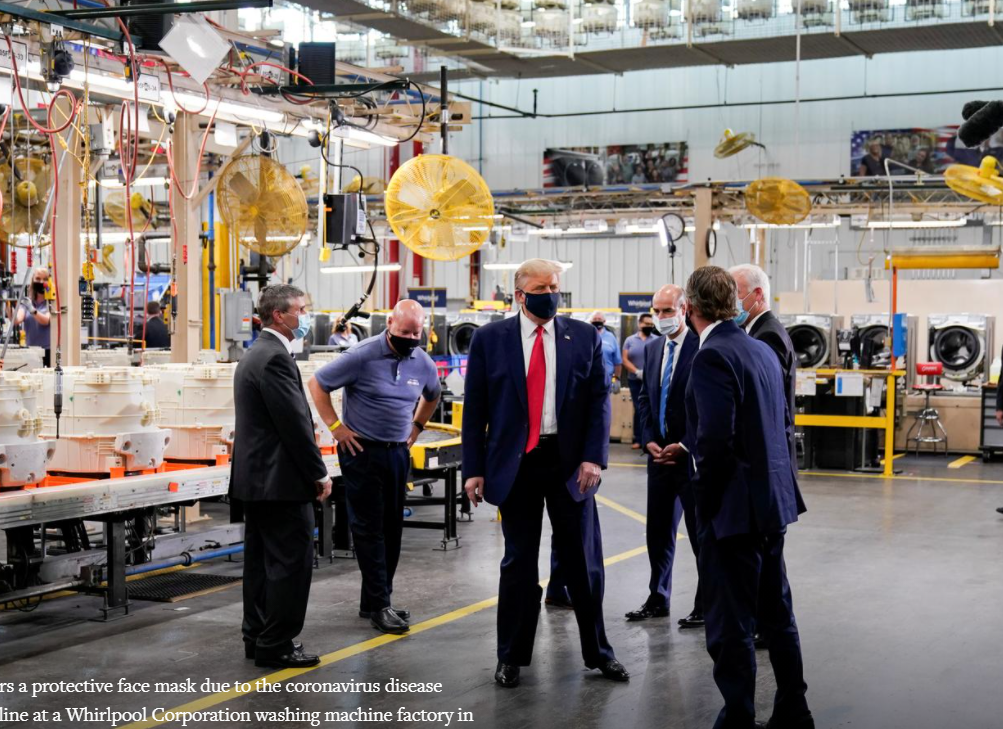
U.S. President Donald Trump wears a protective face mask due to the coronavirus disease (COVID-19) pandemic as he tours the assembly line at a Whirlpool Corporation washing machine factory in Clyde, Ohio, U.S., August 6, 2020. REUTERS/Joshua Roberts/File Photo

By Howard Schneider

Reuters

Oct 27, 2020 – The voters of Monroe County, Michigan, may have expected an economic windfall when they flipped from supporting Democrat Barack Obama to help put Donald Trump in the White House in 2016.

But it went the other way: Through the first three years of the Trump administration the county lost jobs, and brought in slightly less in wages in the first three months of 2020 than in the first three months of 2017 as Trump was taking over.

And that was before the pandemic and the associated recession.

With the U.S. election just a week away, recently released government data and new analysis show just how little progress Trump made in changing the trajectory of the Rust Belt region that propelled his improbable rise to the White House.

While job and wage growth continued nationally under Trump, extending trends that took root under President Obama, the country’s economic weight also continued shifting south and west, according to data from the U.S. Quarterly Census of Employment and Wages that was recently updated to include the first three months of 2020.

Continue reading THE RUST BELT BOOM THAT WASN’T: HEARTLAND JOB GROWTH LAGGED UNDER TRUMP

Donald Trump Campaigned on Restoring Manufacturing Jobs in Pennsylvania

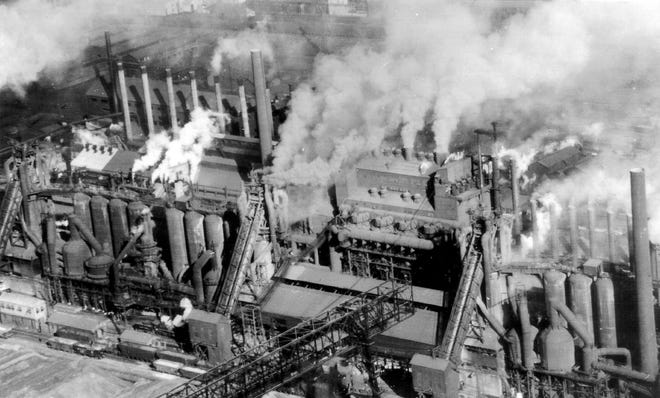
Steel plant in Clairton, PA

Has He Kept That Promise?

By Laura Olsen
The Morning Call / Lehigh Valley

Dec 9, 2019 – Booming. Thriving. The best economy ever.

President Donald Trump loves to tout job numbers, particularly when he’s in Pennsylvania. When he returns to the state for a campaign rally Tuesday, fresh off a national jobs report showing strong gains, expect to hear a lot about the economy and manufacturing during his tenure.

“Since President Trump’s election, Pennsylvania has added 157,800 new jobs, including 2,900 manufacturing jobs,” Michael Glassner, the chief operating officer for Trump’s re-election campaign, said in a statement ahead of the rally. “President Trump is delivering on his promises.”

Democrats, however, have sketched out a much different economic picture in Pennsylvania. They point to a report showing Pennsylvania had lost the most manufacturing jobs of any state in the country — roughly 8,000 — between August 2018 and August 2019.

So who is right?

The data

When Trump took office in January 2017, Pennsylvania had 561,200 manufacturing jobs, according to data from the federal Bureau of Labor Statistics. That’s roughly the same number as in 2009, after employment plunged amid the Great Recession. State manufacturing crept back to 570,000 jobs by late 2014, before dipping again over the next two years.

During the first two years of Trump’s term, manufacturing jobs showed gains in Pennsylvania, peaking in October 2018 at 572,500. But the trend reversed, dropping back to 561,600 in July of this year before ticking back up again to 562,800 in October.

The Trump campaign’s 2,900 figure for manufacturing jobs gained counts gains made during the months between his November victory and January, when he actually became president. Pennsylvania had 559,900 manufacturing jobs in November 2016, according to BLS figures.

Looking beyond manufacturing, overall job growth in Pennsylvania has shown a steadier upward climb during that same period, rising from 5.9 million jobs in January 2017 to nearly 6.1 million jobs in October. Unemployment in the state has fallen since 2017, hitting a record low in April at 3.8% before rising slightly to 4.2% in October.

Tariff ripple effects

One factor that has caused uncertainty for employers in manufacturing and other sectors has been the Trump administration’s escalating trade war and broad use of tariffs. Continue reading Donald Trump Campaigned on Restoring Manufacturing Jobs in Pennsylvania