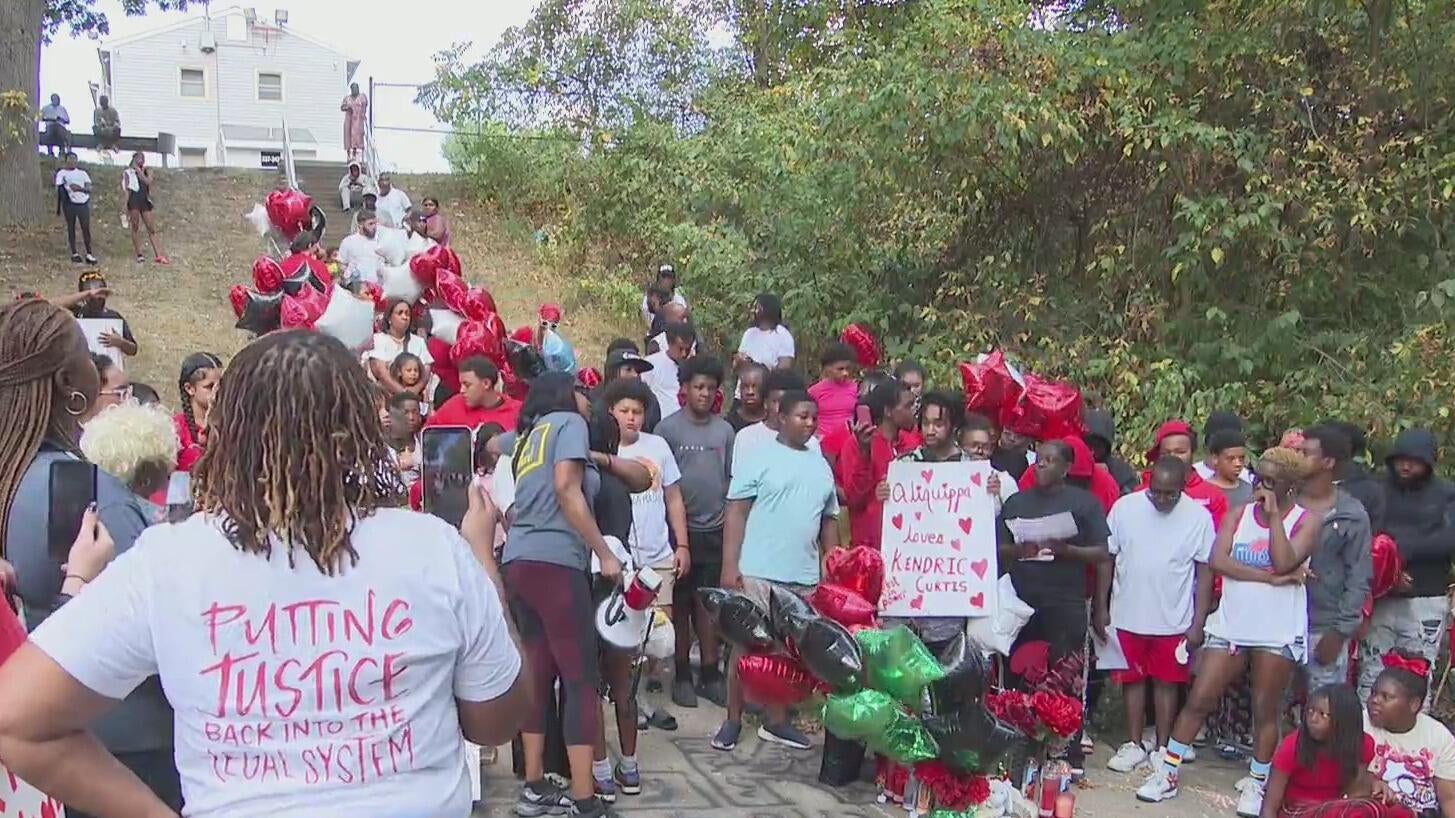
Sept 21, 2025 – Aliquippa community comes together to remember 18-year-old shot and killed by ATF agent 02:17 The Aliquippa community both honored the life of 18-year-old Kendric Curtis and called for accountability and transparency during a vigil on Sunday.
An ATF agent shot and killed the Aliquippa High School student on Thursday after state police say Curtis shot at an officer in Aliquippa’s Linmar Terrace neighborhood.
The emotional vigil featured Curtis’ sisters and girlfriend.
“When I heard what happened, it felt like it ripped my heart out, and it took a part of my soul,” Curtis’ girlfriend said. “I just want answers for my boyfriend.”
While the event focused heavily on Curtis’s life, the bubbling anger in the community was also present.
Pennsylvania State Police say officers ahead of the shooting tried to make contact with Curtis before he ran away and shot at them. The ATF and FBI were working on a joint investigation when the shooting took place.
His sisters said their brother was being painted in a bad light, calling him a “good person” who “everyone loved.”
“I feel like my son was targeted and wrongfully killed by the police,” Curtis’ father wrote in a letter that was read aloud at the vigil. “I don’t know what happened, but I know my son is not here to share his side of the story.”
Neighbors told KDKA-TV on the night of the shooting that the ATF agent, whom they believed had shot Curtis, was in plain clothes.
Community leaders have asked for patience as more information comes out. Skeptical community members, some of whom don’t believe law enforcement’s version of what happened, want more information now.
“We demand an answer why, we demand that answer why. Give us that answer,” said organizer George Powell. “Give us those cameras, give us that man in handcuffs who took that little kid’s life. It’s been three days and we’ve heard nothing.”
Neighbors hoped to change more than just a narrative about Curtis.
“We have to stand up and show everyone that Aliquippa is not just about guns, drugs, death, murder, football, [or] sports,” said one of the speakers. “We got young men growing up and dying daily, and we’re going to stand up.”
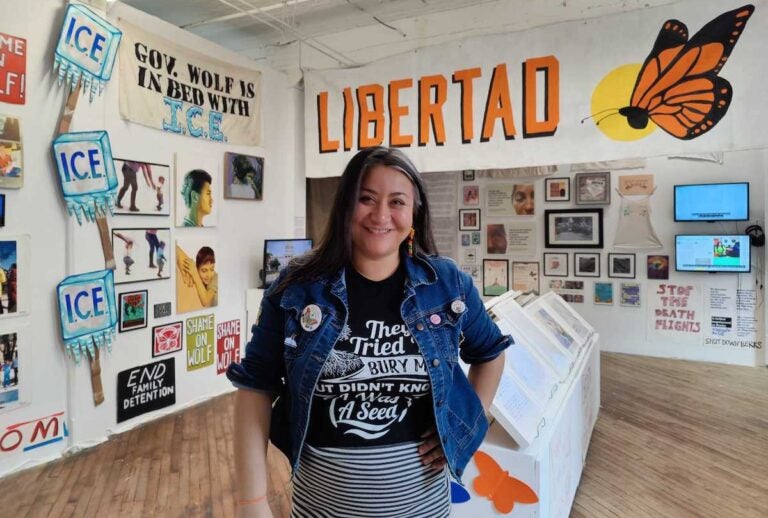
Photo: Jasmine Rivera was an organizer with the Shut Down Berks Coalition, and curated the exhibition “Queremos Justicia: Cómo cerramos Berks,” at the Vox Populi gallery in Philadelphia in 2023. (Peter Crimmins/WHYY)
By Jeffrey Lichtenstein
One PA
Jan 7, 2025 – We’re holding several big questions as we move into 2025 that we hope to learn and struggle through together with our funding partners. All of our work, especially our organizing, advocacy, and outreach efforts, will be working through these questions.
Quality vs Quantity of Doors
Where and when can we initiate and join conversations about the quality of field work rather than simply the quantity of door knock and phone call attempts? The efficacy of canvassing in low-salience elections is statistically unquestionable but in presidential election cycles there is suddenly a great amount of noise. Some of this noise is the result of large-scale vended field programs with weak quality control practices or very low contact rates.
What could it look like to move toward an eco-system wide model for field work that prioritizes the number and quality of conversations, volunteers recruited, and leaders trained? One PA prides itself on high contact rates and rigorous quality control but we still have much to learn. We hope to share and leverage best practices across locally rooted partners and begin to shift the paradigm around field work from quantity alone, to quality and quantity.
Making organizing power more legible
Even the strongest most rigorous electoral field program faces structural challenges with management, hiring and training under conditions of limited funding and time. These efforts also, by their nature, are demobilized and dismantled after an election, even when we know there is another election just around the corner, not to mention countless other opportunities for voters to flex their voice in government and strengthen their civic participation. Political and civic organizing, unlike electoral campaign mobilizations, grow rather than diminish in efficacy and power over time. What would it look like to quantify, validate, resource and scale the civic power of organizing? One PA was successful in 2024 in using every door conversation to begin an organizing pathway. We identified 33,000 hot leads to join One PA. We’re proud of this work, but we have real areas of growth in learning how to maximize the conversion between hot leads and new volunteers.
Dimensions and Cost of Building Precinct Based Structure
The term ‘organizing’ has been stretched in recent years to mean all manner of engagement. At One PA we are working with multiple battle-tested organizing models in an attempt to integrate the best practices of each in a way that can be quantified, studied and validated at every stage using contemporary data tools and tech. Our model combines dues-based membership, structure based organizing units, systematic leadership development, polarizing campaigns and experimentation. We are proud of our work in 2024 to launch a guardians of democracy and elections captains program.
In the year ahead we plan to scale the program by a factor of five, and are holding questions about what level of resource and training this will require at each level of the organizing structure. Independent Voice It is clear our movement must get upstream of elections in the battle to make meaning out of our communities’ lived realities. By the time candidates win their primaries, the ability to shape what that election will be about is out of the hands of most people except the elite few with an extraordinary amount of influence on the candidates. We are asking ourselves the question: what capacities and practices do we need as a movement to help frame the questions in front of people long before an election?
How can we roll into a cycle with voters broadly knowing already that housing is too high because of slumlords and rollbacks on government investment, not because of immigrants? We know part of the answer is an independent voice for Black and multi-racial working class communities, to help compensate for brand weakness in the Democratic party, to ensure voters feel they are heard, and to guarantee a more healthy mix of ideas about what it will take to fix this country. How can we build the power and independence of this voice in a way that our more traditional and conservative allies won’t attempt to smother in its cradle?
Winning the Internet
We’re also holding questions about how to respond to the reality that the Internet is increasingly becoming a place our communities rely on for social and political queues. Cynical or hateful voices have a head start in offering narrative frames in the digital space. We are holding questions about what it looks like to bring an organizing approach and significant investment in mass communications to organize our base in digital space, win over leaders and taste makers in non-legacy media, and contest for narrative primacy on the internet.
Training to Win next quarter and next decade
Training is critical for nearly every aspect of our plan, especially the proposition that we grow in capacity and power over time, and the responsibility to rebuild a majority. We are clear that we must level up the rigor and scale of our training program, and sit with the question about what kind of training school and content will meet the need. We know curricula must include a breakdown of the structures and histories of power and resistance; song, poetry and other forms of culture that bring people together at an emotional register; practical application of ideas through repetition of organizing, storytelling, writing and other skill practice. We’re sitting with the question: how can all those pieces best fit together and what kind of resourcing will it take to hold a training program sustainably that can meet these goals?
A renewed tech advantage
We’re also holding a question about technology. For about 20 years, democratic institutions and networks held an advantage in the use of tech in politics – the VAN, click-to-call tools, ActBlue and early P2P text platforms are all examples. But today republican networks and institutions have caught up or surpassed. What kind of tools allow us to easily give an inspired volunteer a list of the 50 closest target people to them, to register them to vote, get them to sign a petition, or have a persuasive conversation about candidates? How do we move away from site-based voter registration only, and use contemporary data to scale door to door registration programs? How do we use new models, like the Steven Phillips “New Majority Index,” to help us assess opportunities and threats?
Cities: Most of our base lives in cities.
Cities are the places where the housing and homelessness crises are worst. Cities are some of the places with the highest income inequality and violent crime. It’s difficult to live in cities unless you’re rich. There is a relationship between our bases’ weakened sense of political agency and their perception of the corruption of government on one hand, and the way our cities are being run on the other. What does it look like to have an intentional plan to broadcast positive accountability messaging when city leaders accomplish something that improves peoples lives? How do we combine that with real resourcing for primary campaigns to support candidates who are committed to using the government to deliver material gains for working class people.’ And what does it look like to add real resourcing for advocacy and pressure campaigns to encourage local leaders on the fence to move toward policies that will demonstrate in real terms how democratic governance is good for people?
Alignment
Last, we’re holding a question about how to build alignment between progressive base-building organizations to have sufficient power to help win the fights that each of us aren’t strong enough to win on our own. We’re proud of the work that we’ve done to build unity through the cycle of the last several races with several partners, especially PA United , Working Families Party , APIPA, Make The Road, 215 People’s Alliance and UniteHERE. How do we strengthen and build on these existing relationships?
September 22, 2024 – PITTSBURGH — With just 44 days until the 2024 election, U.S. Reps. Summer Lee (D-Pa.) and Alexandria Ocasio-Cortez (D-NY) rallied young voters for the Harris-Walz ticket at Carnegie Mellon University on Sunday.
Young people, Lee told the audience “are not the voices of the future,” but rather “the voices of right now.”
“We are all in the most powerful room in the country,” she said. “This is the most powerful room because we are in Western Pennsylvania, we’re in Western Pennsylvania, and the road to the White House, the road to the Senate and the road to the House all leads right here through y’all’s campuses.”
Pennsylvania is key for both Vice President Kamala Harris, the Democrats’ nominee, and former President Donald Trump, the GOP nominee. With its 19 electoral votes, the Keystone State is the biggest prize of the “blue wall” battleground states for either candidate.
According to the Pew Research Center, about two-thirds of registered voters ages 18 to 24 align with Democrats. In 2023, the Center for Information & Research on Civic Learning and Engagement estimated around 41 million members of Gen Z would be eligible to vote in the 2024 election.
Sunday’s event was co-hosted by College Democrats at Pitt, the CMU College Democrats and the Young Democrats of Allegheny County.
“When I talk about what our job is in the next 40-something days, your job is to take care of each other because that’s who I’m voting for,” Lee said. “I’m going to go and vote for the most marginalized person in my life. Because it’s my job, it’s my responsibility, to make sure that I’m creating the conditions that we all can survive in, not just survive, that we can all thrive in.”
Ocasio-Cortez followed Lee with a list of the issues that young voters might be most concerned with: climate change, school shootings and the cost of rent and healthcare.
“We have been aging and growing in a world that our predecessors have left to us,” Ocasio-Cortez said. “Respectfully, a lot of what has been left to us is messed up, is really messed up, and it’s messed up not even on a partisan basis, it’s messed up generationally.”
Ocasio-Cortez told a story of her time at Boston University when Barack Obama began his candidacy, and her absentee ballot did not arrive in time. She said she took a bus back home to New York City to cast her vote for the future president.
She not only encouraged students to register to vote in Pennsylvania with their on-campus address, but also to sign up for a shift with the Harris-Walz campaign, go door-to-door and ensure a Democratic victory at every level in the election.
Those calls-to-action were the theme of the speakers at Sunday’s event, with Pittsburgh Mayor Ed Gainey, Allegheny County Executive Sara Innamorato, CMU College Democrats President Avalon Sueiro and Harris-Walz campus organizer Agatha Prairie all taking the stage.
Prairie encouraged attendees to convince five friends to vote and Sueiro said to knock on classmates’ doors and “have those tough conversations” about the stakes of the election.
Gainey took a more somber approach.
“We should all be tired. I’m tired of someone that can stand on the stage in a debate and say to the American people and the world that immigrants that are here in our country eat dogs and cats,” he said in reference to former President Donald Trump’s false claim that Haitian immigrants were eating pets in Springfield, Ohio. “I’m tired of that level of hate.”
Trump’s running mate, U.S. Sen. J.D. Vance (R-Ohio) campaigned in Berks County on Saturday, and mentioned Springfield in his remarks. His job “as the United States Senator representing the people of Ohio is to listen to American citizens and fight for them,” Vance said.
“So our message to Kamala Harris and Democrats is we’re going to keep on complaining about their politics because this is America and we have the right to speak our minds,” he added.
Innamorato pointed out that a satellite voting location at the Soldiers & Sailors Memorial Hall in Oakland will be open from 8 a.m. to 4 p.m. from Oct. 15-17. Satellite locations offer residents the ability to register to vote, request a mail-in ballot, complete and return it in one place.
“A Pennsylvania victory runs through Allegheny County, and it runs through young people,” Innamorato said. “I’m asking for all of you to do what you can, to knock doors, to volunteer, to make phone calls, to talk to your weird cousin, to get your classmates on board, because we got a lot of work to do over the next 44 days.”
U.S. Rep. Summer Lee (D-12th District) speaks to the Pennsylvania delegates at the Democratic National Convention in Chicago Aug. 22, 2024 (Capital-Star photo by Kim Lyons)
Delegates and candidates turn to the work of keeping the battleground state blue
By: Kim Lyons
Penn-Capital Star
August 25, 2024 – CHICAGO — Pennsylvania was the most popular kid in the class at the 2024 Democratic National Convention, and the battleground state and its 19 electoral votes were well represented in Chicago and on the convention’s nightly broadcasts. Each night featured a speaker from the Keystone State, with Lt. Gov. Austin Davis on Monday; state Rep. Malcolm Kenyatta on Tuesday; Gov. Josh Shapiro on Wednesday and U.S. Sen. Bob Casey on Thursday.
Shapiro was unquestionably the biggest Pennsylvania presence at the DNC, due in part to his status as a runner-up to be presidential nominee Vice President Kamala Harris’ running mate. He was constantly booked during the week, speaking at numerous state delegations’ breakfasts, attracting the ire of GOP nominee former President Donald Trump, and appearing regularly on cable news channels.
Project 2025 played a key role at the convention, as Democrats continued to try to link the conservative policy plan to reshape the federal government and increase presidential authority with Trump.
Kenyatta, a candidate for state Auditor General held the giant Project 2025 book on stage Tuesday night,, and told the audience it was a “radical plan to drag us backwards, bankrupt the middle class and raise prices on working families like yours and mine.”
Trump has tried to distance himself from Project 2025 but several members of his administration were involved with helping to craft it.
“It’s a big, heavy book full of bad ideas, and it was one of these moments where we’re able to really get people to understand with the visual how serious Trump and this administration are about doubling down on his flawed theory of the case,” Kenyatta told the Capital-Star on the final day of the convention.
Our vote is the highest demonstration of the collective power we have… The purpose of this moment is to use our collective power to elect somebody who gives a damn about us, and then to work side by side with her to help implement the things that she’s talking about.
He added Project 2025 should serve as a warning to Democrats about what they believe a second Trump term would look like.
“When Trump burst onto the political scene, he did so with the thesis that ‘America sucks,’ and that it sucks in large part because our neighbors, the people in our community, people we don’t know — they’re somehow a part of bringing America down,” Kenyatta said, “and the only way we fix it is if we give him all the power.”
While Trump’s first term saw the former president “flailing around,” Kenyatta said, the architects of Project 2025 mapped out a plan for how to reach some of the goals of the far-right wing of the party, such as a national abortion ban and abolishing the U.S. Department of Education.
Kenyatta added he doesn’t believe in the political concept of giving all the power to one person to fix everything.
“Our vote is the highest demonstration of the collective power we have,” he said. “If we elect Kamala Harris in November and then say, ‘OK, we’ll see you in four years at the next convention. Hope you fix all the problems!’ then we’ve missed the thread. The purpose of this moment is to use our collective power to elect somebody who gives a damn about us, and then to work side by side with her to help implement the things that she’s talking about.”
At the final Pennsylvania delegates’ breakfast on Thursday, U.S. Rep. Summer Lee (D-12th District) urged the battleground state delegates to keep up the convention’s momentum.
“We’re here honing our tools so that we can go out and do the very hard work, not for Kamala Harris. We’re not doing hard work for Summer Lee or any of my colleagues,” Lee said, but rather for marginalized and vulnerable people. “Think about that person whose name is in that book over the hundreds and hundreds of pages of Project 2025, who do we see there that we need to make sure is not touched by the evil and the horrors that they have lined up and ready for them.”
Davis, Pennsylvania’s youngest and first-ever Black lieutenant governor, addressed the convention on Monday night and spoke about the importance of building bridges. He appeared on stage with Wisconsin Lt. Gov. Sarah Rodriguez, Harris County, Texas Executive Lena Hidalgo, and California Lt. Gov. Eleni Kounalakis, all of whom shared stories about how Harris had made an impact on their communities.
“I grew up with working class parents in a small steel town in southwestern Pennsylvania, and to have the opportunity to speak on a national stage like that was incredibly humbling,” Davis told the Capital-Star. “It was just an example of how someone can live the American dream, so I hope folks who saw me saw that America should be a place where every person has that same opportunity.”
Davis said the question he heard most often over the course of the convention was whether Democrats can win Pennsylvania. “And I tell them, absolutely, we just have to keep showing up everywhere, competing in places that sometimes it’s not easy to be a Democrat,” he said.
Asked if there were “red” areas of the state he saw as possible to flip blue, he pointed to central Pennsylvania as having the most potential, particularly the race in the 10th Congressional District between former WGAL anchor Janelle Stelson and Republican U.S. Rep. Scott Perry.
“I think we have a great candidate in Janelle Stelson,” he said. “I think there’s a lot of energy also with [state Rep.] Patty Kim running for state Senate. So I think Dauphin, Lancaster, Cumberland — an area Governor Shapiro won when we were running on the ballot.”
Davis said not everyone was completely impressed with his star turn on television, however. His daughter Harper, whose 1st birthday is next month, was asleep by the time he appeared Monday night. “We’re going to replay it for her but she doesn’t care,” he said. “She only cares when I FaceTime her and she’s like, ‘Daddy, when are you coming home?’”
Central Pennsylvania ‘Sundown Towns’ and the Legacy of Racism: ‘It’s Still Here’
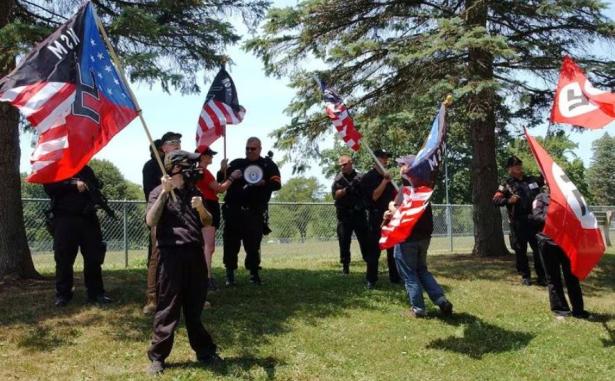
The National Socialist Movement, one of the largest and most prominent neo-Nazi groups in the United States, was one of 36 hate groups active in Pennsylvania in 2020. Members of the group gathered summer 2020 at a downtown Williamsport, PA park.,(Photo credit: PennLive)
‘Don’t get caught there,’ The legacy of sundown towns is not confined to the pages of history books – but is alive and well in 2024. Deep racial disparities are evidence that the intent of sundown towns still lingers today.
Feb 22, 2024 – Growing up in the 1960s, the Rev. Roger Dixon heard the warnings every time the William Penn High School football team was set to play Cedar Cliff.
“The older men used to say ‘don’t get caught up there after the game. You might get into trouble. They might try to arrest you,’” recalls Dixon, who is Black and graduated from William Penn in 1966.
Rafiyqa Muhammad tells of a similar experience growing up in Harrisburg.
“Our parents always told us about certain areas,” she said. “Our father would tell us don’t go here, don’t go there. Do not go over to the West Shore. I remember we would drive in and drive out. There was no going over and hanging out.”
Like Dixon, Muhammad, who is Black and came of age in the 1960s and 1970s, lived through some of the most tumultuous times in this country as the vestiges of segregation and the push for civil rights framed the lives of millions of Americans.
As the nation observes Black History Month in February, celebrating the accomplishments and contributions of Black Americans, the experiences of ordinary Americans like Dixon and Muhammad attest to the painful reality that racism was not confined to the south.
Across communities in central Pennsylvania, Black residents were made to feel unwelcome in many communities, especially after dark, and in many cases the communities were their own.
So-called “sundown towns” became a fixture across the country in the early 1900s. These were all-white communities that excluded non-whites via discriminatory laws, intimidation and violence.
These practices were at times explicit – written into statutes and charters – and other times the understanding that if you were Black, you better be out of town by sunset, hence the name. Some towns posted warning signs to Blacks not to “let the sun go down on you here.” Other towns rang a bell at the end of the workday warning Black workers to leave.
Harrisburg may have been well north of the Mason-Dixon Line, but in many ways was emblematic of the practice of sundown towns. While Dixon and Muhammad attended predominantly Black schools and spent time in mostly Black communities, sometimes they needed to cross the Susquehanna River to the mostly white west shore.
“They didn’t call it sundown town, but we know what they meant,” Dixon said. “The old men would say you never know, you never know. Don’t get caught up over there. They were very serious about it.”
Cultural documentarian Candacy Taylor has collected crowd-sources data showing that Pennsylvania was home to about 40 sundown towns, underscoring that these towns were not confined to the south or Midwest.
In her book, “Overground Railroad: The Green Book and the Roots of Black Travel in America,” Taylor mapped the prevalence of such towns in the region. They included Middletown and Camp Hill, and while Harrisburg was not named among the towns, oral histories of residents suggest that those racist attitudes in some neighborhoods prevailed.
“When I hear people say sundown town, I know what that means but I’m looking at my own backyard,” Muhammad said. “We couldn’t get more sundown than here and it’s still that way.”
Muhammad grew up with the unwritten rule that she and her friends – as they walked to and from school and across their Harrisburg community — needed to avoid areas.
“There were places we could not go to,” she recalls. “When we went to school you better not walk through Bellevue Park. You better not be caught there. Italian Lake? The same. You better not be caught in Italian Lakes or the authorities would be called on you and who knows what else.”
Black Corrections Officer Alleges He Was Called the N-Word, His Co-workers Tainted His Food After He Revealed Racist Treatment of Inmates In Pennsylvania Jail
By Niko Mann
Jan. 14, 2024 – A former corrections officer at the Beaver County Jail in Aliquippa, Pennsylvania, filed a racial discrimination lawsuit against Beaver County on Jan. 8.
Titus Shields claims that he was fired after reporting the treatment of Black inmates and himself by other corrections officers.
According to the lawsuit, Shields moved to the county from California in search of a better life, only to “endure horrific racism” while employed at the Beaver County Jail. The complaint alleges that Shields was called the N-word, and his car was vandalized before he was fired in October 2022.
Shields began working at the jail in February 2022. The lawsuit states that Shields was forced to work in “a hostile environment” after he reported the racial abuse suffered by Black inmates of the jail and that the county “discriminated against him due to his race, complaints of race discrimination, and reports of wrongdoing.”
The former corrections officer said he was given “positive feedback” during his probationary period until he began reporting about the discrimination against Black inmates at the jail. Shields revealed one incident where an officer removed an inmate’s mattress and bedding during freezing weather with cold air blowing into his cell. The inmate was placed in a restraint chair without explanation and forced to sleep on a metal bed frame for approximately eight days.
Another inmate was also strapped to the restraint chair as several officers assaulted him, and after one officer questioned if the abuse was excessive force, Sgt. Decanini said, “What excessive force? It’s part of your job, dude!” the complaint describes. Shields said he was reporting the abuse, and Decanini yelled, “Do it! Do you think anybody really cares? What do you think you are going to change something? You’re not!”
Another inmate whose bedding was taken without cause for an entire month stayed awake all night to avoid the cold, which eventually “caused his legs to swell and start to burst with blood and blisters.”
Shields claims that when he made complaints about the abuse and said he no longer felt safe, Deputy Warden White told Shields to “get over it. It’s not about you.” Shields was also allegedly told by a Sgt. Harris, who is Black, “Yes, it is very racist here” and “You have got to watch your back.” Harris also told Shields, “These people do a lot of dirt and can get away with it. So just keep your head down, and you will be all right.”
Sept. 19, 2023 – Democrats kept control of the Pennsylvania House of Representatives Tuesday after winning an open seat in a special election in the Pittsburgh area.
The state’s lower chamber had been split 101-101 between Democrats and Republicans since July, when former Representative Sara Innamorato, a Democrat, stepped down from her seat representing the 21st House District to run for Allegheny County executive.
Republicans had hoped for an upset in Ms. Innamorato’s former district, which includes part of Pittsburgh and its northern suburbs. That did not happen: Lindsay Powell, a Democrat who has strong ties to party leaders in Washington — including Senator Chuck Schumer, the majority leader, and Representative Hakeem Jeffries, the minority leader — easily defeated Erin Connolly Autenreith, a Republican who is the chairwoman of a local party committee. With 95 percent of the vote counted, 65 percent went to Ms. Powell and 34 percent went to Ms. Autenreith.
Pennsylvania’s House of Representatives has been split between Democrats and Republicans since July, with each party holding 101 seats.Credit…Matt Rourke/Associated Press
Why It Matters: The vote will determine a swing state’s power balance.
Pennsylvania is a crucial swing state, playing an important role in presidential elections, as well as determining which party holds power in the United States Congress. Whichever party gains an upper hand in the state can make a major difference in Washington, in addition to making law in Pennsylvania.
It’s also one of just two states, along with Virginia, where the legislative chambers are split by party.
In Harrisburg, Democrats have controlled the governor’s office since 2015, and Gov. Josh Shapiro won his first term convincingly in November 2022. Republicans, on the other hand, have held a strong grip on the Senate for decades.
Democrats won a majority in the House in 2022 for the first time in 12 years and by the slimmest of margins — it took only Ms. Innamorato’s resignation to make it an even split.
Background: The state has seen several special elections this year.
In May, Heather Boyd, a Democrat, won a closely watched special election in southeast Delaware County, part of the Philadelphia suburbs. Top Democrats, including President Biden and Governor Shapiro, had framed the contest as crucial to protecting reproductive rights in Pennsylvania.
But on the same day, in a separate special election, Republicans retained a state House seat in north-central Pennsylvania with the triumph of Michael Stender, a school board member and firefighter.
Heading into the third special election of the year on Tuesday, the Democratic candidate, Ms. Powell, 32, who works in work force development, was viewed as a solid favorite, with a sizable fund-raising advantage.
She was aiming to become the first African American woman to represent the district, which Ms. Innamorato captured in 2022 with 63 percent of the vote.
Republican officials acknowledged that the heavily Democratic district would be difficult for them to win. Still, Ms. Autenreith, 65, had been active on the campaign trail.
What Happens Next: The state House could soon be in play yet again.
Even with Ms. Powell’s victory, voters in Pennsylvania may soon face yet another special election with huge stakes.
If State Representative John Galloway, a Democrat who represents a district northeast of Philadelphia, prevails in a race for a district judgeship in November, as is expected, the chamber would be split again until another contest could be held to fill his seat.
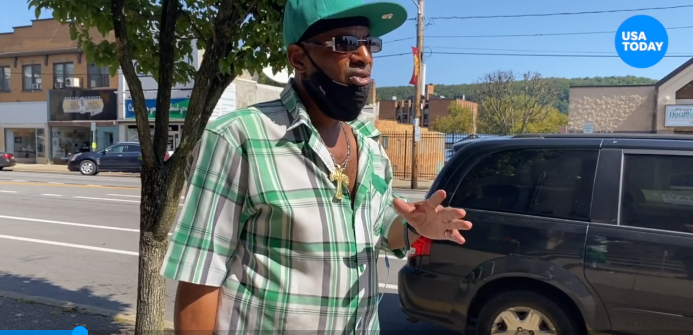
Above: Troy Johnson of Aliquippa speaks up on election turmoil
MILTON, Pa. — Kareem Williams Jr. sits on a park bench in the center of town and waits for the racists to attack. He tells himself he is ready. It’s a cool Saturday morning in fall, and the valley is alive with the rumble of pickups.
When the trucks stop, here at the red light at the corner of Broadway and Front Street, drivers gun their engines. Some glare directly into Williams’ eyes.
Williams is a Black man. The drivers are white. All their passengers are white. Williams returns their gaze with equal ferocity. He tells himself he is ready. He is not. His back faces the Susquehanna River. His car is parked a block away. If these white men jump from their truck, fists or pistols raised, Williams has nowhere to run.
The light turns green. Engine roar blasts the river. Williams follows each truck with his eyes until it’s gone.
“I always knew racism was here. But it was quiet,” said Williams, 24, a factory worker and a corporal in the Pennsylvania National Guard who grew up in Milton. “Now, in this election, people are more openly racist. The dirty looks, middle fingers, the Confederate flags.”
To Williams, and to many non-white people he knows in central Pennsylvania, this rise in overtly racist behavior is linked inextricably to the reelection campaign of President Donald Trump. In yards up and down the Central Susquehanna Valley, Williams sees Confederate flags and Trump flags flying side by side. People with the most Trump bumper stickers seem the most likely to shout hateful things.
As the presidential election approaches, Williams said, such threats grow more common, more passionate.
“On election day I’m going to be in my house. I’m not going anywhere,” said Williams, known by his nickname K.J. “If these racists are looking to protest, they’ll go to Harrisburg or Philadelphia or D.C. If they’re looking to kill people, this will be the place. They’re gonna come here.”
Experts on American racial history agree. For Black people living in towns like Milton, they say, the threat of white terrorism is the highest it’s been in generations.
“Historically, most acts of racial terror have been enacted in rural communities, small towns or medium-sized cities,” said Khalil Muhammad, a history professor at Harvard University. “The conditions for wide-scale anti-Black violence are today more likely than at any point in the last 50 years.”
‘That’s a powder keg’
Within a month, 230 communities in Pennsylvania organized 400 anti-racism events, said Lara Putnam, a historian at the University of Pittsburgh who studies grassroots movements.
“That is an insane number,” Putnam said. “It’s an order of magnitude larger than the number of places that ever held a Tea Party event.”
Many protests happened in towns where African Americans and other non-white people constitute a tiny minority, surrounded by rural communities with virtually no people of color at all. Those areas are overwhelmingly conservative, said Daniel Mallinson, a political science professor at Penn State Harrisburg. Out of 6 million votes cast in Pennsylvania in 2016, Trump won the state by 42,000.
But in Milton he dominated, carrying the surrounding Northumberland County by 69%. In front yards and country fields, Trump flags and Confederate flags comingle.
“Traditionally when we think of political candidates, we think of yard signs. But a lot of Trump flags went up in 2016, and in a lot of places they didn’t come down. It’s a visual representation of tribalism in our politics,” Mallinson said. “There’s a lot of implicit and explicit racial bias in central Pennsylvania.”
As local critics and defenders of the white establishment grow more engaged, state and national politics raise the stakes. Pennsylvania is the likeliest state in the nation to decide the presidential election, according to FiveThirtyEight, a polling and analytics aggregator. Statewide polls place Democrat Joe Biden ahead of Trump by 7%, the same as Hillary Clinton’s lead in Pennsylvania three weeks before the 2016 election.
Large-scale voting fraud has never been detected in modern American politics. Yet Trump often claims he can lose only if the 2020 election is fraudulent, which stokes fear and anger among his core supporters, experts said.
“They fully expect Trump will win,” said John Kennedy, a political science professor at West Chester University outside Philadelphia. “When they hear the results on election night, that’s a powder keg.”
Trump also appears to encourage the more violent factions of his coalition. The president repeatedly has declined to promise a peaceful transition of power. He defended Kyle Rittenhouse for killing an unarmed protester in Kenosha, Wisconsin. During the first presidential debate, Trump appeared to encourage white terrorists, urging the Proud Boys to “stand back and stand by” and insisting that “somebody’s got to do something about Antifa and the left.”
Some white people in central Pennsylvania appear to be following the president’s lead.
“Do I worry about right-wing vigilante violence against peaceful protests if people are protesting Trump after the election? Yes,” Putnam said. “It’s happening. And there’s every reason to think more of it will happen.”
In September, Trump proposed designating the KKK and antifa as terrorist organizations. Antifa is not an organization, however, but rather an idea shared by some on the left to aggressively challenge fascists and Nazis, especially during street protests.
“President Trump has unequivocally denounced hate groups by name on numerous occasions but the media refuses to accurately cover it because that would mean the end of a Democrat Party talking point,” said Samantha Zager, a Trump campaign spokesperson. “The Trump campaign will patiently wait for the media to develop the same intense curiosity on these actual threats to our democracy as it has with regard to hypothetical scenarios from the left.”
In July, neo-Nazis rallied in Williamsport, 20 miles north of Milton. In August, a white person fired into a crowd of civil rights marchers in Schellsburg, Pennsylvania, wounding a man in the face. At a recent event for police reform in Watsontown, three miles north of Milton along the West Branch of the Susquehanna River, white counter-protesters yelled that Black people “live off white people.”
Overlooking the protest, on the balcony of the Mansion House restaurant, white men stood armed with assault rifles.
“They looked like snipers,” Williams said. “Trump is the motivator in all of this. He has a huge following here.”
The last time America witnessed such an open embrace between white supremacists and the White House was the administration of Woodrow Wilson, said Muhammad.
“You have to go back 100 years,” Muhammad said. “We have every reason to be extremely vigilant about the possibility for violence over the next several weeks. Anywhere where people are flying Confederate flags are places where people ought to be mindful of where they move in public.”
Racism in the land of Chef Boyardee
The side streets of downtown Milton end in rich river bottomlands where the autumn corn grows 7 feet tall.
FEBRUARY 20, 2020 – This week, the Pittsburgh-based Allegheny County Democratic Committee voted to officially oppose in her quest for re-election, Summer Lee, the first black woman from Western PA ever elected to the State House.
The decision of the county party to oppose Lee came a week after the Pittsburgh-based Allegheny-Fayette Labor Council voted to oppose Lee. However, UE and SEIU have both backed Lee.
Lee, a former organizer with the Fight For $15, has drawn fierce opposition from the region’s building trades for her opposition to fracking in her district and her support of the Green New Deal. Already, the region’s more conservative unions have pumped more than $67,000 into her opponent, pro-fracking North Braddock councilman Chris Roland.
On Sunday, the Allegheny County Democratic Committee met and voted overwhelmingly to endorse Lee’s opponent, Roland. Much like the Labor Council’s endorsement, Lee was the only incumbent not to endorsed by the labor-dominated Committee.
In addition to opposing Lee, the Committee voted to oppose progressive challenger Jessica Benham vying for a South Side based state representative’s seat. Instead, they choose to endorse Heather Kass, who openly bragged on social media that she supported President Trump.
For Lee, who defeated a 20-year incumbent by a margin of 68%-32% to become state representative in 2018, the snub was yet another sign of the false promises of the white-dominated political machines of Western Pennsylvania.
“The Democratic Party claims it wants more “diversity.” Claims it respects the Black ppl who form its base. Claims it supports women leadership. Claims it trusts the Black women who propel it to victory every time,” wrote Lee on Twitter. “The lie detector test determined…..that was a lie.”
Since the announcement that the local Democratic Party would oppose her re-election, Lee says she has received more than 200 individual donations and an outpouring of support. She says that dozens of people have signed up to volunteer, and the campaign’s grassroots capability is growing as a result of the backlash against the white-dominated Western PA political establishment.
“We know they never wanted us at their little table. We’re still eating, though!” wrote Lee on Facebook.
(Full Disclosure: My father, Gene Elk, is the elected Director of Organization of the United Electrical Workers (UE), which has endorsed Summer Lee’s campaign. Representative Lee and I both attended Woodland Hills High School together, while it was still under federal desegregation orders in the early 2000s).
At least nine sites in New Brighton — homes, flour mill and church — were safe houses to help runaway slaves escape from Southern states where slavery was legal to free states in the North, and ultimately to Canada.
By Marsha Keefer Beaver County Times
June 9, 2019 – NEW BRIGHTON — New Brighton’s strategic location on the Beaver River and compassion of prominent abolitionists made the borough a natural harbor for fugitive slaves seeking asylum prior to the Civil War.
“It was the hub of the Underground Railroad,” said Odette Lambert, a member and former president of New Brighton Historical Society, who’s spent close to a quarter century researching the town’s clandestine freedom trail.
The organized system depended upon a network of people and safe houses to help runaway slaves escape from Southern states where slavery was legal to free states in the North, and ultimately to Canada.
It’s estimated as many as 100,000 slaves may have fled the South between and 1810 and 1850, according to u-s-history.com.
At least nine sites in New Brighton — homes, flour mill and church — were part of the effort.
What’s fascinating, Odette said, is that “very few safe houses are still in existence in the country” — many of them in disrepair and ultimately demolished — “and our little town of New Brighton is one of the few that still has that many homes in existence.” Continue reading New Brighton was ‘Hub of the Underground Railroad’→







 The organized system depended upon a network of people and safe houses to help runaway slaves escape from Southern states where slavery was legal to free states in the North, and ultimately to Canada.
 Beaver County Blue: Voice of the 17th CD of Progressive Democrats of America