Sept. 19, 2023 – Democrats kept control of the Pennsylvania House of Representatives Tuesday after winning an open seat in a special election in the Pittsburgh area.
The state’s lower chamber had been split 101-101 between Democrats and Republicans since July, when former Representative Sara Innamorato, a Democrat, stepped down from her seat representing the 21st House District to run for Allegheny County executive.
Republicans had hoped for an upset in Ms. Innamorato’s former district, which includes part of Pittsburgh and its northern suburbs. That did not happen: Lindsay Powell, a Democrat who has strong ties to party leaders in Washington — including Senator Chuck Schumer, the majority leader, and Representative Hakeem Jeffries, the minority leader — easily defeated Erin Connolly Autenreith, a Republican who is the chairwoman of a local party committee. With 95 percent of the vote counted, 65 percent went to Ms. Powell and 34 percent went to Ms. Autenreith.
Pennsylvania’s House of Representatives has been split between Democrats and Republicans since July, with each party holding 101 seats.Credit…Matt Rourke/Associated Press
Why It Matters: The vote will determine a swing state’s power balance.
Pennsylvania is a crucial swing state, playing an important role in presidential elections, as well as determining which party holds power in the United States Congress. Whichever party gains an upper hand in the state can make a major difference in Washington, in addition to making law in Pennsylvania.
It’s also one of just two states, along with Virginia, where the legislative chambers are split by party.
In Harrisburg, Democrats have controlled the governor’s office since 2015, and Gov. Josh Shapiro won his first term convincingly in November 2022. Republicans, on the other hand, have held a strong grip on the Senate for decades.
Democrats won a majority in the House in 2022 for the first time in 12 years and by the slimmest of margins — it took only Ms. Innamorato’s resignation to make it an even split.
Background: The state has seen several special elections this year.
In May, Heather Boyd, a Democrat, won a closely watched special election in southeast Delaware County, part of the Philadelphia suburbs. Top Democrats, including President Biden and Governor Shapiro, had framed the contest as crucial to protecting reproductive rights in Pennsylvania.
But on the same day, in a separate special election, Republicans retained a state House seat in north-central Pennsylvania with the triumph of Michael Stender, a school board member and firefighter.
Heading into the third special election of the year on Tuesday, the Democratic candidate, Ms. Powell, 32, who works in work force development, was viewed as a solid favorite, with a sizable fund-raising advantage.
She was aiming to become the first African American woman to represent the district, which Ms. Innamorato captured in 2022 with 63 percent of the vote.
Republican officials acknowledged that the heavily Democratic district would be difficult for them to win. Still, Ms. Autenreith, 65, had been active on the campaign trail.
What Happens Next: The state House could soon be in play yet again.
Even with Ms. Powell’s victory, voters in Pennsylvania may soon face yet another special election with huge stakes.
If State Representative John Galloway, a Democrat who represents a district northeast of Philadelphia, prevails in a race for a district judgeship in November, as is expected, the chamber would be split again until another contest could be held to fill his seat.
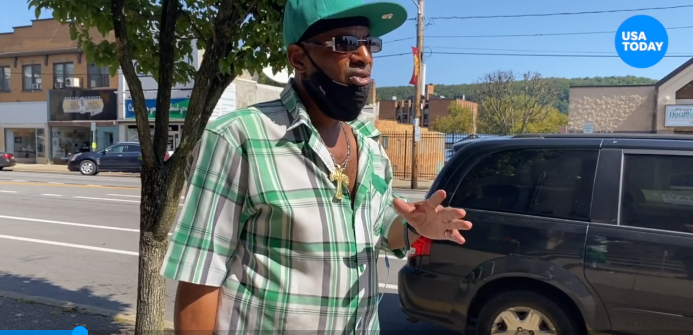
Above: Troy Johnson of Aliquippa speaks up on election turmoil
MILTON, Pa. — Kareem Williams Jr. sits on a park bench in the center of town and waits for the racists to attack. He tells himself he is ready. It’s a cool Saturday morning in fall, and the valley is alive with the rumble of pickups.
When the trucks stop, here at the red light at the corner of Broadway and Front Street, drivers gun their engines. Some glare directly into Williams’ eyes.
Williams is a Black man. The drivers are white. All their passengers are white. Williams returns their gaze with equal ferocity. He tells himself he is ready. He is not. His back faces the Susquehanna River. His car is parked a block away. If these white men jump from their truck, fists or pistols raised, Williams has nowhere to run.
The light turns green. Engine roar blasts the river. Williams follows each truck with his eyes until it’s gone.
“I always knew racism was here. But it was quiet,” said Williams, 24, a factory worker and a corporal in the Pennsylvania National Guard who grew up in Milton. “Now, in this election, people are more openly racist. The dirty looks, middle fingers, the Confederate flags.”
To Williams, and to many non-white people he knows in central Pennsylvania, this rise in overtly racist behavior is linked inextricably to the reelection campaign of President Donald Trump. In yards up and down the Central Susquehanna Valley, Williams sees Confederate flags and Trump flags flying side by side. People with the most Trump bumper stickers seem the most likely to shout hateful things.
As the presidential election approaches, Williams said, such threats grow more common, more passionate.
“On election day I’m going to be in my house. I’m not going anywhere,” said Williams, known by his nickname K.J. “If these racists are looking to protest, they’ll go to Harrisburg or Philadelphia or D.C. If they’re looking to kill people, this will be the place. They’re gonna come here.”
Experts on American racial history agree. For Black people living in towns like Milton, they say, the threat of white terrorism is the highest it’s been in generations.
“Historically, most acts of racial terror have been enacted in rural communities, small towns or medium-sized cities,” said Khalil Muhammad, a history professor at Harvard University. “The conditions for wide-scale anti-Black violence are today more likely than at any point in the last 50 years.”
‘That’s a powder keg’
Within a month, 230 communities in Pennsylvania organized 400 anti-racism events, said Lara Putnam, a historian at the University of Pittsburgh who studies grassroots movements.
“That is an insane number,” Putnam said. “It’s an order of magnitude larger than the number of places that ever held a Tea Party event.”
Many protests happened in towns where African Americans and other non-white people constitute a tiny minority, surrounded by rural communities with virtually no people of color at all. Those areas are overwhelmingly conservative, said Daniel Mallinson, a political science professor at Penn State Harrisburg. Out of 6 million votes cast in Pennsylvania in 2016, Trump won the state by 42,000.
But in Milton he dominated, carrying the surrounding Northumberland County by 69%. In front yards and country fields, Trump flags and Confederate flags comingle.
“Traditionally when we think of political candidates, we think of yard signs. But a lot of Trump flags went up in 2016, and in a lot of places they didn’t come down. It’s a visual representation of tribalism in our politics,” Mallinson said. “There’s a lot of implicit and explicit racial bias in central Pennsylvania.”
As local critics and defenders of the white establishment grow more engaged, state and national politics raise the stakes. Pennsylvania is the likeliest state in the nation to decide the presidential election, according to FiveThirtyEight, a polling and analytics aggregator. Statewide polls place Democrat Joe Biden ahead of Trump by 7%, the same as Hillary Clinton’s lead in Pennsylvania three weeks before the 2016 election.
Large-scale voting fraud has never been detected in modern American politics. Yet Trump often claims he can lose only if the 2020 election is fraudulent, which stokes fear and anger among his core supporters, experts said.
“They fully expect Trump will win,” said John Kennedy, a political science professor at West Chester University outside Philadelphia. “When they hear the results on election night, that’s a powder keg.”
Trump also appears to encourage the more violent factions of his coalition. The president repeatedly has declined to promise a peaceful transition of power. He defended Kyle Rittenhouse for killing an unarmed protester in Kenosha, Wisconsin. During the first presidential debate, Trump appeared to encourage white terrorists, urging the Proud Boys to “stand back and stand by” and insisting that “somebody’s got to do something about Antifa and the left.”
Some white people in central Pennsylvania appear to be following the president’s lead.
“Do I worry about right-wing vigilante violence against peaceful protests if people are protesting Trump after the election? Yes,” Putnam said. “It’s happening. And there’s every reason to think more of it will happen.”
In September, Trump proposed designating the KKK and antifa as terrorist organizations. Antifa is not an organization, however, but rather an idea shared by some on the left to aggressively challenge fascists and Nazis, especially during street protests.
“President Trump has unequivocally denounced hate groups by name on numerous occasions but the media refuses to accurately cover it because that would mean the end of a Democrat Party talking point,” said Samantha Zager, a Trump campaign spokesperson. “The Trump campaign will patiently wait for the media to develop the same intense curiosity on these actual threats to our democracy as it has with regard to hypothetical scenarios from the left.”
In July, neo-Nazis rallied in Williamsport, 20 miles north of Milton. In August, a white person fired into a crowd of civil rights marchers in Schellsburg, Pennsylvania, wounding a man in the face. At a recent event for police reform in Watsontown, three miles north of Milton along the West Branch of the Susquehanna River, white counter-protesters yelled that Black people “live off white people.”
Overlooking the protest, on the balcony of the Mansion House restaurant, white men stood armed with assault rifles.
“They looked like snipers,” Williams said. “Trump is the motivator in all of this. He has a huge following here.”
The last time America witnessed such an open embrace between white supremacists and the White House was the administration of Woodrow Wilson, said Muhammad.
“You have to go back 100 years,” Muhammad said. “We have every reason to be extremely vigilant about the possibility for violence over the next several weeks. Anywhere where people are flying Confederate flags are places where people ought to be mindful of where they move in public.”
Racism in the land of Chef Boyardee
The side streets of downtown Milton end in rich river bottomlands where the autumn corn grows 7 feet tall.
FEBRUARY 20, 2020 – This week, the Pittsburgh-based Allegheny County Democratic Committee voted to officially oppose in her quest for re-election, Summer Lee, the first black woman from Western PA ever elected to the State House.
The decision of the county party to oppose Lee came a week after the Pittsburgh-based Allegheny-Fayette Labor Council voted to oppose Lee. However, UE and SEIU have both backed Lee.
Lee, a former organizer with the Fight For $15, has drawn fierce opposition from the region’s building trades for her opposition to fracking in her district and her support of the Green New Deal. Already, the region’s more conservative unions have pumped more than $67,000 into her opponent, pro-fracking North Braddock councilman Chris Roland.
On Sunday, the Allegheny County Democratic Committee met and voted overwhelmingly to endorse Lee’s opponent, Roland. Much like the Labor Council’s endorsement, Lee was the only incumbent not to endorsed by the labor-dominated Committee.
In addition to opposing Lee, the Committee voted to oppose progressive challenger Jessica Benham vying for a South Side based state representative’s seat. Instead, they choose to endorse Heather Kass, who openly bragged on social media that she supported President Trump.
For Lee, who defeated a 20-year incumbent by a margin of 68%-32% to become state representative in 2018, the snub was yet another sign of the false promises of the white-dominated political machines of Western Pennsylvania.
“The Democratic Party claims it wants more “diversity.” Claims it respects the Black ppl who form its base. Claims it supports women leadership. Claims it trusts the Black women who propel it to victory every time,” wrote Lee on Twitter. “The lie detector test determined…..that was a lie.”
Since the announcement that the local Democratic Party would oppose her re-election, Lee says she has received more than 200 individual donations and an outpouring of support. She says that dozens of people have signed up to volunteer, and the campaign’s grassroots capability is growing as a result of the backlash against the white-dominated Western PA political establishment.
“We know they never wanted us at their little table. We’re still eating, though!” wrote Lee on Facebook.
(Full Disclosure: My father, Gene Elk, is the elected Director of Organization of the United Electrical Workers (UE), which has endorsed Summer Lee’s campaign. Representative Lee and I both attended Woodland Hills High School together, while it was still under federal desegregation orders in the early 2000s).
At least nine sites in New Brighton — homes, flour mill and church — were safe houses to help runaway slaves escape from Southern states where slavery was legal to free states in the North, and ultimately to Canada.
By Marsha Keefer Beaver County Times
June 9, 2019 – NEW BRIGHTON — New Brighton’s strategic location on the Beaver River and compassion of prominent abolitionists made the borough a natural harbor for fugitive slaves seeking asylum prior to the Civil War.
“It was the hub of the Underground Railroad,” said Odette Lambert, a member and former president of New Brighton Historical Society, who’s spent close to a quarter century researching the town’s clandestine freedom trail.
The organized system depended upon a network of people and safe houses to help runaway slaves escape from Southern states where slavery was legal to free states in the North, and ultimately to Canada.
It’s estimated as many as 100,000 slaves may have fled the South between and 1810 and 1850, according to u-s-history.com.
At least nine sites in New Brighton — homes, flour mill and church — were part of the effort.
What’s fascinating, Odette said, is that “very few safe houses are still in existence in the country” — many of them in disrepair and ultimately demolished — “and our little town of New Brighton is one of the few that still has that many homes in existence.” Continue reading New Brighton was ‘Hub of the Underground Railroad’→
Twenty years have passed since the Struggles premiered at the Sundance Film Festival. We are trying to find out what to the children and grandchildren of steelworkers who lost their jobs.
March 9, 2015 – BEAVER FALLS — Upwards of 100 people marched from New Brighton to Beaver Falls on Sunday afternoon to commemorate the 50th anniversary of "Bloody Sunday," which took place March 7, 1965, in Selma, Ala., as civil rights activists marched to the state capital of Montgomery for voting rights.
"Things like this sparks into the people to get out there and vote, and that we have a chance to get out there and make a difference," said Abe Askew, of Aliquippa.
Askew believed that Sunday’s march and similar acts of empowerment can have positive impacts on people and communities alike, saying he will spread the word regarding the importance of voting.
"(I’ll tell) all the people that I know from Aliquippa and it’ll go from here to there," Askew said. "It goes into a stream and a stream into a river."
The march began at New Brighton’s Townsend Park, across from the borough building at Third Avenue and Sixth Street, and crossed the bridge over the Beaver River to Beaver Falls, before concluding at Beaver Falls Memorial Park at Sixth Avenue and 11th Street, where several guest speakers addressed the crowd, including event organizer Olivia Ryan.
Ryan, a graduate of Beaver Falls High School and Kent State University, decided to organize the event after a panel discussion on law, race and the community last weekend at Geneva College. (Continued)
Pittsburgh Police Chief Cameron McLay on New Year’s Eve, holding a sign offered by the local activist group What’s Up?! Pittsburgh. The photo was widely circulated on social media. What’s Up?! Pittsburgh
City police union president objects to chief’s appearance in social media and effect on officer morale
By Michael A. Fuoco Pittsburgh Post-Gazette
Jan 4, 2015 Pittsburgh Mayor Bill Peduto was at home with his girlfriend on New Year’s Eve when he glanced at his smartphone and saw a Facebook posting of a photograph of Police Chief Cameron McLay holding a sign reading “I resolve to challenge racism @ work. # end white silence.”
“I thought, ‘What a great way to begin the new year,’ ” the mayor said, and he showed his girlfriend the photo. It had been taken by activists from What’s Up?! Pittsburgh, who approached the chief in a coffee shop during the city’s First Night festivities and asked him pose with their sign.
So pleased was Mayor Peduto with his new police chief’s action that he quickly posted the photograph on his own Facebook account, adding his support to restoring trust between the police bureau and the communities it serves, a stated goal of Chief McLay.
“I thought there was very little chance for someone to say this was the wrong message to send,” Mr. Peduto recounted Saturday.
He was wrong.
The photo, which continues to be shared on social media, has drawn cheers from numerous groups and individuals, but Fraternal Order of Police President Howard McQuillan isn’t among them.
KDKA-TV quoted him Friday as saying the photo amounted to the chief labeling the police force as racist. And in an email to the chief, obtained by the Pittsburgh Post-Gazette, Officer McQuillan wrote that the chief’s actions raised “serious concerns. … By Mayor Peduto labeling us ‘corrupt and mediocre’ and now our current Chief insinuating that we are now racist, merely by the color of our skin and the nature of our profession, I say enough is enough!”
Moreover, Officer McQuillan accused the chief of violating the bureau’s social media policy and of being “hypocritical” for disciplining two officers who violated it.
In response, Chief McLay sent an email to the entire bureau Friday with the subject line “Race and Police” in which he apologized “if any of my PBP family was offended,” adding “I saw no indictment of police or anyone else in this sign.”
April 14, 2014 – The Reverend William Barber is charting a new path for protesting conservative overreach in the North Carolina—and beyond.
On a recent Sunday afternoon, the Reverend William Barber II [1] reclined uncomfortably in a chair in his office, sipping bottled water as he recovered from two hours of strenuous preaching. When he was in his early 20s, Barber was diagnosed with ankylosing spondylitis, a painful arthritic condition affecting the spine. Still wearing his long black robes, the 50-year-old minister recounted how, as he’d proclaimed in a rolling baritone from the pulpit that morning, "a crippled preacher has found his legs."
It began a few days before Easter 2013, recalled Barber, pastor at the Greenleaf Christian Church in Goldsboro, North Carolina, and president of the state chapter [2] of the National Association for the Advancement of Colored People (NAACP). "On Maundy Thursday, they chose to crucify voting rights," he said.
"They" are North Carolina Republicans, who in November 2012 took control of the state Legislature and the governor’s mansion for the first time in more than a century. Among their top priorities—along with blocking Medicaid expansion and cutting unemployment benefits and higher-education spending—was pushing through a raft of changes to election laws, including reducing the number of early voting days, ending same-day voter registration, and requiring ID at the polls. "That’s when a group of us said, ‘Wait a minute, this has just gone too far,’" Barber said.
Barber "believed we needed to kind of burst this bubble of ‘There’s nothing we can do for two years until the next election.’"
On the last Monday of April 2013, Barber led a modest group of clergy and activists into the state legislative building in Raleigh. They sang "We Shall Overcome," quoted the Bible, and blocked the doors to the Senate chambers. Barber leaned on his cane as capitol police led him away in handcuffs.
That might have been the end of just another symbolic protest, but then something happened: The following Monday, more than 100 protesters showed up at the capitol. Over the next few months, the weekly crowds at the "Moral Mondays" protests grew to include hundreds, and then thousands, not just in Raleigh but also in towns around the state. The largest gathering, in February, drew tens of thousands of people [3]. More than 900 protesters have been arrested for civil disobedience over the past year. Copycat movements have started in Florida [4], Georgia [5], South Carolina [6], and Alabama [7] in response to GOP legislation regarding Medicaid and gun control.
May 6, 2013 – RALEIGH — More than two dozen members of the NAACP and other activists were arrested Monday as part of continuing protests of Republican policies in the state capital, bringing to dozens the number of nonviolent demonstrators facing charges.
The demonstrators were arrested Monday by Raleigh and General Assembly police. The number of arrests, as well as the size of the crowd that turned out to offer support, grew from last Monday’s demonstrations, when 17 were arrested.
General Assembly Police Chief Jeff Weaver said law enforcement officials decided to admit them despite last week’s arrests while they determine what the law permits. He said those arrested most recently will face the same charges of second-degree trespassing, failure to disperse on command and the displaying of signs or placards, which violates building rules.
The group arrested Monday included Barber’s 20-year-old son, William Joseph Barber III, a student at North Carolina Central University; William Chafe, former dean of Arts and Sciences at Duke University; Robert Korstad, a professor of public policy and history at Duke; Jacquelyn Dowd Hall, an historian at the University of North Carolina; Charles van der Horst, a professor at the University of North Carolina School of Medicine and members of the social justice group Raging Grannies.
“I started in 1954 at the Youth March for Integrated Schools in New York,” said Vicki Ryder of Raging Grannies. “I’ve been doing this for a long time.”
Yet Another Reason to Defeat All GOP Candidates—If You Needed One
Viviette Applewhite is 93-year-old and has voted in nearly every election for the last 60 years. She marched with Dr. Martin Luther King, Jr., in Georgia. She has tried for years to obtain photo ID to no avail. Under Pennsylvania’s new voter ID law, Ms. Applewhite’s vote will not be counted. She is a plaintiff in our lawsuit to stop voter ID.




 The organized system depended upon a network of people and safe houses to help runaway slaves escape from Southern states where slavery was legal to free states in the North, and ultimately to Canada.


