All posts by carldavidson

Local Peace Organizations Hold Discussion at CCBC


Michael McPhearson, Vets for Peace, at BCCC

By: Christina Sheleheda

Beaver County Times

April 24, 2017, MONACA — For national peace activist Kevin Martin, the current state of our country can be best described with one word: Resolute.

Martin, along with Michael McPhearson, national executive director of Veterans for Peace; and Nancy O’Leary, president of the Beaver County Peace Links, hosted Prospects of War, the Need for Peace, Saturday at the Community College of Beaver County’s Health Sciences Center.

Presenting to a group of about 50 people, Martin, who currently serves as the national president for Peace Action, kicked off the event, which was hosted by the Beaver County Peace Links. He asked the audience to say how they felt regarding the current administration.

“Scared.”

“Disappointed.”

“Hopeful.”

Having devoted over 30 years to peace activism, Martin believes the election simply drove a deeper wedge into an already divided country.

“We were divided before the election,” Martin said. “The contradictions of election are fascinating to me.”

Martin explained that three “evils” that have been discussed for decades – racism, militarism and economic exploitation – were first cited in Dr. Martin Luther King’s April 4, 1967 speech.

“My assertion,” Martin said, “is that militarism is the one that’s the worst of our society.”

Militarism is defined as “the belief or desire of a government or people that a country should maintain a strong military capability and be prepared to use it aggressively to defend or promote national interests.”

“Progressives often link all struggles together. They list every progressive struggle, but won’t list peace and anti-war discernment, and I have a real problem with that,” Martin said. “We are not going to win if we don’t overcome militarism. That’s where all of our money goes. Not to economic or social justice issues, and certainly not to the environment,” Martin said.

Martin, who grew up in Lancaster, Pa., had both his father and uncle serve in the United States Air Force. He does not believe opposing militarism correlates with being anti-American.

“If you understand militarism as a problem, weapons, nuclear bombs, etc., that is separate from members of our military. [Militarism] has nothing to do with individuals in the military; their service is incredible. I believe that forced patriotism is coercive,” Martin said.

Continue reading Local Peace Organizations Hold Discussion at CCBC

Going Solar in West Virginia

It’s an uphill struggle, but solar entrepreneurs have begun building the state’s post-coal future.

By Manuel Madrid

American Prospect

April 14, 2017 – Former Congressman Tom Perriello makes the case for why he’s got the “insider pragmatism and outsider populism” to win Virginia’s gubernatorial race.

The only reminder Robert Atkins has of his coal days are a hardhat and a heart-shaped scar on his right hand, a souvenir from a voltage explosion in the mines.

Starting right out of high school with a shovel and sledgehammer, Atkins was pulling down a six-figure income by the time he was 23, working 70-hour weeks in the mines as an underground electrician. He didn’t imagine that in just four years he’d be laid off, with a newborn daughter to take care of. Much less that soon after, he’d be a crew chief overseeing solar panel installations.

“If you’d told me I’d be working in solar, I would’ve never believed you,” Atkins says. “I always thought I’d bounce from coal job to coal job until all the mines closed and I had to leave.”

Atkins is one of a small but growing number of West Virginians who’ve said goodbye to coal mining and who’ve staked their future on an industry still distinctly out of place in the state: solar power. West Virginia’s government makes no major investments in commercial solar companies, and offers no tax credits or rebates to residents who install solar panels on their homes. Indeed, state legislators have actively blocked efforts to expand the renewable energy industry. In West Virginia, where Donald Trump, promising to revive mining by slashing regulations, beat Hillary Clinton by more than 40 percentage points, coal remains king.

But Atkins and his colleagues in the nascent renewable energy industry have made a bet that the golden days of coal, hammered by both automation and the boom in natural gas, are gone. They now work for Solar Holler, a Shepherdstown-based venture firm that crowdfunds residential solar installations through an innovative community rebate program. Solar Holler invites supporters to install energy-efficient devices in their homes for free. Instead of keeping the rebates they’d receive for the energy saved, homeowners direct the proceeds toward solar panels and installations on other buildings. This recycling of funds has enabled nonprofits, homes, and businesses to go solar, some for the price of an LED light bulb.

(Photo: Coalfield Development Corporation)

Solar panel installation in Wayne, West Virginia, in 2016

It’s taken awhile to get Solar Holler off the ground. So far, crowdfunding has produced nearly 80 kilowatts of solar energy across West Virginia, enough to power only ten homes—but the company is rapidly expanding. In 2017, Solar Holler expects to install a minimum of 750 kilowatts, equal to nearly a sixth of the state’s currently installed capacity. The company’s model is changing the way people think about solar and has played a part in gradually expanding West Virginia’s solar infrastructure. The surge in demand following Solar Holler’s first major project, a 60-panel installation in Shepherdstown, overwhelmed the limited manpower of installers statewide. Since then, the number of solar companies in West Virginia has grown steadily, from 15 solar companies in 2014, to 26 in 2015.

The driving force behind Solar Holler is Dan Conant, a Jefferson County native with a master’s degree in energy policy from Johns Hopkins, who founded the company in 2013. Conant isn’t just bringing sustainable energy to West Virginia. He’s now helping bring jobs to out-of-work coal miners. Solar Holler had a watershed moment in 2015 when it decided to create the state’s first solar training program in partnership with the Coalfield Development Corporation, a community organization that helps low-income West Virginians in the state’s southern region find jobs and affordable housing.

Since 2012, Coalfield, led by executive director Brandon Dennison, has been offering full-time construction work and training in specialized fields to laid-off miners. The organization’s first foray into solar came as an addition to one of their construction projects, and demands for installations began to balloon soon after. It was around the time that Dennison realized he was onto something big that he got a call from Conant. They struck a deal. Solar Holler would find projects and take care of logistics through crowdfunding, and Coalfield would retrain miners and provide the installation crews.

Denison dubbed the new program ReWire Appalachia. Expanding job training into the solar energy industry, he says, was strictly a market decision. The ReWire crew led by Robert Atkins started with four people, and now boasts a dozen workers.

“Coal miners are smart people,” says Dennison. “It’s important for the country to understand: They make use of hi-tech, sophisticated equipment to do their jobs. They have incredible skill sets to build off of.”

Continue reading Going Solar in West Virginia

Fight for 15 and Black Lives Matter Join Forces on Anniversary of MLK’s Death

Christopher Smith, right, leads chants during a protest for higher wages for fast food workers outside a McDonald’s in Memphis, Tenn., Thursday, April 14, 2016.

Forty-nine years after King was assassinated, the left’s organizing vanguards seek to continue his work. 

By Justin Miller

American Prospect

April 4, 2017 – On the April 4, 1968, Reverend Dr. Martin Luther King Jr. was gunned down on the balcony of the Lorraine Motel in Memphis, Tennessee, where he had come to support the city’s striking sanitation workers, virtually all of them African American. The workers were embroiled in a heated labor dispute with the city government over low wages, dangerous working conditions, and its unyielding opposition to recognizing their union.

Forty-nine years later, much has changed, yet much more has stayed the same. Despite landmark advancements in civil rights, black Americans still face staggering levels of systemic social and economic inequities and rampant state-sanctioned violence and discrimination. Black men are three times more likely to be killed by police than white men, and are incarcerated at a rate five times higher than white men. Meanwhile, black men make 22 percent less in wages compared with white men who live in the same areas, with the same levels of education and work experience. Black women make 11.6 percent less than their white counterparts. On average, white households hold 16 times the wealth of black households. Today, 54 percent of African American workers make less than $15 an hour.

And 49 years later, black activists are still leading large-scale movements to address these injustices. On the anniversary of King’s assassination, Fight for 15 workers and Black Lives Matter activists—many already involved in both movements—are joining together for a series of protests across the country to elevate their intersecting demands for racial justice and economic justice. The actions today not only seek to emphasize and build upon African Americans’ inextricable and intertwined struggle for both civil rights and economic justice of the 1960s, but create a broader front of intersectional progressive power to face off against the Trump administration’s attempt to roll back both.

Activists in 24 cities will be mounting demonstrations and teach-ins under the banner of “Fight Racism, Raise Pay.” They plan to call attention to the systematic targeting of communities of color—ranging from abusive local police departments that harass people of color, to Republicans in the states advancing anti-protest legislation in response to Black Lives Matter and Fight for 15 while at the same time stifling local minimum-wage hikes through state legislation. Activists will also call out the Trump administration for advancing an anti-worker agenda, supporting voter suppression, and threatening immigrant communities.

“Our two movements have a common bond in fighting the racism that keeps down people of color everywhere,” said Latierika Blair, a 23-year-old McDonald’s worker in Memphis, in a statement.

The actions center on Memphis, Tennessee, where thousands of workers, activists, and civil rights leaders will march to and hold a memorial outside the Lorraine Motel. In the mid-South city, Fight for 15 activists have encountered aggressive resistance as fast-food workers organized for higher wages and union rights. As The Guardian reported, organizers alleged in an a lawsuit filed in March that, with the “authorization from the president of McDonald’s,” the Memphis police department was authorized to arrest McDonald’s employees and engaged in a “widespread and illegal campaign of surveillance and intimidation.” Last November, the suit states, police officers allegedly followed organizers home after meetings, banned activists from entering city hall, and in one instance even stepped behind a McDonald’s counter to stop workers from signing a petition demanding better working conditions. Based on these and other allegations, the lawsuit argues that the police department was acting in concert with McDonald’s. 

“White supremacy and corporate greed have always been linked in America,” said Chelsea Fuller, an organizer with the Movement for Black Lives, in a statement. “The fast-food workers who are going on strike for $15 an hour and the right to a union are resisting the same institutional racism and oppression that fuels police violence across the country. We are stronger when we stand together, and so our movements are going to keep fighting back against the twin evils of racial and economic inequality that continue to hold back black and brown people.”

Less than 250 miles southeast, in Alabama, the state legislature, dominated by white lawmakers, passed a law prohibiting localities from instituting their own minimum-wage laws after the city council in majority-black Birmingham had passed legislation in 2015 to phase in a $10.10 hourly minimum wage. The NAACP promptly responded with a lawsuit claiming that the GOP super-majorities in the statehouse and the Republican governor rammed through the legislation in 16 days in order to block Birmingham’s ordinance—which would have largely benefited black low-wage workers—from going into effect, a move that the lawsuit claims was tainted with “racial animus” and undermines the power of the city’s black electorate. A judge has since thrown out the case. (Continued)

Continue reading Fight for 15 and Black Lives Matter Join Forces on Anniversary of MLK’s Death

Casey to White House: Action, Not Studies, Needed for Western PA Locks And Dams


Montgomery Locks in Beaver County

By Tom Fontaine

Tribonline

March 31, 2017 – The Army Corps of Engineers has spent more than $17 million over the past 15 years studying what to do about crumbling locks on Western Pennsylvania’s portion of the Ohio River.

Now the White House’s Office of Management and Budget wants it to spend more, according to U.S. Sen. Bob Casey, D-Scranton.

“We don’t have time for any more studies, nor are they needed or justified,” Casey said Friday during a stop at the Emsworth Locks and Dams, about six miles downstream of Pittsburgh.

Separately, in a letter to the Office of Management and Budget, Casey said a proposed $2.7 billion project to build new, larger lock chambers at the Ohio River’s Emsworth, Dashields and Montgomery facilities is being “unnecessarily delayed” by the office’s request for additional study and economic analysis “to determine whether the proposed project is consistent with the policy and programs of the president.”

The Office of Management and Budget did not return a message.

The three Ohio River facilities began operating between 1921 and 1936. They were built to last 50 years. Beaver County’s Montgomery is in the worst shape. Its two locks share a wall that is cracked. If the crack gets bad enough, authorities could be forced to close both locks in a move that would halt river traffic in both directions, said Col. John P. Lloyd, commander of the Army Corps’ Pittsburgh District.

“Surely, maintaining the health of this significant commercial inland waterways corridor, saving project costs and using taxpayer dollars wisely, and protecting and creating thousands of jobs are more than consistent with the president’s policies,” Casey said in his letter.

Tom Fontaine is a Tribune-Review staff writer. Reach him at 412-320-7847 or tfontaine@tribweb.com.

Clearing the Air on Islam through ‘Spread Hummus, Not Hate’ events in Beaver

Interfaith meeting with Muslims in Pittsburgh

By J.D. Prose

Beaver County Times

March 31, 2017 – BEAVER — If any two things bring Beaver Countians together, it’s food and religion, and Center Township resident Toni Ashfaq will incorporate both to educate residents about Islam during events in Beaver.

“There are a lot of misunderstandings, a lot of false information floating around,” said Ashfaq, a Muslim and the organizer of two Spread Hummus, Not Hate: Meet Your Muslim Neighbor gatherings Wednesday and Saturday at Beaver Area Memorial Library. “We just want people to meet us and see that we’re just like everybody else.”

A Wisconsin native and convert from Catholicism, Ashfaq said she and two friends — Julia Chaney, a Christian, and fellow Muslim Dr. Raniah Khairy, an OB/GYN specialist at Heritage Valley Beaver hospital in Brighton Township — began brainstorming ideas “just to kind of build bridges and promote understanding” because of the “current political climate.”

That brainstorming has resulted in the Spread Hummus, Not Hate gatherings at the library from 6 to 8 p.m. Wednesday and 2 to 4 p.m. Saturday. Ashfaq said they got the idea after learning of a group in Australia doing meetings.

“We thought it was a pretty catchy title,” Ashfaq said with a laugh. Just one gathering was initially planned, but after receiving an “overwhelming” response, she said a second one was added.

Islam has been distorted by politicians and certain media, she said, not naming anyone specifically. Regardless, Ashfaq said Muslims are “not in denial” about Muslims committing violence, but the media too often focuses solely on Islam.

“People get the wrong idea that those people represent the whole faith, and they don’t,” Ashfaq said, recalling a recent conversation in which she told a woman that equating terrorists with Islam would be akin to equating the Ku Klux Klan with Christianity.

Continue reading Clearing the Air on Islam through ‘Spread Hummus, Not Hate’ events in Beaver

Workers Rally to Resist Anti-Union Legislation

carpenters

By Tom Davidson

Beaver County Times

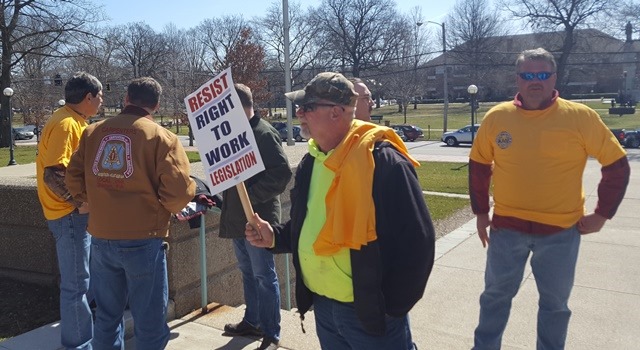
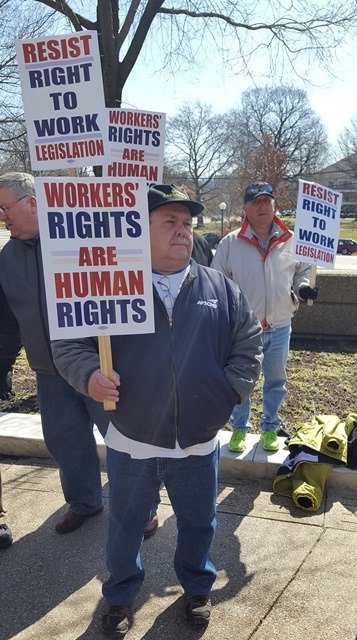
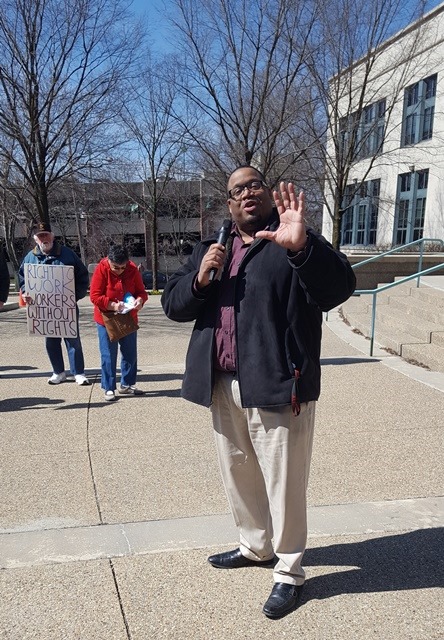
picketsMarch 23, 2017 -BEAVER — About 75 union supporters rallied at noon Thursday in front of the Beaver County Courthouse to rail against legislation they say moves Pennsylvania toward becoming a right-to-work state.

The legislation, Senate Bill 166, is called the Public Employee Protection Act, and it recently passed the state Senate.

"I like to call it ‘paycheck deception,’" is how Steve Kochanowski of Potter Township described the legislation.

He’s on the executive board of the Beaver County Democratic Party and is active with its young Democrats group.

Kochanowski, 32, is looking for a job now and is a former corporate trainer.

He opposed the law because "I believe it’s the first step to trying to make Pennsylvania a right-to-work state," he said.

He and other Democratic leaders, along with Beaver County’s labor union leadership, organized the rally to marshal opposition to the law before it passes the state House.

About 75 people turned out for the rally, wielding signs that said things such as "Workers’ Rights are Human Rights" and "Resist Right to Work Legislation."

The legislation would "hurt everybody here," according to Mitch Kates, political director of the Pennsylvania Democratic Party.

"We’re having organizing events like this all around the state," Kates said. "We want to help raise awareness."

MayorWalkerThe law would prohibit unions from allowing payroll deductions for union dues that are used for political activities, and it’s a step toward stopping union members "from being able to donate to causes that are dear to your heart," Aliquippa Mayor Dwan Walker said.

Walker is the son of a union worker and said his father appreciated that union dues were deducted from his paycheck. Otherwise, with other bills to pay, the dues might not get paid, Walker said.

"These are matters of the heart," Walker said. "I stand for workers’ rights. You must resist."

All of the speakers at the rally urged people to call their state legislators to voice opposition to the law.

People who live in so-called right-to-work states, where union power is limited, make less money under worse conditions, Denise Cox of Ohioville said.

She’s an organizer for the Service Employees International Union and said laws like the one proposed "weaken our workforce."

"Government should … let us work together," Cox said. "(The law) is wrong for our future."

She called it "big government’s intrusion into our workplace."

Continue reading Workers Rally to Resist Anti-Union Legislation

Pittsburgh’s Sala Udin Gets Presidential Pardon, 44 Years Later

20161228-SalaPortrait001 Sala Udin at his Pittsburgh home.

Sala Udin at his Pittsburgh home.

By Tracie Mauriello

Post-Gazette Washington Bureau

WASHINGTON — Sala Udin was stopped for speeding as he drove from a rally in Mississippi to drop off a carload of fellow Freedom Riders in Cleveland before heading home to Pittsburgh. Police who stopped him in Kentucky that day in 1970 searched his car, found an unloaded shotgun and a jug of Mississippi moonshine, and hauled him off to jail.

In 1972, he was sent to federal prison for seven months, with the shadow of his conviction hanging over him for the next 44 years.

No more.

On Monday, President Barack Obama pardoned the civil rights activist and 77 other people across the country. The president also issued 153 commutations to people sentenced for a variety of crimes, most involving manufacturing, selling or possessing drugs.

That brings the president’s total clemency actions to 1,324 — more than any predecessor since Lyndon B. Johnson.

Mr. Obama’s pardons and commutations “exemplify his belief that America is a nation of second chances,” said Neil Eggleston, counsel to the president. “While each clemency recipient’s story is unique, the common thread of rehabilitation underlies them all.”

A presidential pardon grants absolution as if a crime had never occurred.

“It’s a second chance, and I think — for most crimes — people deserve a second chance. Some of them would mess up again, but most of them would take full advantage of a second chance,” Mr. Udin said.

Continue reading Pittsburgh’s Sala Udin Gets Presidential Pardon, 44 Years Later

Midland Labor Leader Offended by Trump’s Attack on United Steelworkers

Tepsic speaking at ATI strike rally in Midland

By Jared Stonesifer

Beaver County Times

MIDLAND. Dec 9. 2016 –  — Tony Tepsic doesn’t have a Twitter account but, if he did, he would tell Donald Trump just when and where to find him.

Tepsic, president of the United Steelworkers Local 1212 in Midland, took offense to the fact that the president-elect earlier this week attacked a fellow United Steelworkers local president in Indiana.

The feud started when Trump claimed he helped save 1,100 jobs from leaving Indiana. Chuck Jones, president of United Steelworkers Local 1999 based in Indianapolis, called Trump a liar and said the real number of jobs saved was around 800.

Trump took to Twitter to fire back, saying Jones has done a “terrible job representing workers” while adding “no wonder companies flee (our) country!”

For Trump, it was just another 15 seconds on Twitter. Jones, however, started receiving anonymous phone calls that threatened his children.

“Nothing that says they’re going to kill me, but, you know, you better keep your eye on your kids,” Jones told MSNBC, according to the Associated Press. “I’ve been doing this job for 30 years, and I’ve heard everything from people who want to burn my house down or shoot me … I can deal with people that make stupid statements and move on.” Continue reading Midland Labor Leader Offended by Trump’s Attack on United Steelworkers

Bernie Sanders on Keeping Jobs: Carrier Just Showed Corporations How to Beat Donald Trump

We need a president who can stand up to big corporations, not fold to their demands.

By Bernie Sanders

Washington Post

December 1, 2016 – Today, about 1,000 Carrier workers and their families should be rejoicing. But the rest of our nation’s workers should be very nervous.

President-elect Donald Trump will reportedly announce a deal with United Technologies, the corporation that owns Carrier, that keeps less than 1,000 of the 2100 jobs in America that were previously scheduled to be transferred to Mexico. Let’s be clear: It is not good enough to save some of these jobs. Trump made a promise that he would save all of these jobs, and we cannot rest until an ironclad contract is signed to ensure that all of these workers are able to continue working in Indiana without having their pay or benefits slashed.

In exchange for allowing United Technologies to continue to offshore more than 1,000 jobs, Trump will reportedly give the company tax and regulatory favors that the corporation has sought. Just a short few months ago, Trump was pledging to force United Technologies to “pay a damn tax.” He was insisting on very steep tariffs for companies like Carrier that left the United States and wanted to sell their foreign-made products back in the United States. Instead of a damn tax, the company will be rewarded with a damn tax cut. Wow! How’s that for standing up to corporate greed? How’s that for punishing corporations that shut down in the United States and move abroad?

In essence, United Technologies took Trump hostage and won. And that should send a shock wave of fear through all workers across the country.

Trump has endangered the jobs of workers who were previously safe in the United States. Why? Because he has signaled to every corporation in America that they can threaten to offshore jobs in exchange for business-friendly tax benefits and incentives. Even corporations that weren’t thinking of offshoring jobs will most probably be re-evaluating their stance this morning. And who would pay for the high cost for tax cuts that go to the richest businessmen in America? The working class of America.

Let’s be clear. United Technologies is not going broke. Last year, it made a profit of $7.6 billion and received more than $6 billion in defense contracts. It has also received more than $50 million from the Export-Import Bank and very generous tax breaks. In 2014, United Technologies gave its former chief executive Louis Chenevert a golden parachute worth more than $172 million. Last year, the company’s five highest-paid executives made more than $50 million. The firm also spent $12 billion to inflate its stock price instead of using that money to invest in new plants and workers.

Does that sound like a company that deserves more corporate welfare from our government? Trump’s Band-Aid solution is only making the problem of wealth inequality in America even worse.

I said I would work with Trump if he was serious about the promises he made to members of the working class. But after running a campaign pledging to be tough on corporate America, Trump has hypocritically decided to do the exact opposite. He wants to treat corporate irresponsibility with kid gloves. The problem with our rigged economy is not that our policies have been too tough on corporations; it’s that we haven’t been tough enough.

We need to re-instill an ethic of corporate patriotism. We need to send a very loud and clear message to corporate America: The era of outsourcing is over. Instead of offshoring jobs, the time has come for you to start bringing good-paying jobs back to America.

If United Technologies or any other company wants to keep outsourcing decent-paying American jobs, those companies must pay an outsourcing tax equal to the amount of money it expects to save by moving factories to Mexico or other low-wage countries.  They should not receive federal contracts or other forms of corporate welfare.  They must pay back all of the tax breaks and other corporate welfare they have received from the federal government. And they must not be allowed to reward their executives with stock options, bonuses or golden parachutes for outsourcing jobs to low-wage countries. I will soon be introducing the Outsourcing Prevention Act, which will address exactly that.

If Donald Trump won’t stand up for America’s working class, we must.

‘Day of Disruption’ Protests in Pittsburgh Target McDonald’s, UPMC, Giant Eagle

Workers’ demands include $15 minimum wage, union rights

By Katelyn Sykes

WTAE Reporter

PITTSBURGH — No 29, 2016 – Thousands of workers are walking off the job and marching Tuesday in cities across the country, including Pittsburgh, where morning protests will be followed by a larger downtown rally in the afternoon.

The Service Employees International Union is targeting McDonald’s restaurants and UPMC with marches demanding a $15 minimum wage and union representation.

Organizers began their "Day of Disruption" marches at McDonald’s on Penn Avenue in East Liberty. Demonstrators went inside to voice their demands, then began circling the restaurant outside and chanting slogans like "Hold your burgers, hold your fries. We want wages supersized."

"I want to be able to take care of my family, to take care of myself, to pay bills," McDonald’s employee Aaron McCollum said. "You can’t possibly do that on $7.25, $7.35 an hour."

The protest then moved to a McDonald’s restaurant on North Euclid Avenue.

"It’s about workers, but it’s also recognizing that workers are more than who they are in between when they clock in and clock out, but that they’re our community members, they’re our neighbors, they’re humans," said Kai Pang, an organizer with Pittsburgh United. "We should have the right to not only survive but thrive in this city."

The group plans a similar protest near a McDonald’s and the federal building downtown during the evening rush hour.

"I’m just trying to fight for something that I believe in," McCollum said.

A press release on behalf of the group added, "Giant Eagle workers will also join the Fight for $15 today, asking that the company start paying family-sustaining wages and stop interfering with Giant Eagle employees’ right to organize."

The union contends UPMC shuttle bus workers have also gone on strike seeking union representation.

UPMC previously announced plans to increase the minimum starting wage for entry-level jobs at most of its facilities to $15 per hour by 2021.

But the union says UPMC needs to move faster, and it accused the network of trying to silence workers and union organizers.

UPMC hasn’t commented on Tuesday’s activity.

"I think more now than ever that we’re standing up for worker’s rights, for economic justice at a time when income inequality is very high and only grows higher," said Pang.