Tag Archives: unions

Are Working People Meeting the Moment? Prepare for Battle

https://www.weekendreading.net/p/the-trump-regimes-war-on-working

The Trump Regime’s War on Working People: The First 100 Days
Weekend Reading

How Unions are Resisting Authoritarian Attacks on Workers’ Rights—and Why It Matters for Everyone

By Michael Podhorzer

Apr 28, 2025

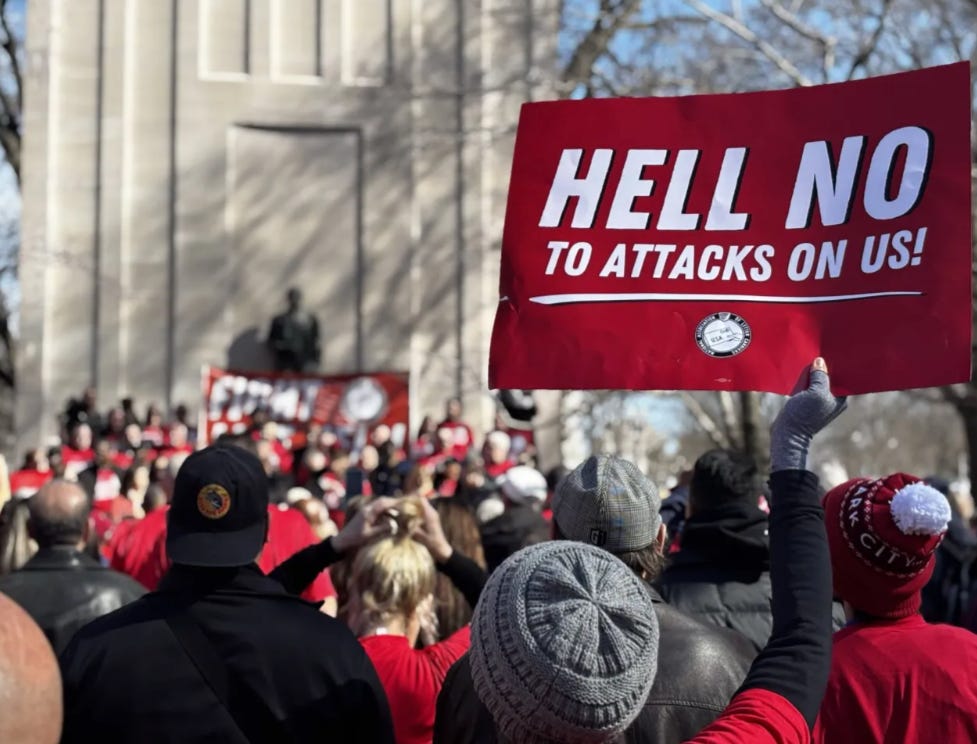
Over the course of the first 100 days, appropriate attention has been paid to Trump’s attacks on the judiciary, law firms, universities, philanthropy, non-profit groups and the media as dangerous in their own right, but more importantly as essential elements of authoritarian consolidationYet almost no one has mentioned the attacks on an equally proven constraint on oligarchy and autocracy: unions. Trump and Elon Musk’s destructive ransacking of our government should remind us of what previous generations of Americans understood intuitively: that “we may have democracy, or we may have wealth concentrated in the hands of a few, but we cannot have both,” as Supreme Court Justice Louis Brandeis put it. Like other attacks on civil society, the Trump regime’s attacks on unions and working people do not just injure those directly targeted, but all of us, as the labor movement is one of the most essential bulwarks against authoritarianism.

I’ve covered the indispensable role of unions in creating and protecting democracy and freedom in earlier Weekend Readings (Oligarchs Understand Power. Do We?As Go Unions, So Goes AmericaMore Than the Weekend: Unions, the Past and the Future of Democracy, and Then they came for the trade unionists).

If we all have a stake in unions as bulwarks against authoritarianism whether we belong to one or not, the same is true because of how unions foster shared prosperity and a healthy society, which I elaborate on here and here. In that regard, it is crucial to recognize the Trump actions as coming from the same playbook as Reagan’s decisive firing of over 11,000 striking air traffic controllers. It was more than punitive—it communicated a clear, aggressive stance against unions nationwide. The immediate aftermath saw corporate America follow Reagan’s lead, significantly increasing anti-union activities and adopting overt union-busting strategies.1 Reagan further entrenched anti-unionism by reshaping the NLRB into a body less protective of labor rights, reversing precedents that had previously safeguarded union activities.2
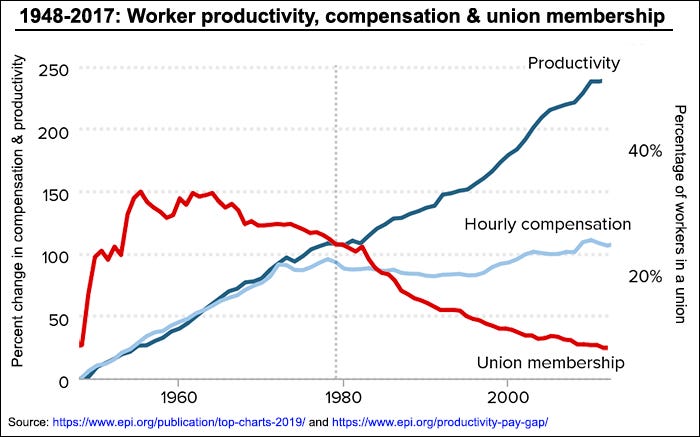
As it did then, today’s federal war on working people comes at a key inflection point. Then it was the rush to globalization, coupled with financialization and deindustrialization. Now it is the imminent transition to artificial intelligence in the workplace. Musk’s firings are providing a new playbook for that transition—fire everyone so as to be able to start from scratch with AI with as little friction from a legacy workforce as possible. And, although not the topic today, it’s important to note here that with respect to DOGE cleaning house to make way for AI, it’s also cleaning house to make way for even more of the government to be privatized—providing a vast market for the tech companies’ AI products and services. Although this future is not certain, it seems to be Musk’s plan: first trash the government, then when the government fails, privatize.

Today, I’ll lay out some of the most egregious actions taken by the Trump regime in the first 100 days to attack unions and working people in both the public and private sectors. Much of this is based on indispensable research by the Economic Policy Institute and its just released 100 Days, 100 Ways Trump Hurt Workers. (For more great reports like this, you can subscribe to EPI here.)

Then I’ll document the robust pushback unions are mounting against the Trump regime’s war on working people in the courts. Unions have also been in the forefront of mobilizing public action, most notably the AFL-CIO’s Department of People Who Work for a Living, which in addition to leading and participating in protests3, has organized town halls across the country.4 AFL-CIO President Liz Shuler declared:

The labor movement is not about to let Trump and an unelected billionaire destroy what we’ve fought for generations to build. We will fight this outrageous attack on our members with every fiber of our collective being.

And, significantly, even sectors mistakenly thought to be pro-Trump like the Building Trades powerfully responded to Trump’s executive order eviscerating collective bargaining for federal workers:

This executive order is an unprecedented assault on worker freedom and a direct attack on those fundamental rights. Americans know that patriotic blue-collar workers built this country, not billionaires. They also know that one of the last best chances to make it to the middle class is collective bargaining. NABTU and our affiliated unions will stand shoulder to shoulder with the entire labor movement to fight this head-on — and we will not back down.

Continue reading Are Working People Meeting the Moment? Prepare for Battle

Penn State Reaches Tentative Deal With Union Days After Teamsters OK Strike

7496245_web1_PTR-BRANCH1-062523

Photo: LOUIS B. RUEDIGER | TRIBUNE-REVIEW Unions representing workers at Penn State University’s main and branch campuses, including New Kensington, seen here, said they have reached a tentative four-year labor pact.

By BILL SCHACKNER

Pittsburgh Tribune-Review

Monday, July 1, 2024 – Union members will vote in the coming weeks on a tentative contract agreement with management covering 2,500 employees on Penn State University branches statewide and the main University Park campus.

The deal, if ratified, could offer a measure of labor peace at a time of heightened workplace anxiety across Penn State generally, and its branches in particular, over university-wide budget cuts and a 10% faculty and staff reduction through buyouts this spring on those branches, where enrollment has fallen sharply since 2010.

Teamsters Local 8 represents employees in custodial service, emergency medical response, food service, housing service, trades, science, athletics, agriculture, research, printing, engineering, transportation, airport services, information technology and media.

Its members on Wednesday had authorized leaders to call a strike if necessary.

The previous contract with Teamsters Local 8 was due to expire Sunday. The union announced the tentative four-year contract on social media Saturday night.

“The new deal includes 20% wage increases (21.79% compounded) over the life of the contract. More details will be shared during the forthcoming ratification meetings,” it read. “This effort was only made possible by the nearly 1,900 members who authorized strike action and showed the University that WE WERE READY!”

The contract would run through June 30, 2028, and will be retroactive to Monday.

Jonathan Light, president of Teamsters Local 8, could not immediately be reached Monday for additional comment on the agreement.

Penn State President Neeli Bendapudi welcomed the tentative pact, and in a statement, said pay raises included are comparable to deals recently reached by Penn State with Service Employees International Union Local 668 and the American Federation of State, County and Municipal Employees (AFSCME) Local 13.

“These are the employees who keep Penn State operational,” said Jennifer Wilkes, vice president for human resources and chief human resources officer. “They maintain our facilities and grounds, provide food and services for our students, and clear the snow and ice during weather emergencies. During the COVID-19 pandemic, they were essential workers, serving on the front lines while the rest of the university was working remotely ….”

The branches statewide covered by the tentative agreement include Penn State New Kensington, Greater Allegheny, Beaver, Fayette and Shenango in Southwestern Pennsylvania.

Collectively, most of the branches have faced enrollment losses between 16% and 50% the last 10 years, officials said. They were expected to bear the brunt of $94 million in cuts announced in January to further reduce a university-wide deficit that at one point was $140 million.

Leadership on a number of those branches, which Penn State calls its Commonwealth system, is also being restructured. Multiple campuses will report to one chancellor under those changes.

On Wednesday, 91% of the 2,053 Teamsters who cast ballots on the strike authorization measure voted to approve it, said Light.

Union members will vote in the coming weeks on a tentative contract agreement with management covering 2,500 employees on Penn State University branches statewide and the main University Park campus.

The deal, if ratified, could offer a measure of labor peace at a time of heightened workplace anxiety across Penn State generally, and its branches in particular, over university-wide budget cuts and a 10% faculty and staff reduction through buyouts this spring on those branches, where enrollment has fallen sharply since 2010.

Teamsters Local 8 represents employees in custodial service, emergency medical response, food service, housing service, trades, science, athletics, agriculture, research, printing, engineering, transportation, airport services, information technology and media.

Its members on Wednesday had authorized leaders to call a strike if necessary.

The previous contract with Teamsters Local 8 was due to expire Sunday. The union announced the tentative four-year contract on social media Saturday night.

“The new deal includes 20% wage increases (21.79% compounded) over the life of the contract. More details will be shared during the forthcoming ratification meetings,” it read. “This effort was only made possible by the nearly 1,900 members who authorized strike action and showed the University that WE WERE READY!”

The contract would run through June 30, 2028, and will be retroactive to Monday.

Jonathan Light, president of Teamsters Local 8, could not immediately be reached Monday for additional comment on the agreement.

Penn State President Neeli Bendapudi welcomed the tentative pact, and in a statement, said pay raises included are comparable to deals recently reached by Penn State with Service Employees International Union Local 668 and the American Federation of State, County and Municipal Employees (AFSCME) Local 13.

“These are the employees who keep Penn State operational,” said Jennifer Wilkes, vice president for human resources and chief human resources officer. “They maintain our facilities and grounds, provide food and services for our students, and clear the snow and ice during weather emergencies. During the COVID-19 pandemic, they were essential workers, serving on the front lines while the rest of the university was working remotely ….”

The branches statewide covered by the tentative agreement include Penn State New Kensington, Greater Allegheny, Beaver, Fayette and Shenango in Southwestern Pennsylvania.

Collectively, most of the branches have faced enrollment losses between 16% and 50% the last 10 years, officials said. They were expected to bear the brunt of $94 million in cuts announced in January to further reduce a university-wide deficit that at one point was $140 million.

Leadership on a number of those branches, which Penn State calls its Commonwealth system, is also being restructured. Multiple campuses will report to one chancellor under those changes.

On Wednesday, 91% of the 2,053 Teamsters who cast ballots on the strike authorization measure voted to approve it, said Light.

Bill Schackner is a TribLive reporter covering higher education. Raised in New England, he joined the Trib in 2022 after 29 years at the Pittsburgh Post-Gazette, where he was part of a Pulitzer Prize-winning team. He can be reached at bschackner@triblive.com.

volume_off

-2:12

sd

share

closed_caption

fullscreen

Auto (360p)

225p

360p

Subtitles Off

Subtitles EN

EU Summit: Leaders Set to Finalize Top Jobs Deal

2:23

Orban Forms EU Alliance, Expands Populist Power

1:51

Von der Leyen to Stay on as EU Commission Head 

2:26

China Miscalculated With Europe in Backing Russia, US Ambassador Says

0:55

Road to White House Goes Through NC, Wiley Says

2:07

arrow_back_ios_new

arrow_forward_ios

Bill Schackner is a TribLive reporter covering higher education. Raised in New England, he joined the Trib in 2022 after 29 years at the Pittsburgh Post-Gazette, where he was part of a Pulitzer Prize-winning team. Previously, he has written for newspapers in Connecticut, New York, Pennsylvania and Rhode Island. He can be reached at bschackner@triblive.com.