Medicare for All Solution to Fiscal Cliff

User Picture

Post election deficit deal threatens Medicare and Social Security

By: Kay Tillow Saturday October 6, 2012 2:46 pm

Sitting with starlings (photo: Monocle / flickr)

The solution is Improved Medicare for All

After the November election, there will be a major effort in Congress to pass a budget deal that will make cuts in Social Security, raise the Medicare and Social Security eligibility age, and perhaps more–unless we act to stop it with a solution that is close at hand.

There is agreement from the Wall Street Journal’s David Wessel to liberal economists Dean Baker and Paul Krugman that the pressure will be on to reach a Simpson/Bowles type of compromise.  Such a bipartisan plan would damage our most cherished programs and excuse the dastardly deed by asserting that the cuts are small and necessary because of the deficit.

Those who relentlessly scream at us and finance ads to persuade us that the deficit threatens our grandchildren are obscuring the truth.  The fact is that the transfer of wealth from public funds and the rest of us to the super rich is the real crisis.  But those who have gorged themselves on this massive transfer of wealth also seek to undermine the Medicare and Social Security which are our grandchildren’s heritage from generations of struggles for a better life.

Continue reading Medicare for All Solution to Fiscal Cliff

The Politics of the Jobs Report

The Politics of the Jobs Report

by Robert Reich
Friday, October 5, 2012

The White House is breathing easier this morning. The Bureau of Labor Statistics reports the unemployment rate dropped to 7.8 percent – the first time it’s been under 8 percent in 43 months.

In political terms, headlines are everything – and most major media are leading with the drop in the unemployment rate.

Look more closely, though, and the picture is murkier. According to the separate payroll survey undertaken by the BLS, just 114,000 new jobs were added in September. At least 125,000 are needed per month just to keep up with population growth. Yet August’s job number was revised upward to 142,000, and July’s to 181,000.

In other words, we’re still crawling out of the deep crater we fell into in 2008 and 2009. The percent of the working-age population now working or actively looking for work is higher than it was, but still near a thirty-year low.

But at least we’re crawling out.

Romney says we’re not doing well enough, and he’s right. But the prescriptions he’s offering – more tax cuts for the rich and for big companies – won’t do anything except enlarge the budget deficit. And the cuts he proposes in public investments like education and infrastructure, and safety nets like Medicare and Medicaid, will take money out of the pockets of people who not only desperately need it but whose spending is necessary to keep the tepid recovery going.

Romney promises if elected the economy will create 12 million new jobs in his first term. If we were back in a normal economy, that number wouldn’t be hard to reach. Bill Clinton presided over an economy that generated 22 million new jobs in eight years – and that was more than a decade ago when the economy and working-age population were smaller than now.

Both Obama and Romney assume the recovery will continue, even at a slow pace, and that we’ll be back to normal at some point. But I’m not at all sure. “Normal” is what got us into this mess in the first place. The concentration of income and wealth at the top has robbed the vast middle class of the purchasing power it needs to generate a full recovery – something that was masked by borrowing against rising home values, but can no longer be denied. Unless or until this structural problem is dealt with, we won’t be back to normal.

PA Gamesa Worker on Tour Calling on Congress to Save Clean Energy Jobs

Area Leaders Join Touring Worker Facing Furloughs to Call for Renewal of the Production Tax Credit to Save 37,000 American Jobs, Ensure U.S. Can Compete in Global Clean Energy Industry

By Blue-Green Alliance

PITTSBURGH (September 25, 2012) Local labor and environmental leaders today joined a furloughed worker from wind turbine-maker Gamesa at the Energy Innovation Center in Pittsburgh to call on Congress to support an immediate extension of the Production Tax Credit. The lack of action on the 2.2-cent per kilowatt-hour tax incentive for wind energy — set to expire at the end of the year — was directly blamed by Gamesa for their decision to institute furloughs at two plants in Pennsylvania, including the plant of Ryan Motel, a United Steelworkers Local 2635 member who is currently on furlough.

“My job is at stake, but so are the jobs of many others,” said Motel. “If companies aren’t building wind farms because they’re not sure what their return on their investment will be, they aren’t buying our blades. My message to Congress is simple: end this uncertainty, save my job, and save the jobs of thousands of people like me across the country.”

Gamesa employs approximately 900 workers in the U.S., with 800 of those jobs in the state of Pennsylvania. Earlier this summer, 165 workers at two plants — in Fairless Hills in Bucks County and Ebensberg in Central Pennsylvania — were given notice that they were being furloughed due to lack of demand and the company attributed that directly to lack of certainty on the fate of the Production Tax Credit

Motel will join other workers in the wind industry in Ohio, Virginia and Michigan to call on Congressional leadership to bring the Production Tax Credit up for a vote in the U.S. House of Representatives.

The American Wind Energy Association estimates that the Production Tax Credit will allow the wind industry to grow from the current 75,000 jobs to 500,000 jobs by 2030. Extending the Production Tax Credit through 2016 would increase total wind-supported jobs to 95,000, with total wind investment growing to $16.3 billion. However, without an extension, America stands to lose 37,000 jobs.

Continue reading PA Gamesa Worker on Tour Calling on Congress to Save Clean Energy Jobs

Question to the Candidates: Who Will Speak for the Antiwar Majority?

American Public Opposes War with Iran

By Tom Hayden
Beaver County Peace Links via Peace Exchange Bulletin

Sept 18, 2012 – Among key findings of a survey conducted by the Chicago Council on Global Affairs are these:

  •     51% oppose the UN authorizing a strike on Iran, 70% oppose a unilateral U.S. strike on Iran, and 59% do not want to get involved in a potential Iran-Israel war; 45% favor the UN authorization of a strike;
  •     “In the hypothetical situation in which Israel were to bomb Iran’s nuclear facilities, Iran were to retaliate against Israel, and the two were to go to war, only 38 percent say the United States should bring its military forces into the war on the side of Israel. A majority (59%) says it should not.” (p. 30)
  •     54% do support an attack by U.S. ground troops against terrorist training camps and facilities, down from 82% in 2002.

    To deal with the crisis in Syria, majorities of Americans support diplomatic and economic sanctions (63%) as well as a no-fly zone in Syria (58%).

Those numbers may be what is causing Benyamin Netanyahu, and his allies in AIPAC, to step up their campaign of implied political threats against the Obama administration for its relative caution over Iran’s nuclear program.

Continue reading Question to the Candidates: Who Will Speak for the Antiwar Majority?

Study: Pennsylvania does not enforce oil and gas regulations

Ambridge Reservoir threatened by Chesapeake Energy, the biggest violator of DEP regulations in the state.

Clean Air Council PA * Clean Water Action PA * Delaware Riverkeeper Network * Mountain Watershed Association * PennEnvironment * Sierra Club PA Chapter

New research reveals Pennsylvania does not
enforce oil and gas regulations

State enforcement data shows more than 85% of active PA wells go uninspected, discovered violations go increasingly unpunished, repeat violators undeterred
Sep 25th, Washington, D.C. — In association with six Pennsylvania groups, national resource extraction watchdog Earthworks today released an unprecedented study, Breaking All the Rules: The Crisis in Oil & Gas Regulation revealing that states across the country fail to enforce their oil and gas development regulations. The one-year, in-depth examination of enforcement data and practices — in Pennsylvania, Texas, Ohio, New York, New Mexico and Colorado — also includes interviews with ex-industry and state agency employees.
“Pennsylvania’s enforcement of state oil and gas rules is broken,” said Earthworks’ Senior Staff Attorney Bruce Baizel. He continued, “In Pennsylvania and across the country, public health and safety are at risk because states are failing to uphold the rule of law. Until Pennsylvania can guarantee they are adequately enforcing their own rules on an ongoing basis, the state must not permit new drilling.”
As recounted in the separate Pennsylvania-specific analysis, failure to enforce oil and gas regulations means that Pennsylvania is not seeking, documenting, sanctioning, deterring, and cleaning up problems associated with irresponsible oil and gas operations such as chemical spills, equipment failure, accidents, and discharges into drinking water supplies
Among the study’s findings —
  • More than 85% of all active oil and gas wells in Pennsylvania go uninspected each year: 66,000 wells.
  • Rule violators are rarely punished, even more rarely of late: on average only 20% of violators have been penalized in 2012, down from 24% in 2011.
  • Worst violators are getting worse: effective regulatory enforcement would stop repeat violators. In Pennsylvania, repeat violations are increasing.

Continue reading Study: Pennsylvania does not enforce oil and gas regulations

PA Court May Enjoin Voter ID Law

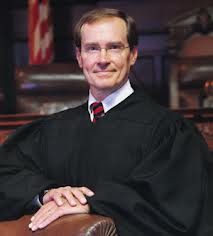
Commonwealth Court Justice Robert E. Simpson, Jr.

Pa. judge raises possibility he will move to block voter ID law


Angela Couloumbis | The Philadelphia Inquirer

HARRISBURG, Pa. — With just six weeks until the presidential election, a judge raised the possibility Tuesday that he would move to block Pennsylvania’s controversial voter ID law.

“I’m giving you a heads-up,” Commonwealth Court Judge Robert E. Simpson Jr. told lawyers after a day’s testimony on whether the law is being implemented in ways that ensure no voters will be disenfranchised. “I think it’s a possibility there could be an injunction here.”

Simpson then asked lawyers on both sides to be prepared to return to court Thursday to present arguments on what such an injunction should look like. There is no hearing Wednesday because of Yom Kippur.

Simpson gave few if any further clues to what he may decide. But his comments provided a dramatic end to a day of testimony in a protracted and widely watched fight over the law, which requires voters to present photo identification at the polls.

Critics of the law have argued that it is being rushed into effect – it was enacted in March – and will disenfranchise hundreds of thousands of voters, particularly minorities, the elderly and the poor. Democrats have branded it a thinly veiled attempt by Republicans to suppress the vote for President Barack Obama on Nov. 6 and boost Mitt Romney’s chances of winning Pennsylvania’s 20 electoral votes.

Continue reading PA Court May Enjoin Voter ID Law

Obama Auto Bailout Saves More than Auto Jobs in Our Region

It’s Not Just About Cars

When President Obama took the bold step of saving the U.S. auto industry, he didn’t just save auto assembly jobs. He saved American manufacturing, including 350,000 USW jobs that are part of the auto supply chain.

All About Jobs

The auto rescue helped millions of Americans and Steelworkers from all over: the single mom making axles in Indiana. The lifelong paperworker in Wisconsin making high-glossy paper used in auto catalogs. The kid just out of high school hired into the tire plant in Ohio. The police officer in small town Pennsylvania. The list goes on and on.

Change Delivered

Mitt Romney says he would have let the auto industry fail — let us fail. President Obama believed in us. Saving the American auto industry was courageous. It was politically unpopular. But it was the right thing to do.

Next Time You Hear ‘Support Our Troops’ from the Right, Remember This:

GOP Blocks Veteran Jobs Bill

By LAWRENCE DOWNES
Beaver County Peace Links via New York Times

Sept. 19, 2012 – Veterans won’t be getting a new, billion-dollar jobs program, not from this Senate. Republicans on Wednesday afternoon blocked a vote on the Veterans Job Corps Bill after Jeff Sessions of Alabama raised a point of order – he said the bill violated a cap on spending agreed to by Congress last year. The bill’s sponsor, Patty Murray of Washington, said that shouldn’t matter, since the bill’s cost was fully offset by new revenues. She said Mr. Sessions and his party colleagues had been furiously generating excuses to oppose the bill, and were now exploiting a technicality to deny thousands of veterans a shot at getting hired as police officers, firefighters and parks workers, among other things.

The vote was 58-40; the bill needed 60 votes to proceed.

It would be easier to admire the Republicans’ late-breaking fiscal scrupulosity if their motives – denying the Obama administration any kind of victory this year, whatever the cost to jobless vets – weren’t so transparent.  It’s probably useful to remind Republicans like John McCain (a "nay" on the jobs bill) that wounded, jobless and homeless veterans aren’t a fact of nature. They’re a product of the wars that Congress members voted for, the war debt they piled on, and the economy they helped ruin.

"It’s unbelievable that even after more than a decade of war, many Republicans still will not acknowledge that the treatment of our veterans is a cost of war," Ms. Murray said in a statement after the vote.

One Step Forward for Voting Rights, One Step Back for the GOP

Photo: Larry Roberts/Post-Gazette – Monel Walker, left, from Braddock, receives reassurance about her voter identification from Marian Schneider, a local attorney volunteering at the "My Vote, My Right" awareness event held in front of the PennDOT office on Smithfield Street in Pittsburgh today.

Pennsylvania Supreme Court sends Voter ID back to lower court

By Karen Langley
Pittsburgh Post-Gazette

Sept 18, 2012 HARRISBURG — The Pennsylvania Supreme Court has ordered a lower court to revisit its decision that allowed the new voter ID law to remain in effect for the November elections.

If Commonwealth Court finds the state’s implementation of the law will disenfranchise voters in November, the high court has ordered it to issue an injunction.

In its decision not to stop the law immediately, the high court ruled that Commonwealth Court relied on judgments about how the state would educate voters and provide access to acceptable forms of identification. The justices wrote that lawmakers have made "an ambitious effort" to put the photo identification requirement in place by the upcoming elections but that state agencies face "serious operational constraints" in doing so.

Given that, the justices wrote, they are not satisfied with a decision based on assurances of what the state will do to ensure all voters have acceptable identification.

They ordered Commonwealth Court to issue a new decision by Oct. 2 based on the present availability of identification.

"The court is to consider whether the procedures being used for deployment of the cards comport with the requirement of liberal access which the General Assembly attached to the issuance of PennDOT identification cards," the order says.

"If they do not, or if the Commonwealth Court is not still convinced in its predictive judgment that there will be no voter disenfranchisement arising out of the Commonwealth’s implementation of a voter identification requirement for purposes of the upcoming election, that court is obliged to enter a preliminary injunction."

The voter ID requirement passed the Legislature with Republican support and was signed into law in March by Gov. Tom Corbett. It requires voters to show one of several forms of photo identification at the polls.

The American Civil Liberties Union of Pennsylvania and other groups filed suit, claiming the law violates the state Constitution and would disenfranchise many Pennsylvania voters. After a week of testimony, the Commonwealth Court in August declined to stop the law.

Supreme Court Justices Seamus McCaffery and Debra McCloskey Todd filed dissenting statements.

Justice Todd wrote that she would reverse the lower court’s decision, not return the matter for further consideration. She wrote of an "impending near-certain loss of voting rights" and said the court was allowing the state to essentially ignore the short timeline before the election.

"The eyes of the nation are upon us, and this Court has chosen to punt rather than to act," she wrote.

Justice McCaffery concluded in another dissent that the evolving efforts by state agencies to implement the law "are a tacit admission that (the law) is simply not ready for the prime time" of the November election. He wrote that further hearings are unnecessary and that the high court should order the lower court to issue an injunction.

Karen Langley: klangley@post-gazette.com or 717-787-2141 .

Romney’s Green Energy Job Destruction Plan: Hurting GOP Governors to Hurt Obama

Wind Subsidies Raise a Storm in Heartland States

By Jim Malewitz
SolidarityEconomy.net via PEW’s Stateline

Across the plains of Iowa, Colorado, Oklahoma, Kansas and South Dakota, tall turbines with sleek blades dot once-clear horizons, churning out carbon-free energy to add to the nation’s power grid. The blades seem to wave a greeting, on windy days at least, to whoever drives across those open spaces.

The wind industry’s rapid growth has been cause for excitement among both Republican and Democratic policymakers in the heartland states. They welcome the jobs that come with it. In South Dakota, which has the capacity to generate almost a quarter of its energy from the turbines, “wind is not a partisan issue,” says Hunter Roberts, the state’s energy director.

But it is a controversial issue in Washington these days, threatening to stop the turbine boom before it progresses much further. Fiscal hawks in Congress — those who don’t represent wind states — question whether Congress can still afford to dole out the generous tax credit that has helped fuel the industry’s rise. Wind energy credits are just one of several renewable energy incentives set to expire at year’s end.

Wind-state governors, most of them Republicans, have loudly called for the credit’s renewal, writing letters to Congress and speaking through the media. But with the expiration deadline looming, the governors have grown curiously quiet on the issue. That’s since Mitt Romney voiced his opposition to the subsidy, shortly before releasing an energy plan that is heavy on oil and natural gas investments and light on wind and other renewables.

Continue reading Romney’s Green Energy Job Destruction Plan: Hurting GOP Governors to Hurt Obama