Sept. 7, 2024 – After spending several days in Pittsburgh this week, Vice President Kamala Harris ventured out Saturday afternoon for a quick campaign stop in the Strip District. She was greeted by emotional supporters.
Harris departed the Omni William Penn Hotel in Downtown around 1 p.m. Security was high around and inside the historic hotel. Secret Service closed off a block of William Penn Place to traffic in front of the Omni, and guests had to pass through a metal detector in the lobby.
The vice president traveled just up the road into the city’s Strip District, making a stop at Penzeys Spices on Penn Avenue.
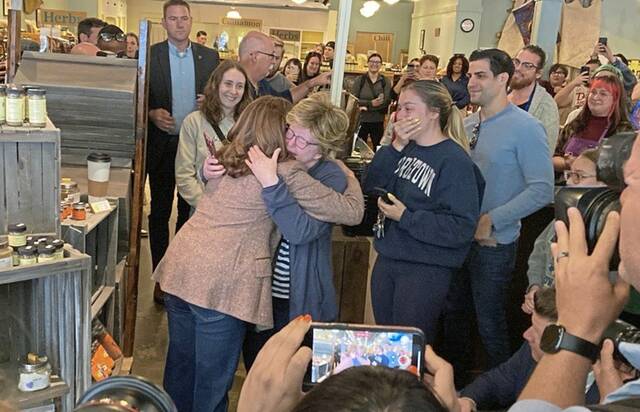
Upon entering, a woman became overwhelmed when looking at Harris and started to cry. The woman told the vice president, “I appreciate you, just so you should know.”
Harris embraced her.
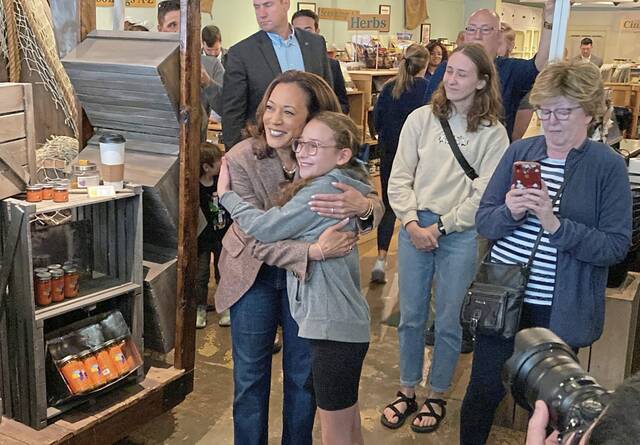
Vice President Kamala Harris shares a hug with a woman overcome with emotion during a campaign stop Saturday at Penzeys Spices on Penn Avenue in Pittsburgh’s Strip District.
“We are gonna be fine, we are gonna be fine,” Harris told her. “We are all in this together.”
Harris then greeted other customers in the spice shop and posed for pictures.
One girl Harris spoke to, named Charlotte, said she is from Freeport and attends school in the Freeport Area School District. The girl asked for a hug. Harris posed for photos with the girl and her entire family — including her father, a seventh grade geography teacher.
Harris thanked him for being a teacher.
“We are counting on your leadership, OK?” Harris told Charlotte, who nodded in approval. “Really I am serious, I am really counting on you.
“Go Yellowjackets,” Harris said, referencing Freeport’s mascot, as she high-fived Charlotte.
Harris then met with some other customers briefly and discussed cooking with a Penzeys staffer and picked out a few spices.
Sept 3, 2024 – Pennsylvania drivers might begin seeing more billboards featuring ordinary people, like a white-haired, red-shirt wearing man named “Mike,” and a simple message: “I’m a former Trump voter. I’m a patriot. I’m voting for Harris.”
The billboards are paid for by a group called Republican Voters Against Trump, a project of the Republican Accountability PAC, that is hoping the voices of ordinary voters will sway conservatives and independents to support Vice President Kamala Harris, the Democratic nominee for president, in November.
On Tuesday, the group announced a new $11.5 million campaign that will feature voters like Mike on billboards, online ads and tv and radio commercials in Pennsylvania and other swing states like Michigan, Wisconsin and Arizona.
But the bulk of the spending, $4.5 million, will target Pennsylvania, which could end up being the decisive state in the 2024 election.
John Conway, the D.C.-based director of strategy for Republican Voters Against Trump, is leading the campaign (He claims no relation to perhaps the most famous never-Trumper, George Conway).
“Our campaign is built on the idea that you need to establish permission structures in order to get voters who have historically identified as Republican to vote against their party’s nominee,” Conway said. “The ads themselves are coming right from the same people we’re targeting with these campaigns: center-right former Trump voters who don’t want to vote for him again.”
The Trump campaign did not immediately respond to a request for comment Tuesday.
Conway says the group has collected the testimonies of roughly 300 voters who previously cast ballots for former President Donald Trump, but who no longer support him. They constitute the heart of the new advertisements.
Kamala Harris will make her second visit to western Pennsylvania in less than a week on Thursday, as the Democratic candidate focuses her presidential campaign on voters at both ends of the battleground state.
Harris appeared at a union hall in Pittsburgh on Monday alongside US President Joe Biden, but will be back in the city on Thursday, days before she heads to a debate with Donald Trump in Philadelphia. Campaign officials say she will remain in the state throughout the weekend as she prepares for the debate.
Harris’s trip comes at a pivotal point, with polls putting her and Trump neck and neck in the race to secure Pennsylvania’s 19 Electoral College votes — more than in any other swing state.
“The state is in play, and the path to 270 for either candidate can run through Pennsylvania,” said Kristen Coopie, a political-science professor at Duquesne University in Pittsburgh, referring to the number of Electoral College votes needed to win the White House in November.
“[The campaigns] know the state is important. They know there is a wide representation of citizens just within one state . . . it is pretty representative of the country at large.”
Harris also arrives amid an escalating political fight over the ownership of US Steel, an iconic American manufacturer and major employer in Pittsburgh, whose future has become an electoral issue. Harris and Trump have both come out against a proposed $15bn takeover of US Steel by Japan’s Nippon Steel — a protectionist stance designed to court blue-collar votes in the state. On Wednesday, the Financial Times reported that Biden was preparing to block the deal on national security grounds.
US Steel has said that if the merger fails it could close plants, raising the stakes ahead of Harris’s Pennsylvania trip, her 10th visit to the state this year.
Trump — who narrowly survived an assassination attempt in July in Butler county, just north of Pittsburgh — has also made the state a focus of his campaign.
On Wednesday night, the former president, was interviewed by Fox News host Sean Hannity in front of a live audience in Harrisburg, the state capital. After vowing to “heal our world”, invoking the praise he had received from Viktor Orbán, Hungary’s prime minister, Trump expressed confidence in his chances to win the election and touted his “love” for Pennsylvania. “We’re going to be very well set up to do a great job,” he said.
Both campaigns have spent more on advertising in Pennsylvania than in any other state, according to FT analysis of AdImpact data, with the Harris campaign and allied groups spending nearly $146mn to date and the Trump team almost $132mn.
The winner of Pennsylvania — whose population spans diverse, urban areas such as Philadelphia and Pittsburgh, highly educated affluent suburbs and poorer rural areas — has won the White House in 10 of the past 12 presidential elections.
Margins of victory in Pennsylvania have been small. In 2020, Biden defeated Trump by about 80,000 votes. Four years earlier, Trump beat Hillary Clinton by about 44,000 votes, or less than a percentage point.
Patrick Murphy, a former Democratic congressman from Pennsylvania, said the state remained a “toss-up” with just two months to go in the race, but insisted it was an “absolutely, positively, must win” for Harris.
A CNN poll from Pennsylvania published on Wednesday found the two candidates tied, each with support from 47 per cent of likely voters. An FT average of statewide polls in Pennsylvania also shows Harris and Trump in a statistical tie, with Harris enjoying an edge of just 0.4 points.
Charlie Dent, a former Republican congressman from Pennsylvania and Trump critic, said that given the former president’s tendency to over-perform polling in past elections, he may already have an advantage over Harris.
But he added Harris was still better positioned than Biden had been to defeat Trump this time.
U.S. Rep. Summer Lee (D-12th District) speaks to the Pennsylvania delegates at the Democratic National Convention in Chicago Aug. 22, 2024 (Capital-Star photo by Kim Lyons)
Delegates and candidates turn to the work of keeping the battleground state blue
By: Kim Lyons
Penn-Capital Star
August 25, 2024 – CHICAGO — Pennsylvania was the most popular kid in the class at the 2024 Democratic National Convention, and the battleground state and its 19 electoral votes were well represented in Chicago and on the convention’s nightly broadcasts. Each night featured a speaker from the Keystone State, with Lt. Gov. Austin Davis on Monday; state Rep. Malcolm Kenyatta on Tuesday; Gov. Josh Shapiro on Wednesday and U.S. Sen. Bob Casey on Thursday.
Shapiro was unquestionably the biggest Pennsylvania presence at the DNC, due in part to his status as a runner-up to be presidential nominee Vice President Kamala Harris’ running mate. He was constantly booked during the week, speaking at numerous state delegations’ breakfasts, attracting the ire of GOP nominee former President Donald Trump, and appearing regularly on cable news channels.
Project 2025 played a key role at the convention, as Democrats continued to try to link the conservative policy plan to reshape the federal government and increase presidential authority with Trump.
Kenyatta, a candidate for state Auditor General held the giant Project 2025 book on stage Tuesday night,, and told the audience it was a “radical plan to drag us backwards, bankrupt the middle class and raise prices on working families like yours and mine.”
Trump has tried to distance himself from Project 2025 but several members of his administration were involved with helping to craft it.
“It’s a big, heavy book full of bad ideas, and it was one of these moments where we’re able to really get people to understand with the visual how serious Trump and this administration are about doubling down on his flawed theory of the case,” Kenyatta told the Capital-Star on the final day of the convention.
Our vote is the highest demonstration of the collective power we have… The purpose of this moment is to use our collective power to elect somebody who gives a damn about us, and then to work side by side with her to help implement the things that she’s talking about.
He added Project 2025 should serve as a warning to Democrats about what they believe a second Trump term would look like.
“When Trump burst onto the political scene, he did so with the thesis that ‘America sucks,’ and that it sucks in large part because our neighbors, the people in our community, people we don’t know — they’re somehow a part of bringing America down,” Kenyatta said, “and the only way we fix it is if we give him all the power.”
While Trump’s first term saw the former president “flailing around,” Kenyatta said, the architects of Project 2025 mapped out a plan for how to reach some of the goals of the far-right wing of the party, such as a national abortion ban and abolishing the U.S. Department of Education.
Kenyatta added he doesn’t believe in the political concept of giving all the power to one person to fix everything.
“Our vote is the highest demonstration of the collective power we have,” he said. “If we elect Kamala Harris in November and then say, ‘OK, we’ll see you in four years at the next convention. Hope you fix all the problems!’ then we’ve missed the thread. The purpose of this moment is to use our collective power to elect somebody who gives a damn about us, and then to work side by side with her to help implement the things that she’s talking about.”
At the final Pennsylvania delegates’ breakfast on Thursday, U.S. Rep. Summer Lee (D-12th District) urged the battleground state delegates to keep up the convention’s momentum.
“We’re here honing our tools so that we can go out and do the very hard work, not for Kamala Harris. We’re not doing hard work for Summer Lee or any of my colleagues,” Lee said, but rather for marginalized and vulnerable people. “Think about that person whose name is in that book over the hundreds and hundreds of pages of Project 2025, who do we see there that we need to make sure is not touched by the evil and the horrors that they have lined up and ready for them.”
Davis, Pennsylvania’s youngest and first-ever Black lieutenant governor, addressed the convention on Monday night and spoke about the importance of building bridges. He appeared on stage with Wisconsin Lt. Gov. Sarah Rodriguez, Harris County, Texas Executive Lena Hidalgo, and California Lt. Gov. Eleni Kounalakis, all of whom shared stories about how Harris had made an impact on their communities.
“I grew up with working class parents in a small steel town in southwestern Pennsylvania, and to have the opportunity to speak on a national stage like that was incredibly humbling,” Davis told the Capital-Star. “It was just an example of how someone can live the American dream, so I hope folks who saw me saw that America should be a place where every person has that same opportunity.”
Davis said the question he heard most often over the course of the convention was whether Democrats can win Pennsylvania. “And I tell them, absolutely, we just have to keep showing up everywhere, competing in places that sometimes it’s not easy to be a Democrat,” he said.
Asked if there were “red” areas of the state he saw as possible to flip blue, he pointed to central Pennsylvania as having the most potential, particularly the race in the 10th Congressional District between former WGAL anchor Janelle Stelson and Republican U.S. Rep. Scott Perry.
“I think we have a great candidate in Janelle Stelson,” he said. “I think there’s a lot of energy also with [state Rep.] Patty Kim running for state Senate. So I think Dauphin, Lancaster, Cumberland — an area Governor Shapiro won when we were running on the ballot.”
Davis said not everyone was completely impressed with his star turn on television, however. His daughter Harper, whose 1st birthday is next month, was asleep by the time he appeared Monday night. “We’re going to replay it for her but she doesn’t care,” he said. “She only cares when I FaceTime her and she’s like, ‘Daddy, when are you coming home?’”
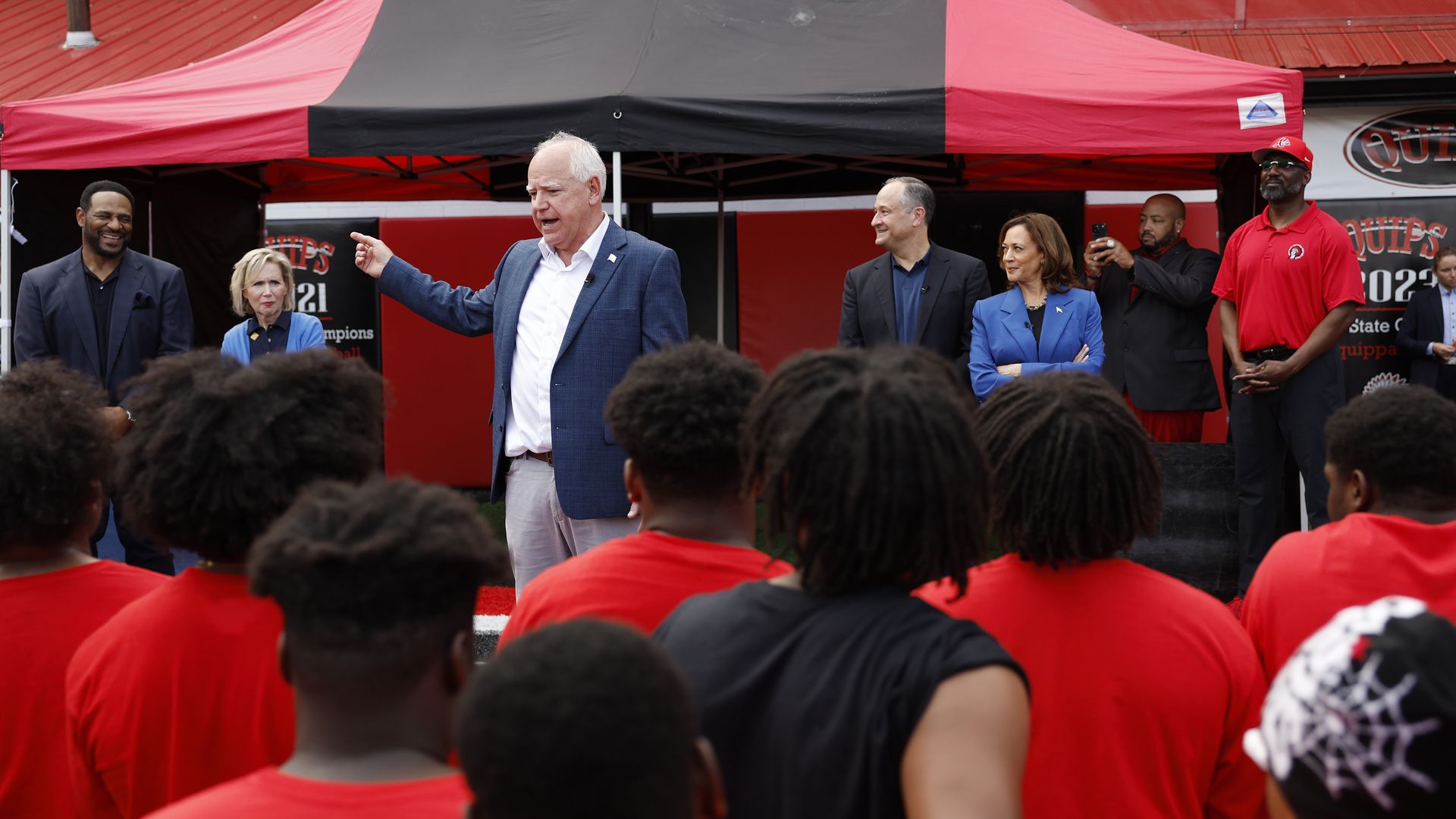
Photo: Walz and Harris talking with Aliquppa’s football team, as part of several stops in Western PA three days ago.
However Democrats Must Communicate Their Positions on Medicare and Social Security with this Critical Voting Bloc
From Retired Americans PAC
Aug 20, 2024
Chicago – A new survey of likely voters ages 65 and up in six key swing states shows Vice President Kamala Harris and former President Donald Trump are in an extremely close race to win the pivotal senior vote in the most contested battleground states. Harris holds 47% of the total senior vote in Arizona, Georgia, Michigan, Nevada, Pennsylvania and Wisconsin, while Donald Trump is supported by 49%. Robert F. Kennedy, Jr. has just 3 percent of the senior vote in those states.
Four years ago, national exit polls found that voters over 65 voted for Trump over Biden by 5%. In each of these states, voters over the age of 65 comprise at least 23% of the electorate.
When asked which party would be best at handling key issues, the poll found that Democrats held a slim 2% advantage on Social Security and Medicare, issues Democrats have led on. On prescription drug costs, Democrats held an 8% advantage over Republicans. However, Republicans held an advantage over Democrats on the issues of inflation, at 9%, and immigration, 18%.
“Harris’ strong showing in the survey with a group that went for Trump four years ago is encouraging,” said Richard Fiesta, an expert on retirement security issues and Treasurer of Retired Americans PAC. “However candidates who want to win must engage older voters directly on the issues that matter most to them now.
“There are stark differences between the two parties on the future of Social Security, Medicare, and prescription drugs – it’s incumbent on Democrats to communicate that they will strengthen and protect these programs, not privatize or cut them,” Fiesta continued.
The poll of 1,200 likely voters ages 65 and up in the November general election was conducted by GBAO between July 23-30, 2024, in AZ, GA, MI, NV, PA and WI on behalf of Retired Americans PAC.*
Harris led Trump among seniors by 3 percentage points in Arizona (49%-46%) and Michigan (50%-47%) and by 4 in Wisconsin (49%-45%). Trump led by 3 in Nevada (48%-45%), by 6 in Pennsylvania (51%-45%) and by 12 in Georgia (55%-43%).
*Two hundred respondents were reached in each state and the results were weighted proportionally. Respondents were reached by live dialers and through text-to-web interviews and the results carry a margin of error of +/- 2.8 percentage points at a 95 percent confidence interval.
In 2000, Hispanics — a term used for Spanish-speakers, while “Latino” includes those with a heritage in all Latin American countries — accounted for less than a quarter of Allentown’s population. Now the city is majority Hispanic, chiefly Puerto Rican and Dominican. With similar alacrity, the nearby city of Reading turned 70 per cent Hispanic.
On a walk through a heavily Puerto Rican neighbourhood, Matt Tuerk, Allentown’s mayor, was greeted every few yards by residents lounging on the stoops of neighbourhood bodegas. Tuerk, a bicycling mayor who speaks fluent Spanish, is trying to set up a direct flight between San Juan, Puerto Rico’s capital, and Allentown. He and Susan Wild, the Democratic congresswoman for the area, recently slept on the floor of San Juan’s airport.
“Hispanics won’t automatically vote for either party — and many won’t vote at all,” Tuerk said. “But you won’t get anywhere unless you meet them halfway.” The Harris campaign has 15 campaign offices across the state. Trump has just one, in northern Philadelphia. “Trump doesn’t seem to be making a serious effort,” said Charlie Dent, a former Republican congressman who until 2018 represented the district that includes Allentown. “The focus is still all about Maga [Make America Great Again]. But I’m sceptical that the Maga base will be large enough to win.”
Dent adds that Trump is on his own version of “a Grateful Dead tour” — replaying his big hits from the glory years. Trump may also be drawing confidence from his victory in Pennsylvania in 2016 after a campaign in which he routinely denigrated Hispanic people. He defeated Hillary Clinton in the state by 45,000 votes — a margin of just 0.72 per cent. The eight years since then have seen rapid population change. Large numbers of Hispanics have arrived to work in the booming logistics hub of the Lehigh Valley, which is close enough to East Coast metropolises like New York and Philadelphia to put 100mn Amazon and Walmart customers one truck shift away.
Many affluent New Yorkers, who tend to be Democrats, also relocated to the area during the pandemic. With its German and Czech-Moravian settler roots, the Lehigh Valley county of Northampton was once described by an eminent historian as the most conservative region in America. Now it is a mosaic. Trump was the first Republican to win Pennsylvania since George HW Bush in 1988. In historic terms, his win may have been a fluke.
Could Trump pull off another shock? Only in spite of himself, said Christopher Borick, a pollster at Allentown’s Muhlenberg College. Borick concedes that polling has not fully caught up with anecdotal evidence of Harris’s lightning switch in momentum. A month ago, polls showed Biden also losing Wisconsin and Michigan, the other two must-win swing states.
The surge in enthusiasm for Harris has brought new states, including North Carolina, Arizona, Nevada and Georgia back into play. Recommended US presidential election 2024 Trump or Harris: Who’s ahead in the polls? A registered independent, Borick lives in Nazareth, a few miles from Allentown, and one of the most hotly contested townships in America. A reminder of the region’s bible-suffused early days, Nazareth is 10 miles down the road from Bethlehem, a former steel hub. In 2020, Biden won Borick’s ward, with its population of 1,000, by just three votes. This time he and his neighbours have been bombarded by Democratic door-knocking and campaign mail.
“The Trump campaign is so far missing in action,” said Borick. By the conventional calendar, Trump has 80 days to make up for lost ground in Pennsylvania and elsewhere. But in practice, early voting starts in mid-September. Roughly a third of Pennsylvanians are expected to vote by mail. If the 2022 midterm elections are any guide, these will veer strongly Democratic.
Here again, Trump is trampling on his campaign’s priorities. Republicans are trying to educate their voters about the benefits of the mail-in ballot. On the stump, however, Trump often repeats his claim that Democrats stole the 2020 presidential election via mail-in fraud. In the next 30 days Republicans must somehow enthuse their foot soldiers to vote early without contradicting their leader’s stolen election theory — and his warning that 2024 will also be rigged. For true believers, this requires semantic acrobatics. Traditional Republicans can put it more bluntly. “That’s malarkey,” Montero, the lawyer based in Allentown, tells conservative voters when they express suspicion of postal votes. “We can only win by voting.”
Penn State Reaches Tentative Deal With Union Days After Teamsters OK Strike
Photo: LOUIS B. RUEDIGER | TRIBUNE-REVIEW Unions representing workers at Penn State University’s main and branch campuses, including New Kensington, seen here, said they have reached a tentative four-year labor pact.
By BILL SCHACKNER
Pittsburgh Tribune-Review
Monday, July 1, 2024 – Union members will vote in the coming weeks on a tentative contract agreement with management covering 2,500 employees on Penn State University branches statewide and the main University Park campus.
The deal, if ratified, could offer a measure of labor peace at a time of heightened workplace anxiety across Penn State generally, and its branches in particular, over university-wide budget cuts and a 10% faculty and staff reduction through buyouts this spring on those branches, where enrollment has fallen sharply since 2010.
Teamsters Local 8 represents employees in custodial service, emergency medical response, food service, housing service, trades, science, athletics, agriculture, research, printing, engineering, transportation, airport services, information technology and media.
Its members on Wednesday had authorized leaders to call a strike if necessary.
The previous contract with Teamsters Local 8 was due to expire Sunday. The union announced the tentative four-year contract on social media Saturday night.
“The new deal includes 20% wage increases (21.79% compounded) over the life of the contract. More details will be shared during the forthcoming ratification meetings,” it read. “This effort was only made possible by the nearly 1,900 members who authorized strike action and showed the University that WE WERE READY!”
The contract would run through June 30, 2028, and will be retroactive to Monday.
Jonathan Light, president of Teamsters Local 8, could not immediately be reached Monday for additional comment on the agreement.
Penn State President Neeli Bendapudi welcomed the tentative pact, and in a statement, said pay raises included are comparable to deals recently reached by Penn State with Service Employees International Union Local 668 and the American Federation of State, County and Municipal Employees (AFSCME) Local 13.
“These are the employees who keep Penn State operational,” said Jennifer Wilkes, vice president for human resources and chief human resources officer. “They maintain our facilities and grounds, provide food and services for our students, and clear the snow and ice during weather emergencies. During the COVID-19 pandemic, they were essential workers, serving on the front lines while the rest of the university was working remotely ….”
The branches statewide covered by the tentative agreement include Penn State New Kensington, Greater Allegheny, Beaver, Fayette and Shenango in Southwestern Pennsylvania.
Collectively, most of the branches have faced enrollment losses between 16% and 50% the last 10 years, officials said. They were expected to bear the brunt of $94 million in cuts announced in January to further reduce a university-wide deficit that at one point was $140 million.
Leadership on a number of those branches, which Penn State calls its Commonwealth system, is also being restructured. Multiple campuses will report to one chancellor under those changes.
On Wednesday, 91% of the 2,053 Teamsters who cast ballots on the strike authorization measure voted to approve it, said Light.
Union members will vote in the coming weeks on a tentative contract agreement with management covering 2,500 employees on Penn State University branches statewide and the main University Park campus.
The deal, if ratified, could offer a measure of labor peace at a time of heightened workplace anxiety across Penn State generally, and its branches in particular, over university-wide budget cuts and a 10% faculty and staff reduction through buyouts this spring on those branches, where enrollment has fallen sharply since 2010.
Teamsters Local 8 represents employees in custodial service, emergency medical response, food service, housing service, trades, science, athletics, agriculture, research, printing, engineering, transportation, airport services, information technology and media.
The previous contract with Teamsters Local 8 was due to expire Sunday. The union announced the tentative four-year contract on social media Saturday night.
“The new deal includes 20% wage increases (21.79% compounded) over the life of the contract. More details will be shared during the forthcoming ratification meetings,” it read. “This effort was only made possible by the nearly 1,900 members who authorized strike action and showed the University that WE WERE READY!”
The contract would run through June 30, 2028, and will be retroactive to Monday.
Jonathan Light, president of Teamsters Local 8, could not immediately be reached Monday for additional comment on the agreement.
Penn State President Neeli Bendapudi welcomed the tentative pact, and in a statement, said pay raises included are comparable to deals recently reached by Penn State with Service Employees International Union Local 668 and the American Federation of State, County and Municipal Employees (AFSCME) Local 13.
“These are the employees who keep Penn State operational,” said Jennifer Wilkes, vice president for human resources and chief human resources officer. “They maintain our facilities and grounds, provide food and services for our students, and clear the snow and ice during weather emergencies. During the COVID-19 pandemic, they were essential workers, serving on the front lines while the rest of the university was working remotely ….”
The branches statewide covered by the tentative agreement include Penn State New Kensington, Greater Allegheny, Beaver, Fayette and Shenango in Southwestern Pennsylvania.
Collectively, most of the branches have faced enrollment losses between 16% and 50% the last 10 years, officials said. They were expected to bear the brunt of $94 million in cuts announced in January to further reduce a university-wide deficit that at one point was $140 million.
Leadership on a number of those branches, which Penn State calls its Commonwealth system, is also being restructured. Multiple campuses will report to one chancellor under those changes.
On Wednesday, 91% of the 2,053 Teamsters who cast ballots on the strike authorization measure voted to approve it, said Light.
Bill Schackner is a TribLive reporter covering higher education. Raised in New England, he joined the Trib in 2022 after 29 years at the Pittsburgh Post-Gazette, where he was part of a Pulitzer Prize-winning team. He can be reached at bschackner@triblive.com.
volume_off
-2:12
sd
share
closed_caption
fullscreen
Auto (360p)
225p
360p
Subtitles Off
Subtitles EN
EU Summit: Leaders Set to Finalize Top Jobs Deal
2:23
Orban Forms EU Alliance, Expands Populist Power
1:51
Von der Leyen to Stay on as EU Commission Head
2:26
China Miscalculated With Europe in Backing Russia, US Ambassador Says
0:55
Road to White House Goes Through NC, Wiley Says
2:07
arrow_back_ios_new
arrow_forward_ios
Bill Schackner is a TribLive reporter covering higher education. Raised in New England, he joined the Trib in 2022 after 29 years at the Pittsburgh Post-Gazette, where he was part of a Pulitzer Prize-winning team. Previously, he has written for newspapers in Connecticut, New York, Pennsylvania and Rhode Island. He can be reached at bschackner@triblive.com.
Vice President Kamala Harris addresses the SEIU convention in Philadelphia May 21, 2024
The vice president addressed the SEIU a day after it elected its first Black woman president.
BY JOHN COLE
Penn-Capitol-Star
MAY 21, 2024 – PHILADELPHIA — Vice President Kamala Harris returned to Pennsylvania on Tuesday, continuing the Biden-Harris campaign’s focus on earning the support of labor unions. Harris delivered the keynote address to the Service Employees International Union (SEIU) gathering at the Pennsylvania Convention Center.
“Since your founding SEIU, you have been on the front lines of every major expansion of rights for the American people,” Harris said.
She spoke to the SEIU a day after the organization elected April Verrett its first Black woman president. “Talk about a phenomenal woman and a powerful fighter for justice and fairness,” Harris said of Verrett. “I know firsthand that April is a leader who is always guided by an uncompromising focus on worker empowerment and their rights.”
Harris reiterated the Biden administration’s defense of Affordable Care Act, which she said they want to strengthen. She blasted former President Donald Trump’s unsuccessful efforts to repeal and replace the healthcare law while he was in office. And she touched on other familiar campaign talking points: noting the Biden administration’s efforts to reduce prescription drug costs and to reduce student debt.
“We have already canceled nearly $160 billion in student loan debt for more than four and a half million Americans,” she said. And, she vowed support for a pathway to citizenship for Dreamers, participants in the Deferred Action for Childhood Arrivals program, or DACA.
Harris also called out the use of the phrase “unified reich” in a video Trump posted to social media and later deleted.
“This kind of rhetoric is unsurprising coming from the former president and it is appalling,” Harris said. “And we’ve got to tell him who we are. And once again it shows that our freedom and our very democracy are at stake.”
Steve Catanese, president of SEIU Local 668, told the Capital-Star that during the convention, attendees heard stories from members about ongoing efforts to form and join unions. He noted that the Biden administration had taken steps to reform the National Labor Relations Board. Harris reiterated the administration’s support for the Protecting the Right to Organize, (PRO) Act on Tuesday which would amend the National Labor Relations Act to make it easier for workers to organize, and stiffen penalties against employers who violate it.
“At least hearing it from the audience, I think the biggest cheer really came up when she talked about making it easier to form and join a union,” Catanese said after the vice president’s remarks.
Competing chants from the audience of “free Palestine” and “four more years” broke out numerous times during Harris’s 20-minute speech.
“There were a lot of workers up there that were clearly excited for the Biden-Harris campaign and chanting favorably about Kamala Harris,” Catanese told the Capital-Star. “There were workers that walked in and had protests in the back and I think their protests came from a place of moral stance of what they think is right.”
The SEIU passed a resolution on Monday during the convention calling for a ceasefire in Gaza, Catanese added.
“Many of the workers felt very strongly about that and wanted to express that,” Catanese said. “They have the right to express those opinions and our goal is to make sure that they had the freedom to express that and that the other workers who wanted to express their appreciation for the administration could do that as well.”
He added that workers within the SEIU respect each other. “We live in a robust democracy and their voice should be respected.”
After departing the convention center, Harris made an unannounced stop at Jim’s West for a cheesesteak. She tried to order two cheesesteaks with provolone, according to pool reports, but was persuaded to try one with Whiz. She was joined at Jim’s by state Sen. Vincent Hughes (D-Philadelphia) and U.S. Rep. Brendan Boyle (D-2nd District).
The bill was the first sponsored by Lee to pass the full House
Photo: Cliff Simmons, an oil and gas inspector supervisor for the Pennsylvania Dept. of Environmental Protection, points a methane sensor at an abandoned well on the Murrysville property of Pamela and Ivan Schrank on Thursday, March 28, 2024. Simmons visited the well site with other DEP officials, journalists and Rep. Summer Lee (PA-12). (Steve Mellon/Pittsburgh Union Progress)
By Kim Lyons
Penn-Capitol Star
APRIL 30, 2024 – Cliff Simmons, an oil and gas inspector supervisor for the Pennsylvania Dept. of Environmental Protection, points a methane sensor at an abandoned well on the Murrysville property of Pamela and Ivan Schrank on Thursday, March 28, 2024. Simmons visited the well site with other DEP officials, journalists and Rep. Summer Lee (PA-12). (Steve Mellon/Pittsburgh Union Progress)
The U.S. House on Tuesday passed a bipartisan bill aimed at finding the thousands of abandoned oil and gas wells across the country, and studying how to better limit their environmental impact.
The legislation would authorize the U.S. Department of Energy to establish a five-year program to improve the location data it has on abandoned wells — some 350,000 of which are believed to be unaccounted for in Pennsylvania alone.
The bill — the Abandoned Wells, Remediation, Research, and Development Act — was the first piece of legislation sponsored by Pennsylvania Democrat Summer Lee to pass the full House. It passed by a vote of 333-75.
“We cannot and should not accept the fact that leaky oil and gas wells from the 1800s are poisoning our communities,” Lee said on the House floor Tuesday. “We must invest significant resources to research and develop solutions to this crisis — because it is still nearly impossible to track every abandoned well, and it is still too expensive to plug leaking wells.
Pennsylvania has the second-largest number of abandoned oil and gas wells; only Texas has more.
Lee visited the Murrysville home of Pamela and Ivan Schrank last month, after the couple discovered a leaky abandoned well on their property. During that visit, Pamela Schrank told Lee how she discovered the well, when she became dizzy while gardening in their backyard. The Schranks reached out to the state Department of Environmental Protection to have the well plugged before further damage occurred.
Pennsylvania’s Democratic governor has earned a reputation for being sure-footed in a crisis.
Photo: Josh Shapiro speaks during campaign event in Scranton, Pa., April 16. PHOTO: MATT ROURKE/ASSOCIATED PRESS
By Salena Zito
Wall Street Journal
April 29, 2024 – Lyndora, PA – Gov. Josh Shapiro walks down the labyrinth of narrow concrete stairs and hallways through Cleveland-Cliffs’ Butler Works steel mill in Western Pennsylvania. Reaching the podium, he raises his arm in victory when Jamie Sychak, president of United Auto Workers Local 3303, notes that a feared shutdown of the plant has been averted.
“It shows what is possible when we come together—Democrats and Republicans, union leaders, and CEOs—and go in the same direction,” Mr. Shapiro says. He praises the work the union’s members do at the only domestic mill that produces the grain-oriented electrical steel used to produce distribution transformers. The mill was set for extinction because of a proposed federal rule mandating that manufacturers use amorphous steel instead.
The union and Cleveland-Cliffs CEO Lourenco Goncalves lobbied local, state and federal elected officials, but only after Mr. Shapiro appealed to the White House did the rule change. “They heard us, loud and clear, and they worked with us to revise this final rule,” Mr. Shapiro tells the crowd. Having the president’s ear is a big advantage for a swing-state governor.
Joe Biden carried the Keystone state by 1.1 points in 2020. Four years earlier, Donald Trump won by less than a point. When Mr. Shapiro won the governor’s office in 2022, his margin was nearly 15 points. That was in part because his opponent, state Sen. Doug Mastriano was a weak candidate. But it didn’t hurt that Mr. Shapiro is “so damn talented,” as GOP strategist David Urban puts it. The latest polling by Quinnipiac University shows Mr. Shapiro has a 59% approval rating. Mr. Biden’s figure in Pennsylvania is 39%.
Mr. Shapiro has developed a reputation for being competent, pragmatic and sure-footed in a crisis. “My job is to keep people safe, and my job every day is to get s— done,” he says in an interview. “Particularly in a time of emergency, you need to take control of the scene, you need to assess the damage and what is needed to be done, and then put your team in place to go and do it.”
After the February 2023 Norfolk Southern train derailment across the state line in East Palestine, Ohio, spilled a cocktail of hazardous chemicals, the Pennsylvania governor was on the ground in Beaver and Lawrence counties, as well as in Ohio at Gov. Mike DeWine’s invitation, to see firsthand what had happened.
“I’ll never forget,” he says. “I knocked on the door of a home in Darlington Township and the woman in the home invited me in. And obviously they were scared, they were worried about their livestock, and she had also shared with me—and this has stuck with me—she had to leave her home for about two days and in the time she left, she lost a batch of eggs.”