Beaver County’s ‘Little Blue Run’ coal ash site to close sooner
Plant owner must contain pollution
By Don Hopey / Pittsburgh Post-Gazette
April 3, 2014 – The largest coal ash impoundment in the United States — Little Blue Run in Beaver County — will be closed and capped and mostly contained by its owner three years earlier than the company first proposed, under a new plan announced by the state Department of Environmental Protection Thursday.
The closure plan now requires Akron, Ohio-based FirstEnergy Generation LLC to complete all of the state-required work at the 1,900-acre impoundment by the end of 2028. A December 2012 federal consent order required the company to stop disposing of coal ash by the end of 2016, in part because seepage of pollutants from the unlined impoundment has contaminated groundwater and surface water in the area.
"We want to see it done sooner rather than later," said John Poister, a DEP spokesman. "It’s a big undertaking, but we think that it can be done in a little less time than FirstEnergy wanted, so we pushed for that."
FirstEnergy submitted a closure plan in October 2013 that the DEP said contained more than 160 deficiencies, including a failure to acknowledge arsenic contamination of groundwater around the impoundment.
Wind farm in Paulding County, Ohio. CREDIT: Shutterstock
By Matt Kasper
Beaver county Blue via Climate Progress
March 31, 2014 – After multiple failed attempts to roll back Ohio’s clean energy and energy efficiency standards, Republicans in the state senate aren’t giving up, releasing another bill on Friday that takes aim at the law. The measure stems from a previous bill pushed by Sen. Bill Seitz (R-Cincinnati), member of the corporate-funded, anti-clean energy group the American Legislative Exchange Council (ALEC). Seitz’s legislation, S.B. 58, would have completely repealed the standards but the bill never made it out of the Senate Public Utilities Committee.
Republican leadership took the debate out of Seitz’s hands and drafted new legislation. The proposed bill, S.B. 310, sponsored by Sen. Troy Balderson (R-Zanesville), would freeze the clean energy and energy efficiency standards at 2014 levels while a committee, established by the legislation, studies how much the existing standards cost customers and what the costs would be if the state resumed the standards.
The law establishing Ohio’s renewable energy and energy efficiency standards, S.B. 221, passed both the House and Senate by a wide margin and was signed into law by Gov. Ted Strickland in 2008. The measure requires investor-owned utilities to provide 25 percent of their electricity supply from alternative energy resources by 2025. The definition of alternative energy resources includes clean coal, advanced nuclear power, distributed combined heat and power, and certain solid waste conversion technologies.
In addition to the account below of the points made by featured speaker Gar Alperovitz, Beaver County’s Carl Davidson joined with Rob Witherell of the United Steel Workers in leading a workshop on the Mondragon Cooperatives in Spain and their growing influence in the US, including cooperative enterprises in Cleveland, Cincinnati and Pittsburgh.
Heard off the Street: Economist touts employee-owned companies
By Len Boselovic
Pittsburgh Post-Gazette
March 23, 2014 – Political economist and historian Gar Alperovitz was in Pittsburgh last week, promoting the idea of rebuilding communities through cooperatives, employee-owned companies and other economic models that he believes would create a more democratic, equitable, sustainable economy.
“One of the things about employee-owned companies that people don’t focus on is that they don’t move,” he said. “There’s a lot of reasons why this new model makes economic and political sense.”
Mr. Alperovitz, who was the featured speaker at a three-day event celebrating Pittsburgh’s new economy, said many of the topics discussed during the event can be traced back to Youngstown, Ohio, in September 1977, when Youngstown Sheet and Tube announced it was closing its mill there. The news devastated the Mahoning Valley economy, putting 5,000 steelworkers out of work and marking the start of seismic upheavals that wrought havoc in the Mon Valley and other Rust Belt communities.
“Youngstown faced the problems other cities are facing now,” said Mr. Alperovitz, who was enlisted in an ill-fated attempt by the mill workers to buy their company.
Even though the effort failed, he said, it laid the groundwork for future employee buyouts, cooperatives and other forms of collaborative ownership that are helping to revive communities following the Great Recession.
“All of that is traceable to that fight,” he said.
March 20, 2014 – Vera Scroggins of Susquehanna County, Pa., will be in court, Monday morning.
This time, she will have lawyers and hundreds of thousands of supporters throughout the country. Representing Scroggins to vacate an injunction limiting her travel will be lawyers from the ACLU and Public Citizen, and a private attorney.
The last time Scroggins appeared in the Common Pleas Court in October, she didn’t have lawyers. That’s because Judge Kenneth W. Seamans refused to grant her a continuance.
When she was served papers to appear in court, it was a Friday. On Monday, she faced four lawyers representing Cabot Oil and Gas Corp., one of the nation’s largest drillers. Seamans told the 63-year-old grandmother and retired nurse’s aide that to grant a continuance would inconvenience three of Cabot’s lawyers who came from Pittsburgh, more than 250 miles away. He also told her she might have to pay travel and other costs for the lawyers if she was successful in getting a continuance.
And so, Cabot presented its case against Scroggins.
The lawyers claimed she blocked access roads to Cabot drilling operations. They claimed she continually trespassed on their property. They claimed she was a danger to the workers.
Scroggins agreed that she used public roads to get to Cabot properties. For five years, Scroggins has led tours of private citizens and government officials to show them what fracking is, and to explain what it is doing to the health and environment.
Photo: Environmental groups are calling for a ban on fracking in Ohio after a series of small earthquakes erupted near an active fracking site last week.
By Mike Ludwig Beaver County Blue via Truthout
March 18, 2014 – Ohio regulators ordered the Texas-based firm Hilcorp Energy to shut down its fracking operations in rural northeastern Ohio after five temblors ranging from 2.1 to 3.0 in magnitude were recorded March 10 and March 11 in the area. The US Geological Survey reported that the epicenter of the first and largest quake was directly below a landfill where Hilcorp was fracking. Local residents felt the quakes but did not report any serious damage.
Officials with the Ohio Department of Natural Resources (ODNR), which regulates oil and gas production in the state, said initial data indicated that the earthquakes were not related to drilling wastewater injection wells, which have been linked to small earthquakes in Ohio, Oklahoma and other states. If investigators link the quakes to Hilcorp’s production operations, it would be the first time that the fracking process has directly caused documented earthquakes in Ohio, if not the entire United States.
Fracking involves forcing millions of gallons of water and chemicals into underground wells to break up rock and release oil and natural gas. Wastewater that returns to the surface during the operation often is disposed of in underground injection wells. Ohio has become a popular destination for the waste, and more than 180 injection wells store waste across the state.
East End Food Coop is one small piece of the ‘new economy’
By Molly Rush Post-Gazette Op-Ed
March 17, 2014 – More and more people have come to distrust our economic system. Low wages, job insecurity, underemployment and loss of pensions stress the social fabric. Compounding the effects on our communities is a growing distrust of a political system driven by the power of major financial donors to candidates and officeholders.
The billionaire Koch brothers, for instance, not only have a war chest of $400 million for targeted campaign contributions, but they also manipulate public discourse by underwriting so-called think tanks that justify legislation benefiting Koch investments in extractive industries, petrochemicals and poisonous pesticides.
The Koch brothers are just one powerful vested interest bent on confusing the public about complex political and social challenges. Add the power of banks and mega-corporations to stack the deck against small businesses and families, and you have a collision between the public good and an unsustainable economy. It is no wonder that so many people feel overwhelmed and discouraged.
“What Is to Be Done?”
That is the title of a book by political economist Gar Alperovitz. He is behind what is being called the New Economy, which is taking root around the United States and right here in Western Pennsylvania.
The idea is to develop an economy that gives people a decent livelihood in a thriving community. We already have the makings of a new economy here in Western Pennsylvania due to some creative initiatives now underway.
Obama proposal sets aside more funds for Mon River, Olmsted lock projects
Overlooking the landside lock, U.S. Army Corps of Engineers and barge industry executives walk atop the Charleroi Lock and Dam during a tour of the Locks and Dams 2, 3, and 4 of the lower Monongahela River in June 2012.
March 4, 2014 – President Barack Obama’s proposed fiscal 2015 budget includes $9 million for continuing long-delayed work on a vital lock and dam project on the Monongahela River, more than four times the funding it received in the current fiscal year.
The White House budget proposal also includes $160 million for continuing construction at an Ohio River infrastructure project plagued by massive cost overruns. Paying for that project, located about 600 miles down the Ohio from Pittsburgh at Olmsted, Ill., has prevented the U.S. Army Corps of Engineers from providing additional funding for the Mon River work and other projects.
The barge industry and the federal government evenly split the cost of major lock and dam construction projects overseen by the Corps. The industry’s share is generated by a tax barge operators pay on the diesel fuel they use.
But river industry officials have complained about covering cost overruns at Olmsted, where the price tag has ballooned from $775 million when Congress authorized the project in 1988 to $3.1 billion.
More than half of the 200-plus locks and associated dams overseen by the Corps were built more than 50 years ago, which is how long they were expected to last.
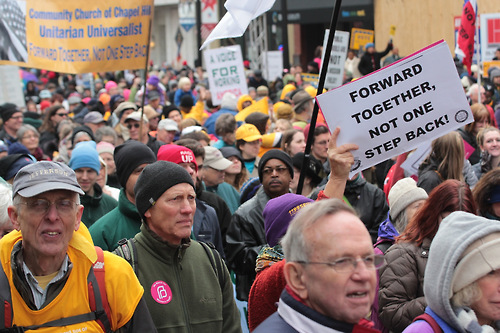
RALEIGH — State NAACP President William J. Barber II laid out goals for a diverse coalition of groups Saturday afternoon at a rally attended by thousands of people from all over the state and the nation who marched, sang, chanted, cheered and even danced through downtown Raleigh.
Organizers said the “Mass Moral March” was intended to push back against last year’s Republican-led legislation in North Carolina.
Barber called for well-funded public education, anti-poverty policies, affordable health care for all that includes the expansion of Medicaid, an end to disparities in the criminal justice system on the basis of class and race, the expansion of voting rights and “the fundamental principle of equality under the law for all people.”
Rev. Barber (back) addresses Moral March
“We will become the ‘trumpet of conscience’ that Rev. Dr. Martin Luther King Jr. called upon us to be, echoing the God of our mothers and fathers in the faith,” he said. “Now is the time. Here is the place. We are the people. And we will be heard.”
The mammoth crowd that gathered in downtown Raleigh represented a variety of causes that joined last year’s Moral Monday protests, but the event also brought in groups and individuals usually on the fringes of state politics.
Susan Fariss of Mocksville drove three and a half hours to hold up a sign supporting the legalization of medical marijuana.
“I have several health problems that cause me pain,” Fariss said. “I have tried Vicodin and different muscle relaxers, but no matter what I’ve tried, I’m in pain. My doctor told me he could not prescribe it, but he recommended medical marijuana.”
Holiday Clinkscale, 60, of Raleigh climbed atop a big potted plant on Fayetteville Street and twirled an American flag above his head. He wore a leather jacket decorated with red, white and blue stars and stripes. Clinkscale wore the regalia on behalf of “depressed” African-American men.
“Black men in Raleigh couldn’t wear red, white and blue after the Civil War when we were freed, or they would have been executed,” he said. “You see a lot of black men here today looking depressed.”
Wake County attorney Daryl Atkinson was at the march, but the look on his face was one of purpose.
Atkinson, who volunteered to represent some of the people arrested at last year’s Moral Monday protests, said he had a long list of reasons for attending the rally.
“Everything from trampling on our voting rights, to the repeal of the Racial Justice Act, not extending unemployment benefits and not expanding Medicaid. The list goes on,” he said.
Hannah Osborne, a student at N.C. State University, said she came to the rally Saturday morning to “promote women’s rights and a woman’s right to choose.” She and her father, Dale Osborne, a pastor at Binkley Baptist Church in Chapel Hill, held purple signs that read “Stop the war on women.”
The march, known as the Historic Thousands on Jones Street, or HKonJ, was organized by the state NAACP and Barber. He and his group drew national attention last year for organizing the Moral Monday demonstrations to protest what they called “immoral” legislation enacted by Republican leaders including Gov. Pat McCrory and House Speaker Thom Tillis. Those policies included new abortion restrictions, an election-law overhaul that will require voter ID and cuts to unemployment benefits.
The McCrory administration tried to block previous Moral Monday events. In late December, a Wake County District Court judge overturned a decision by the administration to keep demonstrators off state Capitol grounds and confine the events to Halifax Mall, a big grassy area enclosed by the state office and legislative buildings.




 Photo: Environmental groups are calling for a ban on fracking in Ohio after a series of small earthquakes erupted near an active fracking site last week.





 Beaver County Blue: Voice of the 17th CD of Progressive Democrats of America