Workers and Community Protest Job and Benefit Cuts

Steelworkers protest loss of jobs, benefits

JACOB TIERNEY | Wednesday, Jan. 4, 2017, 12:06 a.m.

Pittsburgh Tribune-Review
uswprotest


MICHAEL SWENSEN | FOR THE TRIBUNE-REVIEW

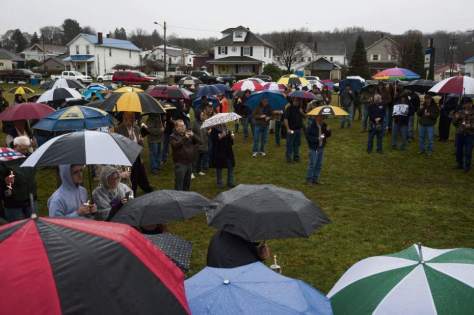
Members of United Steelworkers and community supporters gather for candlelight vigil outside the Akers

Union Electric Steel facility in Avonmore, PA in protest of the company’s plans to lay off dozens of workers

and cut healthcare for hundreds of retirees. Tuesday, Jan. 3, 2016


Steelworkers huddled beneath umbrellas, protecting lit candles from a steady downpour as they held a vigil to protest layoffs and benefit cuts at the Akers National Roll plant in Avonmore.

“It’s just very unfair. I’ve got 27 years down there, my dad had 45,” said machine operator Jimmy Stine, standing with more than 100 people in the field outside the plant.

Union Electric Steel Corp. announced in October it would temporarily shut down the plant, which makes cast steel rolls, as it restructures to cut costs.

The facility will be closed by April 21 if the situation continues as it is, but it is possible a deal could be struck with United Steelworkers to keep it open, according to Union Electric Steel spokeswoman Melanie Sprowson.

USW accused the company of using the looming closure to threaten the union into accepting dozens of job cuts.

“It helps nobody for the plant to be closed,” said Lou Bonnoni, president of United Steel Workers District 10, Local Union 1138.

Sprowson said the company could not comment on layoffs or employee benefits.

“It’s a private matter between the corporation and the union, and we’re hoping our talks with the union are going to continue,” she said.

Union Electric Steel, a subsidiary of Ampco-Pittsburgh, bought the plant from investment firm Altor Equity Partners in March.

It quickly started eliminating positions, according to Bonnoni.

The plant had 198 union workers at the start of 2016. It now has 160, and wants to cut most of those, he said.

“I don’t know how you can run a plant with only 50 people. It’s ludicrous, it doesn’t make any sense to me,” he said.

Sprowson said she could not discuss staffing numbers.

The company also cut health benefits for retired employees, Bonnoni said.

Bob Dobrosky worked as a heavy equipment operator at the plant for more than 24 years. When he retired in 2014, he expected he and his wife would remain fully covered under the company’s health care package until he was eligible for Medicare, the same as all retirees from the plant.

He found out in October that he would have to find his own health insurance, although Union Electric Steel would continue to contribute $500 a month for him and $200 a month for his wife.

“So many things in America happen this way, and it’s a shame,” Dobrosky said. “People work all their lives, and they just turn around and stick a knife in your back after it’s done.”

Bonnoni said USW is planning to file a lawsuit against Union Electric over the cuts to retiree health benefits, which the union contends is a violation of its labor agreement with the company.

“You’re talking about people who worked their whole life, and all of a sudden they had their health care ripped out from under them,” he said.

He said he hopes the candlelight vigil will be a show of community support that might convince Union Electric Steel to change its terms. He’s reached out to politicians at every level, including a letter to President-elect Donald Trump.

At the vigil, USW officials and plant employees urged Union Electric Steel to forestall its planned cuts.

Avonmore Mayor Paula Jones, a lifelong resident of the borough, cried as she recalled how much the plant has meant to the community.

Stine said he expects the plant will go idle, at least for a while.

“It’s going to hurt a lot of people. It’s going to hurt this town.”

Bonnoni said USW is willing to negotiate, but not to accept Union Electric Steel’s terms that include mass layoffs and cuts to retiree health insurance.

“We have no problem giving our shirt, but you’re not taking our pants too,” he said.

Jacob Tierney is a Tribune-Review staff writer. Reach him at (724) 836-6646 or jtierney@tribweb.com

West Virginia Voters Wanted Bernie

Daniel Sidorick

Daniel Sidorick teaches labor history at Rutgers University. His book, Condensed Capitalism: Campbell Soup and the Pursuit of Cheap Production in the Twentieth Century (Cornell University Press) was awarded the Richard P. McCormick Prize by the New Jersey Historical Commission.

View all posts by Daniel Sidorick »

The Guardian‘s West Coast bureau chief paid a quick visit to McDowell County, West Virginia in October to film a video for the news organization’s website titled “Why the poorest county in West Virginia has faith in Trump.” The video’s description promised it would explain why “Donald Trump was more popular in McDowell County—the poorest county of West Virginia—then anywhere else in America during the Republican primaries.” The video dutifully showed what the Guardian’s readers would expect: poor working-class whites in an economically devastated county, left behind by the winds of change and the global economy. The Trump phenomenon growing in its native soil. The video in fact did a great job of showing how working people have been abandoned when they can no longer contribute to the profits of corporate America. What it totally failed to show was that McDowell people were open to, even preferred, a real alternative to Trump and Clinton.

Trump’s alleged popularity was based on the presidential primary results, in which the Republican candidate won a total of 785 votes. Yes, 785 voters were enough to paint McDowell County as the poster child of regressive right-wing populism. Nowhere in the video or the accompanying webpage were the actual primary numbers presented, nor was it mentioned that Bernie Sanders won 1,488 votes in the same primaries—almost twice as many as Trump! Nor that in 2008 a large majority voted for Obama in the general election.

Why are the Democratic party elites so determined to disavow the party’s largest core constituency since the New Deal? Apparently because their strategists have concluded that basing their electoral strategy on identity politics will win them a large and ever-growing share of the American electorate, while a class-based approach, though it would directly address the needs and concerns of all working people—working-class whites and especially minorities and immigrants—would be an anachronistic dead end. Their media allies reinforced their comforting illusions with videos like this one that omit any mention of downtrodden working people’s openness to leftist alternatives. That McDowell’s residents cast far more ballots for a self-described socialist than all other candidates in the primaries should not be all that surprising in a county that took part in the Battle of Blair Mountain, the largest labor uprising in American history. Many of the comments to the video, however, as expected, denounced the poor white Neanderthals there for their obvious misogynist and fascist sympathies: “Ignorant foolish people”; “These are Clinton’s ‘deplorables.’”; “Now WV men can grope and rape at will”; “The nativist, racist and outright fascist language of Il Trumpolini and his promise the [sic] Make Them Great Again – based on their skin tone, unfortunately appeals to far to [sic] many there.” Would they still have made these comments if the Guardian had let them know twice as many McDowell residents voted for Bernie as for Trump?

Trump’s victory came from many segments of America, including some who embrace his proto-fascist rantings. But for millions of Americans who have been suffering due to the policies of both parties over the last few decades, many of their votes were a direct result of his promises, regardless of how bogus they are, to attack trade deals that hurt the working class, bring back jobs, and protect Social Security, along with his middle finger allegedly aimed at the elites and their establishment politics. The Democratic leaders made his job easy for him by derailing Sanders’ bid for the nomination and doubling down on their anti-working-class neoliberal agenda, aided inexplicably and shamefully by most of the top leadership of the unions.

Well, the media got what it wanted. On November 8, McDowell County, in the absence of a left alternative, voted 75% to 23% for Trump. For anyone who wants to build a movement to resist a Trumpian future, providing a real alternative politics to the millions who are suffering in our economy will be absolutely essential.

Pittsburgh’s Sala Udin Gets Presidential Pardon, 44 Years Later

20161228-SalaPortrait001 Sala Udin at his Pittsburgh home.

Sala Udin at his Pittsburgh home.

By Tracie Mauriello

Post-Gazette Washington Bureau

WASHINGTON — Sala Udin was stopped for speeding as he drove from a rally in Mississippi to drop off a carload of fellow Freedom Riders in Cleveland before heading home to Pittsburgh. Police who stopped him in Kentucky that day in 1970 searched his car, found an unloaded shotgun and a jug of Mississippi moonshine, and hauled him off to jail.

In 1972, he was sent to federal prison for seven months, with the shadow of his conviction hanging over him for the next 44 years.

No more.

On Monday, President Barack Obama pardoned the civil rights activist and 77 other people across the country. The president also issued 153 commutations to people sentenced for a variety of crimes, most involving manufacturing, selling or possessing drugs.

That brings the president’s total clemency actions to 1,324 — more than any predecessor since Lyndon B. Johnson.

Mr. Obama’s pardons and commutations “exemplify his belief that America is a nation of second chances,” said Neil Eggleston, counsel to the president. “While each clemency recipient’s story is unique, the common thread of rehabilitation underlies them all.”

A presidential pardon grants absolution as if a crime had never occurred.

“It’s a second chance, and I think — for most crimes — people deserve a second chance. Some of them would mess up again, but most of them would take full advantage of a second chance,” Mr. Udin said.

Continue reading Pittsburgh’s Sala Udin Gets Presidential Pardon, 44 Years Later

Midland Labor Leader Offended by Trump’s Attack on United Steelworkers

Tepsic speaking at ATI strike rally in Midland

By Jared Stonesifer

Beaver County Times

MIDLAND. Dec 9. 2016 –  — Tony Tepsic doesn’t have a Twitter account but, if he did, he would tell Donald Trump just when and where to find him.

Tepsic, president of the United Steelworkers Local 1212 in Midland, took offense to the fact that the president-elect earlier this week attacked a fellow United Steelworkers local president in Indiana.

The feud started when Trump claimed he helped save 1,100 jobs from leaving Indiana. Chuck Jones, president of United Steelworkers Local 1999 based in Indianapolis, called Trump a liar and said the real number of jobs saved was around 800.

Trump took to Twitter to fire back, saying Jones has done a “terrible job representing workers” while adding “no wonder companies flee (our) country!”

For Trump, it was just another 15 seconds on Twitter. Jones, however, started receiving anonymous phone calls that threatened his children.

“Nothing that says they’re going to kill me, but, you know, you better keep your eye on your kids,” Jones told MSNBC, according to the Associated Press. “I’ve been doing this job for 30 years, and I’ve heard everything from people who want to burn my house down or shoot me … I can deal with people that make stupid statements and move on.” Continue reading Midland Labor Leader Offended by Trump’s Attack on United Steelworkers

Bernie Sanders on Keeping Jobs: Carrier Just Showed Corporations How to Beat Donald Trump

We need a president who can stand up to big corporations, not fold to their demands.

By Bernie Sanders

Washington Post

December 1, 2016 – Today, about 1,000 Carrier workers and their families should be rejoicing. But the rest of our nation’s workers should be very nervous.

President-elect Donald Trump will reportedly announce a deal with United Technologies, the corporation that owns Carrier, that keeps less than 1,000 of the 2100 jobs in America that were previously scheduled to be transferred to Mexico. Let’s be clear: It is not good enough to save some of these jobs. Trump made a promise that he would save all of these jobs, and we cannot rest until an ironclad contract is signed to ensure that all of these workers are able to continue working in Indiana without having their pay or benefits slashed.

In exchange for allowing United Technologies to continue to offshore more than 1,000 jobs, Trump will reportedly give the company tax and regulatory favors that the corporation has sought. Just a short few months ago, Trump was pledging to force United Technologies to “pay a damn tax.” He was insisting on very steep tariffs for companies like Carrier that left the United States and wanted to sell their foreign-made products back in the United States. Instead of a damn tax, the company will be rewarded with a damn tax cut. Wow! How’s that for standing up to corporate greed? How’s that for punishing corporations that shut down in the United States and move abroad?

In essence, United Technologies took Trump hostage and won. And that should send a shock wave of fear through all workers across the country.

Trump has endangered the jobs of workers who were previously safe in the United States. Why? Because he has signaled to every corporation in America that they can threaten to offshore jobs in exchange for business-friendly tax benefits and incentives. Even corporations that weren’t thinking of offshoring jobs will most probably be re-evaluating their stance this morning. And who would pay for the high cost for tax cuts that go to the richest businessmen in America? The working class of America.

Let’s be clear. United Technologies is not going broke. Last year, it made a profit of $7.6 billion and received more than $6 billion in defense contracts. It has also received more than $50 million from the Export-Import Bank and very generous tax breaks. In 2014, United Technologies gave its former chief executive Louis Chenevert a golden parachute worth more than $172 million. Last year, the company’s five highest-paid executives made more than $50 million. The firm also spent $12 billion to inflate its stock price instead of using that money to invest in new plants and workers.

Does that sound like a company that deserves more corporate welfare from our government? Trump’s Band-Aid solution is only making the problem of wealth inequality in America even worse.

I said I would work with Trump if he was serious about the promises he made to members of the working class. But after running a campaign pledging to be tough on corporate America, Trump has hypocritically decided to do the exact opposite. He wants to treat corporate irresponsibility with kid gloves. The problem with our rigged economy is not that our policies have been too tough on corporations; it’s that we haven’t been tough enough.

We need to re-instill an ethic of corporate patriotism. We need to send a very loud and clear message to corporate America: The era of outsourcing is over. Instead of offshoring jobs, the time has come for you to start bringing good-paying jobs back to America.

If United Technologies or any other company wants to keep outsourcing decent-paying American jobs, those companies must pay an outsourcing tax equal to the amount of money it expects to save by moving factories to Mexico or other low-wage countries.  They should not receive federal contracts or other forms of corporate welfare.  They must pay back all of the tax breaks and other corporate welfare they have received from the federal government. And they must not be allowed to reward their executives with stock options, bonuses or golden parachutes for outsourcing jobs to low-wage countries. I will soon be introducing the Outsourcing Prevention Act, which will address exactly that.

If Donald Trump won’t stand up for America’s working class, we must.

‘Day of Disruption’ Protests in Pittsburgh Target McDonald’s, UPMC, Giant Eagle

Workers’ demands include $15 minimum wage, union rights

By Katelyn Sykes

WTAE Reporter

PITTSBURGH — No 29, 2016 – Thousands of workers are walking off the job and marching Tuesday in cities across the country, including Pittsburgh, where morning protests will be followed by a larger downtown rally in the afternoon.

The Service Employees International Union is targeting McDonald’s restaurants and UPMC with marches demanding a $15 minimum wage and union representation.

Organizers began their "Day of Disruption" marches at McDonald’s on Penn Avenue in East Liberty. Demonstrators went inside to voice their demands, then began circling the restaurant outside and chanting slogans like "Hold your burgers, hold your fries. We want wages supersized."

"I want to be able to take care of my family, to take care of myself, to pay bills," McDonald’s employee Aaron McCollum said. "You can’t possibly do that on $7.25, $7.35 an hour."

The protest then moved to a McDonald’s restaurant on North Euclid Avenue.

"It’s about workers, but it’s also recognizing that workers are more than who they are in between when they clock in and clock out, but that they’re our community members, they’re our neighbors, they’re humans," said Kai Pang, an organizer with Pittsburgh United. "We should have the right to not only survive but thrive in this city."

The group plans a similar protest near a McDonald’s and the federal building downtown during the evening rush hour.

"I’m just trying to fight for something that I believe in," McCollum said.

A press release on behalf of the group added, "Giant Eagle workers will also join the Fight for $15 today, asking that the company start paying family-sustaining wages and stop interfering with Giant Eagle employees’ right to organize."

The union contends UPMC shuttle bus workers have also gone on strike seeking union representation.

UPMC previously announced plans to increase the minimum starting wage for entry-level jobs at most of its facilities to $15 per hour by 2021.

But the union says UPMC needs to move faster, and it accused the network of trying to silence workers and union organizers.

UPMC hasn’t commented on Tuesday’s activity.

"I think more now than ever that we’re standing up for worker’s rights, for economic justice at a time when income inequality is very high and only grows higher," said Pang.

Faculty Organizing at the University of Pittsburgh: Why a Union, and Why Now?

By Anupama Jain

New People

Oct 22, 2016 – There’s something in the air in Pittsburgh! From Robert Morris to Point Park, Steel City-area faculty are organizing to join the ranks of unionized labor. To some, this might be little surprise: Pittsburgh, is a city with a rich history of labor organizing. At the same time, when one thinks of Pittsburgh labor history they might think of workers smelting steel or armed Pinkertons at the Homestead steel mills. This isn’t entirely off base: in fact, Pittsburgh-area faculty are organizing with the help of the United Steel Workers including faculty at the University of Pittsburgh.

But why unionization, and why now? There are many reasons, but three important ones are: 1) labor contingency and uncertainty worsens learning conditions, 2) teachers and researchers need a stronger voice in negotiations with administration, and 3) academic freedom is an increasingly valuable commodity in an age of emerging social consciousness about inequality.

Focused, appropriately compensated teachers can do their best work,but one class of teachers, adjuncts, teach on a pay-per-class basis. Because the compensation for these classes is very low, adjuncts often teach at several different universities, and many must work other jobs. Moreover, these positions are renewed on an ad hoc basis, often with little lead time before classes start. One colleague of mine would teach two classes at Pitt a semester, a few more at Point Park, and also tended bar in the evening. The only job he could count on having come next semester was the gig tending bar. For many, teaching is a vocation chosen not for monetary benefit, but for the value of teaching itself. But running around town, barely making ends meet is not a recipe for the best teaching. The unpredictability wears both on the teachers —who struggle tol pay their bills—and students, who may be excited about particular instructors and their classes, only to scroll through the catalogue and see no hint of the instructors because they have not yet been renewed. For other, less-contingent faculty, increasing demands for service and research also eat into teaching time. Appropriately compensated faculty are more capable of directing time and effort into education.

Continue reading Faculty Organizing at the University of Pittsburgh: Why a Union, and Why Now?

What Pennsylvania’s Faculty Strike Means for the Future of Labor

By Neil Cosgrove

The New People via Portside

Nov 1, 2016 – The faculty of the 14 Pennsylvania state-owned universities went on strike from October 19th to the 21st, 2016, somewhat less than three days.  Around mid-afternoon on the 21st, a tentative contract agreement was reached with the State System of Higher Education (SSHE), ending the strike.  As part of the agreement, the Association of Pennsylvania State College and University Faculties (APSCUF) "agreed to a salary package that was significantly lower than that of the other unions" that had recently bargained with the State System.

As labor battles are traditionally viewed, making concessions on salary and benefits would have to be considered a defeat.  But the faculty union regards the result of the strike as a clear-cut victory, a victory that preserved what many regard as one of the best university faculty contracts in the country.  For the 16 months since the system’s previous contract with the faculty had expired (June 30, 2015), the Pennsylvania State System had tried to destroy that contract, but was forced by the strike to withdraw most of the 249 changes the Chancellor and Board of Governors had sought.

The most significant of those withdrawn changes, the ones that ultimately forced the faculty to strike, were obvious attempts to break the union by driving a wedge between tenured and tenure-track faculty and the growing number of temporary and adjunct faculty.  What makes APSCUF a strong union is that adjuncts work under the same conditions, including teaching loads, benefit packages, and salary scale as so-called "regular" faculty.  Adjunct faculty at State System schools like IUP, California and Slippery Rock generally regard themselves as an integral part of the universities in which they work, not as an exploited proletariat paid a ridiculously low per-course stipend, without access to offices or benefits, and forced to teach each term at multiple institutions in order to make a low-income living.

Moreover, APSCUF’s 2011-15 contract limited the number of temporary faculty a university could employ to 25% or less "of the full-time equivalent of all faculty members employed at that university." Compare that to estimates of adjuncts constituting close to half of the faculty at colleges and universities across the country.  In 2015, median per-course pay for adjuncts was $2700.  At Pennsylvania State System universities, full-time temporary faculty at the bottom of the salary scale received a 2014-15 salary of $46,610.  If such a faculty member taught only a quarter, half, or three-quarters of the normal teaching load of four class sections per term, they would receive the appropriate fraction of the stated salary.  Moreover, the contract required that temporary faculty members who had "worked at a university for five full, consecutive academic years in the same department" would be given tenure-track status if approved by the department. 

Continue reading What Pennsylvania’s Faculty Strike Means for the Future of Labor

Sanders and Warren: First Vanquish Trump, Then Mobilize for ‘Political Revolution’

Sanders warned Colorado voters that ‘if we do not get our act together, this country is going to slide into oligarchy’

By Lauren McCauley

Common Dreams

Oct 17, 2016 – Sen. Bernie Sanders campaigns for Democratic nominee Hillary Clinton in Denver, where supporters dropped a banner calling for rejection of the Dakota Access pipeline. (Photo: Bruce Finley/ The Denver Post)

Senators Bernie Sanders (I-Vt.) and Elizabeth Warren (D-Mass.) appeared side-by-side in Denver on Sunday evening to once again make the case to progressive voters that a vote for Democratic presidential nominee Hillary Clinton is still a vote for "political revolution."

"To every person who ‘felt the Bern’ during during the primary, America and the Democratic Party know the power and energy of the progressive movement," Warren told the 1,700 who packed the Auraria Campus student union. Sanders won the March caucus in the pivotal battleground state, where Clinton is now polling an average of nine points ahead of Republican rival Donald Trump.

"It goes without saying," Sanders said, "that all of us together have got to do everything we can to elect Hillary Clinton president. But what is equally important is that on November 9th, the day after Hillary is elected president, we continue our efforts because we know what real change is about, what real politics is about, is transforming this country."

Both progressive firebrands touted "the most progressive party platform in the history of the United States of America," which they credited to the millions of voters who supported Sanders during the primary campaign. However, they said that the reforms called for the in the platform which will require defending.

Sanders said that if voters think that Wall Street, as well as the insurance, fossil fuel, and pharmaceutical industries, are going to "go peacefully into the night, you are mistaken."

He laid out the "two-fold struggle" for progressive voters. First, he said, Clinton needs to win by "landslide proportions so there is no doubt in anybody’s mind that this country is going to reject that sexism, that racism, the xenophobia of the Trump campaign." (Continued)

Continue reading Sanders and Warren: First Vanquish Trump, Then Mobilize for ‘Political Revolution’

Green Jobs and the Ohio: A Bold New Vision for Restoring America’s Most Polluted River

24951876696_85224986c5_o-2400px

The Ohio is the archetype of a “working river.” Its near-thousand-mile course connects cities like Pittsburgh, Cincinnati and Louisville and is lined with industrial facilities and power plants. In this February 2016 photo, a coal barge pushes past the industrial town of Marietta, Ohio. Photo: Mike Tewkesbury via Flickr

By Kara Holsopple

AlleghenyFront.org

October 21, 2016 – In many ways, the Ohio River is an unsung resource for the region it serves. The Ohio’s near-thousand-mile course flows through Pennsylvania and five other states before emptying into the Mississippi. It’s a source of drinking water for more than five million people. But its long legacy as a “working river” has also made it the most polluted in the country. Today, many cities and towns along the Ohio are rethinking their relationship to the river—and weighing how a large-scale restoration effort could be critical to the region’s future. But just how do we get there? As part of our Headwaters series, we talked with the National Wildlife Federation’s Collin O’Mara, who’s hoping to ignite a new way of thinking about one of the region’s most vital natural resources. (Photo: Shannon Tompkins via Flickr)

The Allegheny Front: So tell us why the National Wildlife Federation is turning its attention to the Ohio River.

Collin O’Mara: One of the things that we’re seeing is that there have been amazing investments made in the Great Lakes and the Chesapeake Bay. But these investments tend to be in places that are seen as destinations: Folks plan vacations or retire or have second homes in some of these places. But we’re not seeing the same level of investments in what I would consider the “working waterways”—places like the Allegheny River leading into the Ohio River Valley, or places like the Delaware River. But 25 million people live in the Ohio River Valley Basin—that’s almost a tenth of the country. And yet we’ve seen virtually no investment of federal resources in trying to clean up the legacy pollution. The Ohio is still the most polluted waterway in the entire country. Over the last 50 years, between the Clean Water Act and reducing the direct discharge of pollutants into the water, there has been some progress. But folks don’t plan fishing vacations around going to the Allegheny, even though cities are seeing investments in their riverfronts as a way to revitalize their downtowns. So the next thing is having that investment not stop at the river’s edge—literally. We can have the water itself become a place you can swim, fish, recreate and enjoy the benefits that come from that.

AF: There have been some efforts to cooperate around water in this region, but they have largely stalled. So what can be done to move that effort forward?

CO: We’ve been working with some of the mayors and different advocacy groups in the region, trying to just begin talking about the Ohio River as a system and [develop] a vision for the entire watershed. There’s been some good work in places like the Beaver River; there are a bunch of groups in Kentucky working on the Green or the Cumberland. So we’re trying to unite those voices under a common vision. This has been done in places like the Chesapeake or the Great Lakes. So it’s really about trying to have a vision so folks are as excited about restoring these iconic waterways that, in many ways, help build our country.

AF: Well, it seems like the most exciting thing happening on the Ohio recently is the ethane cracker facility that Shell is planning to build near Pittsburgh. People are excited about the jobs and the economic development around that. How do you strike a balance between restoration and economic development?

CO: So often, in places that are working waterways, we basically treat these water bodies as simply a support for larger industrial facilities. And you see it with crackers or refineries, and you have many of those across the entire basin. Those jobs are important, but we don’t value the economic loss when you degrade these waterways. Right now across America, the outdoor economy is about a $646 billion economy. It employs more than six million people. And that puts it on par with many of the largest industries in the country. A lot of those jobs are water-dependent jobs related to fishing or swimming or outdoor activities. So one of the cases we’re trying to make is that it doesn’t have to be “either/or.” The technologies exist now that we can actually have some industrial facilities and still not have to contaminate the waterway. The old dichotomy of having to choose between the economy or the environment really isn’t true, and there are places in the country that are making those choices that they want both. What we’re trying to figure out is how do we work with leaders across the region to prioritize this. The cities are already making investments. In Pittsburgh, for instance, there’s obviously a focus on the fact that the water is what separates Pittsburgh from other cities in the region. So the question is, how do you take the next step?

AF: So do you imagine a scenario where Pittsburgh is more like the Chesapeake Bay—where it’s more of a recreational hub and that becomes a viable alternative to more industry?

CO: I absolutely do. Obviously, you have PCBs and dioxins and other things we have to get out of the water column that are legacy pollution. It’s not cheap, but it can be done. But there are amazing opportunities. (Continued)

Continue reading Green Jobs and the Ohio: A Bold New Vision for Restoring America’s Most Polluted River