A voter drops off their mail-in ballot prior to the primary election, in Willow Grove, Montgomery County, May 27, 2020. (AP Photo/Matt Rourke)
The For the People Act Could Be the Solution. As the Republican-controlled Pennsylvania Legislature works to pass voter suppression laws, Democrats in Congress have one chance to stop the assault on voting rights.
By Keya Vakil The Keystone
MARCH 23, 2021 – WASHINGTON — Earlier this month, President Joe Biden signed the American Rescue Plan into law, sending $1,400 stimulus checks to most Pennsylvanians, extending federal unemployment benefits, providing most parents a guaranteed monthly income, giving schools money to reopen, and bolstering vaccine production and distribution.
The passage of the bill, which was backed by 59% of Pennsylvanians, according to a recent poll, was only possible because Pennsylvania residents voted in record numbers in November to send Biden to the White House.
Now, Republicans in the state Legislature are responding to Biden’s victory by introducing a flurry of bills that would make it more difficult to vote.
To stop the GOP’s war on voting rights, Democrats at the national level have one arrow left in their quiver: the For The People Act (HR 1).
Passed by the US House on March 3, HR 1 would allow automatic voter registration, set unified early and mail-in voting standards, enact campaign finance reform, and modernize elections while ensuring their security.
The bill is also all but certain to stall out in the Senate.
Minority Leader Mitch McConnell (R-Kentucky) has made clear he opposes the comprehensive democracy reform bill. If Democrats choose to eliminate the filibuster—a Senate procedure that allows any one senator to obstruct a bill from being voted on and requires 60 senators to override—they could pass the For the People Act with their 50-vote majority and halt the voter suppression efforts in Pennsylvania.
Republican lawmakers in states across the country have introduced more than 250 bills to disenfranchise voters, according to the Brennan Center for Justice at New York University Law School. Pennsylvania is among the states leading the way in these efforts, as legislators have proposed more than a dozen bills designed to restrict voting access.
The battles over the For the People Act and the filibuster will play out in the coming weeks and months. As Republican lawmakers in Pennsylvania and other states have made clear, there is a lot at stake.
‘Divorced From Reality’
Even though former President Donald Trump lost Pennsylvania, 2020 was, by all accounts, a good year for the state GOP. They gained seats in the legislature, won two of three statewide races, and held onto all nine of their congressional seats.
By Candy Woodall Pennsylvania State Capital Bureau via Beaver County Times
Feb 8, 2021 – Pennsylvania Lt. Gov. John Fetterman on Monday officially entered the 2022 U.S. Senate race, vying for a hotly contested seat that could determine the chamber’s balance of power in the midterms.
The formal bid comes after Fetterman raised more than a $1 million in less than a month after he said he was eyeing a run.
“Thank you to all 35,000 of the folks who chipped in a few dollars and encouraged me to run for Senate, today I am excited to announce that I am running, and I am glad to have the support of people in all 67 of Pennsylvania’s counties,” Fetterman, 51, said in a statement Monday.
He is running for a seat that will be left vacant by U.S. Sen. Pat Toomey, RLehigh Valley, who is retiring upon a selfimposed term limit.
Analysts say it’s the top U.S. Senate race to watch in the 2022 midterms.
“The sole tossup Senate race to start the 2022 cycle is Pennsylvania,” said J. Miles Coleman, associate editor of Sabato’s Crystal Ball, the nonpartisan newsletter at the University of Virginia Center for Politics.
The U.S. Senate race in Pennsylvania is expected to be one of the most expensive in the country and could eclipse the $164 million spent in 2016 when Toomey was challenged by Democrat Katie McGinty.
McGinty defeated Fetterman in the 2016 Democratic primary.
A rising profile for Fetterman
Lt. Gov. John Fetterman went on a tour of all 67 Pennsylvania counties to get feedback from residents on recreational marijuana legalization. He is in favor of legalizing the drug.
At the time, he was mostly known in western Pennsylvania, where he was the mayor of Braddock, an old, bluecollar industrial town Fetterman was working to rehabilitate.
Since then, Fetterman has become better known to voters statewide after running a successful campaign to become Pennsylvania’s lieutenant governor in 2018. He was also a frequent guest on national news programs during the pandemic and 2020 presidential election, and he has built a robust social media following.
Protesters against racism and police brutality march down P.J. McArdle Roadway from Mount Washington on June 7, 2020. (Photo by Ryan Loew/PublicSource)
By Matt Petras Public Source
Jan 19, 2021 – When Jasiri X moved from the south side of Chicago to Monroeville as a teen in the 1980s, he discovered “inyourface racism” for the first time. On his first trip to Monroeville Mall, someone called him a racial slur.
“People refer to Pittsburgh as the Mississippi of the North,” said Jasiri X, founder of the prominent social justice activist group 1Hood in Pittsburgh. “I would tell people that would come here that Pittsburgh is an overtly racist place. It’s not subtly racist. It’s not like, ‘We’re gonna hide it.’ It’s pretty overtly racist.”
Following the storming of the U.S. Capitol on Jan. 6, plans for farright demonstrations and the possibility of violence have been identified across the country. The antidisinformation group Alethea Group identified Pittsburgh as a possible site of farright activity, according to the Washington Post, though the FBI released a statement Jan. 12 explaining it has not identified any threats directed at Pittsburgh.
Still, given initial reports like this and the Pittsburgh area’s existing relationship with white supremacy, it seems intuitive to Jasiri X that more of this violence could be coming to Pittsburgh.
“If we’re a hotbed of white supremacist activity,” he said, “we should be expecting violence, shouldn’t we?”
FBI analysts declared Pittsburgh a “hub” for white supremacy in November 2020. Several white supremacist and other farright hate groups operate across Pennsylvania, including groups associated with the Ku Klux Klan. In October 2018, a gunman attacked the Tree of Life synagogue in Squirrel Hill in the deadliest antiSemitic attack in the history of the United States. The attack was also motivated by hatred toward immigrants.
A man in Toledo, Ohio, who planned another attack on a synagogue, said the Tree of Life shooting inspired him, and the man who shot and killed 49 Muslims at two mosques in New Zealand wrote a manifesto outlining a white supremacist ideology strikingly similar to that of the Tree of Life shooter.
“The Pittsburgh attack was itself worldwide, not just in Pittsburgh and not just nationally,” said Brad Orsini, senior national security advisor for the national group Secure Community Network and former FBI special agent.
Orsini said that since the white supremacist “Unite the Right” march in Charlottesville in 2017, there has been a significant increase in hate crime across the country. Orsini, who managed security for the Jewish Federation of Pittsburgh before taking his national position, has witnessed a slew of farright hate group activity in Western Pennsylvania.
“We’ve seen the Ku Klux Klan in Pittsburgh, we’ve seen Patriot Front, we’ve seen Identity Europa,” Orsini said. “We have seen visible signs of those groups throughout Western Pennsylvania and in Pittsburgh over the past four years, absolutely.”
Shawn Brokos, who replaced Orsini as Jewish community security director for the Jewish Federation of Pittsburgh in early 2020 and is also a former FBI agent, noted that white supremacist incidents in the Pittsburgh area have increased in the past few years, though it’s unclear whether this reflects newfound hate or better vigilance in discovering it.
“This really could be twofold,” Brokos said. “Is there actually an increase in this white supremacy ideology, or are we, as a Jewish community, being more proactive in reporting it? I think it’s really hard to measure.”
Related stories
Hate groups helped storm the Capitol. These groups have been active in Pennsylvania.
As the country braces for unrest, here’s what you should know about staying safe in Pittsburgh The sort of white supremacist activity seen in recent years across the country and in Pittsburgh has a lot of crosspollination with the farright extremists who participated in the storming of the Capitol Building, according to Brokos. In the media footage of the incident, some can be seen brandishing antiSemitic messages.
“If you look at the antigovernment, antiauthority organizations, many of those have their extremistbased beliefs and within them contain a degree of antiSemitism,” Brokos said.
In recent years, hate groups have started to collaborate and gotten better at organizing than before, according to Kathleen M. Carley, director of the Center for Computational Analysis of Social and Organizational Systems at Carnegie Mellon University.
“You’re now getting links between, for example, between QAnon and Proud Boys. You’re getting links to many other vocal homegrown groups,” Carley said. “What you want to watch out for is those groups forming coalitions, forming groups, because that allows them to mobilize.”
QAnon, a movement surrounding discredited conspiracy theories with hateful elements, “is not an organized group with defined leadership,” according to the Southern Poverty Law Center. Still, the FBI declared it a “domestic terrorism threat” and individuals affiliated with QAnon participated in the Jan 6. Capitol attack. The Proud Boys, founded in 2016, has emerged as one of the most prominent violent, white supremacist hate groups in the country in recent years.
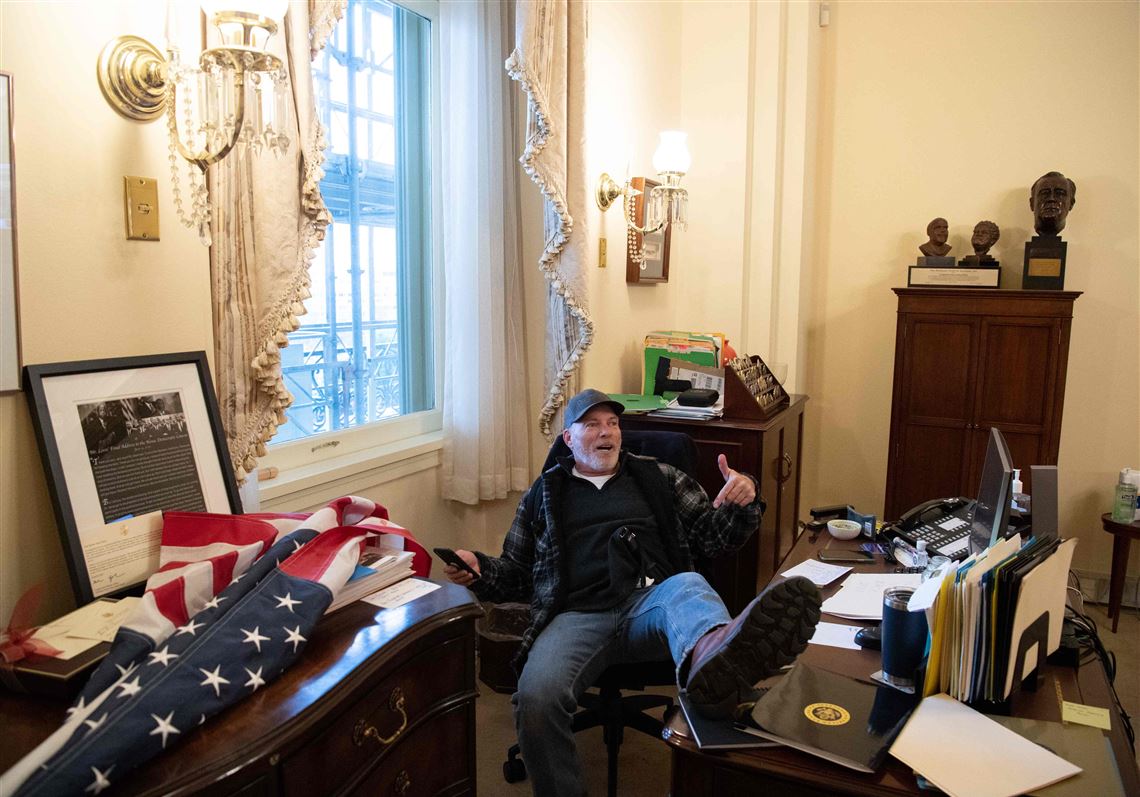
A supporter of President Donald Trump sits inside the office of Speaker of the House Nancy Pelosi as he protests inside the U.S. Capito lon Wednesday. Demonstrators breached security and entered the Capitol as Congress debated the 2020 presidential election Electoral Vote Certification.
Republicans jettisoned personal responsibility long before fiscal responsibility
By Tony Norman Pittsburgh PostGazette Columnist
JAN 12, 2021 – Gruesome details of what happened at the Capitol on Jan. 6 when thousands of deranged followers of President Donald Trump attempted to disrupt the certification of Joe Biden’s electoral victory continued to emerge over the weekend.
We now know about the feces that was smeared across the marbled walls and tracked across once pristine floors. We’ve heard the details about one Capitol Hill police officer beaten to death with a fire extinguisher and we’ve seen the footage of other cops being beaten with broken flag poles by a mob that assures us that “Blue Lives Matter” — except when they don’t.
We’ve heard recordings of the chants “hang Mike Pence” and “bring us Nancy [Pelosi]” by a crowd that erected a hanging post just outside the Capitol grounds. The footage of men running around with plastic zip ties, as if they had expected to take hostages, sends chills because they came within minutes of decapitating the legislative branch of the U.S. government.
It is now clear that with the exception of individual acts of valor — including the officer who lured the mob away from the Senate chamber, where members were evacuating — there was a complete breakdown of security. If the bulk of the insurrectionists had been highly trained Jihadists instead of hypedup QAnon crackpots, they would still be wiping the blood from the floor nearly a week later.
On Tuesday in an attempt to assign responsibility for the assault on the Capitol, the House of Representatives introduced a resolution to impeach Donald J. Trump for the second time.
This followed a weekend in which Mr. Trump found his access to social media permanently denied by two billionaires in California because of his penchant for telling lies that foment sedition and undermine American democracy.
Vice President Mike Pence also made it clear that he reserves the right to use the 25th Amendment should Mr. Trump step out of line during his remaining two weeks in office. The PGA and other bastions of corporate America are unilaterally canceling contracts with Mr. Trump’s companies and resorts rather than be smeared by association with the soontobeimpeached and probably indicted former president.
It is all an attempt to hold a man who denies responsibility for anything responsible for the single greatest — if incompetently staged — coup in American history.
The reactions to Mr. Trump’s turn in fortune have been interesting to watch. Those who typically bellow loudest about personal responsibility rarely show an inclination to take it.
As the latest round of “whatabout” politics proved, all the nattering about Jesus, justice and jurisprudence is just virtue signaling by the right wing — a way to distinguish itself from the socalled “woke mob” of the left.
But when it comes to mobs, “woke” or otherwise, the supporters of Donald Trump are now second to none in America’s fractured discourse. They have a body count of four supporters and one dead cop (and another by suicide) to prove it.
While sincere conservatives have gone into the witness protection program, most Republican elected officials haven’t been serious about personal responsibility in years.
The runup to the Iraq War, the criminal incompetence of the government’s response to Katrina and four years of the Trump administration’s moral callousness has all but scrubbed the terms “repentance” and “responsibility” from the GOP playbook.
Pennsylvania is home to a particularly odious brand of hypocritical rightwing populism and politician. Their ridiculous posturing has been especially evident during Mr. Trump’s attempt to disenfranchise our state’s voters and decertify Mr. Biden as the rightful winner of our 20 electoral votes.
By Tiffany Cusaac-Smith, Adria R. Walker, Peter D. Kramer, Geoffrey Wilson and Jeff Neiburg Beaver County Times via USA TODAY NETWORK
Jan 9, 2020 – Reenah Golden remembers people taking shelter in a church after hours of marching and protesting the death of Daniel Prude, a Black man suffocated while being restrained by Rochester police officers last year.
That night, officers followed protesters to the church, barraging the holy site with pepper balls.
Months later, Golden said the chemical dispersants and other tactics come to mind when she saw law enforcement’s response to President Donald Trump supporters marauding the U.S. Capitol, one of American democracy’s most hollowed spaces.
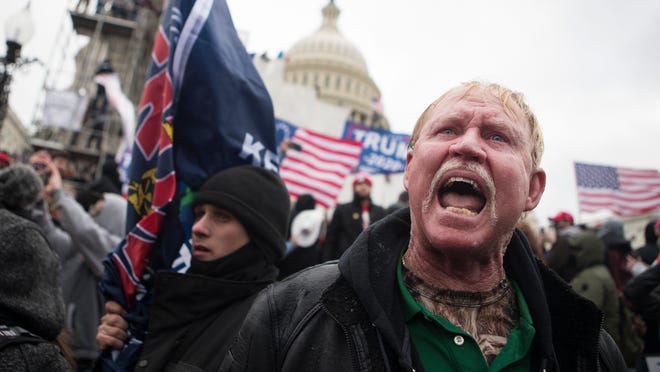
Egged on by Trump, the mob broke through police lines at the Capitol. Rioters were then seen waving flags in the building, sitting in the office of House Speaker Nancy Pelosi and storming the floor of the Senate.
Black activists say their largely peaceful marches following the death of Prude and George Floyd this summer were quickly met with police in riot gear and chemical dispersants, while law enforcement was lethargic in halting largely white marauders from storming the Capitol.
They say that racism is at the root of the disparate reaction from police officials.
The night the Prude protesters sought refuge in the Rochester church last September, Golden remained outside the church. She recalls police firing tear gas at her car while she sought to drive away with protesters for whom she was seeking medical attention.
“At the Capitol, I see just the opposite,” Golden said. “I see care, attention, thoughtfulness in the approach. Regard for human life to an extent — I saw a lot of that watching the footage and that definitely was deeply painful to watch.”
She added: “We didn’t get that same regard, that same care even though we were fighting for injustice.”
‘White privilege’ seen in riot’s aftermath
Mahkieb Booker, a Black Lives Matter organizer, chants as Wilmington police block protesters from moving up Market Street from Fourth Street after they gathered in early September at police headquarters to call for the firing of an officer they say is abusive to the public.
Seeing law enforcement’s slow response, Black protesters and leaders saw race as the determining factor in the difference between the police response on America’s streets this summer and what they saw on Wednesday.
Mahkieb Booker, 50, has long been active on the social justice scene in Wilmington, the largest city in Delaware. He can be found at almost every protest for Black rights, whether there are six people there or 600.
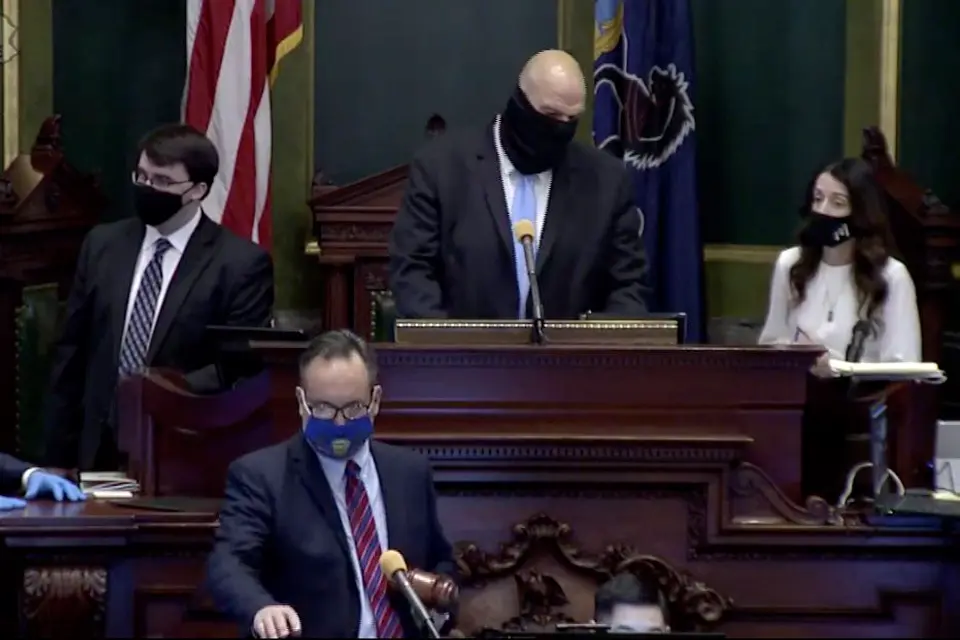
PA GENERAL ASSEMBLY: Lt. Gov. John Fetterman (center) confers with Senate Secretary Megan Martin (right), as Sen. Jake Corman (front, center), takes over the session to conduct a vote to remove Fetterman from residing over the session in Harrisburg on Tuesday, Jan. 5, 2021. Bobby Maggio, Fetterman’s chief of staff, stands to the left.
The Fascist Danger in Our Statehouse
By Angela Couloumbis and Cynthia Fernandez Spotlight PA
Jan. 5, 2021 – HARRISBURG — The new session of the Pennsylvania Senate got off to a chaotic start Tuesday, with Republicans refusing to seat a Democratic senator whose election victory has been certified by state officials.
Amid high emotions and partisan fingerpointing, Republicans also took the rare step of removing the Democratic lieutenant governor, John Fetterman, from presiding over the session. They apparently did so because they did not believe Fetterman was following the rules and recognizing their legislative motions.
Democrats, in turn, responded by refusing to back Sen. Jake Corman (R., Centre) from assuming the chamber’s top leadership position — an unusual maneuver on what is most often a largely ceremonial and bipartisan vote.
The bitterness and rancor on display was a departure from the normally staid and sedate workings of the chamber. And it potentially sets the stage for a tumultuous twoyear session, which will include debate over key legislative priorities such as redistricting.
“With this reckless, outofcontrol, cowboylike behavior, with this Trumpian behavior that we saw today from Republicans … this does not bode well. It does not bode well for the people of Pennsylvania,” said Sen. Vince Hughes of Philadelphia, the ranking Democrat on the Senate Appropriations Committee.
For now, at least, Democratic state Sen. Jim Brewster, of Allegheny County, will not be allowed to take the oath of office, as Republicans believe litigation over the outcome in his race must first play out in federal court. GOP leaders have said the state constitution gives senators the authority to refuse to seat a member if they believe the person does not meet the qualifications to hold office.
Brewster narrowly won reelection over Republican challenger Nicole Ziccarelli, who is asking a federal judge to throw out the election results. At the center of that legal dispute is several hundred mail ballots that lacked a handwritten date on an outer envelope, as required by state law. The Pennsylvania Supreme Court allowed those ballots to be counted, which gave Brewster the edge in the race.
Beaver County’s ‘Little Blue’ waste problem back in the news.
By Daniel Moore PostGazette Washington Bureau
DEC 31, 2020 WASHINGTON — As President-elect Joe Biden eyes a major federal plan to tackle climate change when he enters the White House next month, his policy team could hit roadblocks as they contend with the breadth of environmental measures rolled back by the Trump administration — and differences within his own party on how to address them.
President Donald Trump has consistently worked through his term to weaken rules put into place by his predecessor — and Mr. Biden’s former boss — former President Barack Obama. Mr. Trump’s penchant for regulatory rollbacks won him support from the energy industry in the Pittsburgh region, headlining natural gas drilling industry conferences and dispatching his environmental chief to Pittsburgh to finalize the repeal of an Obama-era rule limiting the industry’s methane emissions.
Now, Mr. Biden’s climate team, introduced at an event in Delaware this month, will be “ready on day one,” he said, to assess how to wholly address a complex global problem falling under the jurisdiction of a slew of federal agencies.
Mr. Biden, facing a divided Congress with an entrenched political opposition, could face hurdles in translating his much-debated climate change platform into action. As he did during the campaign, Mr. Biden framed environmental protection as an economic driver that will lift up regions like Pittsburgh — and a key part of any plan that helps the nation heal from the COVID19 pandemic.
Trump administration relaxes deadlines on power companies for coal ash cleanup
“Folks, we’re in a crisis,” Mr. Biden said during the Dec. 19 event. “Just like we need to be a unified nation to respond to COVID19, we need a unified national response to climate change.”
As the incoming administration works to build a climate strategy, it will balance demands for stricter rules from the progressive wing of the party with his pledges to invest in jobs in regions dependent on fossil fuels. Fracking was one of the most politically explosive issues on the campaign trail, with Mr. Biden pledging to reach a carbonfree power sector by 2035 and netzero greenhouse gas emissions by 2050.
On the surface, some climate moves could be simple.
Mr. Biden has said he will put the United States back into the Paris climate accord, which Mr. Trump exited in 2017 by declaring he “was elected to represent the citizens of Pittsburgh, not Paris.”
Mr. Biden also could use executive powers to quickly reinstate an array of Obamaera regulations relaxed by Mr. Trump that affect the energy industry, auto manufacturers, construction companies and farmers. He could order federal agencies to consider climate change in their practices and procurement strategies.
Whether Mr. Biden can hit his most ambitious targets, however, will hinge on finding consensus on a comprehensive plan that can pass muster on Capitol Hill.
The president-elect’s plan for a “clean energy revolution” and environmental justice pledges a federal investment of $1.7 trillion over the next decade, leveraging other funding sources to reach more than $5 trillion. Cities like Pittsburgh are hoping that includes money for Ohio River Valley communities to launch a largescale transition to clean energy, as Mayor Bill Peduto called for this month.
Biden’s oil comments fuel long-burning debate over Pa. energy jobs “The list of things that need to be corrected are daunting,” said Lisa Evans, an attorney specializing in hazardous waste law for Earthjustice, an environmental group.
Ms. Evans, who has advocated for stronger protections around coal ash disposal, criticized the Trump administration when it moved back deadlines for companies to stop dumping the waste in unlined ponds and landfills. She said she wants Mr. Biden to not only reverse those changes but put in place a stronger federal standard than the one Mr. Obama enacted in 2015.
In Pennsylvania, there are 103 coal ash storage and disposal sites, including 20 unlined coal ash ponds and 13 unlined landfills, according to the Center for Coalfield Justice. Coal ash, which contains heavy metals like arsenic, lead and mercury, creates vast sources of potential contamination, as well as huge costs for utility companies that must either retrofit the sites or find alternative storage facilities.
Every traitor who participates in Mr. Trump’s failed coup attempt should be remembered.
By Tony Norman Pittsburgh Post-Gazette Columnist
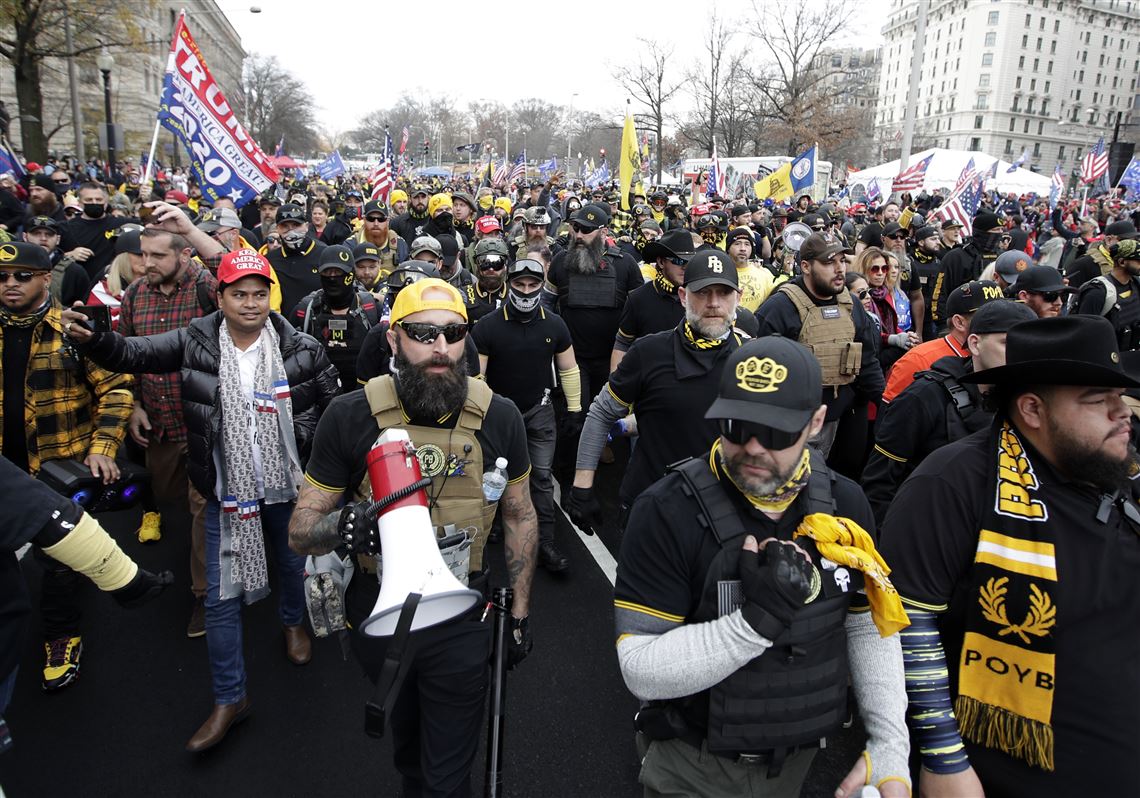
DEC 15, 2020 – Like the fashionable fascists they always strive to be, the contingent of Proud Boys who showed up in D.C. on Saturday to “Stop the Steal” stood out in the madding crowd of revanchist losers pledging their support to Donald Trump, who buzzed them from Marine One overhead.
Rocking black and gold down to the face masks only a few of them wore during the pandemic’s deadliest week, and shouting “All Lives Matter” and “We are Proud Boys,” they looked like a lost tribe of Steelers’ fans, high on hate, trying to score meth outside the Smithsonian.
The Jericho March, as Trump-believers called it, was emceed by conservative talk-radio host Eric Metaxas. The two-fisted evangelical who announced earlier in the week that he would be “happy to die in this fight” for Trump, God, Jesus and liberty — pretty much in that order — did what Jesus surely would’ve under the same circumstances: He asked if anyone had a bazooka he could borrow to blow a news chopper out of the sky.
Over the course of the day, Mr. Metaxas welcomed a who’s who of indicted, convicted, pardoned and guilty-as-hell scoundrels to the stage to ramble on about their love for “Dear Leader.”
The disgraced but recently pardoned Michael Flynn was followed by the always disgraceful Alex Jones, who called Joe Biden a “globalist” and vowed that he “will be removed [from office] one way or another.”
Recently pardoned fixer, dirty trickster and Nixon fetishist Roger Stone was there, as was “eccentric” former congresswoman Michelle Bachmann, who blathered on about a miracle that would soon confirm a second term for Mr. Trump. The list of guest speakers may have been the largest gathering of cultists, ravers and true believers since Jonestown.
Pennsylvania was represented on stage by “Mr. Piety” himself, state Sen. Doug Mastriano, R- Franklin County, who bemoaned the U.S. Supreme Court’s terse dismissal of the Texas lawsuit that would’ve disenfranchised millions of voters in four battleground states, including Pennsylvania, as a “gut shot.” But he vowed to fight on because, well, he’s an irrational fanatic.
We should never forget that 18 attorneys general and more than 120 Republican House members affixed their signatures to an amicus brief asking the Supreme Court to grant Texas’ request to invalidate the outcome of the election in four states that went to Joe Biden.
The following members in the House representing Pennsylvania went along with this mad scheme to disenfranchise their own constituents: Rep. John Joyce of the 13th Congressional District, Rep. Fred Keller of the 12th, Rep. Mike Kelly of the 16th, Rep. Dan Meuser of the 9th, Rep. Guy Reschenthaler of the 14th and Rep. Glenn Thompson of the 15th.
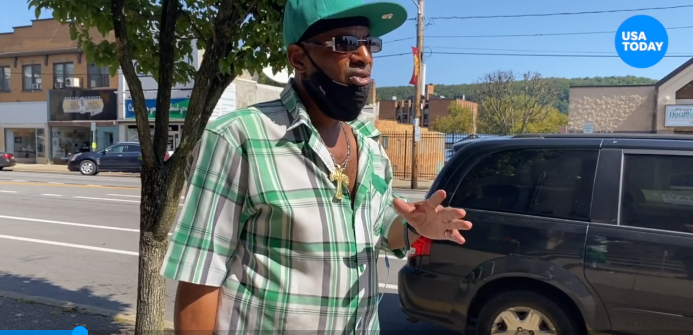
Above: Troy Johnson of Aliquippa speaks up on election turmoil
MILTON, Pa. — Kareem Williams Jr. sits on a park bench in the center of town and waits for the racists to attack. He tells himself he is ready. It’s a cool Saturday morning in fall, and the valley is alive with the rumble of pickups.
When the trucks stop, here at the red light at the corner of Broadway and Front Street, drivers gun their engines. Some glare directly into Williams’ eyes.
Williams is a Black man. The drivers are white. All their passengers are white. Williams returns their gaze with equal ferocity. He tells himself he is ready. He is not. His back faces the Susquehanna River. His car is parked a block away. If these white men jump from their truck, fists or pistols raised, Williams has nowhere to run.
The light turns green. Engine roar blasts the river. Williams follows each truck with his eyes until it’s gone.
“I always knew racism was here. But it was quiet,” said Williams, 24, a factory worker and a corporal in the Pennsylvania National Guard who grew up in Milton. “Now, in this election, people are more openly racist. The dirty looks, middle fingers, the Confederate flags.”
To Williams, and to many non-white people he knows in central Pennsylvania, this rise in overtly racist behavior is linked inextricably to the reelection campaign of President Donald Trump. In yards up and down the Central Susquehanna Valley, Williams sees Confederate flags and Trump flags flying side by side. People with the most Trump bumper stickers seem the most likely to shout hateful things.
As the presidential election approaches, Williams said, such threats grow more common, more passionate.
“On election day I’m going to be in my house. I’m not going anywhere,” said Williams, known by his nickname K.J. “If these racists are looking to protest, they’ll go to Harrisburg or Philadelphia or D.C. If they’re looking to kill people, this will be the place. They’re gonna come here.”
Experts on American racial history agree. For Black people living in towns like Milton, they say, the threat of white terrorism is the highest it’s been in generations.
“Historically, most acts of racial terror have been enacted in rural communities, small towns or medium-sized cities,” said Khalil Muhammad, a history professor at Harvard University. “The conditions for wide-scale anti-Black violence are today more likely than at any point in the last 50 years.”
‘That’s a powder keg’
Within a month, 230 communities in Pennsylvania organized 400 anti-racism events, said Lara Putnam, a historian at the University of Pittsburgh who studies grassroots movements.
“That is an insane number,” Putnam said. “It’s an order of magnitude larger than the number of places that ever held a Tea Party event.”
Many protests happened in towns where African Americans and other non-white people constitute a tiny minority, surrounded by rural communities with virtually no people of color at all. Those areas are overwhelmingly conservative, said Daniel Mallinson, a political science professor at Penn State Harrisburg. Out of 6 million votes cast in Pennsylvania in 2016, Trump won the state by 42,000.
But in Milton he dominated, carrying the surrounding Northumberland County by 69%. In front yards and country fields, Trump flags and Confederate flags comingle.
“Traditionally when we think of political candidates, we think of yard signs. But a lot of Trump flags went up in 2016, and in a lot of places they didn’t come down. It’s a visual representation of tribalism in our politics,” Mallinson said. “There’s a lot of implicit and explicit racial bias in central Pennsylvania.”
As local critics and defenders of the white establishment grow more engaged, state and national politics raise the stakes. Pennsylvania is the likeliest state in the nation to decide the presidential election, according to FiveThirtyEight, a polling and analytics aggregator. Statewide polls place Democrat Joe Biden ahead of Trump by 7%, the same as Hillary Clinton’s lead in Pennsylvania three weeks before the 2016 election.
Large-scale voting fraud has never been detected in modern American politics. Yet Trump often claims he can lose only if the 2020 election is fraudulent, which stokes fear and anger among his core supporters, experts said.
“They fully expect Trump will win,” said John Kennedy, a political science professor at West Chester University outside Philadelphia. “When they hear the results on election night, that’s a powder keg.”
Trump also appears to encourage the more violent factions of his coalition. The president repeatedly has declined to promise a peaceful transition of power. He defended Kyle Rittenhouse for killing an unarmed protester in Kenosha, Wisconsin. During the first presidential debate, Trump appeared to encourage white terrorists, urging the Proud Boys to “stand back and stand by” and insisting that “somebody’s got to do something about Antifa and the left.”
Some white people in central Pennsylvania appear to be following the president’s lead.
“Do I worry about right-wing vigilante violence against peaceful protests if people are protesting Trump after the election? Yes,” Putnam said. “It’s happening. And there’s every reason to think more of it will happen.”
In September, Trump proposed designating the KKK and antifa as terrorist organizations. Antifa is not an organization, however, but rather an idea shared by some on the left to aggressively challenge fascists and Nazis, especially during street protests.
“President Trump has unequivocally denounced hate groups by name on numerous occasions but the media refuses to accurately cover it because that would mean the end of a Democrat Party talking point,” said Samantha Zager, a Trump campaign spokesperson. “The Trump campaign will patiently wait for the media to develop the same intense curiosity on these actual threats to our democracy as it has with regard to hypothetical scenarios from the left.”
In July, neo-Nazis rallied in Williamsport, 20 miles north of Milton. In August, a white person fired into a crowd of civil rights marchers in Schellsburg, Pennsylvania, wounding a man in the face. At a recent event for police reform in Watsontown, three miles north of Milton along the West Branch of the Susquehanna River, white counter-protesters yelled that Black people “live off white people.”
Overlooking the protest, on the balcony of the Mansion House restaurant, white men stood armed with assault rifles.
“They looked like snipers,” Williams said. “Trump is the motivator in all of this. He has a huge following here.”
The last time America witnessed such an open embrace between white supremacists and the White House was the administration of Woodrow Wilson, said Muhammad.
“You have to go back 100 years,” Muhammad said. “We have every reason to be extremely vigilant about the possibility for violence over the next several weeks. Anywhere where people are flying Confederate flags are places where people ought to be mindful of where they move in public.”
Racism in the land of Chef Boyardee
The side streets of downtown Milton end in rich river bottomlands where the autumn corn grows 7 feet tall.
The US is too militantly divided for a sweeping repudiation of the president to last. We need to keep on keepin’ on in organization a progressive majority for years ahead.
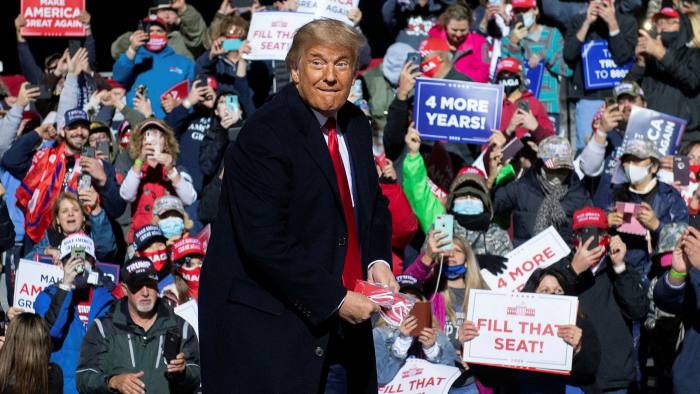
OCT 15 2020 – Though few will dare admit it, much of America is preparing to celebrate the end of Donald Trump. Not only would his defeat bring the curtain down on an administration they regard as the worst in modern US history. In their eyes, it would also dispel the MAGA hat-wearing, militia-sympathising deplorables who make up the US president’s base.
It would be a moment of redemption in which not only Mr Trump, but Trumpism also, will be written off as an aberration. After four years of unearned hell, America could pick up where it left off.
That would be a natural reaction. It would also be a blunder. Should Mr Trump lose next month, it would be with the support of up to 45 per cent of expected voters — between roughly 60m and 70m Americans. Even now when Joe Biden’s poll lead is hardening into double digits, a Trump victory cannot be discounted.
Even if he loses, it is highly unlikely to match the sweeping repudiation that Walter Mondale suffered against Ronald Reagan in 1984, or Barry Goldwater to Lyndon Johnson in 1964. America is too militantly divided for that.
A victorious Biden camp would need to take three concerns into account. The first is that the Republican party is Mr Trump’s, even if he departs the scene. Five years ago, many evangelical voters still felt distaste for Mr Trump’s libertine personality. They quickly learned he was the kind of pugilist they wanted.
The likely Supreme Court confirmation next week of Amy Coney Barrett, and that of Brett Kavanaugh and Neil Gorsuch before her, are testaments to that. America’s Christian right has embraced its inner Vladimir Lenin — the end justifies the means.
The same applies to professional Republicans. Self-preservation might imply they would distance themselves from Mr Trump as his likely defeat drew nearer. The opposite has been happening. As an Axios study shows elected Republicans have become steadily more Trumpian over the past four years.
Partly this was because a handful of moderate representatives either retired in Mr Trump’s first two years, or were ejected by hardliners in primaries. Mostly it was because of the visceral power of Trumpism. It turns out there is not much grassroots passion for fiscal conservatism in today’s Republican party — if there ever was. The impetus is with those who fear that America will cease to be America, partly because of the US’s growing ethnic diversity.
Swamp notes
In the countdown to the 2020 election, stay on top of the big campaign issues with our newsletter on US power and politics with columnists Rana Foroohar and Edward Luce. Sign up here
The second point is that America’s information culture is far more degraded today than in 2016. Democrats often blame Mr Trump’s victory on the Russians. Maybe so. But whatever disinformation Russia spread was dwarfed by home-grown material. According to a study this week by the German Marshall Fund, the amount of fake, or disguised fake, news that Americans consume on their social media has more than tripled since 2016.
Facebook is a much greater vehicle for disinformation today. More importantly, US consumer demand for news that is either distorted or plain false — about the pandemic, for example — continues to grow. A dark conspiracy cult such as QAnon would have been hard to imagine a few years ago. Today it reaches tens of millions of Americans.
The evermore disruptive impact of digital technology on public culture makes governing increasingly difficult. A Biden presidency’s first priority would be to roll out a national coronavirus strategy to flatten America’s curve. Little else can happen before that.
Much of its success would depend on Americans following rules such as wearing masks, avoiding crowds and complying with contact tracers. But a Trump defeat is unlikely to banish the cultural divisions he has stoked. Large numbers of Americans say they will reject a vaccine and view masks as a surrender of their freedom. Mr Biden’s fate will partly hinge on the degree to which he can marginalise those sentiments.
Trump vs Biden: who is leading the 2020 election polls?
Use the FT’s interactive calculator to see which states matter most in winning the presidency
His final concern should be on the conditions that gave rise to Trumpism. The ingredients are still there. Hyper-partisanship, blue-collar deaths of despair, the China threat and middle-class insecurity are all worse, or as bad, as four years ago. Most of those looking to follow Mr Trump, such as Mike Pompeo, his secretary of state, or Tom Cotton, the Arkansas senator, are harder-line versions of him without the caprice.
The fixes to America’s problems are manifold, complex, and painstaking. A vaccine will not suddenly banish the pandemic. Nor would Mr. Trump’s defeat magically bring an end to Trumpism.




 Beaver County Blue: Voice of the 17th CD of Progressive Democrats of America