All posts by carldavidson

PA Top Court: Wal-Mart Must Pay $188 Million in Workers’ Class Action Suit

From Reuters

The Pennsylvania Supreme Court ordered Wal-Mart Stores Inc to pay $188 million to employees who had sued the retailer for failing to compensate them for rest breaks and all hours worked.

Wal-Mart said on Tuesday that it might appeal the decision, which upheld lower court rulings, to the U.S. Supreme Court.

Monday’s ruling on the class-action lawsuit will reduce Wal-Mart’s earnings for the quarter ending on Jan. 31 by 6 cents a share, the company said in a securities filing. That amounts to roughly 4 percent of its profit forecast of $1.46 to $1.56 for the period. Family of Ohio man shot and killed in Walmart sue company, police

Wal-Mart shares were up 0.5 percent at $84.39 in midday New York Stock Exchange trading.

The Pennsylvania Supreme Court upheld a 2007 lower court ruling in favor of the workers, who said Wal-Mart failed to pay them for all hours worked and prevented them from taking full meal and rest breaks.

Continue reading PA Top Court: Wal-Mart Must Pay $188 Million in Workers’ Class Action Suit

Memo to Tom Wolf and Harrisburg: An Eye-Opening Description of Pennsylvania’s Failed School Funding System

By Valerie Strauss
Washington Post

Dec 11, 2014 – Many school reformers today like to say that “money doesn’t matter” in making schools work and that holding students and teachers more “accountable”   — largely through standardized test scores — is what is needed.

Certainly a great deal of money can be used poorly but that is not the same thing as money doesn’t matter. It is, however, a good mantra for people who want to ignore the severe and consequential funding inequities that persist in the U.S. public education system across the United States.

According to this 2013 report on school funding by the Education Law Center:

    In fiscal year 2010, the most recent year for which data is available, state governments, on average, funded 43.5 percent, or $259.8 billion, of the total amount spent on public education. School districts and other local sources were responsible, on average, for almost 44 percent of all public school spending or $261.6 billion. The federal government, on average, provided almost 13 percent of the total revenue received by public schools, or $75.9 billion.

With most of the money coming from state and local sources, disparities are inevitable, especially because in most places local sources are dependent on property taxes, meaning that poor areas have less money to spend on schools. Federal money given to low-income areas doesn’t close the gap.

So how inequitable can school funding be within a single state? Let’s look at one of the most troubled in this respect, Pennsylvania.

Here’s some testimony from Michael Churchill of the Public Interest Law Center of Philadelphia, given to a public hearing of the Basic Education Funding Commission in Pennsylvania about school funding:

    Pennsylvania’s system of funding schools is a failure by every criterion: equity, adequacy, predictability, fairness. Too many students in too many schools are unable to meet state standards of what children should know and be able to do. Too few are going on to college or are prepared for well paying jobs. No one is responsible to calculate how much it will cost districts to provide the necessary instruction and support. The inequity of the system is glaring: the amount of public resources spent on preparing a child to succeed in the adult world varies from $9,000 to $27,000 a year, which is a quarter of a million dollars difference over a school career from K to 12th grade. But it is not only unfair to children, it is unfair to taxpayers where the tax burden can vary from the equivalent of 8 to 36 equalized mills of tax effort for homes with the same value. And in the ultimate insult, the districts bearing the highest tax burdens frequently have less dollars to spend on their students than districts with tax burdens half the amount.

    The reasons for these multiple failures are simple:

    1. Too few state dollars result in too high reliance on local dollars;
    2. The system does not take into account how much it costs to educate children.
    3. State dollars are distributed on a basis which does not reflect the tax effort of the district.

Continue reading Memo to Tom Wolf and Harrisburg: An Eye-Opening Description of Pennsylvania’s Failed School Funding System

Bernie Sanders Lays Out Economic Agenda

Independent Senator Bernie Sanders delivered a fiery speech on the Senate floor Tuesday, laying out his new 12-point plan for rebuilding the middle class. Steve Kornacki speaks to Sanders about his efforts to make his party more progressive as he considers a bid for president.

Young People Take to the Street in Solidarity with Ferguson, Garner and vs. other Killings

Pittsburgh police give Downtown protesters their space

By Liz Navratil

Pittsburgh Post-Gazette

Dec 4, 2014 – Julia Johnson let out a piercing scream on the steps of the City-County Building on Thursday afternoon.

“Stop killing us!” she yelled next. Then, she screamed loudly once more.

Below her, on the steps leading to the Downtown building, dozens of people lay on the ground, their limbs splayed outward as if they were dead. Later, some would be outlined in chalk, and Ms. Johnson would scatter flower petals over their bodies.

On the outskirts of the protest — which at times swelled to include about 100 people — were Pittsburgh police officers on bicycles and on foot, some in plainclothes. Most of them stood silently or chatted with one another while the crowd — over about two hours — chanted slogans such as “no justice, no peace” and “no racist police.”

Their message was being echoed at similar demonstrations across the country — they decried a New York City grand jury’s decision not to indict an officer who killed Eric Garner in a chokehold this year and lamented a Missouri grand jury’s decision not to charge an officer who killed unarmed teenager Michael Brown.

20141204MWHprotestLocal17-1 Protesters rally against police brutality and racism by marching with their hands up along Liberty Avenue, Downtown.

Protesters rally against police brutality and racism by marching with their hands up along Liberty Avenue, Downtown. Michael Henninger/Post-Gazette

But this demonstration, unlike some in other cities, ended peacefully and without arrests.

Pittsburgh police Cmdr. Eric Holmes stood on the fringes of the protest as groups blocked traffic at four intersections and as one of his officers coordinated with demonstrators to clear the path for a woman driving her child to Children’s Hospital of Pittsburgh of UPMC.

The issues discussed, he said, were important to many officers on the force. “I obviously recognize that I’m an African-American male, so I’m going to come to the discussion on both sides.”

Cmdr. Holmes said he took a “passive approach” to working with the demonstrators. “I allowed them to block the street, and I made that call, so that decision rests with me. We wanted to make sure that individuals are allowed to exercise their First Amendment rights and we do recognize that with that comes a cost, and today that cost was [the] disruption of traffic.”

Elizabeth Pittinger, executive director of the Citizen Police Review Board, watched as the group gathered outside the City-County Building. She praised the police and the protesters for the way they acted. The 2009 G-20 Summit aside, she said, Pittsburgh residents and police have a long history of peacefully interacting with each other at protests.

Still, tensions at times were high. Iyanna Bridges, who is black, yelled in the street at a white man who she said described their protest and stories as “funny.”

Continue reading Young People Take to the Street in Solidarity with Ferguson, Garner and vs. other Killings

Big Banks Broke America: Why Now’s the Time to Break Our National Addiction

Why are these guys smiling? Since looting all of us for a generous bailout, you’d have thought they’d all lie low. Here’s what they did instead

Big banks broke America: Why now's the time to break our national addiction

Jamie Dimon, Lloyd Blankfein (Credit: AP/J. Scott Applewhite/Reuters/Natalie Behring/Photo montage by Salon)

By Robert Hennelly

Progressive America Rising via Salon.com

They just can’t help themselves. Like the drunk that ruins family holiday gatherings year after year, the big banks, once they are caught in yet another episode of their serial criminality, feign contrition, pay billions in fines, and swear to go forth and sin no more.

But these repeat offenders know the law does not apply to them. These 21st century pirates of the Caribbean were actually rewarded for sacking and pillaging America. They never have had a greater share of the pie and they have no allegiance other than global wealth accumulation beyond the reach of any social contract.

The one relationship to which they remain faithful is the fee for service one they have with the members of Congress they showered more than $65 million in campaign donations on since 2012.

You would have thought after they peddled hundreds of billions of dollars in worthless toxic mortgage-backed securities to the nation’s pension funds, setting into motion the largest destruction of American household wealth  since the Great Depression, the big banks would have taken their bailout and tried to stay out of the headlines.

But in the years since they took the U.S. economy for a near death spiral spin they have been caught instigating one scam after another. No sooner had the big banks settled with the federal government for perpetrating their massive mortgage fraud and they were back pushing the envelope. Law enforcement and regulatory agencies all scrambled to keep up with these banking behemoths that navigate the line between innovation and criminality with the help of former regulators and prosecutors in their employ.

Continue reading Big Banks Broke America: Why Now’s the Time to Break Our National Addiction

Progressive Caucus to the GOP: Potential Extension Of Tax Cuts Leaves Out Middle Class, Hurts Climate

By Congressional Progressive Caucus

  WASHINGTON, DC – Representatives Raúl Grijalva (D-AZ) and Keith Ellison (D-MN), co-chairs of the Congressional Progressive Caucus (CPC), released the following statement in response to a reported agreement in Congress on extending certain tax breaks.

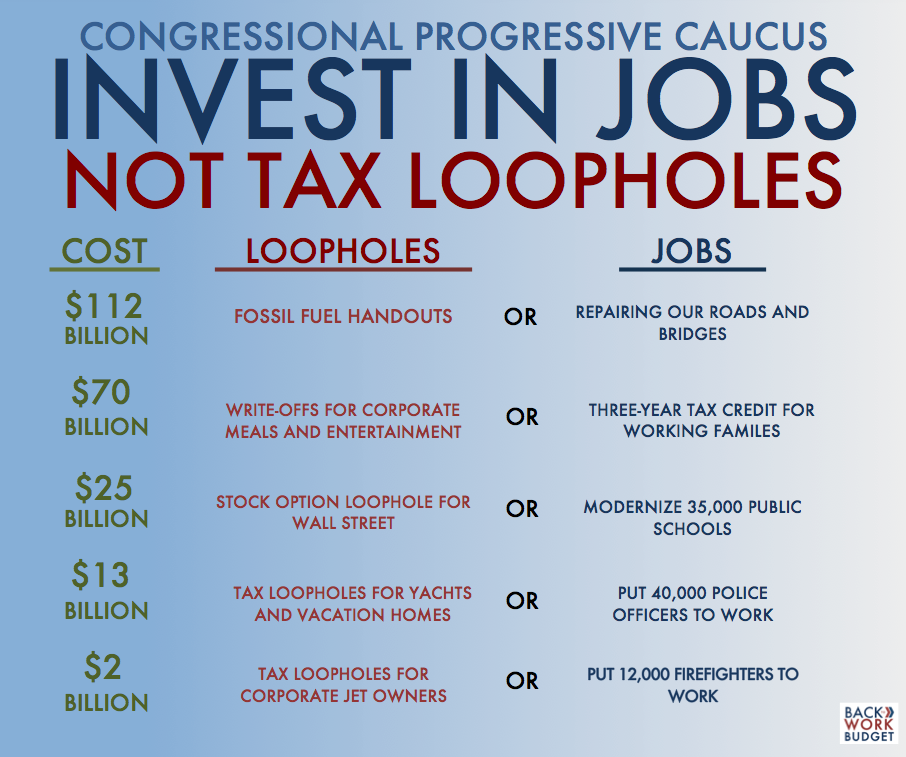
The provisions that are included in the deal, such as permanent extension of tax breaks for corporate research and continued fossil fuel subsidies, will add nearly $450 billion to our budget deficit while providing little relief to the middle class and phasing out renewable energy credits.

“The tax extension package will once again be a boon for corporate profits while largely leaving out middle-class and low-income families who are struggling just to get by. If we can find hundreds of billions of taxpayer dollars to make corporate tax breaks permanent, we should be able to help those struggling to find work. We should be making permanent those tax breaks that help working families without adding restrictions that exclude children in need.  This deal is a permanent step backwards for those who think we have a system that is rigged in favor of the wealthy.”

SEIU, Workers Celebrate NLRB Ruling

Solidarity action vs UMPC earlier this year

By Kris B. Mamula

Reporter- Pittsburgh Business Times

Nov. 17, 2014 – Union and elected officials on Monday celebrated a National Labor Relations Board ruling that reinstated four fired UPMC workers and restored benefits and wages to fifth employee for union organizing activities.

"UPMC has been acting above the law," City Councilwoman Natalia Rudiak told union members and others who turned out for a news conference attended by a couple dozen people. "UPMC is not above the law."

The rally came as Mayor Bill Peduto has been reaching out to UPMC and other nonprofits in the city about voluntarily compensating the city for services in lieu of property taxes. Peduto was not at the news conference Monday, but he called for "long-term financing agreements" with the city’s nonprofits in an address to council Nov. 10.

Rudiak conducted the news conference at the City-County Building downtown and called on UPMC to "stop the intimidation, retaliation and legal maneuvers that keep us down." Separating the nonprofit contribution and unionization issues at UPMC would be "dangerous," Rudiak said.

The NLRB on Nov. 14 ruled that the hospital giant had disciplined and fired employees for try to unionize, which violates federal law. The Service Employees International Union has been trying to organize UPMC’s Oakland hospitals for nearly three years, but a vote by employees has not been scheduled.

Continue reading SEIU, Workers Celebrate NLRB Ruling

Wolf’s Challenge: PA ‘One of the Worst’ in Funding Its Schools

Schools, Parents Sue Pennsylvania Over ‘Educational Caste System’

 By Deirdre Fulton

Beaver County Blue via Common Dreams

Nov. 11, 2014 – Six school districts, seven parents, and two statewide associations sued [1] the commonwealth of Pennsylvania on Monday, claiming legislative leaders, state education officials, and the governor have failed to uphold the state’s constitutional obligation to provide a system of public education that gives all children the resources they need to meet state-imposed academic standards and "participate meaningfully in the economic, civic, and social life of their communities."

According to the complaint [2] (pdf), "state officials have adopted an irrational and inequitable school financing arrangement that drastically underfunds school districts across the Commonwealth and discriminates against children on the basis of the taxable property and household incomes in their districts."

"The disparity in education resources has created an educational caste system that the Commonwealth must eliminate." —Wade Henderson, Leadership Conference on Civil and Human Rights

As a result, the plaintiffs claim that hundreds of thousands of students throughout the state lack basic educational supports and services—functioning school libraries, up-to-date textbooks and curriculum materials, reasonable class sizes, guidance counselors, school nurses, vocational-ed and college prep classes, academic tutoring programs, and more.

"My child is in classes with too many other students and she has no access to tutoring services or support from paraprofessionals, but our elected officials still expect and require her to pass standardized tests," said [3] Jamela Millar, parent of 11-year-old K.M., a student in the William Penn School District. "How are kids supposed to pass the tests required to graduate high school, find a job and contribute to our economy if their schools are starving for resources?"

The state NAACP and the Pennsylvania Association of Rural and Small Schools joined the suit on behalf of their members. Urban, suburban, and rural districts are represented among the plaintiffs. While the state-run Philadelphia School District did not join the legal action, two Philadelphia parents are part of the suit and the Philadelphia Federation of Teachers issued a statement in support on Monday.

Continue reading Wolf’s Challenge: PA ‘One of the Worst’ in Funding Its Schools

Beaver County Aid Providers Experience Tough Decisions During Poverty Simulation

Poverty Simulation

A poverty simulation experience presented by Aliquippa Weed and Seed, in conjunction with the Franklin Center’s Disproportionate Minority Contact Project, was held Friday at the Church in the Round. The simulation experience is designed to help participants begin to understand what it might be like to live in a typical low-income family trying to survive month to month. Here, the Rev. Marvin C. Moreland calls to be let out of "jail" during the simulation.

By Daveen Rae Kurutz

Beaver County Times

Nov. 4, 2014 ALIQUIPPA — Food, medicine or utilities.

It’s one of several stressful choices low-income families have to make each month. Keeping a budget in balance when necessary costs — such as housing, transportation and food — require almost all income is just one stressor that leaves people frustrated and looking for help.

That’s the situation several dozen Beaver County-area human-service providers found themselves in last week during a poverty simulation conducted by Aliquippa Weed and Seed and the Franklin Center of Beaver County. The program put participants in the shoes of a family living in poverty.

Participants were assigned to family roles — parents, children and grandparents — and given a budget and a series of responsibilities as part of Missouri’s Community Action Poverty Simulation.

“The whole idea is for human-service providers to have an idea what their clients go through,” said Jonathan Pettis, executive director at the Franklin Center. “They can take the lessons they learned back to their agencies. It’s really powerful.”

The simulation included representatives from Children and Youth Services, county Behavioral Health Services, Uncommon Grounds and other human-service organizations; members of the clergy; and officials from Aliquippa, Midland, Baden and the Blackhawk School District.

Groups were given different scenarios that low-income families regularly experience. Some families had absentee fathers or included children being raised by their grandparents. Other families struggled with divorce, affording college and teen pregnancy.

“The needs are very great,” said Abigail Young, virtual visitation coordinator for Trails Ministries Inc. in Beaver Falls, a faith-based re-entry ministry that works with incarcerated individuals and their families. “There is so much we all can do.”

Young, two of her co-workers and another participant played the roles of the Zuppot family — grandparents “Zola” and “Zeke” and children “Zenobia” and “Zander” — who struggled for four weeks in poverty.

Week One

A cashier at the local grocery store, Zola is the breadwinner for the family. Her husband has limited mobility and has to stay at home unless someone can help him travel.

The family was not able to buy food this week. There weren’t enough transportation passes to get Zola to work, the market and the Paycheck Advance office. When she did make it to cash her check, the office closed before workers could cash the check.

“Even when this family has cash, they can’t get where they need to go,” said Lola Thomas, a family coach with Trails Ministries who portrayed Zeke.

Week Two

The family still can’t buy food. Zola never made it to work after she and Zeke visited an interfaith service where workers gave them all-day transportation passes that they used to get to the bank to cash Zola’s paycheck and Zeke’s disability check.

Continue reading Beaver County Aid Providers Experience Tough Decisions During Poverty Simulation

Lesson from History: 150 Years Back, Elections Mattered, Too, Only Then the GOP Was Progressive

1864, Lincoln vs. McClellan: How Allegheny County voted

A pivotal presidential contest in the thick of the Civil War, the election was hotly contested in Pittsburgh. Note the role of the ‘Wide Awakes,’ the Insurgent Youth of the time.

20141102hoabelincoln001local Cartoon of Abe Lincoln and Gen. George McClellan prior to 1864 election. Illustration in Harper's Weekly, June 25, 1864.

Cartoon of Abe Lincoln and Gen. George McClellan prior to 1864 election. Illustration in Harper’s Weekly, June 25, 1864.

Voting rites in 1864: messy and unfair, but rough justice

By Len Barcousky

Pittsburgh Post-Gazette

Nov 2, 2014 – While the editors at Pittsburgh’s Gazette and Post disagreed on almost every issue, the rival newspapers were united on one topic: the importance of the presidential election of 1864.

“The hour has come,” The Pittsburgh Daily Gazette told voters on Nov. 8, election day. “The decisive blow must be struck today.”

“The main issue … is no less than the preservation of our country and with it the preservation of our liberties,” The Daily Pittsburgh Post opined.

Despite worrisome results in congressional elections a month earlier that showed Republican gains, Democrats in southwestern Pennsylvania were counting on a win in the presidential contest.

The Post was the city’s pre-eminent Democratic newspaper, and its editor, James P. Barr expressed confidence.

Six days before the election “the Democracy of Washington, Beaver and Allegheny counties, with their wives, children and sweethearts, turned out en masse to vindicate the Union and the Constitution,” the Post reported Nov. 4. The mass meeting was held in Clinton, Findlay Township.

The march of Democratic supporters, led by Allegheny County delegations from Moon, Crescent, North Fayette and Findlay, “took three-quarters of an hour to pass,” the newspaper said. “The States were represented by a wagon filled with young girls, appropriately clad and adorned, drawn by 35 horses ridden by lads uniformly clothed …”

Why 35 horses and riders? The Union, until the admission of Nevada on Oct. 31, 1864, had 35 states.

Continue reading Lesson from History: 150 Years Back, Elections Mattered, Too, Only Then the GOP Was Progressive