State records miss half the waste pumped into injection wells
By John Finnerty CNHI Harrisburg Bureau
HARRISBURG, April 16, 2015 — State environmental officials didn’t account for half the waste pumped into injection disposal wells last year, a comparison with federal data shows.
The state’s injection wells took 330,000 barrels of waste left over after natural gas drilling last year, according to the U.S. Environmental Protection Agency. That’s about six truckloads a day.
The state Department of Environmental Protection only accounted for 167,500 barrels, according to its records.
That means about three truckloads of waste per day are unaccounted for in the state’s tracking system.
The discrepancy “begs the question of whether Pennsylvania should let the industry expand,” said Nadia Steinzor, eastern program coordinator for Earthworks Action, an environmental watchdog.
Pressure is mounting for more disposal wells to serve the burgeoning gas drilling industry.
Steinzor’s group released a report earlier this month that criticized efforts of Pennsylvania and three other states — Ohio, West Virginia and New York — in managing waste generated by the industry.
Injection wells are a conventional way of disposing of liquid waste from fracking, the process in which drillers use pressurized water and chemicals to release underground reservoirs of gas.
Controversy stems from studies that have blamed injection wells for earthquakes. Neighbors of proposed well sites also raise fears about pollution to water supplies and problems related to truck traffic.
Congressional Progressive Caucus presenting its budget
8.4 Million Good Paying Jobs By 2018
$1.9 Trillion Investment In America’s Future
$820 billion infrastructure and transportation improvements
EXECUTIVE SUMMARY The People’s Budget fixes an economy that, for too long, has failed to provide the opportunities American families need to get ahead. Despite their skills and work ethic, most American workers and families are so financially strapped from increasing income inequality that their paychecks barely cover basic necessities. They earn less and less as corporations and the wealthy continue amassing record profits. It has become clear to American workers that the system is rigged.
The People’s Budget levels the playing field and creates economic opportunity by increasing the pay of middle-and low-income Americans. More customers and higher consumer spending advance American businesses, not tax cuts and relaxed regulations. The People’s Budget drives a full economic recovery by creating high-quality jobs and reducing family expenses, restoring the buying power of working Americans.
The People’s Budget closes tax loopholes that companies use to ship jobs overseas. It creates fair tax rates for millionaires and provides needed relief to low-and middle-income families. It invests in debt-free college, workforce training and small businesses within our communities, helping return our economy to full employment and giving a raise to Americans who need it most. Investments in The People’s Budget boost employment and wages by addressing some of the biggest challenges of our time: repairing America’s rapidly aging roads and bridges, upgrading our energy systems to address climate change, keeping our communities safe, and preparing our young people to thrive as citizens and workers.
A fair wage is more than the size of a paycheck. It’s having enough hours, paid overtime, sick and parental leave, and affordable health and childcare. It’s being able to afford a good education for your kids and never living in fear that your job will be sent overseas. It’s knowing you can make ends meet at the end of the month. The People’s Budget helps achieve that with a raise for American workers, a raise for struggling families and a boost to America’s long-term global competitiveness.
A RAISE FOR AMERICA o Creates more than 8 million good jobs by 2018. o Increases functionality of Worker Protection Agencies. o Includes a four percent raise for federal workers. o Provides Paid Leave Initiative and Child Care. o Supports a minimum wage increase and Collective Bargaining.
AUSTERITY TO PROSPERITY o Repeals sequester and all Budget Control Act spending caps. o Increases discretionary funding to invest in working families. o Reverses harmful cuts and enhances social safety net. o Invests in veterans, women, communities of color and their families.
FAIR INDIVIDUAL TAXES
o Equalizes tax rates for investment income and income from work. o Returns to Clinton-era tax rates for households making over $250,000 and implements new brackets for those making over $1 million. o Expands the Earned Income Tax Credit and the Child Care Credit.
FAIR CORPORATE TAXES o Eliminates the ability of U.S. corporations to defer taxes on offshore profits. o Ends corporate inversions that allow U.S. companies to merge offshore to avoid taxes. o Enacts a Financial Transaction Tax on various financial market transactions. o Ends unlimited executive pay tax write-offs.
EDUCATIONAL OPPORTUNITIES FOR EVERY STUDENT o Provides debt-free college to every student. o Allows refinancing of student loans. o Invests in K-12 and provides free pre-school.
AFFORDABLE HEALTH CARE o Repeals excise tax on high-priced workers plans and replaces with public option. o Implements drug price negotiation for Medicare. o Reauthorizes Children’s Health Insurance Program. o Allows states to transition to single-payer health care systems.
PROTECTING OUR ENVIRONMENT o Closes tax loopholes and ends subsidies provided to oil, gas and coal companies. o Enacts a price on carbon pollution without hurting low-income families. o Invests in clean and renewable energy and green manufacturing.
SUSTAINABLE DEFENSE o Modernizes our defense posture to create sustainable baseline defense spending. o Ends emergency funding for Overseas Contingency Operations. o Increases funding for diplomacy and invests in job transition programs.
COMPREHENSIVE IMMIGRATION REFORM
Implements comprehensive immigration reform, including a pathway to citizenship.
ACCESS TO HOUSING
Fully funds programs to make housing affordable and accessible for all Americans.
PUBLIC FINANCING OF CAMPAIGNS
Funds public financing of campaigns to curb special interest influence in politics.
March 10, 2015 – As America marches inexorably toward a presidential election that will almost certainly feature another Clinton, possibly pitted against yet another Bush, a sense of resignation and fatalism has taken hold among many observers on both the progressive left and the anti-establishment right.
While Jeb and Hillary would trade barbs on such perennial wedges issues as abortion and same-sex marriage, and Clinton may be more supportive than Bush of what passes for a social safety net in this country — just don’t mind that bit about ending welfare as we knew it, and try not to focus on that pesky vote for bankruptcy “reform” — neither Wall Street-friendly candidate poses a threat to the plutocratic powers that be. Indeed, the masters of the universe can’t quite decide which of the two they’d prefer to see elected. Either way, they rest assured, they win.
Dispiriting as the coming national contest can be, however, it should not obscure one of the less-discussed dynamics of the 2016 elections: Across the country, a crop of unapologetically progressive candidates promises to infuse a new populist energy into the fight for the U.S. Senate, and may well transform the terms of debate within a Democratic Party that has spent the better part of the past three decades reconciling itself to the Reagan Revolution and embracing neoliberalism.
Rep. Donna Edwards (D-The Elizabeth Warren Wing) is the latest progressive to toss her hat into the Senate ring, announcing today that she will seek the seat being vacated by Maryland Democrat Barbara Mikulski. Though she has served in Congress for six years now, Edwards is fundamentally an insurgent: The community activist won her seat after toppling a hawkish, centrist incumbent in the Democratic primary, and as a member of the Congressional Progressive Caucus and the Populist Caucus, she’s been at the forefront of the effort to move the Democrats leftward on issues like austerity, a living wage, foreign policy, and civil liberties. Befitting her congressional service, Edwards plans to run as an unabashed progressive populist.
“The corporate interests are gonna come at me with all their money,” Edwards tells voters in her announcement video. “But if you’ll join me in this fight there’s no way we can’t win. and when I step into Barbara Mikulski’s shoes as your next senator, you’ll always know where I stand — with you.”
Edwards won’t enjoy a clear Democratic field: Fellow Rep. Chris Van Hollen has already launched his bid for Mikulski’s seat, and he has secured the backing of Senate Minority Leader Harry Reid.
Though Van Hollen has put forth some worthy proposals on economic issues, he’s hardly the most progressive nominee Democrats could field in a race their candidate is almost certain to win: Liberals haven’t forgotten, for instance, that he backed the Simpson-Bowles deficit reduction framework, which would have cut Social Security benefits. Edwards, by contrast, supports Sen. Warren’s proposal to expand the program. The congresswoman has also staked out more civil libertarian positions than Van Hollen; whereas she supported the Amash-Conyers amendment to overhaul the National Security Agency’s surveillance practices, Van Hollen voted against it.
While the Edwards-Van Hollen contest sets up a potentially epic clash, former Wisconsin Sen. Russ Feingold is unlikely to face any serious Democratic challengers as he vies to reclaim his old job next year. Feingold recently stepped down from his role as an African envoy for the State Department, stoking speculation that he’ll seek a rematch with Sen. Ron Johnson (R-WI), the man who ousted him in the 2010 Tea Party wave election. The former senator has done nothing to discourage such speculation, pointedly referring to his “once, current, and I hope future chief of staff” in his final State Department speech and planning a “listening tour” of his state.
Feingold’s return would mark a particularly sweet victory for progressives, whose 2010 defeat ranked among the most devastating blows for Democratic liberals. (Continued)
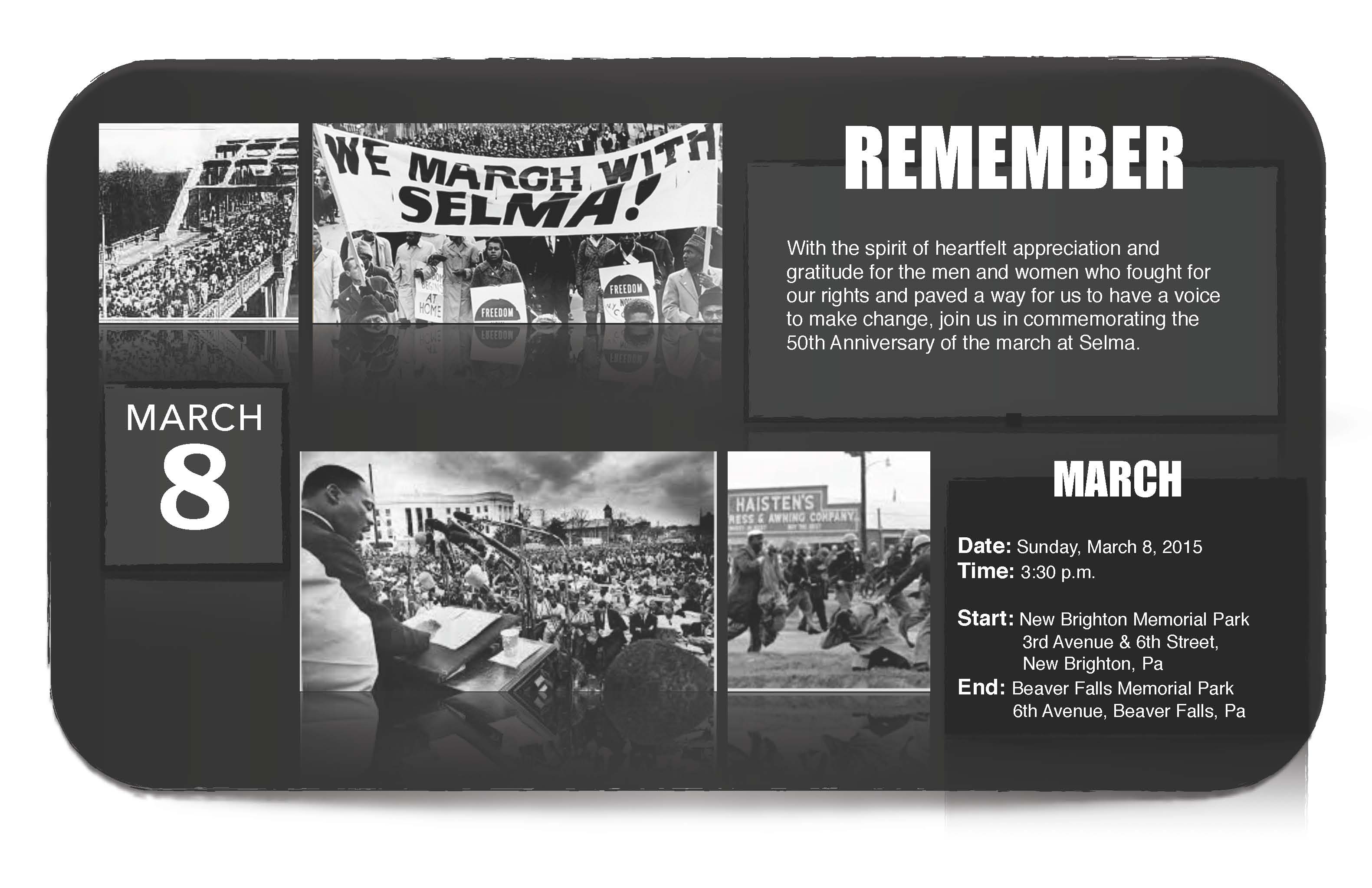
March 9, 2015 – BEAVER FALLS — Upwards of 100 people marched from New Brighton to Beaver Falls on Sunday afternoon to commemorate the 50th anniversary of "Bloody Sunday," which took place March 7, 1965, in Selma, Ala., as civil rights activists marched to the state capital of Montgomery for voting rights.
"Things like this sparks into the people to get out there and vote, and that we have a chance to get out there and make a difference," said Abe Askew, of Aliquippa.
Askew believed that Sunday’s march and similar acts of empowerment can have positive impacts on people and communities alike, saying he will spread the word regarding the importance of voting.
"(I’ll tell) all the people that I know from Aliquippa and it’ll go from here to there," Askew said. "It goes into a stream and a stream into a river."
The march began at New Brighton’s Townsend Park, across from the borough building at Third Avenue and Sixth Street, and crossed the bridge over the Beaver River to Beaver Falls, before concluding at Beaver Falls Memorial Park at Sixth Avenue and 11th Street, where several guest speakers addressed the crowd, including event organizer Olivia Ryan.
Ryan, a graduate of Beaver Falls High School and Kent State University, decided to organize the event after a panel discussion on law, race and the community last weekend at Geneva College. (Continued)
Feb 23, 2015 – The U.S. Geological Survey has backed-up what scientists have been suggesting for years–that deep injection of wastewater is the primary cause of the dramatic rise in detected earthquakes:
Large areas of the United States that used to experience few or no earthquakes have, in recent years, experienced a remarkable increase in earthquake activity that has caused considerable public concern as well as damage to structures. This rise in seismic activity, especially in the central United States, is not the result of natural processes.
Instead, the increased seismicity is due to fluid injection associated with new technologies that enable the extraction of oil and gas from previously unproductive reservoirs. These modern extraction techniques result in large quantities of wastewater produced along with the oil and gas. The disposal of this wastewater by deep injection occasionally results in earthquakes that are large enough to be felt, and sometimes damaging. Deep injection of wastewater is the primary cause of the dramatic rise in detected earthquakes and the corresponding increase in seismic hazard in the central U.S.
“The science of induced earthquakes is ready for application, and a main goal of our study was to motivate more cooperation among the stakeholders — including the energy resources industry, government agencies, the earth science community, and the public at large — for the common purpose of reducing the consequences of earthquakes induced by fluid injection,” said coauthor Dr. William Ellsworth, a USGS geophysicist.
Emphasis added. In the last five years alone, Oklahoma has detected a staggering 2500 earthquakes. Scientists involved in the study are calling for a dramatic increase in transparency and cooperation:
“In addition to determining the hazard from induced earthquakes, there are other questions that need to be answered in the course of coping with fluid-induced seismicity,” said lead author of the study, USGS geophysicist Dr. Art McGarr. “In contrast to natural earthquake hazard, over which humans have no control, the hazard from induced seismicity can be reduced. Improved seismic networks and public access to fluid injection data will allow us to detect induced earthquake problems at an early stage, when seismic events are typically very small, so as to avoid larger and potentially more damaging earthquakes later on.”
Feb 8, 2015, Harrisburg, PA. If the vote were taken for the Democratic presidential candidate at the Harrisburg Hilton on Saturday, Feb. 7, Senator Bernie Sanders, Independent of Vermont, would likely have won by a landslide.
That was the spirit in the hotel ballroom as Sanders addressed the 800 people gathered for the PA Progressive Summit. The annual meeting, sponsored by Keystone Progress, brought together progressive activists—community and trade union organizers, women’s right and civil rights groups, hopeful candidates and door knockers—all of whom made up the democratic wing of the Democratic Party, from all across the Keystone State.
“I’m going to try something a little different this morning,” said Sanders to start things rolling, “I’m going to tell you the truth.” He got a wave of laughter and cheers from people who often got something else from politicians.
Sanders with Tina Shannon
Sanders started off with the ‘Citizen United’ Supreme Court decision taking limits off the superrich in funding elections and candidates. “It will go down is history as one of the worse ever made in modern times” Sanders said by way of description. “By a five-to-four vote, it undermined the very foundations of democracy. I know you think the situation is bad, believe me, it’s worse than you think it is.” Billionaires are not satisfied with owning the economy, he explained. They were buying government as well.”
The Koch Brothers, with 85 billion in wealth, were taken as the case in point. Sanders explained that they alone intended to spend over 900 million dollars on the 2016 election—more than the combined total of Obama and Romney in 2012. This meant these “counter-revolutionaries with a far right agenda” would wield more power than both political parties in the recent past.
Turning to the economy, Sanders said while the economy was clearly in better shape than when Obama, first took office, it was still clearly in bad shape. He explained the different meanings of official unemployment figures, with 5.8 percent being the most common number cited, but double that, near 12%, was more accurate.
Then he broke it down further: “We talk a lot about Ferguson, as we should. But we also need to talk more about Black youth unemployment, which is 30 percent. Nobody should be satisfied with where we are today. We have 45 million people living in poverty, another word we need to talk more about today.”
For those worried about deficits, Sanders noted that they had been reduced under Obama. But he also insisted that if they were truly concerned about deficits, they would have stood up against the Iraq war. This remark got wild cheers and everyone out of their seats.
Unfair Impact of Technological Change
Sanders went on to examine ‘the explosion in technology,’ not only i-Phones and i-Pads, but robotics in factories. “All of this has led to a tremendous growth in productivity on the part of American workers.” Such changes logically might suggest workers were paid more or worked shorter hours, he added, “but all of you know, tens of millions of Americans today are working longer hours for less pay.”
This meant anger and stress among workers—impacting both men and women, even if in slightly different ways—needed discussion as a national issue. There was a time, “ancient history” said Sanders, when one worker could work 40 hours and support a family reasonably well. Now women were working along with men, sometimes at two or three jobs, at long hours and low pay, to hobble together enough to support a family. “This causes a lot of anger, and often it’s being angry at the wrong people for the wrong reasons,” he added. “The average male worker, right in the center of the economy, now makes $800 a year less in inflation adjusted dollars than he did 40 years ago. The average female worker in the center makes $1300 a year, even less. They have a lot to be angry about. They want to know why, and our job is to explain it to them.”
Montgomery Locks and Dam on Beaver County: Army Corps of Engineers spokesman Dan Jones said locks and dams funding on the Ohio River in Pennsylvania and West Virginia will receive nearly $47.97 million based on President Barack Obama’s proposed numbers. The Montgomery Locks and Dam in Potter Township could be among those receiving funding.
Locks and dams funding increases for southwestern Pennsylvania
By David Taube
Beaver County Times
Feb 3 , 2015 – WASHINGTON, D.C. – An Army Corps of Engineers spokesman said the president’s proposed budget calls for significant increased spending on the Ohio River.
Spokesman Dan Jones said locks and dams funding on the Ohio River in Pennsylvania and West Virginia will receive nearly $47.97 million based on President Barack Obama’s proposed numbers. Typically, Jones added, those figures do not change drastically from what’s approved by Congress.
That compares to a previous budget of $30.8 million, he said.
The federal government also will invest $58 million in unallocated dollars to locks and dams in western Pennsylvania, which involves funding already approved by Congress and the administration, U.S. Sen. Bob Casey, D-Pa., said in a statement Monday.
The unallocated money relates to the current 2015 federal fiscal year, which began Oct. 1 and ends Sept. 30. The president’s budget is for the upcoming 2016 federal fiscal year, which begins this fall.
Casey had asked federal staff for that other investment so a lower Monongahela River project could begin constructing a river chamber portion and support existing contracts, he wrote in a letter to Jo-Ellen Darcy, assistant secretary of the Army for civil works.
It was not immediately clear if or how that $58 million change could benefit other locks and dams projects in the state as Casey’s press office stated it would.
Disturbing data: Pittsburgh must get to work on racial disparities
By the Post Gazette Editorial Board
Jan 18, 2015 – When Larry E. Davis says there are wide racial disparities in Pittsburgh that translate into broad and significant disadvantages for local African-Americans, he’s not giving an opinion. He is summarizing 137 pages of alarming statistics.
The report, “Pittsburgh’s Racial Demographics 2015: Differences and Disparities,” was released Tuesday by the University of Pittsburgh’s Center on Race and Social Problems, where Mr. Davis is both director of the center and dean of the university’s School of Social Work.
The compilation paints a bleak picture of the economic, educational, health and social realities conspiring to limit opportunities for black residents. Perhaps even worse, it demonstrates — based on a comparable 2007 report — that circumstances of black Pittsburghers have not improved.
Some key findings:
• The household income for black families in Pittsburgh was just 49 percent of white families between 2007 and 2011 — $21,800 versus $44,600. That far exceeds the gap nationwide.







 Beaver County Blue: Voice of the 17th CD of Progressive Democrats of America