All posts by carldavidson

First Faculty Strike in PA.State System History Begins

By Susan Snyder
Philly.com

Oct 19, 2016 – Faculty in Pennsylvania’s 14 state universities are on strike, the first in the system’s 34-year history.

The Association of Pennsylvania State College and University Faculties union announced shortly after 5 a.m. that a strike could not be averted, likely bringing education to a halt for 105,000 students in the state system universities.

The decision followed five consecutive days of bargaining that went into last evening and broke off after 9 p.m.

"At 11:35 p.m., we made a last attempt to negotiate through back channels," said union president Kenneth M. Mash, a political science professor at East Stroudsburg University. "We waited until 5 a.m. We are headed to the picket lines, but even on the picket lines, our phone will be on, should the state system decide it doesn’t want to abandon its students."

Mash said he would be picketing outside the Dixon Center in Harrisburg, where the chancellor of the state system, Frank T. Brogan, has his office.

There is no limit on how long a strike could last. Mash said faculty will return when negotiators reach a contract.

The state system has said it intends to keep campuses open, including residence halls and dining facilities and operate as close to normal as possible. But it does not intend to hire replacement workers. It remains to be seen how many, if any, faculty cross the picket lines to work.

"I think none of us ever wanted it to end up here," said Amber Holbrook, a West Chester social work professor who was among the more than a dozen faculty members picketing outside the system’s Center City campus. But, she said, the system’s proposed changes would make it "hard to recruit and retain faculty."

Negotiations broke down over health insurance costs and salary increases

Continue reading First Faculty Strike in PA.State System History Begins

22 US House Democrats Press Obama to Adopt ‘No-First-Use’ Nuclear Weapons Policy

Barbara Lee, PDA and the Congressional Progressive Caucus Took the Initiative

By: Joe Gould

Defense News

Oct 13, 2016 – WASHINGTON — Twenty-two more US House lawmakers are calling on President Barack Obama to adopt a policy of no-first-use of nuclear weapons, part of a tide of Democratic lawmakers pushing for restraint on atomic arms as the sun sets on the current administration.

With relations between Washington and Moscow historically tense and unpredictable this week, the lawmakers in a letter to Obama on Thursday expressed worry over the two nations’ launch-under-attack postures and “the risk of catastrophic miscalculation and full-scale nuclear war.”

“As you know, were the United States to exercise its contingency plans to use nuclear weapons first in a conflict against a nuclear-armed adversary, a full-scale nuclear exchange could ensue, killing thousands of civilians,” the letter reads. “For the security and safety of the world, military options that can spiral towards mutually assured destruction should not be on the table.”

Thursday’s letter was led by Rep. Barbara Lee, D-Calif., the Peace and Security Task Force chair for the Congressional Progressive Caucus. Another signatory was Rep. Keith Ellison, D-Minn. Ellison is the caucus’ co-chair and his party’s chief deputy whip in the House.

A no-first-use policy would minimize the need for "first strike” weapons, they argue in the letter, including the next-generation nuclear-armed cruise missile and intercontinental ballistic missiles, "which could generate significant cost savings and lead other nuclear-armed states to make similar calculations."

Continue reading 22 US House Democrats Press Obama to Adopt ‘No-First-Use’ Nuclear Weapons Policy

How Hostile Poll-Watchers Could Hand Pennsylvania to Trump

One tactic is making the lines slow down with spurious challenges

The state’s unique rules make it vulnerable to Election Day mischief. In a tight race, that could help Donald Trump.

By Erick Trickey
Politico.com

In 2004, hundreds of University of Pittsburgh students waited for hours to vote in the presidential election. The local Democratic Party, alarmed at the bottleneck, handed out pizza and water to encourage the students to stay. Pittsburgh Steelers Hall-of-Famer Franco Harris worked the line, armed with a giant bag of Dunkin Donuts, and Liz Berlin of the Pittsburgh band Rusted Root performed on guitar.

The stalled line wasn’t because of the high turnout. It was what was happening at the check-in desk.

“The attorneys for the Republican Party were challenging the credentials of pretty much every young voter who showed up,” recalls Pat Clark, a Pittsburgh activist and registered Democrat who was working for an election-protection group that day.

The GOP attorneys were acting as poll watchers. A common practice in many states, partisan poll watching helps parties get out the vote and keep an eye out for irregularities. But in Pennsylvania, laws governing how observers can challenge voters are unusually broad, and that makes them susceptible to abuse.

On that day in 2004, students who were challenged by the GOP lawyers were told they needed to find a friend who could sign an affidavit proving their identity and residence. Other battleground states, concerned that their voter-challenge laws could be misused, have limited or even abolished them in the past decade. But Pennsylvania hasn’t modified its rules. That worries election experts, who fear Donald Trump’s persistent calls for supporters to monitor the polls to prevent cheating could create conflicts and chaos inside and outside of precincts across the state.

“I hope you people can … not just vote on the 8th, [but] go around and look and watch other polling places and make sure that it’s 100-percent fine,” Trump said at an August 12 rally in Altoona, in rural central Pennsylvania. “We’re going to watch Pennsylvania—go down to certain areas and watch and study—[and] make sure other people don’t come in and vote five times. … The only way we can lose, in my opinion—and I really mean this, Pennsylvania—is if cheating goes on.”

In a speech 10 days later in Ohio, Trump dropped an ominous hint that he had more in mind than just witnessing democracy in action: “You’ve got to get everybody to go out and watch, and go out and vote,” Trump said. “And when [I] say ‘watch,’ you know what I’m talking about, right?”

Trump’s claim that widespread voting fraud could swing the presidential election has been widely debunked; a national study discovered only 10 cases of fraud by misrepresentation from 2000 to 2012—1 in every 15 million eligible voters. But Trump’s remedy could have a very real and much larger impact. In a state that has been described as a “blue wall,” crucial to Clinton’s election chances, and where polls show her lead in the 3 percent range (down from 9 percent a month ago), blocking likely Democratic voters in Pennsylvania’s major cities could help Trump tighten the results on November 8.

“Instead of seeing orderly poll watching,” says Wendy Weiser, director of the Brennan Center for Justice’s Democracy Program, “we might see a lot of individuals trying to take on the role of election officials or law enforcement, and crossing the line into intimidation, discrimination and polling place disruption.”

***

Pennsylvania knows it has a problem on its hands, or at least the potential for one. That’s why the Pennsylvania Department of State issued guidelines in 2012 to help election workers cope with the state’s broad law.

The guidelines, which are nonbinding, call on election workers to prevent watchers from challenging voters “routinely, frivolously or without a stated good faith basis.” Wanda Murren, press secretary for the Department of State, explains that using challenges “to intimidate or harass certain voters” could “rise to the level of criminal behavior.”

Continue reading How Hostile Poll-Watchers Could Hand Pennsylvania to Trump

Bernie Sanders makes appearance at CMU, campaigns for Katie McGinty

Senatorial candidate Katie McGinty campaigns  with Bernie Sanders at Carnegie Mellon University. John Hamilton | Staff Photographer

Senatorial candidate Katie McGinty campaigns with Bernie Sanders at Carnegie Mellon University. John Hamilton | Staff Photographer:Amina Doghri / For the Pitt News

Amina Doghri / For the Pitt News

Add Sen. Bernie Sanders to the list of high-profile Democrats lining up behind Katie McGinty.

The former presidential candidate stumped for McGinty, the Democratic Pennsylvania Senate candidate, at Carnegie Mellon University Friday night.

“Our job is to elect Katie, our job is to elect Secretary Clinton our job is to transform the United States of America,” Sanders, D-Va., said.

McGinty, who’s running against standing Pennsylvania Sen. Pat Toomey, spoke to a crowd of about 800 people about Planned Parenthood, education reform, environmental protection and equal pay — issues she’s focused on more intensely since the close of the Democratic National Convention in July.

“None of this is politics or academics,” McGinty said about equal pay. “This is about families.”

After a post-DNC bump in the polls, the Pennsylvania Senate race has tightened in recent weeks as out-of-state funding and support pours in.

A Muhlenberg College/Morning Call poll released Sept. 16, for example, placed McGinty five points ahead of Toomey, a lead that’s shrunk since her late July high. In recent weeks, the two candidates have traded leads in the polls ––  as recently as a Sept. 7 Quinnipiac poll, Toomey had a lead over McGinty by one point. Across all polls, McGinty maintains a 0.2 lead, according to Real Clear Politics.

Sanders’ support for McGinty comes after both President Barack Obama and Vice President Joe Biden endorsed her run in March, one month before the April primaries.

Also joining Sanders and McGinty at the event were Braddock Mayor John Fetterman, who ran against McGinty in the primary election, and Pittsburgh City Council member Dan Gilman, who stressed the need for Democratic unity.

Since Sanders lost the Democratic primary, he’s done the same, encouraging his steadfast supporters — including members of the “Bernie or Bust” movement — to get behind the Democratic candidates still in the race.

Continue reading Bernie Sanders makes appearance at CMU, campaigns for Katie McGinty

Save the Date! Join Us for Breakfast on Oct 8!

PROGRESSIVE BREAKFAST
…with food for thought…

Saturday October 8th – Doors 8:30am – Serving 9:00am

Penn Bistro, 615 Penn Ave., New Brighton

Full buffet breakfast
$10.00

The Democratic Party Platform

-issues worth fighting for-

One of the most important outcomes of the 2016 Democratic Party primary contest is the Democratic Party platform. The Sanders delegates along with union and minority delegates worked together to craft a progressive platform. How can we make this platform our common cause to organize for justice, equality, and dignity for all Americans?

Speaker: Mr. Don Siegel, International Vice President
IBEW – International Brotherhood of Electrical Workers

clip_image002

RSVP by Wed. October 5th

Tina Shannon: 724-683-1925, tinabshannon@gmail.com
Sponsored by: PA 12th CD Chapter, PDA
Labor donated

Ten Men vs. J&L Steel: How a Supreme Court case rooted in Beaver County forever changed America’s labor movement

By Jared Stonesifer
Beaver County Times

Many battles have been fought in western Pennsylvania in the last 300 years, but one in particular had far-reaching consequences that forever shaped the labor and workers-rights movement in the United States.

Indeed, workers’ rights might not even exist today if it weren’t for a U.S. Supreme Court case that unfolded in Aliquippa in 1937. The case was the last to challenge the legality of labor unions, mostly because the Supreme Court had the final word and deemed the practice constitutional.

Generations of workers have benefited since, but many have forgotten the significant role played by Beaver County workers to ensure those rights.

While residents celebrate Labor Day, it’s important to remember and pay homage to those who came before us, those who fought for their rights and won them in the highest court in the land.

Rededicating the monument

Ten men vs. Jones & Laughlin

It was in 1935 when Congress passed the National Labor Relations Act, commonly referred to as the Wagner Act. Among other things, the legislation guaranteed the basic rights of private-sector employees to organize into unions, to engage in collective bargaining and to strike.

The act also created the National Labor Relations Board.

But just because Congress passes a law doesn’t mean everyone adheres to it. Such was the case with Jones & Laughlin Corp., the gigantic steel company located along the Ohio River in Aliquippa.

Less than a year after the Wagner Act passed, a group of J&L employees decided to join the emerging Steel Workers Organizing Committee, a group of steelworkers who organized in Pittsburgh in 1936.

That action didn’t go unnoticed by J&L officials, who promptly fired the 10 employees who worked at the Aliquippa plant.

However, the newly formed National Labor Relations Board was there to advocate for the workers and ruled the company had to reinstate the fired employees while also giving them back pay.

J&L officials vehemently rejected that opinion, however, and said the company would not conform to the laws laid out in the Wagner Act, because those officials considered the act unconstitutional.

So set the stage for a court battle that went all the way to the Supreme Court. It didn’t take long for the court to hear the case in 1937, and it also didn’t take long for the justices to return their verdict.

The court ruled by a 5-4 vote that the Wagner Act was indeed constitutional. The Steel Workers Organizing Committee flourished, and in 1942 it disbanded and became the United Steelworkers of America.

It was the birth of a labor movement that still exists and is stronger than ever today.

Ramifications of the decision

For Hopewell Township resident Gino Piroli, the 1937 Supreme Court decision was more than just a blurb in history books. It changed his life, and the lives of countless other Beaver County residents.

Piroli was only 10 years old when the decision came down, meaning he remembers a time before labor unions were even legal.

“It gave the working man dignity,” Piroli, 90, said. “Companies had abused workers ethnically, by race when it came to job promotions. That was a big thing.”

Continue reading Ten Men vs. J&L Steel: How a Supreme Court case rooted in Beaver County forever changed America’s labor movement

Bernie Sanders Supporters Say He Changed the Campaign, Prepare to Back Clinton

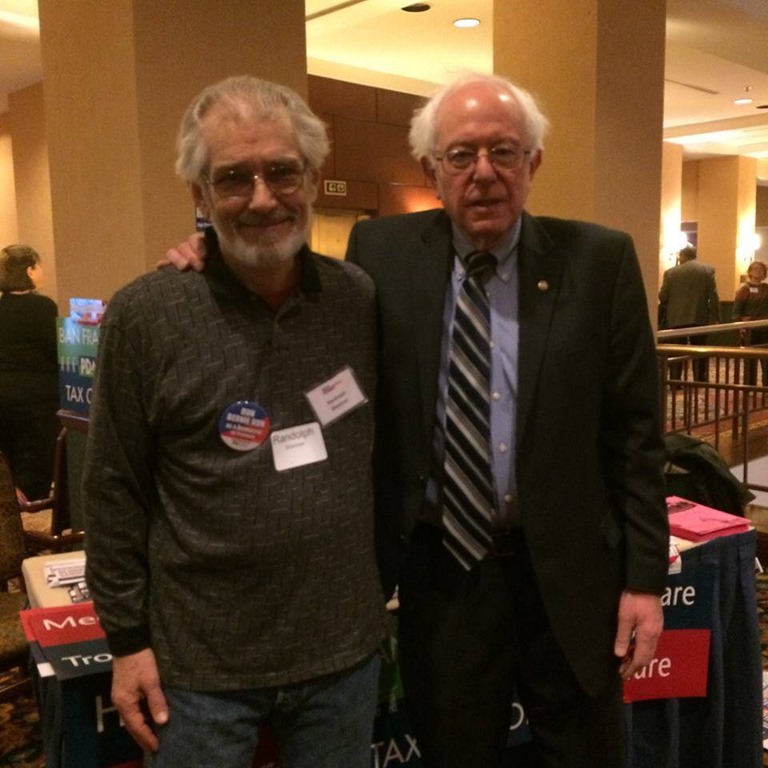
randy-bernie

By J.D. Prose

Beaver County Times

July 13, 2016 – As a member of the Progressive Democrats of America, New Brighton resident Randy Shannon was one of those who wanted self-described democratic socialist U.S. Sen. Bernie Sanders to run for president.

With Sanders, of Vermont, conceding Tuesday that Hillary Clinton will be the Democratic presidential nominee, the dream of a Sanders presidency is over, but Shannon, who was elected a Sanders delegate from the 12th Congressional District, was not too upset.

“I’m pretty satisfied with the progress that’s been made,” he said, pointing to issues such as expanding Medicare and Medicaid, protecting Social Security and replacing free trade deals with fair trade that he said would have gone ignored if not for Sanders.

Sanders, Shannon said, also forced the Democratic Party back to representing interests of regular Americans. “That’s what Sanders was running against,” he said, “the corporate takeover of the Democratic Party.”

Beaver Falls resident Linwood Alford stood behind Sanders with other supporters during an address on labor issues before a Pittsburgh rally in March during the primary and ran unsuccessfully to be a Sanders delegate.

Alford was happy about the endorsement. “We don’t want Trump in there so you know that was going to happen,” he said.

Sanders spotlighted issues that “have to be dealt with,” such as mass incarceration and raising the minimum wage, Alford said. “They’re part of the problem that’s going on in America,” he said.

Coleman Leggett, a 22-year-old Florida native now working as an organizer in Allegheny County for the Clinton campaign, was initially a Sanders supporter up until a few months ago.

Leggett said the supposed political divide between Clinton and Sanders has been greatly exaggerated. “More or less, Sen. Sanders and Hillary Clinton have more in common than people give them credit for,” he said.

Diehard Sanders supporters, some of whom have pledged never to vote for Clinton, should take solace in a Democratic campaign much more in touch with their views than presumptive Republican nominee Donald Trump, Leggett said.

“This is the most progressive platform and the most progressive campaign the Democrats have seen in recent years,” Leggett said.

Continue reading Bernie Sanders Supporters Say He Changed the Campaign, Prepare to Back Clinton

Aliquippa Crime: Perception Isn’t Always Reality


By Kristen Doerschner

kdoerschner@timesonline.com

    ALIQUIPPA — When District Attorney Anthony Berosh speaks to community groups throughout Beaver County, he poses a question to them: How many homicides do you think Aliquippa had last year?

      The estimates people typically give are astoundingly high, he said, often ranging from 20 to as high as 40.

      In reality, the numbers aren’t even remotely close to that high. There was one homicide in the city in 2013, two in 2012 and none in 2011.

      Berosh said when he tells people the actual numbers, they are “flabbergasted.”

      Certain factors within a community tend to correlate to higher crime statistics. Berosh said areas of dense population, a higher proportion of lower-income residents, a large number of rental properties and a large number of residents under the age of 25 tend to have more crime.

      Statistics do show the instances of violent crime in Aliquippa have been on a downward trend over the past decade.

      “You can’t deny that crime occurs in Aliquippa. You can’t deny that crime occurs in any of our communities,” Berosh said.

      The problem is the perception many people have regarding that crime.

      Berosh is quick to point out the perception problem isn’t Aliquippa’s problem.

      “The problem we have as a Beaver County community is the perception we have of Aliquippa,” he said. “They don’t have that problem of perception. We do.”

      Residents and community leaders in the city are frustrated by the view so many people seem to have.

      Herb Bailey moved to Aliquippa from Nashville, Tenn., nearly two years ago to run the ministry at Uncommon Grounds, a popular coffee shop on Franklin Avenue. He quickly found the city to be an inviting place that he made home and moved his family to Franklin Avenue.

      He said he has no hesitation about living in the city or letting his teenage daughters walk through town on their own. He doesn’t view the city as a dangerous place.

      But Bailey learned in short order how others view his new home.

      He said his daughters — who have an interest in art and attend Lincoln Park Performing Arts Charter School in Midland — would invite friends to visit, but their parents were afraid to let their children go to Aliquippa.

      Slowly that is changing, and more parents are allowing their children to visit, he said.

      Continue reading Aliquippa Crime: Perception Isn’t Always Reality

      Hard-Pressed Rust Belt Cities Go Green to Aid Urban Revival

      A community farm in Detroit, which has been a leader in green urban renewal.

      Gary, Indiana is joining Detroit and other fading U.S. industrial centers in an effort to turn abandoned neighborhoods and factory sites into gardens, parks, and forests. In addition to the environmental benefits, these greening initiatives may help catalyze an economic recovery.

      By Winifred Bird

      Beaver County Blue via Environment 360 Yale.edu

      May 31, 2016 – Depending on how you look at it, Gary, Indiana is facing either the greatest crisis in its 110-year history, or the greatest opportunity. The once-prosperous center of steel production has lost more than half its residents in the past 50 years. Just blocks from city hall, streets are so full of crumbling, burned-out houses and lush weeds that they more closely resemble the nuclear ghost town of Pripyat, near Chernobyl, than Chicago’s glitzy downtown an hour to the northwest. Air, water, and soil pollution are severe.

      Yet in the midst of this, Gary has quantities of open space that more prosperous cities can only dream of, and sits on a stretch of lakeshore where plant biodiversity rivals Yellowstone National Park. Now, the big question for Gary, and for dozens of other shrinking cities across the United States’ Rust Belt — which collectively have lost more than a third of their population since the middle of the 20th century — is how to turn this situation to their advantage.

      The answer that is beginning to emerge in Gary and other cities of the Rust Belt — which stretches across the upper Northeast through to the Great Lakes and industrial Midwest — is urban greening on a large scale. The idea is to turn scrubby, trash-strewn vacant lots into vegetable gardens, tree farms, stormwater management parks, and pocket prairies that make neighborhoods both more livable and more sustainable.

      These types of initiatives have been evolving at the grassroots level for decades in places like Detroit and Buffalo; now, they are starting to attract significant funding from private investors, non-profits, and government agencies, says Eve Pytel, who is director of strategic priorities at the Delta Institute, a Chicago environmental organization active in Gary and several other Rust Belt cities. “There’s a tremendous interest because some of these things are lower cost than traditional development, but at the same time their implementation will actually make the other land more developable," she said.

      Or, as Joseph van Dyk, Gary’s director of planning and redevelopment, put it, “If you lived next to a vacant house and now all of a sudden you live next to a forest, you’re in better shape.”

      Van Dyk noted that city planning in the U.S. had long been predicated on growth. But, he added, “That’s been turned on its head since the Seventies — Detroit, Cleveland, Youngstown, Flint, Gary have this relatively new problem of, how do you adjust for disinvestment? How do you reallocate your resources and re-plan your cities?”

      Detroit, which has at least 20 square miles of abandoned land, has been a leader in envisioning alternative uses for sites that once would have been targeted for conventional redevelopment. The city has 1,400 or more urban farms and community gardens, a tree-planting plan so ambitious the local press says it “could serve as a model for postindustrial cities worldwide,” and $8.9 million from the U.S. Department of Housing and Urban Development to implement green infrastructure projects and install solar panels on other vacant lots.

      But while demolition itself has added an estimated

      $209 million to the equity of remaining homes in Detroit, Danielle Lewinski, vice president and director of Michigan Initiatives for the Flint-based Center for Community Progress, said hard data on the value of greening projects is more difficult to come by.

      “There’s opportunity in Detroit to see an impact in surrounding property values, and therefore people’s interest in that area,” said Lewinski, who has been involved in land-use planning there. “The key, though, is that it needs to be done in a way that is strategic and links to other attributes that would attract a person to move into a neighborhood. My concern is that green reuse, absent a connection to a broader vision, may not be nearly as successful from an economic value standpoint.”

      In Gary, the broader vision is to concentrate economic development in a number of “nodes,” each of which would be surrounded by leafy corridors of “re-greened” land. The corridors would separate the nodes, helping to give each neighborhood a more distinct identity, as well as bring residents the benefits of open space and serve as pathways for wildlife moving between existing natural areas. A land-use

      plan for preserving Gary’s core green space is already in place, and officials are currently revising the city’s Byzantine zoning regulations to make redevelopment of the nodes easier. Continue reading Hard-Pressed Rust Belt Cities Go Green to Aid Urban Revival