
https://www.weekendreading.net/p/the-trump-regimes-war-on-working
The Trump Regime’s War on Working People: The First 100 Days
Weekend Reading
How Unions are Resisting Authoritarian Attacks on Workers’ Rights—and Why It Matters for Everyone
Apr 28, 2025
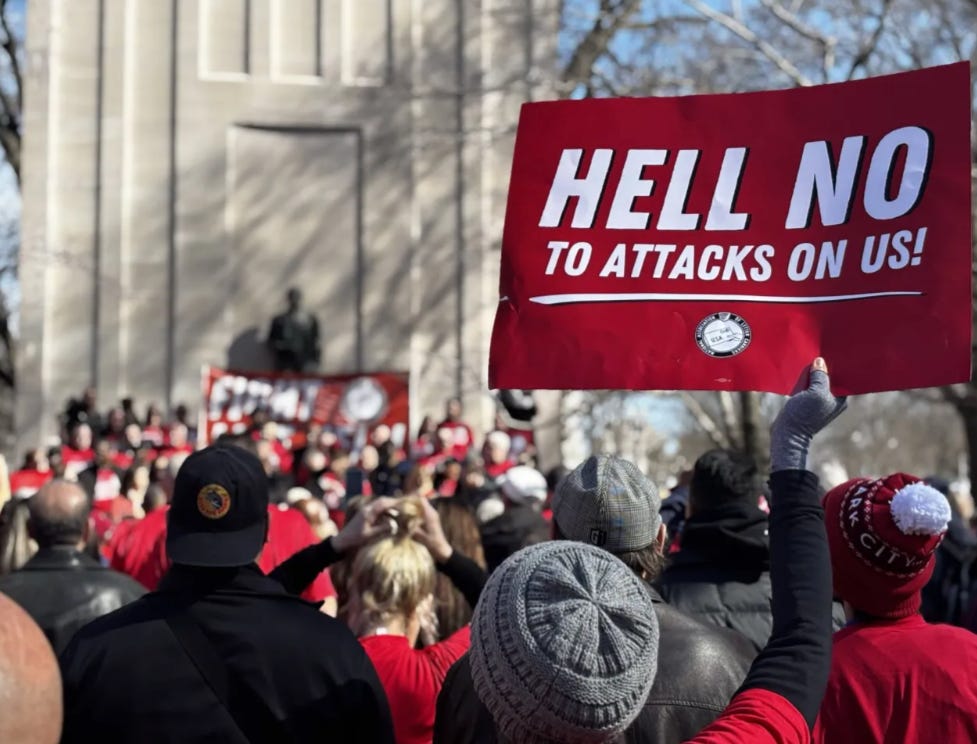
Over the course of the first 100 days, appropriate attention has been paid to Trump’s attacks on the judiciary, law firms, universities, philanthropy, non-profit groups and the media as dangerous in their own right, but more importantly as essential elements of authoritarian consolidation. Yet almost no one has mentioned the attacks on an equally proven constraint on oligarchy and autocracy: unions. Trump and Elon Musk’s destructive ransacking of our government should remind us of what previous generations of Americans understood intuitively: that “we may have democracy, or we may have wealth concentrated in the hands of a few, but we cannot have both,” as Supreme Court Justice Louis Brandeis put it. Like other attacks on civil society, the Trump regime’s attacks on unions and working people do not just injure those directly targeted, but all of us, as the labor movement is one of the most essential bulwarks against authoritarianism.
I’ve covered the indispensable role of unions in creating and protecting democracy and freedom in earlier Weekend Readings (Oligarchs Understand Power. Do We?, As Go Unions, So Goes America, More Than the Weekend: Unions, the Past and the Future of Democracy, and Then they came for the trade unionists).
If we all have a stake in unions as bulwarks against authoritarianism whether we belong to one or not, the same is true because of how unions foster shared prosperity and a healthy society, which I elaborate on here and here. In that regard, it is crucial to recognize the Trump actions as coming from the same playbook as Reagan’s decisive firing of over 11,000 striking air traffic controllers. It was more than punitive—it communicated a clear, aggressive stance against unions nationwide. The immediate aftermath saw corporate America follow Reagan’s lead, significantly increasing anti-union activities and adopting overt union-busting strategies.1 Reagan further entrenched anti-unionism by reshaping the NLRB into a body less protective of labor rights, reversing precedents that had previously safeguarded union activities.2
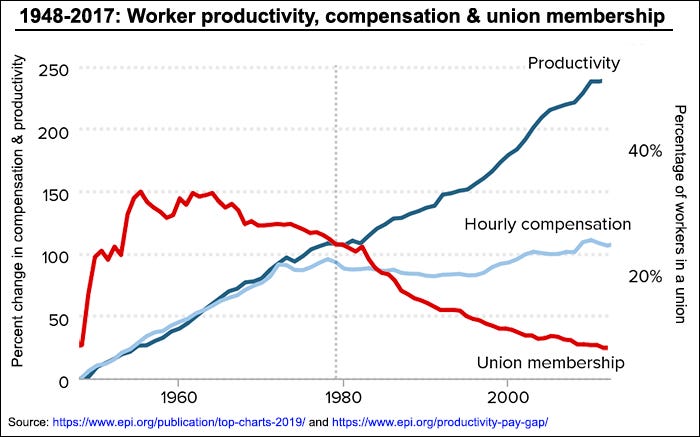
As it did then, today’s federal war on working people comes at a key inflection point. Then it was the rush to globalization, coupled with financialization and deindustrialization. Now it is the imminent transition to artificial intelligence in the workplace. Musk’s firings are providing a new playbook for that transition—fire everyone so as to be able to start from scratch with AI with as little friction from a legacy workforce as possible. And, although not the topic today, it’s important to note here that with respect to DOGE cleaning house to make way for AI, it’s also cleaning house to make way for even more of the government to be privatized—providing a vast market for the tech companies’ AI products and services. Although this future is not certain, it seems to be Musk’s plan: first trash the government, then when the government fails, privatize.
Today, I’ll lay out some of the most egregious actions taken by the Trump regime in the first 100 days to attack unions and working people in both the public and private sectors. Much of this is based on indispensable research by the Economic Policy Institute and its just released 100 Days, 100 Ways Trump Hurt Workers. (For more great reports like this, you can subscribe to EPI here.)
Then I’ll document the robust pushback unions are mounting against the Trump regime’s war on working people in the courts. Unions have also been in the forefront of mobilizing public action, most notably the AFL-CIO’s Department of People Who Work for a Living, which in addition to leading and participating in protests3, has organized town halls across the country.4 AFL-CIO President Liz Shuler declared:
The labor movement is not about to let Trump and an unelected billionaire destroy what we’ve fought for generations to build. We will fight this outrageous attack on our members with every fiber of our collective being.
And, significantly, even sectors mistakenly thought to be pro-Trump like the Building Trades powerfully responded to Trump’s executive order eviscerating collective bargaining for federal workers:
This executive order is an unprecedented assault on worker freedom and a direct attack on those fundamental rights. Americans know that patriotic blue-collar workers built this country, not billionaires. They also know that one of the last best chances to make it to the middle class is collective bargaining. NABTU and our affiliated unions will stand shoulder to shoulder with the entire labor movement to fight this head-on — and we will not back down.
The Trump Regime’s Attacks on Unions and Working People (So Far)
Since retaking power, the Trump regime has launched a systematic assault on unions, collective bargaining, and civil service protections, significantly undermining the rights, wages, working conditions, and job security of working people across the country. In both public and private sectors, Trump’s regime has methodically dismantled crucial institutions and regulatory protections that safeguard employees from unfair practices, discrimination, and unsafe working environments. The sweeping executive orders stripping over one million federal workers of union rights, targeted removals of key independent officials from agencies like the NLRB, FLRA, MSPB, and EEOC, and deliberate weakening of federal mediation and enforcement bodies have created chaos, instability, and a severe deterioration in government services that directly harm American communities.
Trump’s policies have aggressively cut wages, removed safety protections, eliminated essential training and apprenticeship programs, and severely damaged agencies responsible for ensuring workplace equity and non-discrimination. By firing critical personnel, rolling back progressive executive orders, and dismantling entire government agencies, including USAID and the CFPB, the regime has inflicted profound damage on public sector effectiveness and public trust.
Attacks on Unions and Collective Bargaining
- In a sweeping executive order, stripped the collective bargaining and union rights of more than one million federal workers.
- Targeted and disabled the independent federal agency responsible for safeguarding these rights in the private sector. Trump removed Gwynne Wilcox from the National Labor Relations Board (NLRB) for allegedly “unduly disfavoring the interests of employers,” signaling his expectation for the NLRB to align with employers over workers.
- Did the same to Chair Susan Tsui Grundmann of the Federal Labor Relations Authority (FLRA), obstructing public sector collective bargaining adjudications at a time when there is mass upheaval.
- Nominated a partner from Morgan Lewis—a firm actively challenging the NLRB’s constitutionality—as the agency’s General Counsel.
- Attacked other key independent agencies that protect workers’ rights by:
- Firing Merit Systems Protection Board Member Cathy Harris. The MSPB is an independent agency meant to protect the federal merit system which protects federal employees from unfair employment practices from illegitimate partisan destruction.
- Firing Equal Employment Opportunity Commission Commissioners Charlotte Burrows and Jocelyn Samuels. The EEOC is meant to protect American workers from discrimination.
- Reducing the function of the Federal Mediation and Conciliation Service, which provides mediation, training, and facilitation to resolve disagreements between unions and employers.
- Clawed back recent wins for federal workers by:
- Limiting federal workers’ recently ratified collective bargaining agreement.
- Rolling back an executive order requiring federal contractors to recognize existing unions in successor contracts and offer jobs to their predecessors’ employees before hiring new workers.
- Took back an executive order on expanding registered apprenticeships in federal employment or on federally funded projects.
- Delayed the defense of a Biden-era rule that made it harder for employers to misclassify workers as independent contractors. (Misclassification costs many workers about $5,000-$20,000 a year, according to EPI estimates.)
DOGE: Attacks on Civil Service
- Ordered indiscriminate mass firings of probationary employees and large-scale reductions to the federal workforce, which has already created chaos and a damaging deterioration in government services that has directly harmed communities.
- Moved to illegally dismantle entire agencies and fire their employees:
- Effectively shut down U.S. Agency for International Development (USAID) and fired or put on leave its roughly 10,000 workers, with devastating effects on agriculture, human rights, and health initiatives around the globe.
- Attempted to shut down the Consumer Financial Protection Bureau, the only independent agency that ensures consumers are protected in the financial marketplace.
- Effectively shuttered Voice of America, the largest and oldest U.S. international broadcaster.
- Is threatening to dismantle USPS.
- Instituted a hiring freeze for the federal government.
- Declared nonpartisan and career civil servants to be political appointees, making them easier to fire for any reason and replace with loyalists, by reinstating Schedule F and politicizing Career Senior Executive Service officials.
- Sought to humiliate federal workers and degrade their experience at work by:
- Directing all federal agencies to terminate remote work agreements and require full-time in-person work.
- Requiring federal workers to justify their work by submitting a list of five things they accomplished each week.
- Offering deferred resignation to all federal employees.
- Compromised the data and privacy of federal workers, and potentially all Americans, by reportedly allowing DOGE to illegally access federal government systems.
- Attempted to unilaterally control the power of the purse by inserting DOGE in the approval and disbursement of federal contract, grant, and loans payments.
Cutting Workers’ Wages
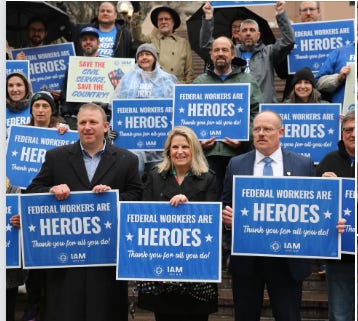
- Reduced the minimum wage for federal contractors (25%-60% cuts).
- Revoked “high road” employer policy that directed federal agencies to prioritize contracting companies committed to paying prevailing wages and providing employee benefits like paid leave and health insurance.
- Eliminated federal training programs for higher-wage skilled trades.
- Rescinded an executive order that gave 390,000 low-wage federal contractors a living wage.
- Rescinded an executive order on the use of compensation history in federal hiring and pay-setting processes.
Worsening Working Conditions
- Compromised the safety of workers in dangerous jobs by:
- Laying off two-thirds of staff at the National Institute for Occupational Safety and Health (NIOSH), effectively shutting down critical divisions focused on the safety of miners, firefighters, and healthcare workers.
- Delaying the enforcement of a rule intended to protect coal miners from exposure to silica.
- Cancelled grants that supported global efforts against forced and child labor which help protect American workers from unfair competition due to imported goods.
- Rolled back guidance on the rights of student-athletes, remedies for victims of labor law violations, electronic monitoring standards, and noncompete agreements.
- Fired Federal Trade Commissioners Alvaro Bedoya and Rebecca Kelly Slaughter.
Dismantling Protections Against Workplace Discrimination
- Fired 90% of the staff at a Department of Labor (DOL) office tasked with enforcing anti-discrimination laws among federal contractors.
- Fired Equal Employment Opportunity Commission Commissioners Charlotte Burrows and Jocelyn Samuels.
- Rescinded Executive Order 11246, which enforced anti-discrimination and equal employment opportunity requirements in federal contracting.
- Issued an executive order that prevents the federal government from factoring in race, sex, gender, or religion in hiring decisions.
- Rolled back an executive order that directed federal agencies that enforce federal laws that prohibit sex discrimination to also prohibit discrimination based on gender identity and sexual orientation.
- Reversed an executive order preventing discrimination against LGBTQI+ individuals and families in several areas, including the education system, child welfare and juvenile justice systems, and the health care system.
- Directed federal agencies to discourage private-sector institutions, such as higher education institutions and nonprofit and philanthropic associations, from voluntarily making efforts to improve hiring or other equitable outcomes along lines of race, gender, disability, or other characteristics.
- Cancelled an executive order directing federal agencies to participate in a government-wide strategic plan to promote DEI and accessibility in hiring and other employment practices for the federal civilian workforce.
- Rescinded an executive order that identified systemic barriers that impede Black Americans’ opportunity to fully participate in educational, economic, and civic life on a level playing field.
Attacks on public education
- Nominated Linda McMahon, a supporter of school vouchers that would allow public school money to be funneled to private schools, to serve as Secretary of Education, where she is overseeing gutting the Department of Education.
- Redirected discretionary grant program spending from the Department of Education away from public schools and toward private and faith-based schools.
- Reduced the Department of Education workforce by half.
- Gutted the National Center for Education Statistics, which is the primary federal entity that collects and reports data on education in the United States.
- Shut down several functions of the Department of Education and sent them to the states.
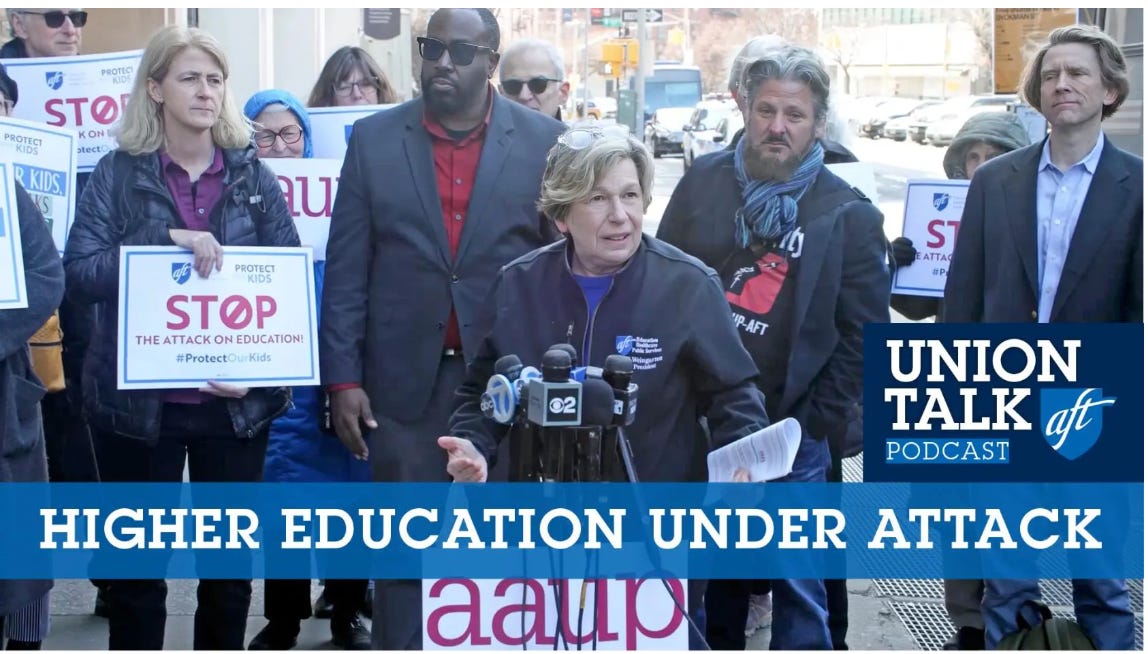
The labor movement’s dynamic leadership is driving critical legal battles against the Trump regime’s relentless attacks on labor protections and collective bargaining. These lawsuits showcase unions’ resilience, positioning them as frontline champions of workplace justice, aggressively confronting executive overreach and safeguarding the foundations of labor rights and democratic governance.
Key Lawsuits Include:
- National Treasury Employees Union v. Trump challenged the executive order that called for agencies to institute large-scale RIFs. The judge ruled that plaintiffs must instead seek relief from the Federal Labor Relations Authority.
- Yet, at the same time the government makes arguments to judges throughout the country that these cases should be brought or adjudicated by the FLRA, MSPB, and OSC, Trump has illegally fired the heads of those agencies without cause, incapacitating their ability to function.
- American Federation Of Government Employees, AFL-CIO v. Office of Personnel Management (not to be confused with other cases with similar captions, below) reinstated probationary employees whom the government had terminated en masse. However, the Supreme Court stepped in to block the district court’s ruling.
- The government pretextually told the probationary employees that they had been fired for poor performance – even though in many cases performance records were purely exemplary – in order to prevent them from obtaining relief.
- In American Federation of Government Employees, AFL-CIO v. Trump, plaintiffs seek relief against Trump’s “Schedule F” executive order.
- American Federation of Government Employees, AFL-CIO v. Ezell challenges the deferred resignation “fork in the road offer.” The judge has so far found that the unions do not have standing to bring these claims.
- The fork in the road offer intersects with Trump’s persistent exercise of impoundment, where he unconstitutionally seizes the power of the purse from Congress. It is not clear if or how the executive will be able to take funds to pay federal employees to resign when Congress has not appropriated funds for that purpose.
- National Treasury Employees Union v. Trump saw the unions succeeding in obtaining a preliminary injunction against the government’s unilateral termination of collective bargaining contracts.
- The freedom to contract is supposed to be a sacred right among conservatives. Yet, when it comes to labor, there is nothing the regime won’t profane.
- In American Federation of Government Employees AFL-CIO v. Noem, plaintiffs seek to reverse the unilateral termination of a collective bargaining agreement with the TSA.
- In National Treasury Employees Union v. Vought, plaintiffs secured a preliminary injunction that ordered the government to reverse the steps it had taken to shutter the CFPB.
- In American Foreign Service Association v. Trump, two unions seek to reverse the destruction of USAID.
- Somerville Public Schools v. Trump seeks to stop a reduction in force at the Department of Education. Another union, with the NAACP, seeks the same result in National Association for the Advancement of Colored People v. The United States of America.
- In Alliance for Retired Americans v. Bessent, union plaintiffs failed to secure an injunction against the DOGE Treasury Team’s abuse and misappropriation of sensitive data.
- In American Federation of Labor and Congress of Industrial Organizations v. Department of Labor, plaintiffs seek similar relief in DOGE’s access and use of Department of Labor data.
- American Federation of Government Employees, v. U.S. Office of Personnel Management covers DOGE data access at OPM.
- American Federation of State, County and Municipal Employees, AFL-CIO v. Social Security Administration does the same for SSA.
Why aren’t some federal employees illegally fired bringing civil suits for damages against those acting illegally such as Musk and company and the administration execs involved.? A probationary employee wrongfully fired on the unsupported grounds of incompetence accompanied by administration officials claiming incompetence publicly should have a valid libel civil suit. Is anybody looking into this?
 Beaver County Blue: Voice of the 17th CD of Progressive Democrats of America