Tag Archives: israel

College Dems Energized, Republicans Seek ‘Safe Spaces’ Amid Consequential Election Season

Photo: Thomas Ross (left) and Austin Wise give a tutorial to students who have never canvassed before on Saturday, Sept. 21, 2024, at Schenley Plaza in Oakland. (Photo by Anastasia Busby/PublicSource)

Democratic organizers say student political engagement has soared since Kamala Harris took over their party’s presidential ticket. Their Republican counterparts report backlash for supporting candidates and views they say are controversial on campuses.


By Spencer Levering

Public Source

October 3, 2024 – Thomas Ross didn’t realize that the political interest on Pitt’s campus was “electric,” as he characterized it, until the semester’s first door-knocking event for Pitt Students for Harris brought 34 volunteers — more than double the number he expected.

“Having 34 volunteers on our first canvass literally blew my mind,” said Ross, a University of Pittsburgh junior studying history and political science. “Everyone that I’ve spoken with has been very excited about the election.” Other Democratic students echoed this, saying they’re seeing new levels of excitement from their peers.

Just up Forbes Avenue, Anthony Cacciato is aiming to make the Carnegie Mellon University College Republicans a space where students can speak freely about their conservative values. Cacciato, president of the chapter, said with election season sparking student’s political intrigue, he’s preparing for a “barrage of negative backlash.”

At colleges around Pittsburgh, political clubs are organizing students to gear up for the upcoming November elections. Club leaders cited Pennsylvania’s influence on national politics as a key reason why they’re trying to mobilize the youth vote as Republican Donald Trump and Democrat Kamala Harris vie for Electoral College votes.

Organizing through socializing

As on-campus political groups look to activate students this fall, many said they are trying to mix political outreach efforts with social events to appeal to young voters.

Cacciato said group outings, such as seeing the new movie “Reagan,” help prevent students from burning out over organizing.

“We’re a space where you can feel comfortable with talking about who you are, but also feel comfortable in knowing that you’re surrounded by friends,” Cacciato said.

The club’s membership increased by 20% this semester, according to Cacciato, because of Pennsylvania’s outsize impact on national politics.

“When you have that knives-edge margin, any little bit of outreach can mean the difference between 10,000 people staying home and not voting and them going out and voting and flipping a precinct, flipping a state House seat, flipping the state, and flipping the country,” Cacciato said.

At Pitt, Sam Podnar, co-president of the Pitt College Democrats, said she creates an environment in which students can meet new people and break out of political apathy.

“We want to let people know that getting involved doesn’t have to be hard, it doesn’t have to be stressful. We just want them to keep showing up,” Podnar said.

She said President Joe Biden’s decision to drop out of the race and endorse Vice President Harris has energized students to get involved in Democratic organizing. General body meetings, weekend canvasses and the club’s presidential debate watch party have all drawn new participants.

“We’ve seen a really, really big surge in membership that just has honestly blown everyone away,” Podnar said.

Avalon Sueiro, president of the CMU College Democrats, said finding a balance between doing work and building a community helps draw students to attend the club’s events. When election day gets nearer, she plans on bringing therapy dogs to campus to calm students’ nerves.

Making it pop

Among Democratic student organizers, leaders are leaning into memes and pop culture as they try to energize college voters. When the semester began, the Instagram pages for Pitt Students for Harris and Pitt College Democrats both had profile photos referencing Charli XCX’s “brat” album. The pop star’s viral summer tweet calling the vice president “brat” spawned a flurry of online memes, which the Harris campaign embraced as an early branding strategy.
John Fetterman Exits the Progressive Coalition

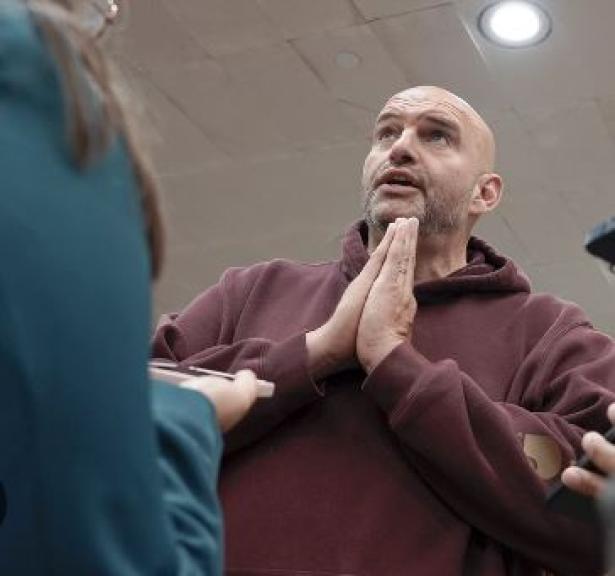
PA Democratic Senator John Fetterman on December 6 defended ‘reasonable’ border talks. This follows his staunch support for Israel’s war in Gaza, which has also befuddled some of his typical allies on the left.,(Photo credit: Politico)

“I’m not a progressive. I’m just a regular Democrat.” Fetterman is in the first year of a six-year term. He has time to repair relations with progressives or sever ties altogether. At this point, the latter is rapidly happening anyway.

By Ross Barkan  

Political Currents

Dec 21, 2023  – Labels in the American political system have always been slippery. Progressive, liberal, leftist, conservative, hard-right, and hard-left can mean very different things to very different audiences. MAGA, perhaps, offers the most clarity—an unabashed supporter of Donald Trump. But even then, within the vast array of Republicans who back Trump, are disparate political views. Some want a national abortion ban. Some, like Trump himself, don’t quite know what they want.

Others strive to shed labels altogether. Many politicians, for somewhat obvious reasons, embrace them when they’re convenient—rounding up votes in primaries, appealing to activists, and raising cash—and abandoning them once they become a burden. The burden, or perceived burden, arrives when a politician has to campaign in a competitive general election. John Fetterman, the famous senator from Pennsylvania, is deep into his rebrand, and seemingly considering how to position himself when he faces voters again in 2028. His campaign proudly promoted a clip from the 2022 Democratic primary when he told a journalist who asked if he’s a progressive that “no, I’m just a Democrat that has always run on what I believe and know to be true.” Interestingly enough, Fetterman’s social media account doesn’t quote this verbatim. Instead, the post above the clip reads “I’m not a progressive, I’m just a regular Democrat.”

It’s a notable approach from a politician who has caught heat, of late, for his hawkish views on Israel. Fetterman, unlike several other Democratic senators, has not called for a ceasefire or denounced the Israeli military for slaughtering thousands of civilians in Gaza. As pressure has grown on the Biden administration to do more to curb Benjamin Netanyahu’s military ambitions, Fetterman’s rhetoric has been mostly indistinguishable from Mike Johnson or any other conservative Republican. His simultaneous embrace of tougher immigration laws has led NBC News to label him a “maverick” for breaking with progressive Democrats.

Calling Fetterman a maverick is understandable, if inaccurate. A maverick politician—few hardly exist anymore, and John McCain barely qualified—will break with their party on major policy questions. Imagine a Republican who loudly supports abortion rights or a Democrat who denounced the first or second impeachment of Trump. Strengthening the border doesn’t count; Democrats themselves have a range of views on immigration and Biden himself has pushed for more border fencing of late. Fetterman, unlike Trump, has not said immigrants are poisoning the blood of America. That would be one way, in a far darker manner, to become a maverick. And defending Israel at all costs certainly doesn’t qualify. The Democratic Party, these days, might be less hawkish on Israel than the GOP, but staunch Zionists occupy all the leadership posts. There is no daylight between Fetterman and Hakeem Jeffries, the House minority leader, or Chuck Schumer, the Senate majority leader, when it comes to Israel.

But Fetterman is punching left. There’s nothing new to this—see Sister Souljah—and Fetterman might even be earnest. His staff has certainly argued his views on Israel are decades-old, solidified in graduate school. What is more obvious, and helpfully collated on X, is that Fetterman used to happily identify as a progressive. He called himself one in 2016, 2018, and 2020. He inched away from the label in 2022, when he became the frontrunner in the Democratic primary for Senate, but never disavowed the movement of left-leaning activists and organizations that backed him earlier in his career. Fetterman ran unsuccessfully for the Senate in 2016 as a Bernie Sanders supporter and remained close to Sanders when he was elected lieutenant governor in 2018. He benefited from Sanders’ enormous network of online donors in all of his statewide campaigns. He took the Vermont senator’s endorsement multiple times and championed key planks of his platform: a $15 federal minimum wage, Medicare for All, and new wealth taxes. He never identified as a socialist or embraced the more confrontational flavor of leftist politics favored by the Squad, but he was, undeniably, a member of his party’s progressive wing.

It would have been plausible for Fetterman to back a higher minimum wage without calling himself a progressive. “I just want people to make more money and have cheap healthcare” would have been enough. “It’s common-sense,” he might have said, to “make the wealthy pay their fair share. There’s nothing progressive or liberal about that. It’s how we should run a country.” But that would have been less exciting to the donors and activists who were going to power Fetterman’s early campaigns. Fetterman wanted to raise cash and he wanted to win. Hence, the Sanders associations were useful. When Dr. Oz, in the 2022 general election, tried to scare moderate Democrats away, the pivot began. He hasn’t looked back.

If Fetterman were being honest, he could simply declare he is no longer a progressive. He could say he used to be one in 2016 and 2018 and 2020 but he feels differently now. He doesn’t like how progressives talk about Israel or the border or some other hot button issue that might matter to a cross-pressured Pennsylvanian and he’s decided he’s going to operate separately from them. He could say he used to believe in Bernie Sanders and now he’s less sure. But doing that would permanently alienate the activist infrastructure that lifted him to prominence in the first place. Fetterman probably believes this is the safer route: to state, against all available evidence, he was never a progressive. This is dishonest and, in the long run, may not even be good politics. It’s not like Trump, when he was first running for president, ever sought to hide that he used to be a Democrat or pal around with the Clintons. If anything, he used his unscrupulousness to his advantage, boasting about how easy it was for him, as a well-heeled donor, to buy Democrats off. Fetterman needn’t be so venal, but he could acknowledge the past and point the way forward.

Politically, all of this can only matter so much. Fetterman is in the first year of a six-year term. He has time to repair relations with progressives or sever ties altogether. At this point, the latter is rapidly happening anyway. For the Pennsylvania activist class, Fetterman is increasingly persona non grata. Since he also needs to appeal to centrists and Israel-supporting Jews in the Philadelphia and Pittsburgh metropolitan areas, he might not care at all. If he does go down this path, though, he’ll have to find a new way to raise cash and wrangle volunteers. There are many young people who showed up to canvass for Fetterman 2022 that will not bother for Fetterman 2028. They’ll have long memories—and other heroes by then.

[Ross Barkan is a contributing writer to the New York Times Magazine. His reporting and essays have appeared in New York Magazine, the Nation, and elsewhere. He is the author of three books, including the novel The Night Burns Bright.]