Defend Our Voting Rights!

BUSES FROM BEAVER TO HARRISBURG on July 24

By Tina Shannon

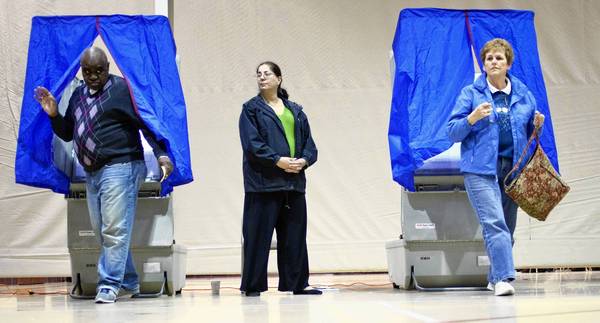
At time when we need to increase the number of people voting, our State legislature has passed a law that will turn voters away from the polls.

Although there are no cases of voter fraud in PA, the Republican controlled legislature is requiring a picture ID to vote. This is part of a nation-wide Republican strategy to reduce the vote in order to defeat Obama.

John Jordan from the Pennsylvania NAACP will be in Beaver County on July 11th to explain the Voter Suppression Law, along with details of the rally and petition for injunction. Please join us for this important public meeting.

Public Meeting
John Jordan

PA NAACP Director of Civic Engagement

July 11th at 7:00 PM

USW Local 8183

1445 Market St, Bridgewater

Sponsored by a coalition of labor, civil rights, and community organizations

In a recently speech Republican Representative Mike Turzai said: “Voter ID, which is gonna allow Governor Romney to win the state of Pennsylvania, done.”

According to the Philadelphia Inquirer: “More than 758,000 registered voters in Pennsylvania do not have photo identification cards from the state Transportation Department, putting their voting rights at risk in the November election, according to data released Tuesday by state election officials.”

The NAACP, ACLU & League of Women Voters have petitioned the Commonwealth Court for an injunction to stop implementation of the Voter ID Law. This will give their lawsuit time to make it to court to see if this law is constitutional. It would be a travesty to allow this law to decide the Presidential election only to later have it ruled invalid. 

A rally will be held at 1:00 PM on the steps of the Capitol in Harrisburg on July 24th, the day before the Court holds the hearing on the petition.

Continue reading Defend Our Voting Rights!

Oppose the GOP Attack on Voting Rights!

Links to Flyer below

Full Text of NAACP Letter, click HERE

PDF File of this Flyer, click HERE

Civic Groups Urge Corbett to Delay Voter Restriction Law

Saturday, July 7, 2012
Civic groups urge delay in

Pennsylvania’s voter-ID law
By Bob Warner
Inquirer Staff Writer READER FEEDBACK

Pa. says 758,000-plus voters lack PennDOT photo ID
 
Groups appeal for delay on voter ID; Corbett refuses
 
Voters without PennDot ID: 9.2%
 
Voter ID law may hit more in Pennsylvania
Spurred by the disclosure that 758,000 registered voters do not have Pennsylvania drivers’ licenses, six civic groups called on Gov. Corbett on Friday to delay implementation of a new voter-ID requirement for at least a year. The administration immediately rejected the request.
“Our goal since the law was signed is to reach out to all voters to make them aware of the law so all eligible voters are able to get ID if needed and cast ballots in November,” said Ron Ruman, a spokesman for the Pennsylvania Department of State, in charge of the state election machinery.
Ruman said Corbett did not have authority on his own to delay the photo-ID requirement and would not ask the Republican-controlled legislature to change the law, passed and signed by the governor in March.  “The administration supports the law,” Ruman wrote in an e-mail, “because it protects the integrity of every vote and voter by giving Pennsylvania for the first time a reliable way to verify the identity of each voter at the polls. This will help detect and deter any illegal voting.”

Continue reading Civic Groups Urge Corbett to Delay Voter Restriction Law

Needed: Worker Organizing and Education

There is No Substitute for Organizing:

How Unions Might Help Win Future Battles

By Bill Fletcher, Jr. and Jane McAlevey
Beaver County Blue via The Nation

July 3, 2012 – Before Wisconsinites voted down the attempt to recall Governor Scott Walker, and certainly since, principled progressives inside and outside of unions have disagreed on whether or not the campaign should have happened. In fact, between the two of us, we don’t fully agree about whether or not the recall was the correct tactic.

But with the defeat in the rear view mirror, two clear lessons can be drawn from Wisconsin: unions need to reinvest in mass participatory education—sometimes called internal organizing in union lingo; and, unions need to stop focusing on “collective bargaining” and actually kick down the walls separating workplace and non-workplace issues by going all-out on the broader agenda of the working class and the poor.

Once you get past the reports that Walker outspent the Wisconsin workers by 7:1, the next most startling fact is that 38 percent of union households voted to keep the anti-worker Governor. That’s slightly more than one third, and had the pro-recall forces held the union households, Walker would no longer be Governor.

With major media outlets drubbing us with the 38 percent number, the liberal political elite seem stuck on a rhetorical question: why do poor people and workers vote against their material self-interest? Actually, in our own experience, the poor and working class don’t vote against their self-interest—but there’s a precondition: we have to create the space for ordinary people to better understand what their self-interest is, and how it connects with hundreds of millions in the US and globally.

Continue reading Needed: Worker Organizing and Education

‘Fracking’: Myth Meets Realties


A natural gas rig side by side with homes in Washington County, PA | B. Mark Schmerling

Fractured Lives

Detritus of Pennsylvania’s Shale Gas Boom

By Edward Humes

Progressive America Rising via Sierra Club

The supple hills of southwestern Pennsylvania, once known for their grassy woodlands, red barns, and one-stoplight villages, bristle with new landmarks these days: drilling rigs, dark green condensate tanks, fields of iron conduits lumped with hissing valves, and long, flat rectangles carved into hilltops like overgrown swimming pools, brimming with umber wastewater.

Tall metal methane flaring stacks periodically fill the night with fiery glares and jet engine roars. Roadbeds of crushed rock, guarded by No Trespassing signs, lie like fresh sutures across hayfields, deer trails, and backyards, admitting fleets of tanker trucks to the wellheads of America’s latest energy revolution.

 
This is the new face of Washington County, the leading edge of the nation’s breakneck shale gas boom. Natural gas boosters, President Barack Obama among them, have lauded it as a must-have, 100-year supply of clean, cheap energy that we cannot afford to pass up. However, recent data suggest that supplies of shale gas may last for only 11 years and that the extreme measures needed to recover it may make it a dirtier fuel than coal. But that hasn’t slowed the dramatic transformation of gas-rich regions from rural Pennsylvania to urban Fort Worth, Texas.

Driving this juggernaut is the amalgam of industrial technologies collectively known as "hydraulic fracturing," or "fracking," which releases the gases (the main component of which is methane) hidden deep within layers of ancient, splintery shale. With five major shale "plays" concentrated in eight states, and more under development, America has been transformed from a net importer of natural gas into a potential exporter.

Perched atop the 7,000-foot-deep Marcellus Shale formation, which undergirds most of Appalachia, Washington County not only boasts enormous reserves of methane but also leads the state in producing far more frack-worthy "wet gas" products: propane, butane, ethane, and other valuable chemicals that can mean the difference between a money pit and a money gusher. Although central Pennsylvania has more wells, this wet gas makes Washington County, in industry parlance, a "honeypot."

The lure of million-dollar payouts has led many farmers, homeowners, school boards, and town commissions to lease out their subterranean energy wealth. Royalty payments on leases so far have topped half a billion dollars statewide–money that, for some, is literally saving the farm.

"An unprecedented economic impact," Matt Pitzarella has called it. He’s spokesman for the leading driller in this part of the state, Texas-based Range Resources, which in 2004 fracked the first successful Marcellus Shale wells–at the time a shot in the dark and now believed to be tapping the second-largest natural gas field in the world. Pitzarella ticks off stories of poor families who hit the gas-lease lottery and are now able to afford college tuition, new cars, and home makeovers.

But unlocking half-billion-year-old hydrocarbon deposits carries a price, and not everyone shares in the bonanza. For every new shale well, 4 million to 8 million gallons of water, laced with potentially poisonous chemicals, are pumped into the ground under explosive pressure–a violent geological assault. And once unleashed, the gas requires a vast industrial architecture to be processed and moved from the wells to the world. Imagine the pipes, compressors, ponds, pits, refineries, and meters each shale well in Pennsylvania demands, planted next to horse farms, cornfields, houses, and schools. Then multiply by 5,000.

Continue reading ‘Fracking’: Myth Meets Realties

GOP Rep Lets the Cat Out of the Bag

Pennsylvania Republican: Voter ID Laws Are

‘Gonna Allow Governor Romney To Win’


By Annie-Rose Strasser
ThinkProgress.org

June 25, 2012 – This weekend, Pennsylvania Republican House Leader Mike Turzai (R-PA) finally admitted what so many have speculated: Voter identification efforts are meant to suppress Democratic votes in this year’s election.

At the Republican State Committee meeting, Turzai took the stage and let slip the truth about why Republicans are so insistent on voter identification efforts — it will win Romney the election, he said:

Continue reading GOP Rep Lets the Cat Out of the Bag

Free medicines for all starting in October 2012

Free medicines for all from October

Kounteya Sinha, TNN Jun 23, 2012, 01.51AM IST

NEW DELHI: India’s ambitious policy to provide free medicines to all patients attending a government health facility across the country will be rolled out from October.

Strongly backed by Prime Minister Manmohan Singh himself, the free-medicines-for-all scheme — being referred to as the “real game changer” — has received its first financial allocation of Rs 100 crore from the Planning Commission for 2012-13.

The entire programme, however, is estimated to cost Rs 28,560 crore over the 12th five year plan.

At present, the public sector provides healthcare to 22% of the country’s population.

The ministry estimates that this will increase to 52% by 2017 once medicines are provided for free from 1.6 lakh sub-centres, 23,000 primary health centres, 5,000 community health centres and 640 district hospitals.

The ministry has sent the National List of Essential Medicines, 2011, (348 drugs which includes anti-AIDS, analgesics, anti-ulcers, anti psychotic, sedatives, anesthetic agents, lipid lowering agents, steroids and anti platelet drugs) to all the states to use as reference.

Continue reading Free medicines for all starting in October 2012

Confronting a Future of Lost Decades

by Randy Shannon

Two years ago we showed that the current crisis was unavoidable as long as the banks controlled state power in the major industrial countries. In “Japan’s Lost Decades: the US Sequel” the political and economic way out of this crisis was set forth on this blog. This agenda is still relevant and waiting to be fulfilled by popular action.

The US economy has begun a new cyclical downturn. This is the first recession since 1937 that has occurred before a full recovery. As in 1937, part of the reason for this second dip is the growth of political power among the reactionary bankers and the Republican Party. This group has thrown roadblocks in the way of real economic stimulus.

The article below shows that the political leaders and the financial media finally are face to face with the reality that the current course is unsustainable. The central banks cannot break out of their narrow mind-set. Their only solution is to print money and lower interest rates. As bankers, they see the solution as saving the banks at the cost of a stable and prosperous society.

We must move forward with nationalizing the zombie banks, imposing a carbon tax and a financial speculation tax, investing in a green new deal to rebuild and solarize the infrastructure, end the wars and retool the military industrial complex to build mass transportation.

Every day that passes without action is lost. This results in lost lives, lost hopes, and a lost future generation. The graphic of construction employment shows the gravity of the situation.

Central Banks Commit to Ease as Threat of Lost Decades Rises

By Simon Kennedy and Rich Miller
Jun 25, 2012 11:11 AM ET

Central bankers are finding it easier to support their economies than to spur expansion as the prospect of Japanese-like lost decades looms across the developed world.

Continue reading Confronting a Future of Lost Decades

If Obama’s Health Plan Goes Down, Then What?

In Health Care, Give the People What They Want: Medicare for All

By Robert Scheer
Common Dreams

June 21, 2012 – The nutty thing about the health care debate that will play a prominent role in the next election is that most Americans want pretty much the same outcome: to control costs without sacrificing quality. And that’s not what either major-party candidate is offering.

Few think that Obamacare, a Romneycare descendant that contains the same kind of individual mandate the then-governor of Massachusetts signed into law, will get us to that desired goal. Nor would Mitt Romney, who has been reborn as a celebrant of the old, pre-Obama system with a few nips and tucks.

As the nation awaits a Supreme Court ruling on the constitutionality of the Obama health care approach, a new Associated Press-GfK poll suggests that the vast majority of Americans want Congress to come up with a better plan. They know that the current system is unsustainable. Only a third of those polled favored the law President Barack Obama signed, but according to the AP, “whatever people think of the law, they don’t want a Supreme Court ruling against it to be the last word on health care reform.” The article continued, “More than three-fourths of Americans want their political leaders to undertake a new effort, rather than leave the health care system alone if the court rules against the law, according to the poll.”

Continue reading If Obama’s Health Plan Goes Down, Then What?

General Order Number 3

U.S. Army Major General Gordon Granger
Abraham Lincoln, author of the Emancipation Proclamation

“The people of Texas are informed that in accordance with a Proclamation from the Executive of the United States, all slaves are free. This involves an absolute equality of rights and rights of property between former masters and slaves, and the connection heretofore existing between them becomes that between employer and free laborer.”

Major General Gordon Granger, United States Army

June 19, 1865, Galveston, Texas