John F. Kennedy’s Vision of Peace

John F. Kennedy’s Vision of Peace

By Robert F. Kennedy Jr., Rolling Stone

21 November 13


On the 50th anniversary of JFK’s death, his nephew recalls the fallen president’s attempts to halt the war machine.

john-f-kennedy

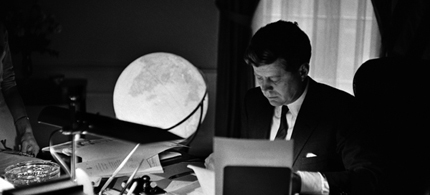
n November 22nd, 1963, my uncle, president John F. Kennedy, went to Dallas intending to condemn as “nonsense” the right-wing notion that “peace is a sign of weakness.” He meant to argue that the best way to demonstrate American strength was not by using destructive weapons and threats but by being a nation that “practices what it preaches about equal rights and social justice,” striving toward peace instead of “aggressive ambitions.” Despite the Cold War rhetoric of his campaign, JFK’s greatest ambition as president was to break the militaristic ideology that has dominated our country since World War II. He told his close friend Ben Bradlee that he wanted the epitaph “He kept the peace,” and said to another friend, William Walton, “I am almost a ‘peace at any price’ president.” Hugh Sidey, a journalist and friend, wrote that the governing aspect of JFK’s leadership was “a total revulsion” of war. Nevertheless, as James W. Douglass argues in his book JFK and the Unspeakable: Why He Died and Why It Matters, JFK’s presidency would be a continuous struggle with his own military and intelligence agencies, which engaged in incessant schemes to trap him into escalating the Cold War into a hot one. His first major confrontation with the Pentagon, the Bay of Pigs catastrophe, came only three months into his presidency and would set the course for the next 1,000 days.
JFK’s predecessor, Dwight D. Eisenhower, had finalized support on March 17th, 1960, for a Cuban invasion by anti-Castro insurgents, but the wily general left its execution to the incoming Kennedy team. From the start, JFK recoiled at the caper’s stench, as CIA Director Allen Dulles has acknowledged, demanding assurances from CIA and Pentagon brass that there was no chance of failure and that there would be no need for U.S. military involvement. Dulles and the generals knowingly lied and gave him those guarantees.

When the invasion failed, JFK refused to order airstrikes against Castro. Realizing he had been drawn into a trap, he told his top aides, David Powers and Kenneth O’Donnell, “They were sure I’d give in to them and send the go-ahead order to the [U.S. Navy aircraft carrier] Essex. They couldn’t believe that a new president like me wouldn’t panic and try to save his own face. Well, they had me figured all wrong.” JFK was realizing that the CIA posed a monumental threat to American democracy. As the brigade faltered, he told Arthur Schlesinger that he wanted to “splinter the CIA into a thousand pieces and scatter it to the winds.”

The next confrontation with the defense and intelligence establishments had already begun as JFK resisted pressure from Eisenhower, the Joint Chiefs and the CIA to prop up the CIA’s puppet government in Laos against the communist Pathet Lao guerrillas. The military wanted 140,000 ground troops, with some officials advocating for nuclear weapons. “If it hadn’t been for Cuba,” JFK told Schlesinger, “we might be about to intervene in Laos. I might have taken this advice seriously.” JFK instead signed a neutrality agreement the following year and was joined by 13 nations, including the Soviet Union.

Continue reading John F. Kennedy’s Vision of Peace

Important Message from Kentucky

Herald-Leader Editorial

Message from Martin County: What’s good for Eastern Kentucky good for U.S.A.

Eastern Kentucky needs a nation that’s committed to economic justice. What we have is identical in Martin County and the U.S.: Great wealth concentrated in the hands of a few while the middle class is hollowed out and those at the bottom watch their opportunities dwindle along with their hope.

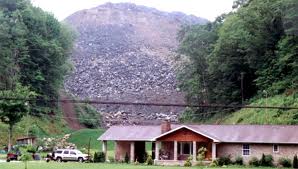
Martin County home
Martin County home

November 21, 2013

It’s always been easy to think of Eastern Kentucky as separate and apart from America’s mainstream.

It was true at the turn of the 20th century when John Fox Jr. wrote wildly popular novels about guileless mountaineers.

It was true in 1963 when Harry Caudill wrote of the region’s brutal exploitation in Night Comes to the Cumberlands, the book that launched a War on Poverty.

And it’s true today when we read of poverty’s stubborn persistence 50 years after Night in Herald-Leader reporter John Cheves’ powerful reporting from Martin County.

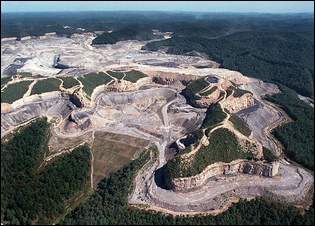
Martiki Mine in Martin County. EPA has loosened restrictions on selenium pollution from mountaintop removal mining, resulting in widespread destruction of fish.

The temptation is to think of this troubled, yet compelling, place as aberrant and unique — The Other America, as Michael Harrington said in the title of his famous 1962 book about poverty in America.

But the notion of Appalachian exceptionalism has never been reality and is more wrong today than ever.

Far from being an outlier, the region, if anything, is a microcosm of this country and the challenges facing all of America.

Any plan for igniting Eastern Kentucky’s moribund economy will have to be built on principles that would work anywhere: Local ownership; support for entrepreneurs; a healthy, educated workforce; healthy land, clean water, good food; towns and parks where people want to visit, live and invest; accountable, honest government; clean energy, and, as Lexington Mayor Jim Gray often says, an authenticity of place.

By the same token, Eastern Kentucky can never pull itself up in a country where the deck is stacked overwhelmingly in favor of the rich and powerful, where Congress won’t raise the minimum wage to make work a rational alternative to disability, or tax the wealthy to support early childhood programs, first-generation college students or the kind of investment in research and infrastructure that built U.S. prosperity and the middle class.

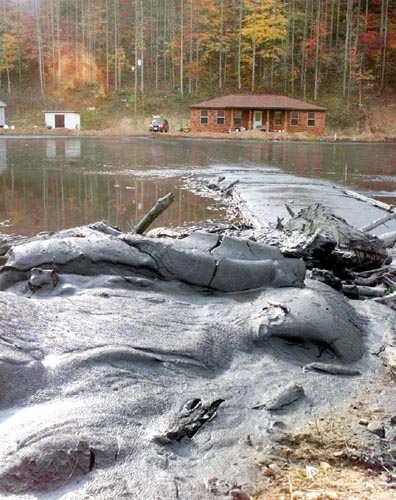
250 million gallons of coal sludge released into Big Sandy Creek block access to a home in Martin County, KY.

Eastern Kentucky needs a nation that’s committed to economic justice. What we have is identical in Martin County and the U.S.: Great wealth concentrated in the hands of a few while the middle class is hollowed out and those at the bottom watch their opportunities dwindle along with their hope.

Another common thread will sound like fighting words in coal’s kingdom. The 21st century’s biggest challenge will be making the transition away from fossil fuels to avert a climate catastrophe without strangling economic opportunity.

Since the 1970s, any prosperity in Martin County, limited though it has been, came from coal. The price has been poisoned water, land and, according to a growing body of science, sickened people.

Even without the climate crisis, though, Eastern Kentucky coal has become noncompetitive in the marketplace. Hardly anyone relishes change, but when change is inevitable, the smart look for opportunities.

Corruption, as endemic to Eastern Kentucky as ginseng and gospel hymns, is far from unique to the region. Somehow, though, our despair grows the closer the corruption.

An impoverished place like Martin County steers college scholarships to the children of public school administrators instead of poor kids and seems just plain hopeless. Meanwhile, we tolerate a U.S. tax code that’s a collection of favors for the special interests that finance political candidates.

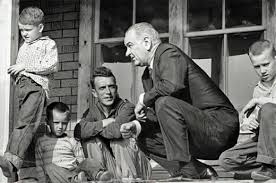
Soon after President Lyndon B. Johnson declared the "War on Poverty" in 1964, he visited Martin County. He was photographed with the Fletcher family on their front porch.
Soon after President Lyndon B. Johnson declared the “War on Poverty” in 1964, he visited Martin County. He was photographed with the Fletcher family on their front porch.

The fact that the mountains have no corner on corruption does not excuse the plague of grand and petty thievery, cronyism and nepotism.

Eastern Kentucky must clean up its image by eradicating corruption if it is to attract outside private investment or keep its bright young people. Honest competitors will go elsewhere to find a game that’s not fixed.

And, just think, if Eastern Kentucky leads, maybe Congress will take a hint and clean up the tax code.

Social Security: “It’s Values, Not Math”

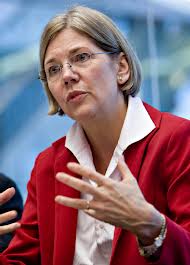
Senator Elizabeth Warren

Elizabeth Warren on Social Security: “It’s Values, Not Math”

November 18, 2013

[Mr./Madame] President, I rise today to talk about the retirement crisis in this country – a crisis that has received far too little attention, and far too little response, from Washington.I spent most of my career studying the economic pressures on middle class families – families who worked hard, who played by the rules, but who still found themselves hanging on by their fingernails. Starting in the 1970s, even as workers became more productive, their wages flattened out, while core expenses, things like housing and health care and sending a kid to college, just kept going up.

Working families didn’t ask for a bailout. They rolled up their sleeves and sent both parents into the workforce. But that meant higher childcare costs, a second car, and higher taxes. So they tightened their belts more, cutting spending wherever they could. Adjusted for inflation, families today spend less than they did a generation ago on food, clothing, furniture, appliances, and other flexible purchases. When that still wasn’t enough to cover rising costs, they took on debt – credit card debt, college debt, debt just to pay for the necessities. As families became increasingly desperate, unscrupulous financial institutions were all too happy to chain them to financial products that got them into even more trouble — products where fine print and legalese covered up the true costs of credit.

These trends are not new, and there have been warning signs for years about what is happening to our middle class. One major consequence of these increasing pressures on working people – a consequence that receives far too little attention – is that the dream of a secure retirement is slowly slipping away.

Continue reading Social Security: “It’s Values, Not Math”

Rep. Rothfus Will Cut Food Stamps

Joseph Stiglitz
November 16, 2013
The New York Times- Opinionator
FARM subsidies were much more sensible when they began eight decades ago, in 1933, at a time when more than 40 percent of Americans lived in rural areas. Farm incomes had fallen by about a half in the first three years of the Great Depression. In that context, the subsidies were an anti-poverty program. Now, though, the farm subsidies serve a quite different purpose.

Food Stamps

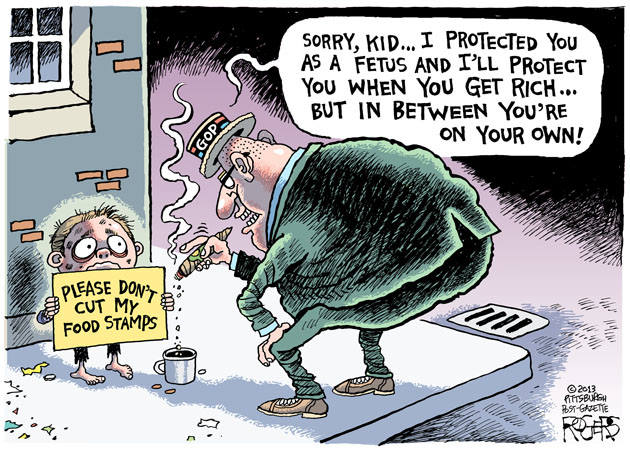
The proposed House Republicans’ farm bill takes real money, money that is necessary for bare survival, from the poorest Americans, and gives it to a small group of the undeserving rich, in return for their campaign contributions and political support.

American food policy has long been rife with head-scratching illogic. We spend billions every year on farm subsidies, many of which help wealthy commercial operations to plant more crops than we need. The glut depresses world crop prices, harming farmers in developing countries. Meanwhile, millions of Americans live tenuously close to hunger, which is barely kept at bay by a food stamp program that gives most beneficiaries just a little more than $4 a day.

So it’s almost too absurd to believe that House Republicans are asking for a farm bill that would make all of these problems worse. For the putative purpose of balancing the country’s books, the measures that the House Republican caucus is pushing for in negotiations with the Senate, as Congress attempts to pass a long-stalled extension of the farm bill, would cut back the meager aid to our country’s most vulnerable and use the proceeds to continue fattening up a small number of wealthy American farmers.

The House has proposed cutting food stamp benefits by $40 billion over 10 years — that’s on top of $5 billion in cuts that already came into effect this month with the expiration of increases to the food stamp program that were included in the 2009 stimulus law. Meanwhile, House Republicans appear satisfied to allow farm subsidies, which totaled some $14.9 billion last year, to continue apace. Republican proposals would shift government assistance from direct payments — paid at a set rate to farmers every year to encourage them to keep growing particular crops, regardless of market fluctuations — to crop insurance premium subsidies. But this is unlikely to be any cheaper. Worse, unlike direct payments, the insurance premium subsidies carry no income limit for the farmers who would receive this form of largess.

The proposal is a perfect example of how growing inequality has been fed by what economists call rent-seeking. As small numbers of Americans have grown extremely wealthy, their political power has also ballooned to a disproportionate size. Small, powerful interests — in this case, wealthy commercial farmers — help create market-skewing public policies that benefit only themselves, appropriating a larger slice of the nation’s economic pie. Their larger slice means everyone else gets a smaller one — the pie doesn’t get any bigger — though the rent-seekers are usually adept at taking little enough from individual Americans that they are hardly aware of the loss. While the money that they’ve picked from each individual American’s pocket is small, the aggregate is huge for the rent-seeker. And this in turn deepens inequality.

Continue reading Rep. Rothfus Will Cut Food Stamps

TPP Trade Deal Puts U.S. Workers’ Rights and Jobs at Risk


A dangerous deal for labor, the Trans Pacific Partnership free trade agreement, gained a key endorsement from the NYTimes on the eve of VP Biden’s trip to China. Ed Schultz and Leo Gerard discuss the effect.

"A US-led trade deal is currently being negotiated that could increase the price of prescription drugs, weaken financial regulations and even allow partner countries to challenge American laws. But few know its substance."

Enroll in Obamacare at Local Drugstores

Tue Nov 05, 2013 at 07:09 AM PST

I bet you didn’t know this : Most Americans will get Obamacare at their drugstore.

by Pluto

cvsMonths ago, the major drugstore chains of the US announced that they were joining with the Federal Government to help their customers around the nation to get signed up for “ObamaScare.” Computer shopping isn’t ubiquitous — and it is merely ONE approach to retail sales. That’s why the Federal Government set up bricks-and-mortar PPACA stores in every neighborhood in America.

I hopped into Walgreens last night and noticed a sign outside offering to get me ACA health insurance. And why wouldn’t they? After all, they receive a commission for doing so, which costs the customer nothing whatsoever. Sounds like a a win-win to me.

riteaidWalgreens offers customers a chance to speak to licensed insurance advisors to discuss health insurance plans sold through the state HIXs. They also have their own private online health insurance portal contracted by GoHealth. According their website, tax credits and subsidies are issued there, as well.

Rite Aid announced that it will initially station independent, licensed insurance agents in nearly 2,000 of its 4,600 stores to help uninsured customers sign up for a health insurance plan for the entire six-month enrollment period. The agents will work one-on-one with customers to help them make insurance choices.

Like Rite Aid and Walgreens, CVS Pharmacy is offering Affordable Care Act information in its 7,500 stores and 650 MinuteClinics; it has launched an informational web site, as well. CVS also plans to have health insurance experts answer customer questions in various stores nationwide during the enrollment period. In a recent press release, CVS notes:

walgreensOur survey results, based on a sample of over 1,000 respondents, found general awareness of the ACA has increased to 74 percent, up from 57 percent as seen in a similar 2011 CVS Caremark survey. But the new survey found that 36 percent of respondents who are likely to enroll in health exchanges need more information and help in evaluating the insurance exchange process. What’s more, perceptions about cost remain the biggest barrier to the likelihood of enrolling and lack of knowledge could prove costly: Only 48 percent of those who are eligible for a subsidy believe that they are.

“We have a tremendous opportunity to help Americans understand the new health care law and how it affects them so consumers receive the coverage that best fits their families,” said Helena Foulkes, Executive Vice President and Chief Health Care Strategy and Marketing Officer of CVS Caremark.

Continue reading Enroll in Obamacare at Local Drugstores

PA Environmental Defense Fund Sues Gov. Corbett

PA Environmental Defense Fund (PEDF) Sues Governor Corbett in Commonwealth Court of PA


Read TEXT of Lawsuit

by Randy Shannon

385650The PEDF has sued the Governor to reverse numerous acts that have gutted the Department of Conservation and Natural Resources. These acts have turned the DCNR into an agency that sells our natural resources to fund other government programs and has practically eliminated the DCNR’s role to protect our natural resources. These acts of the Governor violate the Pennsylvania Constitution. The lawsuit contains eight counts of violation of the constitution and other laws designed to protect the state’s natural resources and seeks relief through a declaratory judgement of the court.

The Commonwealth Court has accepted the suit. On August 20, 2013 the Court denied a request from the Republican Caucuses to intervene in the suit. The Republican Caucuses contended that when gas resources are present all the laws protecting the Commonwealth’s air, water, and land are inoperable. The lawsuit is now in the discovery process.

The gas industry projects that by 2030 there will be 60,000 wells in PA. Presently there are around 3,000 permits. If these projections are accurate, 200,000 acres of land will be cleared for well pads. More land will be cleared for roads, pipelines, and communication systems.

Pennsylvania water resources will lose 240 billion gallons of fresh water forever, as this water will be chemically poisoned and injected over one mile into the Marcellus shale stratum. Approximately 10 billion gallons of radioactive water will be produced at the surface for disposal.

The PEDF is asking for donations from the public to help fund the lawsuit. Go here to make a tax deductible contribution.

In July three newspapers in eastern PA carried news items discussing the case. Below is the item from the Philadelphia Inquirer. No news organization in western PA has covered this story.

Continue reading PA Environmental Defense Fund Sues Gov. Corbett

$61,142 Reward for Text of Secret Trade Agreement

3Wanted

Negotiating Text of the Trans-Pacific Partnership Agreement

$61142 Reward

WikiLeaks: We’ve got a job for you

At this very moment, the Trans-Pacific Partnership agreement (TPP)–a trade agreement that could affect the health and welfare of billions of people worldwide–is being negotiated behind closed doors. While 600 corporate lobbyists have access to the text, the press, the public, and even members of the US Congress are being kept in the dark.

But we don’t have to stand meekly by as corporate cronies decide our futures. Concerned citizens from around the world are pooling together their resources as a reward to WikiLeaks if it makes the negotiating text of the TPP public. Our pledge, as individuals, is to donate this money to WikiLeaks should it leak the document we seek.

As WikiLeaks likes to say, information wants to be free. The negotiating text for the TPP wants to be free. Someone just needs to release it.

1FAQ

1. What is the TPP?

The Trans-Pacific Partnership (TPP) is a multilateral “free trade” agreement for the Asia-Pacific region which some have taken to referring to as “NAFTA on steroids.” The agreement was originally between just three nations–Chile, New Zealand, and Singapore–with a fourth, Brunei, joining shortly after. Today, seven additional countries are in negotiations to join the agreement: Australia, Peru, Vietnam, Malaysia, Mexico, Canada, and the United States. Eventually, every Pacific-rim nation could be included, making it possible for this trade agreement to affect the lives of billions of people.

2. What’s so bad about the TPP?

The TPP negotiations have taken place under an unprecedented shrowd of secrecy, denying all but a very few any input into the terms of the agreement. The chapters that have been leaked are quite disturbing, revealing plans that would threaten public health, the environment, internet freedom, and the general well-being of perhaps billions of people. Here’s a little taste of what the agreement would include: foreign investor protections that would help corporations offshore jobs, powers that allow multinational corporations to challenge domestic regulations before international tribunals, a strengthening of patent and intellectual property rules which would, among other things, raise the price of life-saving medicines in third world countries, and the ability for Wall Street to roll back safeguards meant to restore financial stability worldwide.

Continue reading $61,142 Reward for Text of Secret Trade Agreement

The Top Secret Trade Deal You Need to Know About

Nov 1, 2013 – Secrets… The innocent lives lost in drone wars and the trade deal Washington and big business are trying to hide. From Bill Moyers’ show, ‘Moyers% Company’