
Save the Date: July 16: Michael Moore’s ‘Where to Invade Next’

By Kristen Doerschner
ALIQUIPPA — When District Attorney Anthony Berosh speaks to community groups throughout Beaver County, he poses a question to them: How many homicides do you think Aliquippa had last year?
The estimates people typically give are astoundingly high, he said, often ranging from 20 to as high as 40.
In reality, the numbers aren’t even remotely close to that high. There was one homicide in the city in 2013, two in 2012 and none in 2011.
Berosh said when he tells people the actual numbers, they are “flabbergasted.”
Certain factors within a community tend to correlate to higher crime statistics. Berosh said areas of dense population, a higher proportion of lower-income residents, a large number of rental properties and a large number of residents under the age of 25 tend to have more crime.
Statistics do show the instances of violent crime in Aliquippa have been on a downward trend over the past decade.
“You can’t deny that crime occurs in Aliquippa. You can’t deny that crime occurs in any of our communities,” Berosh said.
The problem is the perception many people have regarding that crime.
Berosh is quick to point out the perception problem isn’t Aliquippa’s problem.
“The problem we have as a Beaver County community is the perception we have of Aliquippa,” he said. “They don’t have that problem of perception. We do.”
Residents and community leaders in the city are frustrated by the view so many people seem to have.
Herb Bailey moved to Aliquippa from Nashville, Tenn., nearly two years ago to run the ministry at Uncommon Grounds, a popular coffee shop on Franklin Avenue. He quickly found the city to be an inviting place that he made home and moved his family to Franklin Avenue.
He said he has no hesitation about living in the city or letting his teenage daughters walk through town on their own. He doesn’t view the city as a dangerous place.
But Bailey learned in short order how others view his new home.
He said his daughters — who have an interest in art and attend Lincoln Park Performing Arts Charter School in Midland — would invite friends to visit, but their parents were afraid to let their children go to Aliquippa.
Slowly that is changing, and more parents are allowing their children to visit, he said.
Continue reading Aliquippa Crime: Perception Isn’t Always Reality

By Winifred Bird
Beaver County Blue via Environment 360 Yale.edu
May 31, 2016 – Depending on how you look at it, Gary, Indiana is facing either the greatest crisis in its 110-year history, or the greatest opportunity. The once-prosperous center of steel production has lost more than half its residents in the past 50 years. Just blocks from city hall, streets are so full of crumbling, burned-out houses and lush weeds that they more closely resemble the nuclear ghost town of Pripyat, near Chernobyl, than Chicago’s glitzy downtown an hour to the northwest. Air, water, and soil pollution are severe.
Yet in the midst of this, Gary has quantities of open space that more prosperous cities can only dream of, and sits on a stretch of lakeshore where plant biodiversity rivals Yellowstone National Park. Now, the big question for Gary, and for dozens of other shrinking cities across the United States’ Rust Belt — which collectively have lost more than a third of their population since the middle of the 20th century — is how to turn this situation to their advantage.
The answer that is beginning to emerge in Gary and other cities of the Rust Belt — which stretches across the upper Northeast through to the Great Lakes and industrial Midwest — is urban greening on a large scale. The idea is to turn scrubby, trash-strewn vacant lots into vegetable gardens, tree farms, stormwater management parks, and pocket prairies that make neighborhoods both more livable and more sustainable.
These types of initiatives have been evolving at the grassroots level for decades in places like Detroit and Buffalo; now, they are starting to attract significant funding from private investors, non-profits, and government agencies, says Eve Pytel, who is director of strategic priorities at the Delta Institute, a Chicago environmental organization active in Gary and several other Rust Belt cities. “There’s a tremendous interest because some of these things are lower cost than traditional development, but at the same time their implementation will actually make the other land more developable," she said.
Or, as Joseph van Dyk, Gary’s director of planning and redevelopment, put it, “If you lived next to a vacant house and now all of a sudden you live next to a forest, you’re in better shape.”
Van Dyk noted that city planning in the U.S. had long been predicated on growth. But, he added, “That’s been turned on its head since the Seventies — Detroit, Cleveland, Youngstown, Flint, Gary have this relatively new problem of, how do you adjust for disinvestment? How do you reallocate your resources and re-plan your cities?”
Detroit, which has at least 20 square miles of abandoned land, has been a leader in envisioning alternative uses for sites that once would have been targeted for conventional redevelopment. The city has 1,400 or more urban farms and community gardens, a tree-planting plan so ambitious the local press says it “could serve as a model for postindustrial cities worldwide,” and $8.9 million from the U.S. Department of Housing and Urban Development to implement green infrastructure projects and install solar panels on other vacant lots.
But while demolition itself has added an estimated
$209 million to the equity of remaining homes in Detroit, Danielle Lewinski, vice president and director of Michigan Initiatives for the Flint-based Center for Community Progress, said hard data on the value of greening projects is more difficult to come by.
“There’s opportunity in Detroit to see an impact in surrounding property values, and therefore people’s interest in that area,” said Lewinski, who has been involved in land-use planning there. “The key, though, is that it needs to be done in a way that is strategic and links to other attributes that would attract a person to move into a neighborhood. My concern is that green reuse, absent a connection to a broader vision, may not be nearly as successful from an economic value standpoint.”
In Gary, the broader vision is to concentrate economic development in a number of “nodes,” each of which would be surrounded by leafy corridors of “re-greened” land. The corridors would separate the nodes, helping to give each neighborhood a more distinct identity, as well as bring residents the benefits of open space and serve as pathways for wildlife moving between existing natural areas. A land-use
plan for preserving Gary’s core green space is already in place, and officials are currently revising the city’s Byzantine zoning regulations to make redevelopment of the nodes easier. Continue reading Hard-Pressed Rust Belt Cities Go Green to Aid Urban Revival

By Kirstin Kennedy
Beaver County Times
Apr 15, 2016 —- The national fight for a $15 minimum wage made its way to the courthouse steps Thursday when nursing home workers from across Beaver County rallied for increased hourly pay.
Renee Ford, a certified nursing assistant at Beaver Elder Care in Hopewell Township, joined about 12 other nursing home workers and community members in the protest. She said she’s fighting for wage increases so that full-time workers won’t have to live in poverty.
A 2015 Keystone Research Center study revealed that nearly 15,000 nursing home workers across the country qualified for public assistance.
"(We’re) the core of the nursing home," said Ford, who has worked for Beaver Elder Care for nearly 30 years. The facility, which is owned by Guardian Health Care, is in active negotiations with workers.
While Ford currently makes above the minimum wage, she feels its important for all of her co-workers to receive an increase in their pay to reduce worker turnaround and provide better care to residents.
Protesters held signs along the courthouse lawn and chanted for better-paying jobs. Two Democratic presidential candidate Bernie Sanders supporters briefly joined the group.
Beaver County Commissioners Sandie Egley and Dan Camp greeted the protesters to learn more about their cause and to welcome them to the courthouse.
While some local workers remain in negotiations, others have reached resolution.
Last week, the Beaver Valley Nursing and Rehabilitation Center in South Beaver Township joined 41 other facilities across Pennsylvania in reaching new contract agreements with workers.

VIGILANT CITIZENS URGED TO ATTEND PUBLIC FORUM
TO PROTECT DRINKING WATER SOURCE
OF EIGHT LOCAL MUNICIPALITIES
Ambridge, Pa.—Timely is the word for “Protect Your Drinking Water,” a public forum to be held in Ambridge, Pa. on April 20, 2016. Starting at 7 p.m. in the cafeteria of Ambridge High School at 909 Duss Ave., vigilant citizens from Ambridge, Baden, Bell Acres, Economy, Edgeworth, Harmony, Leet, and Leetsdale will learn how they can help protect the source of their drinking water from potential contaminants.
An Associated Press-GfK Poll conducted online in February, 2016 showed that only about half of Americans are very confident in the safety of what’s flowing from their tap. And the same poll showed more than half of Americans believing that the problems in Flint, Mich., are a sign of widespread problems in the U.S.
Unlike Flint, a closer-to-home crisis in Coudersport, Pa., at 200 miles away, and previous water-quality problems in Beaver Falls, at 16 miles away, have shown that safe drinking water starts way before it gets to the kitchen faucet: it starts at the source. And that source for customers of the Ambridge and Edgeworth Water Authorities is a unique rural watershed, the Service Creek Watershed and Ambridge Reservoir.
At the forum, explaining how local residents can work together to protect this precious water source will be the job of three water-quality experts: Don Muir, Source Water Protection Plan Specialist, Pennsylvania Rural Water Association; Daniel S. Fisher, Hydrogeologist, Wetstone Solutions, LLC; and Dr. John Stolz, Duquesne Center for Environmental Research and Education.
These speakers will also field questions on why the Ambridge Reservoir, as the source of local drinking water, needs protection now more than ever. Continue reading ‘Protect Your Drinking Water’–A County-Wide Public Form in Ambridge, April 20

Old Horsehead Zinc, site of new Shell ‘Cracker’
By Jared Stonesifer
Beaver County Times
March 10, 2016 – MIDLAND — The Beaver County chapter of the NAACP wants to make sure the local black population isn’t left out of a potential economic explosion that would occur if Shell Chemicals builds a multibillion-dollar ethane cracker plant along the Ohio River.
The chapter is holding an event next week designed to prepare the local population for that possibility. The meeting will inform residents on what skills and qualifications they would need to be hired at the potential plant, while it will also inform them about the possibility of an array of opportunities if the plant comes here.
Shell, which continues work to remediate the old Horsehead Corp. site in Potter Township, has not made a final investment decision on the plant. But that hasn’t stopped local leaders from preparing in the event it does come here.
“There could be an (economic) explosion coming, and we want to make sure African-Americans are part of that explosion,” said Willie Sallis, president of the Beaver County NAACP.
The meeting will be held 5 p.m. Thursday at the American Legion at 800 Midland Ave. in Midland.
It will include representatives from Community College of Beaver County, Shell, Job Training for Beaver County, CareerLink and potentially a local politician, according to the NAACP.
Future meetings could be scheduled in other Beaver County locations in an attempt to galvanize as much of the population as possible.
Continue reading Beaver County NAACP Prepares Black Workers for Employment at Proposed Shell plant

By Robert Borosage
Campaign for America’s Future
March 7, 2016 – Democratic presidential candidate Bernie Sanders won three of four state contests over the weekend. On the Republican side, Ted Cruz emerged as the leading challenger to Donald Trump in what is quickly becoming a two-man race. And the seventh Democratic debate, in Flint, Mich., highlighted the differences between the parties as much as the differences between the two contenders.
Democrats: Sanders Still Rising
Sanders took the caucuses in Nebraska, Kansas and Maine, while losing the Louisiana primary, as Clinton continued her sweep of the red states of the South. While the mainstream media – egged on by the Clinton campaign – edges towards calling the race over, Sanders keeps on rising. His expanding army of small donors continues to fuel his campaign. And he can look forward to growing support – particularly in the contests after mid-March, as he introduces himself to more and more voters.
For Clinton, the victory in Louisiana showed her “firewall” of African-American voters continues to hold. The two candidates ended dividing the delegates won over the weekend, showing the tough challenge Sanders faces. But Clinton’s losses in the caucuses should raise concern. Unlike 2008, she is organized and intent on competing in the caucus states. But she clearly has trouble rousing the passions of the activist voters who tend to dominate caucuses.
Republicans: The Donald Is The Moderate
The Republican race is rapidly turning into a two-man faceoff between Donald Trump and Texas Senator Ted Cruz. Trump won the Louisiana primary and the Kentucky caucus over the weekend. Cruz won the caucuses in Kansas and Maine. Marco Rubio and Governor John Kasich trailed badly in all four. Rubio did pick up the Puerto Rican primary on Sunday.
Clearly, the much ballyhooed plan of the “Republican establishment” to rally around Marco Rubio has collapsed. Rubio’s schoolyard taunts at Donald Trump haven’t helped him. If Rubio doesn’t win Florida on March 15 – and he trails badly in the most recent polls – he is gone. If Kasich doesn’t win Ohio, the race may be virtually over.
Now Republicans must look on their works in horror. Trump – the xenophobic, racist, misogynistic blowhard – is the moderate in the race. Cruz, the most hated Republican in the Senate, is a right-wing zealot. He criticizes Trump not for being extreme, but for being squishy – on abortion, on immigration, on judges, on government. Moderate Republicans may now try to rally around John Kasich, if he wins Ohio. Good luck with that.
Their choice is winnowing down to the disruptor against the zealot. The politics of resentment and racial division have blown up in their faces.
The Democratic Contrast: We Do Substance
The most notable contrast during the seventh Democratic debate in Flint, Michigan was not between Clinton and Sanders, but between the Democrats and the Republicans. As Andrea Bernstein, editor at WNYC, tweeted: “Democratic debate so far: guns, schools, health care, trade, infrastructure, transportation, welfare, racism. GOP debate last week: hand size.”
The Democratic exchange was feistier than normal. Clinton is perfecting the technique of interrupting Sanders, hoping to set off a testy explosion. The campaign and the press tried to make much of Sanders telling her “Excuse me, I’m talking.” But after the Republican melee, this is pretty hard case to make. Sanders remains the courtliest of contenders.
Continue reading Sanders Still Rising; Republican Nightmare Worsens

Herb Bailey, minister director of Uncommon Ground Café, examines site for new park.
By David Taube
Beaver County Times
ALIQUIPPA, Feb 26, 2016 - — A longstanding proposal to create a community park next to Uncommon Grounds Cafe could finally become a reality.
City officials are reviewing a way to help the cafe take over vacant property next to the building on Franklin Avenue. The cafe’s ministry director, Herb Bailey, said the site could have a splash pad, basketball court and music performance area that includes a covered stage.
“This plan for the park has been in place for about nine years, and so this is the culmination of a dream,” Bailey said. “It’s really exciting to finally … be at the cusp of groundbreaking.”
An agreement would involve the city handing property and responsibility over to the cafe’s parent organization, Church Army USA, a ministry affiliated with the Anglican Church in North America.
Uncommon Grounds Cafe serves food, but its leading objective is to serve people. The cafe is run by evangelists and volunteers who seek to transform the community through a Christian message and outreaches.
When Bailey started with the cafe a few years ago, proposed designs envisioned a park next to the cafe. But the project never got past a phase of proposed renderings.
Bailey said he put together a grant and last year received an award notice that a $60,000 federal Community Development Block Grant through the Community Development Program of Beaver County would help the project.
But Bailey said other factors were at play, such as Dwan Walker being elected mayor in 2011. He said the mayor is “excited to write new stories for the community.”
Grading and other work could begin this year, and phases of the project could be finished by 2019 or earlier.
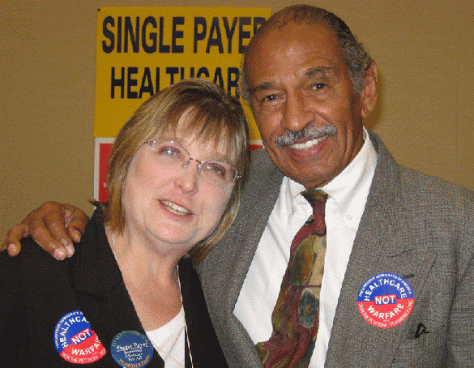
Photo: Donna Smith with Rep. John Conyers, author of HR 676
by Randy Shannon
Treasurer, PA 12th C.D. Chapter, PDA
As a long-time activist in Progressive Democrats of America and the leader of the PDA Economic and Social Justice Team, I want to welcome Donna Smith as PDA’s new Executive Director. Donna Smith has been a national leader in the fight for Medicare for All and a long time member of PDA. She was featured in Michael Moore’s film Sicko.
Thanks to Conor Boylan for his work helping PDA through the transition from the tragic loss of our founder Tim Carpenter.
Tim Carpenter‘s last big project for PDA was to organize a national petition drive to convince Bernie Sanders to run for President. Tim’s vision is now a reality, and it is one of Tim’s greatest successes. PDA is helping build the grass roots movement that can produce a President Sanders.
Bernie has made Medicare for All a central element of his campaign for President. Who better than Donna Smith, shown here with Rep. John Conyers, author of HR 676 – Medicare for All, to lead PDA to help elect Bernie Sanders President and finally win the battle for Medicare for All.
Read the Medicare for All bill – HR 676.

By Jared Stonesifer
Beaver County Times
MONACA — The borough plans on installing 198 solar panels at its reservoir that could produce more than $200,000 worth of electricity over their lifespan.
Borough Manager Mario Leone said the project, which has been in the works for several years, could be up and running by April.
The borough will install the solar panels on the ground and buildings at the reservoir, although it also plans on building a new garage-like structure that will house at least half of the panels.
The panels will cost $150,000 to buy and install, half of which was paid for by a state grant.
Leone said it won’t take long for the panels to make up the cost through savings realized by the efficiency of solar energy.
“We’re looking between a 7 1/2 to nine-year payback on our $75,000 contribution,” he said. “The solar system over 20 years is expected to generate over $200,000 in electricity.”
That number could be higher, Leone said, if the solar panels exceed their typical lifespan of 25 to 30 years.
The solar panel project is just one of several that have led to Monaca being designated a gold-certified municipality in sustainability. The latest solar project means the borough could soon be certified as platinum, Leone said.
“The borough is a leader in sustainability,” he said. “I believe with the installation of the solar panels and other things we’re working on, we will probably achieve that higher standard.”
Another exciting aspect, Leone said, is that the amount of energy generated from the solar panels will be able to be viewed on the borough’s website.
A public hearing will be held Jan. 26, when the project is expected to receive the green light from borough council.
Leone said the panels will take about two weeks to be installed after being delivered.
The panels will generate about 63,000 kilowatt hours annually.
 Beaver County Blue: Voice of the 17th CD of Progressive Democrats of America