PITTSBURGH — Nurses at UPMC Western Psychiatric Hospital said they have “won a historic union contract” following months of negotiations with UPMC over concerns of closures and rising mental health cases.
In a statement Sunday, the nurses’ union said the contract agreement will guarantee a “first-ever guaranteed wage rate above $40 for nurses with a Bachelor of Nursing anywhere in UPMC,” which will be an incentive towards “improving staffing so beds that were previously closed can reopen.”
“Together, we have proven that when UPMC nurses unite, we can achieve historic improvements for our patients, our families, our community and our profession,” Chris Hunter, who has been a nurse at Western Psych for eight years, said in the statement. “Even though we’re a smaller hospital and UPMC has deprioritized us for years, we were able to hold executives accountable and create groundbreaking progress.”
The contract comes weeks after the nurses’ union unanimously authorized a strike after concerns over UPMC’s closure of beds, understaffing, and policy changes.
“The historic contract invests in recruitment, retention, and respect to ensure quality care and address the growing mental health crisis,” the statement read.
Nurses at UPMC Western Psychiatric Hospital had been negotiating a new union contract with UPMC since Aug. 1 after their previous contract expired in September.
“The stunning victory follows on the heels of a rally and unanimous strike vote, and includes groundbreaking pay raises that are unprecedented within the UPMC system,” the statement said Sunday.
Photo: Thomas Ross (left) and Austin Wise give a tutorial to students who have never canvassed before on Saturday, Sept. 21, 2024, at Schenley Plaza in Oakland. (Photo by Anastasia Busby/PublicSource)
Democratic organizers say student political engagement has soared since Kamala Harris took over their party’s presidential ticket. Their Republican counterparts report backlash for supporting candidates and views they say are controversial on campuses.
By Spencer Levering
Public Source
October 3, 2024 – Thomas Ross didn’t realize that the political interest on Pitt’s campus was “electric,” as he characterized it, until the semester’s first door-knocking event for Pitt Students for Harris brought 34 volunteers — more than double the number he expected.
“Having 34 volunteers on our first canvass literally blew my mind,” said Ross, a University of Pittsburgh junior studying history and political science. “Everyone that I’ve spoken with has been very excited about the election.” Other Democratic students echoed this, saying they’re seeing new levels of excitement from their peers.
Just up Forbes Avenue, Anthony Cacciato is aiming to make the Carnegie Mellon University College Republicans a space where students can speak freely about their conservative values. Cacciato, president of the chapter, said with election season sparking student’s political intrigue, he’s preparing for a “barrage of negative backlash.”
At colleges around Pittsburgh, political clubs are organizing students to gear up for the upcoming November elections. Club leaders cited Pennsylvania’s influence on national politics as a key reason why they’re trying to mobilize the youth vote as Republican Donald Trump and Democrat Kamala Harris vie for Electoral College votes.
Organizing through socializing
As on-campus political groups look to activate students this fall, many said they are trying to mix political outreach efforts with social events to appeal to young voters.
Cacciato said group outings, such as seeing the new movie “Reagan,” help prevent students from burning out over organizing.
“We’re a space where you can feel comfortable with talking about who you are, but also feel comfortable in knowing that you’re surrounded by friends,” Cacciato said.
The club’s membership increased by 20% this semester, according to Cacciato, because of Pennsylvania’s outsize impact on national politics.
“When you have that knives-edge margin, any little bit of outreach can mean the difference between 10,000 people staying home and not voting and them going out and voting and flipping a precinct, flipping a state House seat, flipping the state, and flipping the country,” Cacciato said.
At Pitt, Sam Podnar, co-president of the Pitt College Democrats, said she creates an environment in which students can meet new people and break out of political apathy.
“We want to let people know that getting involved doesn’t have to be hard, it doesn’t have to be stressful. We just want them to keep showing up,” Podnar said.
She said President Joe Biden’s decision to drop out of the race and endorse Vice President Harris has energized students to get involved in Democratic organizing. General body meetings, weekend canvasses and the club’s presidential debate watch party have all drawn new participants.
“We’ve seen a really, really big surge in membership that just has honestly blown everyone away,” Podnar said.
Avalon Sueiro, president of the CMU College Democrats, said finding a balance between doing work and building a community helps draw students to attend the club’s events. When election day gets nearer, she plans on bringing therapy dogs to campus to calm students’ nerves.
Making it pop
Among Democratic student organizers, leaders are leaning into memes and pop culture as they try to energize college voters. When the semester began, the Instagram pages for Pitt Students for Harris and Pitt College Democrats both had profile photos referencing Charli XCX’s “brat” album. The pop star’s viral summer tweet calling the vice president “brat” spawned a flurry of online memes, which the Harris campaign embraced as an early branding strategy.
September 22, 2024 – PITTSBURGH — With just 44 days until the 2024 election, U.S. Reps. Summer Lee (D-Pa.) and Alexandria Ocasio-Cortez (D-NY) rallied young voters for the Harris-Walz ticket at Carnegie Mellon University on Sunday.
Young people, Lee told the audience “are not the voices of the future,” but rather “the voices of right now.”
“We are all in the most powerful room in the country,” she said. “This is the most powerful room because we are in Western Pennsylvania, we’re in Western Pennsylvania, and the road to the White House, the road to the Senate and the road to the House all leads right here through y’all’s campuses.”
Pennsylvania is key for both Vice President Kamala Harris, the Democrats’ nominee, and former President Donald Trump, the GOP nominee. With its 19 electoral votes, the Keystone State is the biggest prize of the “blue wall” battleground states for either candidate.
According to the Pew Research Center, about two-thirds of registered voters ages 18 to 24 align with Democrats. In 2023, the Center for Information & Research on Civic Learning and Engagement estimated around 41 million members of Gen Z would be eligible to vote in the 2024 election.
Sunday’s event was co-hosted by College Democrats at Pitt, the CMU College Democrats and the Young Democrats of Allegheny County.
“When I talk about what our job is in the next 40-something days, your job is to take care of each other because that’s who I’m voting for,” Lee said. “I’m going to go and vote for the most marginalized person in my life. Because it’s my job, it’s my responsibility, to make sure that I’m creating the conditions that we all can survive in, not just survive, that we can all thrive in.”
Ocasio-Cortez followed Lee with a list of the issues that young voters might be most concerned with: climate change, school shootings and the cost of rent and healthcare.
“We have been aging and growing in a world that our predecessors have left to us,” Ocasio-Cortez said. “Respectfully, a lot of what has been left to us is messed up, is really messed up, and it’s messed up not even on a partisan basis, it’s messed up generationally.”
Ocasio-Cortez told a story of her time at Boston University when Barack Obama began his candidacy, and her absentee ballot did not arrive in time. She said she took a bus back home to New York City to cast her vote for the future president.
She not only encouraged students to register to vote in Pennsylvania with their on-campus address, but also to sign up for a shift with the Harris-Walz campaign, go door-to-door and ensure a Democratic victory at every level in the election.
Those calls-to-action were the theme of the speakers at Sunday’s event, with Pittsburgh Mayor Ed Gainey, Allegheny County Executive Sara Innamorato, CMU College Democrats President Avalon Sueiro and Harris-Walz campus organizer Agatha Prairie all taking the stage.
Prairie encouraged attendees to convince five friends to vote and Sueiro said to knock on classmates’ doors and “have those tough conversations” about the stakes of the election.
Gainey took a more somber approach.
“We should all be tired. I’m tired of someone that can stand on the stage in a debate and say to the American people and the world that immigrants that are here in our country eat dogs and cats,” he said in reference to former President Donald Trump’s false claim that Haitian immigrants were eating pets in Springfield, Ohio. “I’m tired of that level of hate.”
Trump’s running mate, U.S. Sen. J.D. Vance (R-Ohio) campaigned in Berks County on Saturday, and mentioned Springfield in his remarks. His job “as the United States Senator representing the people of Ohio is to listen to American citizens and fight for them,” Vance said.
“So our message to Kamala Harris and Democrats is we’re going to keep on complaining about their politics because this is America and we have the right to speak our minds,” he added.
Innamorato pointed out that a satellite voting location at the Soldiers & Sailors Memorial Hall in Oakland will be open from 8 a.m. to 4 p.m. from Oct. 15-17. Satellite locations offer residents the ability to register to vote, request a mail-in ballot, complete and return it in one place.
“A Pennsylvania victory runs through Allegheny County, and it runs through young people,” Innamorato said. “I’m asking for all of you to do what you can, to knock doors, to volunteer, to make phone calls, to talk to your weird cousin, to get your classmates on board, because we got a lot of work to do over the next 44 days.”
U.S. Rep. Summer Lee (D-12th District) speaks to the Pennsylvania delegates at the Democratic National Convention in Chicago Aug. 22, 2024 (Capital-Star photo by Kim Lyons)
Delegates and candidates turn to the work of keeping the battleground state blue
By: Kim Lyons
Penn-Capital Star
August 25, 2024 – CHICAGO — Pennsylvania was the most popular kid in the class at the 2024 Democratic National Convention, and the battleground state and its 19 electoral votes were well represented in Chicago and on the convention’s nightly broadcasts. Each night featured a speaker from the Keystone State, with Lt. Gov. Austin Davis on Monday; state Rep. Malcolm Kenyatta on Tuesday; Gov. Josh Shapiro on Wednesday and U.S. Sen. Bob Casey on Thursday.
Shapiro was unquestionably the biggest Pennsylvania presence at the DNC, due in part to his status as a runner-up to be presidential nominee Vice President Kamala Harris’ running mate. He was constantly booked during the week, speaking at numerous state delegations’ breakfasts, attracting the ire of GOP nominee former President Donald Trump, and appearing regularly on cable news channels.
Project 2025 played a key role at the convention, as Democrats continued to try to link the conservative policy plan to reshape the federal government and increase presidential authority with Trump.
Kenyatta, a candidate for state Auditor General held the giant Project 2025 book on stage Tuesday night,, and told the audience it was a “radical plan to drag us backwards, bankrupt the middle class and raise prices on working families like yours and mine.”
Trump has tried to distance himself from Project 2025 but several members of his administration were involved with helping to craft it.
“It’s a big, heavy book full of bad ideas, and it was one of these moments where we’re able to really get people to understand with the visual how serious Trump and this administration are about doubling down on his flawed theory of the case,” Kenyatta told the Capital-Star on the final day of the convention.
Our vote is the highest demonstration of the collective power we have… The purpose of this moment is to use our collective power to elect somebody who gives a damn about us, and then to work side by side with her to help implement the things that she’s talking about.
He added Project 2025 should serve as a warning to Democrats about what they believe a second Trump term would look like.
“When Trump burst onto the political scene, he did so with the thesis that ‘America sucks,’ and that it sucks in large part because our neighbors, the people in our community, people we don’t know — they’re somehow a part of bringing America down,” Kenyatta said, “and the only way we fix it is if we give him all the power.”
While Trump’s first term saw the former president “flailing around,” Kenyatta said, the architects of Project 2025 mapped out a plan for how to reach some of the goals of the far-right wing of the party, such as a national abortion ban and abolishing the U.S. Department of Education.
Kenyatta added he doesn’t believe in the political concept of giving all the power to one person to fix everything.
“Our vote is the highest demonstration of the collective power we have,” he said. “If we elect Kamala Harris in November and then say, ‘OK, we’ll see you in four years at the next convention. Hope you fix all the problems!’ then we’ve missed the thread. The purpose of this moment is to use our collective power to elect somebody who gives a damn about us, and then to work side by side with her to help implement the things that she’s talking about.”
At the final Pennsylvania delegates’ breakfast on Thursday, U.S. Rep. Summer Lee (D-12th District) urged the battleground state delegates to keep up the convention’s momentum.
“We’re here honing our tools so that we can go out and do the very hard work, not for Kamala Harris. We’re not doing hard work for Summer Lee or any of my colleagues,” Lee said, but rather for marginalized and vulnerable people. “Think about that person whose name is in that book over the hundreds and hundreds of pages of Project 2025, who do we see there that we need to make sure is not touched by the evil and the horrors that they have lined up and ready for them.”
Davis, Pennsylvania’s youngest and first-ever Black lieutenant governor, addressed the convention on Monday night and spoke about the importance of building bridges. He appeared on stage with Wisconsin Lt. Gov. Sarah Rodriguez, Harris County, Texas Executive Lena Hidalgo, and California Lt. Gov. Eleni Kounalakis, all of whom shared stories about how Harris had made an impact on their communities.
“I grew up with working class parents in a small steel town in southwestern Pennsylvania, and to have the opportunity to speak on a national stage like that was incredibly humbling,” Davis told the Capital-Star. “It was just an example of how someone can live the American dream, so I hope folks who saw me saw that America should be a place where every person has that same opportunity.”
Davis said the question he heard most often over the course of the convention was whether Democrats can win Pennsylvania. “And I tell them, absolutely, we just have to keep showing up everywhere, competing in places that sometimes it’s not easy to be a Democrat,” he said.
Asked if there were “red” areas of the state he saw as possible to flip blue, he pointed to central Pennsylvania as having the most potential, particularly the race in the 10th Congressional District between former WGAL anchor Janelle Stelson and Republican U.S. Rep. Scott Perry.
“I think we have a great candidate in Janelle Stelson,” he said. “I think there’s a lot of energy also with [state Rep.] Patty Kim running for state Senate. So I think Dauphin, Lancaster, Cumberland — an area Governor Shapiro won when we were running on the ballot.”
Davis said not everyone was completely impressed with his star turn on television, however. His daughter Harper, whose 1st birthday is next month, was asleep by the time he appeared Monday night. “We’re going to replay it for her but she doesn’t care,” he said. “She only cares when I FaceTime her and she’s like, ‘Daddy, when are you coming home?’”
The bill was the first sponsored by Lee to pass the full House
Photo: Cliff Simmons, an oil and gas inspector supervisor for the Pennsylvania Dept. of Environmental Protection, points a methane sensor at an abandoned well on the Murrysville property of Pamela and Ivan Schrank on Thursday, March 28, 2024. Simmons visited the well site with other DEP officials, journalists and Rep. Summer Lee (PA-12). (Steve Mellon/Pittsburgh Union Progress)
By Kim Lyons
Penn-Capitol Star
APRIL 30, 2024 – Cliff Simmons, an oil and gas inspector supervisor for the Pennsylvania Dept. of Environmental Protection, points a methane sensor at an abandoned well on the Murrysville property of Pamela and Ivan Schrank on Thursday, March 28, 2024. Simmons visited the well site with other DEP officials, journalists and Rep. Summer Lee (PA-12). (Steve Mellon/Pittsburgh Union Progress)
The U.S. House on Tuesday passed a bipartisan bill aimed at finding the thousands of abandoned oil and gas wells across the country, and studying how to better limit their environmental impact.
The legislation would authorize the U.S. Department of Energy to establish a five-year program to improve the location data it has on abandoned wells — some 350,000 of which are believed to be unaccounted for in Pennsylvania alone.
The bill — the Abandoned Wells, Remediation, Research, and Development Act — was the first piece of legislation sponsored by Pennsylvania Democrat Summer Lee to pass the full House. It passed by a vote of 333-75.
“We cannot and should not accept the fact that leaky oil and gas wells from the 1800s are poisoning our communities,” Lee said on the House floor Tuesday. “We must invest significant resources to research and develop solutions to this crisis — because it is still nearly impossible to track every abandoned well, and it is still too expensive to plug leaking wells.
Pennsylvania has the second-largest number of abandoned oil and gas wells; only Texas has more.
Lee visited the Murrysville home of Pamela and Ivan Schrank last month, after the couple discovered a leaky abandoned well on their property. During that visit, Pamela Schrank told Lee how she discovered the well, when she became dizzy while gardening in their backyard. The Schranks reached out to the state Department of Environmental Protection to have the well plugged before further damage occurred.
U.S. Rep Summer Lee participates in a Democratic candidates’ forum in Pittsburgh, Jan. 28, 2024
The three wasted no time describing their differences and why their opponents were wrong for the job.
By Kim Lyons
Penncapital-Star
JAN 28, 2024 - PITTSBURGH— The three candidates seeking the Democratic nomination for Pennsylvania’s 12th Congressional District came out swinging during a forum at Carnegie Mellon University on Sunday, not only demonstrating their differences but their willingness to criticize their fellow Democrats in areas of disagreement. And there were plenty of areas of disagreement.
U.S. Rep. Summer Lee (D-12th District), Edgewood Borough Councilmember Bhavini Patel and Laurie MacDonald, president and CEO of the Pittsburgh-based nonprofit Center for Victims, took the stage at the forum moderated by journalist Chris Potter of WESA-FM, Avalon Sueiro, president of the CMU College Democrats, and Heidi Norman, who works for the City of Pittsburgh and is a Democratic committeewoman in the city’s 14th Ward.
The first questioner asked the candidates to offer their thoughts on the role of a Congressional representative in navigating the complex situation in the Middle East. Lee has received criticism for her position supporting a ceasefire in the Israel-Hamas war.
MacDonald said her father was an immigrant from the Middle East, who wanted to “assimilate” and to have people judge him on who he was. She said she was passionate about putting together a coalition of peacemakers in the region, although recognized it would not be easy. “I think if we work together and continue with the Abraham Accords, and get that process going that we can find room for everybody in this world.”
Patel criticized Lee for not attending local rallies with the Jewish community in the days after the Oct. 7 Hamas attack on Israel, and for tweeting out information about a hospital bombing in Gaza that was later found to be erroneous. “To me that’s stoking hatred, that’s stoking antisemitism and it puts people in our communities in a tragic, dangerous position,” Patel said. “That is unacceptable.”
Bhavini Patel participates in a Democratic candidates’ forum in Pittsburgh Sunday Jan. 28, 2024 (screen capture) Lee replied that it was a subject that elicits pain in multiple communities. “The reality is, is that peace— a just and lasting peace— has to start with centering all of the folks who are impacted, and we have to be incredibly clear that there is no pathway to peace if we can only talk about security for one community, or as we continue to pit communities against each other,” she said. “Peace and justice and liberation and accountability for Israelis is not counter to peace and justice for Palestinians or Muslims or for Arabs.”
She added that “anybody who would use this issue as a political wedge is not serious and does not understand the gravity of the situation.”
The two sparred again on a question about the role and responsibility of the United States in geopolitical conflicts around the world.
Patel said as someone with a degree in international relations she has spent time “navigating these issues and getting a sense of what’s going on.” She noted that Lee had tweeted information that the president doesn’t have the authority to authorize airstrikes in the Red Sea against the Houthi rebels, who have attacked ships in the area and disrupted global commerce.
“When we’re unable to actually take these foreign policy concerns in a serious way, and engage with them in an intellectual way, and we’re just focused on posting, rather than understanding the challenges, I think that it sets us up for challenges,” Patel said. “I think it puts us in a precarious position as a country.”
Lee countered that her preference was to center American diplomacy in global conflicts. “The reality is that while an international studies degree is important, I have a law degree,” she said. “And no, the president does not have the authority to declare war or offensive strikes without the prior authorization of Congress.” Patel attempted to interrupt but Potter admonished her to respect the other candidates’ time.
Despite the best efforts by moderators to prevent delays and interruptions, the audience was fairly vocal throughout the event, alternately applauding or heckling the candidates based on their answers. At one point during a response to a question about the role of Congress in supporting gender-affirming care, MacDonald reacted directly to the audience booing her.
“My opponent — the people who live in her district have no families, they live in squalor, they don’t have…” MacDonald began, before audience members shouted back. “You think you know, right, well guess what, I worked there. I have helped those communities.”
When the heckling had died down, MacDonald added, “I don’t need to take that. My record speaks for itself. I’ve walked the walk, I’ve talked the talk, I help families. I help everybody. I don’t have a prejudiced, white, black, purple, pink bone in my body. I love everybody. And I love all of you too, even if we disagree.”
Laurie MacDonald participates in a Democratic candidates’ forum in Pittsburgh Sunday Jan. 28, 2024 (screen capture) The candidates were asked how they would engage younger voters, and in her response, Patel continued a line of criticism she has levied at Lee before: that she thinks the progressive Democrat does not fully support President Joe Biden’s agenda.
“With the Supreme Court overturning affirmative action, Roe v Wade, it really does come down to unequivocally standing with our president,” Patel said. “We really have zero room for error, and heading into the 2024 general election when we think about the future of this country, when we think about the future of our democracy, it really is all hands on deck, and it’s going to come from Western Pennsylvania. It’s going to be Pennsylvania that drives that conversation and drives that turnout and we need to start taking that seriously.”
Lee said the Democratic coalition of 2024 would include Black and brown voters, young voters and progressive voters, “precisely what Western Pennsylvania looks like,” noting that progressives had won decisive victories in recent elections in that end of the state.
“We actually need people who are going to be bold and push the president— just a little bit— so that we can get to [student] debt cancellation,” Lee said. “We need young people who are going to push the administration on climate change, because we have to meet the scope and the scale of the urgency of the moment. That energy is led by young people.”
Sept. 19, 2023 – Democrats kept control of the Pennsylvania House of Representatives Tuesday after winning an open seat in a special election in the Pittsburgh area.
The state’s lower chamber had been split 101-101 between Democrats and Republicans since July, when former Representative Sara Innamorato, a Democrat, stepped down from her seat representing the 21st House District to run for Allegheny County executive.
Republicans had hoped for an upset in Ms. Innamorato’s former district, which includes part of Pittsburgh and its northern suburbs. That did not happen: Lindsay Powell, a Democrat who has strong ties to party leaders in Washington — including Senator Chuck Schumer, the majority leader, and Representative Hakeem Jeffries, the minority leader — easily defeated Erin Connolly Autenreith, a Republican who is the chairwoman of a local party committee. With 95 percent of the vote counted, 65 percent went to Ms. Powell and 34 percent went to Ms. Autenreith.
Pennsylvania’s House of Representatives has been split between Democrats and Republicans since July, with each party holding 101 seats.Credit…Matt Rourke/Associated Press
Why It Matters: The vote will determine a swing state’s power balance.
Pennsylvania is a crucial swing state, playing an important role in presidential elections, as well as determining which party holds power in the United States Congress. Whichever party gains an upper hand in the state can make a major difference in Washington, in addition to making law in Pennsylvania.
It’s also one of just two states, along with Virginia, where the legislative chambers are split by party.
In Harrisburg, Democrats have controlled the governor’s office since 2015, and Gov. Josh Shapiro won his first term convincingly in November 2022. Republicans, on the other hand, have held a strong grip on the Senate for decades.
Democrats won a majority in the House in 2022 for the first time in 12 years and by the slimmest of margins — it took only Ms. Innamorato’s resignation to make it an even split.
Background: The state has seen several special elections this year.
In May, Heather Boyd, a Democrat, won a closely watched special election in southeast Delaware County, part of the Philadelphia suburbs. Top Democrats, including President Biden and Governor Shapiro, had framed the contest as crucial to protecting reproductive rights in Pennsylvania.
But on the same day, in a separate special election, Republicans retained a state House seat in north-central Pennsylvania with the triumph of Michael Stender, a school board member and firefighter.
Heading into the third special election of the year on Tuesday, the Democratic candidate, Ms. Powell, 32, who works in work force development, was viewed as a solid favorite, with a sizable fund-raising advantage.
She was aiming to become the first African American woman to represent the district, which Ms. Innamorato captured in 2022 with 63 percent of the vote.
Republican officials acknowledged that the heavily Democratic district would be difficult for them to win. Still, Ms. Autenreith, 65, had been active on the campaign trail.
What Happens Next: The state House could soon be in play yet again.
Even with Ms. Powell’s victory, voters in Pennsylvania may soon face yet another special election with huge stakes.
If State Representative John Galloway, a Democrat who represents a district northeast of Philadelphia, prevails in a race for a district judgeship in November, as is expected, the chamber would be split again until another contest could be held to fill his seat.
The United Democracy Project, a super PAC for the American Israel Public Affairs Committee, poured millions to defeat Lee in a Pennsylvania House primary. Similar dark money groups have targeted several progressives.
BY ABIGAIL TRACY Wanity Fair
MAY 19, 2022 – Around seven weeks before Pennsylvania’s primary elections, Summer Lee commanded a lead of 25 points over rival Steve Irwin in the race for Pennsylvania’s 12th District, a blue stronghold encompassing Pittsburgh and its surrounding suburbs. It appeared that Lee, 34, a Black woman and progressive activist who currently serves as a Pennsylvania state representative, would make history.
Then came the outside money. By election day, Democratic groups had dumped more than $2 million into the primary race to defeat Lee—dwarfing the outside money spent attacking Irwin, a mere $2,400. Specifically, the United Democracy Project (UDP)—a political action committee for the American Israel Public Affairs Committee (AIPAC)—spent $2,025,297 against Lee and $660,317 in support of Irwin, 62, a Pittsburgh lawyer and county Democratic Party organizer. The ads painted Lee as anti-Israel and claimed she was “not a real Democrat,” following a playbook that moderate groups have run against other progressives nationwide, including against Pennsylvania’s Democratic Senate nominee John Fetterman.
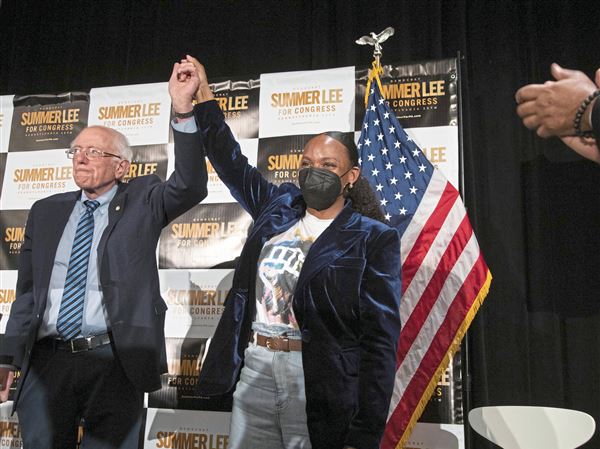
Lee declared victory on election night, at 12:30 a.m.; as of midday Wednesday, news outlets still hadn’t called an official winner—the race was too tight. Progressive groups and lawmakers including Senator Bernie Sanders congratulated her on the win. Lee declared, “This is the mightiest movement in the land!” Much of Pennsylvania’s Democratic establishment, including the retiring representative Mike Doyle, whose seat Lee and Irwin are after, had thrown their support behind Irwin. “They say a Black woman can’t win. Well, we came together. We can’t be stopped. We have a lot of work ahead of us. When we set out to do this, we believed a better world was possible; now we have to go do it,” Lee said in her remarks early Wednesday morning.
But the efforts to stop Lee are part of a broader trend in Democratic politics, as super PACs with big budgets have sought to prevent progressives—often women of color—from winning races across the country. “It’s really concerning to see the huge influx of outside money flowing into this race and the disingenuous effort to paint a progressive woman of color and the only sitting elected official in the race as an opponent of the Democratic Party,” a senior progressive official in the House told me.
April 4, 2022 – The Congressional Progressive Caucus Pac Is Throwing Its Weight Behind A Democratic Socialist Running For The House In Pennsylvania.
The Political Action Committee Is Endorsing State Rep. Summer Lee In The 12Th Congressional District, The Hill First Reported, Offering A Boost In The Crowded Democratic Primary From Top Lawmakers On The Left.
“The Progressive Caucus Has Been Building Power In Congress To Hold Our Party Accountable To The Needs Of Everyday Working People Across The Country,” Lee Said On Monday About The Endorsement.
“They Led The Movement To Pass President Biden’S Full Agenda And Have Been On The Frontlines Of Expanding Our Labor Movement, Advocating For Medicare For All And A Green New Deal And Putting People Back At The Center Of Our Policy.”
Progressive Reps. Mark Pocan (D-Wis.), Pramila Jayapal (D-Wash.) And Jamie Raskin (D-Md.), Who Co-Chair The Pac, Called Lee A “Champion For Union Rights And The Labor Movement, A Leader For Environmental Justice And Strong Advocate For Working Families Across Pennsylvania” In A Joint Statement.
Lee, Who Entered The Five-Candidate Primary In The Fall, Has Already Earned The Support Of Other Major Figures Among The Party’S Left Flank, Including Sen. Bernie Sanders (I-Vt.) And Rep. Ayanna Pressley (D-Mass.). She Is Also Backed By National Progressive And Labor Groups Like The Seiu, Working Families Party, Sunrise Movement, Justice Democrats And The Pro-Female Candidate Organization Emily’S List.
“She Has Led The Progressive Movement In The Pennsylvania State Legislature And Has Built Power For Her Community From The Ground Up – Helping Elect Progressives Up And Down The Ballot,” Pocan, Jayapal And Raskin Said Of Lee.
“We Know She Will Bring This Dedication To Progressive Advocacy And People-Powered Organizing To Congress, And We Are So Proud To Endorse Her In This Campaign.”
Lee Is The Pac’S Latest Endorsement. The Committee Is Seeking To Help Elect Progressive Candidates Into Office — Including By Wading Into Intraparty Primaries — That Share Leaders’ Vision For A Fairer And More Expansive Version Of Government.





 Beaver County Blue: Voice of the 17th CD of Progressive Democrats of America