Category Archives: GOP

Next Time You Hear ‘Support Our Troops’ from the Right, Remember This:

GOP Blocks Veteran Jobs Bill

By LAWRENCE DOWNES
Beaver County Peace Links via New York Times

Sept. 19, 2012 – Veterans won’t be getting a new, billion-dollar jobs program, not from this Senate. Republicans on Wednesday afternoon blocked a vote on the Veterans Job Corps Bill after Jeff Sessions of Alabama raised a point of order – he said the bill violated a cap on spending agreed to by Congress last year. The bill’s sponsor, Patty Murray of Washington, said that shouldn’t matter, since the bill’s cost was fully offset by new revenues. She said Mr. Sessions and his party colleagues had been furiously generating excuses to oppose the bill, and were now exploiting a technicality to deny thousands of veterans a shot at getting hired as police officers, firefighters and parks workers, among other things.

The vote was 58-40; the bill needed 60 votes to proceed.

It would be easier to admire the Republicans’ late-breaking fiscal scrupulosity if their motives – denying the Obama administration any kind of victory this year, whatever the cost to jobless vets – weren’t so transparent.  It’s probably useful to remind Republicans like John McCain (a "nay" on the jobs bill) that wounded, jobless and homeless veterans aren’t a fact of nature. They’re a product of the wars that Congress members voted for, the war debt they piled on, and the economy they helped ruin.

"It’s unbelievable that even after more than a decade of war, many Republicans still will not acknowledge that the treatment of our veterans is a cost of war," Ms. Murray said in a statement after the vote.

One Step Forward for Voting Rights, One Step Back for the GOP

Photo: Larry Roberts/Post-Gazette – Monel Walker, left, from Braddock, receives reassurance about her voter identification from Marian Schneider, a local attorney volunteering at the "My Vote, My Right" awareness event held in front of the PennDOT office on Smithfield Street in Pittsburgh today.

Pennsylvania Supreme Court sends Voter ID back to lower court

By Karen Langley
Pittsburgh Post-Gazette

Sept 18, 2012 HARRISBURG — The Pennsylvania Supreme Court has ordered a lower court to revisit its decision that allowed the new voter ID law to remain in effect for the November elections.

If Commonwealth Court finds the state’s implementation of the law will disenfranchise voters in November, the high court has ordered it to issue an injunction.

In its decision not to stop the law immediately, the high court ruled that Commonwealth Court relied on judgments about how the state would educate voters and provide access to acceptable forms of identification. The justices wrote that lawmakers have made "an ambitious effort" to put the photo identification requirement in place by the upcoming elections but that state agencies face "serious operational constraints" in doing so.

Given that, the justices wrote, they are not satisfied with a decision based on assurances of what the state will do to ensure all voters have acceptable identification.

They ordered Commonwealth Court to issue a new decision by Oct. 2 based on the present availability of identification.

"The court is to consider whether the procedures being used for deployment of the cards comport with the requirement of liberal access which the General Assembly attached to the issuance of PennDOT identification cards," the order says.

"If they do not, or if the Commonwealth Court is not still convinced in its predictive judgment that there will be no voter disenfranchisement arising out of the Commonwealth’s implementation of a voter identification requirement for purposes of the upcoming election, that court is obliged to enter a preliminary injunction."

The voter ID requirement passed the Legislature with Republican support and was signed into law in March by Gov. Tom Corbett. It requires voters to show one of several forms of photo identification at the polls.

The American Civil Liberties Union of Pennsylvania and other groups filed suit, claiming the law violates the state Constitution and would disenfranchise many Pennsylvania voters. After a week of testimony, the Commonwealth Court in August declined to stop the law.

Supreme Court Justices Seamus McCaffery and Debra McCloskey Todd filed dissenting statements.

Justice Todd wrote that she would reverse the lower court’s decision, not return the matter for further consideration. She wrote of an "impending near-certain loss of voting rights" and said the court was allowing the state to essentially ignore the short timeline before the election.

"The eyes of the nation are upon us, and this Court has chosen to punt rather than to act," she wrote.

Justice McCaffery concluded in another dissent that the evolving efforts by state agencies to implement the law "are a tacit admission that (the law) is simply not ready for the prime time" of the November election. He wrote that further hearings are unnecessary and that the high court should order the lower court to issue an injunction.

Karen Langley: klangley@post-gazette.com or 717-787-2141 .

Standing Firm: PDA Organizing at Charlotte Convention

Stage being set up for PDA’s Progressive Central’ forum near the Democratic Convention in North Carolina

2012 Convention: Pulling Democrats’ Platform to the Left

By Martin Wisckol
Beaver County Blue via Orange County Register

Sept 5, 2012 – Proudly liberal activist Tim Carpenter, who toiled in Orange County for more than 20 years before resettling in Massachusetts and co-founding Progressive Democrats of America, has made a career of standing staunchly to the left of mainstream Democrats, relentlessly beckoning and cajoling others to come a little closer.

His 8-year-old PDA group was at it again Tuesday, with a “People’s Convention” at a Charlotte church and soup kitchen that featured the Rev. Jesse Jackson, former presidential candidate Michael Dukakis, a couple Congress members, several Congressional hopefuls – including Paul Ryan‘s Democratic opponent – and a host of progressive leaders.

“The country would have been a lot better if Jesse Jackson was elected and, if not, Michael Dukakis,” said Carpenter, recalling the 1988 presidential field from which George H.W. Bush emerged victorious.“We wouldn’t have had Bush I and maybe not Bush II. But (Jackson and Dukakis) are still engaged. And they’re coming here instead of parading around the convention.”

As usual, Carpenter is pushing an agenda beyond which most Democratic lawmakers are ready to support.  But before outlining the list, Carpenter took a moment to celebrate a Tuesday victory: At the Democratic convention, delegates approved a platform backing marriage rights for gays – a clear distinction from Republicans.

“This election is not simply a choice between two candidates or two political parties,” the platform summarizes, “but between two fundamentally different paths for our country and families.”

The specific support for gay marriage comes after President Bill Clinton signed the Defense of Marriage Act into law and, until recently, Barack Obama opposed gay marriage.

“That’s a victory that’s been a struggle for a long time,” Carpenter said.

Among the 240 people who paid registration dues for the Tuesday event were 92 convention delegates, rallying around eight central issues including:

A single-payer, “Medicare for all” health-care system that, unlike the Affordable Care Act, would leave no American without health insurance. A series of initiatives to diminish corporate influence over the political system. “Main Street, not Wall Street,” Carpenter said. A carbon tax and other measures to address global warming. Immediate withdrawal from Afghanistan. A diplomatic solution to the brewing conflict with Iran. “We’ve got to stop the saber rattling,” Carpenter said.

While it’s trying to pull Obama more toward these positions, PDA supports the incumbent’s reelection as far preferable to a Mitt Romney presidency.

And Carpenter remains as positive and optimistic as ever on a number of fronts. Take, for instance, Rob Zerban, the PDA member challenging vice presidential candidate Ryan in his other race, reelection to Congress.

“Now we get to beat Paul Ryan twice,” he quipped.

If We Can Shoot It Down in Texas, Why Not in Pennsylvania?

Texas Loses Latest Voter ID Battle after Judges Strike Down ‘Retrogressive’ Law

Judges find that law requiring voters to present photo ID at the ballot box placed ‘unforgiving burdens on the poor’

By Chris McGreal
Beaver County Blue via The Guardian, UK

August 30, 2012 – The court said that the law was ‘likely to have a retrogressive effect’ by limiting access to the ballot box. Photograph: Mario Tama/Getty

A federal court has struck down a Texas law requiring voters to present photo identification at the ballot box in the second ruling this week to effectively accuse the state of racial discrimination and attempting to manipulate elections.

In an escalating legal battle between mostly Republican-controlled states and the Obama administration over voter ID and other election laws, a panel of three judges in Washington DC found that the Texas legislation imposed "strict, unforgiving burdens on the poor" because of the cost and process involved in obtaining identification.

The US justice department told the court that voters would have to pay for birth certificates and travel up to 250 miles to obtain ID cards. The court said this imposed a "heavy burden" on any voter and would be "especially daunting for the working poor" who are more likely to be racial minorities.

The court concluded that if the law was implemented it "will likely have a retrogressive effect" by limiting access to the ballot box. It said that evidence submitted by Texas in support of its claim that the law was not discriminatory – and was necessary to combat voter fraud – was "unpersuasive, invalid, or both".

Continue reading If We Can Shoot It Down in Texas, Why Not in Pennsylvania?

Dollarocracy Over Democracy, 2012

One Percenters Buying Themselves an Aristocracy

By Leo Gerard
USW President, via Huffington Post

August 30, 2012 – The U.S. Constitution guarantees separation of church and state. What this nation needs now is separation of wealth and state.

Without such a protection, Americans stand to lose their democracy. They’ll be ruled instead by an aristocracy of 1 percenters.

That’s the 1 percenters’ plan. To them, it was no more than a perk when the U.S. Supreme Court enabled politicians to open their wallets for unlimited, anonymous campaign contributions. That’s because way before the 2010 Citizens United ruling, 1 percenters were working on a takeover. If the 99 percent don’t stop them soon, don’t establish some sort of separation of wealth and state, then the nation will lose its founding precepts — that all men are created equal and that governments derive their just powers from the consent of the governed. Aristocracies can ignore the governed.

Already the 1 percenters have been extraordinarily successful. The rich really do enjoy advantages. They’ve succeeded in stuffing Congress with their peers. In America, fewer than 1 percent of all people are millionaires. In Congress, 47 percent are. The median net worth of a U.S. senator in 2010 was $2.56 million.

Those guys haven’t experienced what it’s like to try to pay a mortgage, fix the car and keep food on the table for the average household with a median income of less than $52,000. They’re completely out of touch with the 50 million Americans who don’t have health insurance.

Continue reading Dollarocracy Over Democracy, 2012

The Long Struggle for Voting Rights


By Al Hart
UE News Managing Editor via Beaver County Blue

August 20, 2012, Pittsburgh, PA – Since the founding of the United States, working people have had to fight to win, and to keep, the right to vote. And through American history, rich and powerful people, often calling themselves "conservatives", have tried to maintain their privileges by depriving other Americans of the right to vote.

The story of the long struggle for voting rights in America is thoroughly and brilliantly told in ‘The Right to Vote: The Contested History of Democracy in the United States,’ by Alexander Keyssar, who teaches history and social policy at the Kennedy School of Government at Harvard. This highly- readable account was first published in 2000, and the 2009 revised edition brings the story up to nearly the present, when voter suppression has again become a national issue.

Before and immediately after the American Revolution, the right to vote in most of the 13 original states was limited mainly to white men, and in most states, only those who owned a certain amount of property. Free blacks who owned property had voting rights in some Northern states and, for a while, North Carolina. The most common property qualification was a freehold of 50 acres (among others, this disqualified tenant farmers who leased land.) In some states the requirement was property of a certain monetary value, such as 50 pounds, or a taxpaying requirement. When Vermont gained statehood in 1791, it was immediately the most democratic state, with no property or tax requirements for voting.

Continue reading The Long Struggle for Voting Rights

Even Papers as Far Away as New Zealand Are Shocked at PA’s GOP Voter Suppression Efforts

Dorothy Cooper, Tn, denied vote by the same GOP efforts back by Santorum here.

Eligibility rules bar millions of voters in US

By Peter Huck
New Zealand Herald

Aug 18, 2012 – When Dorothy Cooper applied for a free voter identity card in Chattanooga, Tennessee, she supplied a rent receipt, a copy of her lease, her birth certificate and her voter registration card to prove who she was.

Voter ID is mandatory to prevent fraud under a new state law passed by Republicans, despite scant evidence fraud exists.

But the 96-year-old, who was on the voting roll, left her marriage certificate behind. Cooper was denied the ID.

Wilola Lee in Pennsylvania has a similar story to tell. The 60-year-old has voted in most national elections since the 1970s, worked at her local Philadelphia polling station and is retired from the city’s education department. She has a social security card and a state identity card.

But a new law, passed by a Republican-controlled legislature, says voters must use an ID card issued by the Pennsylvania Department of Transportation.

To get one you need a birth certificate. Lee’s was destroyed by fire. Efforts to get one from Georgia, her birthplace, have been frustrated for the past decade.

Continue reading Even Papers as Far Away as New Zealand Are Shocked at PA’s GOP Voter Suppression Efforts

A Sensible "Deal for All" Challenges the Dreaded "Simpson-Bowles" Cutbacks

Photo: Cardboard image of Jamie Dimond, JP Morgan’s ‘Simpson Bowles’ Advocate.

By Carl Bloice
Beaver County Blue via Black Commentator

‘The real losers would be seniors, sick poor people, the unemployed, and people with disabilities.’

July 26, 2012 – A highly placed journalist spoke up boldly over the weekend on behalf of the country’s serious people, "those of us who crave a little common sense," who are feeling a bit of "despair," right now because the nation’s capital has become "a sludge pit of dysfunction." This state of affairs, wrote New York Times former executive editor. Bill Keller, could be attributed to "Republican cynicism, Democratic fecklessness or presidential disengagement."

"Talk to any credible economist, wire any serious politician to a polygraph, and you will hear at least 80 percent agreement on what is to be done: investment to goose the lackluster recovery and rebuild our infrastructure, entitlement reforms and spending discipline to lower the debt, and a tax code that lets the government pay its way without stifling business, punishing the middle class or rewarding sleight of hand," wrote Keller in the Times July 21. The problem, he asserted, is the failure of the responsible people to come up with a "grand bargain," the outline of which is pretty much summed up in (a little drum roll here) our old friend, the magic elixir; "Simpson-Bowles."

It just won’t go away. Its promoters continue to use a nonexistent "Simpson-Bowles" report from the failed Presidential deficit reduction commission as the code for what a powerful group among the nation’s political and economic elite want to enact by hook or by crook, whether we the people want it or not.

Continue reading A Sensible "Deal for All" Challenges the Dreaded "Simpson-Bowles" Cutbacks

‘We’re Fired Up!’ – Protestors in Harrisburg Vow to Defeat GOP Voter Suppression Law

Photos by Bill Allen

By Carl Davidson
Beaver County Blue

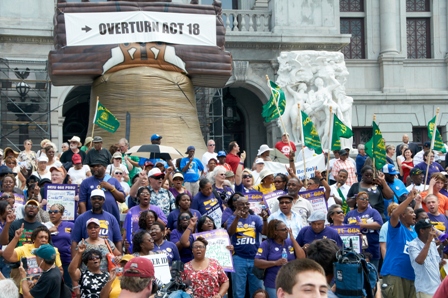
Nearly 500 people gathered on the steps of Pennsylvania’s State Capitol in Harrisburg on the hot afternoon of July 24 to deliver a warning to the GOP-dominated legislature-all their efforts to suppress the right to vote will be met with stiff resistance.

The rally was organized by the NAACP, trade union, women’s and church groups. Its tarrget was the GOP’s so-called ‘VoterID’ law, which may forbid nearly nine percent of the electorate, from voting in November.

"Do you want to know where the voter fraud has occurred? I’ll tell you right now where the vote fraud has occurred?" declared Rep. Ron Waters (D-Philadelphia). "It occurred when the people who wanted to disenfranchise the many 758,000 who are already registered to vote but do not possess a PennDOT-issued Photo IDs. They want to make sure that this is a way to get the candidate of their choice elected."

Continue reading ‘We’re Fired Up!’ – Protestors in Harrisburg Vow to Defeat GOP Voter Suppression Law

Oppose the GOP Attack on Voting Rights!

Links to Flyer below

Full Text of NAACP Letter, click HERE

PDF File of this Flyer, click HERE