Aug 14, 2025 – As the Trump administration aims to bolster fossil fuels at the expense of clean energy expansion, new research shows the oil and gas sector has so far failed to become a major jobs creator for heavily fracked areas of northern Appalachia.
“To the degree that we allocate resources to help develop that industry, we’re diverting those resources from other industries that actually could deliver” more jobs and higher per-capita incomes, said Sean O’Leary, author of the recent report from the Ohio River Valley Institute.
The report uses the term “Frackalachia” to describe 30 top oil- and gas-producing counties in Ohio, Pennsylvania, and West Virginia. As a group, the counties have smaller populations and a net loss in the number of jobs compared to 2008, just before Appalachia’s shale-gas boom began.
The counties’ growth in per-capita income also has lagged behind the national average, even as their nominal gross domestic product nearly doubled, increasing their share of the country’s GDP by 6%. Basically, comparatively high economic output from the counties did not produce higher-than-average incomes for their residents.
“Despite immense economic growth as measured by GDP, Frackalachia is in a position of actually having lost jobs since the beginning of the natural-gas boom,” O’Leary said. In his view, the numbers contradict pro-industry pitches for more oil and gas development.
“Whatever else it is, the natural-gas boom is not an engine for economic prosperity,” O’Leary said. He thinks the gas industry is “structurally incapable” of delivering lasting growth in jobs and income for the people living in heavily fracked areas. The Frackalachia counties have also seen relatively few jobs from “downstream” industries, such as the production of plastics, he added.
Oil and gas development is “highly capital-intensive, but not very labor-intensive,” O’Leary explained. Most earnings go to shareholders, investors, and suppliers based far from where fossil fuels are extracted, so only a small share of project income stays in the community to stimulate more economic activity.
Completed wells don’t need many permanent employees, O’Leary said. And many people who work in drilling and fracking come from outside the local area.
Canary Media’s review of data from the Ohio Department of Job and Family Services is consistent with that observation. From 2012 through 2022, the agency issued annual reports about the economic impact of the state’s oil and gas industry, including data for both “core” jobs and “ancillary” industries, which support oil and gas development.
Photo: High voltage electrical equipment at the University of Pittsburgh’s GRID Institute at the Energy Innovation Center in Pittsburgh’s Hill District on Feb. 10. (Photo by Quinn Glabicki/PublicSource)
As research and investment flow to the region, Pittsburgh strives to develop a workforce to build the green energy future.
By Quinn Glabicki and Alice Crow PublicSource
February 24, 2025 -Brandon Grainger stood beneath a towering, 13,800-volt webwork of power lines and transformers constructed inside a laboratory at the Energy Innovation Center in the Hill District, home to the University of Pittsburgh’s GRID Institute. Solar panels layer the sawtooth roof and a prototype wind turbine spins high above the parking lot. Both provide energy to the lab, and a research opportunity for those seeking to understand how to best integrate renewable energy.
As power demands increase from booming tech and AI development, the GRID Institute studies how to efficiently get electricity where it’s needed, and Grainger and other professors prepare students to eventually work in advanced industry.
But concerns persist, and a question remains: Do we have enough labor — from doctoral candidates to electricians — to meet the demands of the future?
“Well, the answer is no,” said Granger, an associate professor of electrical engineering. His graduate students, mostly electrical engineers, are being hired nearly eight months before they graduate, he said, and undergraduates, too, are being scooped up by industry well before they leave campus.
Industrial electrical equipment with interconnected metal structures and cylindrical components in a facility.
Southwestern Pennsylvania has the industrial capacity and hard-working heritage to be a bedrock of green energy manufacturing and development at a time when climate-friendly projects awaiting connection to the grid could go a long way toward addressing energy supply challenges.
Research and investment is already flowing to the region, but as green energy development accelerates, the local stock of legacy labor might not match the demand for workers, potentially posing a serious risk to the sector’s development amid quality control issues and delays. At the same time, local efforts are striving to train and graduate new workers to help meet the need. (Next page)
The bill was the first sponsored by Lee to pass the full House
Photo: Cliff Simmons, an oil and gas inspector supervisor for the Pennsylvania Dept. of Environmental Protection, points a methane sensor at an abandoned well on the Murrysville property of Pamela and Ivan Schrank on Thursday, March 28, 2024. Simmons visited the well site with other DEP officials, journalists and Rep. Summer Lee (PA-12). (Steve Mellon/Pittsburgh Union Progress)
By Kim Lyons
Penn-Capitol Star
APRIL 30, 2024 – Cliff Simmons, an oil and gas inspector supervisor for the Pennsylvania Dept. of Environmental Protection, points a methane sensor at an abandoned well on the Murrysville property of Pamela and Ivan Schrank on Thursday, March 28, 2024. Simmons visited the well site with other DEP officials, journalists and Rep. Summer Lee (PA-12). (Steve Mellon/Pittsburgh Union Progress)
The U.S. House on Tuesday passed a bipartisan bill aimed at finding the thousands of abandoned oil and gas wells across the country, and studying how to better limit their environmental impact.
The legislation would authorize the U.S. Department of Energy to establish a five-year program to improve the location data it has on abandoned wells — some 350,000 of which are believed to be unaccounted for in Pennsylvania alone.
The bill — the Abandoned Wells, Remediation, Research, and Development Act — was the first piece of legislation sponsored by Pennsylvania Democrat Summer Lee to pass the full House. It passed by a vote of 333-75.
“We cannot and should not accept the fact that leaky oil and gas wells from the 1800s are poisoning our communities,” Lee said on the House floor Tuesday. “We must invest significant resources to research and develop solutions to this crisis — because it is still nearly impossible to track every abandoned well, and it is still too expensive to plug leaking wells.
Pennsylvania has the second-largest number of abandoned oil and gas wells; only Texas has more.
Lee visited the Murrysville home of Pamela and Ivan Schrank last month, after the couple discovered a leaky abandoned well on their property. During that visit, Pamela Schrank told Lee how she discovered the well, when she became dizzy while gardening in their backyard. The Schranks reached out to the state Department of Environmental Protection to have the well plugged before further damage occurred.
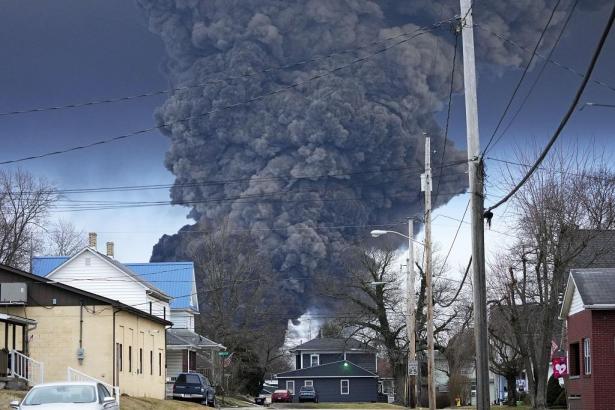
Photo: A large plume of smoke rises over East Palestine, Ohio, after a controlled detonation of a portion of a derailed Norfolk Southern freight train carrying toxic chemicals, February 6, 2023., Gene J. Puskar/AP Photo
Freight rail companies are running their trains ragged to boost profits. Sometimes they crash.
In the village of East Palestine, on a late Friday evening, a Norfolk Southern freight train derailed on the Ohio side of the Pennsylvania border, causing tanker cars to rupture and catch fire, releasing thousands of tons of hazardous chemical compounds into the surrounding land and atmosphere.
At the time of the crash, the known chemicals aboard included the highly toxic vinyl chloride and hydrogen chloride. An EPA document dump on February 12 revealed additional carcinogenic chemicals were aboard too, as well as some highly flammable solvents and gases. Public documents reveal that four tank cars containing vinyl chloride were stacked together.
Responding before the reveal of the cargo’s manifest, Jason Trosky, a resident of East Palestine, told the Prospect: “A $56 billion corporation knows where every one of its assets is at any given time … The reason [Norfolk Southern] didn’t show us the manifest is because the train was overloaded.”
Twenty miles earlier, grainy security footage from an equipment plant in Salem, Ohio, showed flashes of white rising from the train tracks, sparks and flames—a possible indication of fire or malfunction. Before the derailment, Michael Graham, a spokesperson for the National Transportation Safety Board (NTSB), said the crew on board was notified of mechanical failure, prompting them to activate the emergency brakes, which caused the derailment. At time of writing, it was not known whether the hotbox detector, a device used to assess the parts of a rail car, in Salem or the one in East Palestine alerted the crew on board.
In the following days, reporting from The Lever detailed how Norfolk Southern lobbied against transportation safety rules designed to prevent the exact sort of disaster that happened in East Palestine. They spent big to block new rules requiring rail companies to replace conventional air brakes with electronically controlled pneumatic brakes on cars carrying volatile or dangerous material. The new technology is far more effective at braking—unsurprising given that air brakes were designed in the 19th century—but the upgrades would have cost money.
Ben Ratner, a resident of East Palestine, recalled the immediate moments after the freight train derailed to the Prospect. He and his family arrived home from his daughter’s basketball game. The phones buzzed and sirens rang overhead. From the Ratner home, the train tracks are visible from the backyard. He looked outside and saw flames.
“I wasn’t fully sure what was going on for our family and friends who live over there.” So he stepped outside and walked toward the smoke and flames until he was stopped by firefighters. “I tried getting over to my friend’s house and they weren’t letting me cross the intersection,” he said, solemnly, “I was very close to their house, but they were actually getting ready to leave as well.” He then returned home.
By midnight, Ratner and his family decided they’d shelter in place. “Some people were leaving town, but our kids were getting ready for bed. We didn’t know how serious it was.” The following morning, Ratner relocated his family to his mother-in-law’s house, just over two miles away from the crash site, as he went to work for the day. His wife called him, telling Ratner that evacuation for children was mandatory, citing alleged potential charges for child endangerment. Ratner described frantically running around town, being stopped from entering East Palestine, and eventually picking up the family’s dog.
By Sunday, his family had rented an Airbnb next to the family-owned coffee shop in Salem. At the time of the interview, he said his house was on a wait list for air quality testing and he was unsure of returning. He said: “Our kids are supposed to return to school on Monday.”
Norfolk Southern lobbied against transportation safety rules designed to prevent the exact sort of disaster that happened in East Palestine.
An ominous FAQ document, with no company or government letterhead, appeared on the exterior doors of the residents of East Palestine. The document tells residents not to worry about their air quality or drinking water, and compared the inhalation of the chemicals in the air to breathing in smoke from a wood fire. Under the “Is my drinking water safe?” section, the document states:
“It is improbable that substances from the derailment will impact the groundwater or drinking water wells in the area.” Meanwhile, according to the EPA, trace amounts of the chemicals aboard the Norfolk Southern train have been identified in the Ohio River and along the creeks sprouting off the river.
Additionally, the document states that children, the elderly, and other immunocompromised people are not at risk from exposure to the substances released from the derailed train. The document states: “While smoke from any type of fire can exacerbate asthma or other breathing difficulties, no long-term effect is expected from short-term exposure.”
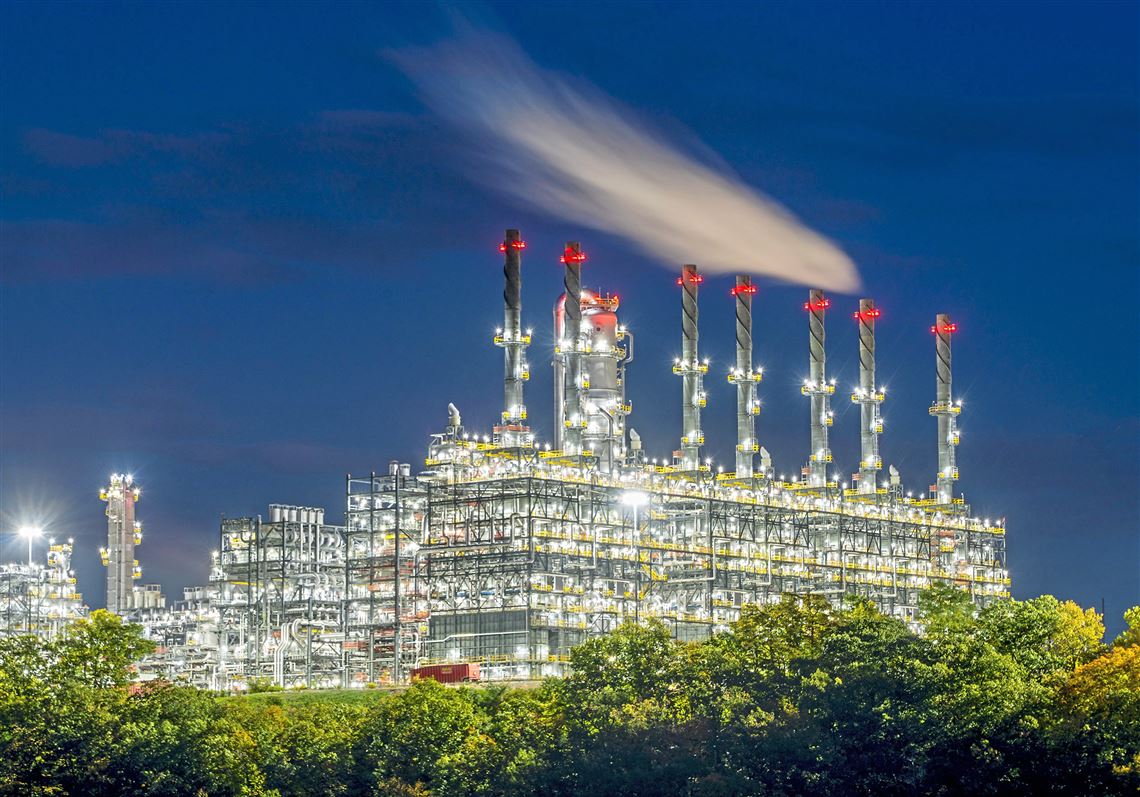
Photo: The bright lights and early emissions of the Shell Pennsylvania Petrochemical Complex in Potter Township, Beaver County.
Petrochemical plants are an environmental and economic dead end
By Matt Mehalik Pittsburgh Post-Gazette Op-Ed
DEC 11, 2022 – Southwestern Pennsylvania could have a brighter and healthier future — if only our state and region made better economic investments. After all, you get what you pay for.
Instead, the region is on a path to a dead-end by pursuing a futile, harmful fossil-fuel based economic strategy. Just last month, Shell’s massive polyethylene resin plant began production near Pittsburgh and is already proving to be a threat to the area.
What’s worse, Pennsylvania taxpayers are bankrolling it. Pennsylvania granted Shell $1.65 billion in state tax credits in 2016, one of the largest tax incentives in state history. In addition, in November the state legislature and governor passed and signed a bill that provides over $2 billion in subsidies over 20 years for natural gas, hydrogen and petrochemical industries — with less than a half-day’s notice and no public hearings.
Additionally, the Department of Energy is looking to provide $8 billion in additional federal subsidies for fossil-based hydrogen hubs. Despite alternative strategies for accelerating decarbonization and promoting inclusive economic growth, our region’s leadership doubled down on a call for fossil fuel subsidies, as detailed in “Our Region’s Energy Future” by the Allegheny Conference on Community Development earlier this year.
The Shell subsidy alone would be enough to cover a payroll of $95,000 per year over 25 years for the 400-600 permanent employees the plant was expected to employ. Shell stated that at peak construction, the site employed more than 8,500 workers. However, these temporary jobs mostly went to construction workers from other states, and have dropped now that the plant is open.
Why should taxpayers continue to subsidize a mature industry that does not deliver jobs and prosperity widely to our communities, and that also locks in harmful air, water and climate pollution?
The Pittsburgh region still suffers from some of the worst air pollution in the country. Allegheny and Beaver County for example, have elevated cancer risks and rates of asthma, heart disease and early deaths. Pennsylvania as a whole has the greatest number of excess deaths due to exposure to fine particle air pollution from fossil fuel sources per person in the country. And half of the region’s pollution still comes from industrial plants.
Emissions from the new Shell plant will add to the already-devastating concentration of pollutants in our air, and undermine the country’s progress on meeting national climate goals. The Shell plant in Beaver County would be the second highest hazardous air polluter in the state, and the 20th most polluting in the country.
The Shell plant is permitted to emit 522 tons of volatile organic compounds (VOCs) and 30.5 tons of Hazardous Air Pollutants (HAPs) per year. These chemicals are, according to the USEPA, known to “cause cancer and other serious health impacts.” VOCs for example, are also known to be damaging to lung tissue. The 159 tons of fine particles the plant will release per year will further contribute to respiratory and cardiac diseases in the region.
The people of Southwestern Pennsylvania should feel confident that the air we breathe won’t make us sick. We have the right to live and work in clean, safe and healthy environments. Why are we subsidizing the opposite of this vision, particularly when it undermines national climate goals as well?
The plant is estimated to release 2.2 million tons of carbon-dioxide-equivalent emissions per year: That’s the equivalent of the emissions from 474,000 passenger vehicles, which is more than half the number of vehicles registered in Allegheny County. The plant will also produce plastic resins that will be used to manufacture more single-use plastic goods in a world that already has too much plastic. Today, 36% of plastic production goes toward single-use plastics, specifically plastic packaging.
These are not investments we should be making or celebrating in a region that shows so much promise in going beyond the fossil fuel economy. Further, they are not a proven way to secure long-term jobs or economic growth. Studies show that wind and solar manufacturing would employ more people than comparable investments in oil and gas: More than 15,000 jobs for the same investment that is producing only a few hundred jobs at the Beaver County plant.
Our neighbors in New York State understand this. According to New York’s “Clean Energy Investment Report 2022,” New York added over 24,000 jobs in the renewable energy sector between 2015 and 2021. That’s a growth of 17% after the governor announced a $1.5 bllion investment in clean energy.
New York is continuing these fossil-free investments, and the growth is accelerating. These are not temporary jobs; rather, they are being built on a solid foundation because they are not based on extracting resources that will someday run out, and because they align with the health, climate and overall well-being needs of communities. They are long-term investments, not short-term stopgaps.
Community organizations in the region understand this. Reimagine Beaver County released a vision in 2019 that outlined a more economically viable future than petrochemicals, one made possible by investing in four major sectors of economic development: energy innovation, green chemistry and manufacturing, sustainable agriculture, and riverfront recreation and tourism.
Just think of where our region would be if we had embraced this vision, instead of propping up petrochemicals and fossil fuels.
That’s why the Breathe Project calls for imagining a brighter, healthier and more prosperous future than the one promised by fossil fuels and petrochemicals. This includes building a new workforce with diverse jobs in solar, wind and other clean technologies that will include everyone from blue-collar workers to high-tech researchers. It also includes transitioning to electric cars, buses and trucks; improving bicycle lanes; and providing more public transportation options.
While our policymakers continue to fail us, we’re glad that other leaders have stepped in. We recently appreciated a huge boost from Mike Bloomberg and Bloomberg Philanthropies’ Beyond Petrochemicals campaign that will invest $85 million in new funding for local advocacy groups in these efforts.
As someone who grew up in the Monongahela Valley, I am ready to see economic and environmental optimism for our region, based on a different vision that recognizes that fossil-fuel-based industries are not in Pittsburgh’s best interests, now and into the future. It is time to go in a different direction. Stop throwing good money after bad investments. Stop subsidizing a mature, private industry that casts burdens on our communities while allowing a narrow few to reap large profits at our expense.
Our economic future should not, and will not, be hitched to subsidizing new uses for dirty materials like petrochemicals. We can have healthy people, healthy workers, a healthy economy and a healthy environment. We deserve a bright future.
Matt Mehalik is Executive Director of the Breathe Collaborative and its communication platform, the Breathe Project.
Environmentalists in Beaver County alarmed by harmful emissions from the plant once it opens say they are discouraged by most voters’ inattention, but not deterred.
By Emma Ricketts
Inside Climate News November 5, 2022
Photo: Shell’s new petrochemical plant in Beaver County, Pennsylvania. Credit: Emma Ricketts
Environmentalists Fear a Massive New Plastics Plant Near Pittsburgh Will Worsen Pollution and Stimulate Fracking
Oct. 27, 2017 – A New Shell Plant in Pennsylvania Will Soon Become the State’s Second Largest Emitter of Volatile Organic Chemicals
ALIQUIPPA, Pa.—From the tranquility of her garden in Beaver County, Pennsylvania, Terrie Baumgardner worries that her grandchildren will grow up without access to clean air, clean water and a safe space to play outdoors.
For decades, Beaver County’s economy has been dependent on polluting industries—first steel, and more recently natural gas drilling. Many longtime residents, who remember the prosperity brought by the steel industry, have welcomed the construction of a massive new Shell petrochemical plant and the politicians that support it.
Baumgardner and other environmental activists are discouraged that local residents and politicians favor the continuation of fracking and the new mega plastics plant it has spawned, but they are not giving up their fight.
“People say that’s what we do in Beaver County—we trade our health for jobs,” Baumgardner said. “But it’s unfortunate, because it doesn’t have to be that way now.”
A reluctant activist, Baumgardner first became involved in environmental issues in 2011, when she learned about the dangers posed by fracking. Concern for the environment and health of local residents led her to canvas for signatures in 2016 as Shell moved toward building the plastics plant.
Spanning nearly 800 acres along the Ohio River, the plant is expected to open later this year. The facility will convert fracked gas into 1.6 million metric tons of polyethylene per year.
Polyethylene, made from ethane, a form of natural gas, is the key building block in numerous common plastic products—from food wrapping and trash bags to crates and bottles.
Despite assurances from Shell that the facility will be safe for the surrounding community, environmental activists have warned that the plant will cause air and water pollution, and a protracted dependence on fracking.
Under Shell’s permit, the plant can release up to 159 tons of fine particulate matter and 522 tons of volatile organic compounds per year. Exposure to these emissions has been linked to issues in the brain, liver, kidney, heart and lungs. They have also been associated with miscarriages, birth defects and cancer.
“They’re going to unload all of these toxic chemicals, hazardous air pollutants, volatile organic compounds and millions of tons of CO2 gas. What’s going to happen?” asked Bob Schmetzer, a local councilman from nearby South Heights and a long-time spokesperson for Beaver County’s Marcellus Awareness Committee. He has opposed the plant since it was first proposed 10 years ago.
Jack Manning, a Beaver County Commissioner, does not share these concerns. “I have great faith in the technology and in the competency of those that will be running the facility,” he said. “It’s a state-of-the-art, world-class facility.”
Manning blamed people’s apprehension on unfair comparisons between the environmental impacts of the plant and those of the steel mills that used to occupy the area. “Those heavy particulates are a different type of pollution,” he said.
Shell has assured residents of the safety of its plant. “At Shell, safety is our top priority in all we do and that includes being a good neighbor by communicating about plant activities that could cause concern if not expected,” Virginia Sanchez, a Shell spokesperson, said in a statement. “When we are in steady operations, it is our goal to have little to no negative impact on our neighbors as a result of our activities.”
For activists, these assurances do little to allay concerns. On a grassy hillside overlooking the massive complex, Schmetzer spoke with his friend and fellow activist, Carl Davidson. While the plant is not yet operational, the grinding sounds of industrial machinery and screeches of train cars disturbed the clear fall day.
Photo: Bob Schmetzer and Carl Davidson, standing above the petrochemical plant. Credit: Emma Ricketts
Davidson, a self-professed “solar, wind and thermal guy,” wore a Bernie cap and alluded to his youth as a student leader of the New Left movement in the 1960s. While he estimates that around one-third of residents were concerned about the plant’s potential impacts from the beginning, he expects this number to grow once it opens. “People are starting to see two things,” he said. “Number one, there is all kinds of pollution that they didn’t know about. And second, all the jobs that were promised aren’t real.”
The plant sparked hope for a revival of economic prosperity in the area. However, now that construction is largely complete and thousands of workers have finished working on the site, the plant is expected to only employ about 600 people going forward, according to Shell.
While opponents wait anxiously for the plant to begin operations, they don’t think it will influence next week’s elections. The Shell plant has been a non-issue in the tight race for the 17th Congressional District in Beaver County between Democrat Chris Delluzio and Republican Jeremy Shaffer, both of whom support continued fracking.
In the state’s closely watched U.S. Senate race between Democrat John Fetterman and Republican Mehmet Oz, both of whom support fracking, the environment has barely come up in a nasty campaign focused on abortion rights.
Similarly, fracking and the environment have hardly been mentioned in the governor’s race between Democrat Josh Shapiro, the state’s attorney general, and Republican state Sen. Doug Mastriano, a Trump supporter and election denier.
Beaver County, while only counting for 1.3 percent of the votes cast in any given election in Pennsylvania, is a bellwether, according to Professor Lara Putman of the University of Pittsburgh. “It is socio-demographically similar to counties that, collectively, make up about one-quarter of Pennsylvania’s population. So in that sense, when Beaver shifts other places are usually shifting as well,” she said.
Baumgardner called the political candidates’ silence “disheartening.”
“I wish they would have the courage to speak up, to take a position and stick with it,” she said.
However, she understands the political risks associated with taking an environmental stand in a community that believes its economic fortunes are tied directly to pollution. She just wishes this wasn’t still the case. “We have alternatives,” she said. “We just need our political leaders to embrace them and get serious about renewables and removing the subsidies on fossil fuels.”
According to Davidson, the key to awakening the public is to ensure that alternatives are tangible. Good ideas aren’t enough to make people give up the job opportunities they have, he said. Clean energy projects are great in theory, but until workers can see a real job with similar wages, many will continue to support the status quo.
Progress might be slow, but Baumgardner, Davidson and Schmetzer remain hopeful that the realities of the plant will sway public opinion once residents’ senses are assaulted with the acrid smells and cacophony of relentless sound they expect the new plastics plant will emit. They each stand ready to educate people on its health and environmental impacts, as soon they are ready to listen. They may be discouraged, but are not deterred.
“Nothing is going to shut me down as long as my grandkids are here,” Baumgardner said.
Emma Ricketts is a graduate student at Northwestern University’s Medill School of Journalism. She focuses on politics, policy and foreign affairs reporting, with a particular interest in climate change and environmental issues. Previously, Emma practiced as a lawyer in a New Zealand-based commercial litigation team where she focused on climate-related risk.
‘This is what the fight for a habitable planet looks like in real time.’
By Julia Conley Common Dreams
April 9, 2022 – Organizers of the “Coal Baron Blockade” protest which targeted right-wing Democratic Sen. Joe Manchin’s coal empire Saturday afternoon reported that state police almost immediately began arresting campaigners who assembled in Grant Town, West Virginia.
“Sen. Joe Manchin’s policies hurt poor people and hurt our environment so deeply that activists are ready to put themselves on the line,” tweeted the Poor People’s Campaign, which joined grassroots group West Virginia Rising and other organizations in the blockade.
Hundreds of campaigners participated in the blockade of Grant Town Power Plant, which receives coal waste from Enersystems, the company owned by the West Virginia senator’s son. Manchin earns $500,000 per year from Enersystems—”making a very lucrative living off the backs of West Virginians,” said Maria Gunnoe, an organizer of the action, this week.
At least 10 demonstrators had been arrested as of this writing.
“This is what the fight for a habitable planet looks like in real time,” said Jeff Goodell, author of The Water Will Come, of the dozens of campaigners who risked arrest.
Speakers and other participants highlighted the need for a just transition away from fossil fuels including coal, carrying signs that read “Solidarity with all coal workers.”
“My dad worked in a chemical plant until he retired with a disability from acute exposure,” said Holly Bradley, a ninth-generation West Virginian. “We can all find common ground, but Joe Manchin is making it impossible.”
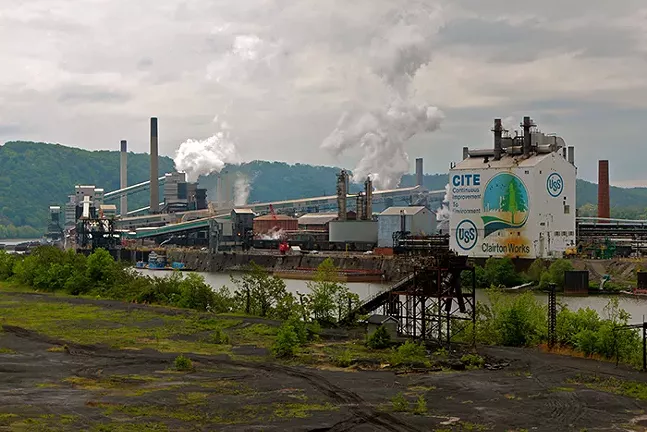
April 30, 2021 – U.S. Steel Corporation is cancelling its $1 billion upgrades to its Mon Valley Works facilities, which includes Edgar Thomson Works in Braddock, Irvin Plant in West Mifflin, and the Clairton Coke Works in Clairton. While the cancellation will likely result in some job losses in the region, it will also reduce the levels of harmful air pollution in the Mon Valley and beyond.
The upgrades, which were announced May 2019, would have included a casting and rolling facility and a cogeneration plant. After several delays due to COVID in 2020 that increased the upgrade costs to a promised $1.5 billion, U.S. Steel pushed the start date of those upgrades to the fourth quarter of 2022. But today, the company announced it would be scrapping those plans entirely.
In addition to cancelling these updates, U.S. Steel plans to permanently idle batteries one through three at Clairton Coke Works by the first quarter of 2023. Batteries one through three are the oldest at the Coke Works and can allow twotothree times more emissions than the rest of the facility, according to environmental groups.
According to the EPA’s National Air Toxics Assessment, toxic air pollution contributes to high risk of cancer, and Clairton Coke Works is responsible for many of the airborne carcinogens in the region. Asthma rates among children in Clairton are three times higher than in the rest of the county.
“For too long, U.S. Steel has run roughshod over our environmental protections and churned out dangerous levels of harmful air pollution,” says PennEnvironment Research & Policy Center clean air advocate Zachary Barber. “Closing these batteries is a necessary and longoverdue step toward reducing that damage and cleaning our region’s air.”
Clairton Coke Works received a $1 million fine from the Allegheny County Health Department in 2019, as well as another $383,450 fine in March 2021. A study from the University of Pittsburgh also confirmed this week that the fire at the Coke Works in December 2018, which destroyed pollution controls, increased asthma exacerbations for residents in the surrounding area.
U.S. Steel President and CEO David Burritt cites the goal for the company to become carbon neutral by 2050 as a motivation for canceling the plan upgrades. As part of that goal, U.S. Steel will shift toward electric arc furnaces, such as Big River Steel, of which U.S. Steel bought a minority share in 2019, in Arkansas.
There are currently about 130 fulltime workers at the three Clairton Coke Works batteries that will be idled. U.S. Steel plans to avoid layoffs by reducing the workforce through retirements and reassignments. According to Pittsburgh Works Together, a cooperative venture mostly comprised of fossilfuel companies and the labor unions that represent their workers, the closures will result in the loss of hundreds of potential construction jobs for the region.
“I am deeply disappointed that the company has broken its promise to the Mon Valley and its own workers by scrapping a plan that would have made the Mon Valley Works the first project of its kind, provided cleaner air for our community and good jobs that would have helped this area prosper for decades,” says state Rep. Austin Davis (DMckeesport), whose district includes the Clairton Coke Works. “I believe that we can create familysustaining jobs and a clean environment.”
From March 30 to April 7, the Mon Valley was one of the top10 worst places for air quality in America. Advocates such as Barber have long criticized Clairton Coke Works’ dangerous emissions, and PennEnvironment had previously called for the batteries to be taken offline when air quality was poor.
“While we are pleased by this development, we still must remain vigilant — especially in light of U.S. Steel’s decadeslong history of legal violations and broken promises,” Barber says. “Local leaders must keep working to ratchet down industrial pollution to ensure that everyone has clean air to breathe every day of the year.”
And it’s possible these upgrade cancellations will have longterm effects on U.S. Steel’s future in the Mon Valley and the Pittsburgh region. As University of Pittsburgh economist Chris Briem notes on Twitter, the status of the Clairton Coke Works and the Edgar Thompson Works is bleak without any upgrades to those legacy facilities.
DEC 8, 2020 – WASHINGTON — The architects of a newly unveiled 10year, $600 billion climate plan to revitalize Appalachia and the Ohio River Valley region are moving forward with a difficult task of building political willpower in Washington while gaining the trust of rural communities tied to the coal and natural gas industries, Pittsburgh Mayor Bill Peduto told a group of sustainable development advocates Tuesday.
That coalitionbuilding — a communications strategy to be forged over the next six weeks among academic institutions in Pittsburgh and seven other cities — is a critical step toward executing the plan Mr. Peduto described as both idealistic and grounded in reality.
It is also necessary as a divided Congress gears up for a fight next year over PresidentElect Joe Biden’s proposal to pull the country out of an economic downturn while investing in clean energy development. Negotiations between Democrats and Republicans for a COVID19 relief bill have dragged for months, raising the question of whether Mr. Biden’s plan could garner enough support.
“We have been in touch during the [plan’s] research phase with the Biden campaign and their ‘Build Back Better’ authors,” Mr. Peduto said, referring to PresidentElect Joe Biden’s jobs and economic recovery plan.
Peduto joins mayors from W.Va., Ohio, Ky. to call for public/private support in climate-friendly industrial growth
Since Mr. Biden won the White House last month, Mr. Peduto and other local officials “have had contact with the transition team,” he said, “working to see what we can try to be able to get on the radar in Washington during the first 100 days of a new administration, while simultaneously working with grassroots organizations.”
It’s unwise to ignore Mother Nature, and not to find ways to live in harmony with her, and all other beings as well
By Kim Stanley Robinson Orbit ($28)
Reviewed by Tom Cox
Pittsburgh Post Gazette
Make no mistake, Kim Stanley Robinson’s new novel, “The Ministry of the Future,” is a good old-fashioned monster story. As with most monster stories, there is an inciting incident witnessed by a few wide-eyed and hysterical nobodies, but their cries are deemed “unreliable.” Who knows what they saw? It only affected those people. And besides, what do they expect us to do, empty the beaches on a holiday weekend just because somebody thinks they saw a shark?
In many of these tales, the monster is a metaphor for something else, such as “Babadook” (grief), “Rosemary’s Baby” (motherhood), “Get Out” (racism), and “Frankenstein” (humanity). But some of the scariest monster stories give us nightmares about the normal things we see in life. Not vampires, werewolves, blobs or radioactive lizards but crazed fans, preppie New York investment bankers or creepy hotel clerks. In “The Ministry of the Future,” Mr. Robinson aims his flashlight into the black waters to reveal just such a monster: climate change. Yeah, we’re going to need a bigger boat.
True to good monster lore, our story begins with an attack: a record-setting Indian heat wave knocks out power and roasts 20 million of the planet’s most vulnerable in two weeks’ time. Enter Mary Murphy, head of the Ministry of the Future, a rather toothless U.N. watchdog agency based in Zurich and created by an international treaty. Nevertheless, Murphy is serious about making a difference in the world and about her agency’s stated mission: “to advocate for the world’s future generations and to protect all living creatures, present and future.” Despite the Indian tragedy, her attempts to enact real and drastic reduction in carbon emissions is resisted. National sovereignties are cited. Fingers of blame are pointed at the long-term carbon culprits, who in turn accuse the most recent contributors. Financial institutions entrench behind privilege and market share. The monster is not our problem.
When the rebuffed Murphy is confronted and briefly held captive in her own home by an addled survivor of the Indian carnage, she recognizes in his frantic demands not a criminal element but perhaps humanity itself (her own humanity?) crying out for drastic steps to be taken — acts of eco-terrorism and even the assassination of select carbon perpetrators. After the man is captured and her safety assured, Murphy finds it hard to dismiss his humble sacrifice and haunted eyes. Does confronting a monster like climate change call for more drastic steps? If black ops are used to fight terrorism, why not this? Maybe it’s time to get our hands dirty. She soon discovers, however, that her darkest notions of such an unauthorized, covert and lethal outfit already exists.
Whereas Mr. Robinson’s earlier novels on climate change, “New York 2140” and “2312,” are set far in the future and deal with the long-term aftermath of the destruction it caused, “The Ministry of the Future” dares to set events within our lifetimes, or at least within the lifetimes of our children. Thirty years from now, the devastation is just beginning. Things can still be done to stop the monster, but only if drastic and expensive steps are immediately undertaken and only if the whole world takes it seriously. If you have met the world, however, you know that this probably isn’t going to go well.
Mr. Robinson’s intrigue and geopolitical drama are well supported by his meticulous research into every sort of environmental theory, proposed solution and geo-engineering possibility, which he deftly incorporates into his work. If you’ve been looking for an environmental monster story in which the heroes are scientists who aren’t above taking off their gloves and getting their hands dirty, this might just be the campfire story for you.





 Beaver County Blue: Voice of the 17th CD of Progressive Democrats of America