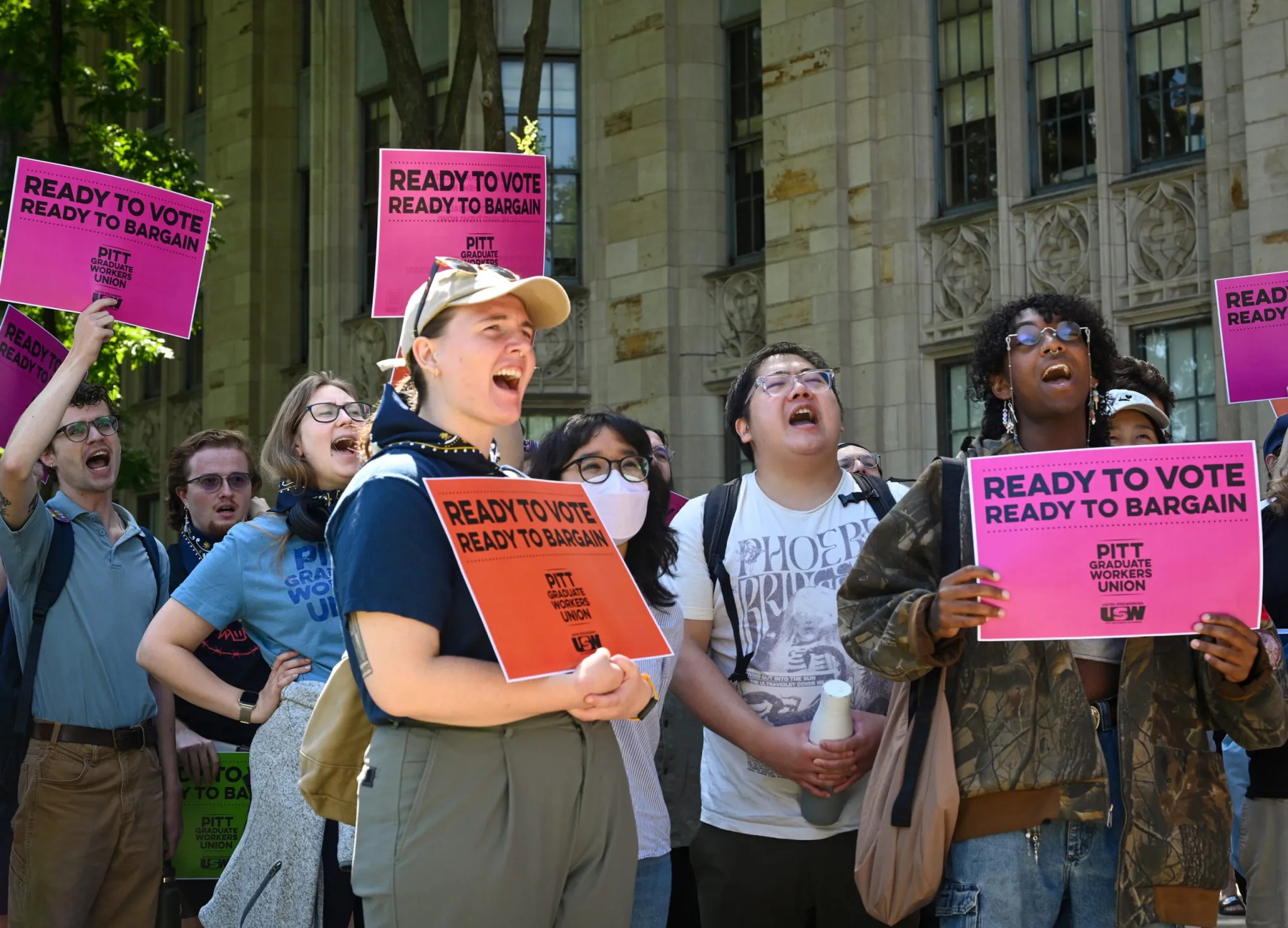
Five Years After Failed Vote, Pitt Grad Students Unionize

The University of Pittsburgh’s graduate student workers narrowly declined unionization in 2019, but this week’s overwhelming vote has the Oakland campus riding a wave of higher ed organizing.

By Maddy Franklin

Public Source

Nov 22, 2024 – Throughout the week, more than 1,000 graduate student workers at the University of Pittsburgh made their way to a nondescript ballroom in the O’Hara Student Center to vote on whether to unionize.

Supporters sought everything from more transparency on the part of university administration to pay equity, better vacation time and health insurance.

The line outside the ballroom stretched, at times, down the stairs of the center. “People are so excited … I’ve never seen engineers this excited,” said Lauren Wewer, a materials science and engineering Ph.D. student and organizer at Pitt.

On Friday, organizers announced the results: a 1033-28 vote to unionize with the United Steelworkers [USW]. The Pennsylvania Labor Relations Board had not yet confirmed the vote count as of mid-afternoon.

With this win, Pitt grad student workers become the latest employees to undergo a successful union bid at a U.S. higher education institution, continuing an upward trend in the sector’s organizing activity over the last few years. They also join faculty and staff at the university which unionized with the USW in 2021 and September, respectively.

Pat Healy, an information science Ph.D. student at Pitt, said the wide margin of support reflected in the vote, “aligns with how most of the grad union votes [in the country] have gone the last couple of years.”
Healy has been organizing at the university since 2019, which was the last time grad student workers attempted to unionize. Then, the pro-union students lost by fewer than 40 votes. For them, the impact of this year’s vote stretches beyond Pitt’s campus.

“I’m happy for the movement [and] looking forward to some other grad unions popping up, I’m sure inspired by us, because that always happens,” Healy said.

After Thanksgiving, they said organizers will begin setting up for bargaining with Pitt’s administration.

In a statement after the vote count, the university said, “While first contract negotiations can be complex, please know that we will come to the table in good faith and be there to support all graduate students throughout and beyond the process.”

Immediately following the loss in 2019, any efforts to restart conversations about unionizing would meet with “a kind of extreme hesitancy,” Healy said, blaming “a lack of understanding of what a union was.”

This year felt different, Healy said. There are likely a few reasons why.

Five years after failed vote, Pitt grad students unionize
EQT’s ‘bulldog’ has D.C. in his grip, with profits — and maybe higher gas bills — on the horizon

A wave of change

From 2021 to 2023, nearly 64,000 U.S. grad student workers joined unions. By comparison, only 20,394 students unionized from 2013 through 2020. Today, four in 10 grad student employees belong to labor groups.

This trend was, experts say, driven in part by the pandemic and by the administration change from Donald Trump to Joe Biden in 2021, which ushered in a National Labor Relations Board more amenable to organizers.

Adrienne Eaton, professor of labor studies and employment relations at Rutgers University, noticed COVID-19-driven layoffs and research funding losses on campus in New Jersey that eventually led to a faculty and grad student strike last year. She describes this time as an “active moment” in American higher ed, with students advocating for change across the board at universities and colleges. And with grad students, there’s another factor at play: “The faltering job market in academia.”

“A high percentage of students no longer [are] confident that they have a future as tenure-track professors, in particular, or potentially as academic faculty at all,” Eaton said. “So, I think it really changes the way that graduate students look at their assistantships that they get.”
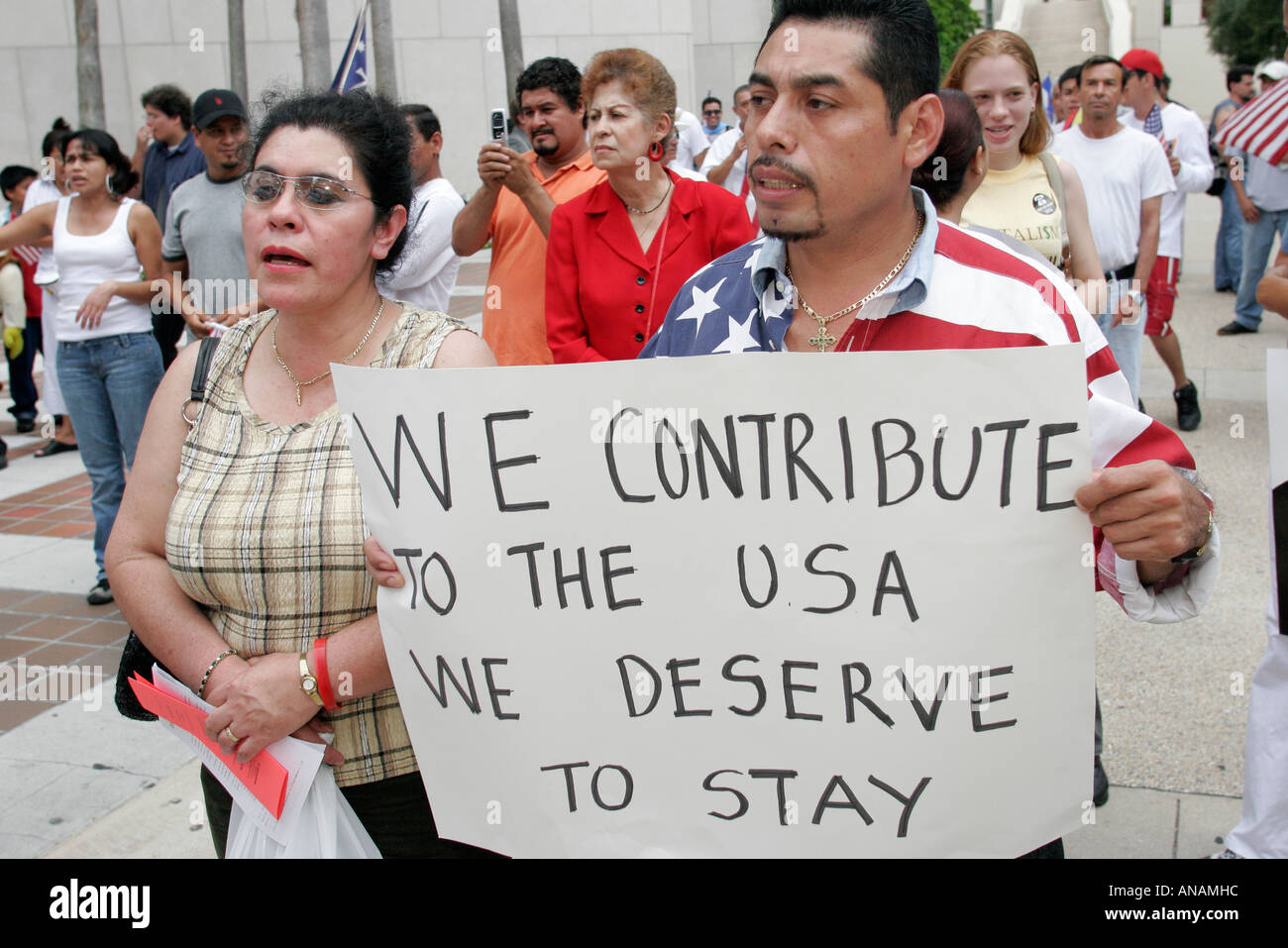
Trump Administration’S Mass Deportation Plan Would Hurt Pennsylvania, Immigrant Advocates Warn

They urged Democratic lawmakers to pass legislation to make the commonwealth more welcoming

By: Peter Hall

Penncapitol-Star

Nov 14, 2024 – President-elect Donald Trump’s plan to carry out mass deportations of undocumented immigrants would lead to population loss, exacerbate workforce shortages and increase tax burdens for Pennsylvania residents and businesses, the Democratic state lawmakers heard Wednesday.

Advocates for the immigrant community testified before the state House Democratic Policy Committee that although the federal government maintains exclusive authority over immigration policy, which is expected to take a draconian shift under a second Trump administration, state lawmakers can make Pennsylvania a more welcoming place.

“It’s been laid out very clearly. Unfortunately, it’s going to be immigrant detention and deportations on the horizon,” Julio Rodriguez, political director of the Pennsylvania Immigration and Citizenship Coalition, said. “So now it’s crucial that this legislature not only has welcoming policies to support immigrants, but to fight back against these proposals.”

The hearing on the last day of the 2023-2024 legislative session was convened by state Rep. Danilo Burgos (D-Philadelphia), who serves as chairperson of the Pennsylvania Legislative Latino Caucus.

Pennsylvania ranks fourth in the nation in population loss, Rodriguez said. In 2021, the net decrease in population between births and deaths was more than 23,000.

“We didn’t see that impact, because net international migration, also known as immigrants moving here, was 25,721,” Rodriguez said “Had it not been for immigrants, we would have seen a drastic population decline.”

A state’s population determines its number of representatives in Congress. Rodriguez noted that Pennsylvania lost one congressional seat after the 2020 census and could lose another in 2030. It would also result in Pennsylvania receiving less federal funding.

But more immediately, the loss of a portion of the commonwealth’s 978,000 immigrant residents would worsen the labor shortage in the agricultural sector, driving up grocery store prices. Undocumented workers also contribute billions in taxes and in the state’s gross domestic product, Rodriguez said.

Deluzio Win In Western Pennsylvania Keeps Swing District In Democratic Control

Photo: U.S. Rep. Chris Deluzio (PA-17) speaks to reporters at an event highlighting the Biden Administration’s investment in infrastructure at the Kingsley Center Pittsburgh’s Larimer neighborhood on Tuesday, Feb. 20, 2024. (Steve Mellon/Pittsburgh Union Progress)

By Kim Lyons

Pennsylvania Capitol-Star

November 12, 2024 – We’re analyzing the results of the 2024 election by taking a closer look at some of the pivotal or unexpected outcomes. First up is an interview with U.S. Rep. Chris Deluzio (D-17th District) who held off a GOP challenger in a key swing district.

Pennsylvania’s U.S. House delegation lost two Democrats in last Tuesday’s election, and promising Democratic challengers in two hard-fought House districts in the central and eastern part of the state failed to unseat longtime Republican incumbents.

But in western Pennsylvania, Democrats in the House fared better. Incumbent Reps. Summer Lee (12th District) and Chris Deluzio (17th District) both won reelection. After Lee won a contentious primary against challenger Bhavini Patel in April, she was widely expected to win the general election, which she did, beating GOP challenger James Hayes 56.1% to 43.9%, according to unofficial results.

But Deluzio’s reelection to a second term representing the district that includes parts of blue Allegheny and red Beaver counties was much more uncertain. The National Republican Congressional Committee (NRCC) put the race on its list of seats to flip in 2024.

His opponent, state Rep. Rob Mercuri (R-Allegheny) received a key endorsement from the conservative Americans for Prosperity (AFP) Action super PAC. Even his own party considered it to be a swing district; the Democratic Congressional Campaign Committee (DCCC) named Deluzio as one of the “vulnerable” incumbents it sought to protect this cycle, adding him to its Frontline list of candidates.

He’s the only one of the three U.S. House candidates from Pennsylvania on the Frontline list who won reelection.

“I’m very proud of the win,” Deluzio told the Capital-Star. “I’m really proud we increased the margin, and especially in Beaver County, which moved to the right at the top of the ticket, but we moved it towards me.”

Deluzio also increased the margins from his first election in 2022, when he won by 6.8% over challenger Jeremy Shaffer. This election, he won by 7.3% over Mercuri.

Deluzio refrained from the blame game going on within some parts of the Democratic Party reeling from Harris’ loss to Trump, but said as a representative of a Rust Belt district, he understands the frustration that many voters have with those in power.

“Whether it’s powerful folks or forces or companies who hurt people or who are making life worse, I think there’s a tendency among some in my party to always look for win-win framing,” he said. “And you know what? Sometimes there’s a bad guy and you’ve got to kick his ass.”