Tag Archives: Education

Timeline: Pittsburgh Higher Ed Responds To Trump Moves, As La Roche Is Latest To See A Visa Nixed

A timeline of federal higher ed changes

and responses by Pittsburgh-area colleges

and universities.

Photo: La Roche University, Friday, Feb. 10, 2023, in McCandless. (Photo by Stephanie Strasburg/PublicSource)

By Maddy Franklin
Public Source

April 11, 2025 –
Here’s how President Donald Trump’s administration has roiled higher ed, and how the University of Pittsburgh, Carnegie Mellon University and other local colleges and universities have responded.

This timeline will be updated as developments occur.

April 11
A visa held by an undergraduate student at La Roche University is revoked, a university administrator shared with PublicSource.

Revocations and wipes of international students’ records through a Department of Homeland Security system have been widespread over the week. Much of this is occurring, schools and students report, without communication from the government and with no reasons provided.

U.S. Secretary of State Marco Rubio said last month that there’s “no right to a student visa” and argued that visas would be cancelled in cases the government finds “appropriate,” such as participation in pro-Palestinian demonstrations.

Without legal status, students with terminated visas risk deportation.

We are local reporters who tell local stories.
Subscribe now to our free newsletter to get important Pittsburgh stories sent to your inbox three times a week.

April 9
Visas held by two recent graduates and one current Pitt student are revoked, according to an email sent by a university administrator. The administrator said no known immigration agencies or authorities have been on campus, and the students were offered unspecified “support.”

PublicSource reached out to Duquesne, Point Park, La Roche, Carlow, Chatham and Robert Morris universities to ask if students or recent graduates have been impacted by sudden visa terminations. Spokespeople for Duquesne, Point Park, Carlow and Chatham said there haven’t been any changes. RMU did not immediately respond.

April 7
Visas held by five recent graduates and two current CMU students are revoked, following a trend seen at universities across the country. The university reports that no immigration authorities have been on campus, and the students were connected with legal resources.

March 19
A congressional committee sends letters to six universities, including CMU, requesting information regarding Chinese students to assess national security risks. The letter states that U.S. higher ed institutions “are increasingly used as conduits for foreign adversaries to illegally gain access to critical research and advanced technology” and sets an April 1 deadline to turn over the details.

March 14
The U.S. Department of Education Office for Civil Rights opens investigations into CMU and 44 other universities nationwide for alleged Civil Rights Act violations following the guidance set out in the department’s “Dear Colleague” letter. The department said these institutions engaged in “race-exclusionary” practices within their grad programs by partnering with The Ph.D. Project, which “limits eligibility based on the race of participants.”


March 13
After Pitt paused faculty and staff hiring, administrators say that federal actions are not the only reason for the freeze. At a university faculty assembly meeting, Pitt’s Chief Financial Officer Dwayne Pinkney says enrollment trends, inflation and flat state funding were also behind the decision. The freeze would’ve happened “a little later” if not for recent events, he says — federal funding uncertainty was simply the catalyst.
Five Years After Failed Vote, Pitt Grad Students Unionize

The University of Pittsburgh’s graduate student workers narrowly declined unionization in 2019, but this week’s overwhelming vote has the Oakland campus riding a wave of higher ed organizing.

By Maddy Franklin

Public Source

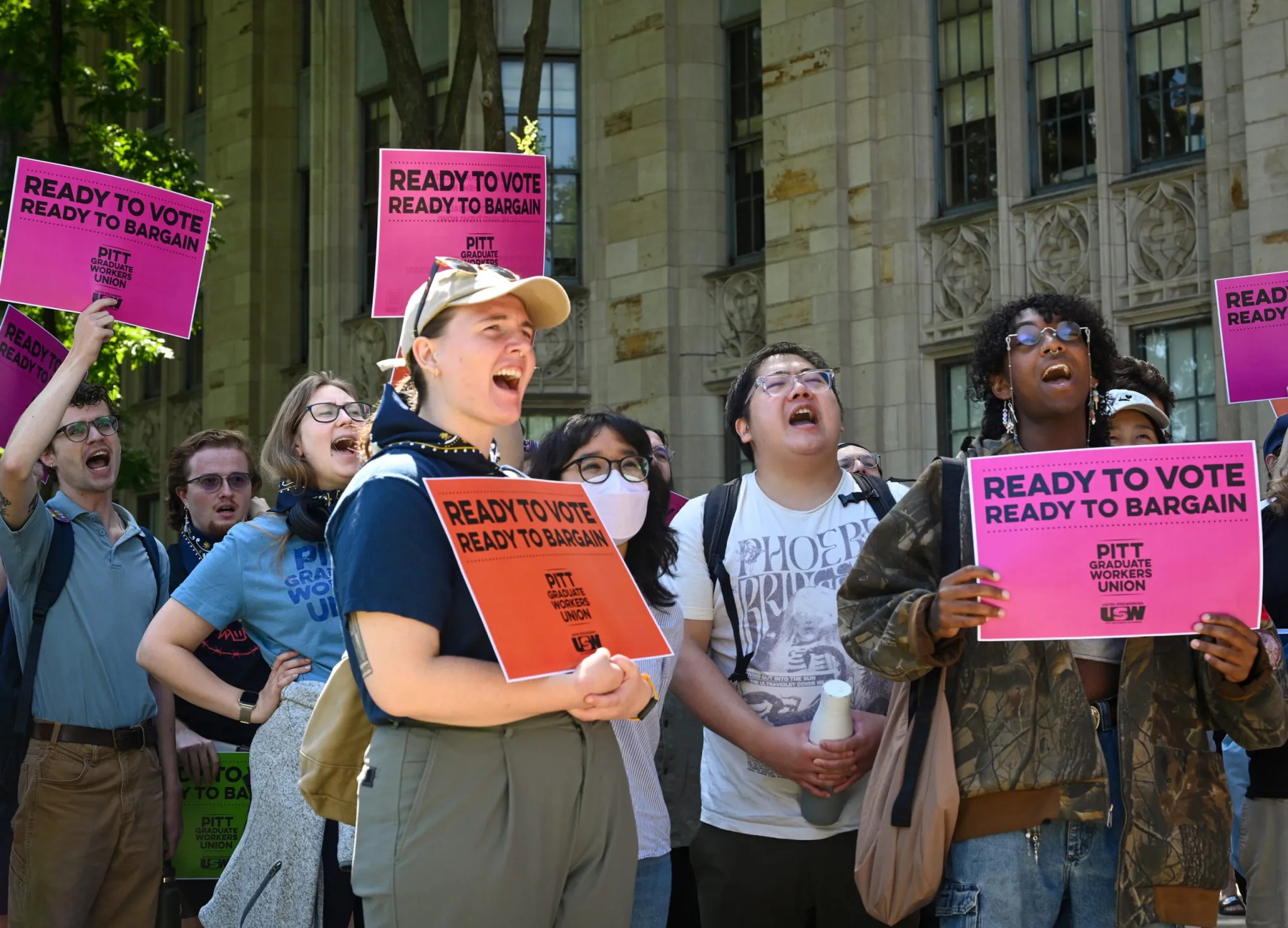
Nov 22, 2024 – Throughout the week, more than 1,000 graduate student workers at the University of Pittsburgh made their way to a nondescript ballroom in the O’Hara Student Center to vote on whether to unionize.

Supporters sought everything from more transparency on the part of university administration to pay equity, better vacation time and health insurance.

The line outside the ballroom stretched, at times, down the stairs of the center. “People are so excited … I’ve never seen engineers this excited,” said Lauren Wewer, a materials science and engineering Ph.D. student and organizer at Pitt.

On Friday, organizers announced the results: a 1033-28 vote to unionize with the United Steelworkers [USW]. The Pennsylvania Labor Relations Board had not yet confirmed the vote count as of mid-afternoon.

With this win, Pitt grad student workers become the latest employees to undergo a successful union bid at a U.S. higher education institution, continuing an upward trend in the sector’s organizing activity over the last few years. They also join faculty and staff at the university which unionized with the USW in 2021 and September, respectively.

Pat Healy, an information science Ph.D. student at Pitt, said the wide margin of support reflected in the vote, “aligns with how most of the grad union votes [in the country] have gone the last couple of years.”
Healy has been organizing at the university since 2019, which was the last time grad student workers attempted to unionize. Then, the pro-union students lost by fewer than 40 votes. For them, the impact of this year’s vote stretches beyond Pitt’s campus.

“I’m happy for the movement [and] looking forward to some other grad unions popping up, I’m sure inspired by us, because that always happens,” Healy said.

After Thanksgiving, they said organizers will begin setting up for bargaining with Pitt’s administration.

In a statement after the vote count, the university said, “While first contract negotiations can be complex, please know that we will come to the table in good faith and be there to support all graduate students throughout and beyond the process.”

Immediately following the loss in 2019, any efforts to restart conversations about unionizing would meet with “a kind of extreme hesitancy,” Healy said, blaming “a lack of understanding of what a union was.”

This year felt different, Healy said. There are likely a few reasons why.

Five years after failed vote, Pitt grad students unionize
EQT’s ‘bulldog’ has D.C. in his grip, with profits — and maybe higher gas bills — on the horizon

A wave of change

From 2021 to 2023, nearly 64,000 U.S. grad student workers joined unions. By comparison, only 20,394 students unionized from 2013 through 2020. Today, four in 10 grad student employees belong to labor groups.

This trend was, experts say, driven in part by the pandemic and by the administration change from Donald Trump to Joe Biden in 2021, which ushered in a National Labor Relations Board more amenable to organizers.

Adrienne Eaton, professor of labor studies and employment relations at Rutgers University, noticed COVID-19-driven layoffs and research funding losses on campus in New Jersey that eventually led to a faculty and grad student strike last year. She describes this time as an “active moment” in American higher ed, with students advocating for change across the board at universities and colleges. And with grad students, there’s another factor at play: “The faltering job market in academia.”

“A high percentage of students no longer [are] confident that they have a future as tenure-track professors, in particular, or potentially as academic faculty at all,” Eaton said. “So, I think it really changes the way that graduate students look at their assistantships that they get.”