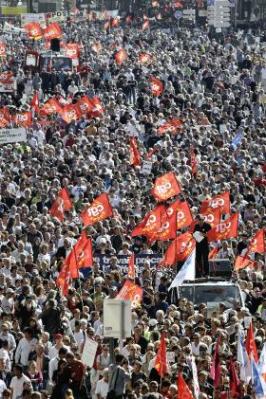
Appeal to Progressives: Join the Nov. 2nd Battle against Austerity
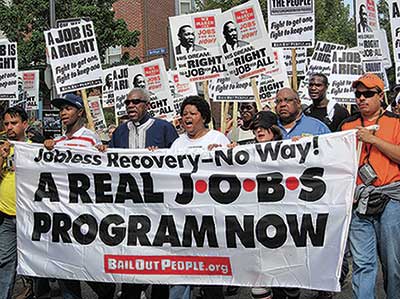
by Tina Shannon
Dear Fellow Progressive Democrats,
Do you think it is important to participate in this election?
We progressives are just beginning to find our voice. People are starting to want to hear what we have to say. Here in Beaver County the regular Dems invited us to their Annual Fundraising Banquet even though we bring no significant monetary resources. We were invited to participate in the One Nation coalition of labor, the NAACP & community leaders that took 4 buses to the October 2nd rally in DC. Our public events to discuss important issues are well attended.
To continue building in Beaver County, in the 4th Congressional District, we must use our growing strength to help stop the far-right from taking power in this election. All the races are close. If our effort makes the difference, we can build a stronger progressive movement. If we help the 2 Democratic labor candidates for State Representative get elected then we have a relationship with them as they move into power.
Pat Toomey is to the right of Bush. Toomey & Corbett are test cases for Tea Party politics. We might be disappointed that we haven’t made as much progress as we wanted for health care, peace, jobs, and the environment. But we must ask ourselves; do we want to be ruled by the likes of the Tea Party? If we do the work that prevents the Tea Party from gaining ascendancy in our country it may feel like the status quo goes on like usual. But we will have made a tremendous contribution by building the foundation for future progress.
Continue reading Appeal to Progressives: Join the Nov. 2nd Battle against Austerity
Pat Toomey – Republican Candidate for US Senator: As Bad As It Gets: Philadelphia Citypaper
66 Reasons NOT to Vote for Pat Toomey
by Jeffrey C. Billman
Published: October 27, 2010
In any other year, it wouldn’t be working. In any other year, Pat Toomey — former derivatives trader, congressman and president of the anti-tax group Club for Growth — wouldn’t be getting away with it. In any other year, his long-standing efforts to privatize Social Security, his radical approach to taxes and spending, his courting of fringe politicians, the millions of dollars he spent purging moderates from the Republican Party, his unabashed corporatism and his voting record — which is, statistically speaking, to the right of the late Jesse Helms — would render him unelectable in a state like Pennsylvania.
Last year, in fact, many Republicans thought that the case. In April 2009, William Parker, founder of the Pennsylvania Club for Growth, begged him to bow out of his challenge to Sen. Arlen Specter: “Pat can’t win the general election,” he wrote in a letter to Republicans. But Toomey pressed on, and not long after Parker wrote that letter, Specter switched parties. Without a serious primary challenge, Toomey was free to reinvent himself: No longer was he a rigid ideologue; instead, he morphed into a “mainstream,” “center-right” businessman who simply wants more jobs and less government.
That this rebranding might succeed is a testament to the times in which we live: 2010 is, after all, the year of the Tea Party, of Christine O’Donnell, of Sharron Angle, of Rand Paul. The year in which Glenn Beck’s paranoia can draw tens of thousands to the National Mall, and revanchist politicians speak openly of repealing the sacraments of the New Deal. This is the year in which anxiety over the economy has poisoned our relationship with rationality.
The Barbarians Are at the Gates
Enthusiasm?: I Am Not Interested in Things Getting Worse!
By Bill Fletcher, Jr
October 27, 2010

There has been a lot of discussion about the apparent enthusiasm gap between Democratic voters and Republican voters. While it is beyond question that the Obama administration has accomplished significant reforms in its first two years, the manner in which these have been accomplished, combined with the fact that they were generally not deep enough, has led many liberal and progressive voters to despair.
So, what should we think as we quickly approach November 2nd? First, there were too many magical expectations of both the Obama administration and most Democrats in Congress. Many of us forgot that while they represented a break with the corrupt Bush era, they were not coming into D.C. with a red flag, a pink flag or a purple flag. They came to stabilize the system in a period of crisis. President Obama chose to surround himself with advisers who either did not want to appear to believe or in fact did not believe that dramatic structural reforms were necessary in order to address the depth of the economic and environmental crises we face. They also believed, for reasons that mystify me, that they could work out a compromise with so-called moderate Republicans.
Progressives and Labor Can Tip This Election
 Progressives and Labor Can Tip This Election
by Randy Shannon
On Tuesday evening, October 26, Beaver County local union leaders, Democratic Party activists, and Progressive Democrats gathered at the IBEW Local 712 Hall in Vanport, PA to plan a get out the vote effort for the next week. In a close off-year election in which the Republicans are spending $millions, the union turnout at the polls can make the difference between winning or losing union contracts, social security, and healthcare.
Yael Foa, National AFL-CIO senior field representative, is spending two weeks in the area pulling together the union effort and coordinating with Progressive Democrats, the regular Democratic Party and union locals. The Beaver County GOTV effort is led by Chuck Munoz, (602) 738-7878, of the National Air Traffic Controllers Association (NATCA).
Ms. Foa pointed out that there are approximately 6,400 union households in Beaver County and around 11,400 members who are registered to vote. The AFL-CIO’s priority list consists of 7,500 households to contact by phone or in person. Representatives of IBEW locals, Postal Workers, USW, AFSCME, IAM committed to mobilize volunteers for the effort.
Labor Walks will be held on Saturday 9am-4pm, Sunday 1pm-6pm, Monday 9am-7pm, and Tuesday 9m-7pm, October 30 through November 2, Election Day. Volunteers can get assignments and partners at the IBEW Local 712 Hall, 217 Sassafras Lane, Beaver. (See Calendar for more details.)
Continue reading Progressives and Labor Can Tip This Election
Marcellus Shale Fracking Releases Uranium: University of Buffalo
 Release Date: October 25, 2010
BUFFALO, N.Y. — Scientific and political disputes over drilling Marcellus shale for natural gas have focused primarily on the environmental effects of pumping millions of gallons of water and chemicals deep underground to blast through rocks to release the natural gas.
But University at Buffalo researchers have now found that that process — called hydraulic fracturing or “fracking”– also causes uranium that is naturally trapped inside Marcellus shale to be released, raising additional environmental concerns.
The research will be presented at the annual meeting of the Geological Society of America in Denver on Nov. 2. Marcellus shale is a massive rock formation that stretches from New York through Pennsylvania, Ohio and West Virginia, and which is often described as the nation’s largest source of natural gas.
“Marcellus shale naturally traps metals such as uranium and at levels higher than usually found naturally, but lower than manmade contamination levels,” says Tracy Bank, PhD, assistant professor of geology in UB’s College of Arts and Sciences and lead researcher. “My question was, if they start drilling and pumping millions of gallons of water into these underground rocks, will that force the uranium into the soluble phase and mobilize it? Will uranium then show up in groundwater?”
Continue reading Marcellus Shale Fracking Releases Uranium: University of Buffalo
Why Finance Capital Is Making You Sick of Voting

What To Do Nov 2?
Follow the Money…
By Robert Creamer
Huffington Post
In the movie version of the story of Watergate — “All the President’s Men” – the Nixon administration source who met Bob Woodward in the underground garage to provide him clues — “Deep Throat” — famously tells Woodward to “follow the money.” Apparently those lines were never uttered in real life, but it’s good advice in politics nonetheless.
The other day, California’s Arnold Schwarzenegger – with whom I rarely agree – said something that should be repeated over and over between now and the mid-term elections. Schwarzenegger was referring to oil company financial support for California’s Proposition 23 that would shelve the state’s four-year-old climate legislation until the state’s unemployment rate hits 5.5% when he said:
“Does anyone really believe that these companies, out of the goodness of their black oil hearts, are spending millions and millions of dollars to protect jobs?” He continued. “….It’s not about jobs at all, ladies and gentlemen. It’s about their ability to pollute and thus protect their profits.”
Continue reading Why Finance Capital Is Making You Sick of Voting
Create Jobs and Keep Social Security Strong: Resolution by Butler County Democratic Committee
PRESS RELEASE
Butler County Democratic Committee
Create Jobs and Keep Social Security Strong
Resolution adopted September 29th by the Butler County Democratic Committee of Pennsylvania: To Create Jobs, Reduce the Deficit and Keep Social Security Strong:
1) We agree with President Obama that tax cuts for the wealthiest 2% of Americans should be retired. Value: $50 billion per annum.(a) The top one percent of Americans earn 23.5% of the total national income with salaries for some on Wall Street being as high as 1 Billion Dollars a year.(b) In 1970 that same top 1% earned 9% of the national income.
2) We agree with President Obama that Middle Class tax cuts and educational tax credits should be maintained.
3) We call for the elimination of the,”Cap,” on contributions to Social Security. Value $130 billion per annum.(c) Most Americans contribute to FICA from every dollar they ever earn. Americans with higher incomes stop contributing once their income reaches $106,800. Obama spoke of eliminating this cap during the campaign.
We are on a cusp! Four weeks from now will be the most important mid-term election of our lifetimes. Unemployment stands at 9.5% and 60 million Americans are on Medicaid. Eligibility requirements for Medicaid differ from state to state but, basically Medicaid starts when a family has nothing left. Sixty million Americans, half of them being children, have nothing. We are at once a nation of billion dollar incomes and working families living in homeless shelters or automobiles.
One More Reason to Vote
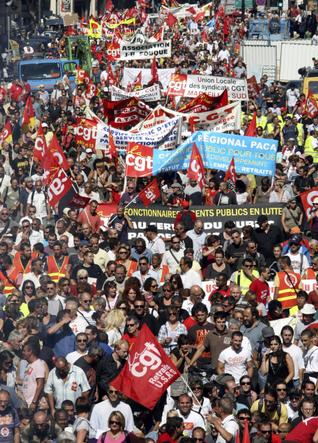
Union Workers and Students of France Fight Austerity Plans: Let’s Fight to Save our Social Security!
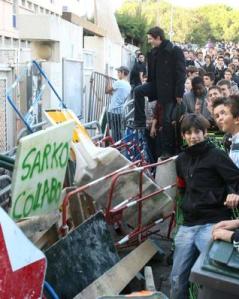
College Students Barricade the Campus 
- Workers March against Austerity in Marseilles

by Randy Shannon
Workers and students in France are putting up a heroic battle to protect their civilization from the depredations of the financial elites who want to return to the days of unbridled exploitation of labor.
Meanwhile, will US unions and political leaders meekly await for the Deficit Commission to deliver its proposed slashing of social security and Medicare benefits for US workers? The lame duck Congress will vote in December.
PA 4th CD Congressman Jason Altmire refuses to oppose cuts in social security. Altmire supports working us to death. Will American unions fight to protect our retirees from impoverishment by the banks and their Blue Dog Democrat and Republican servants?
When will we wake up to realize that for the bankers there is no bottom line on concessions. They will take our country back to the days our forefathers fought and died to overcome, a time of poverty, deprivation, indignity, lawlessness, and thievery on a mass scale.
Cong. Altmire needs to face large militant demonstrations against cutting social security. Let’s don’t have another occasion of sitting on our hands and then crying about the outcome. Social security has nothing to do with the deficit. It is our money that Cong. Altmire plans to steal for the banks. It is better to fight and lose than to meekly accept this theft. At least we will still have our dignity.