
By Kyle Lawson
Beaver County Times
Aliquippa resident Taishawn Harris said she’s satisfied with the selection and prices at the new Aldi store on Shaffer Road. The challenge is getting there.
“It’s affordable, and they have enough produce,” said Harris, 40, as she waited for her ride on a December evening with a cart full of groceries. “But I definitely wouldn’t walk here, I’d have to get a cab.”
Aliquippa is among thousands of areas nationwide the federal government has classified as “food deserts,” based on the poverty level and access to a supermarket.
In conjunction with Michelle Obama’s healthy food initiatives, major retailers promised in 2011 to open or expand 1,500 markets in and around food deserts by 2016, but by their own count are far short.
The nation’s top 75 food retailers opened nearly 10,300 stores in new locations from 2011 to the first quarter of 2015, of which 2,434 were grocery stores. But only about 250 were in food deserts.
Beaver Falls, Vanport Township, Ambridge, Midland, Pulaski Township, and sections of Monaca and Freedom are located within food deserts in Beaver County, according to a formula administered by the U.S. Departments of Agriculture, Treasury, and Health and Human Services.
An urban town qualifies as a food desert if the poverty rate is at least 20 percent and at least 500 people live more than one mile from a supermarket. A rural town qualifies if the poverty rate is at least 20 percent and more than 500 people live more than 10 miles from a grocery store, according to the agriculture department website. Continue reading Nation’s Supermarkets Fall Short of Promise to Combat ‘Food Deserts,’ Including Many in Beaver County →

Local filmmaker Chris Ivey stands at the entrance to East Liberty, now marked by new development
Pittsburgh is poised for growth for the first time in 60 years. Will the city’s African-American community grow with it?
By Ryan Deto
Pittsburgh City Paper
It used to be that community activists, politicians and developers would fight over allowing the gentrification of city neighborhoods. If you eliminated affordable housing and replaced it with housing that was not as affordable, most people agreed it was at least the start of gentrification.
These days, the battle is apparently a little more nuanced.
On Nov. 5, for example, Mayor Bill Peduto tweeted: “So far Pittsburgh’s East Liberty neighborhood has avoided gentrification while reducing crime & improving investment,” with an accompanying study by local analytics firm Numeritics.
The study claims gentrification is “obviously not the case in East Liberty” because all new market-rate development happened on vacant land, and because neighborhood demographics from 2010 to 2013 remained the same.
However, Pittsburgh filmmaker Chris Ivey feels differently.
“The [report authors] certainly knew the story they wanted to tell and chose to ‘back up’ that story with the facts that happen to support it,” wrote Ivey, who documented the demolition of an East Liberty housing project in 2006, in an email to City Paper.
Ivey notes there has been a demographic shift in East Liberty since 2000, with the numbers of blacks declining three times as fast as whites, according to U.S. Census data. Census data also indicate that the northern tract of East Liberty lost hundreds of African-American residents since 2000, and that the median black income there went up 14 percent as a result — or, as Ivey puts it “poor blacks moved out.”
Another statistic foregone by the study was homeownership. According to statistics compiled by Pittsburgh Community Reinvestment Group (PCRG), from 2011 to 2014, East Liberty saw 55 homes purchased by whites, while only three homes were bought by blacks.
So while some may argue whether what’s gone on in East Liberty and other city communities is gentrification, one fact is uncontroverted: African Americans are leaving some of their long-time Pittsburgh neighborhoods in droves because they can no longer afford to live there, and that urban flight could get worse before it gets better.
With thousands of residential units slated for development, the city is seemingly poised for growth for the first time more than 50 years. But will Pittsburgh’s black population grow with it?
Historically, many African Americans came to Pittsburgh in the years between World War I and World War II. During this era of black migration, African Americans settled in the city neighborhoods of South Side, Garfield, East Liberty and Homewood, with the Hill District becoming the preeminent black neighborhood.
Continue reading ‘Unfortunately in Pittsburgh, We Have a Tale of Two Cities.’ →
BY BERNIE WOODALL
December 4, 2015
Reuters
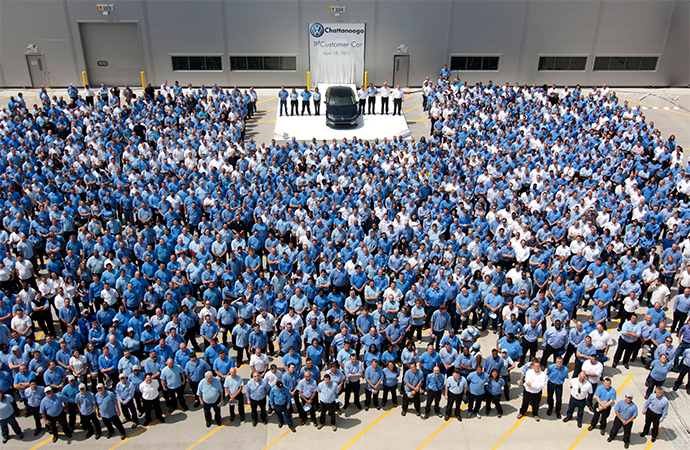
The United Auto Workers union won its first organizing vote at a foreign-owned auto assembly plant in the U.S. South on Friday, in a groundbreaking victory after decades of failed attempts.
About 71 percent of skilled trades workers who cast ballots at Volkswagen AG’s (VOWG_p.DE) factory in Chattanooga, Tennessee voted to join the UAW, according to the company and the union. The skilled trades workers account for about 11 percent of the 1,450 hourly employees at the plant.
If the UAW victory, as expected, survives an appeal by Volkswagen to the National Labor Relations Board, the 164 skilled trades workers will be the first foreign-owned auto assembly plant workers to gain collective bargaining rights in the southern United States. While the unit of skilled trades workers who maintain the assembly machinery are a fraction of the hourly work force, observers said the victory was significant and could serve as a launching pad for the union’s efforts to organize other foreign-owned plants in the south.
“It gives the UAW a significant new tool in trying to organize the foreign automakers in the south. Symbolically, it’s going to be huge,” said Dennis Cuneo, a former automotive executive who has dealt with the UAW in past organizing campaigns. Gary Casteel, UAW secretary-treasurer and head of the union’s organizing efforts, downplayed the significance of the vote and its influence on the UAW’s attempts to organize workers at southern plants including those owned by Nissan Motor Co (7201.T) and Daimler AG’s (DAIGn.DE) Mercedes-Benz.
“To the overall grand plan of the UAW it’s probably not monumental, but to those workers, it’s a big deal,” Casteel said in an interview on Friday.
Casteel, and Chattanooga UAW Local 42 President Mike Cantrell, in a separate interview on Thursday, said the election was a result of the “frustration” of skilled trades workers not having collective bargaining rights for wages and benefits. “Every case has to be built on the circumstances” at each plant, Casteel said. “We are not filing on Nissan or Mercedes tomorrow, but if our evaluation proved that there was a unit that was ready and strong enough to have an election, certainly we would explore it.”
The union narrowly lost a February 2014 ballot in which all of the Chattanooga plant’s hourly workers were eligible to vote.
During that vote, Republican U.S. Senator Bob Corker, whose hometown is Chattanooga, said, “I’ve had conversations today and based on those am assured that should the workers vote against the UAW, Volkswagen will announce in the coming weeks that it will manufacture its new mid-size SUV here in Chattanooga.” Continue reading UAW Wins Election at VW Chattanooga →

By Lauren Walker
Your Beaver County
People don’t just visit Uncommon Grounds Cafe in Aliquippa for the food. But, let me tell you, the food is delicious.
Panini’s made with fresh cut bread, homemade soups, made-to-order breakfasts, fresh desserts baked daily, plus a variety of drinks – hot and cold, coffee and tea, milkshakes and smoothies. And then there are the daily specials – pulled pork, chili, lasagna, ribs, mac n cheese…did I mention its all homemade?
Food this good can’t be this cheap. But it is, because the food isn’t the point.
A Place to be Heard
The main point of the Cafe, the reason it opened its doors in 2001, was to serve people.
Uncommon Grounds Cafe is a cooperative venture of the local people of Aliquippa and local churches working together to provide a safe place for anyone and everyone. A place to be heard, to be known, to be appreciated and accepted.
It’s so much more than a place to grab a quick meal or drink. It’s a ministry. It’s a place where the lonely, the outcast, the hurting can come together and find a friend who will listen. It’s a place where people of all ages and races can walk through the doors, create together, and change Aliquippa.
Changing Aliquippa
Aliquippa, like so many other towns along the Monongahela and Ohio rivers, was an ideal location for industry. When Pittsburgh was emerging as a major steel making hub in the late 1800s, Jones and Laughlin Steel Corp. sought to expand downriver and purchased a huge lot of land along the banks of the Ohio River to build one of the largest integrated steel mills in the world.
Thousands of immigrants flooded into Aliquippa to find jobs and the area experienced an era of prosperity – businesses lined Franklin Avenue, housing developments where built all over the area, generations of families were living in Aliquippa and life was good.
But like all good things, the era of big steel came to an end. Like many towns in Pennsylvania and throughout the Rust Belt, Aliquippa went into a depression. J&L was gone. As were the stores on Franklin Avenue. With nowhere to work, many families packed up and left to begin life elsewhere.
For many years some would say Aliquippa lost its hope and its creativity.
Then John Stanley, a Church Army officer from Australia, moved to Aliquippa. He purchased an old store front and with the help of many volunteers from local churches, remodeled the old building into a cafe.
Meet Herb Bailey
After 14 years of service in Aliquippa, Stanley felt called to return home and left the Cafe in the hands of current Ministry Director, Herb Bailey. Bailey, along with Operations Director Scott Branderhorst and many volunteers, continue the work what Stanley started.
“We are a place of respite for the weary neighbor, a place of encouragement for the local entrepreneur who dreams of being their own business owner, a place where people that want to give back whether it is court-mandated or soul-mandated and are allowed to engage others in a safe environment. We are a hub of opportunity and a bastion of hope, joining others who also are looking for hope. We hope to offer dignity in a way that says we recognize that no matter your story, you are precious in the site of God,” said Bailey.
Continue reading Aliquippa’s Uncommon Grounds: More Than Just a Cafe →

By Dave Johnson
Campaign for America’s Future
“Investing in infrastructure makes our economy more productive and competitive across the board.”
– Hillary Clinton
Dec 1, 2015 – Democratic presidential candidate Hillary Clinton has announced a plan for infrastructure investment. How does her plan stack up against that of her chief competitor, Bernie Sanders?
Also, how will Clinton and Sanders pay for their plans? On that question, Sen. Elizabeth Warren (D-Mass.) recently came up with a set of principles we can use to judge this.
Clinton’s Infrastructure Plan
Clinton on Monday announced a plan for investing in infrastructure improvements. Meteor Blades laid out the need for infrastructure investment at Daily Kos in “Clinton proposes $275 billion spending for infrastructure“:
… 11 percent of the nation’s bridges are structurally deficient and a fourth of them are functionally obsolete. Similar deficiencies can be found in schools, dams, levees, railroads, the electrical grid, and wastewater facilities. In its 2013 quadrennial report card on U.S. infrastructure, the American Society of Civil Engineers said the nation would need to invest an additional $1.6 trillion by 2020 to put its infrastructure into good repair. And that doesn’t include innovative infrastructure like universal broadband.
Clinton’s infrastructure plan is detailed at her website in “Hillary Clinton’s Infrastructure Plan: Building Tomorrow’s Economy Today.” Here is a distillation:
● $250 billion dollars in infrastructure investment, spread out over five years as additional spending of $50 billion each year.
● An additional one-time $25 billion to seed a national infrastructure bank. The bank will support up to an additional $225 billion in direct loans, loan guarantees, and other forms of credit enhancement. These are loans to states and cities which will require tolls, fees, etc. to pay off.
● Spending priorities include “smart investments in ports, airports, roads, and waterways”; “giving all American households access to world-class broadband and creating connected ‘smart cities’”; “building airports and air traffic control systems”; “a smart, resilient electrical grid”; “safe and reliable sources of water”; “a national freight investment program”; “upgrade our dams and levees to improve safety and generate clean energy”; safe, smart roads and highways that are ready for the connected cars of tomorrow” and “the new energy sources that will power them.”
● A promise of “a faster, safer, and higher capacity passenger rail system.” But the plan does not mention high-speed rail. (Note that a single high-speed rail system from Los Angeles to San Francisco is expected to cost up to $60 billion, which alone is almost one-fourth of Clinton’s entire five-year infrastructure investment for all infrastructure needs.)
Sanders’ Infrastructure Plan
Clinton’s $275 billion infrastructure plan offers modest spending and contains few specifics. Contrast that with candidate Bernie Sanders, who has proposed a highly detailed, $1 trillion plan.
Continue reading Public Works: How The Clinton and Sanders Infrastructure Plans Measure Up →

Locked out ATI Flat-Rolled Division workers and family members yell at a tractor-trailer truck driver leaving ATI’s Vandergrift plant during a family picket at the entrance to the plant on Wednesday, Nov. 4, 2015.
By Tom Yerace
Trib Total Media
Nov. 5, 2015 – Anyone going in or out of the ATI steel plant in Vandergrift on Wednesday evening drove through a wall of emotion.
The union workers, whom the company has locked out of their jobs since Aug. 15, were in greater numbers than usual.
That’s because the Wives of Steel, a group of steelworkers’ wives, called a rally at the plant entrance that started at 4:30 and continued for at least two hours.
About 200 steelworkers and their families, most carrying signs demanding a fair contract from ATI, stayed on the move as they picketed. They walked back and forth — slowly — pausing on the driveway when vehicles approached the plant entrance, forcing them to slow down.
At the same time, they hurled verbal abuse and vented their anger, particularly at the vans carrying the people who have taken their jobs. The most frequent insult heard was the ultimate for union members — “scab.”
Yelling into a bullhorn, a steelworker shouted at a truck driver, “Hey dude, you’re a scab! You’re a piece of garbage!”
“Do you think they get the idea that we don’t like what they’re doing?” asked Russ Gainor of West Leechburg, who attended the picket line, even though he retired from ATI in June after 36 years rather than risk the lockout.
A thick white line freshly painted across the edge of the driveway served as the plant’s boundary from the public sidewalk.
As the steelworkers rallied on one side of the stripe, ATI security guards in khaki uniforms and ball caps videotaped the proceedings from inside the plant property.
ATI spokesman Dan Greenfield said the company had no reaction or comment on the rally.
When asked if there was any news about contract negotiations resuming, Greenfield said, “We’ve had contact with the mediator about trying to get talks going again, but so far it hasn’t been successful.”
Regina Stinson of New Kensington, who heads the five-member Wives of Steel at United Steelworkers Local 1138 in Leechburg, said the large turnout is an indicator of the stress the steelworkers and their families are dealing with.
The lockout enters its 83rd day Thursday. While some of the locked-out workers have found temporary work, many are receiving only unemployment compensation, which is a fraction of what they normally earn.
Continue reading Steelworker Families Support ATI strikers in Vandergrift →

In this photo, Pittsburgh’s U.S. Steel Tower, whose upper reaches bear the initials of the city’s largest employer. Flickr Creative Commons/Adam Sacco
By Cole Strangler
International Business Times
Oct 22, 2015 – The tallest building in Pittsburgh owes its title to the industrial giant that made the city famous. But instead of its floundering namesake, the U.S. Steel Tower now displays the initials of a different sort of employer: the University of Pittsburgh Medical Center, or UPMC.
When the signage went up eight years ago, it seemed, as the New York Times noted, to perfectly epitomize the evolution of a city and its labor force — from an economy once world-renowned for its manufacturing might to one focused on “eds and meds”; a place where the working classes flock to booming research institutions and hospitals, not coke plants or blast furnaces.
In the old economy, steelworkers won pay raises and benefits that transformed what used to be a grueling, low-wage job into a virtual ticket to the middle class. But according to policymakers and labor advocates, too many workers in the new Pittsburgh are still struggling to make ends meet.
At hearings slated to kick off Thursday, a newly-formed, city council-backed wage committee plans to shed light on the problem — and consider a potential remedy: Whether to follow the examples set by Seattle, San Francisco, and Los Angeles and adopt a $15 hourly minimum wage, more than double the current statewide minimum of $7.25. This is the core demand of the Fight For 15, the protest movement backed by the powerful Service Employees International Union (SEIU).
“We’ve been talking about the need to increase the minimum wage, but we’ve not really linked that to the benefits it can bring to the city or to workers and their families in a succinct way,” says Reverend Ricky Burgess, the committee’s architect and lone representative from city council. “What I want to do is provide some data.”
In addition to testimony from economists and poverty experts, the data will likely come first-hand from low-wage workers themselves — people like Justin Sheldon, 34. He’s one of 62,000 people who work at the University of Pittsburgh Medical Center, the largest private employer in Pennsylvania, and by far, the largest employer of any kind in the Pittsburgh metropolitan area.
Medical residents at the hospitals tend to earn over $50,000 a year, according to the employee review site Glassdoor. But the more than 10,000 service workers — the people who staff cafeterias, transport patients and sterilize equipment, among other things — earn substantially less. They make an average of $12.81 an hour, UPMC said last year. The health care provider did not respond to request for comment.
“My reason [for supporting $15] is pretty simple,” says Sheldon, a housekeeper at the UPMC Presbyterian hospital. “I want to be able to support my family — properly.”
Sheldon makes $12.52 an hour and works 48 hours a week, cleaning doctor’s offices, conference rooms and restrooms. He says he can barely pay the bills for his household, which includes two young children, ages six and four. His wife is visually impaired and receives Social Security disability payments, about $700 a month, he says. They pay $600 a month to rent a house in McKees Rocks, a blue-collar community that overlooks the Ohio River.
“Anything I save up usually ends up getting used” he says. Within a week of the next paycheck, “I’m usually down to $30 or less.”
Continue reading As Pittsburgh Grapples With A Changing Workforce, The Fight For 15 Comes To Town →


It’s not just unemployment that matters. Many full-time workers take home less money, after inflation, than in decades.
Because most everything we buy gets more expensive over time, we have to earn more money each year just to maintain our existing standard of living. When we’re not given raises that keep up with this rate of inflation, we’re effectively suffering a pay cut.. That’s why many American workers are actually poorer today than four decades ago. They may be earning more money. But, in real terms, they’re getting less for it. Measured in 2014 dollars, the median male full-time worker made $50,383 last year against $53,294 in 1973, according to new U.S. Census Bureau figures.

At $50,383, the figure is the lowest it’s been since 2006. It’s also $450 lower than in 2013. Women have seen bigger increases in real pay in the last few years, though from a lower (unequal) base. The median female worker earned $30,182 in 1973 (in 2014 dollars), but $39,621 last year.
As we explored in our income inequality series recently, technology, globalization, and reduced union bargaining power are all factors behind stagnating wages. The economy has been getting bigger, driven by continuing increases in productivity. But, for one reason or another, workers haven’t been sharing in those gains. But they’re not just disappearing: They’re making a small group of people very, very rich. What are we going to do about that?
[Top Photo: Thomas Barwick/Getty Images]

Bernie on the picket line in Iowa
By Vaughn Hillyard
Beaver County Blue via NBC News
DES MOINES, Iowa, Sept 7, 2015 — A picketing president? Bernie Sanders said it could be him.
"Yeah, I might. That’s right. Why not," Sanders said when asked about the possibility after addressing AFSCME union members on Saturday in Altoona, Iowa.
The day before, Sanders picketed outside a Cedar Rapids plant that produces specialized starches alongside union workers engaged in a battle with the plant’s parent company, Ingredion, over new contract negotiations.
And to a crowd of 400 on Thursday in Burlington, Iowa—an old, union town hit hard over the last three decades by shuttered factories—Sanders emphatically stated: "The bottom line is: For millions of American workers, wages in this country are just too damn low."
Since announcing his candidacy, Sanders has zeroed in on blue-collar voters, consistently addressing low wages, unemployment issues and the country’s trade policies in stump speeches—pushing back against the notion that the economic recovery is as strong as often touted.
"I assumed I would be a Hillary supporter—and rightly or wrongly, probably because I feel like in the last twenty years, the greatest time we had between financial stability was during Bill Clinton’s run," said Ron Lowe, 52, of Grinnell, Iowa.
But Lowe said he will caucus for Sanders in February. He drove 45 minutes with his mother-in-law last Thursday to see the Democratic candidate at a rally.
"I feel like he’s not a filthy rich millionaire," Lowe said. "He wants to take on the rich, powerful people that seem to make all these decisions without any regard to the people in the middle to lower class. And it’s so obvious that the rich keep getting richer."
Lowe, a father of four, is unemployed after losing his job three months ago. He worked in Grinnell’s Donaldson plant—since the age of 24—manufacturing mufflers for agricultural equipment. But over the years, the company moved jobs to Mexico and other states, where Lowe said non-union facilities gave the company a cheaper option. Its last employees are expected to be out of work by the end of the year.
At a time when Democrats tout the economic recovery, Sanders harps on the economic data point of real unemployment, a point often used by his Republican counterparts. Despite a decrease in nationwide unemployment to 5.1 percent, the unemployment rate does not account for individuals who are underemployed, have given up looking for work, and others who are working part time but would like to work full time. Including those individuals, the unemployment figure is 10.3 percent.
"It is absolutely imperative that we stop the hemorrhaging of decent paying jobs because of our disastrous trade policies," Sanders said. ‘You are looking at a Senator and former congressman who voted against [North American Free Trade Agreement], against [Dominican Republic-Central America Free Trade Agreement], against permanent trade relations with China. And you’re looking at a senator who is going to do everything he can to help defeat this disastrous Trans-Pacific Partnership."
Sanders provides a contrast to Sec. Hillary Clinton on trade—without naming her directly. Though she hasn’t taken a stance on the Trans-Pacific Partnership, Clinton helped kickstart the negotiations, and Bill Clinton signed NAFTA into law.
"To simply blame the Republicans for that would be unfair," Sanders said on Saturday. "Democratic presidents have been involved in that trade policy. It has been bipartisan. It has been wrong."
Matt Richards, 56, of Newtown lost his job in 2007 when the town’s Maytag plant closed, putting more than 2,500 employees out of work. Richards worked at the facility for 23 years as an oiler, doing jobs like greasing conveyer lines.
"It’s a whole different town now. There was a lot of money here when Maytag was here," Richards said. "The crazy part of it is these jobs—for a small town like we are—was awesome pay, good benefits, you had some vacation time…It makes it tough in this small town."
Richards—though not ready to fully commit to a candidate—says Sanders’ message resonates.
"A lot of people like Bernie. He has a lot of good ideas," Richards said. "And what he talks about, getting our wages up there, you got to let a guy make a living wage to take care of a family. You know, nine bucks an hour isn’t going to cut it or ten bucks an hour. You’ve got to let a guy get to where he can make some money."
Last month, Richard Trumka, the president of the AFL-CIO, called Bernie Sanders "a warrior" at a labor forum hosted in Iowa.
"I want to say thank you for being a warrior for working people—not just lately but for your entire career," Trumka said to Sanders in front of 200 union workers. "All of us are living a little bit better because of that. And we want to say thank you for those efforts. You’ve earned them."
Trumka, however, made it clear on Meet the Press this Sunday that he will not personally endorse a candidate and likes both Clinton and Sanders.
Another former Maytag employee and United Auto Workers union member, Lonnie White, 66, a porcelain sprayer at the time, sat in the back row of Sanders’ event on the Meskwaki Settlement in central Iowa on Thursday.
"I think that he’s what the Democrats used to be," White said. "I think the Democratic Party used to be exactly what he represents. Taking care of each other. I think we’ve gotten away from that and gone to the middle."


 Beaver County Blue: Voice of the 17th CD of Progressive Democrats of America